

CT's Economic Performance Ranks 49th in US; Economic Outlook Ranks 46th
/Connecticut ranks 49th in economic performance during the past decade and the state’s economic outlook ranks 46th among the nation’s 50 states in the latest “Rich States, Poor States” analysis by the American Legislative Exchange Council.
The look-back at the decade 2005-2015 shows Connecticut ranking near the bottom in the three components that make up the ALEC-Laffer State Economic Competitiveness Index performance numbers. The state ranked 47th in state gross domestic product and 44th in non-farm payroll employment, both below the national average, and 43rd in absolute domestic migration, which increased for the third consecutive year.
Connecticut’s overall economic outlook ranking, 49th in the nation, represents a drop from 47th in each of the past two years, and 44th and 34rd in the two previous years. Back in 20120, Connecticut ranked 36th. The economic outlook includes more than a dozen categories. Among them, Connecticut ranks highest in sales tax burden (12th), remaining tax burden (16th), and debt service as a share of tax revenue (20th).
“Each of these factors is influenced directly by state lawmakers through the legislative process,” the report points out. The policy variables “have a proven impact on the migration of capital—both investment and human—into and out of states.”
In the 10th annual edition of the competitive outlook index, the lead states in the ranking are Utah, Indiana, North Carolina, North Dakota, Tennessee, Florida, Wyoming, Arizona, Texas and Idaho. The highest ranking New England states are New Hampshire (number 18) and Massachusetts (number 25). Joining Connecticut towards the bottom of the list are Rhode Island (number 36) and Vermont (number 49).
The Economic Performance Rankings (2005-2015) placed Texas, North Dakota and Washington State atop the list, followed by Utah, Colorado, Oklahoma, Oregon, South Dakota, North Carolina, and Montana. Massachusetts was the highest ranked New England state, at number 18.
“Generally speaking,” the report indicated, “states that spend less—especially on income transfer programs, and states that tax less—particularly on productive activities such as working or investing—experience higher growth rates than states that tax and spend more.”

 The Office “actively assists local, national and international motion picture, TV and media production entities with finding locations in Connecticut, rules and procedures, securing permits, hiring local cast and crew and other services,” according to the agency’s website. In addition, the Office “represents the state and its agencies, municipalities and resident media professionals in interactions with media production entities and the industry at large.”
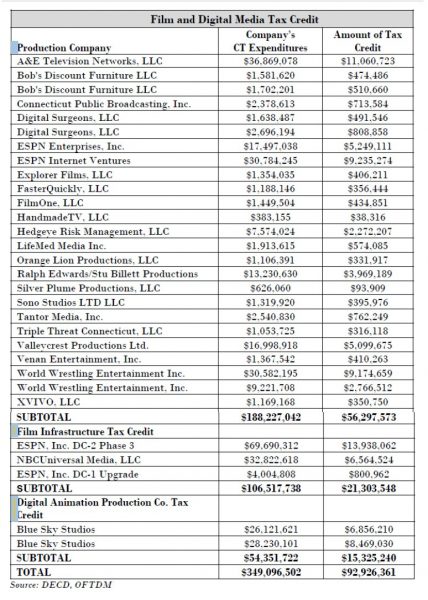
 venue in the city. Ralph Edwards/Stu Billett Productions received nearly $4 million in tax credits in fiscal year 2016, spending just over $13 million in the state on a number of prominent program productions.

 The last statewide deer population estimate, which was done in 2006, yielded 124,000 deer. If we assume that the deer population has remained the same for the past 8 years, a liberal estimate of this additional “take” would be less than 1% of the deer population. If we assume that the population is higher now than it was 8 years ago (this is the widely-held assumption from proponents of this bill, including DEEP), the additional “take” would drop below 1%.
 a Michigan-based “Don’t Veer for Deer” program reduced deer-car collisions 25% despite a 34% increase in herd size; PZP immunocontraception programs; public education on deer resistant plantings). These solutions are not only sustainable solutions, but humane solutions.
 wever, the state is among the worst for distracted drivers.


 The backdrop is offered by more than 700 global companies that have subsidiaries here, employing more than 100,000 people, the Organization for International Investment points out. The state’s convenient access to a variety of transportation options all provides access; there were 4.6 million tons of cargo carried on Connecticut rails in 2015, for example, and 11.4 million tons of freight shipped through Connecticut ports in 2013.
 l and freight movement by rail and highway makes Connecticut a prime location for domestic and international trade,” the report points out. Leading exports include: Aerospace/Transportation Equipment, Non-Electrical Machinery, Computers and Electronics, Chemicals, Electrical Equipment, Fabricated Metals Production, and Primary Metal Manufacturing.
 s specific to their industry.

 We also want development to support healthy lifestyles and enable a vital New Haven.




 es for connectivity, just behind Jersey (New Jersey) and ahead of Newark, Yonkers, Paterson, Elizabeth, and Sunnyvale, Hayward, Fremont and Vallejo in California.
 he study’s methodology.





















