PERSPECTIVE - Suicide Prevention: Beyond the “13 Reasons Why”

by Rachel Papke The Netflix series ‘13 Reasons Why’ has sparked a national conversation about suicide. We see this happen a lot when there’s a big story to tell that strikes a controversial cord. But here’s my opinion: These conversations need to extend beyond the short lifespan of a big story or a popular movie or series.

Whether you know it or not, there are people and organizations working tirelessly year-round to bring suicide prevention into the light. When will those efforts take the spotlight? It’s their work that should be our focus, that we should support and reference throughout the year to have meaningful conversations about mental health and suicide prevention. Suicide prevention efforts exist, persist, and extend far beyond the ‘13 Reasons Why.’

What can you do?

Engage in conversations with each other, your children, your communities, and beyond.

Why do we need to talk about suicide with high school students?

  • 6% of Connecticut high school students said they felt sad or hopeless for 2 or more weeks in a row over the past 12 months*

  • 4% of Connecticut high school students seriously contemplated suicide in the past year*

  • 9% of Connecticut high school students attempted suicide in the past year*

  • 4% of Connecticut high school students said they got the kind of help they needed when they felt sad, angry, hopeless, or anxious*

  • Nationally, almost 1 in 4 high school females seriously considered suicide and 1 in 5 made a plan for how they would attempt suicide*

Suicide is a major public health concern, and we need to always have conversations using safe messaging,supporting help-seeking behavior.

Understand that suicide contagion is a real concern with decades of research to back up its existence. Because of the graphic and triggering content in this series the producers have a tremendous responsibility to adhere to safe messaging recommendations to prevent suicides.

Recently, Netflix responded to the myriad concerns from individuals and organizations regarding this and they are working to add more trigger warnings and place the www.13reasonswhy.info website at the start of the series so that it is visible and viewers know where to go if they need immediate help.

Talking about Suicide

If you’re not sure where to start, I’ve included links to help you start that conversation. Please take the time to educate yourself. Then, start the conversation utilizing these resources to help you. Please share these resources with your network to help keep the conversation going in a safe way that promotes mental health and prevents suicide.

Ask your child, “How are you feeling?”

Maybe they’re embarrassed to share their thoughts with others. Or, they’ve tried talking about it, but don’t feel anyone listened or understood. Help them understand that there are friends, family members, counselors, and therapists available that want to help and are ready to listen.

If you, a friend or family member is struggling emotionally, you, are not alone. The number for the National Suicide Prevention Lifeline is 800-273-8255.

___________________________

Rachel Papke is the Communications Manager at the Jordan Porco Foundation charity. She earned her Bachelor’s Degree in Journalism and Media Studies at Rutgers, The State University of New Jersey.

Resources

Note: The opinions expressed in this perspective piece are personal, and not those of the Jordan Porco Foundation. This content is provided for general informational purposes only and should not be construed as mental health advice from the individual author or the Jordan Porco Foundation. You should consult a mental health professional for advice regarding your individual situation.If you need support now, call the Suicide Prevention Lifeline at 1-800-273-8255, or, text HOME to 741741 to get help 24/7 from the Crisis Text Line. If you or someone you know needs help, you can visit the Jordan Porco Foundation’s resources page.

*2015 Youth Risk Behavior Survey data from the Connecticut DPH and the CDC

CT Communities Among Safest Places to Live; Weston and Madison Lead the Way

Two Connecticut communities – Weston and Madison – are among the top 15 safest cities in America, according to a newly released analysis. SafeWise has compiled their 4th annual 100 Safest Cities in America Report, which also ranked three other Connecticut towns in the top 100 - Wilton, Ridgefield, and Canton.

To compile this report, SafeWise analysts considered the most recent complete FBI crime data from 2015 to rank these communities, which all have a minimum population of 10,000 people. SafeWise is a home security and safety brand committed to increasing safety education, awareness, and preparedness in American communities.

Weston was ranked at #6, Madison at #14, Wilton at #49, Ridgefield at #57, and Canton at #85.

“There is a lot that the nation can learn about community policing, the walkability of safe streets and collaboration between police and neighborhood watch programs to help improve the safety of our cities,” SafeWise Security Analyst Olga Papadimitriou said.

Last year, the top five in Connecticut were Ridgefield, Wilton, Weston, Easton and Redding. 

Based on the most recent FBI Crime Report, according to SafeWise, the violent crime rate in Connecticut is nearly 40 percent lower than the national average and the property crime rate is over 25 percent lower. Among the state’s 20 safest cities, however, only about three crimes were reported for every 1,000 citizens.

Weston, with a population of 10,150 residents, according to the town’s website, features “two acre zoning, a lack of commercial development, a focus on open space, and an outstanding educational system.”  Twenty percent of town residents commute to jobs in Manhattan daily. 

Last month, the Commission on Accreditation for Law Enforcement Agencies, Inc. (CALEA®) awarded the Madison Police Department their second Advanced Law Enforcement Accreditation. This award was presented to the Madison Police Department at the organization’s annual conference.


Fun in CT? Ranked 37th in the US, But Among Leaders in Marinas, Fitness Centers, Money Spent on Recreation

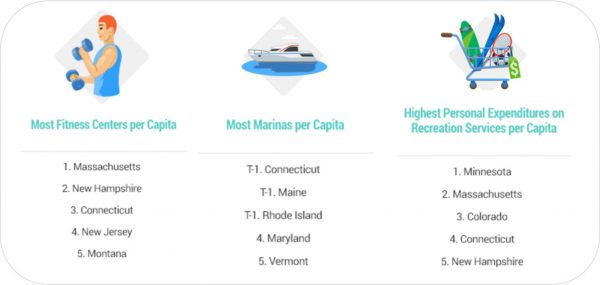
While Connecticut ranked 37th overall among the nation’s 50 states analyzed for their “fun” quotient, the state did have some standout rankings in specific categories – including the amount of money individual residents spend on recreation.  Despite ranking 35th overall in “entertainment & recreation” categories and 40th in “nightlife,” the state reached the top five in three sub-categories. In the analysis by the financial website WalletHub, Connecticut ranked third in the number of fitness centers per capita, at 15.7. New England neighbor Massachusetts ranked #1 with 17, and New Hampshire, New Jersey and Montana rounded out the top five in that category.

Connecticut ranked #1 in number of marinas per capita, tied with Maine and Rhode Island. Connecticut has 3.48 marinas per 100,000 residents, the data indicated. Maryland and Vermont ranked fourth and fifth, respectively.

In another top five finish, Connecticut ranked fourth in Personal Expenditures on Recreation per capita, at just over $1,900. Minnesota ranked first at $2,058. The Top 5 states, in order, were Minnesota, Massachusetts, Colorado, Connecticut and New Hampshire.

Overall, the “most fun states” were Nevada, South Dakota, Colorado, North Dakota, New York, Wyoming, Oregon, Louisiana, Montana, Hawaii, Maine, Minnesota, Florida, Vermont and California.  At the bottom of the list were Arkansas, Kentucky, Alabama, West Virginia and Mississippi.

The overall rankings were weighted 80-20 between Entertainment & Recreation and Nightlife.  The Entertainment & Recreation categories included restaurants, beaches, movie theaters,  national parks, arts venues, and state spending on parks and recreation. The nightlife category included average beer & wine prices, movie costs, music festivals and access to bars.
Data used to create the ranking, which included 22 separate sub-categories, were collected from U.S. Census Bureau, Bureau of Economic Analysis, National Park Service, Council for Community and Economic Research, TripAdvisor, Beachapedia, Stadium and Arena Visits, Graphiq, American Gaming Association and WalletHub research.


16 CT School Districts Named Among Nation's Best Communities for Music Education

Sixteen Connecticut school districts are among 527 districts across the being recognized as being among the Best Communities for Music Education (BCME). The annual listing of outstanding music education programs, now in its 18th year, is developed by The National Association of Music Merchants (NAMM) Foundation in cooperation with researchers at The Music Research Institute at the University of Kansas.

The awards program recognizes outstanding efforts by teachers, administrators, parents, students and community leaders who have made music education part of the curriculum. Designations are made to districts that demonstrate an exceptionally high commitment and access to music education. These districts "set the bar in offering students access to comprehensive music education," according to officials at the NAMM Foundation.

The Connecticut school districts earning a slot on the Best Communities list:  Avon Public Schools, Bethel Public Schools, Bristol Public Schools, Canton Public Schools, Cheshire Public Schools, Fairfield Public Schools, Glastonbury Public Schools, Newington Public Schools, Newtown Public Schools, Plainville Community Schools, Regional School District No. 8, Simsbury Public School District, Southington Public Schools, Torrington Public Schools, West Hartford Public Schools, and Westport Public Schools.

To qualify for the Best Communities designation, local school districts answered detailed questions about funding, graduation requirements, music class participation, instruction time, facilities, support for the music program, and community music-making programs. Responses were verified with school officials and reviewed by The Music Research Institute at the University of Kansas.

Last year, 13 Connecticut school districts were named, among 476 districts nationwide.  New to the list this year are Avon, Fairfield, Plainville, and Regional School District No. 8.  Falling from the list is Wilton.   

The designation takes on added significance this year, officials point out, with new research showing strong ties between K-12 school students who actively participate in school music education programs and overall student success. A recent study of students in the Chicago Public Schools by brain researchers at Northwestern University, detailed in Neuroscientist and Education Week, builds on previous findings that participation in music education programs helps improves brain function, discipline and language development, according to officials.

“Studying music has intrinsic benefits and, on its own, is core to learning.  Also, the links between student success and music education have now been demonstrated by brain researchers in multiple studies,” said Mary Luehrsen, Executive Director of The NAMM Foundation. “The schools and districts our foundation recognizes are building on that connection between music and academics. These schools and districts are models for other educators who see music as a key ingredient in a well-rounded curriculum that makes music available to all children, regardless of zip code.”

The NAMM Foundation is a nonprofit supported in part by The National Association of Music Merchants and its approximately 10,300 members around the world. Its mission is to advance active participation in music making across the lifespan by supporting scientific research, philanthropic giving, and public service programs.

Cigna Recognized for Cultural Competency Efforts

Health disparities directly and indirectly cost the U.S. economy $309 billion annually, and it is estimated that approximately 30% of direct medical costs for Blacks, Hispanics, and Asians are unnecessary costs resulting from health disparities, according to a paper prepared by Connecticut-based Cigna. Indirect costs, the paper points out, include lost work productivity and premature death. The paper, focusing on Cultural Competency in Health Care, is part of an initiative by Cigna that has been recognized with an "Innovation in Advancing Health Equity Award" by the National Business Group on Health, which honored the insurer for its ongoing commitment to promoting health equity and reducing health care disparities in the workplace and community.

"Health equity exists when all people, regardless of race, gender, socio-economic status, geographic location, or other societal constructs have the same access, opportunity, and resources to achieve their highest potential for health. It is our hope that these companies provide an example and encourage other employers to advance health equity," said Brian Marcotte, president and CEO of the National Business Group on Health.

Cigna was recognized for its nationwide program, America Says Ahh, to improve preventive care and encourage regular check-ups. A key feature of the campaign is the TV Doctors of America preventive care advocacy campaign featuring five famous TV doctors.  Among them is Alan Alda, best known for his role on M*A*S*H.  Alda will be on Hartford on Saturday evening at The Connecticut Forum.

“For Cigna's network doctors and clinicians, we created and delivered an in-depth cultural competency training with an emphasis on engaging Hispanic patients, and produced an external white paper on Cultural Competency in Health Care,” said Peggy Payne, a leader within Cigna's Health Equity Strategy area.

“The U.S. population is increasingly diverse. Cultural competency is essential to deliver health care services that meet the needs of each individual and improves overall health,” said Christina Stasiuk, D.O., National Medical Director for Health Equity at Cigna.

Racial and ethnic minorities currently make up about a third of the U.S. population, and are expected to become a majority by 2055, the paper points out, noting that:

  • Hispanics will continue to make up the largest portion of the minority population
  • The Asian population is expected to grow at the fastest rate between 2015 and 2055
  • The foreign-born population will increase at a higher rate than the native born population, accounting for approximately 20% of the U.S. population by 2060

As the U.S. becomes more diverse, it is likely that more individuals will have limited English proficiency or will not adhere to Western cultural norms, which may contribute to greater health disparities, the Cigna paper points out.

“Reducing health disparities is a business and social imperative. Minority populations will likely become an increasing share of providers’ patient panels, employers’ workforces, and health plans’ customers, requiring that all stakeholders seek ways to promote health equity to improve health and access, reduce costs, and improve experience,” the Cigna paper emphasizes, suggesting employers can take to build cultural competency and improve health outcomes for all their employees by:

  • Expanding their human resources leadership team to include experts in cultural competency and diversity
  • Instituting multicultural staff representatives to support onsite health services, such as health fairs and open enrollment
  • Seeking feedback from diverse groups of employees about their experiences as health care customers
  • Providing materials and benefits information that are culturally competent, e.g., culturally adapted or language-specific
  • Proactively gathering the demographic data of their workforce to measure and take action on health trends
  • Collaborating with their health plan to better engage employees in their health

Cigna indicates that the company has “ongoing efforts to help ensure that Cigna staff is culturally and linguistically competent.”

The National Business Group on Health is the nation's only non-profit organization devoted exclusively to representing large employers' perspective on national health policy issues and helping companies optimize business performance through health improvement, innovation and health care management.

https://youtu.be/foL9gfbfweY

PERSPECTIVE: Cheers to Farm Brewers and Tomorrow’s Homegrown Jobs

by Brett Broesder Connecticut’s craft brewery industry is growing, and if lawmakers pass legislation that paves the way for farm brewers to grow statewide, the Nutmeg State will be in a better position to win tomorrow’s good-paying craft beer jobs.

Our state is currently home to more than 50 craft breweries; Connecticut brewers alone are producing more than 3 million gallons annually. The economic impact of the craft beer industry on our state is nearly $569 million every year.

Although craft breweries seem to be popping up everywhere, there’s still a lot of room for growth. In fact, nationwide over 1,000 cities with populations of more than 10,000 people still do not have a craft brewery, confirming that there is still room for growth in the marketplace.

Connecticut lags behind its neighbors. For example, in Massachusetts, there are currently more than 80 craft breweries with an annual economic impact of more than $1.4 billion. On the other hand, the Empire State is home to over 200 craft breweries with an annual economic impact of $3 billion.

The Nutmeg State’s craft beer industry is still growing. There are more than 40 new craft breweries in the planning stages across the state. Not only are craft breweries growing across the state, they’re booming nationwide. In fact, three decades ago, there were less than 125 breweries nationwide. Today, there are more than 5,300, accounting for more than 424,000 jobs.

Across the country, craft brewers created almost 7,000 jobs in 2016, bringing the total amount of industry jobs to nearly 129,000. Craft brewers also saw a six percent year-over-year rise in volume, producing over 24.6 million gallons of beer. Also, the rate at which craft breweries are opening is much faster than that which they’re closing.

One reason for our neighboring states having a leg up on craft brewery growth is their incentivizing farm brewing. In 2012, the New York State Legislature passed – and the governor signed into law – a bill creating a farm brewery license.

Since the license became available in 2013, more than 130 farm brewers have been permitted, creating jobs and growing the state’s economy. In fact, since 2013, craft beer production in New York State has increased by more than 50 percent.

Now, Connecticut has an opportunity to start the process of catching up if the General Assembly passes, and the governor signs, a bill that would create a farm brewers permit. This legislation – An Act Establishing a Manufacturer Permit for Farm Brewers (HB 5928) – allows for the manufacture, storage, bottling, and wholesale distribution and sale of beer manufactured at any place or premises located on a farm.

The permit also allows permitees to sell their craft beer at a farmers market, and requires permittees to use a certain amount of hops, barley, and other fermentable grown or malted in the state. After fulfilling these requirements, and purchasing a $300 permit, farm breweries can then advertise their products as “Connecticut Craft Beers.”

With this bill, state lawmakers have a real opportunity to help strengthen both the craft brewery industry and agriculture. And when a farmer and a brewery partner up, they create jobs, keep farmers farming, and help small businesses grow and thrive.

Connecticut’s House of Representatives recently passed the farm brewers bill unanimously. It’s now up to the State Senate to pass it, and for the governor to sign it into law.

_______________________________________

Brett Broesder is Co-Founder and Vice President of the Campaign for Tomorrow’s Jobs, which focuses on growing Connecticut’s economy for present and future generations in three key policy areas:  workforce preparedness, business growth & innovation and fiscal sustainability.   


Disconnected Youth: Fewer in Connecticut Than Nationally; Disparities Reduced But Continue

Fewer young people across the country are disconnected from school and work today than were before the Great Recession, according to new national data. The 2015 youth disconnection rate, 12.3 percent, is below the 2008 rate of 12.6 and well below the 2010 youth disconnection peak, 14.7 percent. All of Connecticut’s five Congressional Districts show lower rates of disconnected youth than the national average.

That’s a 16 percent drop over five years translates to roughly 900,000 fewer young people cut off from pathways that lead to independent, rewarding adulthoods, according to data compiled by the Social Science Research Council.

The report, “Promising Gains, Persistent Gaps,” compares the degree of youth disconnectedness in Congressional Districts across the country.

Disconnected youth are teenagers and young adults between the ages of 16 and 24 who are neither in school nor working. Being detached from both the educational system and the labor market during the pivotal years of emerging adulthood can be dispiriting and damaging to a young person, and the effects of youth disconnection have been shown to follow individuals for the rest of their lives, resulting in lower incomes, higher unemployment rates, and negative physical and mental health outcomes. The harms accrue not only to young people themselves, but reverberate across time and place, making youth disconnection a national concern that must be addressed by society at large.

Youth disconnection rates vary enormously by congressional district—from an impressively low rate of 4.4 percent in Wisconsin District 2, the mostly urban Madison area, to an alarmingly high rate of 23.1 percent—or nearly one in every four young people—in Kentucky District 5 in rural Appalachia.

Connecticut fares relatively well.  Northeastern and Midwestern congressional districts have lowest rates of youth disconnection, 11.1 percent on average.

Connecticut’s best ranked Congressional district is the 2nd, in Eastern Connecticut, with an 8.7 percent of youth ages 16-24 disconnected, ranking 60th among the nation’s 435 Congressional districts.  Next best if Connecticut’s 5th district, in Western Connecticut, ranked 116th with 9.9 percent disconnected youth.  The 3rd C.D. ranks 134th, at 10.1 percent; the 4th C.D ranks 104th with 10.3 percent; and the 1st C.D. ranks 167th at 10.9 percent.

On average, a gap of 7.4 percentage points separates the best and worst districts within a state. Connecticut’s gap is only 2.2 percentage points.

The greatest disparity is found in New York State; a worrisome 15.2 percentage points separate New York’s District 20 in the Albany area (7.1 percent) and District 15 in New York City’s South Bronx (22.3 percent).

The most equitable state in terms of youth disconnection is also found in the Northeast; a nearly negligible 0.1 point separates Maine’s District 1, which hugs the southern coast and includes the capital, Augusta (9.8 percent), and District 2, a more rural district that encompasses most of the state (9.7 percent).

The analysis found that nationally, young women are slightly less likely to be disconnected than young men. And there is “astonishing variation in disconnection rates by race and ethnicity.” The share of young people cut off from workforce and educational opportunities, the report found, ranges from only one in fourteen Asian American youth to more than one in four Native American youth. The Asian American youth disconnection rate is 7.2 percent; the white rate is 10.1 percent; the Latino rate is 14.3 percent; the black rate is 18.9 percent; and the Native American rate is 25.4 percent.

The report concludes that “at-risk youth need the kind of support from communities and institutions that other young people take for granted: safe places to live and food on the table; caring adults to help them navigate the often-bewildering transition from child to adult; opportunities to try new things, to fail, and to try again; and experiences that build not just hard and soft skills for the marketplace, but also self-knowledge, agency, and confidence.”

Edible Arrangements, Subway Take Steps Forward and Back in Roller-Coaster Economy

Two of Connecticut’s leading food franchise success stories - Edible Arrangements and Subway – have both been in the news in recent days, seemingly moving in opposite directions.  Subway, for the first time in memory, is reducing the number of franchises across the country, while Edible Arrangements is in the midst of extending its brand, as its founder has taken back control of the equity in the business. Subway dropped 359 U.S. locations in 2016, the first time that Subway has had a net reduction. The store count dropped 1.3 percent to 26,744 from 27,103, but Subway remains the nation’s most ubiquitous eatery. (Behind only McDonald’s in sales.) Sales at Subway franchises fell 1.7 percent last year to about $11.3 billion, according to published reports. Subway is still growing internationally, with sales outside the U.S. increasing 3.7 percent to $5.8 billion last year, as the company continued to open locations.

Subway was founded about 52 years ago by Fred DeLuca and Peter Buck in Bridgeport. DeLuca died in 2015, leaving the company in the hands of his younger sister, Suzanne Greco, who became chief executive officer. The chain’s restaurants are entirely owned by franchisees.

Since its founding in 1999 in East Haven, Edible Arrangements has grown to more than 1,300 locations worldwide. Tariq Farid developed a "healthy obsession with fruit," and used his experience in the floral industry insight to develop a new business concept: fruit bouquets. Edible Arrangements began franchising in 2001, according to the company website.

Farid has completed a buyback of equity of the company which had been held by Greenwich private equity firm L Catterton.  The company has entered into a strategic partnership with L Catterton in June of 2012. Farid said the relationship provided assistance during a key growth phase for the brand, a time in which Edible Arrangements expanded into offering fresh fruit smoothies, froyo fruit blends, chocolates and more.

“The timing was right to take back full ownership so that I could be more fully engaged in building the future of the brand with our franchisees," Farid said, adding that "Edible Arrangements finds itself well-positioned for a future that includes exciting new opportunities for our franchises and the brand.”

Edible Arrangements has launched a system-wide conversion of traditional stores to a "whole-store" experience in the Edible To Go platform, featuring fresh fruit smoothies, froyo fruit blends and other fresh fruit treats. The company is coming off a year in which it registered a 27 percent increase over the previous year in both the number of new store openings and signings of new franchise agreements. It was named in Entrepreneur's Top 40 of "Fastest Growing Franchises" and "America's Top Global Franchises" as well as being included among the "Inc. 5000" list of the fastest growing privately-held companies.

"This is an exciting time to be a part of Edible Arrangements," Farid said. "At heart we are really a family of small businesses that have enjoyed incredible growth through a shared passion and willingness to work together towards common goals. Now we can focus all our energy on working together on the next evolution of the Edible Arrangements brand."

Edible Arrangements is headquartered in Wallingford; Subway is headquartered in Milford.

Some of Most Valuable Global Brands Are Connecticut-Based Businesses

Connecticut remains ranked among the top 10 states for corporate brands, according to a new study.  London-based Brand Finance has calculated Connecticut as being home to 20 of the 500 most valuable brands in the nation.  Connecticut ranked seventh. The state also was strongly represented among the 500 most valuable brands in the world, with a half-dozen earning a slot in the global rankings.

The Spectrum brand of Stamford-based Charter Communications is now the most valuable among Connecticut-based companies, at number 83 in the rankings of most valuable global brands, and number 43 among U.S. companies.

Health insurance giant Aetna, which has flirted with merger and departure in the past year but remains headquartered in Hartford, is number 166 on the list of most valuable global brands, moving up from number 188 on last year’s list.  Among U.S.-based brands, Aetna ranked at number 70.

Booking.com, part of The Priceline Group, came in at number 274 on the global rankings, down from number 201 a year ago.

Bloomfield-based CIGNA, which also had a merger thwarted in recent months, was ranked number 305, jumping more than 100 positions on the list, from number 439 last year.

ESPN, with world headquarters in Bristol, is at number 381 on the global list, down from 356 a year ago.

Norwalk-based Priceline was ranked number 386, down from 357 last year.  Xerox, also based in Norwalk, was just behind at number 389, up from number 396 a year ago.

Subway, which recently announced the closure of more than 300 U.S. restaurants in 2016, was ranked number 464 on the list, down from number 417 in the previous annual ranking.

The top ranked global brands were Google, Apple (which switched places from a year ago), Amazon.com, AT&T, Microsoft, Verizon, Walmart, Facebook, Wells Fargo, McDonalds, IBM and Boston-based GE. Six years after it last held the title in 2011, Google is now the world’s most valuable brand with a value of US $109 billion, according to Brand Finance.

NBC, which is not headquartered in Connecticut but has operations in Stamford, was ranked number 93 on the list of the top global brands.  Xfinity, also part of the Philadelphia-based Comcast corporate family, is ranked number 37.

Also earning a spot on the U.S.-based top 500 list are Sheraton (part of Stamford-based Starwood), Carrier (United Technologies), Frontier, United Technologies, Otis (United Technologies), The Hartford, Pratt & Whitney, Praxair, Harman International, and Pitney Bowes.

On the industry-specific list of the most valuable global toy brands, topping the list is Lego.  The company, based in Denmark, has operations in Connecticut.  Lego was also named the world’s most powerful brand, along with google, Nike, VISA, Disney, NBC, PWC, Johnson & Johnson and McKinsey & Company. Lego scores highly on a wide variety of metrics including familiarity, loyalty, promotion, marketing investment, staff satisfaction and corporate reputation.

Financial accounting and reporting standards requires a clear definition of what intellectual property is included in the definition of ‘brand’, Brand Finance points out.  The website defines brand as the “Trademark and associated IP including the word mark and trademark iconography”.

Most Valuable Brands of Connecticut Based Companies (Ranking on list of US Companies) – Spectrum (43), Aetna (70), Booking.com (108), CIGNA (126), ESPN (162), priceline.com (164), Xerox (166), Sheraton (189), Subway (196), Carrier (203), Frontier (208), United Technologies (232), Otis (292), The Hartford (332), Pratt & Whitney (340), Praxair (351), Harman International (372), Pitney Bowes (471), and United Rentals (475).

CT's Economic Performance Ranks 49th in US; Economic Outlook Ranks 46th

Connecticut ranks 49th in economic performance during the past decade and the state’s economic outlook ranks 46th among the nation’s 50 states in the latest “Rich States, Poor States” analysis by the American Legislative Exchange Council. The look-back at the decade 2005-2015 shows Connecticut ranking near the bottom in the three components that make up the ALEC-Laffer State Economic Competitiveness Index performance numbers.  The state ranked 47th in state gross domestic product and 44th in non-farm payroll employment, both below the national average, and 43rd in absolute domestic migration, which increased for the third consecutive year.

Connecticut’s overall economic outlook ranking, 49th in the nation, represents a drop from 47th in each of the past two years, and 44th and 34rd in the two previous years.  Back in 20120, Connecticut ranked 36th.  The economic outlook includes more than a dozen categories.  Among them, Connecticut ranks highest in sales tax burden (12th), remaining tax burden (16th), and debt service as a share of tax revenue (20th).

“Each of these factors is influenced directly by state lawmakers through the legislative process,” the report points out. The policy variables “have a proven impact on the migration of capital—both investment and human—into and out of states.”

In the 10th annual edition of the competitive outlook index, the lead states in the ranking are Utah, Indiana, North Carolina, North Dakota, Tennessee, Florida, Wyoming, Arizona, Texas and Idaho.  The highest ranking New England states are New Hampshire (number 18) and Massachusetts (number 25).  Joining Connecticut towards the bottom of the list are Rhode Island (number 36) and Vermont (number 49).

The Economic Performance Rankings (2005-2015) placed Texas, North Dakota and Washington State atop the list, followed by Utah, Colorado, Oklahoma, Oregon, South Dakota, North Carolina, and Montana.  Massachusetts was the highest ranked New England state, at number 18.

“Generally speaking,” the report indicated, “states that spend less—especially on income transfer programs, and states that tax less—particularly on productive activities such as working or investing—experience higher growth rates than states that tax and spend more.”