$93 Million in Tax Credits to Film, Digital Industries in Connecticut

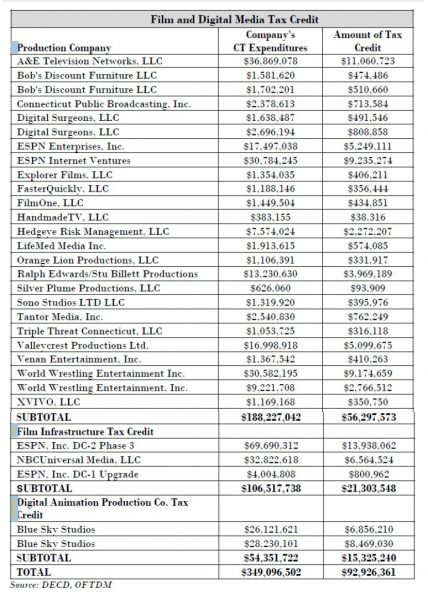
An estimated $349 million was spent in Connecticut by qualified productions and $93 million in tax credits were issued to 25 media production companies under the state’s tax credit program during fiscal year 2016.  The tax credits are designed to boost the state’s economy by attracting film and digital productions to the state, creating employment opportunities for state residents. According to the Office of Film, Television and Digital Media, which supports and enhances Connecticut’s film, television and digital media industry, companies are provided with direct financial assistance programs, including but not limited to loans, grants, and job expansion tax credits structured to incentivize relocation to Connecticut and the growth and development of current Connecticut-based companies.

The breakdown by industry segment:

  • Production Companies - $188 million spent; $56 million in tax credits issued
  • Film Infrastructure - $106 million spent, $21 million in tax credits
  • Digital Animation - $54 million spent; $15 million in tax credits

Film infrastructure tax credits went to companies including ESPN in Bristol and NBC Universal in Stamford; Digital Animation tax credits to Blue Sky Studios in Greenwich.

The production companies receiving tax credits from the state included well-known names such as A&E, Connecticut Public Broadcasting, ESPN, World Wrestling Entertainment and Bob’s Discount Furniture, which received just under a million dollars in tax credits under the program.

The legislation, first approved in 2006 and amended twice during the past decade, makes it possible for eligible production companies to receive a tax credit on a sliding scale of up to 30 percent on qualified digital media and motion picture production, pre-production and post production expenses incurred in the state. The Office “actively assists local, national and international motion picture, TV and media production entities with finding locations in Connecticut, rules and procedures, securing permits, hiring local cast and crew and other services,” according to the agency’s website.  In addition, the Office “represents the state and its agencies, municipalities and resident media professionals in interactions with media production entities and the industry at large.”

The popular reality courtroom drama “The People’s Court” announced this month plans to move to a new location on Stamford’s West Side. The show’s production company, Ralph Edwards/Stu Billett Productions, is moving its headquarters to an 18,739-square-foot space at 470 West Ave., from its current space at 300 Stillwater Avenue in the city. Ralph Edwards/Stu Billett Productions received nearly $4 million in tax credits in fiscal year 2016, spending just over $13 million in the state on a number of prominent program productions.

This summer, a digital training program will provide courses at the UConn Stamford Campus including social media management, web design and development, and manipulating digital content.  Digital Media CT (DMCT) is developed in partnership by the Connecticut Office of Film, Television & Digital Media and the University of Connecticut Digital Media & Design Department. It has been designed for individuals who want to develop the basic skills necessary to seek work in the industry or enhance their current skill set and advance their careers.

The program is described as most appropriate for individuals with prior or current professional experience in the industry, college graduates with majors in communications, film, television, marketing, and digital media, or students currently enrolled in relative academic coursework.

Later this year from Blue Sky:

https://youtu.be/jyJgGsZo2wA
PERSPECTIVE: Wildlife Watching, Not Hunting, Is Better Choice for State Residents and Economy

by Annie Hornish Proponents of HB 5499, expansion of Sunday hunting to include guns on private land, argue that this bill will reduce deer populations, but this is not true.

Deer will produce more fawns and breed at an earlier age after their numbers are reduced. The same pattern repeats: deer are killed by archers in the fall, yet their numbers bounce back by summer.

When doing the math, it is easy to see why HB 5499 won’t reduce the deer population. According to deer harvest figures provided by Connecticut’s Department of Energy and Environmental Protection (DEEP), from September 15, 2016 through January 17, 2017 (latest available), Connecticut archers removed 5,088 deer from private land, and 3,729 deer were killed by shotgun/rifle and muzzleloader.

We can assume that a similar number of deer would be killed on a Sunday as on a Saturday with the additional forms of hunting (i.e., shotgun/rifle and muzzleloader). The latest figures for Saturday volume were 1,218 (shotgun/rifle (961) + muzzleloader (257) (2014)). Assuming this number is similar for the 2016-17 deer hunting season, passage of HB 5499 would therefore remove another 1,218 deer.

The last statewide deer population estimate, which was done in 2006, yielded 124,000 deer. If we assume that the deer population has remained the same for the past 8 years, a liberal estimate of this additional “take” would be less than 1% of the deer population. If we assume that the population is higher now than it was 8 years ago (this is the widely-held assumption from proponents of this bill, including DEEP), the additional “take” would drop below 1%.

Factoring in the additional number of deer taken by archers on private land under special landowner hunting provisions allowed per DEEP, the grand total number of deer killed still amounts to only 1% of the deer population or significantly less, depending on the current size of the deer population, and removing an additional 1% of the deer population will not, even in the immediate short term, significantly reduce deer numbers in Connecticut.

Like with deer, trapping of coyotes does not decrease the population, and may make the problem worse. One study found that even when up to 70% of their numbers are removed, coyote populations bounce back quickly. This is because a stable pack has only one alpha pair, and they are the only ones who reproduce. When one or both members of that alpha pair is killed, other pairs form and reproduce (breeding at earlier ages and having larger litters). Also, unstable packs can attract transient coyotes. The solution to conflicts with coyotes is public education on removal of attractants (e.g., accessible garbage, pet food left outside), and hazing to curb undesired coyote behavior.)

Deer problem management programs that focus on site-specific solutions offer successful, long-term solutions to conflicts with deer (e.g., a Michigan-based “Don’t Veer for Deer” program reduced deer-car collisions 25% despite a 34% increase in herd size; PZP immunocontraception programs; public education on deer resistant plantings). These solutions are not only sustainable solutions, but humane solutions.

Per the latest survey by the U.S. Department of the Interior, Fish and Wildlife Service and U.S. Department of Commerce, wildlife watchers (defined as observing, feeding, or photographing wildlife) in Connecticut not only outnumber hunters by a margin of 29 to 1, but they also outspend hunters by 7.4 to 1, contributing about $510 million to the economy annually.

Further, the survey also shows the following 10-year trends for Connecticut: a 42% increase in the number of wildlife watchers (from 774,000 to 1,102,000), and a 39% decrease in the number of hunters (from 62,000 to 38,000).

Connecticut should be forging policies that cater to wildlife watchers instead of pouring limited tax dollars into programs catering to a diminishing number of hunters.

___________________________________

Annie Hornish is Connecticut State Director of The Humane Society of the United States.

Safest States for Driving? CT Ranks #8 in USA

Connecticut is the eighth safest state in the nation for drivers, according to a new analysis of driving safety across the country. The report was derived from analyzing fatality data from the National Highway Traffic Safety Administration (NHTSA) and correlating the data with speeding, distracted driving and drunk driving statistics. Analysts for Safewise, a home security company that studies a variety of public safety issues, compiled the report, which found:

  • The majority of Connecticut's road fatalities come from drunk driving, however, Connecticut is among the top 10 states for fewest speeding fatalities.
  • Connecticut is among the nation's slowest average speed limits. SafeWise analysts found that slower speed limits lead to fewer fatalities, which explains why Connecticut is among the safest states.
  • Connecticut bans all forms of cell phone use, however, the state is among the worst for distracted drivers.

The safest states, according to the survey, are Delaware, Illinois, Kentucky, New York, Ohio, Louisiana, Massachusetts, Connecticut, Utah and West Virginia.

The report revealed that the safest states for driving typically have lower speed limits and less restrictions on phone use. The states that have longer commute times and slower speed limits have less fatalities. More dangerous roadways tend to be long interstates with speed limits in the 70’s and 80’s. States with younger median ages and higher birth rates correlated with higher fatality rates.  Inexperienced drivers and large families alike seem to be more distracted when on the road.

“Over the past few years, fatal crash statistics have increased substantially,” said Robert Dillman, owner and lead instructor of the Georgia-based NEVO Driving Academy. “According to data released by the National Safety Council, in 2016, the United States reached a 10 year peak in crash related fatalities. With regards to traffic and driver safety, from 2013 to present, we are trending in the wrong direction.”


Home Ownership in CT: Not Best, But Not Worst

When it comes to home ownership, Connecticut is in the middle of the pack among the nation’s 50 states.  A new report ranks the state at number 30, in the lower echelons of the states.  And when the report, by financial website ValuePenguin, identified optimal factors when considering homeownership, Connecticut faired more poorly in some key factors. Connecticut ranked 48th in affordability, followed only by California (49) and Florida (50).  New Jersey and Massachusetts were just ahead of Connecticut.  The best states for affordability were South Dakota, Wyoming and Idaho.

Ten factors, organized into three key categories were used to measure and rank the states. The three key categories of focus were: Housing Market Strength, Residual Costs, and Living Factors.

Factors that weakened a state’s position included propensity for crime, weak housing markets, and heavy burdens of costs to maintain a home – for instance the likelihood of property damage caused by storms and other calamities. Attributes that strengthened a state’s position included homeownership affordability, low mortgage rates, and low risk of calamities.

The 10 worst states to be a homeowner, according to the report, are Louisiana, Mississippi, Tennessee, New Mexico, and Alabama.  The best states, according to the analysis, are Iowa, South Dakota, Wyoming, Nebraska, Maine and Minnesota.

In terms of livability, the top states in the nation are the New England states of New Hampshire, Maine, and Vermont.


Best Small Cities to Start A Business? CT Has Only One - Danbury - Among Top 700 in USA

Only one Connecticut community is ranked in the top 700 “best small cities to start a business” in a new survey of 1,260 cities across the nation.  Danbury, ranked at number 170, was the sole Connecticut city to earn a slot among the nation’s business-friendly small cities.  The next Connecticut municipalities on the list were Torrington, ranked at number 749, and East Hartford, at number 775. To determine the best small cities in which to start a business, the financial website WalletHub’s analysts compared across three key dimensions: 1) business environment, 2) access to resources and 3) business costs. Included were cities with a population of between 25,000 and 100,000 residents.

Among Connecticut municipalities, also reaching the top 1,000 nationwide were East Hartford (775), Bristol (836), Westport (861), West Hartford (876), and Shelton (919).

The Danbury city website highlights that “assets and resources include a pro-business climate, a creative, educated and talented workforce, an excellent education system, transportation advantages, a superior quality of life and much more.”  The website highlights a Danbury business each week.

"We analyzed 21 Connecticut cities and out of these, Danbury ranked the highest at 170," said WalletHub analyst Jill Gonzalez. "Although it offers a strong business environment, the city has high business costs overall. Most of the cities (14 of them) ranked below the 1,000 rank because these fail to offer a thriving business environment, with little access to the resources needed to start a business as well as restrictive labor costs."

business-600x568.jpg

The analysis evaluated each of the three key dimensions using 16 relevant metrics. Each metric was graded on a 100-point scale, with a score of 100 representing the most favorable conditions for launching a business. “ A city with a smaller population can offer a greater chance of success, depending on an entrepreneur’s type of business and personal preferences,” WalletHub points out.

The business environment category (50 points) includes average length of work week, average growth in number of small businesses, number of startups per capita, average revenue per business, average growth of business revenues and industry variety.  The access to resources category (25 points) includes financing accessibility, human resource availability, higher education assets, working age population growth and workforce educational attainment.  The business costs category includes office space affordability, labor costs, corporate taxes, and cost of living.

open-600x381.jpg

Also earning a slot on the “Best Small Cities to Start a Business” list were East Haven (1,004), Norwich (1,014), New London (1,015), New Britain (1,022), West Haven (1,026), Wethersfield (1,028), Newington (1,032), Milford (1,053), Stratford (1,060), Norwalk (1,063), Meriden (1,079), Middletown (1,117), Naugatuck (1,185) and Trumbull (1,239).

Data used to create the ranking were collected from the U.S. Census Bureau, Bureau of Labor Statistics, Federal Deposit Insurance Corporation, AreaVibes, Yelp, Indeed, U.S. News & World Report, Tax Foundation and LoopNet, according to WalletHub.

The top small cities for business in the U.S., according to the analysis, were Holland, MI; Carbondale, IL; Springville, UT; East Chicago, IN; Jefferson City, MO; Wilson, NC; Enid, OK, Rio Rancho, NM; Clearfield, UT and Cheyenne, WY.  The top ranked city in New England was East Providence, RI, ranked at number 38.

Accent on Exports in Connecticut; State Supports Business Outreach Overseas

If Connecticut were a country, it would be the sixth-most productive in the world, according to the state’s annual report by the department of Economic and Community Development. A critical building block for economic productivity is exports, and a look at the data reveals some surprisingly positive statistics. The backdrop is offered by more than 700 global companies that have subsidiaries here, employing more than 100,000 people, the Organization for International Investment points out.  The state’s convenient access to a variety of transportation options all provides access; there were 4.6 million tons of cargo carried on Connecticut rails in 2015, for example, and 11.4 million tons of freight shipped through Connecticut ports in 2013.

The U.S. Commercial Service and the Connecticut District Export Council have teamed up to create a series of events throughout Connecticut marking the annual Connecticut Export Week. These events will take place during  April 24-28. Connecticut Export Week 2017 will educate businesses on initiating and or expanding their global market. Officials describe Connecticut  Export Week 2017 as the only free event of it’s kind in the nation.  A series of free events and webinars will be offered at locations around the state.  Topics include exporting to China, expanding to new markets, initial market research, how to develop and maintain an export network, and export logistics.

“The ease of global travel and freight movement by rail and highway makes Connecticut a prime location for domestic and international trade,” the report points out.  Leading exports include: Aerospace/Transportation Equipment, Non-Electrical Machinery, Computers and Electronics, Chemicals, Electrical Equipment, Fabricated Metals Production, and Primary Metal Manufacturing.

The top three trading partners for the state are Germany (10.8% of state exports), Canada (10.7%), France 12.7%, United Arab Emirates (10.4%) and Mexico (8.7%).

The Connecticut Department of Economic and Community Development (DECD) recently called on companies to apply for grants of up to $7,000 for a wide range of export-related activities. Funding is from the Small Business Administration (SBA), which awarded Connecticut a $244,000 grant to help increase state exports and the number of small businesses that export. The Department has provided more than 350 grant awards allowing Connecticut companies to participate in Medica, the leading international medical device trade show in Dusseldorf, Germany; Hannover Messe, the world’s largest industrial technology trade show in Hannover, Germany; and the international air shows in Farnborough, U.K. and Paris. Additionally, companies can request reimbursement for trade shows, trade missions and other export activities specific to their industry.

“These investments are helping Connecticut’s small businesses compete in the global economy,” said DECD commissioner Catherine Smith. “For example, grants have been provided to companies to help offset the costs of attending the Farnborough Air Show, one of the most important air shows in the world. Without these grants many of the suppliers and component manufacturers in Connecticut’s supply chain could not attend, missing a key opportunity to establish important contacts and build relationships with the leading aerospace contractors across the globe.”

PERSPECTIVE: People, Not Cars, Should Be Union Station Priority

by Krysia Solheim The New Haven community has consistently voiced opposition to the State's plan to build a new $50 million parking garage for Union Station in New Haven, and the State has failed to adequately respond to our concerns, requests, and comments on the design and the environmental impact assessment.

The New Haven community wants new infrastructure and development to prioritize people, not cars. Currently, 30 percent of New Haven residents, including myself, do not own a car.[1] We want a city with better mass transit and better cycling and pedestrian infrastructure and connectivity. We do not want more parking garages or more public space allocated to cars.

We also want development to support healthy lifestyles and enable a vital New Haven.

New Haven residents suffer from the highest rates of asthma hospitalization in the state - the neighborhood surrounding Union Station is an asthma hot spot.[2] Air quality will continue to worsen if the garage is built because more people will drive to Union Station instead of using more sustainable modes of transportation to get there.

The State has committed to reducing greenhouse gas emissions by 80 percent below 2001 levels by 2050 and the City of New Haven is in the process of committing to the same target. Transportation emissions account for 36 percent (2013 inventory)[3] of Connecticut's greenhouse gas emissions. They account for about 26 percent of US greenhouse gas emissions. It is astounding then, that the State wants to spend $50 million on a garage that will only induce more people to drive instead of investing funds to induce more people to walk, bike, and take transit.

Greenhouse gas emissions are a regional and global issue and the State should be seriously considering environmental impacts and how to protect people, especially low-income environmental justice communities who have long borne the brunt of pollution and are the most vulnerable to climate change impacts.

The City of New Haven and the New Haven Parking Authority understand what the community wants and should be allowed to continue to manage Union Station. They have invested in multimodal connectivity to the station, including a free downtown shuttle with GPS and bike parking infrastructure, and have plans for further transportation oriented development in line with this area’s needs.

I have lived most of my life abroad and have seen wonderful examples of cities that have invested in their train stations and multimodal connectivity to ensure that their communities have reliable access to jobs, that they have clean air, and that they do not have to spend a burdensome portion of their income on transportation or subsidizing the increasing costs of maintaining infrastructure for cars.

I strongly believe that the City of New Haven and the New Haven Parking Authority are best equipped to bring similar forward thinking planning and infrastructure to Union Station and the Greater New Haven region.

_____________________________________

Krysia Solheim is the owner and founder of Viosimo, an environmental sustainability consulting firm. She holds a Bachelor of Science with Honors in Environmental Science from the University of Arizona with minors in Spanish, Arabic, and Chinese; and a Masters in Environmental Management from the Yale School of Forestry & Environmental Studies. Born in Arizona, Krysia grew up in Nicaragua, Costa Rica, Thailand, Cyprus, Venezuela, and Qatar.  She speaks English, Spanish, and Greek fluently and intermediate Chinese and Arabic, has dual American and Greek citizenship, and is a resident of New Haven.


[1]www.governing.com/gov-data/car-ownership-numbers-of-vehicles-by-city-map.html

[2] http://www.ct.gov/dph/lib/dph/hems/asthma/pdf/asthmadatabrief_2013.pdf

[3]www.ct.gov/deep/lib/deep/climatechange/2012_ghg_inventory_2015/ct_2013_ghg_inventory.pdf

Hartford Baseball Being Broadcast in Spanish, English

The Hartford Yard Goats minor league baseball team has played the first of 70 home games at Dunkin' Donuts Park. The broadcasts, like the season, have begun with new homes. All 140 games will be broadcast on the Yard Goats Radio Network, which can also be heard on-line at yardgoats.com and on smart phone devices through the iheartradio app.  The Yard Goats will also have all home games broadcast in Spanish through a partnership with iHeartMedia and WPRX 1120AM. At part of the team’s outreach to the region’s Spanish-speaking population, pocket schedules in Spanish that will be distributed throughout the Greater Hartford area.  According to the 200 U.S. Census, 43 percent of Hartford's population is Hispanic.  

Jeff Dooley is set to begin his first season as the "Voice of the Yard Goats" after calling New Britain Rock Cats broadcasts for the past 18 years. He is the lead play-by-play announcer for all games on radio and television and hosts complete coverage of the Pre-game and Post Game shows for all games, home and road. His broadcasts can be heard on i-Heart Media Hartford affiliate, News Radio 1410 AM (WPOP), AM 1150 (WMRD), AM 1420 (WLIS). Home games are streamed on MiLB.TV.

Dan Lovallo also returns to the Yard Goats broadcast booth. He broadcast the team’s games on radio from 2000 through 2008 and worked on select broadcasts the last two seasons. He has an extensive background in broadcasting professional baseball and sports in general.  In 1983, Lovallo began broadcasting games for the Kinston, NC Blue Jays, then affiliated with the Toronto Blue Jays. Lovallo moved on to the Richmond, VA Braves in 1985, then the top farm club of the Atlanta Braves.

Dooley was behind the microphone for some of the most memorable moments in Rock Cats history, including three Eastern League Playoff Series, a major league exhibition game with the Minnesota Twins, and the only two no-hitters in franchise history. He was the television play-by-play broadcaster for the 2013 Eastern League All-Star Game and called the 2003 EL All-Star game on radio. Additionally, Dooley was the master of ceremonies at the All-Star Luncheon at the ESPN headquarters in Bristol. Additionally, Dooley is the play-by-play voice of the University of Hartford Men's Basketball Team.

In 1990, Lovallo returned to his home state of Connecticut and eventually joined WDRC radio in Hartford to become news and sports director. He now joins Brad Davis on mornings on the Talk of Connecticut network. His assignments included broadcasting women's and men's professional basketball, college basketball for the University of Hartford.  In addition to Yard Goats broadcasts, Lovallo continues to serve as radio "Voice of the Manchester Road Race," and broadcasts high school football games on WAPJ radio. He is also the publisher and editor of two baseball-related websites, Your Baseball Buzz and Baseball on the Fly.

The team’s 70 home games broadcast in Spanish on 1120-AM WPRX in Hartford, will have the father-son duo of Danny and Derek Rodriguez at the microphone.

"We are extremely excited to partner with WPRX and bring Yard Goats Baseball to a new radio audience," said Yard Goats owner Josh Solomon.  "It is really important to our organization to have our broadcasts also available in Spanish, knowing how much the Hispanic community loves baseball, and we feel this is a wonderful way to reach the Latino community."

WPRX AM 1120 is a community based radio station with local programming such as news, traffic, and weather.  WPRX, which transmits 24 hours a day, 7 days a week, has live on air talent from its studio and also is very involved with local community events making it a natural fit with the Yard Goats.

"We are thrilled to be to partnering with the Hartford Yard Goats and having their home games broadcast in Spanish on our radio station," said WPRX owner Oscar Nieves.  "So many of our loyal listeners love the game of baseball and are excited about the new Yard Goats brand.  We know that this is going to be a home run."


Stamford Ranks #7 Among Small Cities of the Future in the Americas

Stamford is a "City of the Future," ranking seventh among small cities in the America’s for economic growth, according to a new report.  The city ranks behind Sunnyvale, Irvine and Fremont, CA; Bellevue, WA; Ann Arbor, MI, and Fort Lauderdale. Also ranking in the top 10 are Cary, NC; Plano, TX; and Guelph, Ontario.  It was one of three top-ten showings for Connecticut's third largest city. In addition to its overall position among just over 200 cities with populations between 100,000 and 350,000, Stamford placed second among small cities for connectivity, just behind Jersey (New Jersey) and ahead of Newark, Yonkers, Paterson, Elizabeth, and Sunnyvale, Hayward, Fremont and Vallejo in California.

The city also placed ninth for economic potential in the analysis and report released this week by a division of the Financial Times.  The top cities in that category included Sunnyvale, Bellevue, Fremont, Irvine, Cary, Ann Arbor, Waterloo (Ontario), Plano and Chattanooga.

The 2017-18 rankings for the American Cities of the Future were developed by the Financial Times’ FDI unit, which studies foreign direct investment.  In total, 421 locations were analyzed for the study. Data was then collected under five categories: Economic Potential, Business Friendliness, Human Capital and Lifestyle, Cost Effectiveness and Connectivity. ‘Small’ locations (209 locations) had immediate city populations of between 100,000 and 350,000, according to the study’s methodology.

“This is really good news for Stamford,” Joe McGee, vice president of public policy for The Business Council of Fairfield County, told the Stamford Advocate. “This index is closely watched by people who look at the hot places to invest, and clearly Stamford is one of those places. That connection to New York is really advantageous to Stamford.”

Among larger cities, the top 10 in the Americas are New York, San Francisco, Houston, Toronto, Montreal, Vancouver, Boston, Atlanta, and Sao Paulo.

A year ago, Stamford  launched the City’s new business portal,  Stamfordbusinessportal.org, created "to eliminate red tape and streamline the process for planning and starting a small business in Stamford," according to officials.  The multilingual website was designed and created by six interns during the summer of 2015, including four from the Mayor’s Youth Employment Program. The website includes links for permitting and licensing, starting a business and business incentives.

Stamford was the only Connecticut city to earn a spot on the lists.


Independent Analysis Sought for State's Economic Incentive Programs

Timing is everything.  Just days after the Yankee Institute for Public Policy reported that a federal grand jury has indicted a former Vernon resident for using a fake pita company to fraudulently obtain $3 million, including $400,000 from the State of Connecticut, the state legislature held a public hearing on a proposal designed to enhance Connecticut’s analysis of the efficiency and effectiveness of the state’s economic development investments. State Comptroller Kevin Lembo, joined by a broad coalition of open government advocates, testified in support of the legislation.  “Connecticut can and should be one of the most economically competitive states in the nation – but that can only happen if we adopt best practice in how we analyze the success and failures of our economic development programs,” Lembo said.

“The state provides hundreds of millions of dollars in economic incentive programs to Connecticut businesses every year for the purpose of advancing economic development and job creation,” Lembo said. “The state owes it to businesses and all taxpayers to fully analyze the return on investment that these sizable and important programs actually deliver in order to assess whether such resources are fulfilling their intended purpose or, if not, whether state funds would be better deployed to other economic development or infrastructure investments.

The proposal, House Bill 7316, would improve how Connecticut analyzes the success and failures of its economic development investments in several ways, according to the Comptroller’s Office. It will streamline the reporting requirements, while expanding the scope of reporting to include all business assistance and incentive programs. It will subject business assistance and incentive programs to performance reviews by the Auditors of Public Accounts and require the Auditors to review the analysis and reporting performed by DECD on such programs – providing necessary independent oversight.

Lembo pointed out that “Connecticut is now one of only two states in the nation where the success of economic development programs is analyzed by the same agency that administers the programs. An unbiased assessment of the performance and administration of these programs has in other states resulted in opportunities for savings.

The Comptroller noted that his office has worked with both the Auditors of Public Accounts and the Department of Economic and Community Development, to “come to mutual agreement on the bill’s language.” The legislation would also require specific legislative committees to hold public hearings to discuss the results of the evaluations and receive input from stakeholders.

The Yankee Institute report indicated that the state’s Small Business Express program, which offer grants and loans to small businesses, awarded the now-indicted former resident a $300,000 loan and a $100,000 grant in 2012.  The report said that the state funding was meant to retain 11 jobs and hire 25 more people.

A broad coalition of open government advocates and organizations submitted testimony in support of the legislation.

On behalf of The Pew Charitable Trusts, Robert Zahradnik, Director of Policy, State Fiscal Health, said, “In Connecticut, as in many other states, business incentives are both a primary economic development tool and a major budget commitment. For that reason, The Pew Charitable Trusts’ research shows that studying the results of incentives is a vital step for states to create jobs, raise wages, help businesses to grow, and to maintain a balanced budget.”

Derek Thomas, Fiscal Policy Fellow at Connecticut Voices for Children, said, “Unlike general fund spending on education, roads, and other spending on the building blocks to a healthy economy, business tax breaks lack transparency. Once on the books, they can remain for years, or even decades, without scrutiny. A more efficient, transparent, and fair budget process would include regular reviews of all economic development incentives to ensure that tax expenditures are yielding the promised economic development benefits. Just like spending, business tax breaks should undergo regular scrutiny to determine their effectiveness.”

The Small Business Express program, which gives grants and loans to smaller to medium sized businesses, has “assisted 1,687 companies — ranging from 'mom and pop' stores to advanced manufacturing firms — with $267 million in loans and grants to retain 18,671 and create 6,795 jobs,” according to the DECD 2016 Annual Report.  In 2016, there were 194 businesses receiving assistance in exchange for commitments to retain 2,912 jobs and create an additional 931.  Total funding commitments were $35,408, 428 in grants and loans.  A year ago, DECD celebrated the 1,500th company to take part in “the governor’s keystone small business development program, the Small Business Express program,” the DECD report indicated.

Joe Horvath, Assistant Policy Director at Yankee Institute for Public Policy, said, "Good economic policy is broad-based and does not favor single businesses, or even industries. This bill would help provide state officials with critical information in determining which economic development programs fail to provide the returns promised, an important step to ending waste and cronyism in Connecticut." Added Daniel J. Klau, President of the Connecticut Council of Freedom on Information (CCFOI):  “CCFOI is very pleased to support this legislation that enhances public confidence in the effectiveness of economic development investments.”

The streamlined report will focus on the most pertinent information, Lembo said, including economic impact of each program, the extent to which it is meeting statutory and programmatic goals, and the efficiency with which the program is being administered. “These incentive programs reduce tax revenue at both the state and local level, and increase state borrowing. It is essential that the legislature review their impact and make informed decisions about the continuation, expansion or elimination of each program. The changes proposed in this legislation will help our state make data-driven decisions about tax credit and abatement programs, ensuring that we are focusing state resources toward their highest and best use.