Focus on UConn Funding Includes View of Money Paid to Football Coaches

The UConn football season is underway, and UConn is in the news in a big way.  It is, however,  about not only prospects on the gridiron as prospects on the bottom line for the state’s flagship university.  Officials describe the university as being under unfair and counterproductive attack by a budget recently adopted by the state legislature that would require substantial reductions in state funding.  The budget is expected to be vetoed by the Governor, continuing the legislative stalemate that has prevented agreement on a state budget for the fiscal year that began on July 1. Also within the past week, UConn was among a handful universities portrayed as the poster children for the practice of paying multiple head football coaches simultaneously.  UConn’s situation was listed as among the most costly.

The report, by The New York Times, indicated that “when the Huskies hired Randy Edsall last winter after three losing seasons under Bob Diaco, they got their once and future head coast for a reasonable $1 million salary.”  The article went on to point out, however, that “firing Diaco triggered a $3.4 million buyout.”  Thus, the University is paying $4.4 million in head coach salary this season, to two coaches – one employed by the university, the other not.

It could have been more costly.

“Even though the move was announced in December,” it was effective in January; “an effective end date in 2016 would have cost the Huskies $5 million.  The newspaper notes that “if it had not given Diaco a richer buyout as part of a two-year (contract) extension he negotiated only seven months before he was fired,” the buyout would have been significantly smaller – only $800,000.”

Leading the list of colleges cited in the Times article was Texas, “on the hook for the salaries of current and former coaches” this season to the tune of $12.45 million.  Next was Oregon, at $8.5 million; and Florida at $6.4 million.

Some doubted that Diaco would be fired, because of the continuing cost to the university of doing so.  The website theuconnblog.com said when the firing was announced in late December that “The primary driver behind Diaco’s assumed job security was a substantial buyout owed to him had he been fired right after the season. With UConn’s strapped financial situation, it could ill-afford to be paying Diaco millions to not coach the team.”

Diaco, in January, became the highest paid assistant coach in Nebraska history when he was hired by that university to be the team’s defensive coordinator for $825,000 this year and $875,000 next year.

At the time of Diaco’s firing, UConn emphasized that taxpayers would not be responsible for the buyout.

"It's not taxpayer money," Michael Enright, who oversees communications for UConn athletics told the Hartford Courant at the time. "It's from division of athletics revenues. So ticketing, concessions, licensing, conference revenue."

The Courant went on to report that “sports-related income isn't the only source of revenue feeding the department's $72 million budget. For the 2014-15 school year, student fees provided more than $10 million and the university contributed $18 million, according to a survey by USA Today. The school has taken pains to say the university's share comes from segregated accounts that do not include tuition or state funds. But critics see the university's and athletics department's budgets as homogenous taxpayer-supported piles of money.”

The state provides approximately 28 percent of the revenue funding UConn's overall $1.3 billion budget, the Courant noted, adding that Diaco's salary was $1.7 million last year, making him the third-highest-paid state employee, trailing only the UConn head basketball coaches.

In mid-2016, Diaco and his wife have announced "they will contribute $250,000 to the University to help fund the construction of several new UConn athletic facilities,” according to the UConn website. The Diaco gift, it was announced, would be used to help build new facilities for the UConn men’s and women’s soccer, baseball, and softball teams.

Personal Finance, Economic Education Curriculum Not Required in State's Schools

Connecticut has a curriculum for financial literacy for schools in the state.  But they’re not required to use it.  That’s true for economic education and personal finance education.  Despite having a 9-page state approved set of curriculum guidelines and expectations for student learning detailed on the website of the State Department of Education, there appears to be no indication as to where or whether courses are actually offered, taken and taught. Economic Education is included in the state’s K-12 standards in Connecticut, as it is in every state in the nation.  But Connecticut is one of only six states where the standards are not required to be implemented by districts, one of 27 states where a high school course is not required to be offered, one of 30 states where a high school course is not required to be taken, and one of 34 where standardized testing in the subject is not provided.

The numbers are similar for personal finance education.  Connecticut is one of 13 states that does not require standards to be implemented by local school districts, one of 28 states that does not require a high school course to be offered, and one of 28 that do not require a high school course in personal finance education to be taken. Connecticut, like most states (43) does not have standardized testing in personal finance.

That’s according to the Council for Economic Education’s “Survey of the States 2016,” a report on “Economic and Personal Finance Education in Our Nation’s Schools.”  Among the national findings:

  • While more states are implementing standards in personal finance, the number of states that require high school students to take a course in personal finance remains unchanged since 2014 – just 17 states.
  • Only 20 states require high school students to take a course in economics – that’s less than half the country and two fewer states than in 2014.
  • There has been no change in the number of states that require standardized testing of economic concepts – the number remains at 16.

Connecticut’s seven “content standards” in personal finance focus on personal decision making, earning and reporting income, managing finances and budgeting, savings and investing, buying goods and services, banking and financial institutions, and maintaining credit worthiness, borrowing at favorable terms and managing debt.  The “frameworks” outline skills that students are expected to master, and “learner expectations” at various levels, from beginning to advanced.

“Some states offer little guidance to school districts related to what personal finance content to offer in schools at each grade level; others have pushed ahead, requiring courses from elementary to high school aged students, supporting and training teachers, and in some cases even testing students on learning outcomes,” said J. Michael Collins, of the Center for Financial Security at the University of Wisconsin-Madison in the report.

“Rigorous state standards can facilitate local schools to implement well-designed programs, which in turn expose students to concepts they otherwise would not learn. Communities may also benefit from having more financially competent households; perhaps stronger economics and personal finance standards could even be viewed ultimately as an economic development strategy, equipping young people with an increased ability to manage credit and invest in their future,” Collins added.

Statistics were not available in Connecticut on the number of school districts requiring financial literacy coursework, or the number of students who take such classes.

"States that combine personal finance and economics, support teachers, and hold students accountable for learning objectives have the best chance of promoting the development of young people who are better financial managers and stewards of their credit—behaviors with which many, if not most, young people tend to struggle," Collins pointed out.

The Council for Economic Education (CEE) is a leading nonprofit organization in the United States that focuses on the economic and education of students from kindergarten through high school.  The 65 year-old organization is based in New York City.


Constitution Day in the Constitution State - Celebrate?

Constitution Day, celebrated this year on Sunday, is a national holiday to commemorate the signing of the U.S. Constitution on Sept. 17, 1787.  Connecticut is known as the Constitution State, but that designation has its roots more than a century earlier. Congress first established “Constitution Week” in 1956. It became a national holiday 44 years later when  Sen. Robert Byrd (D-W.V.) introduced an amendment to the omnibus spending bill that made the observance a national holiday, and to require that all schools receiving federal funding, as well as all federal agencies, to provide relevant programming to celebrate the Constitution.

Written in 1787, ratified in 1788, and in operation since 1789, the United States Constitution is the world's longest surviving written charter of government, according to the U.S. Senate website.   Its first three words –– "We the People" –– affirm that the government of the United States exists to serve its citizens.

The National Constitution Center (NCC) devotes space on its website to the question of whether the "constitution" celebrated by Connecticut really a constitution?

The site explains that although the Connecticut Compromise at the 1787 convention in Philadelphia was a critical part of the process of agreeing to and ratifying the U.S. Constitution, Connecticut celebrates – and its nickname is derived - from an event that happened in 1639.

On January 14, 1639 (in the old Julian calendar), the residents of three Connecticut towns - Wethersfield and Hartford - approved a list of rules for running local government called the Fundamental Orders. Most historians agree the Fundamental Orders are significant, but the state of Connecticut decided in 1959 to call itself the Constitution State based on the premise that the Fundamental Orders were the first constitution in North America.

The Fundamental Orders document has a structure that is similar to a constitution, the NCC explains. There is a preamble and a list of powers about local government, taxation and voting rights.

Prior to the legislature determining in 1959 that Connecticut would be known by the official nickname of the Constitution State, it was known as the Nutmeg State.  Before that, in the post-Revolutionary War era, Connecticut was known as the Provisions State.

Officially, the state is not known as the Land of Steady Habits, but that too is commonly used. A Dictionary of Americanisms on Historical Principles, published in1951, defines “Land of Steady Habits” as “1. Connecticut, applied in allusion to the strict morals of its inhabitants.”


PERSPECTIVE: How Connecticut Businesses Are Doing More For People With Autism

by Lucy Wyndham Even as the number of children with special needs increases in Connecticut schools, businesses are creating sensory-friendly environments to accommodate the growing population of children and adults with Autism Spectrum Disorder (ASD). In fact, while there are examples in Europe, the UK, and Australia of retail centers working to accommodate their ASD customers better, small businesses in Connecticut might just be leading the way in the United States.

What Do Sensory Issues Have to Do With Autism?

Autism is a mental condition present from early childhood. Children and adults with autism are characterized by difficulty in forming relationships with other people due to difficulty in grasping social skills, and difficulties in using language and abstract concepts.

Sensory issues are especially prevalent for ASD individuals, as they likely have issues processing information take in through the senses. Where a fluorescent light in a store might not even be noticed by a typical person, a person with autism might find the light physically painful, and might respond in ways that seem aggressive or violent.

Can Autism Help Us?

Growing research indicates that neurodiversity, i.e. the idea that neurological differences like autism are the result of normal variations in the human genome, might actually be a competitive advantage. However, even as the number of children with autism increases, people on the spectrum are largely considered unemployable.

Companies like EY, which created a pilot program to bring new hires with Asperger’s, and airports across the globe that are creating quiet rooms in for children with sensory issues, are at the tip of the spear of a new movement to capture ASD customers and increase ASD hires. Connecticut firms are not far behind.

Sensory Friendly Accommodations

The Connecticut Science Center in Hartford provides over 150 hands-on exhibits for young people, as well as a state-of-the-art 3D digital theater and four education labs. However, for young people struggling with sensory overload, the bustling sounds and bright lights make it nearly impossible to navigate for families with autistic children.

The Science Center has created special Sensory Friendly Hours in the past, and now has a Sensory Friendly Day planned. Visitors with special needs can enjoy a special sensory-friendly theater presentation, lowered PA volume, and dimmed lights for the hours of the event. What’s especially attractive to families about events like these is the lack of stigma.  Families know they’ll be entering an environment that understands and cares, and is truly a judgment-free zone.

Even theaters are beginning to provide sensory-friendly film experiences for families. Last summer, select AMC theaters hosted special film viewings with the lights up, the sound turned down, and an open invitation for audience members to move around, be active, and make noise. The program was jump started with a parent request, and over 300 children and parents attended the first screening.

It’s a Great Start

Making conducive physical accommodations available for those with autism is helpful and popular with children on the spectrum, but businesses don’t have to stop there. One of the most valuable things a company can do is educate staff and employees on autism, enabling staff to be resources in a supportive environment for children and adults. 

Also, businesses can:

  • Change how they hire (moving away from interview-based hiring practices to low key, informal tasks and projects)
  • Offer more online experiences so ASD individuals don’t have to go into the store
  • Dim the lights, and make more use of natural light
  • Create quiet rooms or break away spaces
  • Provide noise canceling headphones and fidget spinners
  • Lower the noise

Autism impacts over 1% of the worldwide population, but with nearly 1 in 3 young adults on the spectrum disconnected from work and school, businesses must do more to accommodate for the neurological differences autism causes. Special hours and program just for customers with sensory processing issues are a great start, but most Connecticut firms continue to strive to do more to hire ASD staff and to accommodate ASD customers.

_____________________________

Lucy Wyndham is married to a guy on the autism spectrum. It's a wonderful and interesting ride, which has opened up her eyes to a new way of seeing the world. She is also a writer, content manager, and a mother to two wonderful daughters.

“Museum Day Live” Event to Include 18 Connecticut Museums

Eighteen Connecticut museums in twelve communities will be participating in Museum Day Live! On September 23, offering free admission in a national initiative led by Smithsonian magazine and supported by Microsoft, to increase awareness of the assets that museums have to offer residents throughout the country. Museum Day Live! is described as “an annual celebration of boundless curiosity.” Participating museums and cultural institutions across the country provide entry to anyone presenting a Museum Day Live! ticket. Individuals can get tickets on-line to any of the participating museums, simply by indicating the museum they intend to visit.  A ticket specific to that museum is then downloaded, and recipients can either print the ticket or show it on their smart phones in many of the museums.

To get free admission, guests must present an official Museum Day Live! Ticket, which provides general admission for the ticketholder plus one guest.  It is not valid for special exhibits, parking, IMAX film screening or any other offer.

Across the country, there are nearly 1200 participating museums, including 457 museums in the Northeast, 188 across the South, 402 in the Mid-West and 136 in the Western U.S.

Participating museums in Connecticut include:

BRISTOL

DANBURY

Danbury Museum and Historical Society Authority

FAIRFIELD

Fairfield University Art Museum 

GREENWICH

Bruce Museum

HARTFORD

MASHANTUCKET

Mashantucket Pequot Museum & Research Center 

NEW HAVEN

NEW LONDONCustom House Maritime Museum

RIDGEFIELD

The Aldrich Contemporary Art Museum

TOLLAND

WEST HARTFORD

Art Museum, University of Saint Joseph 

WOODBURY

Glebe House Museum & Gertrude Jekyll Garden


CT Ranked 36th in Construction Jobs Added During Past Year

Connecticut ranked 36th in the nation in the number of construction jobs added between July 2016 and July 2017, one of 36 states (and the District of Columbia) that added construction jobs during the 12-month period. The analysis by the Associated General Contractors of America of Labor Department data found that firms in parts of the country that build infrastructure projects are seeing less demand for their services amid overall declines in public-sector spending. Only 100 construction jobs were added in Connecticut during the past year, moving the states employment level in construction industries from 58,800 to 58,900, reflecting growth of two-tenths of one percent.

“Despite growing private-sector demand, it appears that construction employment in some parts of the country is being brought down by declining public-sector investments,” said Ken Simonson, chief economist for the association.  “Some of these declines will be offset thanks to recently enacted state infrastructure funding increases, but stagnant federal investments are not helping.”

Among the New England states, Rhode Island ranked third in the nation, with a 12-month gain of 12.7 percent, New Hampshire ranked fourth with 11.8 percent growth in construction jobs, and Maine ranked sixth, with a 9.3 percent increase.

California added the most construction jobs (51,000 jobs, 6.6 percent) during the past year. Other states adding a high number of new construction jobs for the past 12 months include Florida (35,800 jobs, 7.5 percent); Louisiana (13,900 jobs, 9.8 percent); Oregon (11,900 jobs, 13.2 percent) and Texas (10,400 jobs, 1.5 percent). Oregon added the highest percentage of new construction jobs during the past year, followed by Nevada (12.8 percent, 9,700 jobs).

Thirteen states and the District of Columbia shed construction jobs between July 2016 and July 2017 while construction employment was unchanged in North Dakota. Iowa lost the highest number of construction jobs  (-4,400 jobs, -5.4 percent), followed by Illinois (-4,300 jobs, -2.0 percent) and North Carolina (-2,500 jobs, -1.2 percent).  South Dakota lost the highest percentage for the year (-5.6 percent, -1,400 jobs) followed by Iowa and Mississippi (-3.9 percent, -1,700 jobs).

Association officials have continued to urge Congress and the administration to make needed new investments in the country’s aging infrastructure to offset declining public-sector investments in construction. In particular, they urged officials to consider including new infrastructure investments as part of a tax reform measures expected this fall, the association indicated in a news release.

PEZ Dispenser and Whiffle Ball Named Finalists for National Toy Hall of Fame

Two Connecticut natives are being considered for induction into the National Toy Hall of Fame.  The Strong National Museum of Play in Rochester, N.Y. has announced its twelve finalists for this year’s induction into the National Toy Hall of Fame, and the Wiffle Ball – invented and still manufactured in Shelton –  and the PEZ Candy Dispenser  - still the pride of Orange - are among them. The Strong’s National Toy Hall of Fame in Rochester, New York, announced the 12 finalists for induction into the hall: Clue, Magic 8 Ball, Matchbox Cars, My Little Pony, paper airplane, PEZ Candy Dispenser, play food, Risk, sand, Transformers, Uno, and Wiffle Ball.

EZ emerged first as a breath mint in 1927, but in 1948, the creators turned it into a candy and added a small, mechanical box to dispense the PEZ bricks. The dispensers featured pop-culture characters, making them both a plaything and collectible. PEZ sells three billion individuals candies each year and keeps about 60 or 70 dispensers in production—such as Batman, Mickey Mouse, and Wonder Woman.

PEZ Candy is manufactured in Orange, Connecticut by PEZ CANDY, INC. and marketed through supermarkets, mass merchandisers, variety stores, drug stores, convenience stores, toy chains and gift stores throughout the U.S. and Canada; available around the world in more than 80 countries.

Whiffle ball? It all began in the summer of 1953, when David N. Mullany, grandfather of the current company owners (brothers David and Stephen) was watching his 12 year old son and a friend play a game in their backyard in Fairfield, using a perforated plastic golf ball and a broomstick handle. They had given up on baseball and softball – not enough players for two teams, not enough space for a field, and too many broken windows.

After some trial and error, Wiffle Ball’s inventors determined that a ball with eight oblong slots cut into one hemisphere worked best at grabbing the air and diverting the trajectory. Pitchers then could easily throw curves, sliders, or even difficult knuckle balls, and the rest is history – perhaps Hall of Fame worthy history. Even with the abundance of toys and rapidly expanding new technology available to today’s youth, the Wiffle Ball business remains strong, with millions manufactured in Shelton and distributed world-wide every year.

The National Toy Hall of Fame receives thousands of nominations annually. Whiffle Ball was nominated, but not selected, in 2015.  The final 2017 toy inductees, chosen on the advice of a national selection advisory committee, will be announced at The Strong museum on Thursday, November 9.  Only two or three of these finalists will join other iconic toys in the hall and sit alongside past inductees such as Barbie, LEGO, Monopoly, Rubik’s Cube, and Star Wars action figures.

The Strong’s National Toy Hall of Fame recognizes toys that have engaged and delighted multiple generations, inspiring them to learn, create, and discover through play. Criteria for induction include: Icon-status (the toy is widely recognized, respected, and remembered); Longevity (the toy is more than a passing fad and has enjoyed popularity over multiple generations); Discovery (the toy fosters learning, creativity, or discovery through play); and Innovation (the toy profoundly changed play or toy design).

To date, the following 63 toys have been inducted into the National Toy Hall of Fame: alphabet blocks, Atari 2600 Game System, baby doll, ball, Barbie, bicycle, Big Wheel, blanket, bubbles, Candy Land, cardboard box, checkers, chess, Crayola Crayons, dollhouse, dominoes, Duncan Yo-Yo, Dungeons & Dragons, Easy-Bake Oven, Erector Set, Etch A Sketch, Fisher-Price Little People, Frisbee, G.I. Joe, The Game of Life, Hot Wheels, hula hoop, jack-in-the-box, jacks, jigsaw puzzle, jump rope, kite, LEGO, Lincoln Logs, Lionel Trains, little green army men, marbles, Monopoly, Mr. Potato Head, Nintendo Game Boy, Play-Doh, playing cards, puppet, Radio Flyer Wagon, Raggedy Ann and Andy, rocking horse, roller skates, rubber duck, Rubik’s Cube, Scrabble, Silly Putty, skateboard, Slinky, Star Wars action figures, stick, Super Soaker, swing, teddy bear, Tinkertoy, Tonka Trucks, Twister, and View-Master.

New Haven's “SeeClickFix” Selected by National Mag, Set to Host User Summit as Hurricane Residents Use Service

When Fast Company magazine developed a feature article entitled “United States of Innovation” for its most recent issue, they selected one business in each state to highlight.  Connecticut’s representative was SeeClickFix, a New Haven-based business that began a decade ago with a basic premise and has expanded steadily since. As Fast Company described it:  “A Help Desk for Citizens – New Haven resident Ben Berkowitz created the SeeClickFix app to allow locals to quickly report non-emergency issues (broken meters and streetlights, potholes, and even excessive noise from ice-cream trucks).  Officials can track, manage and reply within the app.  It has since expanded to some 300 municipalities across the country.”

There have been a total of more than 3 million “issues fixed” according to the SeeClickFix website, in communities including Chicago, Minneapolis, St. Petersburg, Detroit, Oakland, Albany, Albuquerque, Washington, D.C. Of particular interest this during the past two weeks - SeeClickFix in numerous Florida communities, and in Houston.

In the aftermath of Hurricane Harvey, the efforts with Houston instantly intensified.  Berkowitz said SeeClickFix has worked with the city of Houston and several of its neighboring suburbs since 2009, handling an estimated 30,000 residents.  Those numbers will likely jump when the totals for 2017 are tallied.  Berkowitz told CTNewsJunkie that will be especially true in the coming weeks as operations shift from emergency calls handled by police and other emergency personnel to calls that are SeeClickFix specialties, such as power outages, downed trees and other types of “more routine” assistance.
In Florida, St. Petersburg is among the 10 communities with SeeClickFix in operation, and the site is filled with reports of downed trees, storm debris, broken water mains, non-working street lights, and other hazards, with many accompanied by photos illustrating the danger or dilemma.  Other communities include Pinellas County (which includes Clearwater), Seminole, Gainsville, and Venice, which signed on a year ago.

The company’s website continues to proudly boast “Made in New Haven” and Berkowitz’ company profile explains “The inspiration for SeeClickFix came from a desire to improve his own community with his neighbors and his government.”

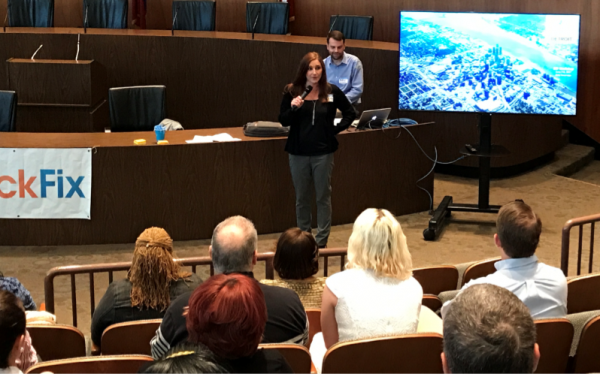
Even before the hurricane in Houston this year, the company's growth has continued, with the first city in Kentucky signing on recently, and communities in Georgia and Michigan also added.  A workshop, with municipal attendees from more than 80 communities, was held in Detroit.  Next, a SeeClickFix User Summit is scheduled for September 13 & 14 in New Haven.

Fast Company summed up “50 projects that are really making America great again” noting that “Change doesn’t have to happen from the top down” as the publication highlights “some of the most promising projects, initiatives, and companies that are springing up in every state of the union. Together, they present a portrait of the country today—its concerns and responses, and its enduring capacity for progress.”



State’s Money Woes Earn National Spotlight

The cover of the national magazine depicts a waterfront home in Mystic Seaport, under the headline that reads “The fiscal mess in America’s richest state.”  Connecticut, without an approved state budget for all of July and August and nearly half of September, is earning some notice.  And it is not particularly friendly. The article, in the September issue of Governing, begins with the question, “How could the nation’s wealthiest state become a fiscal basket case?”  The answer is complex, and the magazine devotes a full six pages to walking through how the state got into this mess, and how it might navigate its way out.

Along the way, the magazine suggest that the state “may be too rich for its own good,” pointing out that “long blessed with a disproportionate number of high-income residents, the state has entertained lavish spending habits for decades.” It also cites statistics that underscore the problems and challenges:

  • Over the past 20 years, job creation numbers have ranked in the bottom five among the 50 states
  • Connecticut has the nation’s second-highest rate of income inequality, after New York
  • The state has lost population for three years running
  • Last year, Greater Hartford ranked fourth and New Haven fifth in population loss among the nation’s 100 largest metro areas

The ineffective state spending cap, approved by voters more than 20 years ago but routinely circumvented since, is cited as a contributor to the fiscal cliff the state sits on, along with an overreliance on the income tax, political infighting, increased taxes, the lack of regionalism and a host of other decisions made by Governors and legislatures for decades.

One glaring example cited:  “Connecticut, which is home to 3.6 million people, has 111 police dispatch centers.  By comparison, Houston, which as 2.3 million residents, has just one emergency dispatch center, which handles fire as well as police.”

With a circulation of 85,000 in print and a widely viewed website, Governing is described as "the nation's leading media platform covering politics, policy and management for state and local government leaders." It is among the most widely read and most influential among government leaders - with an audience that also includes "journalists, academics, advocates and activists."

The article did point to some silver linings, past and present.  “Connecticut clearly has the means to change course. Not only is its median income still high, but the state boasts assets such as proximity to Boston and New York, amiable coastlines and river valleys, and notable institutions of higher education.  In addition to the continuing presence of a thriving financial sector, Connecticut is home to aerospace and defense contractors and other advanced manufacturers who can’t hire help fast enough, as well as a growing medical and life sciences sector.”

On the other hand, the publication points out, “Connecticut is 80 percent white, but its population of white children under the age of 10 is falling faster than in any other state.  Racial and ethnic minorities already make up more than 50 percent of infants and toddlers and are about to become a majority of 3- and 4-year olds.”  There is, the publication adds, “a pronounced achievement gap among racial groups and by geography.”

The conclusion reached by the Governing article?  “Connecticut is not in a death spiral but it has failed to position itself to react to changing demographics and location preferences… it’s clear that what’s worked so well for Connecticut in the past isn’t working now.”

Summed up House Speaker Joe Aresimowicz, one of many political leaders, including the Governor and legislators from both political parties, as well as city officials and economic analysts, who were interviewed for the article: “We are the land of steady habits and the world has changed around us.”

PERSPECTIVE - How to Attract and Retain a Young, Skilled and Energetic Workforce

by Kayleigh Lombardi and Christine Schilke Connecticut can be tough for young people, that’s for sure. A telling example of this was shared at a recent forum on the economic impact of exclusionary zoning when a representative from the manufacturing industry told the audience how he’d recruited a young, skilled professional from the south, offering him an alluring $25 an hour wage to keep pace with Connecticut’s cost of living — more than double the $11 an hour he was making back home. Yet, it wasn’t enough.

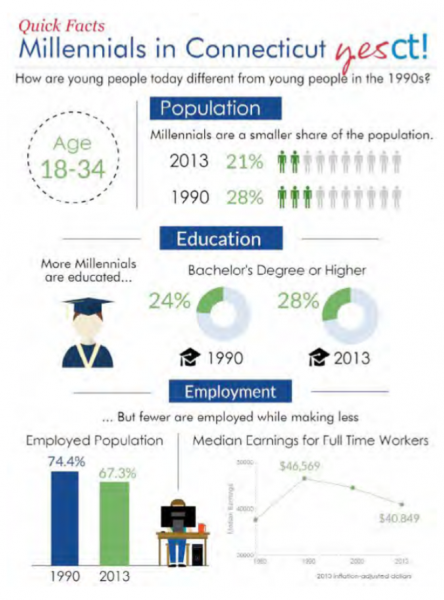
After about two years, the young man decided to head back south. His reasoning: that even making more than double his salary, his costs — like paying $1,000 monthly rent — were simply too high for him to be able to afford to stay in Connecticut. His decision that he could have a better quality of life somewhere else, even earning less, is a scene being played out by millennials all across the state. The high costs of housing, college debt, transportation, and a myriad of other factors, mean that today’s millennials face a far tougher environment than their 1990s peers.

The data is pretty stark: despite being more educated, today’s young people are less likely to be employed, earn less overall, and, not surprisingly, are more likely to live with their parents or roommates. What’s more, the cost of that higher education lingers, hampering their ability to get ahead. With an average college debt of $34,773, they can little afford Connecticut’s housing costs — the 3rd highest in the nation — meaning our state’s young workers are starting their professional lives in the red and with little to spare for other expenses like a car, healthcare costs, or retirement savings.

Connecticut’s inability to retain young people has become increasingly evident over the past several years, resulting in dour headlines as major companies pick up stakes and move to those locations that are attracting young talent. An interest in lively downtowns, a variety of housing options, walkable communities, access to transit, and availability of jobs and economic opportunity are topping their lists, according to numerous studies and reports.
Recognizing the need to attract and retain a young, skilled, and energetic workforce, the Partnership for Strong Communities and Connecticut Main Street Center are partnering on Young Energetic Solutions (YES). YES is a statewide initiative aimed at empowering young people to create a vibrant Connecticut — a Connecticut where young people want to live. Building on the value gained in partnering with like-minded programs and organizations, YES is continuously forging partnerships with a variety of groups, in order to act as a resource for young people to effectuate positive change.

By engaging and educating young people to participate in their towns, on their local committees, or on statewide initiatives, YES works to support change in communities, expand the state’s housing options, and ultimately strengthen the state’s economy. Empowering young people to participate meaningfully in their neighborhoods and towns can develop a strong sense of ownership and belonging.

Participation at a local and state level allows young adults to provide necessary input into important decisions surrounding affordability, zoning, density, and transportation, as well as proactively address housing needs across municipalities.

Bolstering the millennial generation with dynamic, connected communities is a good thing for older and younger generations alike, as amenities such as walkability, access to transit and a variety of housing options are beneficial to all of us. Dynamic communities and diversity in housing are also economically fruitful, as the younger generation replaces retiring workers, providing the revenue towns and cities need in order to offer critical services to residents. With a fresh supply of young people and families to create that demand and potentially move into larger single-family homes as they grow their families, new opportunities to downsize will be available to our older residents stuck in large homes they may no longer want or need.

While our state clearly faces daunting budget challenges, there is hope. There’s growing consensus around the need to attract and retain young people, an increasing demand for information about what can be done and what’s working elsewhere, and a willingness to be innovative in our response. YES is finding a niche as this resource, building a network of young people and organizations that recognize the need for more millennials to stay and come to Connecticut, with the goal of incorporating young people’s perspectives into planning and design. And while we don’t claim to have all the answers, having the support of our respective organizations behind us means that we have access to experts in the realms of affordable housing and downtown revitalization — two key components in attracting this valuable demographic.

Beyond our work, there is much positive progress in the state. Efforts to improve the connectivity and appeal of our communities are everywhere— from Windsor’s revised website that lists available local board and commission seats, to Hartford’s revamped zoning code, or from Simsbury’s new multifamily housing to New Haven’s miles of bike lanes, change is coming to Connecticut. YES aims to add to these efforts by spurring more civic engagement among young people, while offering new ideas, best practices, and ultimately policies around how to attract and retain millennials.

_____________________________________

Kayleigh Lombardi is a Policy Analyst at the Partnership for Strong Communities. The Partnership is a statewide nonprofit policy and advocacy organization dedicated to ending homelessness, expanding the creation of affordable housing, and building strong communities in Connecticut.

Christine Schilke is Communications Director for the Connecticut Main Street Center, whose mission is to be the catalyst that ignites Connecticut’s Main Streets as the cornerstone of thriving communities. CMSC is dedicated to community and economic development within the context of historic preservation, and firmly believes that when our downtowns are great, they’re great for everyone, attracting young talented workers, creative thinkers and entrepreneurs, and in turn powering Connecticut’s economy.

For more information on YES, visit www.yesct.org or email yes4ct@gmail.com.

This article first appeared in the Summer 2017 issue of Connecticut Planning, a publication of the Connecticut Chapter of the American Planning Association.