State Energy Policy Needs Further Revisions, Environmental Advocates Say

Connecticut Fund for the Environment has formally submitted its comments on the state’s draft 2017 Comprehensive Energy Strategy to the Connecticut Department of Energy and Environmental Protection. The plan is intended to shape the state’s energy policies and investments for the next three years. “The draft energy strategy includes some important recommendations that will reduce dependence on outdated fossil fuels, landfill gas, and biomass, but it still doesn’t map out how the proposed policies will put Connecticut on a path to achieve the greenhouse gas reduction targets of the Global Warming Solutions Act,” said Claire Coleman, climate and energy attorney at CFE.

The final CES should do the following to sustain Connecticut efforts to combat climate change, CFE urged:

  • Incorporate a quantitative analysis of how its policies will achieve the emissions reductions necessary to meet Connecticut’s 2020 commitment under the Global Warming Solutions Act;
  • Go forward, not backward, on renewable energy by proposing a more ambitious annual increase to the renewable portfolio standard, with the minimum goal of powering 45 percent of Connecticut’s needs from renewable sources by 2030;
  • Recommend a full-scale shared solar program to allow access to renewable energy for the 80 percent of Connecticut residents who can’t install solar panels on their own roofs, and remove the proposed cap on behind the meter solar;
  • Bring Connecticut’s energy efficiency investment in line with neighboring states;
  • Create incentive and marketing programs to encourage consumers to switch to efficient heat pumps; and
  • Rapidly get more electric vehicles on the road by strengthening the CHEAPR rebate program, expanding charging infrastructure, and establishing a regional cap-and-trade program for fuels to reduce emissions.

    “Meeting these goals isn’t optional—it’s required under state law that’s been on the books now for almost a decade,” Coleman stressed. “State agencies and lawmakers need to get serious about rapidly ramping up renewables and energy efficiency, cutting emissions from cars and trucks, and clearly identifying how state policies will work together to meet the 2020 and 2050 targets. That’s what we’ll be looking for in the final plan.”

The Connecticut Electric Vehicle Coalition, of which CFE is a founding member, submitted its own comments last week. The coalition emphasized the urgency of more specific plans to get EVs on the road and meet the state’s commitments under the Zero Emissions Vehicle Memo of Understanding to get have 150,000 EVs on Connecticut roads by 2025.

CFE, Consumers for Sensible Energy, RENEW Northeast, and Sierra Club also released an analysis by Synapse Energy Economics  which concluded that a 2.5 annual increase in Connecticut’s renewable energy growth would yield significant public health, economic, and climate benefits. Increasing the Connecticut RPS to 2.5% per year, the report indicated, would add an estimated 7,100 additional jobs to New England between 2021 and 2030, or about 710 jobs per year.

The Sierra Club noted that “even the administration's own analysis shows the draft energy strategy is not sufficient to protect the climate, and that more clean energy would create jobs, grow the economy, and improve public health.”
Bradley Ranks Last in Passengers’ Satisfaction Rating of 21 Mid-Sized U.S. Airports

Air travelers ranked Connecticut’s Bradley International Airport last among 21 medium-sized airports in a passenger satisfaction survey.  The airport fell from a second-to-last ranking in a similar analysis done at the end of last year, to the bottom rung of the latest ratings. Sacramento International Airport ranks highest among medium airports, with a score of 810. Indianapolis International Airport (807) ranks second, and Ted Stevens Anchorage International Airport (806) ranks third, in the survey by J.D. Power.

Bradley’s score of 742 was an improvement from 724 last year, but did not prevent the drop to the bottom of the category.  Just ahead of Bradley were Cleveland Hopkins International Airport (754) Kahului Airport (758), and San Antonio International Airport (761).  In last year’s survey, Bradley was tied for second-to-last with Kahului; Cleveland finished last.  Both passed Bradley in the latest rankings.  The medium airport average score was 781 in the survey released this month.

Connecticut Airport Authority Executive Director Kevin Dillon told the Hartford Business Journal, "We're pleased that our score has increased from last year and that our score is the highest among competing airports in the region."  He added that “we know that there are areas that need to be addressed, such as enhancing our concessions and terminal facilities. We have already introduced a number of new concessions over the last year and have made major updates to our terminal, and we have an ambitious plan for further upgrades over the coming months and years."

Nationally, overall traveler satisfaction scored a 749 out of 1,000 points, an 18-point increase from last year’s survey.  Among the nation’s largest airports, Orlando International Airport received a score of 778 out of 1,000, beating out the runner up, Detroit Metropolitan Wayne County Airport, which received a 767 score.

Newark Liberty International Airport in New Jersey received the lowest ranking among “Mega” airports, earning a score of 686. LaGuardia Airport, in New York City, ranked worst among “Large” airports, with a score of 654.

The survey ranked airports across the U.S. based on several key factors: accessibility, check-in and baggage check process, security screening, shopping, terminal facilities and baggage claim.

Airports were broken down into three categories based on size. “Mega” airports were defined as those handling more than 32.5 million annual passengers. The “large” category included airports with 10 million to 32.4 million passengers and “medium” airports, including Bradley, are those with between 3 million and 9.9 million passengers.

The J.D. Power analysis indicated that “with nearly every airport in the country dealing with challenges of high passenger capacity and ongoing construction projects to address increased demand, technology is helping to directly address these issues.”

“The trifecta of a steadily improving economy, record passenger volume and billion-dollar renovation projects unfolding in airports across the country has created a challenging environment for customer satisfaction,” added Michael Taylor, Travel Practice Lead at J.D. Power.

Now in its 12th year, the study is based on responses from 34,695 North American travelers who traveled through at least one domestic airport with both departure and arrival experiences (including connecting airports) during the past three months. Travelers evaluated either a departing or arriving airport from their round-trip experience. The study was conducted from January through August 2017.

New Haven Chamber Recognizes Business Success Stories, Starting with "Juice"

The annual Greater New Haven Chamber of Commerce awards luncheon on Thursday, September 28  will celebrate the diverse accomplishments of members of the region’s business community – including an entrepreneurial business with the “juice” to grow from a home-based start-up in Wallingford to employ more than 120 people in New Haven in less than a decade. The company - FreshBev LLC - produces two primary lines of beverages - RIPE Craft Juice and RIPE Craft Bar Juices, bringing real fresh juice to the market, and connecting local farmers to consumers by using only ingredients that could be traced back to the grower and region.
“We don’t heat our juice, we don’t pasteurize it. It’s cold-pressed,” founder Michel Boissy told NewsChannel 8 earlier this year. “We use an amazing new technology called high-pressure processing, which does everything that pasteurization does minus the heat. So we’re not heating the juice, we’re not killing the color, flavor, aroma, nutritional profile and all of what fresh juice is.”

The company’s website explains that “In the fall of 2008, tired of being subjected to the big ol’ bottle of day glow “margarita” mix, childhood friends and founders Michel Boissy and Ryan Guimond came to the conclusion that they had no choice but to create the first line of legit, handcrafted bar juices. With Mike's experience in high end kitchens and behind the bar, coupled with Ryan’s picky palate and a shared love of a good cocktail, these drink mix mercenaries set forth to create the nation's first pure squeezed, cold pressed, Bar Juice™.

The results are making local history, and spreading.  RIPE Craft Juices are available nationally through Whole Foods and select regional grocery chains.

The Chamber’s business leadership event is highlighted by the presentation of the Community Leadership Award to an individual who has made an outstanding contribution to the Greater New Haven Community.   That award will go to longtime Quinnipiac University President John Lahey, who has announced his retirement.  The other awards to be presented by the Greater New Haven Chamber of Commerce include:

Small Business Achievement Award  Four Flours Baking Company

Legislative Leadership Award   First Selectman Mike Freda, Town of North Haven

Achievement in Manufacturing Award  Cowles & Company

Leadership in Healthcare Award  Cornell Scott-Hill Center

Community Partnership Award  Easter Seals Goodwill Industries

Developer Investment Award  Randy Salvatore, RMS Companies

Alumnus of the Leadership Center Award  Paul Bartosic, Harvard Pilgrim Health Care

Volunteer of the Year Award  Mary Grande, New Reach

The awards will be presented on September 28 at the Omni Hotel in New Haven.


https://youtu.be/X56KIS8TEd0

Neighboring States Bring in Millions in Toll Revenue; CT Remains Toll Free

The Connecticut House of Representatives debated for nearly six hours the issue of reinstating tolls on Connecticut highways, but did not vote.  Connecticut remains a toll-free state, for residents and those driving through the state. How much money might the state receive in toll revenue if tolls were imposed?  The Office of Legislative Research, responding to a legislative inquiry, has surveyed neighboring states and issued a report this past week.

Toll revenue ranged from $20.4 million in FY 16 (Rhode Island) to $1.57 billion in calendar year 2016 (New Jersey), according to the legislature’s research office. In Massachusetts in FY2016, toll revenue was $395 million; in Maine $133.8 million in calendar year 2016; in New Hampshire a total of $130.7 million. 

The New York Thruway Authority and New Jersey Turnpike Authority each collect tolls on their respective highways, the Office of Legislative Research (OLR) report noted. In addition, the Port Authority of New York and New Jersey collects tolls on its bridges and tunnels connecting those two states (the George Washington, Goethals, and Bayonne bridges, the Outerbridge Crossing, and the Lincoln and Holland tunnels). In calendar year 2016, the Port Authority collected $1.86 billion in toll revenue.

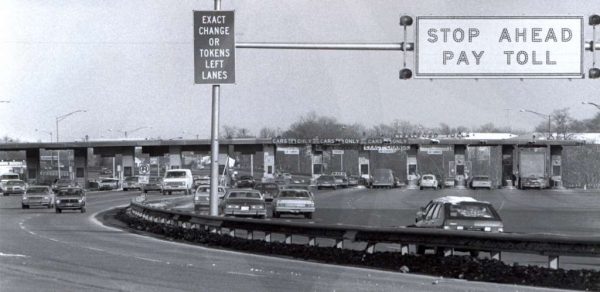
Tolls were eliminated by lawmakers more than three decades ago in 1983, following a horrific accident at the then-Stratford toll booths, in which six people were killed. The last Connecticut highway toll was paid at the Charter Oak Bridge in Hartford on April 28, 1989.

In their final year of operation in the mid-‘80’s, Connecticut Turnpike tolls brought the state $56.4 million, the Merritt and Wilbur Cross Parkways 11.3 million, and the three bridges in the Hartford area, $4.7 million, according to a previous OLR report issued in 2009.

Technology, however, has made traditional toll booths obsolete, and Massachusetts recently removed its toll booths, switching to an overhead electronic system – thus maintaining the revenue without extending the dangers and the highway back-ups inherent with the toll plazas.  Connecticut residents driving through Massachusetts on the MassPike have noticed the striking difference.

Despite projections of budget deficits in coming years, the legislature did not vote on imposing tolls as a means of raising revenue this year.    It was estimated that 30 percent of the tolls would be paid by out-of-state drivers and 70 percent by Connecticut residents.  Federal rules require that toll revenue from interstate highways must be used for maintenance or improvements on those highways.  The legislature’s Transportation Committee had voted 19-16 in favor of the tolls bill, which led to the House debate on the proposal.  It was pulled before a vote could be held.

The 2009 OLR Report also noted that according to annual data compiled by the Federal Highway Administration, in 2007 almost 32.5 percent of all the vehicle miles traveled (VMT) in Connecticut occurred on its Interstate highways. Nationally, only 24.4% percent of all VMT occurs on Interstate System. Connecticut's Interstate VMT percentage is higher than many other states, including, at the time, Massachusetts, New York, New Jersey, and Pennsylvania.

The most recent OLR Report did not estimate what Connecticut might earn in toll revenue; it merely reported on the most recent earnings of neighboring states that impose tolls on their major roadways.

PERSPECTIVE: State Cuts will Mean Ballooning Costs; People with Traumatic Brain Injury Left Without Services

by Julie Peters Numbers matter. Traumatic brain injury (TBI) is a major cause of death and disability in the United States.  TBIs contribute to about 30 percent of all injury deaths. TBI was the diagnosis in more than 2.5 million ED visits. (www.cdc.gov). There were over 36,000 TBI ER visits in CT alone in 2014 (CT Dept. of Public Health).  Every 21 seconds in the US, a person sustains a brain injury.  5.3 million Americans currently have a long-term need for assistance to perform activities of daily living as a result of TBI.

The Brain Injury Alliance of Connecticut (BIAC) has been Connecticut’s resource for those with brain injuries and their families for over 35 years, and is the only organization that offers support to survivors and their caregivers while providing prevention education completely free of charge. BIAC’s brain injury specialists field thousands of calls each year, requesting our help.  Our 20 support groups provide peer support. We provide education and training to professionals who serve individuals with brain injury, assuring that they have the most up-to-date information possible.

Because Connecticut has no department of brain injury, and no mechanism to assist its residents with information regarding brain injury, they have contracted with BIAC for over 30 years to provide helpline, support, and community education on behalf of the Department of Social Services. Calls to 211 are referred to BIAC.

So when the State is considering a budget that would entirely eliminate BIAC’s funding, and a loss of up to 40 percent of our entire budget, the results could be catastrophic for those who need our help.

People like Linda, a 63 year old woman who contacted BIAC, is one such example.  Linda’s electricity was scheduled to be turned off, and her medical benefits, food stamps and cash assistance had all been discontinued as she had not remembered to fill out the redetermination paperwork.  She was out of her prescribed medication and was unable to see a doctor.  She had no medical insurance nor any medical transportation.  Additionally, Linda does not drive and has minimal family support.

All of the reported issues posed a significant health/safety risk for Linda within the community. Linda was not able to successfully complete the steps and activities necessary for her to pay bills or respond to mail which led to repeated discontinuation of benefits putting her housing and healthcare at risk. HelpLine staff were able to provide her with assistance in response to all of her concerns.  Calls and emails were made on Linda’s behalf to facilitate her obtaining services.  Together we were able to prevent the electricity from being turned off, an application was made for fuel assistance, medical insurance, food stamps, cash assistance were all reactivated.

Michael, a veteran injured during his second tour in the United States Army, contacted BIAC via his Veteran’s Affairs office. He was struggling with significant health issues, as well as cognitive challenges, behavioral and marital problems – decades after his initial injury from a fall. Navigating daily life became increasingly more challenging for him.  His BIAC brain injury specialist connected him to community based resources, including a physician who has successfully assisted him with medication. Michael remains independent and has also learned how to proactively advocate for his needs to be met in and outside of the VA system.  He credits his progress and significantly increased quality of life to his relationship with BIAC.

State funding for BIAC is an investment that pays off substantially, ensuring that those in need have access to lives of wellness, dignity and fulfillment.  In the short time it took you to read this article, at least 5 people in the U.S. sustained a brain injury. This could be your neighbor, your co-worker, your family member, or you.

Think about it – every number equates to a person, and every person has a name and a face – and a story to tell. Should funding for BIAC be severely reduced or eliminated, the State will experience ballooning costs as those who contact BIAC have nowhere to go for help.  They will end up in hospitals, long-term nursing facilities, or on the street.  And those numbers will matter to all of us.

____________________________

Julie Peters, CBIS, is Executive Director of the Brain Injury Alliance of Connecticut, which provides critical resources and support to brain injury survivors, their families and caregivers while educating individuals throughout Connecticut about brain injury awareness and prevention.

Focus on UConn Funding Includes View of Money Paid to Football Coaches

The UConn football season is underway, and UConn is in the news in a big way.  It is, however,  about not only prospects on the gridiron as prospects on the bottom line for the state’s flagship university.  Officials describe the university as being under unfair and counterproductive attack by a budget recently adopted by the state legislature that would require substantial reductions in state funding.  The budget is expected to be vetoed by the Governor, continuing the legislative stalemate that has prevented agreement on a state budget for the fiscal year that began on July 1. Also within the past week, UConn was among a handful universities portrayed as the poster children for the practice of paying multiple head football coaches simultaneously.  UConn’s situation was listed as among the most costly.

The report, by The New York Times, indicated that “when the Huskies hired Randy Edsall last winter after three losing seasons under Bob Diaco, they got their once and future head coast for a reasonable $1 million salary.”  The article went on to point out, however, that “firing Diaco triggered a $3.4 million buyout.”  Thus, the University is paying $4.4 million in head coach salary this season, to two coaches – one employed by the university, the other not.

It could have been more costly.

“Even though the move was announced in December,” it was effective in January; “an effective end date in 2016 would have cost the Huskies $5 million.  The newspaper notes that “if it had not given Diaco a richer buyout as part of a two-year (contract) extension he negotiated only seven months before he was fired,” the buyout would have been significantly smaller – only $800,000.”

Leading the list of colleges cited in the Times article was Texas, “on the hook for the salaries of current and former coaches” this season to the tune of $12.45 million.  Next was Oregon, at $8.5 million; and Florida at $6.4 million.

Some doubted that Diaco would be fired, because of the continuing cost to the university of doing so.  The website theuconnblog.com said when the firing was announced in late December that “The primary driver behind Diaco’s assumed job security was a substantial buyout owed to him had he been fired right after the season. With UConn’s strapped financial situation, it could ill-afford to be paying Diaco millions to not coach the team.”

Diaco, in January, became the highest paid assistant coach in Nebraska history when he was hired by that university to be the team’s defensive coordinator for $825,000 this year and $875,000 next year.

At the time of Diaco’s firing, UConn emphasized that taxpayers would not be responsible for the buyout.

"It's not taxpayer money," Michael Enright, who oversees communications for UConn athletics told the Hartford Courant at the time. "It's from division of athletics revenues. So ticketing, concessions, licensing, conference revenue."

The Courant went on to report that “sports-related income isn't the only source of revenue feeding the department's $72 million budget. For the 2014-15 school year, student fees provided more than $10 million and the university contributed $18 million, according to a survey by USA Today. The school has taken pains to say the university's share comes from segregated accounts that do not include tuition or state funds. But critics see the university's and athletics department's budgets as homogenous taxpayer-supported piles of money.”

The state provides approximately 28 percent of the revenue funding UConn's overall $1.3 billion budget, the Courant noted, adding that Diaco's salary was $1.7 million last year, making him the third-highest-paid state employee, trailing only the UConn head basketball coaches.

In mid-2016, Diaco and his wife have announced "they will contribute $250,000 to the University to help fund the construction of several new UConn athletic facilities,” according to the UConn website. The Diaco gift, it was announced, would be used to help build new facilities for the UConn men’s and women’s soccer, baseball, and softball teams.

Personal Finance, Economic Education Curriculum Not Required in State's Schools

Connecticut has a curriculum for financial literacy for schools in the state.  But they’re not required to use it.  That’s true for economic education and personal finance education.  Despite having a 9-page state approved set of curriculum guidelines and expectations for student learning detailed on the website of the State Department of Education, there appears to be no indication as to where or whether courses are actually offered, taken and taught. Economic Education is included in the state’s K-12 standards in Connecticut, as it is in every state in the nation.  But Connecticut is one of only six states where the standards are not required to be implemented by districts, one of 27 states where a high school course is not required to be offered, one of 30 states where a high school course is not required to be taken, and one of 34 where standardized testing in the subject is not provided.

The numbers are similar for personal finance education.  Connecticut is one of 13 states that does not require standards to be implemented by local school districts, one of 28 states that does not require a high school course to be offered, and one of 28 that do not require a high school course in personal finance education to be taken. Connecticut, like most states (43) does not have standardized testing in personal finance.

That’s according to the Council for Economic Education’s “Survey of the States 2016,” a report on “Economic and Personal Finance Education in Our Nation’s Schools.”  Among the national findings:

  • While more states are implementing standards in personal finance, the number of states that require high school students to take a course in personal finance remains unchanged since 2014 – just 17 states.
  • Only 20 states require high school students to take a course in economics – that’s less than half the country and two fewer states than in 2014.
  • There has been no change in the number of states that require standardized testing of economic concepts – the number remains at 16.

Connecticut’s seven “content standards” in personal finance focus on personal decision making, earning and reporting income, managing finances and budgeting, savings and investing, buying goods and services, banking and financial institutions, and maintaining credit worthiness, borrowing at favorable terms and managing debt.  The “frameworks” outline skills that students are expected to master, and “learner expectations” at various levels, from beginning to advanced.

“Some states offer little guidance to school districts related to what personal finance content to offer in schools at each grade level; others have pushed ahead, requiring courses from elementary to high school aged students, supporting and training teachers, and in some cases even testing students on learning outcomes,” said J. Michael Collins, of the Center for Financial Security at the University of Wisconsin-Madison in the report.

“Rigorous state standards can facilitate local schools to implement well-designed programs, which in turn expose students to concepts they otherwise would not learn. Communities may also benefit from having more financially competent households; perhaps stronger economics and personal finance standards could even be viewed ultimately as an economic development strategy, equipping young people with an increased ability to manage credit and invest in their future,” Collins added.

Statistics were not available in Connecticut on the number of school districts requiring financial literacy coursework, or the number of students who take such classes.

"States that combine personal finance and economics, support teachers, and hold students accountable for learning objectives have the best chance of promoting the development of young people who are better financial managers and stewards of their credit—behaviors with which many, if not most, young people tend to struggle," Collins pointed out.

The Council for Economic Education (CEE) is a leading nonprofit organization in the United States that focuses on the economic and education of students from kindergarten through high school.  The 65 year-old organization is based in New York City.


Constitution Day in the Constitution State - Celebrate?

Constitution Day, celebrated this year on Sunday, is a national holiday to commemorate the signing of the U.S. Constitution on Sept. 17, 1787.  Connecticut is known as the Constitution State, but that designation has its roots more than a century earlier. Congress first established “Constitution Week” in 1956. It became a national holiday 44 years later when  Sen. Robert Byrd (D-W.V.) introduced an amendment to the omnibus spending bill that made the observance a national holiday, and to require that all schools receiving federal funding, as well as all federal agencies, to provide relevant programming to celebrate the Constitution.

Written in 1787, ratified in 1788, and in operation since 1789, the United States Constitution is the world's longest surviving written charter of government, according to the U.S. Senate website.   Its first three words –– "We the People" –– affirm that the government of the United States exists to serve its citizens.

The National Constitution Center (NCC) devotes space on its website to the question of whether the "constitution" celebrated by Connecticut really a constitution?

The site explains that although the Connecticut Compromise at the 1787 convention in Philadelphia was a critical part of the process of agreeing to and ratifying the U.S. Constitution, Connecticut celebrates – and its nickname is derived - from an event that happened in 1639.

On January 14, 1639 (in the old Julian calendar), the residents of three Connecticut towns - Wethersfield and Hartford - approved a list of rules for running local government called the Fundamental Orders. Most historians agree the Fundamental Orders are significant, but the state of Connecticut decided in 1959 to call itself the Constitution State based on the premise that the Fundamental Orders were the first constitution in North America.

The Fundamental Orders document has a structure that is similar to a constitution, the NCC explains. There is a preamble and a list of powers about local government, taxation and voting rights.

Prior to the legislature determining in 1959 that Connecticut would be known by the official nickname of the Constitution State, it was known as the Nutmeg State.  Before that, in the post-Revolutionary War era, Connecticut was known as the Provisions State.

Officially, the state is not known as the Land of Steady Habits, but that too is commonly used. A Dictionary of Americanisms on Historical Principles, published in1951, defines “Land of Steady Habits” as “1. Connecticut, applied in allusion to the strict morals of its inhabitants.”


PERSPECTIVE: How Connecticut Businesses Are Doing More For People With Autism

by Lucy Wyndham Even as the number of children with special needs increases in Connecticut schools, businesses are creating sensory-friendly environments to accommodate the growing population of children and adults with Autism Spectrum Disorder (ASD). In fact, while there are examples in Europe, the UK, and Australia of retail centers working to accommodate their ASD customers better, small businesses in Connecticut might just be leading the way in the United States.

What Do Sensory Issues Have to Do With Autism?

Autism is a mental condition present from early childhood. Children and adults with autism are characterized by difficulty in forming relationships with other people due to difficulty in grasping social skills, and difficulties in using language and abstract concepts.

Sensory issues are especially prevalent for ASD individuals, as they likely have issues processing information take in through the senses. Where a fluorescent light in a store might not even be noticed by a typical person, a person with autism might find the light physically painful, and might respond in ways that seem aggressive or violent.

Can Autism Help Us?

Growing research indicates that neurodiversity, i.e. the idea that neurological differences like autism are the result of normal variations in the human genome, might actually be a competitive advantage. However, even as the number of children with autism increases, people on the spectrum are largely considered unemployable.

Companies like EY, which created a pilot program to bring new hires with Asperger’s, and airports across the globe that are creating quiet rooms in for children with sensory issues, are at the tip of the spear of a new movement to capture ASD customers and increase ASD hires. Connecticut firms are not far behind.

Sensory Friendly Accommodations

The Connecticut Science Center in Hartford provides over 150 hands-on exhibits for young people, as well as a state-of-the-art 3D digital theater and four education labs. However, for young people struggling with sensory overload, the bustling sounds and bright lights make it nearly impossible to navigate for families with autistic children.

The Science Center has created special Sensory Friendly Hours in the past, and now has a Sensory Friendly Day planned. Visitors with special needs can enjoy a special sensory-friendly theater presentation, lowered PA volume, and dimmed lights for the hours of the event. What’s especially attractive to families about events like these is the lack of stigma.  Families know they’ll be entering an environment that understands and cares, and is truly a judgment-free zone.

Even theaters are beginning to provide sensory-friendly film experiences for families. Last summer, select AMC theaters hosted special film viewings with the lights up, the sound turned down, and an open invitation for audience members to move around, be active, and make noise. The program was jump started with a parent request, and over 300 children and parents attended the first screening.

It’s a Great Start

Making conducive physical accommodations available for those with autism is helpful and popular with children on the spectrum, but businesses don’t have to stop there. One of the most valuable things a company can do is educate staff and employees on autism, enabling staff to be resources in a supportive environment for children and adults. 

Also, businesses can:

  • Change how they hire (moving away from interview-based hiring practices to low key, informal tasks and projects)
  • Offer more online experiences so ASD individuals don’t have to go into the store
  • Dim the lights, and make more use of natural light
  • Create quiet rooms or break away spaces
  • Provide noise canceling headphones and fidget spinners
  • Lower the noise

Autism impacts over 1% of the worldwide population, but with nearly 1 in 3 young adults on the spectrum disconnected from work and school, businesses must do more to accommodate for the neurological differences autism causes. Special hours and program just for customers with sensory processing issues are a great start, but most Connecticut firms continue to strive to do more to hire ASD staff and to accommodate ASD customers.

_____________________________

Lucy Wyndham is married to a guy on the autism spectrum. It's a wonderful and interesting ride, which has opened up her eyes to a new way of seeing the world. She is also a writer, content manager, and a mother to two wonderful daughters.

“Museum Day Live” Event to Include 18 Connecticut Museums

Eighteen Connecticut museums in twelve communities will be participating in Museum Day Live! On September 23, offering free admission in a national initiative led by Smithsonian magazine and supported by Microsoft, to increase awareness of the assets that museums have to offer residents throughout the country. Museum Day Live! is described as “an annual celebration of boundless curiosity.” Participating museums and cultural institutions across the country provide entry to anyone presenting a Museum Day Live! ticket. Individuals can get tickets on-line to any of the participating museums, simply by indicating the museum they intend to visit.  A ticket specific to that museum is then downloaded, and recipients can either print the ticket or show it on their smart phones in many of the museums.

To get free admission, guests must present an official Museum Day Live! Ticket, which provides general admission for the ticketholder plus one guest.  It is not valid for special exhibits, parking, IMAX film screening or any other offer.

Across the country, there are nearly 1200 participating museums, including 457 museums in the Northeast, 188 across the South, 402 in the Mid-West and 136 in the Western U.S.

Participating museums in Connecticut include:

BRISTOL

DANBURY

Danbury Museum and Historical Society Authority

FAIRFIELD

Fairfield University Art Museum 

GREENWICH

Bruce Museum

HARTFORD

MASHANTUCKET

Mashantucket Pequot Museum & Research Center 

NEW HAVEN

NEW LONDONCustom House Maritime Museum

RIDGEFIELD

The Aldrich Contemporary Art Museum

TOLLAND

WEST HARTFORD

Art Museum, University of Saint Joseph 

WOODBURY

Glebe House Museum & Gertrude Jekyll Garden