WalMart Dominates National Map, But Not in Connecticut

Connecticut’s largest employers – after the state itself – are Yale New Haven Health Systems, Hartford Healthcare, Yale University and United Technologies Corp, General Dynamics Electric Boat, and the University of Connecticut, according to a list published last year by the Hartford Business Journal.  Wal-Mart Stores ranks eighth in the state, followed by Sikorsky (Lockheed Martin) and Travelers and The Hartford Financial Services Group. Connecticut is one of a dozen states where the dominant employer is the healthcare.  The others include Rhode Island, Massachusetts, Vermont, Alaska, Delaware, Minnesota, North Dakota, South Dakota, Oregon, Idaho, and Utah, according to data published by Visual Capitalist.

In nearly as many – 11 states – higher education institutions are the largest employer, including New York, Michigan, Wisconsin, Iowa, Nebraska, New Mexico, California, Maryland, Pennsylvania, and North Carolina.

Maine’s largest employer is Hannaford Supermarkets.  In New Jersey it is Wakefern Food Corporation, the largest supermarket cooperative in the United States, including ShopRite and PriceRite stores in Connecticut.

In an era where Amazon steals most of the headlines, it’s easy to forget about brick-and-mortar retailers - especially Walmart, which remains dominant across much of the nation's retail landscape.  The company is the biggest private employer in America in a whopping 22 states -  and employs 1.5 million people nationwide.

In New England, Wal-Mart is the largest employer in New Hampshire, with more than 8,000 employees.

In Walmart’s home state of Arkansas, the company employees 53,310 people, or about 4% of the non-farm work force. That includes about 18,600 jobs at the HQ in Bentonville, AR.

Despite the company’s obvious influence in the state where it was founded, Walmart is also the largest employer across the South in general. Whether it is Texas (171,531 employees) or Virginia (44,621), there are Walmarts aplenty in the states surrounding Arkansas.


Michelle Obama Influences Children's Trick-or-Treat Choices, Yale Study Says

The conclusion is striking:  Michelle Obama’s initiative to reduce childhood obesity has influenced children’s dietary preferences. Researchers estimated that viewing a photograph of Michelle Obama’s face caused children to be 19 percent more likely to choose fruit over candy, on Halloween.  The experiment – Yale University researchers - was conducted on a New Haven porch over three consecutive Halloweens, and the results are published this month in a journal of the Public Library of Science (PLOS). The participants were 1,223 trick-or-treaters in New Haven over three years; on average, 8.5 years old and 53 percent male (among children whose gender was identifiable). To be eligible for inclusion in the study, trick-or-treaters had to be over the age of three.

The porch of a home had photographs clearly visible in front of the trick-or-treating children.  One was of Michelle Obama.  The other side, the “comparison” side in the study, “had a photo of Ann Romney (2012), a photo of Hillary Clinton (2014, 2015), or no photo (2014, 2015).”

At both sides of the porch, children were asked their age and whether they would prefer to receive fruit (a box of raisins) or candy (a more typical small packaged piece of name-brand chocolate such as Snickers or Milky Ways). Each child was given the option (fruit or candy) that they requested.

“The experimental set-up allows us to measure what proportion of children chose fruit instead of candy when in the presence of an image of Michelle Obama’s face, as well as the proportion of children who chose fruit instead of candy when not in the presence of an

image of Michelle Obama’s face,” the researchers pointed out.

Publishing the research are Peter M. Aronow, Dean Karlan, Lauren E. Pinson.  Peter Aronow is Assistant Professor of Political Science and in the Institute for Social and Policy Studies and of Public Health at Yale University; Dean Karlan is a Professor of Economics at Yale; Lauren Pinson is a Ph.D. candidate in Political Science at Yale University.

The experiment was conducted in the East Rock neighborhood of New Haven, which is about one mile from the Yale University campus, and contains many single family homes owned by Yale faculty, as well as some multi-family homes in which many graduate students live, the study explained. “There are also low income neighborhoods within a mile of this neighborhood,” and “due to the high level of activity during Halloween, many families drive from further away in order to trick-or-treat in this neighborhood.”

The study provides background, explaining that “During her tenure as First Lady of the United States, Michelle Obama has spearheaded one of the largest public health initiatives focused on childhood obesity. In 2010, Obama unveiled her Let’s Move Initiative, aimed at fostering a healthy lifestyle and reducing childhood obesity. As the public face of the campaign, Obama urged healthy eating and exercise in a variety of classic and social media venues accessible to minors and their parents, including appearances on Sesame Street and Oprah and posts of online videos.”

In regards to the results, the researchers caution that “we ran the experiment on a day where candy is readily available, the influence on children’s dietary preference for fruit instead of candy may differ from other days of the year; for instance, perhaps children are more willing to choose fruit since it is unique for the holiday, or children are less willing to choose fruit because they are under the influence of sugar consumption.”

PLOS was founded in 2001 as a nonprofit Open Access publisher, innovator and advocacy organization with a mission to accelerate progress in science and medicine by leading a transformation in research communication.

Harp Stands Out as Number of Big-City Black Mayors Diminishes Nationally

Last April, New Haven Mayor Toni Harp was sworn in as the first woman selected as president of the African American Mayors Association (AAMA).  In November, she was elected to a third two-year term leading the Elm City, earning more than 70 percent of the vote. In doing so, she ran counter to an apparent national trend – fewer African American Mayors in the nation’s largest cities.  According to an analysis by Governing magazine, in 2000, 19 of the largest cities in the country by population either had, or would soon have, black mayors.  By 2017, that number had fallen to six. Today, the Wall Street Journal recently reported, that number is four.

African Americans, and African American women, continue to be elected to City Hall.  Charlotte and New Orleans both elected their first black women mayors in November.  St. Paul and a number of smaller cities elected their first black mayors ever, the publication reported.

Among Connecticut’s largest cities, the mayors of Bridgeport, Hartford, Stamford, Waterbury, and Danbury are white males.  Hartford, which elected Thirman Milner and Carrie Saxon-Perry decades ago, hasn’t elected an African American since, but has seen two Latino men hold the office.

Carrie Saxon Perry was the first black woman to be elected mayor of a major New England city – in 1987. Milner was the first black mayor in all of New England, elected in Hartford in 1981. There hasn’t been a black mayor leading the Capitol City since Saxon-Perry’s term ended in 1993.

Were the current office-holder, Luke Bronin, to resign the office (a scenario that could result if he decides to run for Governor and if he is elected later this year) the newly elected City Council President, Glendowlyn Thames, could change that, if she succeeds to the office.

New Haven’s first black Mayor was John Daniels, who served from 1990 to 1993.  Like Harp, he previously served in the State Senate.

Across the country, Jacksonville, Memphis, Philadelphia and San Antonia had black mayors until recently, Governing reported.  Detroit elected its first white mayor in 40 years in 2013. The nation’s largest cities – New York, Los Angeles and Chicago – have each has one black mayor, years ago. Atlanta elected a black female as mayor in a run-off election, winning with just over 50 percent of the vote.

Harp is the only member of the AAMA from Connecticut.  The organization was formed in 2014.  Fifty years ago, the election of Carl Stokes in Cleveland in 1967 put him on the cover of TIME magazine as the first black elected mayor of a major U.S. city. Richard Hatcher, also African American, was elected mayor of Gary, Indiana that same year.


Norwalk, New Haven Among Communities Receiving Free Home Smoke Alarms

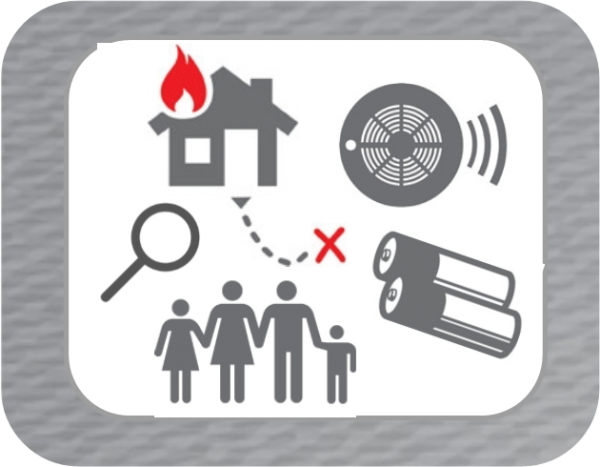
With the Connecticut Home Fire Campaign, the American Red Cross is working to reduce death and injury from home fires by 25% by 2020.  “Sound the Alarm. Save A Life.”, a series of home fire safety and smoke alarm installation events in Connecticut and nationwide, is deploying volunteers will install 100,000 free smoke alarms in high risk neighborhoods. In Connecticut, the initiative has been to 76 cities and towns, replacing nearly 1,000 smoke alarm batteries and installing more than 12,000 smoke alarms.  The program has conducted more than 700 in-home visits, making an estimated 4,400 households safer, according to officials.

Norwalk was the center of activity last month, and New Haven is next in line. 

Teams make visits to homes sharing fire safety and preparedness information and install smoke alarms in homes as requested. Volunteers help families understand the importance of fire safety and help them develop personalized family escape plans to use in the event a fire breaks out in their home.

The program was in Norwalk in December in conjunction with the City of Norwalk, and will be in New Haven in the spring.  A large-scale event is scheduled for New Haven to install 1,000 smoke alarms in and around the city on April 28, 2018.

“Our mission at the American Red Cross is to prevent and alleviate human suffering caused by disasters,” said Mario Bruno, CEO, American Red Cross Connecticut and Rhode Island Region. “Home fires are the biggest disaster threat faced in the U.S. On average, in our region, we respond to about two home fires each day. Our goal is to reach as many homes as we can with this program to help ensure people know what to do and are prepared in the event they experience a home fire. We want people to be safe.”

Nationally, the Red Cross just installed its one millionth smoke alarm last fall.  Since October of 2014, the Red Cross has worked with fire departments and community groups across the country as part of a multi-year campaign to reduce the number of home fire deaths and injuries.

Officials indicate that 60 percent of house fire deaths occur in homes with no working smoke alarms. The campaign initiative is in direct response to that “dire threat,” with the Red Cross committing to install 2.5 million free smoke alarms in neighborhoods at high risk for fires, and to educate those residents about fire prevention and preparedness.

Officials estimate that as of November 2017 the Red Cross and partners have saved more than 285 lives nationwide as part of the campaign.  In Connecticut, individuals can make an appointment by visiting http://www.redcross.org/local/connecticut/home-fire-safety-visit or by calling 877-287-3327 and choosing option 1 on the menu to request a smoke alarm installation.

PERSPECTIVE: Racism 101

by Debby Irving “Data is like a Rorschach test.” Brandeis University’s Tom Shapiro said this to me when I confessed to him how I would have once interpreted the below data.

  • US Racial Wealth Gap: Average Household Wealth
  • White              $ 656,000
  • Latino              $   98,000
  • Black               $   85,000     (2013 Institute for Policy Studies)

Only ten years ago, I would have seen the above as evidence that white people were smarter, harder working, and more financially responsible. Because I thought racism meant white people not liking people of color, I remained clueless about the vast racialized systems and structures that shape the lives of all Americans, including mine. The process of “Waking Up White” has been an education in how an entire population, myself included, can be duped into ideas about human superiority and inferiority along racial lines.

Data is fascinating in that, without drilling into the story behind the data, it can serve to reaffirm ideas we already hold. Which is what happened to me.

  • US Incarceration Rates by Race and Ethnicity
  • White   380     per 100,000
  • Latino   966     per 100,000
  • Black   2,207   per 100,000     (2010 Prison Policy Initiative)
  • CT Public School Graduates’ College Graduation Rates
  • White              53.8%
  • Hispanic          21.4%
  • Black               24.4%     (2008 Connecticut State Department of Education)

Pre-wake-up, the three sets of above data would’ve reaffirmed my embedded racial beliefs, ideas I’d ingested early and often about white people as harder working, more responsible, less threatening, smarter, and less of a drain on society. Can you see how this data could support each and every one of those beliefs?

What’s astounding to me is that in my white, suburban childhood no one even mentioned white people’s supposed superiority. My ideology formed around counterpart ideas that were more explicit; ones about black and brown people as lazy, irresponsible, criminal, dangerous, less intelligent, and content to live like sloths off of hard working white people.

My understanding was that the US specialized in fairness, offering everyone a chance at the “American Dream,” through sheer hard work and good character. In that scheme, those who achieved success had earned it. If white people were in positions of leadership -- more specifically, white male Christian people – that meant they got there on their own merit, right? This thinking allowed me, at a very early age, to form ideas that connected ability to biological type and, in my imagination, white trumped all other racial types. It felt obvious, and in my all-white world, no one ever challenged my racial beliefs. We didn’t talk about race. It was considered rude.

In the white silence, my ignorance deepened as I collected evidence in support of what I already thought was true. Images of thriving, white all-American prototypes saturated my world through real life, TV Shows, textbooks, literature, and dollar bills. It felt wonderful to be part of a country ruled by fairness. I was emboldened imagining myself part of the superior race. The seduction of contempt is powerful.

The reality is far from fair. Embedded in US society lives a web of systems that differentially distribute access to rights, resources, representation, and respect. Creating room for this far harsher reality has been the ultimate waking up challenge. I resisted it for decades. As I’ve learned that there is a drastically different explanation for the above data, I’ve had to do battle with feelings of defensiveness, guilt, shame, and entitlement.

Here’s just one example of what I’ve learned. Following WWII, the US government transferred $120 billion to private citizens through the housing portion of GI Bill, a benefit package offered to returning veterans. Despite that fact that 1.2 million African-American GIs, as well as Latino-, Indigenous-, and Asian-American GIs also fought in WWII, 98% of GI Bill housing wealth went to white GIs, like my father. Though the GI Bill didn’t specify “whites only,” US housing and lending policy at the time restricted who could live where according to racially “redlined” maps. The GI Bill was only good in white-designated neighborhoods. My socially engineered, racially segregated, white world, where stories of rags to riches abounded, all but guaranteed I’d have no exposure to real black or brown people to pull me from denial.

Racism 101 is about this paradigm shift. Until white people understand the degree to which “we don’t know what we don’t know,” data intended to explain racial disparities in health care, food supply, transportation, education, lending, housing, and law is more likely to reaffirm old ideas than to inspire new ones. Waking up is hard to do. It’s also the only option to make a fair and just America a reality.

__________________________________________

Debby Irving is a racial justice educator and author of Waking Up White: And Finding Myself in the Story of Race. She will be speaking on Saturday, Jan. 20 at First Church in West Hartford as part of “Racism 101” which begins at 9 a.m. 

Colorado's Hickenlooper Reconnects to Middletown Years, Discusses Key Healthcare Issues

John Hickenlooper, mentioned in national political circles as a potential presidential candidate in 2020, is a graduate of Wesleyan University in Middletown, class of 1974, and the incumbent Governor of Colorado. His current career and Middletown roots come full circle this week, as Hickenlooper is the guest on the weekly podcast hosted by the leaders of Middletown-based Community Health Center, Mark Masselli and Margaret Flinter.

The podcast, Conversations on Health Care, has a national following and is also aired on more than a dozen radio stations across the country, including Atlanta, Chicago, Michigan and Minnesota.  The program focuses on the opportunities for reform and innovation in the health care system.  In addition to health care headlines, the centerpiece of each show is a feature story and conversation with an innovator in the delivery of care from around the globe.  Guests are drawn from healthcare organizations, policy makers, researchers, educators, nonprofit leaders and individuals breaking new ground in scientific research and the delivery of health care services in the U.S. and abroad.

Hickenlooper, who took office in 2011 and is term-limited and in his final year as Governor, discusses how expanded coverage under the Affordable Care Act has improved access to health care in his state, how embedding behavioral health in primary care is improving outcomes, and how they're fighting the opioid crisis in Colorado.  He addresses lessons learned from the state's marijuana legalization, and his bipartisan campaign with Governor John Kasich of Ohio, a past presidential hopeful, to promote sound health policies on the federal level including funding for CHIP, Community Health Centers and expanded coverage.  Kasich is a Republican; Hickenlooper a Democrat.

“States are the laboratories of democracy,” Hickenlooper said on the program. “We’re the ones that have to be doing the experiments and coming up with the innovations and then finding out whether they work or not.”

Masselli, founder and president/CEO of CHC, and Margaret Flinter, Senior Vice President and Clinical Director, each bring four decades of experience in overcoming the barriers that block access to care in their work at community health centers.  Their conversations with “creative thinkers and doers from all parts of the field” are aimed at “all who believe that Health Care is a Right, Not a Privilege,” according to the podcast’s website.

The program is recorded at WESU at Wesleyan University, and is underwritten by Community Health Center, Inc. Conversations on Health Care episodes are also broadcast by ReachMD, which can be heard on iHeartRadio. Past guests with Connecticut connections include former Middletown Mayor Paul Gionfriddo, CEO of Mental Health America; Save the Children CEO Carolyn Miles; and Aetna Foundation President Dr. Garth Graham.  Topics in recent months have include cancer therapy breakthroughs, telemedicine, innovations in caring for an aging population, obesity and efforts to transform healthcare through big data.

Hickenlooper graduated from Wesleyan University with a bachelor’s degree in English and a master’s degree in geology.  He began his career as a geologist and later opened a series of restaurants and brewpubs across the country, including the Wynkoop Brewing Co. in downtown Denver, which helped spark the revitalization of the city’s now-thriving Lower Downtown (“LoDo”) district.  He served as the mayor of Denver, Colorado, from 2003 to 2011.  He is a past chair of the National Governor’s Association.

CHC serves 145,000 patients statewide, providing medical, dental and behavioral health services, and is a nationally recognized innovator in the delivery and the development of primary care services to special populations.

Eversource Hartford Marathon Brought $14.5 Million in Economic Benefit to Region in 2017

Just four years ago, in 2014, there was a title sponsor changing-of-the-guard at Connecticut’s premier spectator sporting events, as Eversource took over sponsorship of the Hartford Marathon, Travelers stepped in to save the state’s PGA Tour event (now the Travelers Championship), and United Technologies took the lead sponsorship that same year of what had been the Pilot Pen tennis tournament, now renamed as the Connecticut Open. Aside from a source of pride in maintaining marquee sporting events, the economic impact of the events continue to underscore the significance of local corporations coming through to sustain the events.

The latest evidence comes with news that the Hartford Marathon Foundation’s 2017 Eversource Hartford Marathon, Half Marathon, Team 26.2 Relay and Charity 5K brought an estimated $14.5 million of economic value to the area over the course of race weekend.  That figure is up from an estimated $13.6 million in 2015.  Eversource is signed on as title sponsor through 2019.

Official indicated that the Hartford Marathon Foundation (HMF) spent approximately $1 million to produce the Saturday, October 14th race in 2017, primarily working with local vendors and service providers.

In addition to a local economic boost to the city of Hartford and surrounding communities, the marathon drew 71,780 spectators, participants and volunteers to the area. Officials point out that runners, friends and families stayed in Hartford lodging, shopped in the area and dined in local restaurants. Significantly, 87 percent of participants visited Hartford primarily for the event. Of those traveling from out of state, 44 percent were visiting the city for the first time, officials specified.

Thousands of runners are motivated to use the race to raise funds on behalf of various charities and causes. Through these efforts more than $288,000 was raised and reported by the event’s 20 official charities and other groups, although charity fundraising is not required to be reported, so the true numbers may be higher.

The annual Travelers Championship has an annual economic impact on the state of $68.2 million, according to a recent study by Connecticut Economic Resource Center, Inc. (CERC). An economic impact study conducted a decade ago, in 2008, found that the tennis tournament predecessor to the Connecticut Open contributed approximately $26 million to the regional economy, including $10 million in local economic impact.

The Hartford Marathon will mark its 25th running on October 13, 2018.  The 2018 Travelers Championship, will be held June 18-24 at TPC River Highlands in Cromwell.  The Connecticut Open, at the Connecticut Tennis Center at Yale, will be held August 17-25 in 2018.

“We’re proud to host people from across the country to achieve personal goals and celebrate their accomplishments,” said Beth Shluger, CEO of the Hartford Marathon Foundation and Race Director of the Eversource Hartford Marathon and Half Marathon. “We are able to highlight the best of what the capitol region has to offer in a positive and truly inspiring event that allows tens of thousands to run, walk, volunteer or spectate. We are excited to be celebrating our 25th running in October 2018 and hope to create an even bigger positive impact through this milestone event.”

The Hartford Marathon Foundation also produces more than 30 events through the year, many that contribute to other organizations’ community fundraising goals.  The 2017 Mystic Half Marathon and 10K in May 2017 generated $28,000 to benefit the charitable works of the Mystic Rotary Club.  Additional fundraising events HMF was contracted to produce races for in 2017 include the Mahoney Sabol 5K to benefit Hospital for Special Care, CT Race in the Park to benefit CT Breast Health Initiative, Zero Prostate 5K to benefit ZERO - The End of Prostate Cancer, Achilles CT Hope & Possibility 5K & 10K to benefit Achilles International – CT Chapter, Pumpkin Run/Walk to benefit Youth & Family Services of Haddam-Killingworth, Inc. and the Norwich Winterfest 5K to benefit Reliance Health, Inc.

Planning Underway for Nation’s Next Decade of Public Health Goals, to be Unveiled in 2020

In fiscal year 2017, the State of Connecticut received $373,921 from the Centers for Disease Control and Prevention for childhood lead poisoning prevention programmatic activities. The funding arrived, at least in part, because one of the goals of the federal government’s Healthy People 2020 initiative, launched in 2010, is the elimination of childhood lead poisoning as a public health problem.

The Center for Disease Control and Prevention (CDC), the Department of Housing and Urban Development (HUD), U.S. Environmental Protection Agency (EPA), and other agencies have developed a federal interagency strategy to achieve this goal by 2020.   The key elements of this interagency strategy include:

  • Identification and control of lead paint hazards;
  • Identification and care for children with elevated blood lead levels;
  • Surveillance of elevated blood lead levels in children to monitor progress; and
  • Research to further improve childhood lead poisoning prevention methods.

The U.S. Department of Health and Human Services unveiled Healthy People 2020 in December 2010, laying out the nation’s new 10-year goals and objectives for health promotion and disease prevention. Healthy People provides science-based, 10-year national objectives for improving the health of all Americans, according to the program’s website.

Childhood lead poisoning prevention was one item on a lengthy list of national priorities.   Chronic diseases, such as heart disease, cancer and diabetes, are responsible for seven out of every 10 deaths among Americans each year and account for 75 percent of the nation’s health spending, officials said as the agenda was announced.  Topics added in 2010 included Dementia’s, including Alzheimer’s Disease; Early and Middle Childhood; Sleep Health; Social determinants of Health; and Adolescent Health.

For three decades, since 1979, Healthy People has established benchmarks and monitored progress over time in order to encourage collaborations across communities and sectors, empower individuals toward making informed health decisions and measure the impact of prevention activities.  The initiative is housed in the federal office of Disease Prevention and Health Promotion, part of the Department of Health and Human Services (HHS). Approximately three-quarters of the goals of the previous decade-long Healthy People agenda had been achieved, officials said in 2010.

Even as federal and state authorities work to achieve the 2020 goals, work has begun on the next set of national objectives.

The planning process for Healthy People 2030, the fifth edition of Healthy People, is already underway.  Federal agencies sought comments from the public last fall on a proposed framework, which “aims at new challenges and builds on lessons learned from its first four decades.”  In December, officials indicated that “The foundational principles and overarching goals of the proposed framework for 2030 include a call to attain health literacy, achieve health equity and eliminate health disparities, improve the health and well-being of all populations.”

Once the framework is finalized, the agency “will begin the development and selection process for Healthy People 2030 objectives. We anticipate that the public will be invited to comment on proposed objectives as part of this process.”  It is expected that four regional “listening” sessions will be held.  Connecticut is included in the New England region, one of 10 regions across the country.  A session held in Atlanta in November was attended by 77 people.

The imperative to improve public health has not lessened over time.

“The United States lags behind other Organisation for Economic Co-operation and Development (OECD) countries on key measures of health and well-being, including life expectancy, infant mortality, and obesity, despite having the highest percentage of GDP spent on health,” the website points out.

Hartford Rail Line May Bring Jobs, Opportunity for Key Populations, Study of Public Transit Suggests

As Connecticut moves closer to a significant increase in rail service connecting communities from New Haven to Springfield, MA, with the introduction of the Hartford line, anticipated in May, a report by Demos underscores the potential impact on economic opportunity and segments of the state’s population. The report, “To Move is to Thrive:  Public Transit and Economic Opportunity for People of Color,” which looked at public transportation in metropolitan areas across the country, presents a series of findings on the use of public transit by people of color and on the potential jobs benefits that people of color can gain from investments in public transit.

Its key findings on the use of public transit are:

  • Racial, ethnic, and class inequities in the access to and funding of public transit continue today.
  • Latino and Asian-American workers are twice as likely as white workers not to have a vehicle at home. African American workers are three times as likely. These disparities are heightened in certain metropolitan areas; Latino and black workers lack a private vehicle at as much as six times the rate of white workers in some areas.
  • Asian-American and African-American workers commute by public transit at nearly four times the rate of white workers. Latino workers commute by public transit at nearly three times the white rate.
  • Workers of color are overrepresented among public transit commuters with “long commutes”—one-way commutes of 60 minutes or longer.

The key findings on the jobs benefits from investment in public transit are:

  • America’s employment rates are still low relative to 2000, and there is a strong racial hierarchy in employment rates.
  • The majority of the jobs created from infrastructure investments can be non-construction jobs.
  • All racial and ethnic groups gain jobs from large infrastructure investments and, generally, the larger the investment, the more jobs for each group.
  • Investments in public transit show good returns in terms of the shares of the total jobs going to workers of color.

The report also noted that “growing numbers of Americans rely on public transit in their daily lives. In 2015, passengers took 10.5 billion trips on transit systems, up 33 percent from 20 years ago. Public transit ridership has grown faster than the population. But our public transit infrastructure, like much of our infrastructure generally, is old and decrepit. And many of our transit systems were not designed to handle such heavy use.”

While Connecticut’s cities are not as large as many of the nation’s largest metropolitan areas, they do have populations with larger numbers of people of color than mnay surrounding suburbs.  Providing greater ease of mobility to station stops along the Hartford line could offer impacts suggested by the study.

The Hartford line, which is focused on increasing the frequency of station stops from Springfield to New Haven, will also see additional stations constructed in the coming years.  When the CTrail Hartford Line service launches in May, it will consist of both expanded Amtrak service and new regional trains operated by the Connecticut Department of Transportation and will offer more frequent, convenient and faster passenger rail service between New Haven, Hartford and Springfield.

Plans call for an increase in the number of round trip trains from six daily Amtrak intercity and regional trains to a total of 17 round trip trains a day to Hartford, and 12 trains per day to Springfield. In addition, trains will operate at speeds up to 110 mph, reducing travel time between Springfield and New Haven. Stops are to include rail stations in Windsor Locks, Windsor, Hartford, Berlin, Meriden, Wallingford and New Haven.   New stations are to be added, refurbished or relocated in North Haven, Newington, West Hartford, Windsor, Windsor Locks and Enfield by 2020.

Projections include more than 4,500 construction related jobs and over 8,000 total jobs, including both direct and indirect jobs.  Transit-oriented development, including housing is also anticipated along the route. Recently, plans to convert a long-vacant factory into housing was announced in Windsor Locks.

The national data indicates that workers of color are roughly 2 to 3 times as likely as white workers not to have a private vehicle at home: only 2.8 percent of white workers do not have a vehicle at home, but 6.9 percent of Asian-American workers, 7 percent of Latino workers, and 9.5 percent of African-American workers do not have a vehicle at home.

Nationally, 3.1 percent of white workers use public transit, while 7.8 percent of Latino workers, 11 percent of Asian-American workers, and 11.1 percent of African-American workers commute using public transit. In other words, Latino workers are almost 3 times as likely, and Asian-American and African-American workers are almost 4 times as likely as white workers to commute by public transit, the report indicated.

Based in New York, Boston and Washington D.C., Demos is a public policy organization “working for an America where we all have an equal say in our democracy and an equal chance in our economy.”

Hartford, New Haven See Diminishing Car Ownership Among Households; Hartford Ranks 8th in U.S. in Percentage Without Cars

Owning a car isn’t what it used to be – at least it isn’t as necessary as it used to be.  Demographics, fuel prices and where people live also play a role in whether a household goes car-free, according to a recent analysis by Governing magazine. Research also suggests younger families and one-person households are more likely to not own a car. The publication reports that several mid-sized cities recorded notable increases in shares of car-free households when averages from the 2015 and 2016 American Community Surveys are compared with those for 2009 and 2010. Those cities include New Haven.

According to the Census Bureau estimates, only 8.7 percent of U.S. households reported not having any vehicles available in 2016, about the same level as before the Great Recession.

In New Haven, the trend is stronger.  About 30 percent of New Haven households are without access to vehicles, an increase from about 27 percent in 2009-2010, Governing points out.  Part of the reason so many residents can go car-free stems from the city’s fairly residential downtown and pedestrian-friendly street grid layout, the publication explains, adding that New Haven’s high poverty rate is also a likely contributing factor, with many families unable to afford cars.

Other cities earning a spot on the list of for rapidly dropping car ownership are Paterson, N.J.; Davenport, Iowa; Elizabeth, N.J.; and Peoria, Ill.

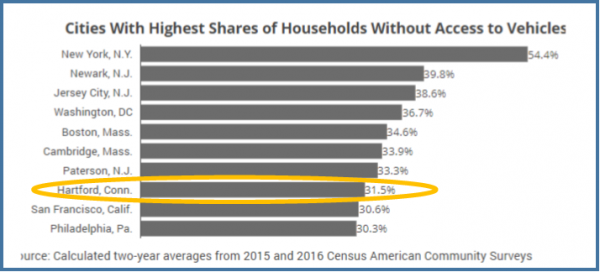
Hartford has a presence in the top 10 cities that already have among the highest share of households without a car, at a 31.5 percent two-year average.  Hartford ranks 8th.  The list is led by New York City at 54.4 percent, with Newark, Jersey City, Washington, Boston, Cambridge and Paterson in between.  San Francisco and Philadelphia round out the top 10 after Hartford.  Hartford increased from 30.3% in 2015 to 32.6% in 2016.

Among other Connecticut cities, Stamford’s households without vehicles is at 10 percent; Waterbury at 20.5 percent; and Bridgeport at 21.1 percent.

Data was calculated using two-year averages from 2015 and 2016 Census survey estimates.