Firm Inspecting New London's Gold Star Bridge Project Also Designed Collapsed Florida Pedestrian Bridge

Project inspection and oversite for the rehabilitation of the southbound Gold Star Bridge structure on I-95 in New London and Groton, due to be completed later this year, is being conducted by the Connecticut Department of Transportation and FIGG Bridge Inspection.  FIGG, whose logo appears prominently on the website devoted to providing the public with project information, is the firm that designed the pedestrian bridge that collapsed at Florida International University on Thursday. The Gold Star Memorial Bridge, described as “Connecticut’s most iconic structure,” is the largest bridge in the State of Connecticut. It is 6,000 feet long and over 150 feet tall at the center span. The bridge is actually a pair of steel truss bridges that span over the Thames River, between New London and Groton, according to the project website.

The project was awarded to Mohawk Northeast in December 2016 and onsite activities began a year ago, in April 2017. Project inspection and oversight, conducted by the state Department of Transportation and FIGG Bridge Inspection, is anticipated to be completed by late Fall this year.

UPDATE:  The Miami Herald is reporting that an engineer from FIGG working on the Florida project notified the state two days before the collapse of cracking on the bridge.  

FIGG has its headquarters in Tallahassee with offices in Pennsylvania, Minnesota, Texas and Colorado, the Miami Herald reported. The company specializes in all types of bridge design and focuses solely on bridge design and engineering both in the U.S. and abroad, according to the company's website. The FIU-Sweetwater UniversityCity Bridge is the largest pedestrian bridge moved via Self-Propelled Modular Transportation in U.S. history, the University's website noted prior to the collapse.

The newspaper also reported that FIGG, which provides design, engineering and construction services, was cited by the Virginia Department of Labor for four violations in 2012 after a 90-ton piece of concrete fell from a bridge under construction near Norfolk, Virginia.

At the Gold Star Bridge, plans call for the structure’s expansion joints to be replaced, as well as overhead sign structures, according to the project website. In total, the bridge has more than 1,000,000 square feet of deck surface area spread over 11 vehicle traffic lanes and a pedestrian sidewalk. The average daily traffic count is 117,000 vehicles.

“Repairs and maintenance of the bridge’s structural steel includes steel girder end repairs, bolt replacements, and bearing replacement and maintenance.  Repairs to the substructure include concrete repairs and crack sealing,” the website explains.

The site notes that “During off peak hours the number of lanes may be reduced to accommodate repairs and improvements,” and there will be periodic closures of the sidewalk.

The company’s website touts “FIGG's exclusive focus on bridge design and construction engineering inspection enables us to provide state of the art technology, innovative aesthetics and materials, and a unique capacity to partner for research.”

After the 2007 collapse of the Highway 35 West bridge in Minneapolis, Minnesota, FIGG built a $233.8 million 10-lane replacement bridge, the Tallahassee Democrat reported.  It was heralded for its state-of-the-art safety systems, including sensors designed to monitor bridge stress and corrosion.

FIGG focuses solely on bridge design and engineering both in the U.S. and abroad. Since 1978, the company has built, studied and designed $10 billion in bridges in 39 states and six countries, according to its website.

The Northbound Gold Star Bridge was built 30 years prior to its sister Southbound Gold Star Bridge.  Repairs on the Northbound bridge are due to begin later this year, the project website indicated. “In the end,” the website predicts, “the service life of the iconic Gold Star Bridges will be extended for decades.”


https://www.youtube.com/watch?v=xYLrBQv3t4o

CT School Administrators Oppose Arming Educators

As students at schools across Connecticut held local observances in memory of the 17 students killed one month ago at Marjory Stoneman Douglas High School in Parkland, Florida, the Connecticut Association of School Administrators released the results of a survey of its members on proposals to arm teachers and administrators as a means of combating the growing problem of gun violence in school settings. When asked “Do you support providing teachers and administrators with firearms?” 84 percent of respondents said no, and 16 percent were supportive.  Asked if schools “will be safer if teachers and administrators are armed,” 85 percent said they would not; 15 percent thought they would.

“The recent proposal to combat school shootings by allowing armed teachers and administrators has little support. Millions of students attend schools throughout the nation for one purpose, to get an education,” said Anthony Ditrio, Chair of the Connecticut Association of School Administrators and a retired administrator who was a Norwalk School Principal for three decades.

“While we agree students should feel safe in every learning environment, arming school teachers and administrators is not the right course of action,” Ditrio added. “The results of our survey don’t surprise me or our organization at all.”

The Connecticut Association of School Administrators is a non‐profit membership organization aimed at advocating to protect the status and welfare of Connecticut school administrators, below the rank of assistant superintendent, in elementary, middle, and secondary schools or working in their board's central office. The Association includes approximately a thousand members from urban, suburban and rural school districts.

More than 160 members participated in the brief survey.

Nominations Open for Annual Connecticut Book Awards

Read a good book lately?  Written by a Connecticut author or featuring a local illustrator?  You may want to urge that their work be submitted for a 2018 Connecticut Book Award.  The annual awards returned last year after a multi-year hiatus, to solid reviews.  The Connecticut Center for the Book (CCB) at Connecticut Humanities, which sponsors the awards, is now looking to build on that momentum.

The awards are designed to recognize and honor those authors and illustrators who have created the best books in or about the State of Connecticut, and celebrate the state’s rich history of authors and illustrators.

“There was such a wonderful selection of books submitted last year in each category that it was very hard to choose” said Lisa Comstock, director of the Connecticut Center for the Book. “We are confident that submissions this year will be exceptional as well.”

Eligibility requirements for the 2018 Awards include:

  • Authors and illustrators must currently reside in Connecticut and must have lived in the state at least three consecutive years or have been born in the state. Alternatively, the work may be substantially set in Connecticut.
  • Titles must have been published for the first time between January 1, 2017, and December 31, 2017, or have a copyright within 2017.
  • All submitted books must have a valid ISBN.
  • Anthologies are acceptable. Author(s) must currently reside in Connecticut and must have lived in the state at least three consecutive years or have been born in the state. Alternatively, the works must be substantially set in Connecticut.
  • Books by deceased authors will be accepted only if the author was still living at the beginning of the eligibility year (January 1, 2017).

The deadline for submission for the 2018 Connecticut Book Awards is April 20, 2018. Finalists will be announced in September and winners announced in October. For more information, visit: http://ctcenterforthebook.org/submission-guidelines/.

Last year’s winners in each category include: Poetry: Fugitives by Danielle Pieratti; Lifetime Achievement for Literary Excellence to Gray Jacobik represented by The Banquet: New and Selected PoemsYoung ReadersThe Weight of Zero by Karen Fortunati; NonfictionNever Look an American in the Eye by Okey Ndibe; and in FictionCajun Waltz by Robert H. Patton.  They followed in the footsteps of literary legends like Mark Twain, Harriet Beecher Stowe, Wallace Stevens – and more recently, Connecticut-connected authors such as Annie Proulx, Suzanne Collins, Elizabeth Gilbert, Maurice Sendak and Luanne Rice.

Connecticut Humanities (CTH) is the state affiliate of the National Endowment for the Humanities and administers the Connecticut Center for the Book.  Established by Congress in 1977 to “stimulate public interest in books and reading,” the Center for the Book in the Library of Congress is a national force for reading and literacy promotion.

Not eligible for the 2018 Connecticut Awards are reprints of books published in another year, eBooks, and books written by staff or families of Connecticut Center for the Book, Connecticut Humanities, or members or families of the CT Book Award review committee and/or its judges.


Public Access to State Government Data Would be Strengthened by Proposed Law

“If we want better government, we need better data.”  That succinct observation by Michelle Riordan-Nold, Executive Director of the Connecticut Data Collaborative, summed up the push for legislation that would codify in state law an “expectation of increased access to state government public data.” The proposal, House Bill 5172, supports the ongoing work of the State’s Open Data Initiative, which is currently maintained by the state Office of Policy and Management.  Riordan-Nold, in supportive testimony last week, said passage of the bill would be “an important step in institutionalizing the state’s commitment to public open data sharing.”  She noted that Connecticut has been a national leader in its commitment to open data, adding that passage of the bill was necessary to “continue the momentum.”

The Connecticut Data Collaborative works with state agency staff, nonprofit staff and community organizations.  Riordan-Nold said that “data users from all sectors across the state are hungry for unbiased, high quality public data,” pointing out that “the increased availability of public data from state agencies will not only aid many individuals, organizations and researchers in their daily work, it will also drive programming decisions, support funding opportunities and illuminate the health and well-being of our residents and municipalities.”

State Comptroller Kevin Lembo told the Government Administration Committee that “Making raw data regarding state agency performance and operations available to the public increases accountability. Access to data allows third parties in the public, including journalists and academics, to review and critique government performance, resulting in a more efficient and responsive government.”

Lembo added that passage of the bill would “affirm Connecticut’s commitment to open government. It allows existing transparency efforts to evolve and grow, providing easy access to public data while increasing government accountability and responsiveness.”  The Comptroller’s Office has a number of initiatives on its website that provide easy public access to data, and Lembo said passage of the bill would ensure that the data necessary for the sites would continue to be available to the public.

State Consumer Counsel Elin Swanson Katz added that the bill “provides the confidence and volume of data that users require through the open access to the quality and unbiased public data that H.B. 5172 ensures.”  She said the bill “will allow for increased agency accountability and responsiveness in order to improve public knowledge of the state government and its operations, by safely providing timely data that the state makes easily accessible to the public.”

In his testimony before the committee, David Wilkinson, Commissioner of the Office of Early Childhood, said “by advancing better data systems, customer feedback mechanisms, and outcomes-driven contracting, we will get smarter and spend smarter, becoming more cost-effective as we achieve better results.”  A recent report by Connecticut Voices for Children pointed out that “integrated data would improve reporting and decision making within agencies, but public access to data is also vital.”  The report also noted that “the state needs more holistic and actionable data on health and social determinants of health in order to work towards health equity.”

The bill would codify Governor Malloy’s Executive Order 39, signed in 2014, which requires executive branch agencies to regularly publish data that is of high value to the public.

On behalf of the Hartford Foundation for Public Giving,  Research and Community Indicators Director Scott Gaul testified in support of the provisions in HB 5517  that would establish the Connecticut Data Analysis Technology Advisory Board and encouraged the state to involve philanthropy and nonprofits on the Board. In recent testimony before the Commission on Fiscal Stability and Economic Growth, the Foundation asked the Commission to prioritize the development and coordinate use of high-quality research and data to ensure that limited public and private resources support best practices and policies.


PERSPECTIVE: Crying in the Cafeteria

by Ellen Fuller My teacher is crying in the cafeteria. The teacher who is over six feet tall and wears stylish black heeled boots and winged eyeliner and leather jackets with extraneous zippers everyday. The teacher who prances exuberantly in front of the classroom waving Julius Caesar and riling up the students into caring deeply about a play written hundreds of years ago. The teacher who snaps her gum to get your attention and grades papers with emoticons. She is crying into her hand as the social studies teacher wards off concerned and interested students.

Rumors spread, of course. We guess everything we think a 20-something-year-old middle school teacher could have to cry about – her boyfriend broke up with her, her pet died, she found out she is pregnant, a family member is sick, a student told her she was a bad teacher. If we had made a list of a thousand items from most likely to least likely, we still never would have guessed the truth. Seventh grade was a time when we never would have guessed that only a couple miles away, a man had killed 20 little babies. Seventh grade was the last time when a school shooting seemed a remote possibility.

There was talk of going home early, although none of the students knew why. Outside, there was no sign of snow. In the end, we stayed for the entire day, although the teachers, still the only ones in the building who knew the truth, just drifted through the remaining hours. Every teacher set boring tasks to be completed in silence, much to the complaints of the students. I know now why the teachers couldn’t bear to stand in front of us and act as though it were any other day. They were busy watching the door, their eyes sometimes drifting to cabinets and closets. They were busy wondering if they could protect us. If their quick thinking and altruism could be enough to stop the bullets of an AR-15 assault rifle.

I only heard about it at 2:50 p.m. on the bus ride home that day. My best friend had received a text from her mom, but none of us had been allowed to check our phones during school. I remember that she had to explain it to me several times. I asked questions like, “How many did he kill?” and “But how did he kill them?” And she gave me answers like, “I don’t know, my mom says about 20 and a couple teachers” and “With a gun.”

But those weren’t the answers I was really looking for. I didn’t want a death count. I wanted an estimate of the number of years of life lost. I wanted a numerical answer to how many times over the next 40 years their parents would stare into the smiling eyes of their 5-year-old’s school photo and try to imagine them with acne or facial hair or wedding dresses. I wanted a hypothesis at the number of prescriptions filled out for PTSD from the other students. I didn’t want to know the weapon. I wanted to know how he had come across it. I wanted to know how their lockdown drill had failed as naively as a duck-and-cover method from the atomic bomb.
I acted cool, of course. I was 45 miles away from Sandy Hook Elementary School, I was seven years older than the students killed, and I went to a school with only around 500 students. These numbers were a thin barrier between me and something unthinkable. There was no real reason that I was alive and these 26 people were dead. I callously shrugged it off because I was in seventh grade and I was trying to stay calm for my friends and I didn’t want to go to school thinking about it every day. I don’t think, at that point in my life, I ever expected our lawmakers to take the same apathetic stance.

My mom hugged me that afternoon, even though I was in the stage of life when hugging me was like hugging an extremely embarrassed prickly pear cactus. “Every parent across America should be hugging their child and telling them that they love them today,” my mom said. I returned the sentiment without much thought. I didn’t think how much those parents would pay to hear their child say “I love you” one more time or how the phantom feel of their baby’s chubby arms around their necks would haunt them.

Dec. 14, 2012, was a day of endings. The ending of lives and my own innocence. I learned that day that in our constitution, the Second Amendment – the right to own a gun – came before the First Amendment – the right to life; that my safety was dependent only on the whims of the adults around me; that my government cared more for the NRA than their own children.

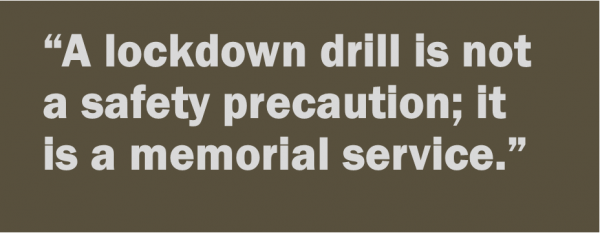
From that day on, lockdown drills were never as much fun. Now, there is no giggling. We scrunch ourselves into tighter balls and, just like my seventh grade teachers, plan our escape. My last one, I hid under a grand piano with five of my best friends and we all trembled as the assistant principal checked the door. A lockdown drill is not a safety precaution; it is a memorial service. As the lights dim to nothing and the shades are drawn, we are all dressed in black. The loudspeaker blares like the officiant at a funeral: We are now going into lockdown. We bow our heads and imagine, for half-an-hour, how it must have felt to be a 5-year-old staring down the barrel of a gun. They never tell us if it is a drill.

This is the best protection the United States government can offer us: a piano canvas and our backpacks clutched to our chests. In school, the only lesson you ever need to learn is how to get really good at hide-and-seek.

There is another one now. Another “anomaly.” According to some estimates, it’s around the 18th “anomaly” this year. I wonder how many “anomalies” it will take before they admit it is a pattern. I hear about the latest shooting on the radio while passing through the kitchen. Now, five years after Sandy Hook, I am not confused. My first thought when I hear the word “school” on the news is “another one.” I am not shocked. I am a girl raised in a country where school shootings are a part of life. I am a girl desensitized to the massacre of children 50 minutes from my house. I am a girl who had her first kiss on a playground built in memory of a murdered 5-year-old. I am a girl like every other child in Connecticut who was in school on Dec. 14, 2012; ever since that day, we have all wondered “Why wasn’t it enough?” I am just a tiny part of the state that had a school shooting back when school shootings were still news.

I am a girl who is going to be a teacher. Teachers don’t take an oath to protect and serve, yet they are the front lines in a battle that America is losing. There isn’t a single teacher – or student – in America who hasn’t wondered what they would do in a school shooting. I’d be willing to bet that most of the teachers, administrators, and security guards around the country have come to the same grim conclusion: that there is a unspoken clause in their job description.

What do I want to be when I grow up? Anything but a statistic; anything but the mother of a dead child; anything but a human shield; anything but cannon fodder in defense of a murderer’s right to murder; anything but a teacher crying in the cafeteria.

___________________________________

Ellen Fuller is a senior at Hall High School in West Hartford and an aspiring writer.  This piece originally appeared on we-ha.com and is published here with permission.

Increase in College Student Voting Rates in CT Among Largest in US in 2016 Election, Study Finds

Across all regions of the U.S., students voted at higher rates in 2016 than 2012, with students enrolled in New England and the Mid-East having the highest increases (5.1% and 5.0%), according to a comprehensive new student on student turnout by the Institute for Democracy and Higher Education at Tufts University.  Connecticut saw the 7th highest increases in voting rates among the states. The National Study of Learning, Voting, and Engagement (NSLVE), which included college and university students attending 1,023 higher education institutions in the U.S. across all 50 states, found that Connecticut college students voted in higher numbers in 2016.  Nearly two dozen colleges in the state were included, and according to the data, all saw increases in student voting from 2012 to 2016.

Compared to the rest of the country, institutional voting rates in New York, Pennsylvania, and Massachusetts tended to increase the most, followed by California, Texas, Illinois, Connecticut, Indiana and Florida.  Institutions in Georgia, Wisconsin, and Mississippi had the largest decline.

The demographics of the nearly 10 million students in NSLVE resemble those of the approximately 20 million college students in the U.S, according to the study, which is described as “a significant step forward in measuring students' political interest and engagement.”

By combining student enrollment records with publicly available voting records, the Institute has “created a one-of-a-kind database that provides the higher education community with its only objective measure of student voting,” according to the study authors.  Overall, NSLVE students voted at a higher rate in 2016 than 2012 by about three percentage points, rising from 45.1% to 48.3%, according to the report. Relative to the turnout of the general U.S. population of 18 to 24-year-olds, NSLVE student turnout was somewhat higher in both election years and increased slightly more between elections.

Among undergraduates, turnout increased from 2012 to 2016 across all class years—first-years, sophomores, juniors, and seniors. In both elections, seniors voted at the highest rate (47.0% in 2012 and 51.8% in 2016) and first-years' turnout was lowest (39.5% in 2012 and 42.8% in 2016). Individual data for the participating colleges, or specific state-by-state data was not released in the national study.

Across the country, nine institutions saw turnout increases of at least 15 percentage points between 2012 and 2016. The study also found that 60.4% of students enrolled at women’s colleges voted in 2016, compared to 53.1% in 2012, an increase of over seven percentage points.  In addition, the study found that “unlike voting rates, registration rates did not increase appreciably.”

In addition, the largest increase in voting rate was among private four-year institutions, where turnout increased by 4.1 percentage points from 2012 to 2016, although four-year public institutions still have the highest turnout rate overall, the report indicated. Women voted at rates nearly seven percentage points higher than men in both elections.

The study also found that voting rates increased from 2012 to 2016 in all academic fields of study. In both election years, students majoring in the social sciences voted at the highest rate, followed by those studying health professions, the humanities, and business. Students majoring in STEM fields (science, technology, engineering, and math) voted at the lowest rate in both election years. These differences could be due to many potential factors, including civically engaged students self-selecting into more civically oriented majors, the study analysis theorized.

The objective measure of student civic engagement that the data provides can be particularly insightful to the extent that voting can be seen as a proxy for student interest in public affairs.  The Institute is in the Jonathan M. Tisch College of Civic Life at Tufts University.

Women's History Month Focuses on Current Issues, Locally and Globally

As Women’s History Month unfolds in the light of #METOO and #TIMESUP, two Hartford-area events bookend the month and underscore the evolving contributions of noteworthy women on the local and global scene. The World Affairs Council of CT and the University of Saint Joseph Women’s Leadership Center “work to motivate women to continue to be bold, to press for progress and take groundbreaking action that truly drives the greatest change for women locally and across the globe.”  The two organizations will present “Global Changemakers” on March 7, in observance of International Women’s Day.  The event, on the University campus, opens with a 5 p.m. reception followed by a 6 p.m. program and audience questions.

On campus will be:

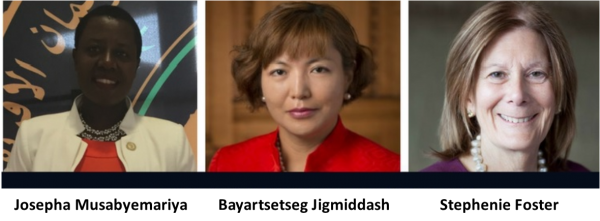
Bayartsetseg Jigmiddash has held senior government positions in the justice sector and has been at the forefront of Mongolia’s far-reaching reform initiatives. Currently, she is CEO and Founding Director of Veritas Consulting. From 2012 to 2016, Jigmiddash served as Secretary of State of the Ministry of Justice of Mongolia, becoming the first woman appointed in this position. Under her leadership, the legal policy on gender-based violence has been significantly improved, including criminalization of domestic violence. Prior to this top civil service post, she served as legal advisor to the president of Mongolia, and has been involved in the judicial reform as well as abolishment of death penalty in Mongolia. She has extensive civil society experience and pioneered an array of initiatives to promote human rights and access to justice.

Stephenie Foster is a Partner in Smash Strategies and a former Senior Advisor and Counselor to the Ambassador-at-Large for Global Women’s Issues at the U.S Department of State. As a member of the leadership team, she coordinated, managed and implemented a wide range of policies and programs, including the women, peace and security initiative, women’s political participation and women’s economic empowerment. At the State Department, Ms. Foster represented the United States in various multilateral and bilateral forums. She served at the U.S. Embassy in Kabul, Afghanistan, focusing on women and civil society, travelling extensively throughout the country to work with individuals and organizations advancing the role of women in Afghan society. Ms. Foster served as Chief of Staff to two United States Senators, Barbara Mikulski and Christopher Dodd.

Josepha M. N. Musabyemariya is the United States Rwandan Community Abroad (USRCA) Commissioner for Gender and Social Affairs. She also is President of Rwandan Community Abroad (RCA) in Maryland, District of Columbia and Virginia (DMV). She has more than 25 years of experience in handling special projects and initiatives designed to positively impact lives of people in her home country of Rwanda,  the communities in and outside DMV and around the globe. She works for the African Union in the U.S.  In this office, she was among the handful of individuals charged with setting up the African Union office in Washington DC which was just prior to the arrival and assumption of duties of the first Permanent Representative in 2006. Josepha’s passion lies in dealing with all issues concerning gender and women empowerment.

Later this month, “The Evolving Role of Women in Politics and Governance” will be presented by Duncaster, the Hartford area’s first LifeCare community, located in Bloomfield.  With more women than ever running for public office in the United States, including in Connecticut, organizers say, the discussion will focus on their evolving roles on the local and national political stage.  The panelists will include:

  • State Senator Beth Bye of West Hartford
  • Mayor Suzette De Beatham-Brown of Bloomfield
  • Assistant Attorney General Claire Kindell of Bloomfield, a candidate for Connecticut Attorney General
  • Mayor Erin Stewart of New Britain, who has an exploratory candidacy for statewide office.

The program will be moderated by Carole Mulready, the past president of the Great Hartford League of Women Voters.  It begins at 11:00 a.m. on Friday, March 23.  The event is free, but pre-registration is required.

PERSPECTIVE: Time to Arm Our Girls to be Entrepreneurs

by Jennifer Openshaw If there are millions of teachers and nurses needed, why on earth should we be equipping our girls to be entrepreneurs? People like Apple’s Steve Jobs, Microsoft’s Bill Gates, or even Oprah Winfrey?

It’s all about the numbers, in Connecticut and beyond.

It turns out, that that “entrepreneurial mindset” – the ability to solve problems, adapt to new situations, and execute -- will be one of the single most important qualities to a successful future.

Did you know that 40% of the US workforce -- 50 million people -- will be operating in a ‘gig’ economy just by 2020?  Further, as David Noble, head of the Entrepreneurship Institute at UConn told me: “Employers today are asking: ‘So, show me what you’ve done.’”

But why girls?

Over the last 10 years, the needle has hardly moved for women.

Here we are, and still just 6% of Fortune 500 CEOs are women, 14% of engineers are women, and just 36% of women are entrepreneurs.

We need to change this – today -- and we can’t rely on our schools alone. Here’s why.

First, girls have tremendous capabilities that have gone ignored.  It turns out that even in college, young girls excel in entrepreneurship. In our study, just 18% of college women participated in business competitions, but they overwhelmingly ranked at the top: a whopping 60% of the winning teams had a woman on the founding team and 40% had a female CEO. And they took home the bulk of the prize money - $90,000 of $180,000.

Yet, without early exposure, girls opt-out of these economic opportunities. Even dads understand this: “This is business conditioning my daughter needs; it starts now,” said Dr. Steve Allard, the father of one Girls with Impact member.

Second, early lack of confidence holds girls back. Research by Proctor & Gamble highlights the particular fears of failure that girls face in high school. Those fears – like the pressure to please others or a sense that society will reject them if they fail -  prevent potential entrepreneurs or CEOs from emerging into the marketplace with their unique products and services, ultimately creating a drag on our economic productivity as a nation.

Confidence, we’ve heard, comes from execution. Early results from Girls With Impact finds that, after the 12-week “mini-MBA program, 4 out of 5 parents said they saw a difference in the confidence in their daughters. And girls themselves showed a 140% improvement in their confidence in leading teams and overwhelmingly said they are benefitting with college prep, business and financial skills, and handling rejection.

“I don’t know how to explain it, but I feel powerful,” is how Greenwich High student Jody Bell, 16, described her experience. (watch what girls are building)

The time is now. From technology that allows the delivery of these programs affordably to the pent-up desire of men and women to enable and empower the next generation, it’s never been a better time.

These programs can address the “disconnect” with extra-curricular activities, says Harvard entrepreneurship professor Lynda Applegate, between what students are doing versus what “they could be doing to build their futures.”

Plus, companies focused on innovation – and driving gender diversity with more women -- are wondering how and where they can find the next best talent.

There is just no question that our daughters are the answer to this and more. They have the capability to lead from the top – as CEOs and entrepreneurs. We just need to give them the tools.

_________________________________________

Jennifer Openshaw is CEO of Girls With Impact (www.girlswithimpact.com), the only entrepreneur and leadership program created just for girls.  @jopenshaw  @girlswithimpact 

Applications are now being accepted for the Girls with Impact six week Summer Program.  More information here; application form here


https://youtu.be/WKGAat6uV6s

Marijuana, Cellphones May Increase Pedestrian Fatalities, Federal Report Suggests; Fewer Deaths in CT as 23 States See Increase

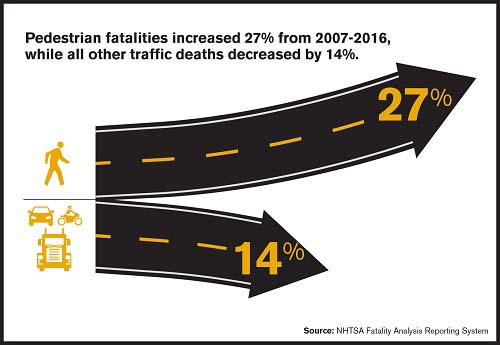
Connecticut is one of 20 states that saw a decline in the number of pedestrian deaths in the first half of 2017, as compared with the first half of the previous year.  The trend nationally, however, is in the opposite direction, as 23 states saw pedestrian deaths increase.  Seven states were virtually unchanged.  And the trend in recent years has also been a rising death toll. The number of pedestrian fatalities increased 27 percent from 2007 to 2016, while at the same time, all other traffic deaths decreased by 14 percent. A new national study raises the possibility of a number of factors for the increase – an increase in the number of cars on the road, the increasing use of cell phones, and the use of marijuana, which has been legalized for recreational use in some states, including neighboring Massachusetts. The report suggests that it "provides an early look at potential traffic safety implications of increased access to recreational marijuana for drivers and pedestrians."

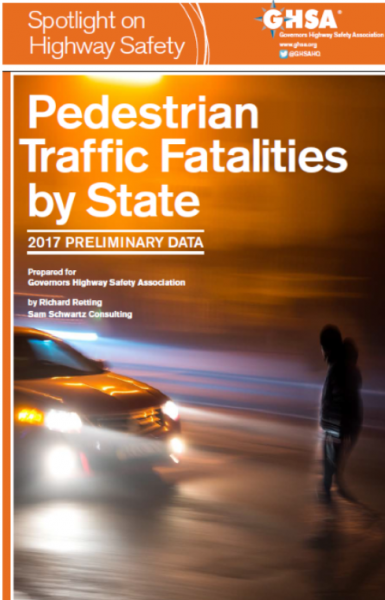
The Governors Highway Safety Administration (GHSA) released a 38-page study this week estimating that just under 6,000 pedestrians lost their lives last year, essentially the same death toll as 2016. The projected total in both years represent the highest levels seen since 1990, Governing magazine reported.  The number of states with pedestrian fatality rates at or above 2.0 per 100,000 population has more than doubled, from seven in 2014 to 15 in 2016. From 2015 to 2016, pedestrian fatalities in the nation’s ten largest cities increased 28 percent (153 additional fatalities), according to the GHSA report.

The number of miles traveled by vehicles increased nationally by 2.8 percent between 2015 and 2016 then rose another 1.2 percent the first half of last year, according to Federal Highway Administration data  The GHSA report noted that nearly 6,000 pedestrians died in motor vehicle crashes in 2016 and 2017, coming after a spike in the number of pedestrian deaths in 2015. "It has been more than 25 years since the U.S. experienced this level of pedestrian fatalities. Because both 2015 and 2016 saw large increases in pedestrian fatalities, the continuation of pedestrian fatalities at virtually the same pace in 2017 raises continued concerns about the nation’s alarming pedestrian death toll," the report stated.

“We’ve plateaued at a very bad place,” Richard Retting, who authored the report, told Governing. “This should not be a new normal.”

While pedestrian deaths have increased over the past decade, other types of traffic fatalities declined. Pedestrians accounted for 16 percent of all motor-vehicle related deaths in 2016, up from 11 percent in 2007. Federal data suggests nighttime collisions are a major problem -- three quarters of fatal crashes occurred after dark.

In Connecticut, there were 31 pedestrian fatalities in the first half of 2016; 20 in the first half of 2017, a decrease of 35 percent. Connecticut was one of 11 states, 2014-2016, where 20 percent or more of the pedestrian deaths were among people age 70 or older.  Connecticut's pedestrian fatality rate in 2016 was 1.73 per 100,000 population, which ranked 20th in the U.S.  In the first half of 2017, the state ranked 31st.

Retting told Governing that he suspects cellphone use by drivers and pedestrians could also be a culprit. The GHSA report stated that "Without stating a direct correlation or claiming a definitive link, more recent factors contributing to the increase in pedestrian fatalities might include the growing number of state and local governments that have decriminalized recreational use of marijuana (which can impair judgment and reaction time for all road users), and the increasing use of smart phones (which can be a significant source of distraction for both drivers and pedestrians).

The total number of multimedia messages sent has more than tripled since 2010.  The report also suggests a possible link with marijuana use.  According to the report, the seven states (Alaska, Colorado, Maine, Massachusetts, Nevada, Oregon, Washington) and  DC that legalized recreational use of marijuana between 2012 and 2016 reported a collective 16.4 percent increase in pedestrian fatalities for the first six months of 2017 versus the first six months of 2016, whereas all other states reported a collective 5.8 percent decrease in pedestrian fatalities.
One example cited is Washington state, where marijuana was legalized in late 2012 and the first dispensaries opened in mid-2014.  According to data from the Traffic Safety Commission, Governing reported, Washington state saw an increase in 2015 and 2016 in fatal crashes where THC, the primary psychoactive chemical in marijuana, was present in blood tests of either the pedestrian or driver.

It was noted, however, that the totals, while higher, still remain relatively small. THC levels can be detected days or even weeks after marijuana use, and Washington state’s data also indicates that between 70 and 80 percent of drivers found to have THC also tested positive for alcohol or other drugs, according to that report.

The federal report also indicates that Connecticut DOT recently completed a statewide overhaul to replace old signage, including signs for pedestrian safety. "These are new, bright signs that are up to code," the report explained.  "The Highway Safety Office also launched an outreach and advertising campaign titled 'Watch for Me CT' which focuses primarily on pedestrian safety but also includes bicyclists."  Law enforcement training for this issue is currently being developed, the report said.

Nationally, there were 4,457 pedestrian fatalities in 2011 and 5,987 in 2016.  The data for the first half of 2017 is considered preliminary, and may rise higher as some state records are updated with additional data, the report indicated.

Hartford Region Coalition Embarks on Development of Economic Strategy

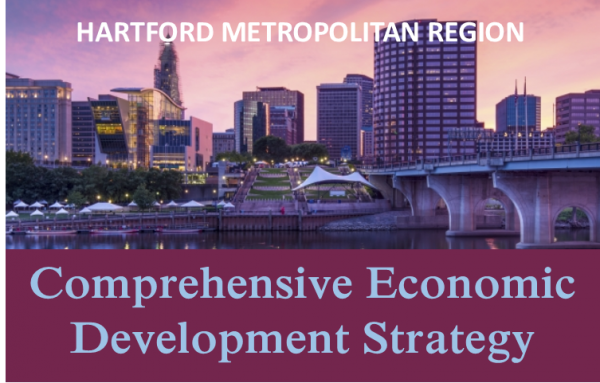
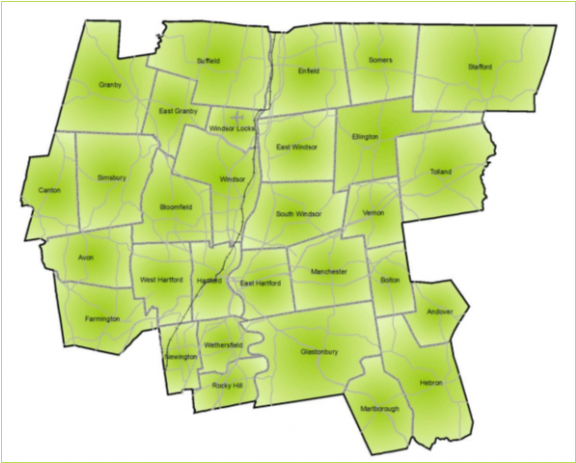
A coalition of prominent business, transportation and community development organizations in the Hartford Metropolitan Region has begun the process of taking a fresh look at its position in the global economy, with an eye toward taking advantage of economic opportunity. In announcing the initiative, the organizations noted that the region and the state have struggled to recover from the 2008 recession and that global, national, and local trends are reshaping the region’s economy. The state and many of the region’s 38 municipalities face increasingly difficult fiscal situations that hamper their ability to pursue projects that will lead to growth, officials said.

Recognizing that these trends, if left unaddressed, can dramatically impact the region, the organizations – the Capitol Region Council of Governments (CRCOG), Hartford Foundation for Public Giving (HFPG) and MetroHartford Alliance - will be working as an advisory committee to develop a new Comprehensive Economic Development Strategy (CEDS) for the Hartford Metropolitan Region. The most recent strategy was developed in 2012, and a previous effort took place in 2006.

“This strategy will take a hard look at the region and identify and prioritize the most promising opportunities for creating lasting economic growth. This region is a leader in insurance, finance, and advanced manufacturing; we need to build on these strengths to encourage the kind of growth that will lead to lasting fiscal stability,” said Jim Scannell, Senior Vice President, Administrative Services, at Travelers and co-chair of the CEDS Advisory Committee.

The effort gets underway with new leadership at the helm at a number of the organizations, which may impact the perspective along the way, if not the final results.  Led by the CRCOG, and longtime Executive Director Lyle Wray, the initiative is in partnership with the Hartford Foundation, where President Jay Williams, a former Assistant Secretary of Commerce for Economic Development and mayor of Youngstown, OH relocated to the region last year, and the MetroHartford Alliance, which hired David Griggs, mostly recently leading economic development efforts in Minneapolis-St.Paul as its new President and CEO.  Williams joins Scannell as co-chair of the CEDS Advisory Committee.

The consulting firm of Fourth Economy Consulting has been hired to help the region complete a situational assessment and develop “game changer” initiatives to serve as the core of a new economic development strategy. Fourth Economy, based in Pittsburgh, recently worked with the 100 Resilient Cities initiative to help cities around the world become more resilient to economic changes.

The process will be led by an advisory committee comprised of representatives of businesses, governments, educational institutions and non-profits throughout the region. A smaller working group, comprised of partner organizations like the New Britain Chamber of Commerce, will work closely with the consulting team and the advisory committee to develop a regional vision and turn it into an actionable plan.

Four primary tasks have been identified for the initiative:

  • Goal-Setting: Build consensus around the need for accelerating inclusive/equitable economic growth; that is raising incomes across the income distribution with particular attention to opportunities for engaging those who have often been left behind.
  • Situational Analysis: Do a clear-eyed assessment of our situation: who, what, where to identify opportunities that we should be pursuing as a metropolitan region (i.e., SWOT with an emphasis on context and opportunities).
  • Strategic Planning: Formulate a limited number of “game changer” strategies that will move the trajectory of inclusive economic growth in the right direction.
  • Capacity-Building: Identify organizational forms and collaborations that we will need to implement and sustain the strategies over time.

During this process the Advisory Committee will also identify potential partner organizations and set up an organizational structure to implement the initiatives.  A final strategy report is due next winter.  CRCOG has set up a website that already includes key resources, and will be updated as the work proceeds during the year.

“There is only one way our region will achieve equitable and sustainable economic growth.  We must eschew the past squabbles and divisions that have kept us mired in anemic progress,” said Jay Williams, president of the Hartford Foundation and co-chair of the CEDS Advisory Committee.  “If we commit to a bold, collaborative, and pragmatic approach, we can develop a roadmap to capitalize on the enormous talent and multiple assets our region possesses.  I’ve seen the success of this approach in other parts of the country and there is absolutely no reason it can’t occur here, unless we lack the collective will to make it happen.”


Similar efforts occur throughout the state led by various economic development regions. The WestCOG Region’s first Comprehensive Economic Development Strategy (CEDS) was developed throughout 2017.  WestCOG includes 18 towns in the Stamford - Norwalk - Danbury region of the state.  Public comment on the draft plan was solicited last fall.

The state’s South Central Connecticut region, centered around New Haven, undertook a similar effort in 2013, which has been updated annually. The Strategic Planning Committee and sector subcommittees have been established for 2018, and are currently gathering data and input from community stakeholders, according to the website for that region’s economic strategy planning initiative. It is led by Economic Development Corporation of New Haven,  a private, non-profit organization, dedicated to business and economic development within the city of New Haven and REX Development, which was formed as the economic development entity for the fifteen towns served by the South Central Regional Council of Governments (SCRCOG).

Of the Hartford region’s CEDS initiative, East Hartford Mayor Marcia Leclerc, the Chair of the CRCOG Policy Board said “Our metropolitan region needs to competitively position itself for the future in relation to other regions in the country, as well as globally. To do that we need to take a hard look at our current situation and our opportunities.”