US News, Aetna Foundation Rank Nation's Healthiest Counties; Three in CT Reach Top 100

Three Connecticut counties are among the 100 healthiest in the nation.  Tolland County ranked #44, Middlesex County was #46, and Litchfield County placed #54, in an analysis published by U.S. News & World Report in collaboration with the Aetna Foundation. Two additional Connecticut counties ranked among the top 500:  Fairfield County was #351 and New London County was #411.  Hartford Country, New Haven County, and Windham County were unranked, outside the top 500.

The “Healthiest Communities” analysis is designed as an interactive destination for consumers and policymakers.  Backed by in-depth research and accompanied by news and analysis, the site features comprehensive rankings drawn from an examination of nearly 3,000 counties and county equivalents on 80 metrics across 10 categories, informing residents, health care leaders and officials about local policies and practices that drive better health outcomes for all, the website explains.

The data categories include Population Health, Equity, Education, Housing, Food & Nutrition, Environment, Public Safety, Community Vitality, and Infrastructure.  All of the categories but one, equity, were identified as key considerations in evaluating community health by the National Committee on Vital and Health Statistics as part of its Measurement Framework for Community Health and Well-Being.  Data were gathered and analyzed by the University of Missouri Center for Applied Research and Engagement Systems (CARES).  The overall project was developed by U.S. News & World Report in collaboration with the Aetna Foundation.

Topping the national rankings were Falls Church, Virginia; Douglas County, Colorado; Broomfield County, Colorado; Los Alamos County, New Mexico; and Dukes County, Massachusetts.  Dukes County, the second smallest in Massachusetts, includes Martha’s Vineyard and the Elizabeth Islands.

The scores for Connecticut’s counties were Windham 56.6, New Haven 60.2, Hartford 61.6, Fairfield 69.1, New London 67.9, Litchfield 82.0, Middlesex 82.6, and Tolland, 82.9.  The overall state average was 70.4.  The U.S. average was 52.3.  Among neighboring states, the Massachusetts statewide average was 72.8, Rhode Island was 74.8 and New York was 61.7.

“Healthiest Communities evaluates and explores how counties and county equivalents can minimize chronic disease, keep people out of the hospital, provide access to health care and lower costs,” the website explains.  “The Aetna Foundation, the independent charitable and philanthropic arm of Aetna, invested in this project as part of its broader effort to improve the health of communities.”

Naturalization Ceremonies Highlight National Library Week in CT

Libraries across Connecticut will join in the celebration of National Library Week 2018, April 8-14, which will mark the 60th anniversary of the first event, sponsored in 1958.  This year, in keeping with the theme “Libraries Lead,” libraries will be asking patrons to “tell us how the library led you to something of value in your life.”  And programs such as the Library Passport have been developed to encourage people throughout the state to visit libraries – including those located in communities outside their own. National Library Week is an annual celebration of the life-changing work of libraries, librarians and library workers. Libraries aren’t just places to borrow books or study, official explain, they’re also creative and engaging community centers where people can collaborate using new technologies and develop their skills and passions.

Libraries of all types have long been evolving to meet the needs of the communities they serve, officials indicate, noting that diverse groups including elected officials, small business owners and students depend upon libraries and the resources they offer.

Resources like e-books and technology classes, materials for English-language learners and programs for job seekers are just a few ways libraries and librarians are transforming to lead their communities. That is particularly true in Connecticut in urban libraries.

Hartford, for example, has developed The American Place, with an array of resources and programs for immigrants and those seeking citizenship. The Hartford Public Library is recognized by the U.S. Department of Justice, Board of Immigration Appeals to provide legal advice and representation by accredited staff in matters before United States Citizenship and Immigration Services.

On Thursday, April 12, 2018, at 11:00 a.m. Hartford Public Library will be one of six libraries working with USCIS to host Naturalization Ceremonies during National Library Week. Other sites hosting ceremonies during this week are:  Danbury Public Library, Ferguson Library (Stamford), New Britain Public Library, Otis Library (Norwich), and Rockville Public Library (Vernon).

Community members can also develop their own leadership skills at the library, with endless opportunity to build skills and confidence through resources and programming, officials stress.

More than one hundred Connecticut libraries are participating in the Connecticut Library Association’s Passport to Connecticut Libraries Program. The program is open to adults and children, and the hope is that it encourages residents to explore the amazing diversity of our public libraries.

“Libraries are windows into the spirit and culture of the community. I encourage our residents to take advantage of this fun program that celebrates public libraries and the communities who support them,” said Hartford Public Library CEO Bridget Quinn-Carey, one of the program participants.

Celebrations during National Library Week include:

  • National Library Workers Day, celebrated the Tuesday of National Library Week (April 10, 2018), a day for library staff, users, administrators and Friends groups to recognize the valuable contributions made by all library workers;
  • National Bookmobile Day, celebrated the Wednesday of National Library Week (April 11, 2018), a day to recognize the contributions of our nation's bookmobiles and the dedicated professionals who make quality bookmobile outreach possible in their communities, and
  • Take Action for Libraries Day, a national library advocacy effort observed for the first time in 2017 in response to proposed cuts to federa
  • l funds for libraries.

Each library has its own architecture, vibe and collection to explore and browse, official said, urging state residents to take a look at “the amazing diversity of our public libraries.”

PERSPECTIVE: State Auditors Can Be Partner in Preserving Resources

by Robert J. Kane On February 3, 2017, I had the honor of becoming State Auditor. Looking back, there was so much to learn when I joined the Auditors of Public Accounts (APA), but with the help of fellow State Auditor John Geragosian and our amazing team, the transition was rather smooth.

Learning the “ins and outs” did not take long, as support from throughout the agency was overwhelming. The incredibly talented and dedicated APA staff are professional and committed to the work they do for our state. We are the General Assembly’s “eyes and ears” inside state agencies and thrive on working to make state government more accountable and efficient.

In my nine years in the State Senate, I wish I had interacted with the APA more. Serving in my new role, I now realize what a valuable resource our office is for legislators and legislative employees. We can assist them as they shape fiscal policy for years to come.

Our work is crucial to the stability of our state’s finances, securing federal funding, and ensuring state agency compliance. The work we do on whistleblower cases, in conjunction with the Attorney General, provides all citizens the opportunity to expose waste, fraud and corruption without threat of retaliation.

Being the only state to have two state auditors from differing parties creates a bipartisan office that eschews partisan politics and promotes fairness and transparency. As budget constraints and fiscal matters continue to dominate the debate, now more than ever the APA can be a true partner with the legislature in preserving state resources, protecting taxpayer dollars, and acting as the watchdog over fiscal matters.

We continually work to build these relationships and, in a short period of time, we have already surveyed our stakeholders to better serve them. We are redeveloping our website and improving the look of our reports. With these improvements, the APA seeks to build on our already exemplary reputation among government agencies and encourage greater communication with those we serve.

During 2017, our auditors completed 29 audits of state and quasi-public agencies and made 398 audit recommendations. During the past calendar year, these agencies have implemented approximately 43% of our prior recommendations.

Our audit approach entails, among other procedures, an examination and verification of financial statements, accounting records, and supporting documents; a determination of the agency's compliance with statutory and budgetary requirements; an evaluation of the agency's internal control structure; verification of the collection and proper handling of state revenue; and an examination of expenditures charged to state appropriations. Our audit reports consist of findings and recommendations and, where appropriate, certified financial statements setting forth the condition and operations of the state funds involved.

In accordance with Section 2-90 of the General Statutes, we report any unauthorized, illegal, irregular, or unsafe handling or expenditure of state funds to the Governor, the State Comptroller, the clerk of each house, and the Attorney General. We report these matters in our audit reports or by formal letter. We collectively report less serious matters such as minor losses and acts of vandalism.

State loss reports filed in 2017 with this office and the State Comptroller, in accordance with Section 4-33a of the General Statutes, disclosed approximately 308 losses, primarily through theft, vandalism, and inventory shortages involving an aggregate loss of $1,966,360.

_______________________________

This is excerpted from the Auditors of Public Accounts 2017 Annual Report, issued earlier this year, including a Message from State Auditor Robert J. Kane and portions of the Auditing State Agencies section of the report. Kane is a former Republican member of the Connecticut Senate, representing the 32nd District from 2009 to 2017.

Opioid Epidemic Evident in CT Communities Large and Small; Data Show Rapidly Growing Health Crisis

In 2012-13, 111 of Connecticut’s 169 towns had at least one death attributable to opioids, and one city, Hartford, had more than 100 deaths that were caused by the drug.  Just four years later, in 2016-17, 138 towns saw at least one death during the two-year period, an increase of 24 percent, and the number of cities with more than 100 deaths had quadrupled, as Hartford, Bridgeport, New Haven and Waterbury each saw the death toll climb past 100. A review of data from the Connecticut Medical Examiner by the Connecticut Data Collaborative found that “opioid deaths have doubled and tripled in some towns in Connecticut in only six years.” The analysis found that although Bridgeport, New Haven, Waterbury, and Hartford have the highest rates per population, “many smaller towns have seen their rates of death triple as well.”

In comparing the average annual opioid-related death rates per 100,000 population in 2012-13, 2014-15, and 2016-17, the dramatic increases across communities statewide is quite evident. The data analysts point out that data are where deaths from 'any opioid' (meaning some type of opioid were found in the person) take place. Therefore, they explain, one would expect to see higher rates in places with large hospitals (hence high rates in cities). They add that one can also not discount that these places are also seeing higher rates among its residents.

In Danbury, for example, the rate of deaths nearly tripled from 2012-13 to 2016-17, from 6.88 to 18.20. In Enfield, it more than tripled, from 2.01 to 6.70.  In that northern Connecticut community, the rate translates to 9 opioid-related deaths during the two years of 2012-13 to 30 in 2016-17.

In Norwalk, the rate quadrupled from 2.57 in 2012-13 to 10.70 in 2016-17, when 25 people died from opioid-related causes.  The rate in New Britain more than tripled from 8.78 to 29.65 – from 24 deaths over a two-year period to 81 in the same period four years later.  In Hamden the number of deaths from opioid-related causes doubled from 8 to 16 in four years; in West Haven there were 7 deaths in 2012-13 and 29 in 2016-17.

The Connecticut Data Collaborative has posted on its website an interactive series of state maps that allows visitors to compare the number of opioid deaths in every town in Connecticut in each of the three years.  The maps indicate “the breadth of the problem” and “intensity of the issue.”

Earlier this year, Connecticut officials launched a statewide public awareness campaign aimed at reducing opioid misuse.  The "Change the Script" campaign provides information on prevention, treatment and recovery provided by local health departments, prevention councils, healthcare providers, pharmacists, and other community partners and stakeholders.

The state departments of Mental Health and Addiction Services (DMHAS), Consumer Protection (DCP) and Public Health (DPH) are working together on the campaign, which grew out of the Governor's Connecticut Opioid Response (CORE) Initiative, a three-year strategy to prevent addiction and overdoses.


https://youtu.be/Uy3IVFjUAjE

New Citizens Sworn In, Distinguished Immigrants Honored at State Capitol Ceremonies

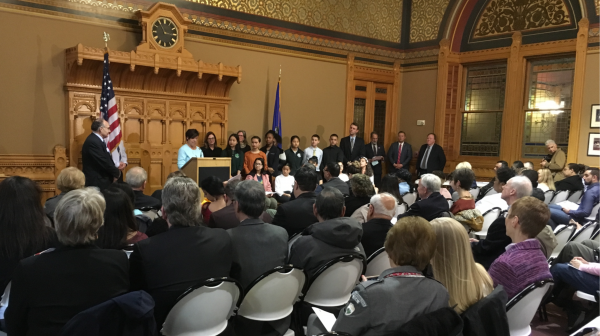
Fifteen recent immigrants living in Connecticut took the oath of allegiance as American citizens on Wednesday during a special court session to be held at the State Capitol.  Minutes after the new Americans were sworn in as citizens, the Connecticut Immigrant & Refugee Coalition (CIRC) honored eight longtime state residents who have made significant contributions to life in Connecticut. The individuals honored on the 21st Annual Connecticut Immigrant Day came to the United States from Belarus, Italy, Vietnam, Poland, Egypt, Pakistan, India and Taiwan.  The new Americans citizens came to the U.S. from Brazil, Canada, Ecuador, Guatemala, Iraq, Italy, Jamaica, Kenya, Mexico, Russia and Syria.

“Immigrants have always been – and continue to be – an abundant and enduring strength of our great nation,” said Robert Fishman, Executive Director of the Connecticut Immigrant & Refugee Coalition (CIRC), which sponsored the observance with the Office of Secretary of the State. “Connecticut is fortunate to have many remarkable individuals who have contributed tremendously to our state, and as we honor them we are also inspired by the newest group of proud and determined immigrants to take the oath of allegiance as Americans.”

The court session that administered the oath to 15 new Americans was presided over by The Honorable Donna F. Martinez, U.S. Magistrate Judge for the District of Connecticut.

Lieutenant Governor Nancy Wyman shared brief remarks at the ceremony, recalling her grandfather’s journey to America.  The CIRC award recipients at this year’s 21st annual ceremony included residents of Avon, Trumbull, Farmington, Norwich, Monroe and East Hartford, in addition to West Hartford.  The National Anthem was led by Chris Nelson, a native of Ghana and current Goodwin College student.  The Governor’s Foot Guard presented the colors at the start of the ceremony, which was led by Chris George of Integrated Refugee & Immigrant Services.

The mission of CIRC, a coalition of about a dozen organizations across Connecticut, is to promote the rights and opportunities of immigrants and refugees in Connecticut and to foster their civic participation.

The individuals honored are:

  • Bassam Gayed, born in Egypt, is Multicultural Services Coordinator at the Otis Library in Norwich.
  • Irena Rak Dzierzbinski, born in Belgium, teaches French and Spanish in middle school in Darien and is active in Girl Scouts. She hosts a Polish-English radio program at Fairfield University.
  • Naeem Khalid, born in Pakistan, started Sam’s Food stores and employs 1,000 in his businesses. He formed a charity, Sam’s Children, to assist needy children in Connecticut and is active with the Pakistan American Association of Connecticut.
  • Ruth Lazowski, born in Belarus, is a Holocaust survivor who speaks with school groups.
  • Cary Lakenbach, born in Italy, is the current Board Chair of the Jewish Federation of Greater Hartford and an actuary.
  • Bruce Tsan-Tang Liang, born in Taiwan, is the Dean of the University of Connecticut School of Medicine.
  • Vani Nidadavolu, born in India, operates an Indian Dance School and works part-time for Edward A. Jones. She holds an MA in Commerce and is a Philanthropist.
  • Trinh K. Duong, born in Vietnam, came to Connecticut as a refugee and now works with new refugees and immigrants, helping them to resettle. She received her degree in Accounting from UConn.

In addition, Alicia Kinsman, Director and Managing Attorney of Immigration Legal Services at the Connecticut Institute for Refugees and Immigrants received the Myra M. Oliver Memorial Award, and two student groups were presented with the Angela R. Andersen Memorial Award, created to honor students who demonstrate deep commitment to issues impacting refugees and immigrants.

Sixth-graders from the Interdistrict School for Arts and Communication in New London were recognized for their project, “Community Faces-Humanizing the Immigrant Label,” parts of which were on display at the Capitol.  The second group was Teens4Citizenship, a Hartford Public Library and Hartford Public Schools collaborative program. As "Citizenship Guides," these high school immigrant students support family and community members on the path to Citizenship and upon turning 18 pursue their own citizenship.

Member organizations in the Connecticut Immigrant & Refugee Coalition include: Milan Cultural India Association, Polish American Foundation of CT, The American Place at the Hartford Public Library, Catholic Charities Migration Services, Connecticut Coalition of Mutual Assistance, Connecticut Institute for Refugees and Immigrants, Integrated Refugee & Immigrant Services (IRIS), Jewish Family Services of Greater Hartford, Legal Assistance Resource Center, Center for Urban Research, Education and Training, Pakistani American Association of CT, Hellenic Society of Paideia and World Affairs Council of Connecticut.


More Than 1,500 College Students from CT Save Average of $7,700 in Tuition in New England Program

Seventy-eight percent of college students from Connecticut participating this academic year in a reciprocal tuition reduction program coordinated by the New England Board of Higher Education (NEBHE) attend undergraduate programs at state colleges and universities.  That’s the highest participation level at state colleges and universities among the six New England states, and provides Connecticut students, on average, with $7,747 in tuition savings.  That's the third highest average tuition savings among the six states. In an annual report on the Regional Student Program (RSP), also known as Tuition Break, NEBHE reported that more than $59 million in tuition savings was provided during academic year 2017-18 to 8,654 participating students throughout the region.  Just over 1,500 of them are from Connecticut.

The RSP allows eligible residents of the six New England states to pay a reduced tuition rate when they enroll at out-of-state public colleges and universities within the region and pursue approved degree programs not offered by their home-state public institutions. In some cases, students may be eligible when their home is closer to an out-of-state college than to an in-state college. Connecticut residents are eligible for more than 500 undergraduate and graduate degree programs with the RSP Tuition Break.

There were more students coming in to Connecticut public institutions of higher education from other New England states than Connecticut students pursuing their education elsewhere in the region.  There were 239 students from Connecticut attending community colleges elsewhere in the region, while 197 students came into Connecticut.

Among the institutions seeing the highest number of incoming students in the Tuition Break program were the University of Connecticut (724 undergraduate students), Asnuntuck Community College (163) and Eastern Connecticut State University (172).

At the undergraduate level, 1,210 students came into the state under the RSP initiative, while 948 from Connecticut attended colleges outside the state under the program.  At the graduate level, the trend was reversed:  102 came in to Connecticut while 93 went outside the state through the tuition break program.

The data compiled on the RSP indicates that participating students and families saved an estimated $59 million on this academic year's tuition bills, with a full-time student saving an average of $8,157.  Overall, enrollment at four-year undergraduate institutions decreased by 2%, following a 6.8% increase the previous year. Graduate enrollment increased by 11%. Enrollment at community colleges decreased by nearly 9%.  Participating Massachusetts students saved an average of $9,285; Rhode Island students an average of $8,613 and Connecticut students an average of $7,747.

New England public colleges and universities received nearly $97 million in tuition revenue from RSP students enrolled at their campuses.  Undergraduate programs at four-year state colleges and universities accounted for 59% of RSP enrollment; associate programs, 35%; and graduate programs, 6%.

In Connecticut, Massachusetts, Maine and Rhode Island, the highest percentage of residents enrolled under the RSP in undergraduate programs were at the state colleges and universities: 78%, 66%, 60% and 56%, respectively. In Vermont and New Hampshire, the highest percentage of residents enrolled under the RSP were at the community colleges: 52% and 48%, respectively.

Among the programs enrolling Connecticut residents in 2017-18 are animation, aquaculture & fisher technology, criminal justice, food science, forestry, legal studies, marine engineering, marine science, marine transportation, mountain recreation management, performing arts, fashion merchandising, and zoology.

More than 850 undergraduate and graduate degree programs are offered under the RSP, many of them in specialized and high-demand fields. In 2017, the region's public colleges and universities approved 33 additional programs.  Officials note that program offerings expand each year.  Programs now include:

Associate degree programs (8): Audio Engineering, Culinary Arts: Baking and Pastry, Entrepreneurship, Fine Woodworking and Furniture Design, Global Studies, International Business, Professional Writing, Video/Film

Bachelor's degree programs (13): Accelerated Nursing, Aging Studies, Climate Change Science, Elementary Education: Community Engaged Learning, Environmental Studies and Sustainability, Fine Woodworking and Furniture Design, Fisheries Biology, Health Care Studies, Information Technology International Affairs (dual major), Movement Science: Wilderness Leadership Concentration, Wildlife Biology, World Languages Education (K-12)

Graduate programs (12): Master's: Athletic Training, Engineering Management, Exercise and Health Sciences, Genetics and Genomic Counseling, Music Pedagogy, Quantitative Economics, Transnational, Cultural and Community Studies, Urban Planning and Community Development

Doctoral: Computational Sciences, Counseling Psychology, Exercise and Health Sciences, Health Promotion Science

Now in its 61st year, the RSP was established by NEBHE in 1957-58 to fulfill the purposes of the congressionally authorized New England Higher Education Compact forged to expand educational opportunities for New England residents and share higher education resources. The RSP helps the individual New England states avoid the high costs of establishing and operating academic programs already offered in the six-state region.

PERSPECTIVE: Most Investors See Finances on Track in 2018

by Joseph Matthews Confidence in achieving financial goals is solidly on the positive side of the spectrum, according to a recent survey, with a significant majority of those surveyed reporting that they are on track, progressing in their desired direction.

A Morgan Stanley poll of high net worth investors revealed that 91 percent of investors surveyed believe they are on track to achieving their long-term financial goals. About 35 percent see saving for retirement as their top goal, with 33 percent most interested in transitioning wealth to the next generation – and the remaining 32 percent working to pay off a mortgage.[1]

In what could be a major statement of confidence in the future, 88 percent of Millennials, nationally, said they believe they are on track to reach their long-term goals. Interestingly, Millennials’ priorities also include saving for retirement, with 44 percent placing that objective as their top priority. But their number two and three goals swap places with many older respondents with 42 percent of Millennials preferring to pay off a mortgage, and 35 percent listing paying for a child or a grandchild’s education. [2]

While it is difficult to say what has led to this sentiment, there are a few factors to consider regarding the Connecticut economy in particular. The state added 6,000 jobs in December, pushing year-end totals to 7,700.[3] Even manufacturing jobs increased over the year, while the largest gain came in the professional and business services category.[4]

Meanwhile, nationally, 77 percent of those polled in the Morgan Stanley survey said they expected improvement in their various state economies over the next year, and 87 percent said they expected the same for their local economies.[5]

However, when it came to their personal finances, 88 percent of those surveyed said they wish they started to save for their overall financial goals much sooner.[6]
So, despite the fact that the future is looking good in the eyes of most investors surveyed, it remains key to keep financial goals in mind. It is never too earlier to plan for the future. And, I believe, it is never too late to try to begin to make up for the years when funds might not have been earmarked for longer term financial goals.

As well, I believe that the seemingly ongoing bullish stock market should not cause an investor to shy away, believing the financial train has already left the station. Of course, while there certainly are no guarantees that this market trend will continue, there remain solid opportunities to selectively add equities to one’s portfolio – as long as long-term goals are kept in mind and the portfolio remains properly diversified.

Balance remains the watchword. That means proper balance of risk, as well as proper balance of the various types of investments in a portfolio.

So, if the stock market continues to go up or if it should pull back from record highs, each investor should feel confident that, over time, there is a plan in place that will help you achieve your financial goals.

_______________________________

Joseph Matthews is a Financial Advisor with the Wealth Management Division of Morgan Stanley in Fairfield. He can be reached at 203-319-5165 or by email at joseph.matthews@morganstanley.com.


The information contained in article is not a solicitation to purchase or sell investments. Any information presented is general in nature and not intended to provide individually tailored investment advice. The strategies and/or investments referenced may not be suitable for all investors as the appropriateness of a particular investment or strategy will depend on an investor's individual circumstances and objectives. Investing involves risks and there is always the potential of losing money when you invest. Morgan Stanley and its Financial Advisors do not provide tax or legal advice. The views expressed herein are those of the author and may not necessarily reflect the views of Morgan Stanley Wealth Management, or its affiliates. Morgan Stanley Smith Barney, LLC, member SIPC.

 ---------------------------

[1] Morgan Stanley Investor Pulse Poll 8; CRC # 1960216 (12/17)

[2] Morgan Stanley Investor Pulse Poll 8; CRC # 1960216 (12/17)

[3] https://www.nhregister.com/business/article/Connecticut-adds-6-000-jobs-in-December-ends-12515976.php

[4] https://www.nhregister.com/business/article/Connecticut-adds-6-000-jobs-in-December-ends-12515976.php

[5] Morgan Stanley Investor Pulse Poll 8; CRC # 1960216 (12/17)

[6] Morgan Stanley Investor Pulse Poll 8; CRC # 1960216 (12/17)

CT's Firearm-Related Mortality Rate is 5th Lowest in U.S.; MA is Lowest, Seen as Model for Nation

The death rate from firearms in Connecticut is fifth lowest in the nation, according to data compiled by the Center for Disease Control and Prevention.  The state follows Massachusetts, Rhode Island, New York and Hawaii.  Connecticut’s 4.6 deaths per 100,000 residents, is slightly higher than Massachusetts’ nation-lowest 3.4 deaths.  And now Massachusetts U.S. Senator Ed Markley is urging other states to follow the Bay State’s lead, and seeking federal funds as incentive for the changes. Markey's newly introduced bill would allocate $20 million in Department of Justice grants each year for the next five years to states that adopt laws like those in Massachusetts, according to published reports.  Perhaps best known is the state's ban on assault weapons, signed in 2004 by Gov. Mitt Romney, now a candidate for U.S. Senate in Utah. The state also requires gun dealers to conduct background checks, mandates private sellers to verify that buyers have a valid gun license, bans “mentally defective” people from owning firearms, and requires weapons to be unloaded and locked away when not in use.

Last year, Massachusetts became the first state to ban rapid-firing bump stocks after the Las Vegas shooting. At least 15 states – including Connecticut - are currently considering similar bans, and several others have tightened up restrictions already in place, Governing magazine recently reported.

In Connecticut, Governor Malloy has repeatedly called for a ban on bump stocks in Connecticut, and the matter is currently before the state legislature.  The bill was subject of a lengthy public hearing last week at the State Capitol complex.

Connecticut is also one of only five states – including Massachusetts - that gives police chiefs the authority to deny, suspend or revoke licenses for handguns and long guns. This aspect of the law has been cited as being instrumental in keeping guns out of the hands of dangerous people. In addition to Connecticut and Massachusetts, the District of Columbia, California, Hawaii, Illinois and New Jersey have enacted a law allowing local law enforcement to approve or deny gun licenses.

The highest per capita firearm mortality rates in the nation are in Alaska (23.3), Alabama (21.5), Louisiana (21.3), Mississippi (19.9), Oklahoma (19.6) and Missouri (19.0).  The United States average is 11.8.  The statistics are based on 2016 data, the most recent available.

Goodbye Columbus? Indigenous Peoples Day Gains Another CT School District

West Hartford’s Board of Education voted this month to mark Indigenous People’s Day, rather than Columbus Day, in the town’s schools beginning next year.  Bridgeport schools made the change in 2015, and the New London school district replaced Columbus Day with Indigenous Peoples Day in 2016. There are no Connecticut municipalities that have voted to change the name of Columbus Day. In 2017, Rep. Josh Elliott of Hamden introduced legislation at the state level to make the change, but the proposal died in a legislative committee and was not voted on by either the House or Senate.

Instead of honoring Christopher Columbus, the Indigenous Peoples’ Day recognizes Native Americans, who were the first inhabitants of the land that later became the United States of America. Advocates for the switch to Indigenous Peoples Day argue that Columbus did not “discover” America in 1492 but instead began the colonization of it.

The states of Minnesota, Alaska and South Dakota celebrate Indigenous People’s Day or Native Americans Day, instead of Columbus Day.

TIME magazine has reported that with the exception of Santa Cruz, Calif., and the state of South Dakota, which adopted the similar Native American Day in place of Columbus Day in 1990, the jurisdictions that have chosen to celebrate Indigenous Peoples Day have done so relatively recently, with cities like Minneapolis and Seattle voting to celebrate Indigenous Peoples Day instead in 2014, and Los Angeles doing so last year, with the observance to begin in 2019.  In 2016, the state of Vermont (by gubernatorial proclamation) and city of Phoenix, AZ celebrated Indigenous Peoples Day. When the city of Austin adopted Indigenous Peoples’ Day in October 2017, the resolution stated that the city wanted to encourage schools to teach this history.

For decades, Native American activists have advocated abolishing Columbus Day, which became a federal holiday in 1937.  On the 300th anniversary of Columbus’ landing, the Society of St. Tammany, or the Columbian Order, organized the first celebration of Columbus Day on Oct. 12, 1792, according to the Library of Congress. In 1934, President Franklin D. Roosevelt designated Oct. 12 as the national holiday called Columbus Day. It became a federal holiday honored annually on the second Monday in October in 1971.

Tracey Wilson, a former social studies teacher at Conard who is also town historian, told we-ha.com that it’s important to “help our students distinguish between nostalgia and history.” Today’s world is different than it was when Columbus Day was first celebrated in 1892 and when the day became a national holiday in 1934, she said.


Land of Steady Habits is 4th Most Unpredictable State, Analysis Shows

Connecticut, long seen as the quintessential Land of Steady Habits, is surprisingly ranked as the nation’s fourth most unpredictable state in an analysis that appeared recently in the Orange County (CA) Record. The analysis brought together three recent surveys: Best State to Raise a Family, by WalletHub; Best Livability from Gallup; and “Best state” by U.S. News & World Report. The analysis included each state’s overall rankings plus the subcategory scores that helped produce the three scorecards, the newspaper reported.

The goal was to use “standard deviation” on the factors in the three studies to see if there were any patterns of predictability.  And some were, more than others.  Predictability was not necessarily reflective of high regard.  West Virginia, for example, finished near the bottom of two of the three surveys, and thus was “predictable,” finishing high in predictability because of finishing predictably low in the various surveys.

The most unpredictable state was New Jersey, followed by New Mexico and Idaho.  After fourth-ranking Connecticut were California, Florida, Rhode Island, Alaska, Arizona, Massachusetts and Hawaii.

On the other end of the spectrum, the most predictable state was Minnesota, followed by West Virginia, Nebraska, Louisiana, Michigan, Virginia, Colorado and Pennsylvania.

In the three surveys studied, Connecticut ranked 11th, 24th and 20th.  The composite of the three scores ranked the state 17th in the U.S. on the three rankings combined.  Its’ range in the subcategories was from third to forty-third – hence the unpredictability.