Advocates Urge End to CT's Statute of Limitations for Sexual Assault Crimes; Legislation Awaits Action
/The statistics were stark and unsettling, featured in an informational display in the corridor connecting the State Capitol and the Legislative Office Building, in the midst of Sexual Assault Awareness Month:
- 77% of victims in Connecticut know their perpetrators
- In 2016, the estimated cost of sexual violence in Connecticut was $5,762,944.30, including lost wages and medical costs based on emergency department visits.
- Connecticut students who experienced sexual violence were 3 times more likely to miss school because they felt unsafe
- 8% of CT students in grades 9-12 reported being forced to have sexual intercourse.
- 1 in 2 women and 1 in 5 men have experienced sexual violence other than rape in their lifetimes.
Less prominent, but described as equally significant, was advocacy information that explained Connecticut has the third shortest statute of limitation in the country in cases of sexual assault, and the shortest in New England – five years.

The Connecticut Alliance to End Sexual Violence is calling for that to change, but it is unclear if a legislative proposal (House Bill 5246) to eliminate the criminal statute of limitations will be approved in the final three weeks of the state legislative session. Another proposal would extend the period to ten years (Senate Bill 238), an improvement over the current 5-year window, but still shorter than it should be, advocates say.
The "elimination" bill was approved by the legislature's Judiciary Committee, 26-14, earlier this month.
The organization points out that Connecticut’s short reporting window does not account for new crimes that involve online victimization. And it does not recognize the multiple barriers to reporting immediately after an assault, or that five years has not always been enough time to investigate and bring a case against a perpetrator, “allowing some likely offenders to go free.”
 Stating that “justice should not have an expiration date,” the organization points out that eight states have no statute of limitations for felony sexual assault crimes, and 28 states have a statute of limitations of 21 years or more. Only 10 states, including Connecticut, have a statute of limitation of 10 years or less.
 According to the National Institutes of Health, sexual violence is the leading cause of Post-Traumatic Stress Disorder (PTSD) in women. Testifying in support of the bill last month, Madeline Granato of the Connecticut Women's Education and Legal Fund (CWEALF) said a survivor of sexual assault may face multiple barriers that prevent timely reporting, and "the elimination of the statute of limitations will remove at least one barrier: time."
The bill has been opposed by the State Office of Chief Public Defender, which told legislators in March that "Without any finite period of time within which a prosecution can be brought, it may be impossible for an innocent person to fairly defend himself, 10, 20 or more years beyond the date of the offense."
The Connecticut Alliance to End Sexual Violence partnered with the Connecticut Department of Public Health in showcasing materials and information to help the public identify sexual violence, offer support to survivors, and prevent sexual violence. Throughout the month of April, The Alliance its member programs, are raising awareness about sexual violence through hosting events across the state.
Connecticut Alliance to End Sexual Violence is a statewide coalition of individual sexual assault crisis programs. The Alliance works to end sexual violence through victim assistance, community education, and public policy advocacy.


 Cantor Colburn’s clients are among the leading companies in the country and around the world, including Fortune 100 companies, privately-held companies, select high tech start-ups, and universities.
 Enter the Benefit Corporation (known as B Corp). There are two types of B Corps. One is a certification through B Lab, an NGO that codified the structure. The other is a type of business incorporation, and is obtained by application through the Secretary of the State. Both give legal protection to leaders who consider the interests of all stakeholders - not just shareholders or a board of directors - when making business decisions.
 The five dimensions, mentioned above, were weighted to determine an overall score on a 100 point scale using thirty relevant metrics including the cost of living, rate of home ownership and insurance, average student loan debt, voter turnout rate, unemployment rate, percentage diagnosed with depression and the average price of a latte at Starbucks.
 The
The 

 Topping the national rankings were Falls Church, Virginia; Douglas County, Colorado; Broomfield County, Colorado; Los Alamos County, New Mexico; and Dukes County, Massachusetts.
 National Library Week is an annual celebration of the life-changing work of libraries, librarians and library workers. Libraries aren’t just places to borrow books or study, official explain, they’re also creative and engaging community centers where people can collaborate using new technologies and develop their skills and passions.
 On Thursday, April 12, 2018, at 11:00 a.m. Hartford Public Library will be one of six libraries working with USCIS to host Naturalization Ceremonies during National Library Week. Other sites hosting ceremonies during this week are: Danbury Public Library, Ferguson Library (Stamford), New Britain Public Library, Otis Library (Norwich), and Rockville Public Library (Vernon).
 l funds for libraries.
 Our work is crucial to the stability of our state’s finances, securing federal funding, and ensuring state agency compliance. The work we do on whistleblower cases, in conjunction with the Attorney General, provides all citizens the opportunity to expose waste, fraud and corruption without threat of retaliation.
 In comparing the average annual opioid-related death rates per 100,000 population in 2012-13, 2014-15, and 2016-17, the dramatic increases across communities statewide is quite evident. The data analysts point out that data are where deaths from 'any opioid' (meaning some type of opioid were found in the person) take place. Therefore, they explain, one would expect to see higher rates in places with large hospitals (hence high rates in cities). They add that one can also not discount that these places are also seeing higher rates among its residents.
 The Connecticut Data Collaborative has posted on its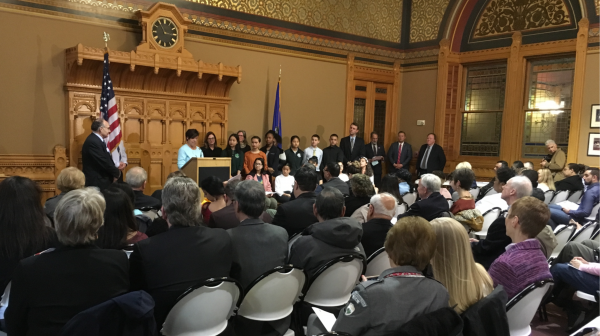
 Sixth-graders from the Interdistrict School for Arts and Communication in New London were recognized for their project, “Community Faces-Humanizing the Immigrant Label,” parts of which were on display at the Capitol. The second group was Teens4Citizenship, a Hartford Public Library and Hartford Public Schools collaborative program. As "Citizenship Guides," these high school immigrant students support family and community members on the path to Citizenship and upon turning 18 pursue their own citizenship.