CT’s K-12 Enrollment Drops, Demographic Diversity Grows

Between the 2007-08 school year and the just completed 2017-18 school year in Connecticut, total K-12 student enrollment across the state dropped by nearly 40,000 students, reflected a gradual year-over-year decline in every year of the decade. According to state Department of Education data, enrollment in 2007-08 was 574,848, which slid down to 535,025 this past year, a decline of 39,823 students, or just under 7 percent.

The demographic characteristics of Connecticut’s students has changed substantially.  During the past ten years, the percentage of White students has dropped from 65 percent of those enrolled to 53 percent, while the percentage of Hispanic students has grown from 17 percent in 2007-08 to nearly 25 percent (24.85%) during the school year that ended last month. The percentage of Black students has nudged upward, from 13 to 14 percent.

There were 286,506 White students, 132,940 Hispanic students and 68,697 Black or African American Students during the 2017-18 school year.  That compares with 373,818 White students, 96,127 Hispanic students and 80,234 Black students.  In the past decade, the number of Black students has increased by about 11,000 while the number of Hispanic students has grown by more than triple that - about 36,000.

There were 79,256 students who had qualified for Special Education status last year, up from 68,750 in 2007-08.

Seven percent of students, a total of 38,368, qualified for English Learner status, compared with about 5 percent, or 30,088 students, during the 2007-08 academic year.

Looking ahead, there were 36,239 students in Kindergarten in Connecticut public schools last year.  In 2007-08, there were 39,944.

9 CT Communities Among Nation’s Best to Start Small Business

Nine Connecticut communities are among the best in the nation for starting a small business, according to student loan company LendEdu, which has produced a list of the 500 Best Cities to Start a Small Business in the U.S. Storrs/Mansfield topped the list in Connecticut at 89. Also making the list were Stamford (178), Farmington (214), Windsor (247), Hamden (285), Oxford (387), Westport (477), Cromwell (486) and New Fairfield (493).

Founded in 2014, LendEdu describes itself as a marketplace for private student loans, student loan refinancing, credit cards and personal loans.

The top 10 included three cities in North Dakota, four from Virginia, and cities in Maryland, Colorado and Alabama.  The highest ranked New England community – Canton, MA – was number 49. Storrs-Mansfield was the leading community in Connecticut.

On the population score rankings alone, New Fairfield had the eighth best score in the nation.  On the income score scale, Hamden ranked 29th, highest among the Connecticut communities.  On the Expense scale, Stamford, just outside the top 50, was tops in Connecticut.

Cities were ranked based on the following criteria:

  • Population Score (20 points maximum) – including the daytime population score - the difference in the normal population and the population that is present during standard working day hours – and the population growth score - forecasted population growth over the next five years.
  • ​Income Score (40 points maximum) – consisting of the average disposable income available to residents and forecasted income growth over the next five years.
  • Expense Score (40 points maximum) – which includes consideration of property tax rates, sales tax rates, average cost of utilities, rate of burglaries and property crimes compared to the national averages.

PERSPECTIVE: Protecting the Separation of Powers

by Mark Dubois [This is] a topic that is much discussed by us who study and live the law, but little understood and appreciated by the public: the separation of powers.

The origin of the separation of powers is specifically credited to Montesquieu during the Enlightenment, who wrote of it in “The Spirit of the Laws in 1748,” a document whose influence was significant in the 1787 creation of the Constitution of the United States.

“When the legislative and executive powers are united in the same person, or in the same body of magistrates, there can be no liberty; because apprehensions may arise, lest the same monarch or senate should enact tyrannical laws, to execute them in a tyrannical manner.

“Again, there is no liberty if the judiciary power be not separated from the legislative and executive. Were it joined with the legislative, the life and liberty of the subject would be exposed to arbitrary control; for the judge would be then the legislator. Were it joined to the executive power, the judge might behave with violence and oppression.

“There would be an end of every thing, were the same man, or the same body, whether of the nobles or of the people, to exercise those three powers, that of enacting laws, that of executing the public resolutions, and of trying the causes of individuals.”

James Madison wrote on the necessity of a separation of powers in the “Federalist Papers”: “It may be a reflection on human nature that such devices should be necessary to control the abuses of government. But what is government itself, but the greatest of all reflections on human nature?

“If men were angels, no government would be necessary. If angels were to govern men, neither external nor internal controls on government would be necessary.

“In framing a government which is to be administered by men over men, the great difficulty lies in this: you must first enable the government to control the governed; and in the next place oblige it to control itself.

“This policy of supplying, by opposite and rival interests, the defect of better motives, might be traced through the whole system of human affairs, private as well as public … that each may be a check on the other that the private interest of every individual may be a sentinel over the public rights.

“These inventions of prudence cannot be less requisite in the distribution of the supreme powers of the State.”

The role of the courts in regulating the other branches of government was not immediately acknowledged, receiving its first expression in Marbury v. Madison in 1803 and later in Dred Scott in 1857, both instances when SCOTUS held federal laws to be unconstitutional and unenforceable.

As a matter of fact, it wasn’t until after the Civil War that the notion that our federal courts were a co-equal branch of government and not just a place for the resolution of private disputes really began to take hold.

Since then, however, it’s become accepted and understood that our courts remain the bulwark where those seeking relief from executive fiat or legislative errors can be given shelter.

Closer to home, and unlike the federal system where separation of powers is found in the interstices rather than in the text, we have our own constitution which specifically spells the concept out.

In Connecticut, separation of powers was not codified into our law until the adoption of the Constitution of 1818.

Article 2, as amended by Article 18 of the amendments, provides: “The powers of government shall be divided into three distinct departments, and each of them confided to a separate magistracy…”

Before that constitution, much of the power of state government resided in the legislature. And here in the land of steady habits, change came slow. It took more than 60 years from the adoption of the 1818 constitution until the first meaningful iterations of the principle of separation of powers was realized by action of the Supreme Court of Errors in Styles v. Tylerin 1884 and the Norwalk Street Railway Appeal 13 years later in 1897.

Indeed, the most significant separation-of-powers cases did not begin until the latter half of the last century, with the Connecticut Bar v. Connecticut Bank unauthorized practice of law case in 1958, Adams v. Rubinow, dealing with probate courts in 1968 and State v. Clemente, in 1975, a criminal case nearly 160 years after the constitution was adopted.

As with our federal brethren, our state courts have now fully embraced their role as protectors of this important principle.

Recently we’ve seen separation of powers being the deciding issue in a number of cases in very different contexts. State v. Courchesne, and its progeny, dealt with the ability of the Legislature to establish rules governing how courts were to interpret statutes; Bysiewicz v. Dinardo (whether exercising executive powers and functions could be deemed to be practicing law); Persels v. Banking Commissioner (regulation of the legal profession by the executive branch); and Coalition for Justice in Education Funding v. Rell (education funding).

The push and pull of power and authority against and across the necessary porous boundaries between these separate magistracies remains an ongoing dynamic, no less today than when Montesquieu and Madison wrote about it in the 18th century. And, as Madison correctly noted, none of us is an angel. The process of government is far from perfect, and even the best systems are no better than those who enforce them.

Federal courts who have been asked to slow our president down have been attacked as “so-called judges,” not much different from a half century or more ago when they were desegregating the schools.

Closer to home, the recent legislative grilling of a sitting Supreme Court justice over his rulings on the death penalty and other politically charged issues during hearings over his proposed ascension to the position of chief justice warns us that we’re no better or worse than our friends in Washington.

We may not all agree on specific issues, but we can and should agree that the system of separation of powers or constitutional checks and balances is a necessary and enervating principle essential to the proper working of our government.

It is our duty, having taken an oath as both a lawyer and a commissioner of the superior court, to stand up and say no when political, personal or passing fashions or ideas threaten the proper and independent operation of any of our branches of government, especially the judiciary.

It is therefore fitting that we take time today, celebrating the rule of law, to reaffirm our fealty to these principles. If the ideals embodied in our state and federal constitutions are to continue to make us a strong and vibrant country, it’s all our duty to speak out and protect them when we see them under attack.

___________________________________

Former Connecticut Chief Disciplinary Counsel Mark Dubois is with Geraghty & Bonnano in New London.  These remarks were delivered as part of a Law Day 2018 observance in Middletown this spring, and subsequently published in the Connecticut Law Tribune.  

Education, Individual Impact Drive Mission of New Climate Change Center

Former Connecticut Commissioner of Environmental Protection and Administrator of the federal Environmental Protection Agency Gina McCarthy has made the shift from government to academia, with the launch of The Center for Climate, Health, and the Global Environment (C-CHANGE) at the Harvard T.H. Chan School of Public Health. C-CHANGE is a new collaboration between Harvard University and Google that will seek to reduce the use of harmful chemicals in building products and materials.  C-CHANGE is committed to transforming science into meaningful actions that will deliver a healthier, more just, and sustainable world, according to the university.

The Center aims to ensure that government officials, business leaders, and the public have access to the best science so they can understand the health and environmental challenges they face, why it matters to them, and how they can get engaged.

McCarthy headed the Connecticut DEP from 2004 to early 2009, and left to become head of EPA's air and radiation office before advancing to the nation’s top environmental protection job in 2013.

Appearing on Conversations on Health Care, a podcast produced by Middletown-based Community Health Center Inc., McCarthy discussed past, present and future.  On the program, hosted by President and Co-founder Mark Masselli and Senior Vice President and Clinical Director Margaret Flinter, McCarthy said C-CHANGE was working to make climate change “very personal, and actionable to individuals, and families and businesses.”  She added, “information is power… I want people to have that information.”

McCarthy said she understands the concerns of some in the environmental community regarding Trump Administration efforts to roll back many of the Obama-era policies, but she said it will be tougher to accomplish than most believe.

“What we did was follow the science, we followed the law, we did great public process around it and I think we did a really good job,” McCarthy said, noting that many of the rule-change proposals of the past year or so are not yet final, and may not become final. “They’re going to have a very hard time.”

Her work at C-CHANGE is designed to accelerate and strengthen public education on climate change and pollution issues, bringing the science down to the individual level, highlighting the impacts on people, rather than the planet.


Reflecting on her time leading EPA, McCarthy said “We showed you can make progress environmentally, to preserve and protect public health, and our natural resources, but you can also, at the same time, do them in very cost effective, reasonable ways that in fact enhanced our economy and jobs.”

Last spring, Gov. Malloy appointed McCarthy to serve as a member of the Board of Directors of the Connecticut Green Bank.

At the C-CHANGE kick-off this spring, Harvard Chan School Dean Michelle Williams said “The Center will pave the way for new research and student engagement on energy systems, food and nutrition, healthier buildings, and products to benefit our school, our country, and the world.”  McCarthy spoke about the importance of broadening support for environmental and climate action by calling attention to the impact of climate change on people’s health and the solutions to address it.

“Climate change isn’t about saving the planet and it’s not about politics, it’s about our kids and making sure they have the opportunity for a healthy, sustainable world,” said McCarthy. “C-CHANGE will ensure that cutting-edge science produced by Harvard Chan School is actionable—that the public understands it, and that it gets into the hands of decision-makers so that science drives decisions.”

C-CHANGE, the Harvard Office for Sustainability, and Google will work together to develop a set of public tools and resources that use the latest scientific research to inform decision-making by large institutions, purchasers, and manufacturers to help transform the marketplace to healthier alternatives. The collaboration,  to the university, aims to improve public health and the well-being of communities, reduce the use of harmful chemicals and leverage lessons learned to create a model that can be replicated by other organizations.

Moving forward, the two groups intend to continue partnering with Harvard’s schools to use the campus as a living lab to test new ideas and verify performance.


Tanning Beds in Gyms Is Concerning Trend, UConn Study Finds

"By pairing exercise with tanning beds, gyms send the message that tanning is part of a healthy lifestyle. It is not," according to University of Connecticut researcher Sherry Pagoto in a study published this month in the Journal of the American Medical Association Dermatology. Pagoto is a professor of allied health sciences and president of the Society of Behavioral Medicine.  “The presence of tanning beds in gyms is a concerning trend.” Pagoto and her colleagues surveyed more than 600 people who had used a tanning bed at least once in their life. Nearly one-quarter (24%) had tanned in a gym at least once, the findings showed.  Those who had tanned at a gym tended to be heavier tanners overall, and were more likely to be what the researchers called "addictive" tanners.

Nearly half the gyms in the U.S. contain tanning beds.  Two of the largest American gym chains (Planet Fitness and Anytime Fitness) with total combined membership of more than 13 million people offer indoor tanning, the study pointed out.  Anytime Fitness and Planet Fitness each have 26 Connecticut locations.

Exercise and tanning are both activities people use to improve their appearance; and people who tan in gyms tan more often – and more addictively – than other people who use tanning beds, according to the study. Exercise reduces the risk of every cancer except one – melanoma, the deadliest form of skin cancer. People who exercise heavily are at greater risk of skin cancer, and yet many gyms in the U.S. have tanning beds. In other words, tanning beds in gyms are targeting people who are already at higher risk of skin cancer, UConn Today explained recently in highlighting the study.

“Exercise and tanning are both things people use to look better, which may be why we see a connection between these two behaviors, and why gyms are providing tanning beds to patrons,” Pagoto said.

The study also found that greater tanning was associated with more frequent exercise, which is especially concerning, because of the connection between heavy exercise and skin cancer risk. Researchers don’t know why exercise is associated with an increased risk of skin cancer. But they do know that the majority of skin cancers are caused by exposure to ultraviolet light, which is what tanning beds produce.

Ongoing, occasional use of tanning beds triples a person’s lifelong risk of melanoma, according to the Melanoma Research Foundation, and the incidence of skin cancer has been rising for 30 years in the U.S. About 91,000 people will be diagnosed with melanoma in 2018, and about 9,000 will die from it, according to the American Cancer Society.

“Indoor tanning is the same class of carcinogen as tobacco, radon, and arsenic,” says Pagoto. “Those are not things you’d want around you while you’re working out.”

Pagoto is also Director of the UConn Center for mHealth and Social Media. She is also a licensed clinical psychologist her research focuses on leveraging technology in the development and delivery of behavioral interventions targeting diet, physical activity, and cancer prevention behaviors. She has had federal funding for her program of research for 14 consecutive years, totaling over $11 million, and has published over 170 papers in peer-reviewed journals, according to the UConn website.

Among the statements from survey respondents: “My urges to indoor tan keep getting stronger if I don’t indoor tan,” and “at times, I have used money intended for bills to pay for my tanning sessions.”

Pagoto was joined in the study by researchers from the University of Mississippi Medical Center, Lincoln memorial University in Tennessee, University of Massachusetts Medical School, Pennsylvania State University and East Tennessee State university.  The study was funded by the Centers for Disease Control and Prevention, Division of Cancer Prevention and Control.

CT Headed for Population Also-Ran Status by 2040; Eight States Will Be Home to Nearly Half of Us

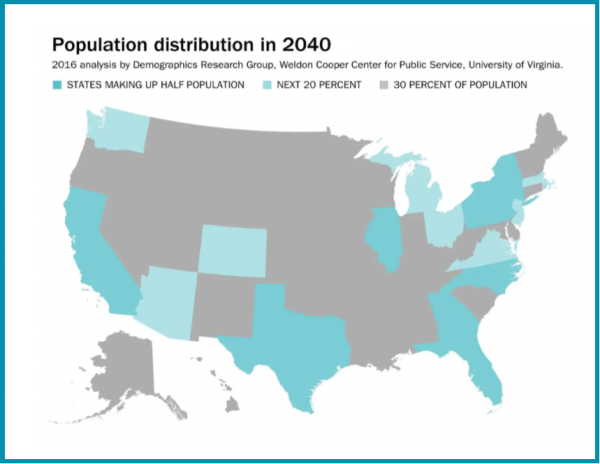
In 2040, it is anticipated that eight states will have just under half of the total population of the country, 49.5 percent, according to the Weldon Cooper Center for Public Service of the University of Virginia, which analyzed U.S. Census Bureau population projections.  Connecticut is not one of them. A report published in the Washington Post also indicated that the next eight most populous states will account for an additional fifth of the population, up to 69.2 percent — meaning that the 16 most populous states will be home to about 70 percent of Americans.

Geographically, the Post reports, most of those 16 states will be on or near the East Coast. Only three — Arizona, Texas and Colorado — will be west of the Mississippi and not on the West Coast.

The eight states expected to dominate the population numbers, with nearly half the nation’s residents, are California, Illinois, Pennsylvania, New York, Texas, North Carolina, Georgia and Florida.  The next eight, which will include 20 percent of the population, are Arizona, Colorado, New Jersey, Ohio, Virginia, Massachusetts, Michigan and Washington.

Connecticut is one of 34 states in which the remaining 30 percent of the nation’s population will reside.

The projections by the Weldon Cooper Center for Connecticut’s population are: 3,606,144 in 2020; 3,634,820 in 2030; 3,585,765 in 2040.

In previous populaton analysis, the Center has noted that the U.S. population is expected to reach 383 million by 2040, but the rate of growth is projected to slow down from nearly 10 percent over the 2000-2010 decade to 6 percent between 2030-2040. Similar trends are also expected from most states.

The geographic distribution of the nation’s overall growing population also reflects geographic shifts. Back in 2000, six of the top ten largest states belonged to the North. By 2040, five of the top ten are expected to be in the South. The slowing down of the northern states growth, along with rapid population growth in the south and west, means that over time the country will become more Southern and Western, the Center indicates. 

The fastest growth is projected to take place in Washington D.C., Texas, Colorado, Utah, and Florida. As noted above, the Connecticut population is expected to drop between 2030 and 2040.  Also expected to see population declines in that decade are Illinois, Maine, Michigan, Mississippi, New Hampshire, Ohio, Pennsylvania, Rhode Island, Vermont and West Viginia.


Nine CT Employers Among Nation's Best for Women, Analysis Shows

Nine Connecticut companies are among the 300 best employers in the country for women, according to a new analysis. Four of them - Booking Holdings in Norwalk (54), Pitney Bowes in Stamford (63), The Hartford in Hartford (88) and Farmington-based United Technologies (99) earned a spot in the top 100. The No. 1 company on Forbes' list was Iowa-based Principal Financial Group. According to Forbes, 59 percent of the company's employees are women and the company offers benefits like flexible work schedules and onsite child care. Philadelphia-based Penn Medicine was ranked second. According to Forbes, women comprise 77 percent of Penn Medicine's workforce and 55 percent of its executive positions. Five of Penn Medicine's seven CEO positions are held by women, the magazine noted. 

The survey is the first-ever ranking of America’s best employers for women produced for Forbes.  Rounding out the top five were Hallmark CardsBayCare and Oregon Health & Science University.  At Hallmark, 83 percent of employees, 40 percent of senior managers and 75 percent of board members are women.  Hallmark closed its longtime Enfield distribution center two years ago.

The five other Connecticut employers to merit mention in the inaugural top 300 list were: WR Berkley of Greenwich (171), Synchrony Financial of Stamford (194), Ethan Allen (197) and Praxair (220), both based in Danbury, and Hartford-based Aetna (287).

Forbes partnered with market research firm Statista to develop the list. Statista surveyed 40,000 Americans, including 25,000 women, working for businesses with at least 1,000 employees. The surveys were anonymous.

Respondents were first asked to rate their organizations on criteria such as working conditions, diversity and how likely they’d be to recommend their employer to others. These responses were reviewed for potential gender gaps. If women, for example, rated an organization poorly on diversity, but men rated it highly, Statista would take that into account and adjust the company’s score accordingly. Women were also asked to rate employers on factors like parental leave and pay equity, according to Forbes.

Earning a position in the top 10 were Keller Williams Realty (#6), Boston Children’s Hospital (#7), Providence Health & Services (#8), and Harvard University (#9).

Among the employers on the list with a presence in Connecticut are YMCA (#34), Lincoln Financial (#52), Ikea (#56), Five Guys (#65), Gap (#66), Hilton (#90) and Whole Foods (#93).


PERSPECTIVE: Challenging Times, Leaders Needed

by Dr. Johnnetta Betsch Cole I do not think I have to convince you that we are living in very challenging times.

But in case you ask me for evidence that all is far from peaceful and just in our communities, our nation, and our world—let me recall with you that on August 12 in Charlottesville, Virginia, white supremacists wore the symbols and shouted out words associated with the Ku Klux Klan and Nazis. And day after day, we hear from more than one leader in the world expressions and actions of bigotry and hatred for people of color, for women, for people of Jewish and Islamic faiths, for individuals of LGBTQ communities, for differently abled individuals, for immigrants, and yes, for women, men and children who are poor.

Surely you agree with me when I say that in communities across our nation and our world, there is a crying need for peace, justice, and equality for all people. It is because of the state of our nation and our world that we turn to you, the graduates of this very special college, to say that you can be and you must be the leaders we desperately need.

So what is required of you to be the leaders we have been waiting for? First, you must be of service to others. Listen to these words of Dr. Martin Luther King:

“Everybody can be great because anybody can serve. You don’t have to have a college degree to serve. You don’t have to make your subject and your verb agree to serve. You don’t have to know about Plato and Aristotle to serve. You don’t have to know Einstein’s theory of relativity to serve. You don’t have to know the second theory of thermodynamics in physics to serve. You only need a heart full of grace. A soul generated by love.”

This idea of being a servant leader was taught to me by my parents, my minister, and my community leaders as I grew up in the segregated South. They repeatedly said to me, “Doing for others is just the rent you’ve got to pay for your room on earth.”

The much-admired African American educator, Dr. Mary McLeod Bethune, who founded Bethune- Cookman College that is now a university, would often say, “Go on and climb to the top. But remember, you must lift others as you climb.”

Elie Wiesel, the great humanitarian who as a boy was put in a concentration camp because he was Jewish, once said this, “Our lives do not belong to us alone. Our lives belong to those who need us the most.”

There are so many ways to be of service, such as volunteering in a soup kitchen, a center for the victims of domestic violence, or an after-school program. Beyond the moral and ethical reasons to volunteer, there are some very practical reasons. Studies have shown that people who volunteer have less stress, greater satisfaction, as well as improved problem-solving and networking skills. And yes, students who volunteer do better in school.

A second requirement if you are to fulfill the promise of being effective leaders in today’s highly technological and diverse world is this: You must not only understand and respect your own culture; you need to have knowledge of and respect for people who are different from you. Indeed as technology transforms our world into a global village, a leader must respect the diversity of humankind and think and act in an inclusive way.

To acquire the skills and sensibilities to function in today’s world, you must be able to work and interact with people who do not have the same skin color and hair texture as you do, who do not speak as you do, worship as you do, move about physically as you do, and partner as you do.

There is an incredibly rewarding bonus in store for those who manage to do this. And that is you will come to more fully understand and respect yourselves. As we anthropologists say, “It’s scarcely the fish who discovers water.” Indeed by learning about others, we better understand ourselves.

Here is a third requirement if you are to fully embrace your potential to be the leaders we desperately need: You must believe that a positive change is possible and that you have a responsibility to help to make it happen. There are so many ways that, as young and not-so-young people, you can help to change our world. Indeed, we are witnessing a time in our county when young folks are at the forefront of the call for positive change on a number of issues.

One of my heroes, Marian Wright Edelman, the president of the Children’s Defense Fund, has said this: “If you don’t like the way the world is, you change it, you have an obligation to change it. You just do it one step at a time.” There is an African saying that speaks to the power of one person to make a difference. It says: “If you believe one creature cannot make a difference, you have never spent a night in a closed room with a mosquito.”

Let me bring closure to my remarks by telling you a story.

One day, while walking on a beach, an old man encountered a young girl picking up starfish and throwing them back into the ocean. The old man asked, “Why are you throwing starfish into the ocean?” The girl replied, “The sun is up and the tide is going out, and if I don’t throw the starfish into the ocean, they will die.” “But young girl, don’t you realize that there are miles and miles of beach and starfish all along it? What you are doing can’t really matter.” The young girl listened politely to the old man, but then as she bent down, picked up another starfish, and threw it into the ocean, she said, “It mattered to that one.”

The girl was indeed a leader. This young hero honored her responsibility to be of service to others—including starfish! She understood and respected diversity, including biodiversity. And this young girl was committed to being an agent for positive change, even when that meant saving a few starfish along a beach.

I believe that each of you can and must be the leaders we need—for you can be of service to others, you can respect human diversity, and you can be agents for positive change. So go on dear graduates and be the leaders we have been waiting for!

___________________

Dr. Johnnetta Betsch Cole, former president of Spelman College and Bennett College, and former director of the National Museum of African Art, delivered this Commencement Address at Trinity College in Hartford on May 19, 2018. In honor of her broad civic involvement in various worthwhile causes, Cole has received 64 honorary degrees and numerous awards, including the TransAfrica Forum Global Public Service Award; the Radcliffe Medal; the Eleanor Roosevelt Val-Kill Medal; the Alexis de Tocqueville Award for Community Services from United Way of America; the Joseph Prize for Human Rights presented by the Anti-Defamation League; the Straight for Equality Award from Families and Friends of Gays and Lesbians (PFLAG); and the Alston-Jones International Civil and Human Rights award.

Town Centers Gain Recognition, Walkability Highlighted

Connecticut’s official state tourism site is touting the virtues of visiting six “walkable town centers” in the state, noting that the state “has many town centers where a nice ramble takes you to shops, restaurants, galleries, museums and even a park bench or two.” The number 1 location in the state, according to the website, is West Hartford Center.  Also highlighted are New Canaan, New Haven’s Chapel Street, Chester, Greenwich Avenue in Greenwich, and Litchfield.

Each of the six locations is highlighted on the site with information on attractions, events, restaurants, accommodations and shopping.

Of West Hartford Center, the state website says “the intersection of Farmington Avenue and South Main Street in West Hartford can lead you to many shopping or dining pleasures, and eventually to the adjacent Blue Back Square.”

New Canaan is described as “this classic commuter town,” which “has an appealing downtown and many restaurants, especially in the triangle formed by Main, Locust and Forest Streets.  Lots of places to shop, too.”

Describing Chapel Street in New Haven, the website suggests “you can truly spend an entire day (and night) without getting off Chapel Street.”  Chester, the website notes, has “small-town charm you’re looking for,” including “tasteful little shops and an interesting variety of restaurants.”

When the website Redfin compiled their latest list of most walkable cities, Hartford made the list.  With a walk score of 71, transit score of 54 and bike score of 53, the site noted the state’s Capital City as having an average walk score, good public transportation and “somewhat bikable.”  The most walkable neighborhoods named were Downtown, South Green and Frog Hollow, and the review of the city indicated that “most errands can be accomplished on foot in Hartford.”

New Haven received a walk score of 68 and a bike score of 66.  Both New Haven and Hartford (more recently) have launched bike exchange programs within the past year.  Bridgeport also received a walk score of 68, along with a bike score of 50.  Stamford earned a walk score of 54, bike score of 39 and transit score of 38.  Waterbury’s walk score was 49; bike score was 25.  Danbury’s walk score was 38.
The walk scores for cities across the country were grouped from 90-100 (walker’s paradise), 70-89 (very walkable), 50-69 (somewhat walkable), 25-49 (car dependent), to 0-24 (very car dependent).

The top bike friendly cities are Minneapolis, Portland, Chicago, Denver and San Francisco.  The most transit friendly are New York, San Francisco, Boston, Washington, DC, and Philadelphia.  The most walkable are New York, San Francisco, Boston, Miami and Philadelphia.

Gerrymandering Lessens Compactness, Which Lessens Voting, UConn Study Finds

The less geographically compact a district is, the lower the voter turnout. That’s the bottom-line finding of a study by a University of Connecticut political scientist, published in the June issue of Election Law Journal.  The study suggests that gerrymandering – often criticized for skewing political representation to one party or the other – has additional ill-effects, including the act of voting itself. Using a dataset on the compactness of U.S. House districts—with multiple measures generated by geographic information system (GIS) analyses over two redistricting cycles, UConn Associate Professor Jeffrey Ladewig estimated the effects of congressional district compactness on electoral turnout. The conclusion:  compactness matters.  The study “Appearances Do Matter”: Congressional District Compactness and Electoral Turnout” was led by Ladewig.
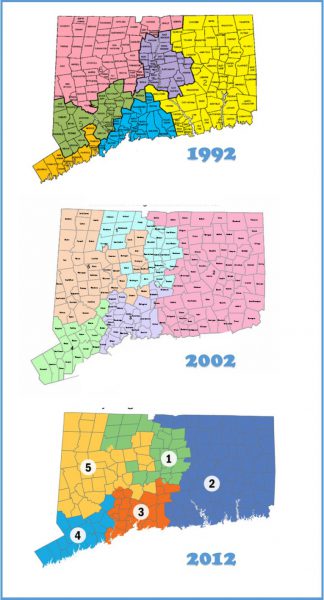
“Districts that were less geographically compact had lower voter turnout – measured both from election data and individual survey data – even controlling for district demographic and election characteristics,” the Boston Globe reported in a brief news item about the study.

States determine their district lines for Congressional seats and state legislative seats every ten years, following the U.S. Census.  The next Census will be in 2020, with district lines slated to be redrawn for the 2022 elections.

According to Governing magazine, states around the country have a range of criteria in drawing district lines, including:

  • Compactness: Having the minimum distance between all the parts of a constituency (a circle, square or a hexagon is the most compact district).
  • Contiguity: All parts of a district being connected at some point with the rest of the district.
  • Preservation of counties and other political subdivisions: This refers to not crossing county, city, or town, boundaries when drawing districts.
  • Preservation of communities of interest: Geographical areas, such as neighborhoods of a city or regions of a state, where the residents have common political interests that do not necessarily coincide with the boundaries of a political subdivision, such as a city or county.
  • Preservation of cores of prior districts: This refers to maintaining districts as previously drawn, to the extent possible. This leads to continuity of representation.
  • Avoiding pairing incumbents: This refers to avoiding districts that would create contests between incumbents.

Connecticut has no guidelines or limitations in drawing Congressional District lines. (Although it does have a process.)

Jeffrey W Ladewig earned his Ph.D. from the Department of Government at University of Texas at Austin in 2002 and his B.A. from the Department of Political Science and the Department of Economics from the University of Wisconsin at Madison in 1993. He teaches courses on the U.S. Congress, the U.S. President, American political economy, and American political parties.