Report: Medicaid's Impact Goes Beyond Health Care to Economy
/Medicaid is, at its core, a health insurance program that provides coverage to low-income Connecticut residents. A new report in Connecticut finds that the program also plays a key role in the state’s economy, budget, and ability to weather economic challenges. The report was developed for, and released by, the Connecticut Health Foundation.
In Connecticut, Medicaid is known as HUSKY and covers approximately one in five state residents – close to 800,000 people. HUSKY covers more than one third of Connecticut children, nearly 47 percent of non-elderly adults with disabilities, 15 percent of seniors, and 70 percent of nursing home residents.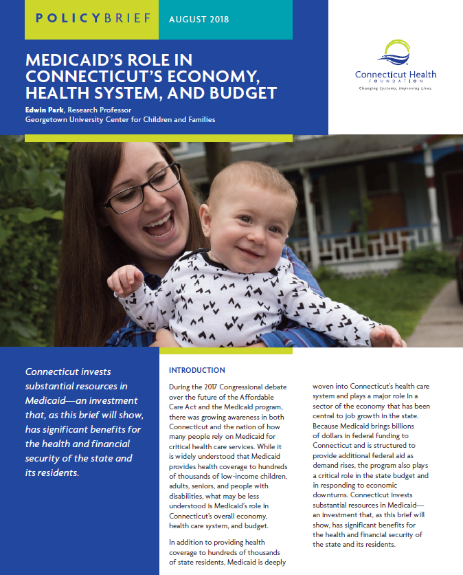
The report, developed by the Georgetown University Center for Children and Families, finds that the program is deeply woven into Connecticut’s health care system and plays a major role in a sector of the economy that has been central to job growth in the state. Health care makes up nearly 15 percent of the state’s gross domestic product. Medicaid finances about 20 percent of health care expenditures in Connecticut.
“It is important for policymakers to understand the full impact of Medicaid in the state, particularly as they face difficult budget decisions,” said the report’s author, Edwin Park, research professor at the Georgetown University Center for Children and Families. “Medicaid plays a key role in the state’s economy and is linked to long-term positive outcomes for children like better health, obtaining a college degree, and higher earnings.”
 Among the report’s other key findings:
- Research has linked Medicaid coverage of children and pregnant women to long-term health and economic benefits when children reach adulthood: better health outcomes, greater educational attainment such as completing high school and obtaining a college degree, and higher employment and earnings.
- Medicaid can help states cope with recessions and economic downturns because it automatically increases federal funding in response to higher state costs, such as those resulting from enrollment increases as people lose their jobs and health insurance.
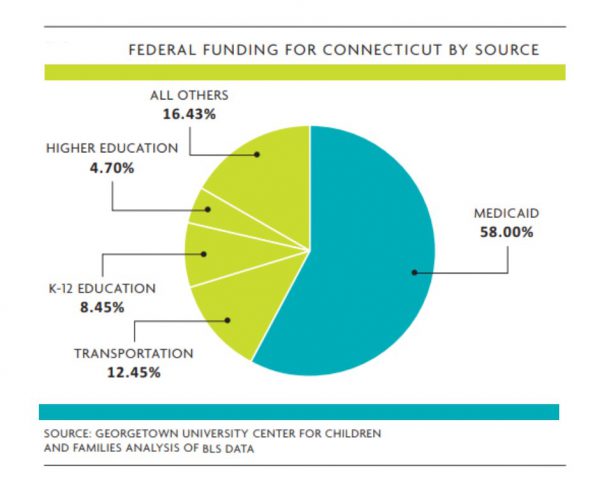
- Medicaid contributes the majority of the federal funding spent through Connecticut’s state budget – 58 percent in the 2016 fiscal year. The federal government pays more than half of the state’s Medicaid costs. For every $10 spent on Medicaid in Connecticut, approximately $5.92 comes from the federal government.
“Connecticut invests significant resources in HUSKY and the findings of this report underscore the impact of this investment,” said Patricia Baker, president and CEO of the Connecticut Health Foundation.
The report also indicted that “research has found that Medicaid eligibility during childhood is tied to higher wages and cumulative higher tax payments made as young adults. It also increases employment and reduces the need for public assistance, especially assistance needed due to disability. According to the report, in 2016 Medicaid covered:
- 4 percent of the nearly 400,000 hospital discharges and 12.9 percent of hospital payments.
- 63 percent of the 373,200 patients who received care at community health centers.
The Connecticut Health Foundation is the state’s largest independent health philanthropy dedicated to improving health outcomes for people of color. Since its creation in 1999, the foundation has awarded more than $62 million to nonprofit organizations and public entities to expand health equity, reduce health disparities, expand health coverage, and improve the health of all Connecticut residents.
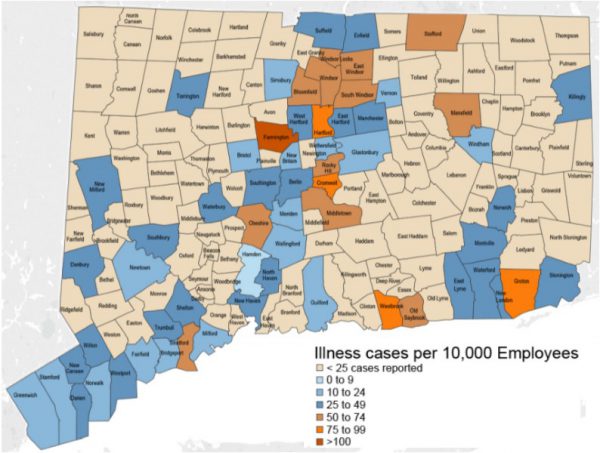
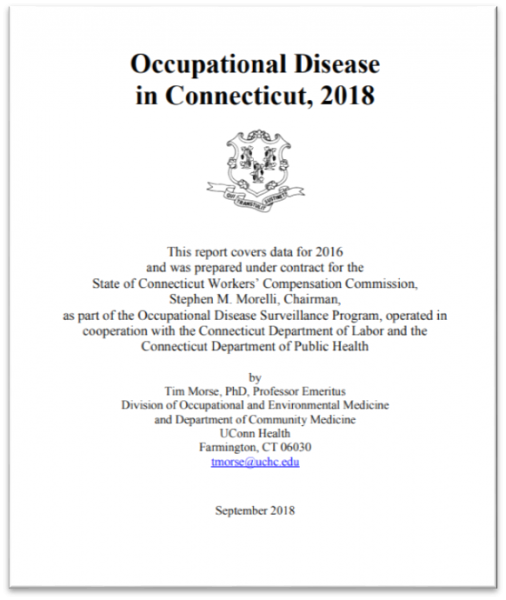
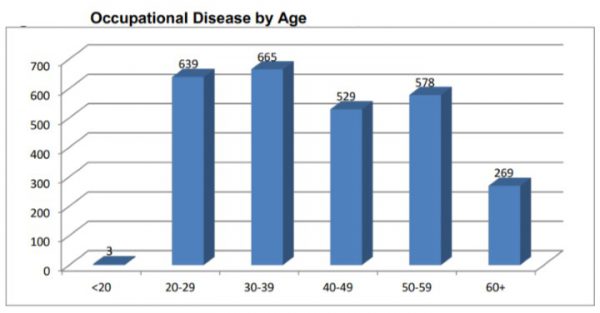 These higher town rates often reflect the locations of large employers in higher hazard industries, and may also reflect better reporting of cases, since cases of occupational illness are often not reported, the study points out.

 After a lot of hard work in recruitment and creating lesson plans, we had our first meeting in September of 2017. We were both excited and anxious that this day had finally arrived and that our hard work had paid off.

 One student wrote on the before side of the poster that they feared “we might not be able to get along.” However, after our lesson they wrote on the after side of the poster that now they know “we are so similar and can be close friends.” It was truly inspiring to see how much new knowledge they acquired regarding the similarities between the two religions in just one short hour. The kids were so excited to learn this material and fascinated by the common ground.

 Trumbull First Selectman Vicki Tesoro has expressed reservations, encouraged public comment, and kept an open mind. In a public
 The Bridgeport-Stamford-Norwalk metropolitan area also ranked fifth in the nation in the percentage of bachelor’s degree holders and the percentages of graduate or professional degree holders. The regions with higher percentages in both categories are Ann Arbor, Washington D.C., and San Francisco, joined by San Jose for bachelor’s degrees and Durham-Chapel Hill, NC for graduate or professional degrees.

 The Fix Connecticut campaign centers on a five-point plan that outlines key policy steps designed to remove barriers to economic growth and leverage the state's many strengths, according to CBIA:
 That shift of political influence has ramification across the electoral system, and was the impetus for a lawsuit filed this summer against the state of Connecticut by the NAACP to force an end to the practice. It is the first of its kind, and being widely watched.

 I sit before you now as someone past 70 wondering why you - strangers to me, members of this Public Health Committee as well as your colleagues in the CT General Assembly - get to decide what my end of life is going to be like. This is very real … and gets more real every day for me and thousands of other people in Connecticut.

 NEFAC
 Stephanie McCrummen of The Washington Post, who won a Pulitzer Prize this year for investigative reporting, will deliver the keynote address. Joining McCrummen as featured speakers are Terence Smith, a contributing columnist for the Capital Gazette in Annapolis, Md., and David Cuillier, an associate professor at the University of Arizona School of Journalism.

 Timex