Norwalk Joins Sustainable CT Effort

Norwalk is the latest Connecticut municipality to join Sustainable CT, a statewide initiative that offers detailed array of sustainability best practices, tools and resources, peer learning, and opportunities for recognition.The Sustainable CT platform supports a broad range of actions, such as improving watershed management, supporting arts and creative culture, reducing energy use and increasing renewable energy, implementing “complete streets” (streets that meet the needs of walkers and bikers as well as cars), improving recycling programs, assessing climate vulnerability, supporting local businesses, and providing efficient and diverse housing options.   “I am delighted the city has joined Sustainable CT in our latest efforts to develop and implement sustainability and renewable energy initiatives in Norwalk,” said Mayor Harry Rilling. “Being energy conscience is the right thing to do as we all have a moral obligation to lessen our environmental impact. I am glad the city has taken a leadership role and joined this important sustainability initiative.”  Norwalk’s Council approved the resolution to join Sustainable CT in mid-August and designated the Common Council Planning Committee as the “Sustainability Team” for the program. Norwalk was officially registered with Sustainable CT on August 24.

The Sustainable CT initiative was developed under the leadership of the Institute for Sustainable Energy at Eastern Connecticut State University in partnership with the Connecticut Conference of Municipalities.

There is no cost to participate and communities voluntarily select actions that meet their unique, local character and long-term vision. After successful implementation of a variety of actions, municipalities will be eligible for Sustainable CT certification. According to the organization’s vision statement, “Sustainable CT communities strive to be thriving, resilient, collaborative, and forward-looking. They build community and local economy. They equitably promote the health and well-being of current and future residents, and they respect the finite capacity of the natural environment.”

“We are thrilled that Norwalk has passed a resolution to join Sustainable CT. The program builds on many current success stories in our communities to create and support more great places to live, work, and play,” said Lynn Stoddard, Director of the Institute for Sustainable Energy. “We are looking forward to working with the city as they pursue Sustainable CT certification."

The town of Thomaston joined the initiative in July. Three Connecticut philanthropies - The Emily Hall Tremaine Foundation, the Hampshire Foundation, and the Common Sense Fund – have supported the program's development and launch.
Report: Medicaid's Impact Goes Beyond Health Care to Economy

Medicaid is, at its core, a health insurance program that provides coverage to low-income Connecticut residents.  A new report in Connecticut finds that the program also plays a key role in the state’s economy, budget, and ability to weather economic challenges. The report was developed for, and released by, the Connecticut Health Foundation. In Connecticut, Medicaid is known as HUSKY and covers approximately one in five state residents – close to 800,000 people. HUSKY covers more than one third of Connecticut children, nearly 47 percent of non-elderly adults with disabilities, 15 percent of seniors, and 70 percent of nursing home residents.

The report, developed by the Georgetown University Center for Children and Families, finds that the program is deeply woven into Connecticut’s health care system and plays a major role in a sector of the economy that has been central to job growth in the state. Health care makes up nearly 15 percent of the state’s gross domestic product. Medicaid finances about 20 percent of health care expenditures in Connecticut.

“It is important for policymakers to understand the full impact of Medicaid in the state, particularly as they face difficult budget decisions,” said the report’s author, Edwin Park, research professor at the Georgetown University Center for Children and Families. “Medicaid plays a key role in the state’s economy and is linked to long-term positive outcomes for children like better health, obtaining a college degree, and higher earnings.”

Among the report’s other key findings:
  • Research has linked Medicaid coverage of children and pregnant women to long-term health and economic benefits when children reach adulthood: better health outcomes, greater educational attainment such as completing high school and obtaining a college degree, and higher employment and earnings.
  • Medicaid can help states cope with recessions and economic downturns because it automatically increases federal funding in response to higher state costs, such as those resulting from enrollment increases as people lose their jobs and health insurance.
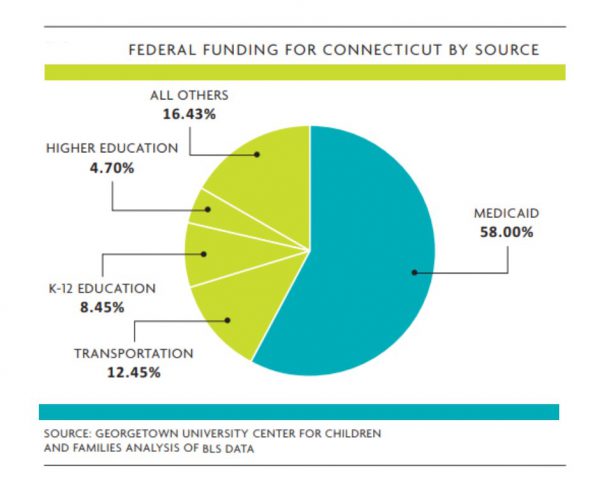
  • Medicaid contributes the majority of the federal funding spent through Connecticut’s state budget – 58 percent in the 2016 fiscal year. The federal government pays more than half of the state’s Medicaid costs. For every $10 spent on Medicaid in Connecticut, approximately $5.92 comes from the federal government.

“Connecticut invests significant resources in HUSKY and the findings of this report underscore the impact of this investment,” said Patricia Baker, president and CEO of the Connecticut Health Foundation.

The report also indicted that “research has found that Medicaid eligibility during childhood is tied to higher wages and cumulative higher tax payments made as young adults. It also increases employment and reduces the need for public assistance, especially assistance needed due to disability. According to the report, in 2016 Medicaid covered:

  • 4 percent of the nearly 400,000 hospital discharges and 12.9 percent of hospital payments.
  • 63 percent of the 373,200 patients who received care at community health centers.

The Connecticut Health Foundation is the state’s largest independent health philanthropy dedicated to improving health outcomes for people of color. Since its creation in 1999, the foundation has awarded more than $62 million to nonprofit organizations and public entities to expand health equity, reduce health disparities, expand health coverage, and improve the health of all Connecticut residents.

Occupational Illnesses Remain High in Connecticut, Report Finds

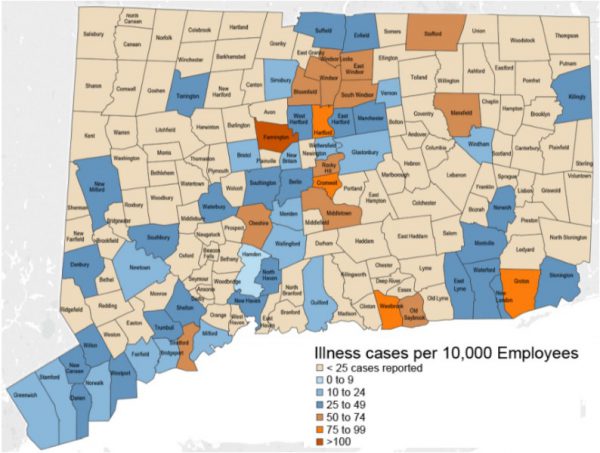
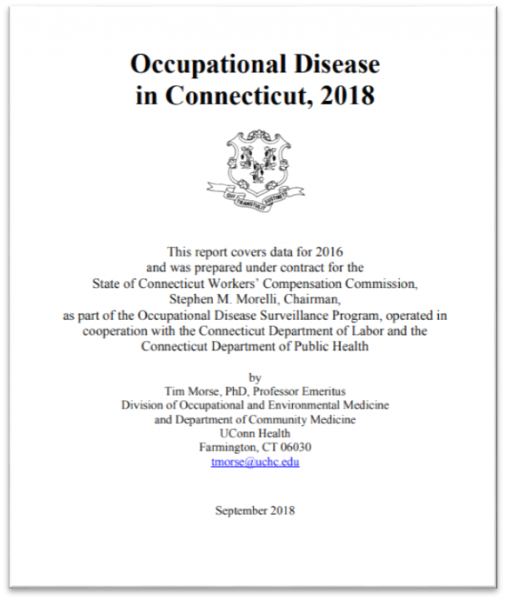
Occupational illnesses remain a serious and under-reported issue in Connecticut, with a rate 6 percent higher than the national average, according to a new report issued by UConn Health.  The latest data shows a reporting of over 7,500 occupational illnesses, with up to an estimated 25,000 cases going unreported. The highest number of cases reported were in Farmington, Hartford and Cromwell. The newly published Occupational Disease in Connecticut, 2018 report examined the latest 1997-2016 data, based on reports of individuals filing for workers’ compensation, physician reports to the Occupational Injury and Illness Surveillance System, and the ConnOSHA/BLS survey of employers.

Connecticut’s illness rate ranked 15th highest out of 41 states with publishable data (fourteen states had higher rates and 26 had lower rates). Maine had the highest rate of 38.8 and Texas had the lowest at 9.8. Private sector rates for occupational illness were 15.0 in Connecticut and 14.1 nationally. Connecticut’s public sector rate was 35.7; the U.S. public sector rate was 31.6, according to the report.

The Connecticut data revealed reports of 7,675 unique occupational illnesses.  Most frequent were 3,430 musculoskeletal cases (such as sprains, Carpal Tunnel Syndrome, and tendonitis), and 2,408 infectious diseases (such as bloodborne diseases and exposures, meningitis, and Lyme Disease).  In addition, the data indicated there were 431 respiratory illnesses (such as chemical exposures, asthma, and poisonings), 313 skin disorders (such as poison ivy and chemical dermatitis), 115 cases of hearing loss, and 978 “other illnesses” (such as heart conditions, stress, and dizziness).

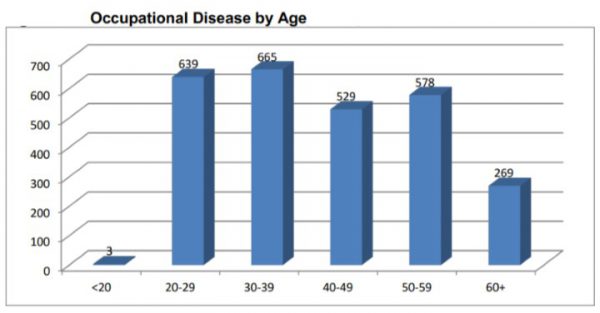
The OSHA/BLS survey shows a rate of 17.4 cases per 10,000 workers in Connecticut, 6 percent higher than the national rate of 16.4. The report focuses on chronic job-related illnesses, and does not include acute traumatic injuries. Overall, approximately 49% were for women, but this varied by type of case, with women accounting for 66% of infectious cases. Based on workers’ compensation reports of occupational illnesses, there were similar proportions (between 20%-25%) for workers in their 20’s, 30’s, 40’s and 50’s.

Rates of occupational illnesses varied widely across Connecticut towns and cities. Based on workers’ compensation reports from towns with at least 25 cases, the 10 highest rates were found in Farmington (126 cases per 10,000 workers - almost 4 times the rate as the state average), Hartford (89), Cromwell (89), Groton (85), Westbrook (84), Windsor Locks (73), East Windsor (63), Cheshire (61), Stratford (60), and Middletown (58). The town average across the state was 33 cases per 10,000 workers.

These higher town rates often reflect the locations of large employers in higher hazard industries, and may also reflect better reporting of cases, since cases of occupational illness are often not reported, the study points out.
Based on workers’ compensation reports, the highest rates of occupational illnesses were found in the industries of beverage and tobacco product manufacturing (170 cases per 10,000 workers), computer and electronic product manufacturing (131), primary metal manufacturing (112), state government (103), local government (81), transportation equipment manufacturing (59), electrical equipment manufacturing (57), miscellaneous retail stores (51), fabricated metal product manufacturing (49), and hospitals (46).

The highest specific sector rate, according to the report, was State Government with 41.8, with the highest rates for skin conditions (17.7) and lung conditions (7.9).  Local Government was second with 32.1, and Utilities third highest rate with 31.8.

Each year the report is prepared for the Connecticut Workers’ Compensation Commission by occupational and environmental health expert Tim Morse, professor emeritus at UConn Health. The 53-page report is part of the Occupational Injury and Illness Surveillance System, a cooperative effort of the Connecticut Workers’ Compensation Commission, the Connecticut Department of Public Health, and the Connecticut Labor Department.

The system is designed to track occurrences of work-related disease, with an eye to understanding patterns and developing approaches to prevent occupational illness.

“We must take stronger actions to improve the employee work safety experience and environment, with improvements in ergonomics, safe needle devices in health care, reducing mold and increasing fresh air flow in indoor environments, providing education on toxic chemicals, and increasing the recognition of such hazards as poison ivy,” Morse told UConn Today.

Morse and UConn Health researchers analyze survey responses and occupational illness reports from the State Labor Department/Bureau of Labor Statistics (BLS) survey; the first reports of injury to the Connecticut Workers Compensation Commission; and health provider reports to the Connecticut Departments of Labor and Public Health under the Occupational Illnesses and Injury Surveillance System.

PERSPECTIVE - Discovering Common Ground, Developing Friendships and Creating Impact: A Teenage Sisterhood Driven by Faith

by Olivia Rotter and Layan Alnajjar Around the time of the presidential election of 2016, we embarked on a journey to find peace and unity amidst high tension in our society and government. Coming from moderately conservative Jewish and Muslim homes, we were encouraged to raise our voices during this time of bigotry.

We have been friends throughout high school and were both passionate about social justice issues. Specifically, we were concerned about the hate speech and discriminatory language that was being used to target faith groups - including our own.

With this knowledge, we decided to form the first official teen chapter of the Sisterhood of Salaam Shalom, an international organization that aims to eliminate stereotypes and celebrate the power of friendship and compassion between Muslim and Jewish women. Historically, these two religions have had turmoil in reference to the Israeli-Palestinian conflict. However, this empowering sisterhood distances themselves from any opinionated topics and instead focuses on the similarities of the Jewish and Muslim practice.

The nonprofit organization Civil Politics conducted a study of participants in the Sisterhood. They concluded that “having more in common with members of each faith, more improvement in their comfort with others, and greater commitment to speaking out against divisive rhetoric,” is an extremely powerful agent for change. In correlation with our chapter’s success, this Civil Politics study proved that friendship and acceptance can overcome misunderstanding and misconceptions.

After a lot of hard work in recruitment and creating lesson plans, we had our first meeting in September of 2017. We were both excited and anxious that this day had finally arrived and that our hard work had paid off.
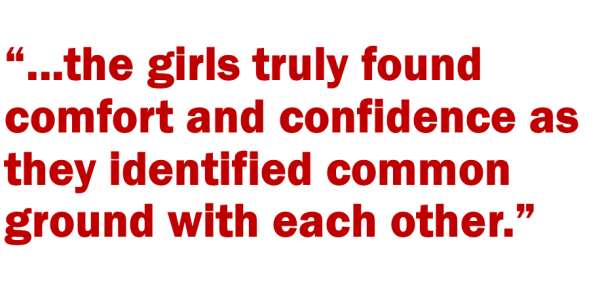
The excitement stemmed from our curiosity and hope that this one chapter could change our local community’s outlook. Our angst was in regards to the possibility that these fourteen high school girls - seven Jewish and seven Muslim - might not get along. To our pleasant surprise, the first meeting went exceptionally well and early friendships quickly began to form. Despite our previous concerns, the girls truly found comfort and confidence as they identified common ground with each other.

Since then, these friendships have taken flight and evolved through the process of giving back to our community. Our first charitable act was around the holiday season when we collected food cans, toiletries, and books for a local family shelter in Hartford. We unloaded and stocked hundreds of supplies that would be given to various families in need. This experience was a gateway to many more acts of service that brought us even closer as a sisterhood.

Soon after, we partnered with the Muslim Coalition of Connecticut to serve those in need of a healthy meal and a place to relax at Mercy Shelter in Hartford. Some of us were in charge of plating the food, while others waitressed. The facilitator for Mercy Shelter was so happy to have us all there and commented that we had the best teamwork he had ever seen. We look forward to going back this year and to gaining even more perspective.

The highlight of our year was teaching our own curriculum to 5th grade students at Beth El Hebrew School in West Hartford. For months our group spent time together creating an intricate lesson plan to teach these young students. The curriculum had a few different components, beginning with a Venn diagram activity that demonstrated the ways that Muslims and Jews are alike. The students soon caught on that every element was a part of both religions, falling into the center section of the diagram.

After many insightful discussions with the students, we then moved on to passing out a coloring page with the Jerusalem skyline on it. During that time, we played music in both Arabic and Hebrew. Lastly, we had each student write on a poster what they thought before versus what they know now, after the activity.

One student wrote on the before side of the poster that they feared “we might not be able to get along.” However, after our lesson they wrote on the after side of the poster that now they know “we are so similar and can be close friends.” It was truly inspiring to see how much new knowledge they acquired regarding the similarities between the two religions in just one short hour. The kids were so excited to learn this material and fascinated by the common ground.

A few weeks ago we were contacted by the coordinator of the Hebrew school and asked to officially be a part of the curriculum for 5th grade students. We feel so fortunate that we will be able to make an even greater impact this year.

In just a few short weeks our chapter will reunite for the first meeting of this new school year! We look forward to another successful year full of friendship, knowledge, and service.

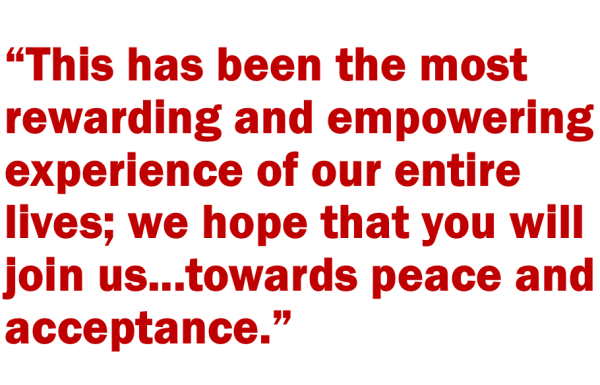
Next year, we are beginning another chapter in our lives as we head off to college. We both plan on bringing all we have learned to our universities, and hopefully starting the first Salaam Shalom college chapter! We urge you to begin making an impact by starting a new chapter of the sisterhood in your own community.  For us, this has been the most rewarding and empowering experience of our entire lives; we hope that you will join us on our journey towards peace and acceptance!

_______________________________________

Olivia Rotter and Layan Alnajjar are seniors at William H. Hall High School in West Hartford; dedicated students and active leaders within their community. This year, they will continue helping to start new chapters across Northern America and will mentor future teen leaders, giving them advice and ideas for meetings. They will be honored for their hard work and devotion to the Sisterhood at the organization’s annual conference in November.

 For more information about the sisterhood, visit https://sosspeace.org, follow the organization on facebook at the Sisterhood of Salaam Shalom, and follow their new teen-run instagram@sossteens.

Want to Live at the Mall? It Could Happen – in Trumbull

The Westfield Trumbull mall’s unusual request for a zoning change that would allow it to build 290 apartments on its 76-acre site may be the harbinger of things to come for suburban malls.  The plan was the subject last month of a Trumbull Planning & Zoning Commission hearing; a final decision is pending. The 290 units are planned to be one or two-bedroom apartments, with the opportunity to rent a garage and/or a storage space. The buildings will be on slabs, four stories high, with elevator access. Developers are hoping for a clubhouse, with a gym and common meeting room, and a pool.

The units would be marketed to professionals, young couples and older couples looking to stay in Trumbull, but not in a single-family home.  The plan is a trimmed down version of a proposal floated in the spring that would have developed 580 units.

Mall housing?  Nina Fuhrman, head of retail strategy at global design company IDEO, noted that “As we see the lines blurring between where you work and where you play and where you live, we’re going to see more residences and office spaces attached to malls.”

Trumbull may provide a glimpse into a trend gaining traction.  In a feature article last May in Business of Fashion, Westfield’s development of mall-adjacent residential properties was described as “a no-brainer because doing so will not only create a revenue stream from rent, but will also increase foot traffic to stores.” Already, Chief Operating Officer Bill Hecht told the publication, “the residential buildings in close proximity to our malls can charge slightly above market rent, because they have access to all our amenities close by.”

Trumbull First Selectman Vicki Tesoro has expressed reservations, encouraged public comment, and kept an open mind. In a public statement, she “expressed an understanding that malls throughout the country are reinventing themselves out of necessity. We, as a town, should work with them to the extent possible in that process. The mall is our largest taxpayer, and its success is a shared goal.”

In Bethesda, Maryland, Westfield plans to close a Sears store at the Westfield Montgomery Mall within the next year and is looking to launch a major mixed-use development on its piece of the property. The first phase, according to a report published by Bisnow, is expected to be completed by 2022, and would create 170K SF of new retail space with 350 to 360 apartments above, plus a health club. After that, Westfield would build an additional 300 units and 130K SF of retail and hotel space.

Jim Agliata, Westfield’s vice president of development, told Bethesda magazine earlier this year that the project represents the next phase of Westfield Montgomery’s emergence as a “lifestyle destination.”

Survey: Three CT Metro Areas Among Top 50 Most Educated in U.S.

In an analysis ranking America’s metropolitan areas to identify the most educated in the nation, one Connecticut region – the Bridgeport-Stamford-Norwalk area – was the 10th best in the nation, and two others earned spots in the top 50.   Hartford-West Hartford-East Hartford was ranked number 26 and New Haven-Milford placed at number 44. The Bridgeport-Stamford-Norwalk metropolitan area also ranked fifth in the nation in the percentage of bachelor’s degree holders and the percentages of graduate or professional degree holders.  The regions with higher percentages in both categories are Ann Arbor, Washington D.C., and San Francisco, joined by San Jose for bachelor’s degrees and Durham-Chapel Hill, NC for graduate or professional degrees.

Topping the overall list of “Most Educated Cities,” in an analysis from the financial services website WalletHub, were Ann Arbor, Washington DC, San Jose, Durham-Chapel Hill, San Francisco-Oakland, Madison, Boston-Cambridge-Newton, Austin, and Seattle-Tacoma.  The analysis was developed by the financial services website WalletHub.

On a substantially less positive note, the Bridgeport-Stamford-Norwalk metropolitan area had the largest racial education gap in the nation, of 140 metropolitan regions included in the analysis.

Data used to create this ranking were collected from the U.S. Census Bureau, GreatSchools.org, Education Cities.org, Yelp and WalletHub research.  A total of 11 relevant metrics were used, in the areas of Educational Attainment, Quality of Education and Attainment Gap.

In another recent survey, using different methodology, West Hartford was declared the "most educated city" in Connecticut by the financial insurance website Insurify.  The website noted that the  U.S. Census Bureau recently reported that for the first time in history, over one-third of American adults now have at least a Bachelor’s degree and high school completion rates are at an all-time peak.

To determine the most educated community in each U.S. state, Insurify analyzed over 1.4 million completed auto insurance applications in which individuals were asked about their city of residence and highest level of education. Using a proprietary scoring algorithm, Insurify's analysts calculated a score for each applicant based on educational achievement, and, for current high school students, likelihood of advancement to college based on reported GPA. The resulting data set was analyzed to determine the average scores for each city across all age ranges, and a composite score was created for each city.

West Hartford led the list in Connecticut.  In Massachusetts it was Cambridge; in Rhode Island, Providence led the way.

Business Association Launches Campaign Urging Candidates to "Fix Connecticut"

Connecticut’s largest business association is launching a statewide advertising blitz to exert its voice in the political debate in the aftermath of the state’s primaries as the focus turns to the November elections.  CBIA will on focus on raising public awareness of what it describes as the critical issues and challenges impacting the state's economic future and job growth. The campaign, called “Fix Connecticut” will include digital, broadcast, and print advertising and will run into the 2019 General Assembly session and beyond, officials said.  It includes a website, fixconnecticut.com, and a video that acknowledges some progress made since the 2016 election, noting that "our state's economy is better than it was," but stresses that "we have a long way to go."

“High taxes, job growth, and a sluggish economy are the top concerns for Connecticut residents and must be priorities for lawmakers and candidates for elected office," CBIA president and CEO Joe Brennan said, echoing the video's urging "we need lawmakers that have a plan" to make the state more affordable, cut state spending and "help us compete with other states in the region."

The advertising campaign may also serve as a precursor to anticipated endorsements of candidates by CBIA in statewide and local legislative races.  In 2016, CBIA endorsed candidates in 22 of 36 State Senate races, urging the election of 4 Democrats and 18 Republicans.  There were also endorsements made in 85 of 151 House districts, including 23 Democrat and 62 Republican candidates.  Those endorsements came in mid-September two years ago.

“Lawmakers and candidates must understand what really matters to Connecticut and we want residents to understand how critical these issues are to the state's economic future,” Brennan added.  “We want to make sure those issues are front and center during what we believe is a make-or-break time for Connecticut.

The Fix Connecticut campaign centers on a five-point plan that outlines key policy steps designed to remove barriers to economic growth and leverage the state's many strengths, according to CBIA:

  • Prioritize Economic and Job Growth. Help businesses compete for talent, expand private-public workforce development initiatives, and continue strengthening high school and college programs to meet the needs of our 21st century economy. The best way to solve the state's fiscal problems is to grow the economy.
  • Cut State Spending. Reduce the size and cost of government, privatize appropriate state services, expand the use of non-profit agencies, and put the brakes on spiraling overtime costs.
  • Make Connecticut More Affordable. That starts with lowering taxes. Connecticut's personal income, business, and property tax burden is one of the highest in the country—a key factor behind the state's population decline, including the loss of billions of dollars in income.
  • Reform the State Employment Retirement System. Align state employee compensation and benefits with Northeast states' public sectors and the private sector and end the use of overtime in calculating pensions.
  • Improve Connecticut's Business Climate. Reject costly, burdensome workplace mandates, cut unnecessary red tape, block new taxes and fees that drive up healthcare costs, reform the state's unemployment compensation system, and overhaul transportation infrastructure.

"State lawmakers' actions have a far greater impact on our daily lives, our workplaces, and our economy than decisions that are made at the federal level.  With so much attention on national politics, we cannot lose sight of the critical issues impacting Connecticut,” Brennan pointed out, noting that the campaign will complement CBIA's advocacy efforts during the next legislative session, which begins in January.

https://youtu.be/1UTTqLaVpUI

Legal Challenge Seeks to End Prison Gerrymandering in CT

In 2010, New York State enacted legislation to ensure that incarcerated persons are be counted as residents of their home communities when state and local legislative districts are redrawn in New York, in an initiative designed to end what has come to be called “prison gerrymandering.” Connecticut has repeatedly considered legislation during the past decade – in 2011, 2013, 2015 and 2016 - that would make the same policy change, but that legislation has failed to pass.  A 2013 report by the Prison Policy initiative and Common Cause found that almost half of the state's prison population comes from the state's five largest cities, but almost two-thirds of the state’s prison cells are located in just five small towns - Cheshire, East Lyme, Enfield, Somers, and Suffield.

Because prisons are disproportionately built in rural areas but most incarcerated people call urban areas home, counting prisoners where they are incarcerated rather than in their home municipality results in a “systematic transfer of population and political clout” from urban to rural areas, according to the Prison Policy Initiative.

That shift of political influence has ramification across the electoral system, and was the impetus for a lawsuit filed this summer against the state of Connecticut by the NAACP to force an end to the practice.  It is the first of its kind, and being widely watched.

The NAACP points out that Connecticut, like many states, disenfranchises prisoners and has concentrated its prisons primarily in rural areas. The effect is that white, rural voters in the districts where prisons are located have their electoral power unconstitutionally inflated, at the expense of voters of color in other, over-crowded districts.

The plaintiffs seek to compel the State of Connecticut to adopt a new redistricting map that counts incarcerated individuals in their home state legislative districts rather than in the districts where they are being incarcerated, thereby safeguarding the Fourteenth Amendment principle of “one person, one vote.”

Although a number of states continue to engage in this practice, the NAACP explains, Connecticut has some of the worst discrepancies in population numbers between its prison districts and most populated districts.

According to the complaint filed in U.S. District Court, when prisoners are reallocated to their home districts, the population of the 59th House District, which includes Enfield and East Windsor, where three state prisons are located, has an overall population that is more than 15% smaller than the most populated district in the state. The effect is that the vote of a person in that prison district counts for 15% more than each vote of a person in the largest district.

“This is about making sure everyone gets an equal voice,” said Germano Kimbro, a formerly incarcerated individual and plaintiff in the case. A resident of the 97th House District, located in New Haven, one of the most overcrowded state legislative districts in Connecticut, Kimbro argues “My vote shouldn’t count less than someone else’s just because they live near a state prison.”

The NAACP, together with the NAACP Connecticut State Conference and individual NAACP members who live in five of the most overcrowded Connecticut state legislative districts, filed the suit.  The plaintiffs in the lawsuit are represented by the Rule of Law Clinic at Yale Law School and the NAACP.

“Each person’s vote is to be equal to that of their fellow citizens,” explains Alden Pinkham, a student in Yale Law School’s Rule of Law Clinic. “Using prisoners to inflate the population of the districts where prisons are located violates this principle.”

Seven states (Colorado, Mississippi, New Jersey, Virginia, Maryland, Michigan, and New York) encourage or even require local governments to exclude prison populations during redistricting.  The next legal filings in the case are due just after Labor Day.  A conclusion is not anticipated prior to the 2018 November elections, but with an eye toward 2020.

PERSPECTIVE: Making Our Own Individual End-of-Life Decisions

by Paul Bluestein I am speaking out about this because my friend Hal can’t.

Hal was an international systems analyst until his retirement after which he devoted his time to things he loved including music, theatre, painting, sailing, windsurfing, gardening, and photography. He volunteered for the CATCH Program in Bridgeport, and the Norwalk Senior Center. Over the years, he served on boards of the American Red Cross, his church, the Carver Center in Norwalk and the Voluntary Action Center.

Hal was physically active and involved in the life of his community then, at age 90, he was diagnosed with a terminal illness. He did not want to endure the inevitable period of declining mental and physical capability or the pain of being dependent on his wife and children after a lifetime of independence. Hal had lived a long, productive and rewarding life and wanted to die with dignity … just as he had lived and not spending his hours and his days between medical treatments and interventions that would only prolong, for a short period, the remaining time he had. He wanted to bring a rapid end to what had been a life well-lived.

Hal’s wife of 57 years agreed with his decision and so did his children. He talked to his doctor who, not surprisingly, was unable to do anything for his patient. Hal wrote to his friends to say goodbye and to let them know that he had decided to not eat or drink – anything – until he died. He had made the calculations and figured that would be the way he could accomplish his quickest exit. It took Hal more than a week to die, but during that time he never voiced any regret about his decision but he often said that he wished there had been an easier option for him.

It would be easy to see Hal’s story as just an anecdote, especially if you don’t happen to agree with the decision he made. But this is not just an anecdote to me. It’s personal. For me, for my wife, and for most of my friends who are about my age, one of the biggest worries that we share is that we may end up without having the right to make the our own most personal decisions at the end of our lives.

We live with the fear that, because we live here in Connecticut, a state that does not honor individuals’ rights to use prescribed medication to end their lives peacefully rather than suffering a painful and protracted death, we may end up having to leave our home to travel to a more humane state, or to do as our friend Hal, and more recently Denny, did and quit eating and drinking to hasten our own final exits.

I sit before you now as someone past 70 wondering why you - strangers to me, members of this Public Health Committee as well as your colleagues in the CT General Assembly - get to decide what my end of life is going to be like. This is very real … and gets more real every day for me and thousands of other people in Connecticut.
I have been a practicing physician. I’ve seen firsthand the indignities and suffering that dying can inflict. I am no stranger to the American way of dying. But, in my last days or months, what I want for myself, for my wife and friends, and also for my physician, is to have available all options for care at the end of life. I do not want others to consign me to starving myself to death to avoid prolongation of life that has lost its meaning to me.

More than 20 years ago, Oregon implemented its Death with Dignity Act. Since then, Washington, Vermont, California, Montana, Colorado and Washington DC have passed legislation authorizing medical aid in dying for terminally ill adults, and just this week, the Hawaii State House approved the Our Care, Our Choice Act.

Last November, the Vermont Medical Society dropped its opposition to Death with Dignity; in December, its Massachusetts counterpart followed suit. Physicians are increasingly becoming Death with Dignity proponents and 7 in 10 Americans support death with dignity.

What about Connecticut? Death with Dignity bills have been considered several times. The first attempts came in 1995 and 1997. After Washington passed the second Death with Dignity statute in the nation, the issue returned to the Connecticut legislature in 2009. Bills considered in 2013, 2014, 2015 and 2017 received Committee hearings but were not put up for a vote.

Isn’t it finally time for the citizens of this state, and their doctors, to have the right to make their own decisions about the care they will receive at the end of their own lives?

_________________________

Dr. Paul Bluestein, MD, FACOG is an obstetrics & gynecology specialist in Fairfield, and has been practicing for four decades. This testimony was submitted to the Connecticut General Assembly’s Public Health Committee earlier this year and is included in the record of a public hearing on proposed legislation that would have allowed “a physician to dispense or prescribe medication at the request of a mentally competent patient that has a terminal illness that such patient may self- administer to bring about his or her death.”  The proposal was not approved during the 2018 legislative session.

CT Journalists to Focus on First Amendment, Press Freedoms

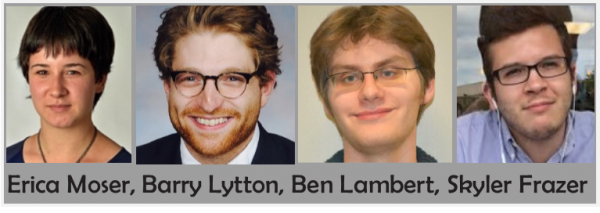
Erica Moser was told, “newspapers are a dying industry,” when she began classes at Northeastern University in Boston in 2011. Since June a higher education and business reporter for the Day of New London, Moser will be back on campus in Boston next month as one of four Journalism Fellows from Connecticut selected to participate in the New England First Amendment Institute, organized by the New England First Amendment Coalition.

This three-day institute is open each year to 25 New England journalists and “provides the support and training necessary to become more accomplished investigative reporters, well versed in the freedom of information laws that govern today’s difficult reporting landscape,” according to NEFAC officials.

NEFAC provides the institute — from Sept. 16-18 this year at Northeastern University — at no cost to those who attend.  Joining Moser and representing Connecticut will be Ben Lambert of the New Haven Register, Barry Lytton of the Stamford Advocate and Skyler Frazer of the New Britain Herald.  It includes workshops and presentations featuring some of the country’s elite investigative reporters, editors and media attorneys.

Ben Lambert, a reporter for the New Haven Register, worked previously for the Torrington Register-Citizen, Mass Live News and the Valley Advocate.  Barry Lytton, a Stamford Advocate reporter since 2016, previously covered New Milford and surrounding towns for the News-Times in Danbury. Skyler Frazer is a government and education reporter for the New Britain Herald.  A Wethersfield native, he joined the paper in 2016.

NEFAC is the region's leading advocate for the First Amendment and the public's right to know. Formed in 2006, the coalition is a broad-based organization of people who believe in the power of an informed democratic society.  Among the 2018 Fellows are four reporters from Maine, eight from Massachusetts, and three from New Hampshire, Rhode Island and Vermont.

Stephanie McCrummen of The Washington Post, who won a Pulitzer Prize this year for investigative reporting, will deliver the keynote address. Joining McCrummen as featured speakers are Terence Smith, a contributing columnist for the Capital Gazette in Annapolis, Md., and David Cuillier, an associate professor at the University of Arizona School of Journalism.

Other speakers include Jennifer Bjorhus of the Star Tribune in Minneapolis, Minn.; Michael Kilian of the Burlington Free Press; Cheryl Thompson, a contributing investigative reporter for The Washington Post; Cindy Galli of ABC News; Todd Wallack of The Boston Globe; Mike Beaudet of WCVB-Boston and Northeastern University; and Tim White of WPRI-Providence.

In recent years, attendees from Connecticut have included Susan Haigh of the Associated Press, Stephen Busemeyer, Suzanne Carlson and Mikaela Porter of The Harrtford Courant, Jill Konopka of NBC Connecticut, Kaitlyn Krasselt of the Norwalk Hour, Patrick Skahill of WNPR, Martha Shanahan, Lindsay Boyle and Julia Bergman of the Day, and Estaban Hernandez and Ann Misaro of the New Haven Register.