PERSPECTIVE: Remembering 12.14.12

This statement was read to the American people and the world at 3:15 PM on December 14, 2012 by President of the United States Barack Obama, in the James S. Brady Press Briefing Room at the White House.  This afternoon, I spoke with Governor Malloy and FBI Director Mueller.  I offered Governor Malloy my condolences on behalf of the nation, and made it clear he will have every single resource that he needs to investigate this heinous crime, care for the victims, counsel their families.

We’ve endured too many of these tragedies in the past few years.  And each time I learn the news I react not as a President, but as anybody else would -- as a parent.  And that was especially true today.  I know there’s not a parent in America who doesn’t feel the same overwhelming grief that I do.

The majority of those who died today were children -- beautiful little kids between the ages of 5 and 10 years old.  They had their entire lives ahead of them -- birthdays, graduations, weddings, kids of their own.  Among the fallen were also teachers -- men and women who devoted their lives to helping our children fulfill their dreams.

So our hearts are broken today -- for the parents and grandparents, sisters and brothers of these little children, and for the families of the adults who were lost.  Our hearts are broken for the parents of the survivors as well, for as blessed as they are to have their children home tonight, they know that their children’s innocence has been torn away from them too early, and there are no words that will ease their pain.

As a country, we have been through this too many times.  Whether it’s an elementary school in Newtown, or a shopping mall in Oregon, or a temple in Wisconsin, or a movie theater in Aurora, or a street corner in Chicago -- these neighborhoods are our neighborhoods, and these children are our children.  And we're going to have to come together and take meaningful action to prevent more tragedies like this, regardless of the politics.

This evening, Michelle and I will do what I know every parent in America will do, which is hug our children a little tighter and we’ll tell them that we love them, and we’ll remind each other how deeply we love one another.  But there are families in Connecticut who cannot do that tonight.  And they need all of us right now.  In the hard days to come, that community needs us to be at our best as Americans.  And I will do everything in my power as President to help.

Because while nothing can fill the space of a lost child or loved one, all of us can extend a hand to those in need -- to remind them that we are there for them, that we are praying for them, that the love they felt for those they lost endures not just in their memories but also in ours.

May God bless the memory of the victims and, in the words of Scripture, heal the brokenhearted and bind up their wounds.

 

First-time Analysis Stresses Economic Case for State Colleges, Universities

A 103-page report analyzing the economic benefits of the 17 institutions of the Connecticut State Colleges and Universities (CSCU) system concluded that $11.1 billion, equivalent to 4.1% of the GSP of Connecticut, is attributable to the institutions.  The components contributing to the bottom line conclusion are varied, and not limited to current students or activities on the campuses - included is $9.9 billion in "accumulated income" by  "hundreds of thousands of ... former students ... employed in Connecticut," the report stated. The institutions include the 12 community colleges, which the system has sought to merge into one institution, the four state universities, and the on-line Charter Oak State College.  The University of Connecticut is not part of the CSCU system and was not included in the analysis.  The report generally does not distinguish between the four universities - Central, Eastern, Southern and Western Connecticut - and the 12 community colleges in its presentation of the analysis.  

The economic benefits that the analysis indicates are attributable to the colleges and universities, as outlined in the report, include:

  • “Some students are residents of Connecticut who would have left the state if not for the existence of CSCU. The money that these students spent toward living expenses in Connecticut is attributable to the institutions.” Around 3 percent of credit students attending CSCU originated from outside the state. Some of these students relocated to Connecticut to attend the institutions. The expenditures of relocated and retained students in the state during the analysis year added approximately $137.9 million in income for the Connecticut economy”
  •  “Over the years, students gained new skills, making them more productive workers, by studying at the institutions. Today, hundreds of thousands of these former students are employed in Connecticut. The accumulated impact of former students currently employed in the Connecticut workforce amounted to $9.9 billion in added income for the Connecticut economy”
  • “Out-of-state visitors attracted to Connecticut for activities at the institutions brought new dollars to the economy through their spending at hotels, restaurants, gas stations, and other state businesses. The spending from these visitors added approximately $5.6 million in income for the Connecticut economy.” The report estimates that “over 73,000 out-of-state visitors attended events hosted by the institutions in FY 2016-17.”

The report goes on to explain that “Connecticut benefits from the education that CSCU provides through the earnings that students create in the state and through the savings that they generate through their improved lifestyles. To receive these benefits, however, members of society must pay money and forego services that they otherwise would have enjoyed if CSCU did not exist.”

In summarizing the “social savings” provided to the state by the CSCU institutions, the report stated that “In addition to avoided costs to the justice system, crime savings also consist of avoided victim costs and benefits stemming from the added productivity of individuals who otherwise would have been incarcerated. Income assistance savings are comprised of the avoided government costs due to the reduced number of welfare and unemployment insurance claims.”

Regarding the financial impact of the colleges and universities on its graduates, the report concluded that “for the certificate, associate’s and bachelor’s degree earner at CSCU this translates to an increase in earnings of $5,900, $12,800 and $37,200 each year, respectively, compared to a person with a high school diploma or equivalent working in Connecticut.”  The analysis indicated that 1 out of 19 jobs in Connecticut is supported by CSCU activities and their students.

In announcing the results of the first-time study, CSCU President Mark Ojakian said “We knew our CSCU institutions provided incredible value to Connecticut and this report confirms it. A bottom line analysis was needed to understand what CSCU contributes to the state economy. Both students and taxpayers invest in our system and we have a clear picture now of that return on investment.”

The report was prepared for CSCU by Emsi, a Moscow, Idaho-based provider of economic impact studies and labor market data to educational institutions, workforce planners, and regional developers in the U.S.

Travelers Ranked in Top 100 Best Places to Work

Founded in Hartford in 1853, Travelers is one of the nation’s top 100 places to work for 2019 according to a new ranking from the website Glassdoor.com.  The Travelers Companies Inc. ranked number 70, the only Connecticut-headquartered company to earn a slot on the list.

The Travelers Companies, Inc. is a leading provider of property and casualty insurance for auto, home and business, with approximately 30,000 employees and operations in the United States, Brazil, Canada, Ireland and the United Kingdom.  It is one of the oldest insurance companies in the U.S. and the only property casualty company in the Dow Jones Industrial Average.  The iconic red umbrella logo have been staples of the company for generations, and the Travelers Tower has long held a prominent place on Hartford’s skyline.

While steeped in history, the company’s status on the top 100 list for the coming year is a reflection of continual efforts to respond to both customer and employee preferences.  Travelers was ranked number 80 on last year’s top 100 list and also appeared in 2010 and 2011.

The latest annual list marks the 11th annual Employees’ Choice Awards, honoring the Best Places to Work in 2019. The rankings rely on feedback from employees who elected to anonymously submit a company review on Glassdoor.

The top 10 companies were Bain & Co., Zoom Video Communications, In-N-Out Burger, Procore Technologies, Boston Consulting Group, LinkedIn, Facebook, Google, lululemon, and Southwest Airlines.

The top six industries represented on the list: Technology (29 companies), Health Care (13 companies), Retail (8 companies), Manufacturing (8 companies), Consulting (5 companies), and Finance (5 companies).  The most-represented metropolitan areas include SF Bay Area (23 companies), New York City, NY (9 companies), Boston, MA (7 companies), Los Angeles, CA (6 companies), Dallas-Fort Worth, TX (6 companies), and Seattle, WA (5 companies).

The Glassdoor 2019 Employees’ Choice Awards for the Best Places to Work feature distinct categories.  For each category, company reviews and ratings from current and former employees were considered between October 23, 2017 and October 21, 2018. They include overall company rating, career opportunities, compensation & benefits, culture & values, senior management, work/life balance, recommend to a friend and six-month business outlook. All eight attributes are a part of the awards algorithm.

Travelers work was evident during the wildfires in California last month as the company responded to policy owners impacted by the devastating fires. The response came from the glassed-in Travelers National Catastrophe Center, located in Windsor, a short drive from the corporate headquarters in downtown Hartford.

Modeled after military war rooms, the Associated Press reported last month, it includes a conference table behind 19 high-definition screens, which display maps, graphs, television images and social media sites, all providing real-time data on the fires. By overlaying the data on maps marking its customers’ locations, the company can quickly identify those who are likely to have been affected, Jim Wucherpfennig, Travelers vice president of claims, told the AP.

Glassdoor, which compiles the annual ranking, is one of the world’s largest job and recruiting sites, with more than 62 million unique users each month.


History of Travelers 

Hartford Ranked 3rd in U.S. for Women in Business

If you’re a woman in business, Hartford is among the best places in the nation to be.  That’s according to a new analysis by the website ShareFile, which ranked Hartford as the third best place in the U.S. for businesswomen.  Hartford ranked seventh a year ago. The “Businesswomen Power City Index” was developed by evaluating the 50 largest cities in the U.S. to determine where the best locations are for women to achieve business success, according to ShareFile.  The index ranks cities based on the percentage of women-owned businesses, executive jobs held by women, women vs. men wage gaps and the buying power of women, which is based on the cost of living and the average wages earned by women.

Hartford has jumped four places from 2017, as a result of a higher percentage of women-owned businesses (up 1.4%), according to the analysis.  Hartford’s ranking in the individual categories was:

  • 3rd (down from 2nd) in women’s buying power: 119
  • 6th (same as last year) in the percentage of women business executives: 31.9%
  • 16th (up from 22nd) in the wage gap between women and men: 18.1%
  • 31st (up from 42nd) in the percentage of women-owned businesses: 20.4%

The website points out that Hartford is home to the Women’s Business Center, located at the University of Hartford, which supports female entrepreneurs across the city and the state, offering advice, training, and events for women looking to expand their business.

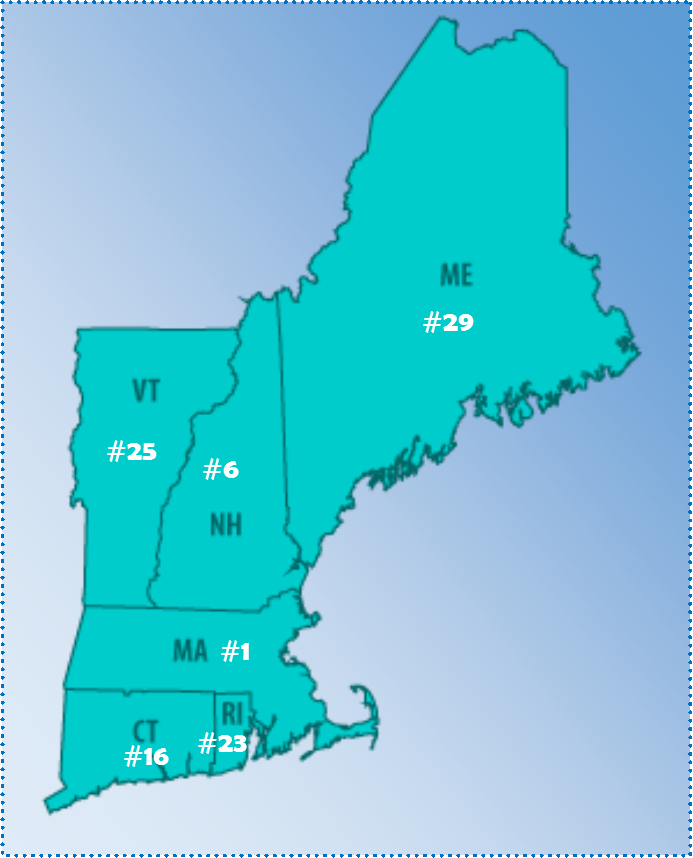
Hartford is the only New England city in the top 20.  Providence, in the top 10 a year ago, fell out of the top 20.

Just ahead of Hartford, and retaining the top two positions in the ranking, were Baltimore and Tampa.  Rounding out the top 15 were Washington DC, Jacksonville, Raleigh, Denver, Orlando, Miami, Austin, Virginia Beach, Las Vegas, Sacramento, Los Angeles and Atlanta. Aside from the top two, no other city in the top 20 has remained in the same position as a year ago.

The analysis relies on data from four main sources, including the U.S. Census 2016 Annual Survey of Entrepreneurs, U.S Census Bureau 2015 American Community Survey 1-Year Estimates, Sperling’s Best Places and the Equal Employment Opportunities Commission. ShareFile is a cloud-based file sharing service, a Citrix Systems company, based in Raleigh.


Organizations Focused on Progress for Women and Girls Form Statewide Collective

It began as a casual conversation between Kate Farrar, Executive Director of the Connecticut Women's Education and Legal Fund (CWEALF) and Sharon Cappetta, Director of Development at The Community Foundation for Women and Girls, during the 2016 United State of Women Summit.  Now, it is a full-fledged and far-reaching network aimed at providing support and collaboration for organizations serving women and girls across Connecticut. The Connecticut Collective for Women and Girls (CCWG), launched last month with more than 20 members and six funders, gathered at Fairfield County’s Community Foundation to celebrate the beginning of the Collective. Members range from Girl Scouts to Planned Parenthood and the Commission on Women, Children and Seniors; the YWCA to The Alliance to End Sexual Violence and Connecticut Women’s Hall of Fame.

The Collective is a supportive network that unifies organizational members, facilitates collaboration, and bolsters their collective power to advance rights and opportunities for women and girls in Connecticut. CWEALF is the initiative's organizer.

“Now is the moment to come together to make progress for women and girls,” said Kate Farrar, Executive Director of CWEALF. “As the state’s leading champion for women and girls, CWEALF is thrilled to convene organizations across the state to increase our impact.”

Organizers say that while many organizations are doing critical work to transform the lives of women and girls in the state, too often, these organizations operate separately, leading to silos. The CCWG aims to “expand our strength as a collective force. It builds on participants’ individual assets with a community network of organizations that uplift and amplify each other’s work. The very act of coming together in this way increases each organization’s impact to advance rights and opportunities for women and girls in Connecticut.”

"Fairfield County’s Community Foundation’s Fund for Women & Girls is pleased to support the newly launched Collective. Collaboration, Diversity and Inclusion are core values of the Community Foundation’s. Through the Collaborative, partner organizations will develop a common language and requisite understanding of what is needed to advance gender equity," said Tricia Hyacinth, Director, Fund for Women & Girls. "Moreover, members, from all regions of the state, currently working independently, will achieve greater impact through their collective efforts."   

“The Community Fund for Women & Girls and The Community Foundation for Greater New Haven are delighted to support the Connecticut Collective for Women and Girls,” said Sharon Cappetta, Director of Development. “This emerging network of committed program providers are already doing great work with women and girls in the state. Together, working collectively, they strengthen their individual organizations and connect to potential partners, as well as bring attention and audiences to the gender implications of public policy in Connecticut. Our communities and our state benefit from targeted investments in nonprofit organizations, especially those who are working directly to advance women and girls.”

Other funders of the Collective are the Aurora Foundation for Women and Girls; The Community Foundation of Eastern Connecticut's Women and Girls’ Fund; the Women’s Fund at Connecticut Community Foundation; and the Main Street Community Foundation's Women & Girls’ Fund.  The Connecticut Collective for Women and Girls is guided by the following principles of gender equity, racial justice, LGBTQIA rights, civil rights, disability rights, ending and preventing violence, economic justice, reproductive rights, and immigrants’ rights.

Millennials Make the Most Money in Massachusetts; Connecticut Ranks 16th

If you were born between 1982 and 2000, and you live in Massachusetts, you’re making more money, on average, then people of your generation living elsewhere in the United States.  If you live in Connecticut, there are 15 states where the average salary for millennials is higher. Based on U.S. Census data analyzed by the website howmuch.com, the average salary for millennials in Connecticut is $69,600, compared with $80,307 in Massachusetts.  The states in between, reaching the top 10, are Minnesota ($77,090), North Dakota ($76,836), Washington, DC ($75,220), Maryland ($74,737), New Hampshire ($73,941), Wyoming ($73,345), Alaska ($72,374), New Jersey ($72,150), and Virginia ($71,397).

Also ahead of Connecticut are Utah ($71,284), South Dakota ($70,989), Nebraska ($70,870), Washington ($70,441), and Iowa ($69,739).

The analysis points out that millennials “are the most diverse generation in American history, more of them went to college than previous generations, and they are now the largest contingent in the workforce. Many of them also graduated in the middle of the Great Recession, which economists believe might have a lifelong impact on their wages.”

Geography also plays a role, according to the data.  The South, for example, “clearly stands out as a lackluster region for millennials in the labor market.”  In the Upper Midwest, salaries tend to be higher, and the same is true for much of the Northeast.

With the exception of Washington State, much of the west coast does not stand out.  “This highlights the fact that big tech companies are creating great jobs for a select group of skilled workers,” the analysis points out.

Millennials are making the least amount of money in Florida ($54,889), Mississippi ($53,269) and New Mexico ($51,893).

The data used is 2016 median household income for 25 to 44 year olds, taken from Census data and adjusted by Bureau of Economic Analysis regional price parity data, the most recent and comprehensive available.


PERSPECTIVE: Nonprofits Are Under [Cyber] Attack - But They Don’t Have to be Easy Targets

by Amber Mata Nonprofits often tend to be targeted by cyber criminals due to a lack of resources to implement cybersecurity measures. They are just as susceptible to a data breach as for-profit organizations, if not more. However, they often don’t embrace the same level of changes that other organizations are making to implement a sophisticated cybersecurity program as there is a belief that they are not a target.

This is a dangerous assumption to make.

The reality is, nonprofit organizations collect incredibly sensitive information about its members and donors, which can include social security numbers, credit card information, and even medical information. It’s time for nonprofits to get serious about cybersecurity because without proper measures in place, one single breach could end their entire organization and its mission.

Why they should be concerned

Nonprofit websites that end in .org are often targets of hackers because they usually show up early in search results leading to high visibility. The higher the visibility, the greater the value of the target. A valuable target with little or no security is a no brainer target for cyber criminals.

Nonprofit organizations tend to handle volumes of sensitive data every day. Member records, donor information, confidential emails, and hundreds of other transactions pass through their gates. Without proper cybersecurity measures, an organization can easily be breached leaving the path to this sensitive information wide open to cyber criminals.

For an organization that relies heavily on grants and donors, a cybersecurity breach can be deadly. A breach can result in lost trust and confidence if donors fear their reputation or identity could take a hit. Even if a nonprofit organization does survive the reputational loss, the costs of settlements, notifying affected parties, and monitoring breached parties are sure to put a financial strain on the organization.

Where to begin

Get a game plan together – Start with a holistic approach looking from the outside, in. Preparation involves a risk assessment of the organization’s IT environment. Nonprofits should also consider taking a complete infrastructure inventory and review any regulatory requirements. It is important to create necessary policies and enforce them.

Always inform and train all volunteers and employees to properly embrace all updates. Initiate a plan to know what data is kept, where it is, how it is used, and who has access.

Secure all technology – The two best places to start with protecting technology is to always utilize multi factor authentication and always upgrade the latest patches to all software. Patches can ensure that the latest security measures are deployed to software and multi factor authentication can prevent remote attacks even if credentials become compromised. It is an easy and effective tool to implement, yet over 70% of nonprofits do not utilize.

It takes time – Security is not a destination it’s a way of life. It can take 18 to 24 months to raise an organization’s cybersecurity maturity by just one level. Establishing a proper and mature cybersecurity posture is an ongoing effort. Patience and dedication is definitely a requirement.

Doing nothing is absolutely not an option. Even if an organization hasn’t experienced a cyber breach to date, there’s no telling what tomorrow may bring. A lack of cybersecurity measures is like driving a car without insurance; it’s a big risk. Small organizations, for-profit and not-for-profit, are attractive targets but they don’t have be easy targets.

A breach is inevitable if proper security is not implemented but proactive measures can minimize the effects and allow a clear path to an accomplished mission. Don’t become an easy target, it’s time to take cybersecurity seriously.

______________________________

Amber Mata is Marketing Manager at Kyber Security, with offices in Fairfield, Rocky Hill and Providence, RI.  Kyber Security provides cybersecurity and compliance for small firms up through enterprise businesses. Kyber Security is a partner in the The Alliance for Nonprofit Growth and Opportunity (TANGO), where this article first appeared.  TANGO creates partnerships between nonprofit and for-profit organizations to drive innovation, create cost savings, and deliver mission advancement.

CT Ranks 5th in Charitable Giving, Analysis Says

The residents of Connecticut are the fifth most generous in the nation, according to a new analysis.  The review of charitable giving by the financial website WalletHub, across the nation’s 50 states, found that Connecticut ranked:

  • 3rd – Percentage of Population Who Donated Money
  • 8th – Charities per Capita
  • 18th – Percentage of Donated Income
  • 19th – Volunteer Rate
  • 25th – Volunteer Hours per Capita

Overall, only Minnesota, Utah, New York and Maryland placed higher than Connecticut in the ranking of Most Charitable States.  Rounding out the top ten were Virginia, Georgia, Washington, New Hampshire and Wisconsin.

A year ago, Utah topped the list and Connecticut was just outside the top 10 at number 11.

The 18 key metrics used in the analysis were grouped in two categories weighed equally, Volunteering & Service and Charitable Giving.  Connecticut ranked 7th in the former and 14th in the latter.  The Volunteering & Service category included share of the population collecting or distributing food or clothes for people in need, volunteer hours per capita, and fundraising or selling items to raise money.  The Charitable Giving section included donating money and time, as well as the number of public charities, and share of the population donating time.

The least charitable states, according to the analysis, were Arizona, Rhode Island and Nevada.

Americans are among the world’s most generous people, WalletHub points out, ranking fourth out of 140 countries. U.S. donors in 2017 gave more than $410 billion to charity, with 70 percent of the funds coming directly from individuals, according to the National Philanthropic Trust.  In addition, nearly 63 million people volunteer in the U.S., serving a combined total of 7.9 billion hours per year, the equivalent of $184 billion of service.


https://youtu.be/t5lI9urlYkM


Impact of One Black Teacher Can Be Life-Changing, UConn Research Reveals

The influence of having a black teacher can significantly impact a black student’s life, and the effect begins early in an education.  Having just one black teacher in elementary school not only makes children more like to graduate high school – it also makes them significantly more likely to enroll in college, according to a new study co-authored by a University of Connecticut researcher. Black students who’d had just one black teacher by third grade were 13 percent more likely to enroll in college – and those who’d had two were 32 percent more likely.

The research paper, published this month by the National Bureau of Economic Research, observed that “Black teachers provide a crucial signal that leads black students to update their beliefs about the returns to effort and what educational outcomes are possible.”  In addition, “role model effects help to explain why black teachers increase the educational attainment of black students.”

The findings, from researchers at UConn, Johns Hopkins University, American University, and the University of California-Davis, were published recently in a working paper titled “The Long-Run Impacts of Same-Race Teachers.”  Another, related working paper by the same team titled “Teacher Expectations Matter,” also published by NBER, found teachers’ beliefs about a student’s college potential can become self-fulfilling prophecies.

In that research, every 20 percent increase in a teacher’s expectations raised the actual chance of finishing college for white students by about 6 percent and 10 percent for black students. However, because black students had the strongest endorsements from black teachers, and black teachers are scarce, they have less chance to reap the benefit of high expectations than their white peers, UConn Today reported.

“Black student students often don’t have parents or other black adults in their lives who have gone to college and gotten professional jobs,” Joshua Hyman told UConn Today.  Hyman, an assistant professor of public policy at UConn, who has a joint appointment in the Department of Educational Leadership in the Neag School of Education, co-authored the papers along with researchers from the three other universities.

“All it takes is one black teacher to influence a student,” he adds. “They see someone like them in their classroom and start to believe they can go to college too, and get a good job.”

The paper appears to be the first to document the long-term reach of the role model effect, UConn Today reported.  The researchers previously found that having at least one black teacher in elementary school reduced their probability of dropping out by 29 percent for low-income black students – and 39 percent for very low-income black boys.

In a New York Times op-ed last year, a ninth-grade teacher who has worked for 10 years in high schools and middle schools in the New York City area, and is Black, wrote this: “Black students need teachers who understand that they’re capable of the full range of anxieties and insecurities, greatness and success, hilarious moments and generous surprises. The amount of melanin in my skin is neither necessary nor sufficient for this: It’s not a magic formula. But I can remember a time when I looked and sounded like my students. That helps me see myself in them, and all they’re capable of. I hope they can see themselves in me.”

The latest findings are based on data from the Tennessee STAR class size reduction experiment that started in 1986 and randomly assigned disadvantaged kindergarten students to various sizes of classroom.  The researchers replicated the findings with similar data for North Carolina students.

The study found that black students who’d had a black teacher in kindergarten were as much as 18 percent more likely than their peers to enroll in college. Getting a black teacher in their first STAR year, any year up to third grade, increased a black student’s likelihood of enrolling in college by 13 percent.  Black children who had two black teachers during the program were 32 percent more likely to go to college than their peers who didn’t have black teachers at all.

“What’s very interesting about this paper is that it looks later in a student’s life,” says Hyman. “It’s impressive that the impression of having a black elementary school teacher last that long. It helps reduce the race gap.”

Additionally, students who had at least one black teacher in grades K-3 were about 10 percent more likely to be described by their 4th grade teachers as “persistent” or kids who “made an effort” and “tried to finish difficult work,” the researchers found. These students were also marginally more likely to ask questions and talk about school subjects out of class.

“One of the lingering issues of this paper is that we have to entice black people to enter the teaching areas,” Hyman points out. “In schools where there is a large black population, that has to be addressed.”


CT Per Student Spending in Public Higher Education Saw 7th Largest Drop in Nation During Past Decade

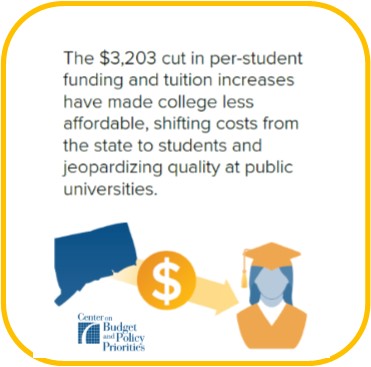
The burden has shifted and grown during the past decade for students attending Connecticut’s public two- and four-year institutions of higher education. Between 2008 and 2018, average tuition at public colleges and universities (adjusted for inflation) grew by 38.4 percent in Connecticut, according to a new national analysis by the Center on Budget and Policy Priorities. The study found that average tuition increased by $3,437 during the decade – 13th largest average increase among the states - as state spending per student dropped by $3,203.

That is the 7th largest average drop in state per student spending in the nation, and the largest among the New England states.  The next largest state reduction in the region was in New Hampshire, ranking 24th.  Massachusetts ranked 28th, reducing state spending per student by $1,295.

Tuition climbed as state spending per student dropped by 20.2 percent at Connecticut’s public higher education institutions - the 20th largest percentage decrease among the states.

Connecticut is not alone.

Overall state funding for public two- and four-year colleges in the school year ending in 2018 was more than $7 billion below its 2008 level, after adjusting for inflation, according to the study.

Of the 49 states (all except Illinois) analyzed over the full 2008-2018 period:

  • 45 spent less per student in the 2018 school year than in 2008. The only states spending more than in 2008 were California, Hawaii, North Dakota, and Wyoming.
  • States cut funding deeply after the recession hit. The average state spent $1,502, or 16 percent, less per student in 2018 than in 2008.
  • Per-student funding in nine states — Alabama, Arizona, Louisiana, Mississippi, Missouri, New Mexico, Oklahoma, Pennsylvania, and South Carolina — fell by more than 30 percent over this period.

The report also found that annual published tuition at four-year public colleges has risen by $2,651, or 36 percent, since the 2008 school year.  In Louisiana, published tuition at four-year schools has doubled, while in six other states — Alabama, Arizona, California, Colorado, Georgia, and Hawaii — published tuition is up more than 60 percent.

“These sharp tuition increases have accelerated longer-term trends of college becoming less affordable and costs shifting from states to students,” the report, “Unkept Promises:  State Cuts to Higher Education Threaten Access and Equity,” stated.

The largest tuition increases, comparing public, four-year colleges in 2008 and 2018, were in Arizona, Louisiana, Hawaii, New Hampshire, Virginia, Colorado, Alabama, California, Rhode Island, Vermont, Georgia, Tennessee, Connecticut and Massachusetts.  Connecticut was fourth highest among the six New England states.  Maine had the smallest tuition increase.

Indications are that the trend has slowed during the past year.  Published tuition — the “sticker price” — at public four-year institutions rose by less than 1 percent nationally between the 2017 and 2018 school years, the report indicated.  Rhode Island increased average tuition across its four-year institutions on a dollar basis more than any other state, by $559, or roughly 4.8 percent. Connecticut - along with Iowa, Mississippi, Montana, and Oregon - raised average tuition by more than $300, according to data compiled for the report, published last month.

The Center on Budget and Policy Priorities is a nonpartisan research and policy institute which pursues federal and state policies designed both to reduce poverty and inequality and to restore fiscal responsibility in equitable and effective ways, according to the organization’s website.  The Center is based in Washington, D.C.