Connecticut's 40 Fastest Growing Technology Companies Earn Statewide Recognition

Some of the names may be familiar – Priceline, Alexion, TicketNetwork, HigherOne - but most will likely not be, despite steady track-records of rapid growth in their respective technology industries.  The Connecticut Technology Council (CTC) and Marcum LLP have announced the 2013 Marcum Tech Top 40 list of the 40 fastest growing technology companies in Connecticut.

Companies earn their place on the list on the basis of revenue growth over the last four years. They must have at least $3 million in revenue, with several of the public companies this year approaching or exceeding $1 billion in revenue.  Companies were grouped into six technology areas:  Software, IT Services, Life Sciences, Advanced Manufacturing, New Media/Internet/Telecom, and Energy/ Environmental Technologies.

The 2013 list features primarily privately held companies, but 14 public companies also made the list, including: Priceline.com, Rogers Corporation, Gartner Inc. and Alexion Pharmaceuticals.

Geographically, Fairfield County is home to 14 companies this year, followed by Hartford County with 10 companies and New Haven County with eight companies.

The winners in each of the six categories will be announced on September 26, and one company will be named overall winner for demonstrating the greatest percentage growth in revenue across all the technology verticals. The six category winners from 2012 – RSL Fiberstate tech Systems, FuelCell Energy, eVariant, Datto, and Alexion – as well as overall winner iSend, all earned a spot on this year’s Top 40.

Matthew Nemerson, CTC’s President & CEO said, “Connecticut is proud of its remarkable heritage of innovation and invention. The 2013 list of Tech Top 40 companies reinforces the vital role the tech sector plays in job creation. These 40 firms are also successful models in their technology verticals and deserve the attention this event brings them.”

The Connecticut Technology Council is a statewide association of technology oriented companies and institutions, providing leadership in areas of policy advocacy, community building and assistance for growing companies. Speaking for over 2,000 companies that employ some 200,000 residents, the Connecticut Technology Council seeks to provide a strong and urgent voice in support of the creation of a culture of innovation.

“Every year, the program serves as a reminder never to underestimate the promise of a great idea, the role of passion, the importance of management talent, and the significance of having the right team. Marcum is extremely proud to partner with the Connecticut Technology Council in presenting this year’s outstanding class of top technology companies. We enthusiastically congratulate all the winners,” said Anthony P. Scillia, Partner-in-Charge, Marcum New England.

CTC and Marcum LLP will honor the Top 40 companies September 26, 2013 at the Oakdale Theater in Wallingford. This year’s event sponsors include: title sponsor Marcum LLP, AT&T Connecticut, Comcast Business Class, Connecticut Innovations, MY HR Supplier, the law firm of Pullman & Comley, OneBeacon Insurance Group, Robert Half Technology, TriNet HR Corporation, UK Trade & Investment, Webster Bank, Xand, and Wellstone Insurance.  To register for the September 26 event, visit http://www.ct.org/Tech_Top_40.asp.

2013 Marcum Tech Top 40 Companies by Industry Category Advanced Manufacturing Amphenol Corp., Wallingford APS Technology, Inc., Wallingford ATMI Inc., Danbury Dymax Corporation, Torrington EDAC Technologies Corp., Farmington Foster Corporation, Putnam Harman International Industries, Stamford Rogers Corporation, Rogers RSL Fiber Systems, LLC, East Hartford

Energy/Environment/Green Technology FuelCell Energy, Inc., Danbury Proton OnSite, Wallingford

IT Services Amnet Systems LLC, Stamford Cervalis LLC, Shelton Cierant Corporation, Danbury Datto Inc., Norwalk Gartner Inc., Stamford Information Services Group Inc., Stamford VLink Inc., Hartford

Life Sciences Alexion Pharmaceuticals, Inc., Cheshire Bio-Med Devices, Inc., Guilford Metrum Research Group, LLC, Tariffville New Media/Internet/Telecom EasySeat, LLC, Plainville iSend, LLC, Middlebury JobTarget, LLC, New London M2 Media Group, Stamford Mediabistro Inc., Norwalk Priceline.com, Inc., Norwalk TicketNetwork, South Windsor

Software Clarity Software Solutions, Inc., Guilford Core Informatics, LLC, Branford ePath Learning, Inc., New London eVariant, Inc., Farmington Evolution1, Inc., Avon Higher One, Inc., New Haven PASSUR Aerospace, Inc., Stamford Shoptech Corporation, Glastonbury Square 9 Softworks, Inc., New Haven SS&C Technologies Holdings Inc, Windsor Tangoe, Inc., Orange Triple Point Technology, Westport

Manufacturing, Higher Education Strengthen Alliance, Looking Toward Future Jobs

As the New Haven Manufacturers Association celebrates its 100th anniversary in 2013, the future is looking up for an industry that has long been seeing at its heyday in the rear-view mirror.  There has been greater recognition that high tech manufacturing brings opportunities to attract and maintain jobs in Connecticut, and heightened connections between higher education and the manufacturing industry is reflecting the new approach.

That was evident when a fledgling initiative between NHMA and Southern Connecticut State University quickly filled to capacity in its pilot year.  NHMA and SCSU teamed up to sponsor a three-day program acquainting area science teachers with modern manufacturing and materials engineering methods this summer that officials hope will become an annual program.

The Materials & Manufacturing Summer Teachers' Institute, a collaboration that also includes Platt Technical High School in Milford and CRISP (Center for Research on Interface Structures and Phenomena at Yale University and Southern), attracted 30 science teachers from grades 7 to 9. NHMA

The program was designed to enable teachers to better educate middle school students about the relationship between STEM and manufacturing and what types of careers are available in the manufacturing field. Officials say that grade level was specifically targeted because students often decide as early as the middle school years whether or not to pursue math and science in high school, college and even in terms of career paths. More than 40 Connecticut teachers applied to attend the program, which could only accommodate 30 this summer.

Christine Broadbridge, chairwoman of the Physics Department at Southern and education director at CRISP, says area manufacturers and academics have been working for the past year to bring teachers, engineers and scientists together in more effective ways.

"We've learned from the teachers that they value relationships with industry," Broadbridge says. "At this institute, the teachers have found out about potential careers for their students as they learn about engineering and cutting-edge science. It has given them an opportunity to network with industry leaders and to gain hands-on knowledge about manufacturing. We hope they can bring that excitement back to their students."

Gregory W. Gray, the recently installed President of the Connecticut State Colleges and Universities, which includes 17 institutions across Connecticut, told the Connecticut Post this week that he wants the community colleges to take on a more aggressive workforce-development mission by expanding a manufacturing technology program that exists now on a few campuses, including Housatonic Community College (Bridgeport), Naugatuck Valley Community College (Waterbury) and Quinebaug Valley Community College (Danielson).  The program expanded a year ago, based on a very successful program offered at Asnuntuck Community College in Enfield.

There are almost 5,000 manufacturing commaterials-sciencepanies in Connecticut, according to the U.S. Census Bureau, and Connecticut manufacturing employees are 20 percent more productive than competing states, data from the state’s Department of Economic and Community Development indicates, as featured on the ConnSCU website.

The New Haven Independent recently reported on a New Haven company that is very much a part of the future of New Haven manufacturing. That future lies in specialization, in the rapid turnaround of high-tech niche parts, the Independent reported, according to Bill Neale, head of the New Haven Manufacturers Association and vice-president of operations at Radiall manufacturing on John Murphy Drive in the Fair Haven section of the city. The factory isn't trying to compete with massive operations in places like China and India, Neale said. It’s advantage lies not in productivity, but in speed and specificity.

Governor Malloy announced in June that state’s Advanced Manufacturing Centers at the three community colleges will receive $7,325,000 in funding for facility and equipment upgrades that will allow the centers to enhance and develop their educational opportunities. The funding was approved by the State Bond Commission.  According to ConnSCU, the funds would be allocated:

  • $1.5 million for Housatonic Community College to add a welding lab to their manufacturing center. HCC continues its work with its Regional Advisory Board to confirm the need for skilled welders in the region, including the review of options for virtual equipment and the pursuit of appropriate faculty expertise for student learning.
  • $825,000 for Naugatuck Valley Community College to add additional manufacturing equipment to the existing advanced manufacturing center, retrofitted to support local industry needs including the purchase of a deep draw press.
  • $5 million for Quinebaug Valley Community College to build an advanced manufacturing center on their campus in Danielson. For the first year, QVCC has worked with nearby Ellis Technical High School to utilize existing space until the college could grow the program and obtain funds for construction on its own campus. The funding will be used for construction, as well as for the purchase of machinery and other manufacturing equipment.

NHMA was founded in 1913 as the Employer's Association of New Haven County. Today the organization serves businesses, especially manufacturers, in the entire Southern Connecticut region and beyond. They’ll be celebrating a century of operations - looking forward - with a gala on September 19 at Housatonic Community College in Bridgeport.

UConn the Latest to Proceed with Scoreboard Replacement; Controversy Erupts at Penn State

When the State Bond Commission voted last week to approve $2.8 million for repairs to Rentschler Field in East Hartford, home of the newly rebranded Connecticut Huskies, it was said that about $1.67 million of that money will be used to replace scoreboards at the stadium.

The Hartford Courant reported that Kim Hart, the venue director for the Capital Regional Development Authority, which overssees the state-owned facility, said that scoreboards like the main one at Rentschler are typically replaced every 7 to 8 years.  The main scoreboard at the Rent has been in place since the facility opened, a decade ago.

“It’s outlined its useful life and we’ve squeezed a few years out of it,” she was quoted as saying.

For sports fans accustomed to seeing stadium scoreThe Rentboards in place for well over a decade at venues across the nation, the statement may have been jarring.  But apparently, new technology is driving new scoreboard purchases at colleges coast-to-coast – and at costs considerably higher than in Connecticut.

In 2012, Ohio State University announced plans to install a larger high-definition scoreboard screen and improved audio equipment as part of $7 million in upgrades at its football stadium.  The school said that the new 42-by-124-foot scoreboard at Ohio Stadium would  replace an 11-year-old board that measures 30 feet by 90 feet, the CBS affiliate in Cleveland reported.   When the new scoreboard debuted in August 2012, the school’s Lantern newspaper website reported that Don Patko, associate athletic director of Facilities Management, said the improvements were necessary and well worth the cost.  “It was time for the video board to be replaced,” Patko said. “The usual life for a scoreboard is 12 to 15 years, and the last one was 12 years old.”

When Brigham Young University announced plans for a new scoreboard in 2012, to be paid by corporate donations, it was noted that  “In 1996, a video wall was added to the south end zone and a matrix scoreboard to the north end zone. The north end zone scoreboard was updated in 2008 to include a small video board. The project will include state-of-art LED video walls in the north and south end zones, as well as LED ribbon boards across the top of both end zones.”

When North Carolina State University embarked on a fundraising drive for scoreboard replacement in 2011, Mark Steinkamp, a senior marketing director at Brookings, S.D.-based scoreboard provider Daktronics, told the StateFansNation that “large college football scoreboards can cost as much as several million dollars. Schools typically will replace them every seven to 10 years as new control and display technologies come along.”

Also in 2011, Penn State University launched a scoreboard replacement initiative.  In a letter to prospective design professionals, University Architect David Zenghut pointed out that “The existing main end zone scoreboards were installed prior to the 2001 football season and operational maintenance is becoming increasingly challenging and costly. In addition, there have been dramatic advances in the audio/video technology of these products. In order to address the operational issue and enhance the game day spectator experience, we intend to replace both scoreboards with state-of-the-art, HD video boards that will complement the character of the stadium.”

Penn State assumed a construction budget of $5.5 million, according to the document.  A year later, it was reported by StateCollege.com that the completion of the scoreboard replacement was pushed back from 2012 to 2014. And this week, with the projected cost now pegged at nearly $10 million, a local newspaper is calling for the project to be scaled back or scrapped.

The Centre Daily Times, in an editorial published on July 28, 2013, said “We question the decision to install a new scoreboard, approved at last week’s board of trustees meetings, … while costs tied to the Jerry Sandusky abuse scandal reached nearly $47 million. We wonder what the scoreboard decision says about the school’s priorities,” The newspaper continued “We’re surprised Penn State thought this was the right time to take an expensive step toward enhancing its athletics brand, the stated goal with the scorebodmrdc5-6a0bvtplo8316jj1q5nj_originalard, given criticism hurled at the university during the Sandusky scandal. Those same trustees meetings approved yet-another tuition hike — this one nearly 4 percent ...”

Just last month, progress in construction of a new scoreboard at the University of Iowa’s Kinnick Stadium was reported by the local ABC affiliate, which explained that “The video board/sound upgrades will be up and running for Iowa’s home football schedule this fall. The financing package the board approved for that Kinnick project totals $8 million, but they expect the total cost of everything will be $9 million because of the increase in bids on a portion of the project.  The existing video walls, control room equipment and sound system at Kinnick are eight years old, UI officials told The Gazette.  The company handling the project is Daktronics, Inc. As per usual, the Iowa athletics department will foot this bill using no tax or tuition cash.”

And earlier this year, Virginia Tech issued an RFP for a new scoreboard, which would be among the largest in college sports.

14 States and D.C. Have Recovered Recession-Lost Jobs; Connecticut Hasn't Yet

While employment has steadily climbed since the nation’s economic recovery began, only a few states have seen job levels return to pre-recession numbers thus far, and Connecticut is not among them.  Last month marked the four-year anniversary of the end of the recession in June 2009, and updated U.S. Department of Labor estimates published within the week show the extent to which states are rebounding.

The U.S. has recovered 5.3 million jobs since job losses bottomed out, still about 2.2 million below pre-recession levels, Governing magazine reported. Only 14 states and the District of Columbia have fully recovered jobs dating back to 2008. Of those, only oil-rich Texas, North Dakota and Alaska recorded notable job growth exceeding a couple percentage points.  In Connecticut, net employment is down 3.6 percent and in Rhode Island it’s down 4.5 percent. Employment is up one percent in New York, and nearly one percent in Massachusetts over that period.jobs-300x211

Across the country, North Dakota experienced a 20.6 percent gain in employment since the recovery began, by far the nation’s largest increase. The state's population also jumped, accordingly.  Texas (8.6 percent), Utah (7.8 percent) and Indiana (6.4 percent) recorded the next-highest percentage increases over the four-year period.

As residents of Connecticut have seen first-hand, Texas is aggressively job poaching.  The Lone Star State and California are in the midst of a well-publicized battle for jobs, with Gov. Rick Perry making numerous visits to California and airing radio ads courting the state’s employers. The two states collectively added nearly 1.4 million jobs since the recovery began, accounting for more than a quarter of the nation’s total job growth. Perry, of course, is also taking on New York, Connecticut and Illinois in his jobs-snatching corporate romancing.

Most states still have a long way to go before payrolls return to pre-recession levels, Governing magazine reports. Nevada’s unemployment rate remains the country’s highest at 9.6 percent. The state also has registered the largest percentage drop in employment since the recession began (-9.8 percent), followed by Arizona (-6.3 percent) and Alabama (-5.2 percent).

A map developed by the publication shows the extent to which each state recovered, with states shaded based on the percentage change in nonfarm employment since the recession began in January 2008 (the National Bureau of Economic Research determined the economy peaked in December 2007).

State economies didn't all peak or bottom out at the same time either, so the data represents snapshots since the official start of the recession.  Traditionally, Connecticut enters national recessions late, and emerges from them after most states as well.  Governing also notes that the data doesn’t take into account more people entering the labor force.

The U.S. Bureau of Labor Statistics recently reported that Federal government employment continued to trend down in June (-5,000) and has declined by 65,000 over the past 12 months.  Of particular interest in Connecticut due to its employment levels in the financial services industry, employment in financial activities rose by 17,000 in June, with most of the increase occurring in credit intermediation (+6,000) and in insurance carriers and related activities (+6,000), according to the Bureau.

Employment in professional and business services rose by 53,000 in June. Over the past year, the professional and business services category has added 624,000 jobs.  Leisure and hospitality added 75,000 jobs in June. Monthly job growth in this industry has averaged 55,000 thus far in 2013, almost twice the average gain of 30,000 per month in 2012. Employment in the amusements, gambling, and recreation industry also continued to trend up in June (+19,000).

change in jobs

Hour-Long Commutes to Work Rank CT 36th in USA; Bridgeport 5th in Extra Travel Time on Fridays

Connecticut is a relatively small state.  Only Rhode Island and Delaware are smaller.  Yet, the percentage of workers in Connecticut who commute for 60 minutes or longer - one way -  to go to work each day is 7.7 percent.  That ranks the state 36th in the nation in percentage of workers commuting an hour or longer each trip to get to work.

Perhaps surprisingly, Connecticut is not among the states with the lowest percentage of workers needing to make an hour-long commutes to get to work each day.  In fact, more than a dozen states have a smaller percentage of long-commute drivers than Connecticut.  The lowest percentages of long commutes are in South Dakota (3.6% of workers), Iowa (3.7%) , Kansas (3.3%)  and Nebraska (2.9%). The study compared 2011 data.

The states with a larger percentage of their workforce making hour-long commutes includes California (10.1%), Delaware, D.C., Georgia, Hawaii, Illinois, Maryland, Massachusetts, New Hampshire, New Jersey, New York, Pennsylvania, Puerto Rico, Virginia, Washington and West Virginia.  Connecticut ranks 22nd in population among the states.

Overall, Connecticut’s average commuting time ranked 19th in the nation, at 24.6 minutes, based on 2006-2010 data compiled by the website indexmundi.org.  The U.S. average was slightly higher at 25.2 minutes.  Among the state’s eight counties, the longest commutes – in time, not distance – were in Fairfield County, followed by Litchfield, Windham, Tolland, Middlesex, New Haven, New London and Hartford counties.cities

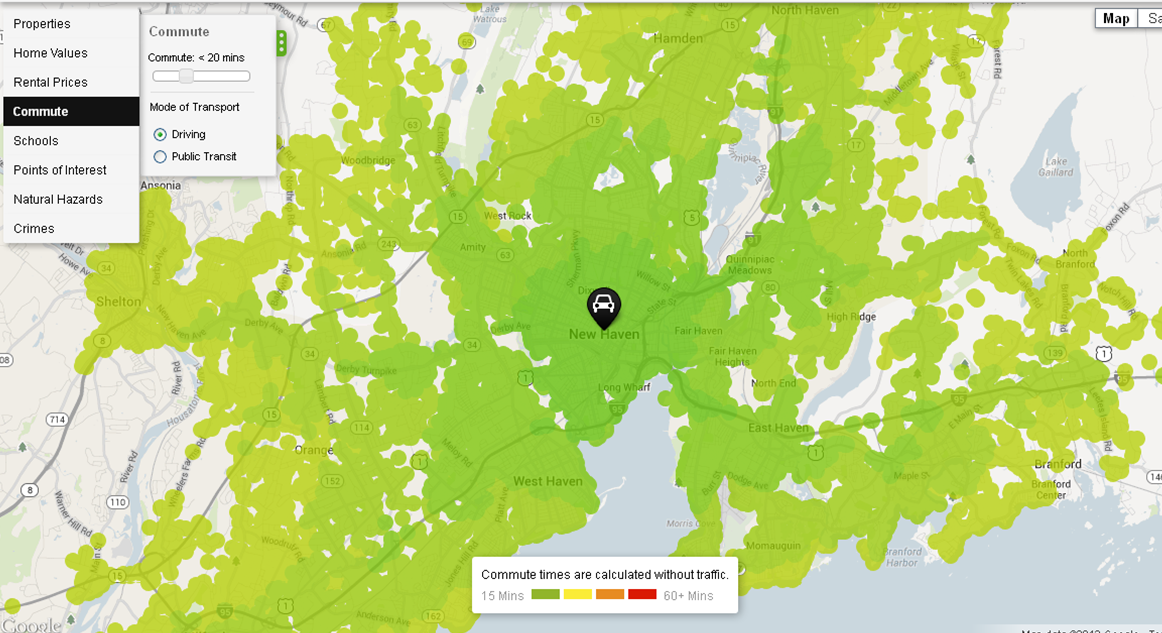
The website trulia.com provides graphic representations of travel time from areas surrounding major cities, including Hartford, New Haven and Bridgeport in Connecticut - looking at travel by car, and via mass transit.

A year ago, the Bridgeport metropolitan area was ranked as the 5th worst traffic delay corridor in the country by Governing magazine.  Data compiled for Governing by traffic research firm Inrix shows Friday afternoons are the worst time of the week to drive in nearly three-quarters of metro areas across the country.  For most cities with already lengthy rush-hour commutes throughout the week, time spent behind the wheel is further prolonged on Fridays.

Bridgeport came in just behind Los Angeles, San Francisco, Honolulu and Austin, Texas – and worse than Seattle, New York City, Portland, Washington and Chicago, which all fared somewhat better than the Park City in the Friday-afternoon traffic tie-up analysis done by the publication.    Areas with many workers living far outside a city can experience significant congestion when all flee the office early, the publication noted, citing Bridgeport, which recorded the nation’s fifth-longest Friday afternoon delays, as an example.

For the Bridgeport area, commuters added nearly 10 minutes in delays due to traffic congestion on Friday afternoons.  Boston, by comparison, added just under 7 minutes, New Haven 5 ½ minutes, Hartford just over 4 minutes.  Los Angeles, which topped the list, exceeded 13 minutes in the additional travel time necessary during car commute NHthe peak commute due to the traffic volume.

transit commute NH

New London Harbor Light Recognized as State's Leading Lighthouse in USPS Stamp

The U.S. Postal Service has unveiling a stamp featuring the New London Harbor Light, the oldest and tallest lighthouse on Long Island Sound. The USPS indicates that it was originally established in 1761, financed by a lottery held by the Connecticut colonial legislature. The present lighthouse, built in 1801, was one of the earliest American lighthouses with a flashing beacon.

The lighthouse, which is owned by the New London Maritime Society, is the featured lighthouse for Connecticut in the 2013 United States Postal Service’s New England Coastal Lighthouses series. The stamp series highlights lighthouses from throughout the country.

New England Coastal Lighthouses also features the lighthouses at Portland Head, Maine; Portsmouth Harbor, New Hampshire; Point Judith, Rhode Island; and Boston Harbor, Massachusetts. Each stamp shows a close-up view of one of the five lighthouses that captures not only the down-to-earth aspect of the tower but also the mysteriouNew Londons qualities that compel us to come closer.

These five lighthouses are among the oldest in the U.S., and each is on the National Register of Historic Places. Boston Harbor Light is also a National Historic Landmark.  Howard Koslow created original paintings for New England Coastal Lighthouses stamp art-and for the entire lighthouse series. Howard E. Paine and Greg Breeding served as art directors.

The New England Coastal Lighthouses stamps are being issued as Forever® stamps. Forever stamps are always equal in value to the current First-Class Mail one-ounce rate.  The USPS has also developed a short video about each of the lighthouses.

Previously, the Connecticut state 34 cent stamp from the Greetings From America commemorative stamp series featured the state. The United States Postal Service released this stamp on April 4, 2002. The retro design of this stamp resembled the large letter postcards that were popular with tourists in the 1930's and 1940's.

Last fall, Westport Now reported that Westport holds a special place in U.S. Postal Service history with more of its artists (17) designing more postage stamps (161-plus) than any other community in the nation.


Told You So, Nader's Latest Title, Replays Past Columns

In the beginning, Ralph Nader was often right.  In 1965, the publication of Unsafe at Any Speed changed the face of the automobile industry and made his a household name. The Winsted, Connecticut native became synonymous with consumer activism, and earned the designation time and again, revealing alarming and potentially harmful corporate actions and alerting consumers and government agencies to perils unknown.  That was last century.

As the current century got underway in earnest, Nader was campaigning for the office of President of the United States, appearing on the November 2000 ballot in states across the country, most notably New Hampshire and Florida, as it turned out.  Because in those states, Nader’s vote total exceeded the margin by which George Bush defeated Al Gore.  And, so the argument goes, had he not been a “spoiler,” most of those votes would have gone to Gore, who would then have won the Electoral College outright in addition to the popular vote, avoiding the Florida recount debacle and the U.S. Supreme Court decisnader2ion that ultimately decided the election’s outcome for Bush.

The rest, as they say, is history.  And a whole lot of columns.  (For the record, Nader received 22,188 votes in New Hampshire; Bush’s margin over Gore was 7,211 votes.  In Florida, after the aborted recount, Bush won the state by 537 votes out of 5.9 million votes cast.  Nader received 97,488 votes.  On the ballot in 43 states, he won 2,882,995 votes, or 2.74 percent of the popular vote.)

Fast forward to 2013, Told You Soand Nader’s latest book, which is neither modest in length, title or time period.  The book tour for “Told You So:  The Big Book of Weekly Columns,” which is hefty if not heavy, brought Nader, at age 79, to the Barnes & Noble at the Shoppes at Farmington Valley in nearby Canton on July 13, where stories were told, books were sold, and advice offered.

The Table of Contents – which runs 11 pages – indicates that “Big Book” is no euphemism.  The final column, circa 1972, is listed in the “Golden Oldies” category and begins on page 507.  The bulk of the entries, however, were written in the Bush and post-Bush era, between 2002 and 2012 – in other words, after the extraordinary 2000 election.

The book’s publisher says it provides a “panoramic portrait of the problems confronting our society and provides examples of the many actions an organized citizenry could and should take to create a more just and environmentally sustainable world.”  Nader continues to criticize those in power and corporations, and raise issues including increasing the minimum age.

Certainly a great many subjects are covered substantively in the book, and Nader spoke easily and expansively to a substantial audience of the curious and the book-buying snaking through the Barnes & Noble aisles.  (Autographs, of course, were free.)  Any rear-view mirror retrospective on Nader, however, cannot help but be seen through the prism of 2000 as well as 1965, and the consumer action organizations he launched.  Which may explain the volume of columns since his 2000 presidential run, and as the cover boldly states, the reminder directed to the reader (or even the passer-by), that Nader “Told You So,” even lately.

Veterans Education and Career Training Gains New Focus in Connecticut

With veterans returning from active duty in increasing numbers and seeking to pursue higher education or achieve a place in the workforce, efforts are underway in Connecticut to respond.

The Veterans Vocational Training Program (VVTP), is a new initiative of Hartford-based Connecticut Public Broadcasting Network (CPBN).  The program offers veterans,free of charge, two different programs of study.  Media Arts, which focuses on the Adobe programs Photoshop, Illustrator, and In-Design, is offered during the Fall 2013 semester, which begins on August 26.   The other program seeks to develop the talents of budding video producers and editors.

Both programs incluveteransde 90 hours of classroom instruction, professional portfolio development, and an additional 60 hours of hands-on learning. In addition, the VVTP helps potential employers connect with veterans seeking specific employment opportunities.

There will be an Open House for veterans to learn more about the program on July 18 at5:30 PM at CPBN, located at 1049 Asylum Avenue in Hartford.  Inquiries about the program can be directed to Major (ret) Tim Krusko, Program Manager, at 860-275-7337 or email veterans@cpbn.org.  Questions can also be directed to CPBN’s Director of Education Services, Donna Sodipo at dsodipo@cpbn.org or 860.275.7337.  Individual tours of the facilities are also available.

The initiative has quickly developed a wide range of partners that will help CPBN provide veterans with a real-world education while increasing their employment opportunities. CPBN is also reaching out to colleges and universities for referrals of veterans who might benefit from the VVTP as a no-cost way to supplement or enhance their current media education experience through hands-on learning. The VTTP is not restricted to Connecticut residents.

The Fall 2013 semester starts August 26, 2013 and ends December 19, 2013.  The Spring semester will run January 13 through May 12, 2014.  The goal is to have 85 percent of program participants successfully employed after completing the program.

In a separate effort, the Connecticut Conference of Independent Colleges, which includes 16 higher education institutions in the state, recently held a one day, state-of-the-art training for over 100 campus participants from throughout Connecticut that focused on military culture and serving student veterans.

Offered by the Center for Deployment Psychology, the training was designed to increase competency in the concerns, challenges, culture and experience of service members and veterans attending college. Mental health professionals as well as non-clinical university staff specializing in student affairs, financial aid, disability services, housing, campus security and oveterans learning labthers attended.

The training covered:

·  Culture and Experience of Service Members & Veterans on Campus

·  The Deployment Cycle and its Impact on Students

·  Reintegration on Campus

·  Outreach Strategies and Group Exercise

·  Overview of Treatments for PTSD on Campus

The training was offered free of charge to every non-profit public and private college in Connecticut.  It funded by a grant from the Bob Woodruff Foundation and was offered through a collaboration of the American Council on Education and the Center for Deployment Psychology at the Uniformed Services University of the Health Sciences.  The event was part of an ongoing effort coordinated by CCIC “to help campus representatives learn best practices and gain an understanding of resources available to make the campus experience successful for those who made the commitment to protect and serve our country.”

The VTTP is made possible through the generous corporate sponsorship of organizations and businesses including the Wounded Warrior Project, Newman’s Own Foundation, Walmart Foundation, the SBM Charitable Foundation, Farmington Bank Community Foundation and the Corporation for Public Broadcasting.  Wounded Warrior Project awarded CPBN with a $250,000 grant for the economic empowerment of wounded warriors and their family members. CPBN is currently seeking additional grant programs to help grow the program beyond the first year and replicate it in other parts of the country.

The VVTP program is a component of CPBN’s soon-to-be-completed $3.5 million Learning Lab, which will also offer education programming aimed at Hartford public school students. CPBN will dedicate a state-of-the-art learning space to these initiatives, to include studios, sound rooms, classrooms, offices, and video production and media arts facilities.

veteranprogramenrollmentFY11

CT Businesses Report "Going Green" Worthwhile; Sustainability Has Multiple Impacts

Eight in ten Connecticut companies that have invested time and money in “going green” say the effort has been worthwhile, citing benefits on the bottom line as well as improved employee morale, public image, and client/customer relationships. According to a new survey,  the main barrier to going green is cost, the factor cited by 65% of businesses.  Among companies engaged in sustainability, the strongest areas of involvement are energy efficiency (90%), waste management (77%), and green purchasing (74%).

Those are among the findings of the Connecticut Business & Industry Association (CBIA) 2013 Sustainability and Connecticut Business Survey.  Sponsored by UIL Holdings, Inc., the survey gauges Connecticut companies’ commitment to environmental principles in their business operations and the impact of those efforts on business performance, stakeholder relations, and communities served.

The survey found that nearly two-thirds (66%) of Connecticut businesses engaged in sustainability. This is up from less than half (47%) in 2007, when CBIA first surveyed companies—but down from 74% in 2010, when the previous survey was conducted.

Mostt businesses (72%) find Connecticut’s environmental regulatory climate more restrictive than other states, according to the survey.  And nearly three-quarters of businesses surveyegoinggreen-icond (74%) say they would take advantage of state government incentives for going green, such as tax incentives and refunds for capital investments.

Among the other findings this yea, posted at www.cbia.com/business, include:

  • Renewable energy is the area of greatest interest among businesses for future activities.
  • Though slightly more than half (53%) of the companies surveyed say current economic conditions have not changed their level of commitment to sustainable business practices, 11% have stepped up their efforts, while 9% have made green practices less of a priority. Eighteen percent say green practices are part of their DNA.
  • Nearly one-third of businesses surveyed (32%) require others in their supply chain—manufacturers, suppliers, distributors, and retailers—to adopt green business practices; 28% say that their own customers have requested or stipulated that they incorporate green business practices into their supply chain; and 9% have received similar requests from vendors.

The 2013 Sustainability and Connecticut Business Survey was emailed to 5,035 businesses in late April and early May; 434 businesses took the survey, for a response rate of 9% and a margin of error of +/- 4.8 %.  Most respondents (77%) were small businesses employing fewer than 50 workers. Businesses represented include manufacturers (33%), professional services (23%), retail (9%), nonprofit associations (8%), construction (6%), wholesale (6%), healthcare (5%), finance, insurance, and real estate (5%), and technology firms (4%). Companies engaged in hospitality, tourism, arts, and entertainment accounted for the remainder of respondents.

Two Connecticut Burgers Make America's Top 40

Two Connecticut-made burgers have been selected as among the 40 top burgers in America, according to the website The Daily Meal.  What better time to review the list then in the midst of the July 4th celebration?

Coming in at #17 is The Original Burger at Louis’ Lunch in New Haven, and at #32 the Steamed Cheeseburger from Ted’s in Meriden.  Both are perennial favorites, and no stranger to acclaim, here at home and well beyond Connecticut.32-teds-flickr_Ken-ichi

As the Louis’ Lunch website recalls the story… “One day in 1900, a gentleman hurriedly walked into Louis' Lunch and told proprietor Louis Lassen he was in a rush and wanted something he could eat on the run. In an instant, Louis placed his own blend of ground steak trimmings between two slices of toast and sent the gentleman on his way. And so, the most recognizable American sandwich was born.”  The New Haven icon was also featured by ABC television’s The Chew earlier this year, and Food and Wine magazine a year ago.

The Daily Meal added this description of the burger cooked in downtown New Haven: “A flame-broiled burger made in a vertical hinged-steel wire gridiron that cooks the burgers on both sides at the same time. That’s what. It’s a hamburger sandwich supposedly made from a blend of five cuts of ground steak. If you want condiments, you’ll have to ask. The extent that your burger is going to get tricked out is cheese, tomato, and onion. No mustard, ketchup, or mayo. But do you really need all that? You can practically taste the nostalgia. And that never disappoints.”

The other Connecticut top finisher is summed up this way by The Daily Meal: “Since 1959, Ted's, in this historic community north of New Haven (there is another location in nearby Cromwell and a food truck on the way), has steamed theirs. Steamed meat? Yep. Steamed Cheddar cheese, too. Cooked in custom-designed steam boxes, the burgers, served on kaiser-roll-like buns, lose very little bulk while cooking and, need we say, stay very moist. The steametedlogod cheese is spooned over the patties and cloaks them thickly. Add lettuce and tomato (or complimentary sautéed onions and/or mushrooms) and you've got an unusual, and unusually good, burger.”

Ted’s “world famous steamed cheeseburgers” also topped the local Advocate newspaper’s “best of” list, most recently in 2012, “Best Burger in CT” from The Food Network Magazine and “Best Burger” from Connecticut Magazine. Ted’s describes itself as the only known restaurant in the U.S. that exclusively sells steamed cheeseburgers.

If you were wondering, New York City establishments took three of the top five slots, with the others going to burgers in Atlanta and Virginia.  The Daily Meal has America’s Top 40 burgers listed on their website, with mouth-watering images accompanying.  The Daily Meal, according to its website, produces more culinary content than any other resource.

Louis Lunch