Hartford Marathon Prepares for Hand-off to New Title Sponsor

More than 1200 volunteers, 30 bands and local entertainers, and thousands of participants and spectators will flood into the Capitol City on October 12 for the annual ING Hartford Marathon.  It will be the last time they do so under the ING banner, as the company is not renewing its sponsorship of the race after this year’s edition, their sixth as title sponsor.

This year’s race is expected to attract 18,000 runners and 57,000 spectators.  Prior to ING, United Technologies had been the title sponsor, following Aetna in the lead role since the race’s inception.  The Hartford Marathon has served as an increasingly impactful economic stimulus to Greater Hartford, helping to fill hotel rooms, bars, restaurants, and other tourist attractions throughout the region.

In 2012, the marathon brought in at least $11 million of economic value to the Hartford area, according to an analysis by Witan Intelligence Strategies Inc. About 29 percent was spent on lodging, 26 percent on recreation, and 20 on percent meals. The remaining expenses were for transportation and shopping, the Hartford Business Journal reported.

ING U.S., with major operations in Windsor, will end its association with the state's signature running event as it separates from its Dutch parent and rebrands into a new company — Voya Financial.  ING U.S. is also dropping its title sponsorships of races in New York and Miami. ING employs more than 1,700 people in the state, mostly in its Windsor campus on Day Hill Road.

The Hartford Marathon Foundation is alrHartford_Marathon2010eady searching for a new 2014 title sponsor, which it hopes to have in place by the end of this year.

ING will have 200 volunteers at this year's event. ING staffers will anchor water stations, hand out material (including medals for participants), and assist in various capacities.  Water and carbo fluid stations are to be located at mile 2, mile 4 and every mile thereafter on both the the Marathon and Half Marathon courses, officials say.

In addition to more than a dozen major sponsors drawn from the ranks of Connecticut’s leading corporations (including United Technologies, Hartford Hospital, Power Station, legrand, Aetna, Travelers, Baribault Jewelers and Executive Auto Group), volunteers each year include staff members from Connecticut businesses, community groups and organizations that devote volunteers as a group service effort.

In addition to the Hartford Marathon, ING also sponsors Run For Something Better, a program that encourage kids to participate in the sport of running and make healthy lifestyle choice.  Participants in the initiative run various times per week in the weeks leading up to the race, and then arrive on marathon day to complete their final mile.

In addition to the race itself, numerous associated activities have grown up through the years.  For the first time last year, the “Mile Barkers", members of Sea Tea Improv of Hartford performed at mile markers as runners pass by. They’ll be back this year.  A new "Psyching Team" is available before race day, at the start, on the course and at the finish.   Hartford's Post-Race is "one of the best in North America," says The Ultimate Guide to Marathons.

The event has also developed a national reputation for extensive greening initiatives.  New this year are collaborative efforts with the UCONN EcoHusky Club and EcoHouse Learning Community and Hartford's Knox Park.
 

Jepson, Blumenthal Seek Federal Action to Limit Electronic Cigarettes As Concerns Grow

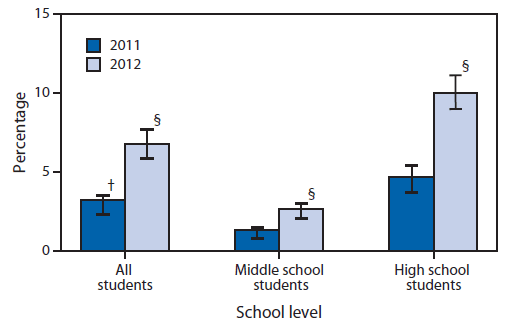
On September 6, the Centers for Disease Control and Prevention (CDC) reported that the use of electronic cigarettes by middle and high school age children had doubled in the past year.  Less than three weeks later, the Attorneys General of 40 states – including Connecticut - announced that they are calling on the U.S. Food and Drug Administration (FDA) to issue regulations by October 31, 2013, addressing the advertising, ingredients and sale to minors of e-cigarettes.

The CDC survey noted that an estimated 1.78 million students reported having used e-cigarettes as of 2012. Additionally, an estimated 160,000 students who reported using e-cigarettes had never used conventional cigarettes. “This is a serious concern,” the CDC pointed out, “because the overall impact of e-cigarette use on public health remains uncertain. In youths, concerns include the potential negative impact of nicotine on adolescent brain development, as well as the risk for nicotine addiction and initiation of the use of conventional cigarettes or other tobacco products.”

In a bipartisan letter this week, the attorneys general asked the FDA to regulate e-cigarettes as “tobacco products” under the Tobacco Control Act and to prohibit their sale to minors. E-cigarettes – rapidly growing in popularity among both youth and adults – are battery-operated products that heat liquid nicotine, derived from tobacco plants,ecig into a vapor that is inhaled by the user.

“Nicotine in any form is highly addictive,” said Connecticut Attorney General George Jepsen. “While some marketing claims imply that e-cigarettes are a safe alternative to smoking, the fact is that the health effects of e-cigarettes have not been adequately studied. Without sound research, we simply do not know whether the chemicals a user is inhaling are safe.”

At present, no federal age restrictions prevent children from obtaining e-cigarettes, and e-cigarettes are available in fruit and candy flavors – including bubble gum, ge cig imageummy bear and chocolate – that appeal to youth and have been banned from cigarettes.

Earlier this week, U.S. News reported that Sen. Richard Blumenthal,  the state's former Attorney General, "is one of the most vehement advocates of restricting the sale of electronic cigarettes. "  The magazine reported that Blumenthal says the vapor-producing devices, which are booming in popularity, have become "gateway nicotine-delivery devices" for children and he advocates banning flavor options and online sales.

U.S sales are expected to double this year to $1.7 billion, according to a Wells Fargo Securities estimate published in August. Year-to-date retail sales were estimated at around $700 million and online sales were pegged at $500-625 million.  "I think flavors ought to be banned," Blumenthal told U.S. News. It's "completely disingenuous" to say adults are the primary users of popular flavor options, he said.  "There may be a handful of adults who like bubble gum-flavored e-cigarettes, but the overwhelming purpose," he said, "is to appeal to kids."

In addition to Connecticut, attorneys general from Alaska, Arizona, Arkansas, California, Colorado, Delaware, Guam, Hawaii, Idaho, Illinois, Indiana, Iowa, Kentucky, Louisiana, Maine, Maryland, Massachusetts, Michigan, Minnesota, Mississippi, Missouri, Montana, Nevada, New Hampshire, New Mexico, New York, North Carolina, Ohio, Oregon, Pennsylvania, Puerto Rico, Rhode Island, South Dakota, Tennessee, Utah, Vermont, Virgin Islands, Washington and Wyoming signed the letter sent to the FDA today.

“Given the rapid increase in use and youths' susceptibility to social and environmental influences to use tobacco, developing strategies to prevent marketing, sales, and use of e-cigarettes among youths is critical,” the CDC report stated.

Good News, Bad News as Connecticut Seeks Economic Rebound

The assessment of the Connecticut Economic Resource Center (CERC) is good news, bad news for Connecticut’s economic recovery.  In a presentation to The Alliance for Nonprofit Growth and Opportunity, CERC Vice President of Research Alissa DeJonge and Research Analyst Carmel Ford reached two central conclusions:

  •  Connecticut has structural problems that continue to make its economy recover more difficult.  Structural problems include workforce and industry compositions that are not particular strengths in the overall U.S. ecnoCERC-300x100my.
  •  Connecticut has advantages in some areas such as healthcare employment, and we may see improvements in the state’s housing market as forecolousres start to diminish and inventory supply inequities become smaller.

Among the key stats that contributed to the overall analysis from CERC:

  1. Connecticut ranked 5th lowest among the states in per capita energy consumption in 2010.  However, Connecticut ranked 3rd highest in total energy prices and had the highest energy expenditure among all New England states.ctcounties
  2.    Connecticut’s youth unemployment rate was 17.1 percent in July 2013, compared with the national rate of 16.2 percent.
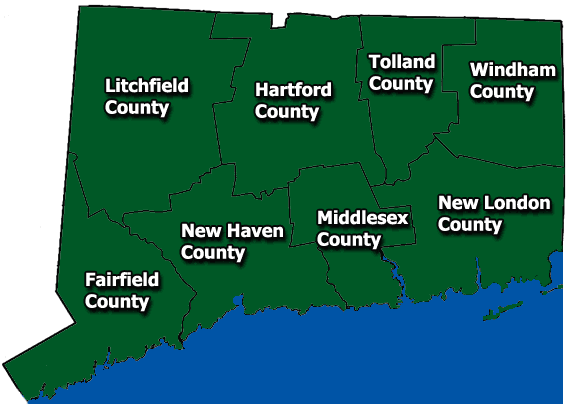
  3.   The unemployment rate in New London county hasn’t decreased significantly since 2010, and in Tolland County since 2011.  Overall, the states unemployment rate by county has been decreasing steadily in the state’s other six counties.
  4.   Median prices of single family homes in Connecticut increased 2.7% to $429,000, according to most recent data, and the inventory of single homes went down by 12.9% compared with a year ago.
  5. Newly issued housing permits in July 2013 incased slightly to 420 from 375 in July 2012.
  6. Connecticut remains the richest state with a per capita income of $58,908.

The CERC officials also pointed out that some of Connecticut’s leading industry categories, such as insurance and finance, are not performing well nationally, thus slowing the opportunities for the state’s economy to advance.

Based in Rocky Hill, CERC is a public-private partnership that provides economic development services consistent with state strategies, leveraging Connecticut’s unique advantages as a premier business location.  CERC was recognized earlier this month  for excellence in economic development marketing by key industry group, the Northeastern Economic Development Association (NEDA).  The award was presented at the recent NEDA annual conference in Portland, Maine among more than 130 economic development professionals from across the Northeast.

High School Ambulance Corps Gains Prominent Supporter, Urges CPR Training

Local resident Scott Pelley is prominently featured in efforts to alert Darien neighbors  of an upcoming opportunity to learn how to save a life.  Pelley, widely known as the anchor of the CBS Evening News and a lead correspondent on 60 Minutes, has recorded a video in support of Darien Emergency Medical Services Post 53, which is presenting Hands for Life, a day of training in hands-only CPR, open to local residents on September 29.

In the video that appears on the Post 53 website, Pelley notes that the local ambulance service, founded in Darien in 1970, is “possibly the only one in the country” staffed predominantly byscott pelley high school studentsPost 53 and the Darien YMCA are coordinating the training day.

Each year approximately 20 high school students, at least 14 years of age, are selected to be members of Post 53 from53 a large pool of applicants. Over the course of their four-year career at Post 53, members progress through five roles: Candidate, Radio Roomie, Rider, State-Certified EMT, and then Driver, usually by their senior year, according to the organization’s website.

The mission of Post 53 is to provide emergency medical services to the Darien community at the highest level of excellence, using Darien High School students and adult volunteers. The members of Post 53 are committed to achieving and maintaining the highest level of training and skill in providing pre-hospital care and transport to the citizens of Darien.

The young aduHFL-DARIEN_logo_Hlts staff the ambulance on a 24-hour/day, 7-day/week basis, except during regular school hours (7:30 AM - 2:30 PM, Monday-Friday during the school year).  During those times, the adult advisors staff the first response ambulance and are the primary support unit for Darien.  In the event that two calls occur which overlap during the school day, the second response young adult crew is paged out.  Darien High School supports the commitment of the Post 53 young adults and there is a mutual obligation to support the emergency medical needs of Darien while minimizing the impact on the school work of the young adults.

Post 53 is considered one of the finest emergency ambulance services in the United States for its consistently high quality pre-hospital emergency care, accambulanceording to the website.  In total, over 550 Darien High School students have served their community as members of Post 53 since its inception four decades ago.  Darien EMS-Post 53 does not rely on any government funding for the annual operating budget.

Each year, nearly 785,000 Americans suffer from a heart attack. Nearly 300,000 of these people suffer sudden cardiac arrest at the time of their heart attack, outside of a hospital setting. Less than one in four receive CPR from a bystander, and only about 5 percent of cardiac arrest victims survive, the Post 53 website points out.

Studies show that survival rates fall 10 percent each minute without CPR before emergency medical assistance, often with a fatal outcome. The Post 53 website points out that if more people knew how to provide effective, simple-to-apply Hands-Only CPR, more victims could be helped, doubling or even tripling their chances of survival.

The September 29 day of CPR training for members of the community is free of charge and open to people of all ages. It is being held, 10AM – 4PM, at the YMCA in Darien.  No appointment is necessary.

Warning: Be Wary of State Economic Development Rankings, Study Finds

New analysis from a national research organization is casting considerable doubt on the validity of the steady stream of state economic development rankings that routinely appear in the media.  State economic rankings cannot be taken at face value, according to an article published online by the Journal of Applied Research in Economic Development.

"How Can I Create My Favorite State Ranking?" points out that such rankings typically are subjective and often offer little meaningful information, despite their pervasiveness in the media, government and among economic analysts.

"Often, these ranstateskings are plagued by lack of clarity about what is being measured or whether the ranking accurately assesses what it claims to measure," said Yasuyuki Motoyama, Ph.D., senior scholar at the Ewing Marion Kauffman Foundation, who wrote the article with Jared Konczal, a senior analyst. "Further, the connection between these indexes and actual economic growth and performance at the state level is ambiguous, at best."

The proliferation of state rankings, the authors point out, can lead policymakers and economic development consultants to misuse them, either celebrating a conveniently positive ranking or initiating efforts to address a poor ranking, when neither action may be based on valid economic indicators.  The Kauffman Foundation website points out that the authors conducted a series of exercises to demonstrate how such rankings can be manipulated, using eight state-level indicators:

  • Self-employment rate
  • Kauffman Index of Entrepreneurial Activity
  • Business startup rate
  • Ratio of science and engineering bachelor degree holders to the total population
  • Patents per science and engineering workforce
  • Venture capital investment over Gross State Product
  • Research and development expenditures
  • Number of high-growth Inc. 500 firms  

The indicators were chosen because they typically are used to measure entrepreneurship and innovation, two vital indicators for every state's economic health. The subjectivity and limitations of state economic rankings led to four observations, according to the article:

  1. Policymakers should not rely on a single indicator to gauge economic conditions.
  2. Aggregating indicators does not provide solutions because indicators are highly variable.
  3. Policymakers should not focus on improving their states' rankings because the rankings lack meaning.
  4. Rather, they should employ a scorecard approach, which does not create a normative, quantified measure, but descriptively assesses various conditions of each state.  

Demonstrating that rankings can be developed in ways that favor any given state, the Kauffman researchers created a simulation analysis with randomly generatedkauffman-details-logo weights, which revealed that, among 1,000 different scenarios, five states were eligible to be No. 1, 16 were eligible for the Top Five and 22 could be ranked in the Top 10.

Depending upon how a range of variables were weighted, Connecticut placed in the top 10 in 41 of the scenarios, 17th overall among the states.  (Just ahead of Texas; just behind Maine).  The full report can be viewed on Journal of Applied Research in Economic Development. website.

CT Companies Among World’s Most Innovative, Forbes List Shows

Google was #47.  Apple was #79.  Ranked at #43, Danbury headquartered Praxair surpassed both, one of two Connecticut-based companies in the top 50 on the latest Forbes® World's Most Innovative Companies list. 

The highest-ranked company located in Connecticut, placing at #2 globally, was New Haven based Alexion, in the midst of a much-heralded move back to the city where it was founded.   It is the second consecutive year that Alexion was ranked at #2.Alexion-Logo-Official

Alexion Pharmaceuticals, Inc. is a biopharmaceutical company focused on serving patients with severe and ultra-rare disorders through the development and commercialization of life-transforming therapeutic products. Its marketed product Soliris is the first and only therapeutic approved for patients with two ultra-rare and severe disorders.

A specialized chemicals company with more than 26,000 employees worldwide, Praxair improved its “innovative” position on the Forbes list, up from #46 in 2012. Praxair, Inc. praxairproducts are oxygen, hydrogen, nitrogen, argon, carbon dioxide, helium, electronic gases and a range of specialty gases. Praxair Surface Technologies supplies coatings, which protect metal parts from wear, corrosion and heat. 

Ranked at #73 among the world’s 100 most innovative companies according to Forbes was Amphenol Corporation, with world headquarters in Wallingford.  Amphenol is a designer, manufacturer and marketer of electrical, electronic and fiber optic connectors, interconnect systems and coaxial and high-speed specialty cabAmphenol Corporationle. Amphenol systems are used primarily to conduct electrical and optical signals for a range of electronic applications.

Assa Abloy, at #78, is a Sweden-based company engaged in the secure door opening solutions. With operations in New Haven, the company's operations are divided into five divisions, including the supply of electronics security solutions worldwide. Assa Abloy provides secure identity solutions, contactless identification technology solutions, electronic lock systems and safes for hotels and cruise ships.

Based in Ireland, but with a strong presence in North Haven, Covidien Public Limited Company ranked at #67.  Covidien is engaged in the development, manufacture and sale of healthcare products for use in clinical and home settings. It operates its businesses through three segments: Medical Devices, Pharmaceuticals, and MedicForbes innovativeal Supplies.

The San Francisco Bay Area had three of the top 10 spots and six spots overall on the list of 100 companies.  Companies headquartered in Connecticut, or with a strong presence in the state, had a strong presence among the world’s most innovative. 

For the third year in a row, San Francisco-based Salesforce.com topped the Forbes’ list.  After Alexion, the remainder of the top five were U.S. companies VMware at #3, followed by Regeneron Pharmaceuticals and ARM Holdings. Amazon was # 7; Starbucks was #19. The complete ranking is featured in the September 2 issue of Forbes magazine.

In compiling the list, Forbes utilizes a detailed methodology.  Companies are ranked by their innovation premium: the difference between their market capitalization and a net present value of cash flows from existing businesses (based on a proprietary formula from HOLT/Credit Suisse), the magazine reported.  To be included, firms need seven years of public financial data and $10 billion in market capitalization.

“Hometown” Banks Continue to Locate Away From Home

Apparently hometown pride and banking are mutually exclusive – or at least travel well.  The volume of banks bearing a community’s name that are opening branches far, far away from home continues to grow, which suggests that banks have clear and convincing evidence that the distant moniker just isn’t an issue for consumers.

The latest: Vernon-based Rockville Bank is asking state approval to open a Hamden branch, its first retail incursion into New Haven County, the Hartford Business Journal hasbank-vault reported.  The bank is planning to establish a 2,000-square-foot, full-service retail branch near the commercial- and residential-loan production office the bank opened in July 2011.  Earlier this year Rockville Bank crossed the Connecticut River to open a high profile branch in thriving West Hartford Center.

Connecticut by the Numbers has previously reported on the increasing number of banks with the name of a Connecticut town within the bank’s name that have opened branches – and many of them – in other towns.  An increasing number are opening in towns far afield, and last month, Massachusetts-based Westfield Bank opened a branch in Granby, CT.

Already, the list of town names doing double-duty as bank names is lengthy, with the institutions numbering two dozen:  Fairfield, New Canaan, Groton, Darien, Essex, Farmington, Greenwich, Suffield, Guilford, Jewett City, Litchfield, Milford, Naugatuck, Putnam, Rockville, Salisbury, Danbury, Simsbury, Stafford, Thomaston, Torrington, Wilton and Windsor.  And those are only the Connecticut towns, of course.

Among the town-line-jumping trendsetters:  Farmington Bank in South Windsor, Essex Savings Bank in Madison,  Jewett City Savings Bank (“your hometown bank”) in Brooklyn, Simsbury Bank in Bloomfield, and the Savings Bank of Danbury in Waterbury.  There are many more.

Although there are 25 out-of-state banks connecticutwith a presence in Connecticut, only Rhode Island-based Newport Federal Savings Bank, with an office in Stonington, included the name of a town – until the arrival of Westfield Bank.  Other well-known names, evoking out-of-state regions, include Bank of New York, Berkshire Bank (which is now in the process of purchasing 20 Bank of America branches in New York State), First Niagra Bank, and Hudson Valley Bank.

To look back at the CT by the Numbers hometown bank story, click here:

http://ctbythenumbers.info/2013/04/17/hometown-names-go-beyond-hometown-for-connecticut-banks/

To review the list of banking institutions in Connecticut, see the state Department of Banking list:

http://www.ct.gov/dob/cwp/view.asp?a=2228&q=296954

Connecticut's Green Report Card: Needs Improvement

Connecticut’s state government received mixed grades in the new edition of the Connecticut Green Guide, published by Hartford Business Journal.  The publication reviewed state policy in our areas – microgrids, gasoline taxes, wind turbines and greenhouse gas reduction efforts – and graded the state’s efforts.

Connecticut received an “A” for recently announcing an $18 million grant program with nine microgrid projects in eight Connecticut communities, “adding protection from power outages and moving away from a centralized electriciMalloy aParkvillety system.”  Just a week ago, Gov. Malloy was joined by the White House Chair of the Council on Environmental Quality to highlight one of the state’s microgrid sites, in the Parkville neighborhood of Hartford.

The state received an “F” because of a moratorium on wind turbines, which has been in place since 2001, according to the Green Guide.  “Because of poorly written legislation and prolonged bureaucracy,” the publication explained, several projects have been delayed.  Another poor grade, a D+, was assigned because state taxes on gasoline rose 4 cents on July 1, “giving Connecticut the third highest taxes on motor vehicle fuel in the country.”  The publication noted that while “higher prices might egreen guilde logoncourage conservation, very little of the tax revenue goes toward fixing the aging transportation system, leading to vehicle inefficiencies and congestion.”

Connecticut fared better. earning a B+, in the analysis of the state’s participation in the Regional Greenhouse Gas Initiative, along with the other eight states in the region, which will “further lower the cap on power plant pollution,” which should, according to the publica50 statestion’s review, “make the air cleaner, and the proceeds will aid the clean energy industry.”

The publication also noted that Connecticut became the first state in the country to mandate mattress recycling, with a new law approved by the legislature this year, also adding a new paint recycling requirement to existing laws that call for recycling of electronic waste and mercury thermostats.  The state’s move toward a greater emphasis on “product stewardship,” is characterized by an increasing obligation imposed on consumers to recycle designated products, which helps the environment and provides business opportunities in the recycling of those products.

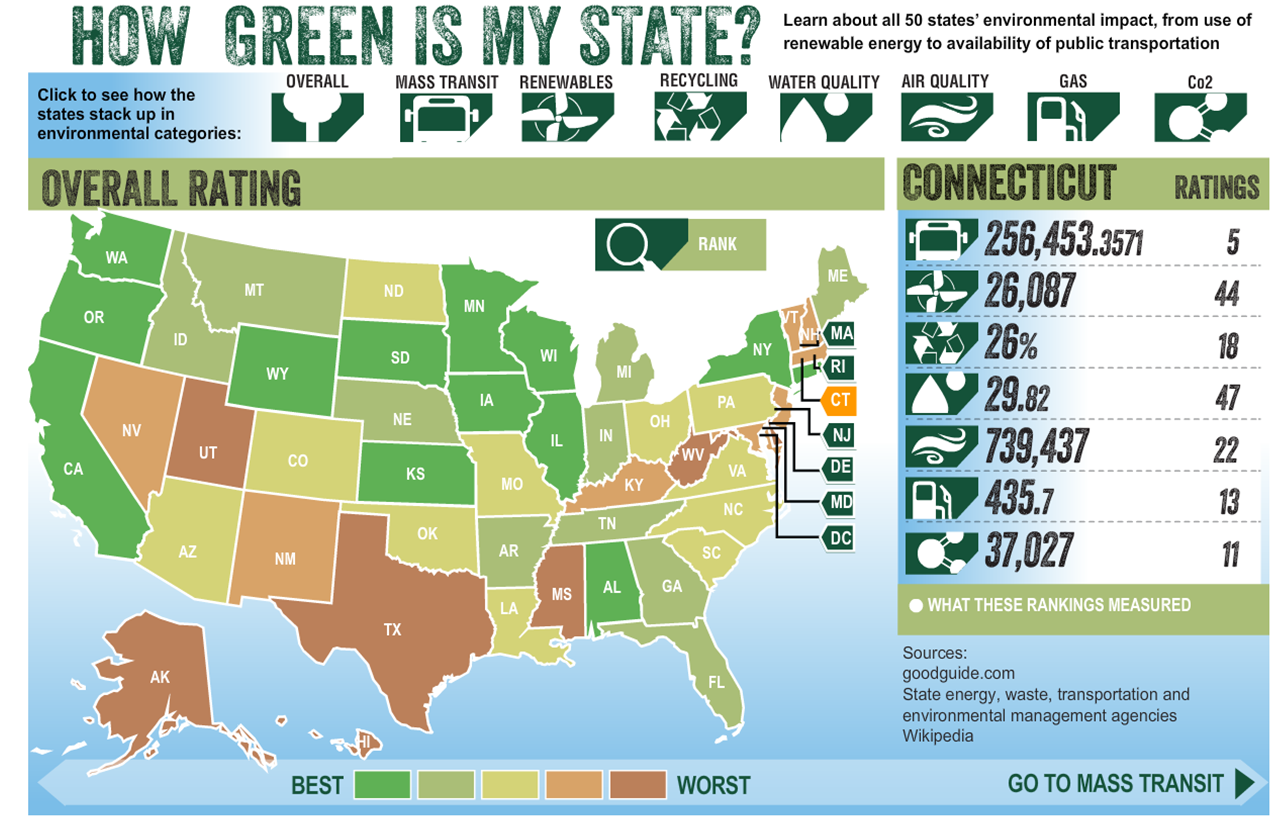
In a report on the green initiatives across all 50 states, published by Forbes magazine in July, Connecticut excelled in the areas of mass transit, ranking 5th among the states, in CO2 controls, ranking 11th, and recycling, ranking 18th.  The state was 44th in use of renewables and 47th in water quality.  That's according to this recent green ranking of states from MPHOline.org, a website that provides information on a variety of public health topics.

Data from the green product rating site GoodGuide was used to assess air and water quality, information from Wikipedia was the basis of the comparison on the number of mass transit systems in each state, and state agencies were used to provide information on the other categories.

CT Worst in Nation for Unemployed, Near Bottom in GDP Growth - But Not Miserable

Connecticut is the worst state in the nation for the unemployed, according to data compiled by Bloomberg news.  The state ranked last among the 50 states and District of Columbia on the difficulty of life for the unemployed based on three equally weighted criteria: income replacement, the unemployment pool and income disparity, based on data compiled from U.S. Bureau of Economic Analysis, U.S. Bureau of Labor Statistics, and U.S. Census.

According tbea_logo_460o the business news service, the ten most challenging states for unemployed residents are Connecticut, New Jersey, District of Columbia, California, Maryland, Alaska, New York, Virginia, Delaware, Massachusetts and New Hampshire.

The best states – at the opposite end of the data compilation – are North Dakota, Utah, Iowa, New Mexico, Oklahoma, Arkansas, West Virginia, Montana and Idaho.economic-indicators2

In developing the rankings, Bloomberg used the following:  Average weekly unemployment benefits was the quarterly average from 2Q 2012 to 1Q 2013. Personal Income per capita was calculated by dividing 2013 preliminary total personal income by state data from the Bureau of Economic Analysis by the state population from the Census as of mid-year 2012. Unemployment rates were the July 2012 to June 2013 seasonally adjusted 12-month average figures for the civilian non-institutional population. Household income ratios were from the U.S. Census Bureau, 2011.  The three scores were averaged for the final ranking.

Connecticut also ranked third from the bottom on Gross Domestic Product growth between 2008 and 2012, according to a companion Bloomberg report of data from the U.S. Bureau of Economic Analysis.  Only Arizona and Nevada had a worse track-record during the period.  Connecticut was one of ten states to experience negative GDP growth during the years of the comparison.  The state’s GDP dropped to 197.2 billion last year, from 202.5 billion in 2008.  The most dramatic increase in GDP was in North Dakota, where GDP grew 35 percent.  Next was Texas, with a 12 percent increase, followed by Oregon, West Virginia, Alaska, Louisiana, Utah, Nebraska, Maryland and Indiana.

There was some good news for the Land of Steady Habits in recent data.  Connecticut ranked #13 among the "least miserable" states in the nation.  Which are the most miserable states?  Louisiana, Mississippi, Arkansas, West Virginia, New Mexico, SoutCT welcomes youh Carolina, Alabama, Nevada, Tennessee and Kentucky.  All of which seems to indicate that a state can have solid GDP growth and still be relatively miserable - particularly for the unemployed.

Thirteen variables from the United Health Foundation's America's Health Rankings were isolated to determine each state's Misery Score. Among them:  Air pollution levels refer to micrograms of fine particles per cubic meter. High school graduation rates refer to percent of incoming ninth graders who graduate within four years. Poor health days refer to the number of days in which a person could not perform work or household tasks due to poor mental or physical health. Personal income refers to income from all sources and is not inflation adjusted.

The least miserable states were – from the top - Minnesota, North Dakota, New Hampshire, Vermont, Massachusetts, Hawaii, Iowa, Nebraska, Utah, Wisconsin, Wyoming, South Dakota – and then Connecticut, at lucky #13.

State Lottery Shows Strength in Connecticut, Land of Steady Habits

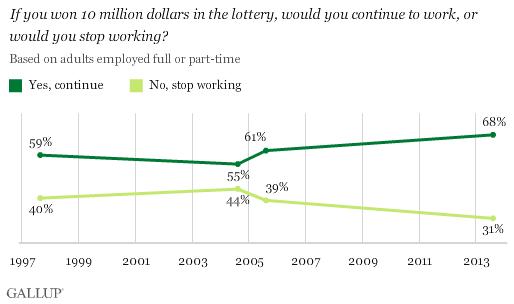
What would you do if you won the lottery?  According to a new survey, you’d go to work.  That's true not only in the Land of Steady Habits, but nationwide.

Two-thirds of American workers say they would continue working even if they won $10 million in the lottery, while 31% say they would stop, according to a new Gallup poll, released earlier this month. The desire to keep working after enjoying a financial windfall is higher today than in three earlier Gallup measures, all prior to the 2008-2009 recession, the polling firm reported.

Additionally, most American workers who predict they would continue working even after winning the lottery say they would want to stay at the same job rgallup pollather than seek a new job. The roughly 2-to-1 ratio in favor of keeping the same job versus getting a new one is about the same as in 2004, but slightly higher than in 2005 and 1997.

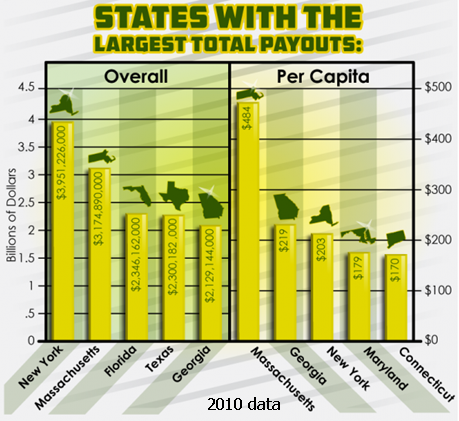
Bloomberg News has reported that lottery players in the U.S. spend an average of $396 a year purchasing lottery tickets, with residents of Massachusetts, Georgia and New York leading the way.  Using data from this analysis, Bloomberg identified which states see the highest and lowest payout ratios. Connecticut tops  neither list. On average, Massachusetts players spend $861, Georgians spend $471 and New Yorkers spend $450 on lottery tickets.  At the bottom in per person spending, on average, are Oklahoma ($71), Montana ($61) and North Dakota ($47).

In fiscal year 2012, players in Connecticut won $659.9 million in prize money. At the same time the CT Lottery provided a record $310 million to support the services and programs founded by the state’s General Fund including public health, libraries, public safety, education and more, according to state lottery officials. Connecticut’s first lottery btop 3egan in 1972, and was the fourth in the nation.

According to the quasi-public Connecticut Lottery Corp.'s most recent annual report, released in May, the lottery achieved record sales totaling nearly $1.1 billion in fiscal year 2012, an increase of $65.1 million from the previous fiscal year, the Day of New London reported.  The lottery credited a number of factors for its total sales increase, including higher sales of instant tickets and higher sales of multistate games, such as Powerball, Mega Millions and Lucky for Life. Also, 2012 was a leap year, meaning an extra day for sales.

For the first time in 15 years in fiscal year 2013 (which ended on June 30), the lottery is bringing in more revenue ($16 million) than both Foxwoods and payoutsMohegan Sun, WTNH-TV reported last week.  Lotteries are ubiquitous.  In North America every Canadian province, 43 U.S. states, the District of Columbia, Mexico, Puerto Rico, and the U.S. Virgin Islands all offer government-operated lotteries. Elsewhere in the world, according to NASPL, publicly-operated lotteries exist in at least 100 countries on every inhabited continent.


According to the U.S. Bureau of Economic Analysis, only seven U.S. states don't run lotteries: Alabama, Alaska, Hawaii, Mississippi, Utah, Wyoming, and Nevada. Of the 43 states that do run lotteries, the average payout is just under 60% of the revenue dollars collected. Using U.S. Census data, Bloomberg reported that of the estimated $50 billion spent on lottery tickets in 2010, only $32.8 billion was returned in prize money.

A previous Gallup Poll on Gambling in America found that 57% of American adults reported buying a lottery ticket in the past 12 months. People with incomes of $45,000 to $75,000 were the most likely to play -- 65 percent had played in the past year -- while those with incomes under $25,000 were the least likely to play at 53 percent. Further, people with incomes in excess of $75,000 spend roughly three times as much on lotteries each month as do those with incomes under $25,000, the National Association of State and Provincial Lotteries (NASPL) points out.