CT, NY, NJ Should Expect Unprecedented Flooding by Mid-Century, Scientists Predict

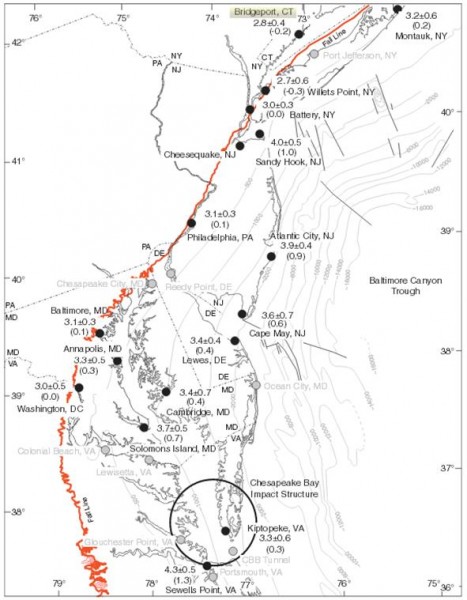
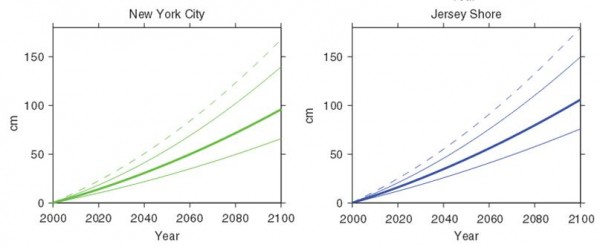
It will get worse, not better, for shoreline residents and businesses in Connecticut, New York and New Jersey within range of the Atlantic Ocean.  That’s the likely scenario based on newly completed research by a team of geoscientists who are predicting that the New Jersey shore will likely experience a sea-level rise -- about 1.5 feet by 2050 and of about 3.5 feet by 2100 – that will be 11 to 15 inches higher than the average for sea-level rise globally over the century.

Hurricane Sandy Bears Down On U.S. Mid-Atlantic CoastlineThat would mean that by the middle of this century, the one-in-10 year flood level at Atlantic City, for example, would exceed any flood level seen previously, including the natural disaster that was Superstorm Sandy.  The scientists suggest, based on their research, that “planners should account for rising sea levels,” noting that “where the consequences of flooding are high, prudent planning requires consideration of high-end projections” outlined in their study.

Geoscientists at Rutgers University and Tufts University base their projections in part upon an analysis of historic and modern-day records of sea-level rise in the U.S. mid-Atlantic region. Their research appears in the inaugural issue of the journal Earth's Future, published this month by the American Geophysical Union (AGU).

While much to the work centers on the New Jersey shore and The Battery in Lower Manhattan, Rutgers researcher Ken Miller told Connecticut by the Numbers that their analysis included both Montauk on Long Island and Bridgeport.  Since Connecticut lies on bedrock, Miller said, it will largely behave like The Battery in New York CityAGU logo.  “I believe that the projections for bedrock locations are applicable throughout Connecticut,” said Miller, a professor of earth and planetary sciences in Rutgers' School of Arts and Sciences. shore map

Miller collaborated in the study with colleagues Robert Kopp, Benjamin Horton and James Browning of Rutgers and Andrew Kemp of Tufts. Kemp, an assistant professor of earth and ocean sciences at Tufts since May, joined the faculty from Yale University, where he was a Postdoctoral Associate at the Yale Climate and Energy Institute (YCEI).  The new research builds upon a recent study by Kemp, Horton and others that reconstructed a 2,500-year record of sea level at the New Jersey shore. Horton is a professor of marine and coastal sciences in Rutgers' School of Environmental and Biological Sciences.

"It's clear from both the tide gauge and geological records that sea level has been rising in the mid-Atlantic region at a foot per century as a result of global average sea-level rise and the solid earth's ongoing adjustment to the end of the last ice age," Miller told Rutgers Today. "In the sands of the New Jersey coastal plain, sea level is also rising by another four inches per century because of sediment compaction -- due partly to natural forces and partly to groundwater withdrawal. But the rate of sea-level rise, globally and regionally, is increasing due to melting of ice sheets and the warming of the oceans."

The researchers suggest that “additional work is needed to integrate site-specific sea-level rise projections with storm tide statistics to guide planning decisions and investments that may have time frames of 20 years, 40 years, or longer.”  They indicate that sea-leEarth's Future covervel rise in the mid-Atlantic region also results from changes in ocean dynamics. The researchers said sea-level rise could be higher -- 2.3 feet by mid-century and 5.9 feet by the end of the century -- depending on how sensitive the Gulf Stream is to warming and how fast the ice sheets melt in response to that warming.

The study found that the eight inches of climate change-related regional sea-level rise in the 20th century exposed about 83,000 additional people in New Jersey and New York City to flooding during 2012's Superstorm Sandy.  The research was supported by a grant from the National Science Foundation.

Earth’s Future, with its inaugural issue, joins AGU’s prestigious portfolio of peer-reviewed research publications, including Geophysical Research Letters and Journal of Geophysical Research – Atmospheres. Both are ranked among the top ten most-highly cited research publications on climate change over the past decade.  The American Geophysical Union is dedicated to advancing the Earth and space sciences for the benefit of humanity through its scholarly publications, conferences, and outreach programs. AGU is a not-for-profit, professional, scientifinyc njc organization representing more than 62,000 members in 144 countries.

Developing Downtown Housing Above Commercial Space Brings Obstacles, Opportunities, New CT Report Finds

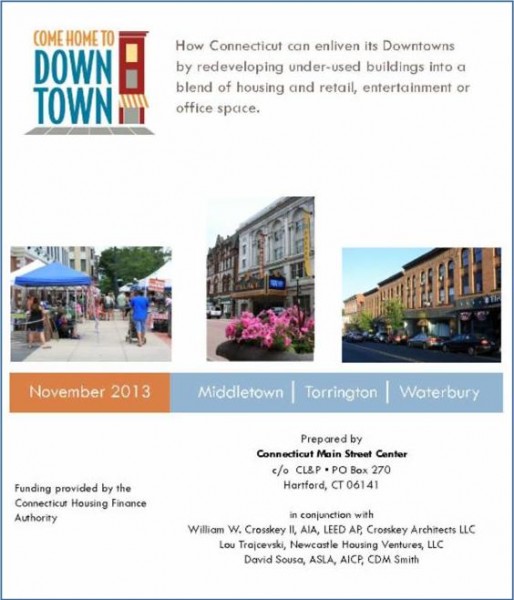
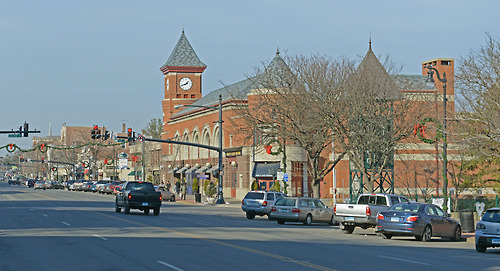
Connecticut's downtowns have a wealth of potential to redevelop under-utilized buildings into housing above commercial space - if mixed-use development can be encouraged through financing and favorable regulations, according to a new report from the Connecticut Main Street Center (CMSC).

The report comes at the conclusion of the first year of Come Home to Downtown, a pilot program CMSC established to encourage and facilitate viable, interesting housing opportunities while revitalizing downtown neighborhoods.  The initiative was contracted by the Connecticut Housing Finance Authority (CHFA) to promote housing in Connecticut's downtowns.

Three communities - Middletown, Torrington and Waterbury - as well as three property owners and their buildings, were selected as the focus of the program’s inaugural year. CMSC chose buildings typically found throughout Connecticut so they could serve as models for other towns. As a result, most of the findings expressed in the report apply to any Connecticut downtown wishing to maximize the potential of its existing infrastructure.Come-Home-logo-150x150

Among the key findings, the report indicates that mixed-use development is among the most challenging, and private owners are often in a “catch-22” as they seek financing.  Downtown management capacity is critical to the success of mixed-use development, the study found. In addition, the CMSC report explains that even when zoning regulations promote redevelopment, they are often not enough to enable mixed-use growth and a severe lack of financing impedes the growth of much-needed mixed use development.

"CMSC's report provides insights that will guide future housing development on Main Streets across Connecticut. The first year of the Come Home to Downtown program is not only creating opportunities to establish new rental housing in downtown neighborhoods, it's creating a model for other communities to follow,"   said Eric Chatman, President & Executive Director of CHFA, which has contracted with CMSC for a second year of the pilot program, which will focus on finding and creating financing.

The report's seven key findings are:

1. There is a huge amount of potential for accommodating mixed-use development - which both saves and generates monies - in Connecticut's downtowns. According to the U.S. Environmental Protection Agency, the infrastructure costs to service compact, dense development like that found Downtown reportin mixed-use neighborhoods are one-third to one-half lower than in suburban areas. It has been estimated that every downtown in Connecticut has at least one building that is under-utilized, containing a store or restaurant on the first floor, but with upper floors that are vacant or used for storage that could instead generate income if converted to apartment homes.

2. Mixed-use development is one of the hardest types to accomplish. There are several reasons why this is the case: these buildings are usually older and in need of greater rehabilitation; they are in need of complex financing from multiple sources; combine several uses in one building (such as housing and retail space); and are often owned by people with little to no redevelopment experience.

3. A severe lack of financing impedes the growth of mixed-use development. Because these deals are so intricate and multi-faceted, financing for the total development costs rarely exists from traditional sources.

4. Education and outreach to owners of possible mixed-use property is needed. Property owners are often unprepared for the complex process of redeveloping their building and unaware of the potential benefit in doing so. Very often, they also need assistance learning how to become landlords and attract good tenants.

5. Private-owners are in a catch-22 when it comes to obtaining financing. With regard to apartment homes located in mixed-use buildings, private owners can either apply for subsidies if they place income/affordability restrictions on the apartments, or the units are not restricted, but there is no subsidy for apartments at the same rental rate.

6. Even when zoning regulations promote redevelopmmiddletownent, they are often not enough to enable mixed-use growth. Favorable zoning regulations are important, but they cannot create mixed-use development by themselves. Each of the pilot communities had zoning policies that allowed for buildings with a mix of uses - a practice which should be commended and encouraged - but there were still significant impediments to promoting this type of growth. In addition, lessening current on-site parking requirements as a whole will also help promote housing in our downtowns.

7. Downtown management capacity is critical to the success of mixed-use development. Any community interested in promoting revitalization of its downtown should consider enhancing its management function by becoming a resource center for mixed-use development, including convening key stakeholders, collecting data, offering education and information and coordinating development incentives.

"There is now a better understanding of what the next steps need to be, and a greater appreciation of the importance of the public-private partnership that is necessary to overcome the challenges and achieve reuse of these properties," Rose Ponte, Torrington's former Director of Economic Development, said about the new report.

 Engaging an expert team of consultants, CMSC worked with municipal officials and the building owners to develop viable redevelopment options including: determining what financing would likely be needed for redevelopment; performing an assessment of zoning and regulatory requirements; reviewing the downtown management function; and measuring the downtown's walkability. Specific recommendations for improving the buildings, including a recommended floor plan designed to attract new residents and bring market rate housing downtown, was also provided to each property owner.

Once rehabilitated, these buildings will create 60 new units of rental housing in downtown Middletown, Torrington and Waterbury, as well as make approximately 25,000 square feet of commercial and retail space available. The total development cost to renovate all three buildings is estimated to be $11.4 million.

"You see it on an almost daily basis - news articles and reports showing the demand, especially among Millennials and Baby Boomers who want to live in walkable, interesting places. It doesn't seem to matter if the downtown is large or small, as long as they can live there and get around without a car to go to the movies, grocery store or coffee shop, that's where people want to be these days," said John Simone, CMSC President & CEO.

In the pilot program’s second year, CMSC will choose two new communities while continuing to work with the property owners and municipal officials in Middletown, Torrington and Waterbury.

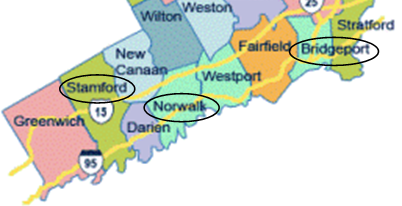
Bridgeport-Stamford-Norwalk Above National Average in Sustaining Startups, Study Finds

A new report assessing trends in start-up companies in 40 major metropolitan areas in the U.S. over the past two decades has found that the Bridgeport-Stamford-Norwalk corridor has performed well compared with similar regions in weathering, and rebounding from, the national economic downturn’s impact on the level of start-ups.

The report by the Kauffman Foundation, “The Most Entrepreneurial Metropolitan Area?,” was recently presented to the U.S. Conference of Mayors on Entrepreneurship, the first such confestart uprence of municipal leaders devoted solely to exploring entrepreneurship.

In reviewing Metropolitan Statistical Areas (MSA) with a population of between 500,000 and one million people, the report found that the Bridgeport-Stamford-Norwalk MSA placed “toward the top of the group, consistently above the year-to-year changes.”  In addition, the data indicate that Bridgeport-Stamford-Norwalk “did not fall as far during the (economic) downturn, so it appears to have fared slightly better.”

The paper compared the trends in the 40 metropolitan areas with high numbers of start-up businesses to the significant national downwkauffman-details-logoard trend in overall new firm formation starting after 2006.  Nationally, the trend reversed and started to recover in 2011. No metropolitan area escaped this downward trend, but there are differences among regions in the timing of the downturn and subsequent recovery.

In counting the number of times that the annual percentage change in start-up density for each of the MSA’s, within the same size class, five of the MSA’s – including Bridgeport-Stamford-Norwalk – were “above average 12 times thorough the period” reviewed. The others to attain that “level of consistency” were Tulsa, OK; Omaha-Council Bluffs, NE-IA; Little Rock-North Little Rock-Conway, AR; and Knoxville, TN.

map

The report also found that the largest MSAs – those with populations greater than 1 million – fared slightly better through the recession and have experienced slightly stronger recoveries, though none has returned to pre-downturn levels.

The report compared MSAs with relatively larger populations and high startup densities from among the nation’s 366 MSAs.  The MSAs were divided into four groups for purposes of comparison, those with greater than 1 million population, those with 500,001 to 1 million, those between 250,000 and 500,000, and those smaller than 250,000.

The federal government’s Office of Management and Budget (OMB) provides official definitions for MSAs in the United States:  densely populated areas with close economic ties.

LEGO KidsFest in Connecticut This Weekend, State Experiences Company’s Growth, Strength

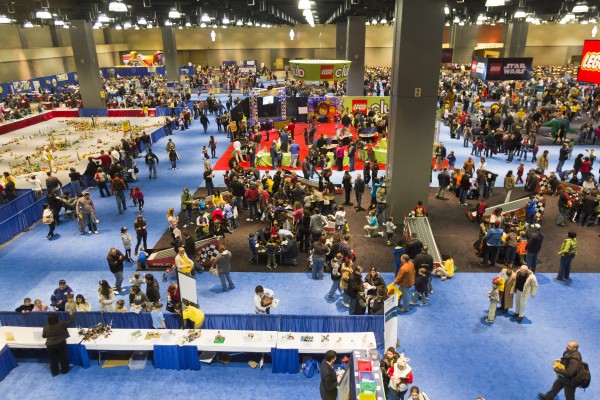
There’s no mistaking the popularity of LEGO.  The colorful bricks are ever-present in playrooms, bedrooms, and under couch cushions everywhere.  The passion for the colorful bricks will be on display this weekend (Dec. 6-8, 2013)  in Connecticut when the LEGO Kidsfest returns to the Connecticut Convention Center in Hartford for a weekend of creativity and construction, concluding the year’s six-city tour, and the first time it’s been back in Connecticut in two years.  (Tickets for Saturday are already sold out, with limited availabilities for Friday and Sunday sessions. )KidsFest

Beyond this weekend’s event, the Connecticut connections to LEGO may be surprising.

The LEGO KidsFest is a nationally-traveling giant LEGO expo held over three days and filled with interactive, creative and educational activities for the whole family. Connecticut is central to the LEGO universe.  LEGO Systems, Inc. is the North American division of The LEGO Group, a privately-held, family-owned company based in Billund, Denmark, one of the world’s leading manufacturers of creatively educational play materials for children.  The LEGO Kidsfest, however, is produced by LIFE Marketing and Events, located in West Hartford.

LEGO floorAt each tour stop, the LEGO KidsFest partners with national and local organizations and businesses whose products, services and promotional efforts are kid-friendly and beneficial to attendees. Next year, the tour will again run in seven cities: North Carolina: February 28–March 2;  Michigan: April 25–27;  Alberta, Canada: May 16–18;  Georgia: June 27–29;  Texas: August 29–31;  Virginia: October 3–5; and Indiana: November 7–9.  In 2011, the KidsFest was held in five cities, and has steadily grown in popularity.  Sellouts have been regular occurrences throughout 2013.

In the new book “Brick by Brick:  How Lego Rewrote the Rules of Innovation and Conquered the Global Toy Industry,” published by Crown Business division of Random House, author David C. Robertson points out that Lego “is driven by two desires.  The first is to inspire imaginative play and creative expression in as many kids and kids-at-heart as possible, in as many ways as possible.”  The second is to out-innovate every company it comes up against.”

The book, which explores Lego’s resurgence from near oblivion over the past two decBrickbyBrickades, outlines the company’s trials, tribulations (including near-bankruptcy in 2003), innovations and success, observing that “The LEGO Group’s leaders believe that to discover the next big growth opportunity, the company must adhere to a fundamental truth about innovation:  the more experiments you launch, the more likely it is that one will strike gold.”   KIdsFest is but one example.

The company is also expanding is footprint in Connecticut, having announced earlier this year that it was leasing an additional 80,198 square feet in the Enfield Business Park.  The company eventually plans to add more than 200 employees.

“We have about 600 employees in Enfield currently, and the space will provide desks for an additional 250 — not all of whom will be hired immediately,” Michael McNally, Lego’s brand manager said in April. The company in 2011 started to reconfigure its former manufacturing space into administrative offices. The building houses workers in finance, human resources, information technology, consumer services, direct-to-consumer retail, as well as Lego Master Builders.

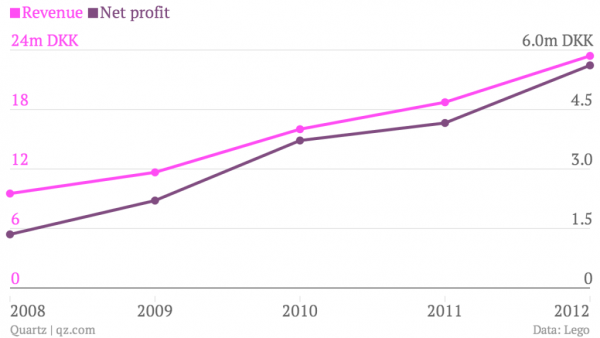
revenue-net-profit_chartbuilderLast month, it was reported that LEGO, already the second-biggest toy maker in the world, after Mattel, is continuing its expansion. In 2014, it will go from having one global headquarters, in Denmark, to five. The company is expanding its offices in London, Singapore, Shanghai and Enfield, Connecticut to form a network of global hubs.

The globe depicted on the cover of Robertson’s book, made of LEGO bricks, of course, is a fitting representation of the company’s growth – with Connecticut playing a noteworthy role.

Rising Star No More, Visitors Now Urged to DASH

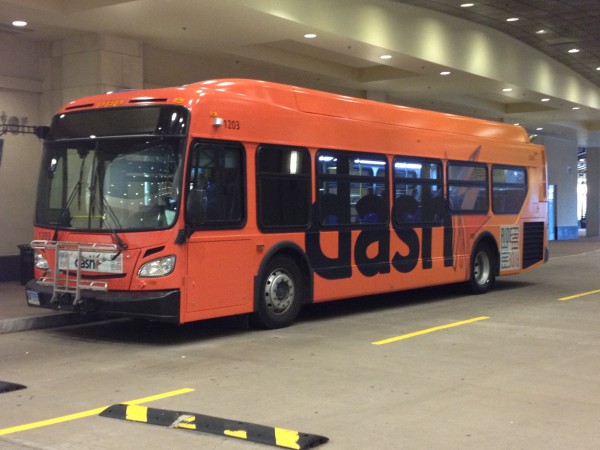
Hartford’s downtown circulating bus – developed as an easily accessible means of moving tourists and convention goers around the city – was re-launched this fall with a new name, distinctive new coat of paint and renewed enthusiasm.

Previously operating as the Star Shuttle since September 2005, nearly 728,700 passengers have used the specially designated bus service, which connects the Connecticut Convention Center, the Riverfront, the CT Science Center, the Arts and Entertainment District, various restaurants, and downtown hotels.

Now, it has received an all-orange makeover, along with the new name – DASH.

The change follows the change in Hartford's tourism campaign branding from "New England's Rising Star" to "Hartford Has It" and continues as  a collaboratiodashn among CT TRANSIT, CT DOT, the City of Hartford, the Capitol Region Development Authority, the Hartford Business Improvement District, the Hartford Metro Alliance, and the Connecticut Convention & Sports Bureau.

A year ago, the Hartford Business Improvement District tapped the collective creativity of capitol region residents to help re-name the free downtown circulator.  Local resident David Ceder suggested “dash”. Ceder explained "I am excidashart_webted the time has come to showcase the rebranding and new shuttle name! I chose "dash" not only because of the acronym (Downtown Area SHuttle) but also because it's an action word --"dash," to me, is exciting, inviting, and invokes you to hop on and discover Downtown."

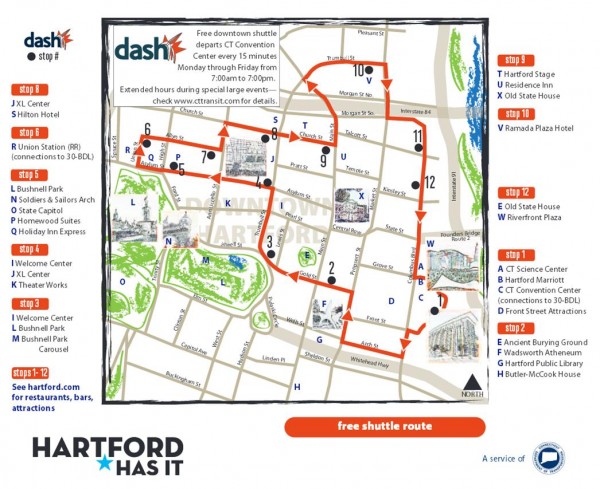
The bright orange DASH bus has been accompanied by updated signs downtown and an interactive map to help passengers know where to go to get on the free shuttle. Regular DASH service operates every weekday from 7:00 a.m. to 7:00 p.m., departing every 15 minutes from the Connecticut Convention Center.

During major downtown events, enhancements may include later evening service on weekdays, as well as service on Saturdays and Sundays. The specific services planned for each major event are posted on the CT TRANSIT website. The dash Shuttle does not operate on weekends when there is no downtown event scheduled.  The free shuttle also offers convenient connections to both the Bradley Flyer bus and to regular local CT TRANSIT bus service.

An out-of-town visitor to a convention earlier this year – before the name change -  praised the service. "My daughter and I ...have been using the Shuttle extensively to navigate the conference sites. I cannot say enough good things about ALL of the bus drivers. Thanks for making our trip so much fun."

Should you be  wondering, two buses have received the DASH makeover, adash mapnd the vehicles alternate in providing the service.  The DASH shuttle is a service of the CT Department of Transportation and operated by CT TRANSIT. Information on the route and extended service hours can be found at www.cttransit.com.

Nation of Coffee Drinkers, Across Every Demographic

Thanksgiving may be all about turkey, but odds are that most people around the table will wash it down with a cup of coffee.  According to the latest National Coffee Drinking Trends (NCDT) market research study, 63 percent of adults age 25-39 report drinking coffee every day, an increase of five percent from 2012 and a sizable jump from 44 percent who reported drinking coffee daily during 2010.  The study also found that just over 83 percent of U.S. adults drink coffee, and those who drink coffee at least once per week grew slightly to 75 percent of the population.

Coffee drinkers outnumber tea drinkers in the U.S.: 183 million coffee drinkers to 173.5 million tea drinkers.

coffeeYoung people are drinking more coffee than in recent years, according to the data compiled by the National Coffee Association:  41 percent of 18-24 year olds are drinking coffee each day —up from the 31 percent of this age group who said they had a daily cup of coffee during 2010. Overall daily consumption of coffee among those 60+ rose to 76 percent from 71 percent last year, and for those 40-59 to 69 percent from 65 percent in 2012.

Most adult coffee drinkers said their lifelong habit began during their teenage years. In fact, 54 percent said they began drinking coffee between 13 and 19.  Another 22 percent reported their coffee cravings started between the ages of 20 and 24. This means that 76 percent of adult coffee drinkers began drinking coffee by the time they were 24, the report pointed out.

Analysts indicate that U.S. Coffee consumption is expected to increase through 2015 at an average annual rate of 2.7 percent, while tea consumption is expected to increase through 2015 at an average annual rate of 3.1 percent, the organization reported.

In a breakdown of ethnic groups, tncdtCoverWEB_SMALL_FINALhe National Coffee Association data indicates that 76 percent of adult Hispanic-Americans said they drank coffee yesterday, 13 percentage points ahead of the total population. By comparison, 47 percent of African-Americans and 64 percent of Caucasian-Americans said they drank coffee yesterday.

With holiday gift giving now in full swing, the data regarding single-cup brewing systems is of note.  The data, from earlier this year, indicates that 13 percent of the U.S. population drank a coffee made in a single-cup brewer yesterday - up from just 4 percent in 2010.  That number is expected to climb when 2013 year-end numbers are compiled.

So-called “gourmet coffee” is also heating up. Nearly one third (31 percent) of the population say they drink gourmet coffee every day. At the same time, consumption of traditional coffee declined by seven percentage points to 49 percent.

NCA's National Coffee Drinking Trends (NCDT) study has been conducted annually by NCA since 1950. It is the longest available statistical series of consumer drinking patterns in the U.S. The study engaged a nationally representative sample of 2,840 people 18 and older.  The 2014 report is due to be issued early next year. The National Coffee Association of U.S.A, Inc. (NCA), established in 1911, is the leading trade organization for the coffee industry in the United States.

Worldwide consumption of coffee in calendar year 2012 was estimated at around 142 million bags by the International Coffee Organization, an increase of 2.1 percent from 2011.  The U.S. remains the largest consuming country, although consumption in non-traditional markets has increased 50 percent since 2003, according to the report issued in August.

Earlier this year, USA Today reported that a study published online in the journal Mayo Clinic Proceedings, indicated that men younger than 55 who drank more than 28 cups of coffee a week (four cups a day) were 56% more likely to have died from any cause. Women in that age range had a twofold greater risk of dying than other women. The study looked at 43,727 men and women ages 20-87 from 1971 to 2002.  However the publication also noted a 2012 study that found that coffee drinkers ages 50-71 had a lower risk of death than their peers who did not consume coffee. In that study, researchers from the National Cancer Institute, part of the National Institutes of Health, and AARP found that the more coffee consumed, the more a person's death risk declined.

Nonprofits See Tangible Benefits from Leadership Greater Hartford’s Quest Program

Four Hartford-based nonprofit organizations have received a boost from some of the region’s up-and-coming leaders participating in the flagship program of  Leadership Greater Hartford (LGH).  The Hartford Consortium for Higher Education, Oak Hill School, CountMeIn! Hartford and GreenShare Technology saw rising and established leaders from diverse career backgrounds - corporate, government, small business, academia and nonprofit – work on key projects as part of the Quest program.  It is the most recognized community-based leadership development program for professionals working throughout the Greater Hartford region, a landmark initiative of LGH for more than three decades.

The 11-month program kicks off with an orientation and retreat in January and ends with November class presentations and commencement. Workshops throughouQuestt the program focus on learning about one’s own leadership personality, participatory decision- making, effective group dynamics and leadership practices, including change leadership. The field experiences allow participants to meet the area’s key players and organizations, better understand the region’s assets and challenges, and gain a greater understanding of creative problem solving while leveraging limited resources.

Central to the Quest program is the community service component, a collaborative team project working alongside various nonprofits in the Hartford region. Through real world community projects, Quest participants work in teams and learn the tools and insights needed to become collaborative leaders. The four community-based projects tackled by the 2013 Quest participants, now completed, included:

Working with the Hartfordcareer beginnings Consortium for Higher Education (HCHE) to create a media device that would tell the story of the Career Beginnings program, which connects Hartford-area high schools, businesses, volunteers/mentors and parents in a coordinated effort to increase the percentage of Hartford teenagers who graduate from high school, pursue higher education and fulfill career goals.

One of the Quest project groups created a magnificent 25-page booklet – which has now been produced by HCHE and is being distributed to interested parties throughout the region - that effectively tells the story of the students who are a part of the Career Beginnings program.  They presented the publication to stakeholders of Career Beginnings at an event held at the Artist Collective.

 Working on the project were Brenda de los Reyes (Corporation for Independent Living), Diana Marsh (United Healthcare), Cara Farrrell (Women’s Health USA), Teresa Nieves (Village for Families and Children), Shawnee Baldwin (Archdiocese of Hartford), Lisa Galinski (Wild Heart Coaching), Brenda Pabon (Aetna), Vivek Mukherjee (OptumHealth), Karen Bernard (retired; Dept. of Correction), William Tarinelli, Jr. (Travelers), Alice Ferguson (HIV/AIDS Commission) and Shazia Chaudry (Alzheimer’s Resource Center). They coordinated with Martin Estey, a Quest 2012 participant, the executive director of HCHE. 

Working with Oak Hill School on a new, all abilities/inclusive wellness facility that is being built in Bristol, a second Quest group was charged with developing aspects of a recruitment plan for members and staff for the wellness facility.  They produced a video montage for marketing and a recruitment plan for staff and facility members.  The group worked with a 2012 Quest graduate, Leslie Sanborn.  The wellness center is projected to open in late 2014 or early 2015.

The participants in the projected included Bob Bourett (ConnectiCare), Pat Sebring (Imagineers), Kent Limson (Phoenix), Alex Cuevas (Stone Academy), Neville Brooks (Hartford Police), Leilany Rivera (Harc Inc.), Jim Mindek (UConn), Chris Baker (American Red Cross), Anne Hayes (Travelers), Casey Bandarra (Eastern Connecticut State University), Mel Camacho (United Way of Central and Northeast CT), and Dan Wenner (Day Pitney).

CountMeIn! Hartford is a new, local think tank whose mission is to provide thought leadership for individuals who want to turn an idea into an organization.  The third Quest group – anxious to help start an endeavor from scratch – set out to provide organizational structure.  The group focused on marketing, strategic relationships, board development and fundraising, breaking into subcommittees to develop a document with plans outlined in each of these areas.  They worked with Scott Orsey, a Quest 2009 participant , who is leading CountMeIn! Hartford.

The project team included Betty Ann Grady (Hartford Foundation for Public Giving), Aliza Finn-Welch (Junior League of Hartford), Mike Fritz (Shipman and Goodwin), Lee Hameroff (Goodwin College), Dartanion Reed (Hartford Arts Center), Jay Arcata (Halloran & Sage), Lindsay Ryan (Ryan Marketing Partners), Jas Millette (CT1 Media), Mick Connors (CCMC), Kiran Panati (OptumHealth) and Christian Sager (TravelersGroup Pic).

The fourth Quest group shared a passion for closing the digital divide for residents of Hartford, and worked with GreenShare Technology, a social enterprise and one of the first reSET Social Enterprise Trust projects, now operating in Hartford.  The organization refurbishes computers and then sells them to organizations that might not otherwise be able to afford computers.  The group developed and held a fundraising event which raised sufficient funds to purchase six refurbished computers that could then be donated to area nonprofits that the group had visited as part of their Quest program.

Working on the GreenShare Technology project were James McLaughlin (Murtha Cullina), Corey Fleming (Hartford Public Library), Jessica Gagliano (Lincoln Financial Group), Anthony DeSalvo (Travelers), James McLoughlin (Hartford Fire Department), Rasheed Ali (Phoenix), Christopher Pagano (Travelers), Jennifer Carrier (CRCOG), Matthew Wallace (CCMC), Dalyn Delgado (CNG) and Kim McPherson-Shiffrin (OptumHealth).

 Photo: Leadership Greater Hartford's 2013 Quest class

Charities Receive Record-Setting Contributions from Travelers Championship

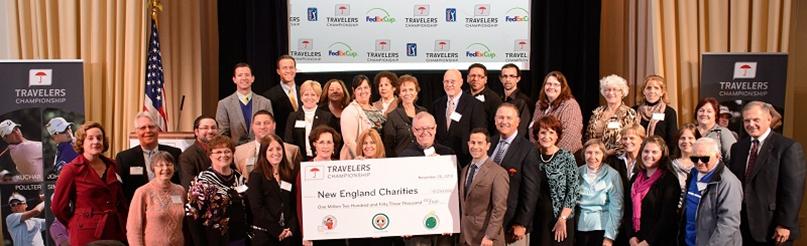
Charitable organizations associated with the Travelers Championship, Connecticut's only PGA TOUR event, were well-served in 2013 - the event generated a record $1,253,000 for 180 charities throughout the region.

It is the largest annual amount the tournament has given since Travelers became title sponsor in 2007, helped in part by 2013 winner Ken Duke who made a personal donation of $25,000 during the tournament’s closing ceremonies following his playoff win in June. logo-Travelers-Championship-Golf

The Travelers Championship donates 100 percent of net proceeds to charity and offers a variety of fundraising programs that allow for community involvement. Duke, who won his first PGA TOUR event at the 2013 Travelers Championship, attended last week’s announcement at The Bushnell, where Travelers recognized his generosity by donating an additional $10,000 to the charity of his choice.

Hundreds of organizations have benefited from the charitable giving of the Travelers Championship, most notably The Hole in the Wall Gang Camp. Founded in 1988 by Paul Newman, the Camp is dedicated to providing "a different kind of healing" to children and their families coping with cancer, sickle cell anemia and other serious illnesses. Through summer sessions and family weekends at the Camp in Ashford, Conn., and year-round outreach to hospitals and clinics across the Northeast, the Camp serves more than 20,000 children and family members annually. All services are provided free of charge.

The 2013 Travelers Championship benefited 180 charities through hundreds of thousands of dotravelers charitiesllars raised in the Birdies for Charity pledge-based fundraiser and the Chip In for Charity ticket-sales fundraiser. Additionally, the Travelers Championship raised awareness and funds for local charities through a variety of special events like the Birdies for the Brave Golf Outing, BlumShapiro 5K for Charity, Premier Limo First Tee Classic, Military Appreciation presented by Saint Francis Care, Golf Digest Junior Pro-Am, Northstar Wealth Partners Celebrity Mini Golf Tournament, Women's Day presented by Travelers, Powerstation Events Concert Series, and the LEGO® Children's Charity Golf Tournament.

Since 2007, the tournament has generated more than $7 million for charity, bringing the total giving since 1952 to more than $31 million.  For the fifth consecutive year, CohnReznick was the presenting sponsor of Birdies for Charity, by supporting administration of the program and contributing to a bonus fund for the charities that raised the most money. New this year, the bonus bucks pool increased from $15,000 to $50,000 to be distributed among qualifying nonprofits.

 "We are thrilled to be giving more than $1 million to charity for the fifth consecutive year, which wouldn't have been possible without the sponsors, volunteers and fans who support our event," said Travelers Championship Tournament Director Nathan Grube. "This record donation is a testament to the support the community gives in making our tournament one of the top sporting events in the Northeast. As we look ahead to 2014, we encourage everyone to continue to show their support."

Preparation has already begun for the 2014 Travelers Championship, which will be held from June 16 to 22 at TPC River Highlands in Cromwell. More information is available at www.TravelersChampionship.com

Best Pizza in America? Connecticut, Especially New Haven, Tops the Lists

When Zagat recently set out to select the best pizza in each of the nation’s 50 states, the competition both fierce and tasty.  That’s certainly true of Connecticut, where special pride is taken in pizza specialties in every corner of the state.   It was the white clam pie at Pepe’s on Wooster Street in New Haven that came out atop the list.

When the website The Daily Meal compiled the 101 best pizzas in America, the result was the same.  The number one pizza in America?  At Frank Pepe’s in New Haven.

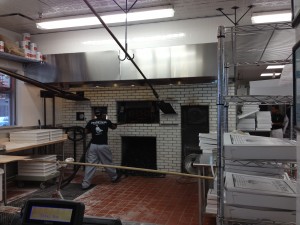
That’s not all.  Connecticut fared quite ovenwell among the top 101, with no less than five pizza selected – including another top ten selection – the Tomato Pie at Sally’s Apizza at number seven - and yet another ranked at #11, Modern Apizza – both, of course, in New Haven.

As was pointed out by Zagat, “whether it's regional specialties like Detroit deep dish or white clam pie in Connecticut, or unusual varieties like python pizza down in Florida, we've got something for every palate and every citizen.”  And indeed they did.

Sally's Apizza is a New Haven classic,” the Daily Meal described, “operating from the same location where they opened in the late 1930s in New Haven's Wooster Square. Their pizza is traditionally thin crust, topped with tomato sauce, garlic, and "mozz."

Of Modern's, the Daily Meal noted “coal-fired brick oven puts out pizza in the same thin-crust style. Modern's pies are a little topping-heavy with less structural integrity. Given the focus on toppings, the iconic Italian Bomb is the pie to try: bacon, sausage, pepperoni, garlic, mushroom, onion, and pepper.”

The 27th best pizza in America is tZagat-Logohe sausage pie from Colony Grill in Stamford. They have been serving up pizza since 1935 and now have locations in Fairfield and Milford.

At #68 on the list is the Margherita pizza from Alforno in Old Saybrook. When Bob Zemmel opened the restaurant in 1992, his goal was to bring the style of pizza you typically find in New Haven’s “Little Italy” to the shoreline. It was a success, the website noted.

Why was Pepe’s number one?

There's a reason Frank Pepe routinely inspires a line down New Haven's Wooster Street: that101best_pizza_america670x400_a crust! It's coal-fired perfection, thin yet substantial - a true feat of pizza engineering. You can pick up a slice, and it won't flop over like most new-school Neapolitan pies. The most justly famous option is the white clam, piled with out-of-the-shell longnecks and a healthy dose of garlic - it's briny, creamy, chewy and a true revelation,” Zagat pointed out.

Established in 1925, recent years have seen the singular location replicated – or nearly replicated – in a half dozen satellite locations, the latest in West Hartford, following Fairfield, Manchester, Danbury, Mohegan Sun, and Yonkers (just over the state line in New York). It began as so many immigrant stories did, with hard work, a transplanted delicacy, and more hard work.  As the company website explains, “in 1925, with his wife Filomena, who was a pivotal influence on his success, Frank Pepe started making a simple and humble product from their homeland, pizza — or as they would say in their Neapolitan dialect, "apizza" (ah-beets). They baked their pizzas offering two types, tomatoes with grated cheese, garlic, oregano and olive oil and the other with anchovy. The Original Tomato Pie is still offered today and anchovy is still available as a topping.”

Pepe's signature pizza, the White Clam Pizza, was most likely an organic inspiration by Frank Pepe; an idea born from the fact that Pepe's also served raw little neck clams frfrank_pepe_680_340_85_s_c1om Rhode Island, on the half shell, as an appetizer. This occurred around the mid 1960's, the website explains, and gradually became popular through the years.

The Daily Meal considered 400 pizzas from throughout the U.S., using a judging panel that included 46 American chefs, restaurant critics, bloggers, writers, and pizza authorities. “Of the 101 best pizzas, 30 were from New York State (that includes Long Island),” the website reported.  “That being said, only three New York City pizzas made the top 10 and two of them were in Brooklyn. By contrast, two pizzas from Connecticut made the top 10, and three from California ranked among them.”

Local Entrepreneur Brings Social Benefits to Coffee Sales with Innovative Product

It took root when he was a 9-year-old earning nickels and dimes at the Hartford Regional Market,  gained impetus at Hartford High School and was cultivated at the University of Richmond.  By the time Ray Fraser graduated college in 2011 with a business degree in marketing and finance, he was convinced that his life’s work would not center solely on making a profit, but on simultaneously making the world a better place.  He’s doing just that, one tree at a time.

With a relentless work ethic and an engaging, easy-going personal style, Fraser’s start-up business – growing rapidly in just a few months – is called Tree Sleeves.  His mission:  to produce and sell reusable cup sleeves that combine comfort and utility with charity – “to help eradicate the cycle of deforestation affecting our planet.”

 For every Tree Sleeve sold, a tree is planted in a part of the world affected by deforestation.  It is a simple but profound concept, and the reaction has been overwhelmingly positive from a rapidly growing roster of retailers and consumers.  With a retail price of only $2.00 - a Tree Sleeve is perfect for daily use while on the go, quite affordable, and reusable.

Fraser has never shied away from challenges – in fact, he has consistently sought them out since he first visited the local Regional Market and asked what he could do to earn some money.  Told he needed to dump some boxes, he did – and came away with a nickel for his efforts.  Thus began a working relationship – and first-hand glimpse of what it takes to succeed in business – that continued as a part-time job through high school.  (The pay improved somewhat over time.)

As a teenager, Fraser was an Eagle Scout (his Eagle project was organizing a blood drive accompanied by a canned food drive for a homeless shelter) and an athlete who excelled in football, wrestling and track.  He discovered a knack – and enjoyment – in working with people, as well as an aptitude for business.  He would be the first in his family to attend college, encouraged by his parents, a machinist and teacher who resettled in Hartford from the West Indies and took education and diligence seriously.  Missing a day of scRay-005hool for being sick, Fraser recalls, was simply not an option.

In college, he developed an affinity for brands with a cause, and in addition to working as a Resident Assistant on campus, had motivating internships with United Technologies in Connecticut and Saks Fifth Avenue in New York City.  Both would express interest in hiring him after graduation, but by senior year Fraser had decided to chart his own entrepreneurial path, the example of Tom’s Shoes founder Blake Mycoskie (the subject of a college research paper), among others, serving as his frame of reference.

“I had looked at the corporate ladder,” Fraser recalled recently, “and I wanted to have a bigger impact, to do more than just bring home a paycheck.  I wanted to expand my mind, and make a difference.”

tree sleeveInnovative Idea

After graduating from college and returning to Hartford, Fraser tried to develop an entrepreneurial business with friends that didn’t quite come together, stymied by software development issues.  Then one day in January, in a local Starbucks working on elements of that initial attempt at enterprise, the frequency which employees needed to empty trash cans overflowing with disposable cardboard sleeves caught his attention, and imagination.  He thought there must be a better way, and then went about inventing it.

“They’d empty the trash, and then two hours later they’d do it again.  The waste was astronomical.  When I looked into the numbers on paper sleeves, I was shocked.  We throw away 3 billion a year,” he emphasized.  “That translates into thousands of trees cut down needlessly each year.”

The traditional disposable cardboard cup sleevemakes carrying easier and holding the cup possible by providing an extra barrier to reduce the heat from the cup. Based on his extensive and resolute research, Fraser has done the disposable cup holder one better, with purpose.

It didn’t happen overnight.  He visited local coffee shops to talk to owners about their business, customers, and interest in a potential product.  He had informal conversations with friends, inquiring whether they’d buy a reusable sleeve, and what attributes would make it attractive.  (Being good for the environment was a recurring theme.) He scoured the internet in search of potential manufacturers, first in this country, then overseas.  He taught himself about nations that produce coffee, and learned of the challenges many face due to deforestation.

photo 1Building A Business

Fraser carefully nurtured relationships, engendering trust and crafting a business that he sees as having limitless potential – and enduring impact.  He developed and produced an attractive, lightweight design made of 100% food grade silicone, a reusable sleeve that makes going green easy.

Research completed and initial business relationships established, it was time to take a leap of faith.  With initial start-up funds borrowed, the 24-year-old ordered 1,000 silicon sleeves in July.  He was quite optimistic that he would be able to sell them to retailers.  But not certain.

After printing some promotional signs from his computer, buying handful of baskets at the local dollar store and a fistful of rubber bands at an office supplies store, Fraser set out to area coffee shops, bundles of product in hand.

One of the coffee shop owners he visited months previously to engage in speculative conversation was not surprised when he returned with a well-produced product – but he didn’t necessarily expect he’d be back.

“He was a nice polite young man, but I didn’t know that he’d actually do something.  We try to encourage renewables, so I thought I’d buy some, and if people liked the idea, they’d buy it,” said Bill Sze, owner of Jojo’s Coffee Roasting Company, with locations in Hartford and New Haven.  His initial order was for 100, this summer.  “I’ve been going through them at a good rate.  Most people like the idea.”  Sze just re-ordered, another 100 for each location.

Within a couple of months, Fraser – pounding the pavement and meeting with coffee shop owners – had Tree Sleeve locations grow from a handful, to a dozen, to now nearly 30.  By late October, he ordered the second batch of 1,000 to be manufactured, and continues to visit coffee shops personally, extolling the virtues of a product that allows purchasers to impact the planet, and people’s lives.

Along the way, he has patched together an informal set of advisors, including two of his former professors at Richmond, two volunteers from the Hartford chapter of SCORE (Senior Corps of Retired Executives), a local marketing professional that he learned of through CT NEXT, and a growing array of local coffee shop owners willing to give the product a try.

Another of the initial locations, J. Rene Coffee Roasters in West Hartford Center, has also re-ordered in recent weeks, based on solid sales.  Current locations include Avon, Stamford, Windsor, New Haven, Middletown, and Shelton.   But Fraser’s sites are set on a broader reach, and impact.

Having An Impact

The initial tree planting is being handled by Eden Reforestation Projects.  Since 2005, the California-based Eden has employed thousands of workers in Ethiopia, Madagascar, and Haiti who have planted millions of seedlings that are growing into healthy forests. They will be planting trees quarterly for Tree Sleeves, and Fraser now looks forward to 2,000 trees being planted in December.

Eden’s website explains that radical deforestation is a major cause of extreme poverty and oppression in impoverished nations, and that deforestation, which can result in soil erosion and destructive flooding, contributes to the climate change crisis.

The local start-up company’s slogan of “Grab 1 Plant 1” is quite concise: GRAB 1 - customers purchase tree sleeves and the company provides the necessary funding to a non-profit tree planting partner; PLANT 1 - Tree Sleeve's nonprofit partner plants and nurses tree seedlings in greenhouses located within deforested parts of the world. Upon maturity, trees are then transported and planted in areas most affected.photo

With patent pending, Tree Sleeves are currently manufactured overseas, but Fraser hopes that as the business grows he will be able to bring manufacturing to the U.S., while keeping prices affordable for consumers and continuing to impact the environment and vast populations.  Not unexpectedly, he is optimistic.  “Our generation wants to make a difference.  Impact is huge for me, and this is a huge issue.  I want to be the one who helps to solve it.”

Always looking ahead, co-branding, college stores and internet sales may be on the horizon, Fraser says, and perhaps a college intern to provide support.  Right now, to help pay for the gas his car requires to get him around the region, Fraser is working an overnight job at a local warehouse distribution center while building his own business by day.

Don’t even ask when he manages to sleep -that’s not a priority.  Fraser has been taking samples of Tree Sleeves to retailers since early summer, shows no sign of slowing down, and is encouraged by the response.  He’s also quite proud to be launching his business in the city where he grew up.  “It feels good.  I went away to school, I came back.  We certainly have the resources here to get this off to a great start.”