Connecticut Is Part of ESPN’s Strategic Focus on Corporate Citizenship Targeting Youth

There’s a change at ESPN.  The sports giant has launched a new citizenship strategy focused on using the power of sports for social good, and Connecticut is very much a part of the strategy. The launch includes a new name change (from Corporate Outreach to Corporate Citizenship), as well as a new website that highlights ESPN’s commitment to the community, www.ESPN.com/Citizenship,  Ed Durso, ESPN’s Executive Vice President of Administration, in explaining the overall strategy, said ESPN has “a tremendous legacy of giving and as our brand and reach have grown, so too has our commitment to the community. We are now taking a more strategic approach that focuses on using sports to transform lives and uplift communities.”

Durso explained that ESPN will focus in five key areas:espn

  • Access to Sports
  • Leadership Through Sports
  • The V Foundation
  • Good Neighbor grants
  • Sustainability

He noted that “ESPN can offer meaningful help to many in need. For example, it may be surprising to some, but youth sports participation in the U.S. has been on the decline since 2008. The decline is due to many factors and the problem is especially prevalent in underserved communities.

This is worrisome because sports is so important to development.”

teamespn_info_002“Studies show that kids who are physically active have higher test scores, are more likely to go to college, and smoke and drink less,” he added. ”Sports can also help build life skills, including enhancing self-esteem, unifying teams and driving social inclusion. By driving support to entities enhancing access to sports, we can help.”

Earlier this year, ESPN announced it would team up with the National Recreation and Park Association (NRPA) to award grants to seven local park and recreation departments in the U.S. that improve and expand their youth sports programs, especially in underserved communities.  The $150,000 grant would be targeted to purchase needed equipment, make improvements in facilities and help local parks expand their programs to give more children the opportunity to participate in community-based sports.

The communities receiving grants included Hartford, Los Angeles, Charlotte, Coral Gables, New York City and Austin.  In Hartford, the parks department set out to introduce 1,000 kids, ages 3-6 years, to the sport of soccer throughout the winter at inside recreation centers, with the objective of launching the "Litter Soccer Stars" league this spring, according to ESPN.

We believe that everyone should have the opportunity to play sports and be able to take advantage of its many benefits. ESPN is working with nonprofits to develop sports curriculum, distribute sports equipment and create safe spaces to play sports. We’re also finding ways to foster physical development, leadership and life skills through sports. We’re working with others who share this vision, and together hope to make sports more accessible, especially to those in underserved communities,” Durso explained.

A 2014 study from the University of Kansas suggests that if students are given a compelling reason to come to school—even if that reason has nothing to do with academics – they will. University of Kansas’s Angela Lumpkin and Rebecca Achen analyzed high-school testing, graduation, and attendance data and found that Kansas’s student athletes go to school more often than non-athletes. They also have higher graduation rates: 98 percent of athletes in Kansas’s class of 2012 graduated, compared with 90 percent of non-athletes.

An article published in The Atlantic pointed out “The higher graduation rates could be explained away by the theory that teachers have lower standards for athletes—that they’re willing to let athletes pass without doing all the work. But state test data challenges that theory: Athletes also score highfuture filmmakerer on the Kansas state assessments than non-athletes, in all subject areas. They are clearly learning something in their classes.”

ESPN has also included 32 colleges and universities across the country in a new initiative with the legendary Tribeca Film Institute for budding filmmakers.   Connecticut’s Quinnipiac University, University of Hartford, and Connecticut College are among the eligible institutions.   The TFI/ESPN Future Filmmaker Prize will award three graduate level media makers devoted to creating short-form documentaries highlighting the exceptionally creative work of an athletic community or organization that is working towards solving social issues in the United States or around the world. Submissions opened May 5 and close July 5.

The prize aims to support the next generation of filmmakers in producing creative, story-driven films that highlight issues of social importance through the lens of sports, athletics and or competition with a $25,000 production grant.

Recipientsteamespn_icons_008 will also receive professional guidance and mentorship from TFI staff and select media professionals. Along with the monetary grant, the three filmmaking teams will participate in a two-day workshop in the fall with activities tailored to their needs and culminating with an industry showcase to both celebrate their work and introduce them to the filmmaking community at large.

The workshop will include pitch training, story structure lectures, footage critiques, master classes led by industry leaders and one-on-one meetings with industry professionals and nonprofit athletic institutions. Also, each grantee will be paired with a current or former Tribeca Film Fellow. They will work closely together throughout all aspects of the filmmaking process from production to editing.


Governor Travels to Iowa for Insurance Industry Keynote

When “attendees from around the world” convened in the “insurance hub of Des Moines, Iowa,” for the second annual Global Insurance Symposium, the keynote speaker was an individual from a state long considered as the hub of the industry, Governor Dannel Malloy of Connecticut. The symposium, being held this week, was designed to “provide a forum for insurance professionals and regulatory authorities to share insights into challenges facing the insurance industry,” and includes “some of the most knowledgeable experts in the insurance field and discuss important issues facing the industry, such as cybersecurity and big data,” according to conference organizers.

Why Des Moines, Iowa?  The conference website points out that “for decades, Iowa has been committed to policy that creates favorable conditions for the insurance industry to thrive. As home to more than 200 insurance companies, Iowa is uniquely suited to host the Global Insurance Symposium and assemble global leaders to discuss these important issues.”

The symposium will  also serve as a coming out for six start-ups completing Iowa's Global Insurance Accelerator, a fast-track business development program focused on insurance innovation. The accelerator brought together startups from Iowa, Nebraska, California, Germany and Brazil, for 100 days of fast-paced business development, and mentoring.  The initiative was launched in February.

global insuranceIowa Governor Terry Branstad provided opening remarks at Wednesday’s session, followed by Malloy’s keynote address.  Branstad, a Republican, and Malloy, a Democrat, were re-elected by voters in their respective states last fall.


The 2014 Connecticut Insurance Market Brief reports that Connecticut ranks #1 in the U.S. for insurance carrier employment as a percentage of total employment, #1 in the U.S. for insurance payroll as a percentage of total payroll (5.6 percent) and that one new job in the insurance industry results in 1.73 additional jobs to the Connecticut economy.  The insurance sector accounts for 5.7 percent of Connecticut’s Gross State Product, ranking #2 in the U.S. as a percentage per capita. CT map insurance

A 2012 report by the Connecticut Insurance and Financial Services (IFS) Cluster and PwC US indicated that an increase of $1 in insurance labor income puts an additional $0.78 into state commerce; and every year the insurance industry purchases an average of $2 billion in goods and services from other industries in Connecticut.

The Iowa Economic Development Authority reports that “Iowa’s insurance industry grew by 11 percent during the past 15 years, while industry throughout the entire U.S. was flat.”  The agency indicates that while Iowa has 1.6 percent of the nation’s finance and insurance jobs, it generates 2.9 percent of the nation’s insurance GDP.

FIT01_InsuranceLocationMap

In a op-ed co-authored by the two Governors and published in 2012 by the Connecticut Post, Malloy and Branstad pointed out that “in Connecticut and Iowa, the multibillion-dollar insurance industry remains one of the essential anchors for sustained prosperity and quality of life. Both states are among the top four in the nation for the share of insurance and financial services jobs when compared to the entire workforce. In addition, the U.S. insurance industry is a titan in the world marketplace, accounting for nearly 34 percent of the worldwide market share.”

“Unique and fundamentally stable, insurance would top the list of industries for any governor to nurture and grow in his or her state,” the states’ chief elected officials noted. “The industry attracts a well-educated, well-paid work force of actuaries, financial analysts, attorneys, certified accountants and skilled support staff.”

The text of remarks by Branstad and Malloy at the Global Insurance Symposium were not immediately available, but The Hartford Courant reported that Malloy advocated continued state regulation of the industry, rather than an increased federal regulatory scheme.  "Our states, our commissioners and our governors need to be more actively involved if we are going to protect our industry as we know it, and not be dictated to, not simply by people in Washington but people abroad as well," the Courant quoted Malloy as stridently urging those gathered for the symposium.

https://youtu.be/R_aApLrqy5o

https://youtu.be/CmDCxvRIC3I

Agencies, Organizations to be Honored for Efforts Advancing Local Downtowns

A high school AP economics class that engages students in proactive land-use planning, the owners of a downtown Segway tour company that let the community help name their new business, and the state’s Department of Transportation are among the organizations and initiatives chosen to receive a 2015 Award of Excellence from the Connecticut Main Street Center (CMSC). Seven recipients were selected for the prestigious award, representing initiatives in Mansfield, New London, Putnam, Simsbury, Waterbury, and Upper Albany in Hartford.segway

The other winning entries included a First Fridays series that draws thousands of visitors with its hands-on arts and cultural events; a massive, multi-cultural downtown gathering of dozens of ethnic groups to celebrate a common community pride; a multi-year, multi-million dollar public/private partnership to design and build a brand-new town center; and a local merchant who remains committed to the neighborhood and the state despite becoming an international success.

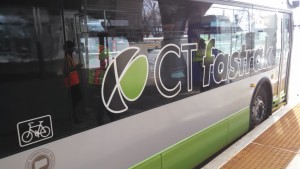
wpid-img_20150311_152459_058For the first time in the history of the awards program, a state agency was also selected to receive an award. The CT Department of Transportation received a special award for Starting a Revolution: Integration of Land Use and Transit in recognition of the progressive nature of CTfastrak, the bus rapid transit system opened earlier this year. The awards jury that selected the winners gave the award because they felt the new busway represents a cultural shift in how Connecticut views transit, and wanted to acknowledge the future promise of transit oriented development that will hopefully result around the station locations.



The Connecticut Main Street Awards annually celebrate and communicate the most successful and innovative efforts in Main Street revitalization in Connecticut. A jury comprised of industry-related professionals and CMSC staff judged the submissions on criteria that included innovation, replication, representation, partnerships utilized, and outcomes.20150507_townsquare_pavilion

"Our members continue to impress us with how they support, encourage and implement new ideas from the ground up," said CMSC President & CEO John Simone. "They're constantly forming partnerships with new groups, working to sustain local merchants, and tirelessly promoting how wonderful our downtowns and Main Streets are. We're proud of their efforts and excited to share their achievements with everyone else."putnam

The awards will be presented at the 2015 Connecticut Main Street Awards Gala on June 8th at Trinity-on-Main in downtown New Britain. This year's event will feature guided tours of downtown New Britain, including a Downtown Arts, Heritage & Culture tour, a tour of Walnut Hill Rose Garden & New Britain Museum of American Art, and a tour of CTfastrak in New Britain: Transportation, Housing & Main Street.

The full list of 2015 Awards of Excellence winners:

2015 Connecticut Main Street Awards of Excellence                 

Main Street Partnership

▪   Simsbury High School AP Economics Course, to Simsbury Main Street Partnership and Simsbury High School.

Planning

▪   Step by Step: Building a Downtown from Scratch (Storrs Center), to Mansfield Downtown Partnership, the Town of Mansfield, UConn, LeylandAlliance and the Citizens of Mansfield. (photo, above right)

Events & Programming  (Sponsored by Webster Bank)

▪    The Gathering (Downtown Waterbury), to the City of Waterbury, the Waterbury Observer, and Main Street Waterbury.

Award of Merit for Events & Programming

▪   First Fridays (Downtown Putnam), to the Town of Putnam, Putnam Business Association, and the Putnam Arts Council.

Business Owner of the Year

▪   Dawn & Kristin Harkness / Wheeling City Tours (New London), Submitted by New London Main Street.

2015 Main Street Pioneer: Outstanding Commitment to The Avenue  (Sponsored by Webster Bank)

▪    Vivian Akuoko / Evay Cosmetics (Upper Albany Avenue, Hartford), Submitted by Upper Albany Main Street.

Starting a Revolution: Integration of Land Use and Transitphoto_center_01

▪   CTfastrak, to the State of Connecticut Department of Transportation and the Capitol Region Council of Governments (CRCOG).

The Connecticut Main Street Awards of Excellence were created in 2003 to recognize outstanding projects, individuals and partnerships in community efforts to bring traditional downtowns and neighborhood commercial districts back to life, socially and economically.  In recent years, the Awards Gala has been held in New Haven, Hartford, Manchester, Torrington and Bridgeport.

CT Ranks #21 for Working Women, New Analysis Finds

Connecticut ranks 21st in the nation for working women seeking to balance the various aspects of work and family life, according to a new analysis by the Institute of Women’s Policy Research. The top five:  New York, California, D.C., New Jersey and Rhode Island. The bottom five:  Indiana, Utah, Montana, Mississippi and Wyoming. Women make up almost half of the workforce, according to the report, which notes that “few families have someone who can stay at home to take care of health emergencies, pick children up from school and supervise howoman with laptop and childmework, or take an elderly parent to a doctor’s appointment.”  In half of all families with children, women are the primary or co-breadwinner, the report indicates, and low-income families are particularly likely to have all parents in the labor force.

“Yet, as mothers’ labor force participation has dramatically increased in the past decades (U.S. Bureau of Labor Statistics 2014) and the number of women and men aged 50 and older who provide care for a parent has tripled during the last 15 years (MetLife 2011), the development of an infrastructure to support workers with family caregiving responsibilities has been largely neglected," the report stresses.logo

The work and family composite compares states’ performance across three components of work-family policy—paid leave, dependent and elder care, and child care—and a fourth component, the gender gap in the labor force participation of parents of children under six, an indicator that highlights gender inequality in family care of young children.

Connecticut received an overall “C” grade in the analysis of work and family issues; no state received a grade higher than B.  In breaking down the rankings, Connecticut ranked 5th in paid leave legislation, 27th in Elder and Dependent Care, 34th in Child Care, and 12th in the Gender Gap in Parents’ Labor Force Participation Rates.  The report indicated that 11.6 percent of women in Connecticut have a person with a disability in their household.

21The analysis pointed out that nationally “many workers lack access to even the most basic supports such as earned sick days and job-protected paid parental leave. Quality child care is also out of reach for many families because it is not affordable. Women are the large majority of family caregivers, and in the absence of reliable family supports, too many women are forced to make difficult decisions between keeping their jobs and caring for their family members.”
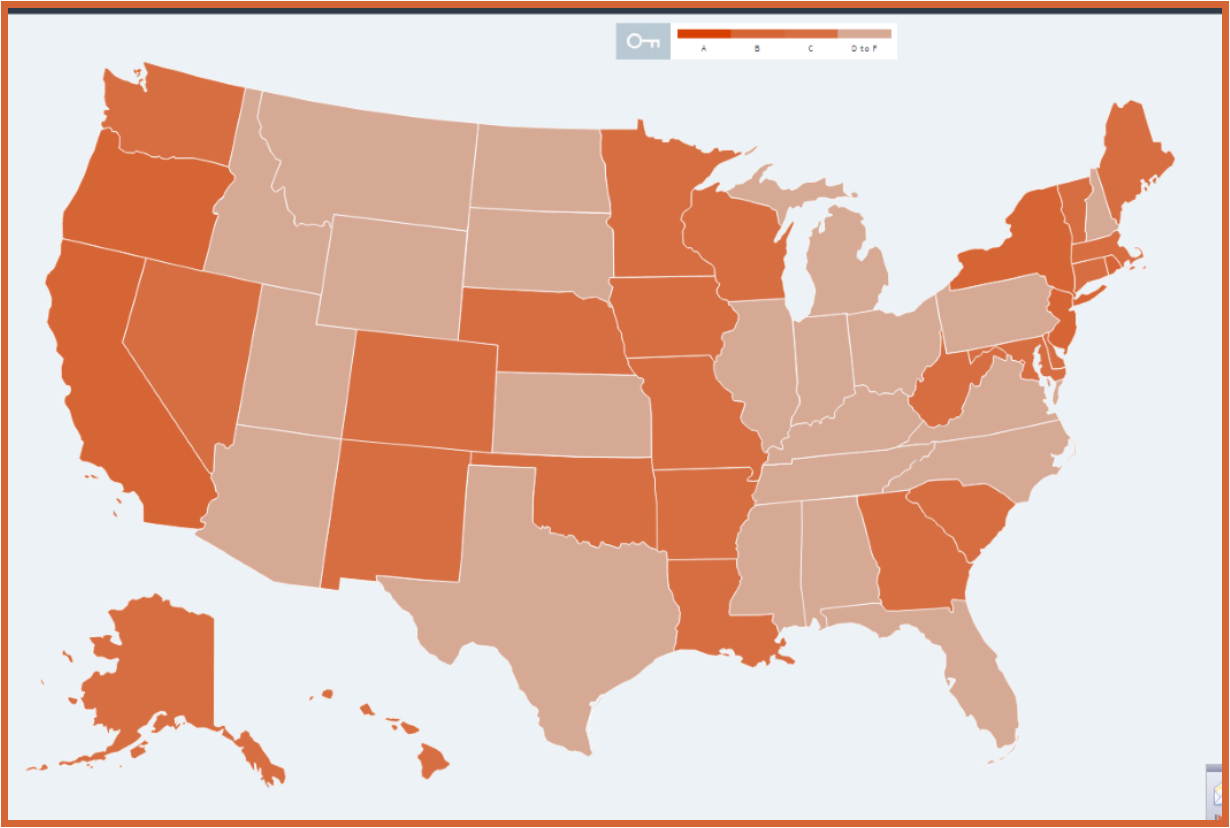
New York, California, and the District of Columbia have the highest scores on the work and family composite index, which reflects, in part, high rankings on paid leave. None of the highest ranking states, however, consistently ranks in the top ten states for each of the four component indices, the analysis indicates.

The large majority of mothers are in the workforce, according to the data cited in the report, including 62 percent of mothers who gave birth within the last 12 months map(U.S. Department of Labor Women’s Bureau 2015). The report indicates that Connecticut has 392,974 “breadwinner mothers in households with children under 18,” using 2013 data, ranking the state 25th in the nation at 29 percent.

The Work & Family index was one chapter in a larger report card developed by the Institute of Women’s Policy Research, in their Status of Women in the States report.  Connecticut’s ranking was lowest in the Work & Family analysis.  The state ranked as high as 4th in Poverty & Opportunity, 5th in Employment & Earnings, 6th in Reproductive Rights, 7th in Health & Well-Being, 12th in Political Participation, in addition to ranking 21st in Work & Family.  Overall, Connecticut ranked 5th when all the areas researched were considered.

The Institute for Women’s Policy Research conducts rigorous research and disseminates its findings to address the needs of women, promote public dialogue, and strengthen families, communities, and societies.  Among the partners in the study in Connecticut were the General Assembly's Permanent Commission on the Status of Women and Fairfield County's Community Foundation Fund for Women & Girls.


Pedals for Progress Sends Bicycles Overseas to Boost Opportunity, Improve Economic Conditions

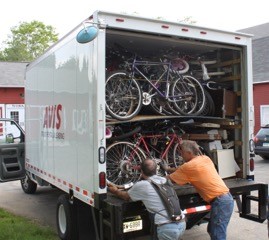
Area residents with an adult or child’s bicycle in repairable condition are urged to consider a donation to Pedals for Progress (P4P) in West Granby this weekend.  The national organization rescues bicycles destined for overburdened U.S. landfills and ships them to developing countries where they are sorely needed and highly valued. Last year, bike collections were sponsored by approximately 41 community partners in six states, including Connecticut. P4P bikes are put to work not only as basic transportation, but are used as a supplement to school and community programs. The bikes are adapted for use as trash haulers, produce trucks, taxis, and farm machinery.bicycle 1

With overseas partners, the bicycles take on an even greater significance – to keep the bikes working, maintenance is necessary. Children and adults are trained in bicycle maintenance and repair, and the bicycles are sold within the community, fostering the development of a local economy. If a person would like to have a bicycle but cannot pay for it, that person has to work for the shop (and learn a new skill) in order to cover the cost of the bicycle.

P4P also arranges for the bicycle shops to have a supply of tools, parts, accessories, and lubricants for maintaining the bikes. With Pedals for Progress, a bicycle becomes a valuable commodity for trade, employment, transportation, local government – the list goes on.

Sponsored by Jackie Rubell Johnson with support from Holcomb Farm, bikes can be dropped off from 12 noon to 3 PM on Saturday May 23, 2015, rain or shine at Holcomb Farm, 113 Simsbury Road, in West Granby. [“Bikes for parts” or disassembled bikes are not accepted.] It costs $40 to collect, process, ship, rebuild and distribute each bicycle. A donation toward shipping costs is necessary.  Organizers ask for a minimum $10 donation with each bike or sewing machine to help cover the cost of shipping. Receipts are offered for value of donation including cash.

P4P collects 5,000 to 7,000 bicycles annually and transfers this material wealth to those in need. To date, more than 140,000 have been shipped to developing countries in Latin America, Africa and Eastern Europe.  Last year, the bicycles were donated to recipients in Nicaragua, Guatemala, Albania, Moldova, and Madagascar. Pedals1

In these countries the bikes are reconditioned by partner agencies and distributed at low cost to poor working adults. These bikes provide reliable transportation for commuting to work, transporting product to market, or accessing health care and other services. Steady employment for is vital to the development and success of these economies.

In 2014, Pedals for Progress shipped a total of 3,634 bicycles, 274 sewing machines, and approximately $360,000 in bicycle parts and accessories, to seven nonprofit agency partners in seven developing countries. That brought the cumulative donations shipped in the last 24 years, since the organization’s inception in 1991, to 142,437 bicycles, 2,860 sewing machines, and over $12 million in parts and accessories donated to 38 countries.

Among the organizations providing support are the Clif Bar Family Foundation, FedEx and Thulé.   Connecticut organizations that participated in collecting bicycles in 2014, in addition to Jackie Rubell Johnson with support from Holcomb Farm in West Granby, include Newtown Rotary Club, Old Greenwich Presbyterian Church, and the Wilton High School Spanish Honor Society.

bicycle 2The organization also accepts working portable sewing machines and P4P seeks donations of wrenches for their overseas shops. All cash and material donations are fully deductible and a receipt will be available at the collection site.

Pedals for Progress is a 501 © (3) corporation and a registered charity in the states of New Jersey, Pennsylvania, Vermont, Iowa and Connecticut.  More information about the organization is available at  www.p4p.org; for information about the May 23 pick-up in West Granby, call 860 653 7758.

https://www.youtube.com/watch?v=U0qfStNmS6k&feature=youtu.be


States Under Pressure to Raise Gas Tax to Support Infrastructure Repair

In nearly two-thirds of states, state-imposed fuel taxes have not kept up with inflation for two decades, according to a Governing analysis of state gas tax data reported to the U.S. Census Bureau. That is forcing legislators around the country to consider raising gas taxes or exploring other ways to increase transportation spending, as Congressional action on adjusting the federal portion of the gas tax to meet infrastructure needs remains stalled. As Connecticut – with among the nation’s highest gas taxes - contemplates embarking on a decades-long comprehensive transportation infrastructure upgrade, how to fund the likely record-setting fiscal requirements has been assigned to a task force to consider and propose recommendations.  Earlier this month, Michigan voters resoundingly defeated a measure -- 80 percent voted “no” -- to hike gas taxes and make many other changes to boost state transportation spending, Governing reported. Last fall, Massachusetts voters recinded (with 53% of the vote) a law that would have automatically tied gas tax rates to inflation.  The law had been passed by the state legislature in 2013. Gas-pump-image

Connecticut’s gas tax, increased most recently by about 4 cents per gallon in July 2013, based on legislation approved previously – a step not taken by many other states in recent years. The Institute on Taxation and Economic Policy reported earlier this year that 22 states hadn’t raised their gas taxes in more than a decade, according to Governing.  Connecticut is not among them.

At the federal level, the gas tax was last increased in 1993. Since then, inflation, fuel-efficient vehicles and changing driving habits are all undermining the per-gallon charges that are the country’s main source for transportation funding to repair roads, bridges, and related infrastructure.  In most states, just as nationally, those problems grow because lawmakers rarely adjust fuel taxes, Governing noted. Connecticut, as other states, has also seen funds derived from the gas tax diverted from transportation-related purposes through the years, adversely impacting the status of transportation infrastructure.

In January, USA Today and 24/7 Wall Street reported that Connecticut’s state fuel tax of 43.2 cents per gallon was the fifth highest in the nation, and as a percentage of the gas price, the state was third highest.  At the time, Connecticut’s gas price was the sixth highest in the nation.  Gas prices nationwide and in Connecticut have risen since January, and Connecticut continues to rank near the top of most gas price surveys.

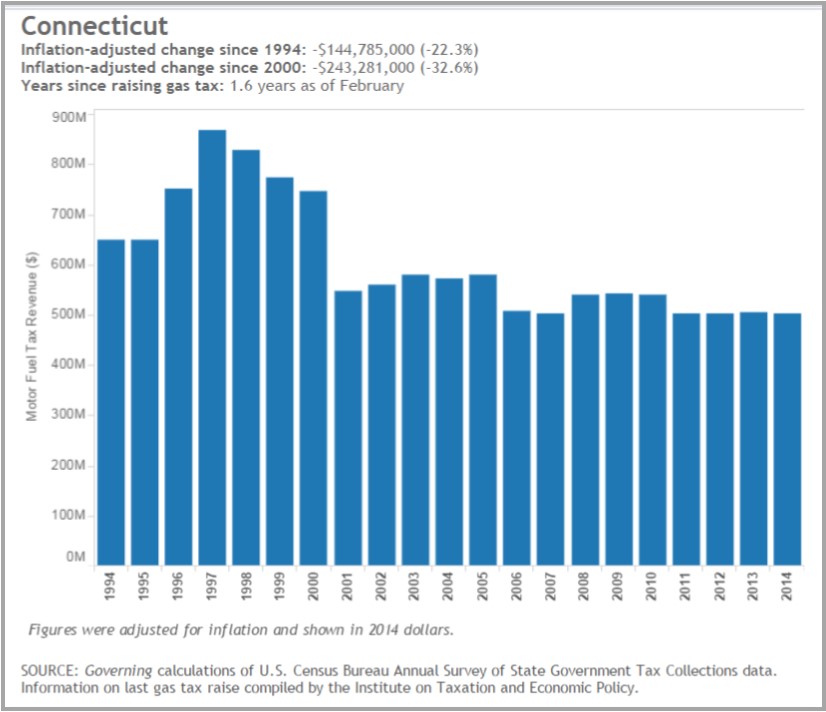
CT gas taxIn Connecticut, the inflation-adjusted change is a reduction of in the value of the dollars provided by the tax of 32.6 percent since 2000 and 22.3 percent since 1994, according to the Governing analysis, using data from the U.S. Census Bureau and the Institute on Taxation and Economic Policy.  Earlier this year, Governor Malloy announced a two-part transportation plan consisting of a five-year ramp-up that utilizes $10 billion capital funding, and leads up to a 30-year vision utilizing $100 billion in funding.  The Transportation Finance Panel he appointed to  recommend options the state can utilize to finance the infrastructure transformation is due to report this summer (see members below).

The federal government’s 18.4-cent gasoline tax brought in a fifth less, in inflation-adjusted dollars, in 2013 than in 1993, Governing reported. The federal government’s buying power peaked in 1994, immediately following its gas tax hike. The purchasing power of states fuel taxes peaked five years later, in 1999. In 37 states, inflation-adjusted revenues from fuel taxes slipped since 2000.

At the federal level, fuel taxes have been flat for more than 20 years, starving the Highway Trust Fund of revenue used for rising infrastructure repair costs, according to Reuters.  According to Forbes, the Congressional Budget Office (CBO) has estimated that in 2024 alone the Highway Trust Fund will spend $18 billion more than it brings in, Forbes has reported. The CBO estimates the cumulative shortfall over the next decade will top $160 billion.

A year ago, when gas prices nationwide were at their lowest levels in years, Republican Senator Bob Corker of Tennessee and Democrat Chris Murphy of Connecticut proposed raising federal gasoline and diesel taxes by 12 cents a gallon over two years– to bring the tax where it would have been had it kept up with inflation for the past two decades.  As in the past, the prospect of a federal tax increase in the gas tax – even to address needed transportation infrastructure repairs – did not gain significant support.

At the time, it was estimated that American drivers pay an average of $94 a year to access over 11,618 miles of highways, roads and bridges.  Based on data from the Government accountability Office, the National Stone, Sand & Gravel Association pointed out that “with a growing number of potholes, cracked roads and traffic jams plaguing America, we need a common-sense and responsible way to pay for improving our infrastructure.”

The Governor’s Transportation Finance Panel, appointed earlier this spring, includes:
  • Cameron Staples (Chair): President and CEO, New England Association of Schools and Colleges; Former Co-Chair of the Finance, Revenue and Bonding Committee, Connecticut General Assembly
  • Beth Osborne: Senior Policy Advisor, Transportation for America; Former Acting Assistant Secretary for Transportation Policy, U.S. Department of Transportation
  • William Bonvillian: Director, Massachusetts Institute of Technology’s Washington, D.C. Office
  • Joan Carty: President and CEO, Housing Development Fund
  • Bert Hunter: Chief Investment Officer, Connecticut Green Bank
  • Oz Griebel: President and CEO, MetroHartford Alliance
  • Paul Timpanelli: President and CEO, Bridgeport Regional Business Council
  • Stanley Mickus: Marketing and Public Affairs, Cross Sound Ferry Services
  • Emil Frankel: Consultant on transportation policy; Former Commissioner, Connecticut Department of Transportation (1991-1995); Former Assistant Secretary for Transportation Policy, U.S. Department of Transportation (2002-2005)

CT Among Worst States For Business, Chief Executive Survey Says

Connecticut dropped one slot closer to the bottom of the list in this year’s Best & Worst States for Business, ranked by Chief Executive magazine’s survey of more than 500 CEOs nationwide.  The state was ranked 45th this year, down from #44 a year ago. Connecticut’s Northeast neighbors were mostly in the same neighborhood on the rankings list, with New York (#49), New Jersey (#47), and Massachusetts (#46) also in the bottom ten, along with Vermont, ranked #41.  In the middle of the pack, Maine was ranked #30 and New Hampshire was #21.best

According to Chief Executive, which is published in Greenwich, the results of the 11th annual survey show that CEOs favor states with progressive business development programs, low taxes and a quality living environment.  States are measured across three key categories to achieve their overall ranking: Taxes and regulations, quality of the workforce, and living environment, which includes such considerations as quality of education, cost of living, affordable housing, social amenities and crime rates.

The top ranked states were Texas, Florida, North Carolina, Tennessee, Georgia, Indiana, Louisiana, Nevada and Arizona.  Texas and Florida were also ranked one-two last year.  Texas has topped the list for a decade.  Tennessee and North Carolina traded places from a year ago. 61u-av0cWvL._SY300_

Among the CEO comments highlighted by the publication:  “A difficult tax structure like the ones in New York or Connecticut makes incentive-giving easy, but penalizes existing businesses. The climate for coming is better than the climate for staying.”

ctOf a maximum five stars in the CEO ratings, Connecticut received 1.5 for Taxation and Regulations, 3.0 for Workforce Quality and 3.0 for Living Environment.  The data used in determining the states' rankings included state GDP for 2013 vs. 2012, the unemployment rate in December 2014, state debt per capita in 2013, and state-local tax burden.  Key companies in the state highlighted by the website reporting of the survey include General Electric Company, Xerox Company, Aetna Corporation, The Hartford, and Stanley Black & Decker.

Indiana ranked first in the Midwest and sixth nationwide as the best place to do business. It was the only Midwestern state ranked in the top 10.  Among neighboring states, Kentucky ranked 28th, Ohio ranked 22nd, Michigan ranked 43rd and Illinois ranked 49th.  Among the largest moves up the list were Idaho (from #28 to #18), Pennsylvania (from #42 to #35), Iowa (from #19 to #13) and Maine (#36 to #30).

Chief Executive magazine is a bi-monthly publication for top management executives published by the Chief Executive Group LLC., founded in 1977, and headquartered in Greenwich.  According to the publication, state governments use the survey results to help determine how to improve their regulatory environments to attract more businesses, while corporations use the data to decide where to build facilities and attract vibrant workforces.

Last fall, Connecticut economic development officials and leading companies were featured in videos touting the state's efforts to attract and retain businesses.

https://youtu.be/sqNs8aaWpd0

https://youtu.be/CmDCxvRIC3I


Bigelow Tea Takes On Flavor of Girl Scout Cookies

Fairfield-based Bigelow Tea, celebrating its 70th year of operation as a family-owned company, has teamed with the Girls Scouts of the USA in a licensing agreement that has put the popular Thin Mints and Caramel & Coconut cookie flavors in teas on shelves across the country. The teas are marketed as gluten free, sugar free and Kosher-certified and will be available for a limited time only, according to company officials. Bigelow produces 1.7 billion tea bags annually in 130 flavors, the company reported. Bigelow, which is privately held, employs 350 people in Fairfield; Boise, Idaho; and Louisville, Kentucky; as well as its Charleston Tea Plantation in South Carolina.

scoutsBigelow President and CEO Cindi Bigelow is a former Girl Scout. “Once a Girl Scout, always a Girl Scout,” she said in a statement. “As a proud Girl Scout alumna, our two new tea temptations reflect the Bigelow Tea blenders’ never-ending quest to delight consumers with up-to-the-minute flavor innovations in a way that’s very special to me.”

Only about 5 percent of companies nationwide have female CEOs, including Cindy Bigelow, who has been involved with the family business in one way or another since she was a teenager.  Bigelow, who represents the third generation in her family to run the business, said it's the personal touch that keeps the company successful.  The company was founded in 1945 by Cindi Bigelow's grandmother, Ruth Campbell Bigelow.

“These delicious teas are made possible by a licensing arrangement with Girl Scouts of the USA and combine the renowned flavor blending expertise of the Bigelow Tea Co. with the time-honored exciting Girl Scout Cookie flavors we all know and love,” the company said. The company-suggested price is $3.99 per 20-bag box.Cindi-Bigelow-head-shot

The Thin Mint tea “delivers the perfectly balanced mint and chocolate flavor of the Girl Scouts’ famous Thin Mints cookies” and the Caramel & Coconut tea is described as a “black tea blend offering a delectable taste combination of luscious caramel and coconut,” the company explained.

Tea has been increasing in popularity, and now ranks as the second most consumed beverage in the world, after water, according to the Tea Association of the U.S.A.  The wholesale value of tea sold in the U.S. grew from less than $2 billion in 1990 to more than $10 billion today.  Bigelow has about $150 million in annual sales, according to a company news release, but it claims 24 percent market share in the specialty teas category, making it the industry leader.

As CEO, Cindy Bigelow initiated the Annual Bigelow Tea Community Challenge that has donated over $1 million to local charities and participates in volunteer projects that include Habitat for Humanity’s Adopt-a-Home program. Under her leadership, the company was one of the first in Connecticut to install solar panels to offset energy usage, and she has implemented other innovations that have earned Bigelow Tea the distinction of being a Zero Waste to Landfill company.  Over the past several years, the company reports it has reduced our energy consumption by over 2.5 million kWh in the Fairfield plant through energy efficiency measures, resulting in a savings of over 2.7 million pounds of carbon, or the equivalent of planting 41 million trees.

As a family owned company for three generations, Bigelow Tea’s company culture includes a commitment to sustainability and fair business practices, "not only here at home but around the world.  That’s why we’re proud to be part of the Ethical Tea Partnership, an organization that works with tea growers to establish methods for responsible conservation of the world’s tea fields and improve the lives of the beautiful people who work the," the company website points out.


https://youtu.be/6xQVEtve_d4

Portions of this story originally appeared in the Fairfield County Business Journal

State Tourism Front and Center in Connecticut with Conference, Television Ads

Connecticut may be facing tough budgetary decisions, but unlike a handful of years ago when tourism promotional efforts were virtually eliminated in the midst of a recession, the state’s tourism initiatives are gaining renewed attention. The Connecticut Department of Economic and Community Development (DECD), Office of Tourism will host a 2015 statewide tourism conference for industry professionals in the state’s leisure, hospitality and tourism sector on May 12.  The all-day Connecticut Governor’s Conference on Tourism will run from 8 am to 4 pm at the Connecticut Convention Center in Hartford.

The goal of the conferenceCTC_Logo_260px is to bring together professionals from every aspect of Connecticut’s tourism industry — including hotels, restaurants, casinos, tourist attractions, entertainment venues, historic sites, and cultural and arts institutions — to share best practices and learn from national tourism and travel experts.  The statewide conference is managed by the DECD Connecticut Office of Tourism in partnership with the Connecticut Convention & Sports Bureau.

This day-long industry conference will feature speakers presenting the latest research and best practices, sessions for industry professionals, an overview of the state’s htourismigher education resources,  a focus on New York City meeting planners, experts on capturing a share of the international tourist market, ways to maximize use of social media, Tourism Awards for outstanding industry leaders, and an array of workshops on areas including mobile marketing and group bus tours, as well as an exhibition of the most innovative products and services in the tourism sector, according to state officials. Cost for the conference is $99, for industry professionals.
In addition, the conference will feature a special report on the results of the state’s still revolutionary campaign over the last three years. The keynote speaker will be Peter Yesawich of MMGY Global, a travel marketing expert who will share research-driven insights about the very latest trends in the travel industry and how they can affect Connecticut’s tourism efforts.

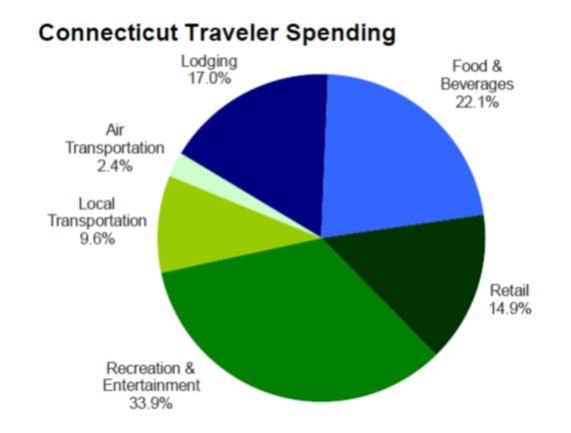
traveler spendingTraveler spending of $8.3 billion generated $14 billion in economic activity statewide in 2013, according to a study released recently by the office of Gov. Dannel P. Malloy.  The study shows funds generated directly, through traveler spending, or indirectly, as employees, businesses and other beneficiaries turned around and paid for goods and services. Travelers to Connecticut destinations spent 3.0% more in 2013 than in 2012.  Of all Connecticut travelers in 2013, nearly two-thirds were day travelers (66%). The tourism sector supported more than 118,500 jobs in 2013, according to a recent state report.

The state’s tourism efforts are also quite visible on television, with a series of promotional commercials highlighting various attractions in the state.  Standard DSDirectors, a Greenwich-based live action production company, is producing a series of six on-air commercials for the Connecticut Office of Tourism, working in conjunction with Avon ad agency Adams & Knight.
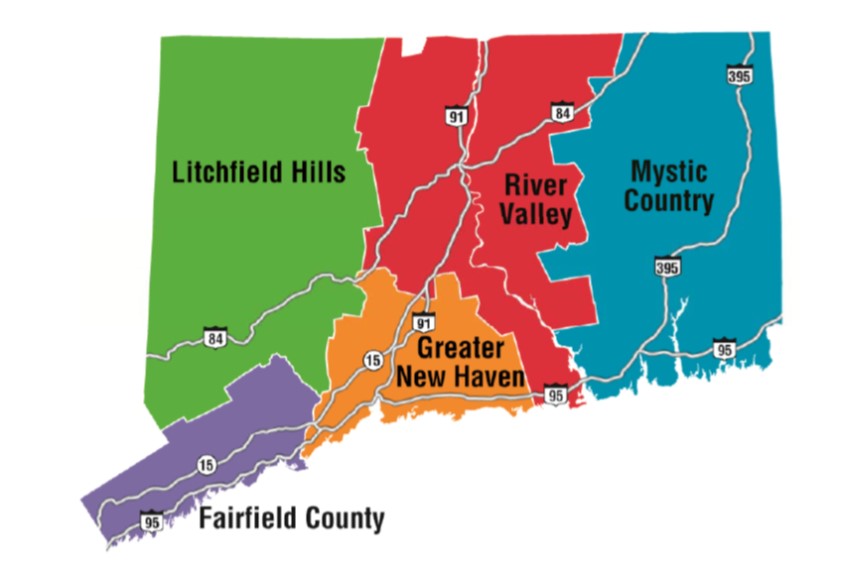
The campaign features six spots across the state that highlight Connecticut’s small towns, parks, beaches, vineyards and sightseeing attractions. Standard Directors was founded in 2013 and creates commercials for local, state and national companies and agencies. Among the attractions featured in the commercials are Silverman’s Farm in Easton, Mystic Aquarium, Craig Castle in Meriden and Hartford Stage.map

“This campaign is entirely location driven, pairing two locations in the state that can be visited in one day, without having to travel too far, by families, couples and friends,” said Brian Bennhoff, partner and executive producer, Standard Directors, and a New Canaan resident. “We spent a lot of time … selecting beautiful locations that represent the state.”  Philip McIntyre, a Greenwich resident and partner in Standard Directors, said the majority of the 20-plus person crew were local hires and all 19 actors were local talent. Editing, he said, was done both at Standard Directors’ office on West Putnam Avenue and at Palace Production Center in South Norwalk, according to the Fairfield Business Journal.

Lead sponsors for the Tourism Conference on May 12 include Foxwoods, Mohegan Sun, Waterford Hotel Group and the Connecticut Convention Center.


https://youtu.be/JHSPwk-Y4RM

https://youtu.be/jINU9kBKOrM

Digital Citizenship Summit will Bring State, National Tech Experts to Connecticut

Connecticut will be the center of the digital universe this fall, when the University of Saint Joseph (USJ) in West Hartford hosts a Digital Citizenship Summit, bringing local and national experts together to explore the good, the bad and the ugly about the pervasive and ubiquitous use of technology in our personal and professional lives. The term “digital citizenship” describes appropriate, responsible tech and Internet use. Similar to the rights and responsibilities involved in being a citizen, there are legal and ethical obligations with being a digital citizen, organizers explain.digital-access1

The aim of the Digital Citizenship Summit, to be held on October 3, is to create positive, practical solutions along with amplifying the overall message of improving tech usage. Topics for the all-day Summit include digital literacy, etiquette, wellness, security, and law.

“We believe that digital citizenship deserves its own space for educational, non-profit, and industry leaders to focus on solutions and push new ideas forward focused on positive, practical solutions to improve our use of technology and the Internet. The Digital Citizenship Summit aims to bring together the various silos of thought and activity across the country in order to create a stronger, more unified message for better tech usage,” organizers said.

This inaugural event is being sponsored by the University of Saint Joseph’s School of Education, Office of Student Affairs and Office of Informational Technology and will engage students, teachers, parents, administrators and policy makers in a dynamic conversation focused on digital citizenship.  It comes in the first semester of the administration of incoming university President Rhona Free, who takes office July 1.  Free is a past national Professor of the Year as selected by the Carnegie Foundation for the Advancement of Teaching and the Council for Advancement and Support of Education (CASE).

Plans are for the Summit to include a panel discussion, breakaway sessions, a keynote talk TED-style, and a social event to “connect with all the fascinating big thinkers across the country who are pivotal in shaping digital citizenship.”Picture2

Among the speakers will be:

  • Alan Katzman is Founder of Social Assurity, the leading youth social media advisory service in the country. They work with students and families on customized social media training to maximize the students’ opportunities and use of social media to their advantage.  He is an entrepreneur and former attorney with an expertise in law, technology and software, compliance, human resources and investigations.
  • Mike Ribble: Known as the godfather of digital citizenship, Kansas-based Ribble is an international speaker, researcher and author of the books Digital Citizenship in Schools (soon to be in its 3rd edition) and Raising a Digital Child. He has worked within the education field his entire career, including as a science educator, an assistant principal at the high school level, and adjunct faculty at the college level.
  • Jennifer Scheffer: Mobile Learning Coach and Instructional Technology Specialist at Burlington, MA Public Schools, she is a dynamic and energetic teacher leader with over a decade of experience teaching project-based computer technology, marketing, and business management courses. She coaches students on how to leverage social media tools to showcase their talents, create a positive online presence, and build their professional network.
  • Sarah Thomas is a Google Certified Teacher and Edmodo Certified Teacher, as well as a leader of the Washington, DC Google Educator Group and founder of the EduMatch project. She is the Technology Liaison at John Hanson French Immersion School in Oxon Hill, MD and teaches Technology Integration and English Language Arts at the middle school level.  She is a recipient of the 2014 Digital Innovation in Learning Award and was named by the National School Board Association as one of the “20 to Watch” in 2015.

The organizing committee for the Summit includes:250px-UnivSJct

  • David Ryan Polgar, a frequent speaker and respected tech commentator whose ideas and thoughts concerning digital citizenship have been featured in publications including The Boston Globe, Financial Times, Sydney Morning Herald, US News & World Report, and Forbes. With a background as an attorney and college professor, he examines the use of technology from an ethical, legal, and emotional perspective.
  • Marlialice B.F.X. Currran, an Associate Professor at USJ, focuses on digital citizenship and social media in K-12 teacher education. A former middle school teacher, principal and an advocate for young adolescents, Curran was named one of the Top 10 Digital Citizenship bloggers by Common Sense Media in 2014.
  • JoAnn Freiberg is an Educational Consultant with the Connecticut State Department of Education, responsible for managing bullying, improving school climate and character education, and has taught at numerous colleges in Connecticut and currently is Co-Chair of the National School Climate Council.

organizing committeeOften referred to as a Tech Ethicist, Polgar has become a respected and unique voice in the digcit community. He is a contributing writer with the Family Online Safety Institute, iKeepSafe, and The Good Men Project, along with appearing regularly on television to discuss issues such as tech balance, cyber ethics, and tech etiquette.  He has delivered two TEDx talks on digital technology.

In describing Dr. Curran, Common Sense Media said “she is a long-time proponent of responsible online behavior, and encourages her undergraduate and graduate students to learn and explore what it means to be socially responsible both face to face and online, how teaching empathy is the most important 21st century skill and how social media can change teaching and learning in PK-12 classrooms.” Dr. Curran and Tracy Mercier co-founded the digital citizenship #digcit chat on Twitter in 2011. The first chat was inspired as a result of a digital citizenship course at USJ.

Registration for the Summit will be available later this spring, along with additional details regarding the agenda and program, at the website www.digcitsummit.com.

Photo: Marlialice B.F.X.Curran,  David Ryan Polgar,  JoAnn Freiberg.