20,000 Mattresses Recycled in CT's First-in-Nation Program Since May 1

Connecticut’s first-in-the-nation mattress recycling program, Bye Bye Mattress, has recycled 20,000 mattresses since it began in May, according to program officials. The groundbreaking program was established by state law in 2013, calling for the manufacturers and consumers of mattresses to pay for their end-of-life disposal under a concept called product stewardship. Connecticut has a similar product stewardship program for paint, one of only six states in the nation to institute that program.gI_162482_mattresses at Hartford Bulky Waste - lo res

The Connecticut mattress recycling program, launched on May 1, is funded by a $9 fee collected from consumers when a new mattress or box spring is sold. The program is administered by the Mattress Recycling Council, which is a 501(c)3 non-profit organization created by the International Sleep Products Association (ISPA). The organization’s Board of Directors includes individuals who are employed by some of the industry leaders, including King Koil, Serta Simmons, Tempur Sealy and Paramount Sleep.  It is based in Alexandria, VA.

Under the program, dubbed “Bye Bye Mattress,” any used mattress that is discarded for municipal collection, picked up by a retailer, or dropped off by a consumer in Connecticut will be sent to a mattress recycler, who will break it down to reuse its components for other products.

Connecticut’s Public Act 13-42 (enacted in 2013 and amended in 2014) required the mattress industry to create a statewide recycling program for mattresses discarded in the state.  When the program began, nearly 50 cities and towns across the state were participating to recycle the mattresses and box springs collected at their solid waste transfer stations.

Among those facilities is Park City Green in Bridgeport where employees break down old mattresses into its recyclable parts. Officials say they recycle 96 percent of mattress materials into usable products: the covers (which can be turned into mattress pads), the cotton stuffing (turned into fabric), the foam (automobile padding), wood pieces (mulch), and springs (reforged steel).  The program diverts mattresses from waste-to-energy facilities and landfills and allows materials like fiber, foam, steel and wood to be reused. bye bye mattress
Residents drop-off their used mattresses and box springs at no-cost. Then, MRC provides the collection container, transportation from the facility to the recycler and the mattress recycling services at no-cost.  MRC continues to enroll interested municipal transfer stations in the program.  A fact sheet about the program has been developed, Connecticut Recycling Program  for interested municipalities, providing information about the benefits of participating. Springs-and-Foam-358x200

A $2 reimbursement per mattress is only given at the program’s two participating recycling facilities (Recyc-Mattresses in East Hartford or Park City Green in Bridgeport). It is limited to four units per person per day; eight per person per year.

MRC is also working with mattress retailers, hotels, military facilities, universities, healthcare facilities and other public and private entities in Connecticut to divert mattresses from the solid waste stream. It will report the program’s progress to the state Department of Energy and Environmental Protection annually in October.  Earlier this month, students and staff at Central Connecticut State University recycled mattresses from student dorms as part of the program.
MRC-logo-copy-3A similar statewide mattress recycling program was adopted by the Rhode Island legislature in 2013 and is due to launch in 2016.  To participate, Rhode Island producers must have joined the Mattress Recycling Council (MRC) by July 1, 2015, according to the organization’s website.  Producer is defined as any person who manufactures or renovates a mattress that is sold, offered for sale or distributed in Rhode Island under the manufacturer’s own name or brand.  California’s program, enacted in 2013 and amended in 2014, is also expected to begin statewide in 2016, administered by the Mattress Recycling Council.

The MRC notes that more than 50,000 mattresses end up in landfills every day.  The recycling programs aim to reduce that number. Each year, 35 to 40 million new mattresses and box springs are sold in the United States, and at least 15 to 20 million used mattresses and box springs are discarded.


https://youtu.be/Gsi6KgnvJF4


With Resignation, Recommendations for Higher Education May Receive Renewed Attention

With the resignation of Board of Regents for Higher Education President Gregory Gray – announced Friday and effective December 31 – there may be renewed review of structural recommendations enumerated in the state’s Strategic Master Plan for Higher Education, published earlier this year after a more than year-long study, and the subject of legislative action during the 2015 General Assembly session. Developed by the Planning Commission for Higher Education, which was created by the Connecticut General Assembly and chaired by Judith Resnick of the Connecticut Business and Industry Association, the 19-member Commission included high-ranking individuals from higher education, state government and business.  A revised commission was established by the state legislature earlier this year in legislation (Public Act 15-75)  that took effect this summer, advancing many of the planning commission's recommendations. The new law  "requires the Board of Regents (BOR) president to implement Planning Commission strategic master plan goals. It also narrows many BOR duties prescribed by law from a statewide to a BOR institution-specific scale," according to the official summary of the legislation.report

Regarding higher education policy leadership in Connecticut, the Planning Commission indicated in a comprehensive 23-page report that “since the abolition of the former Department of Higher Education, Connecticut has not had an entity responsible for policy formulation and leadership for the higher education system as a whole.”  The Department was abolished in 2011.   The Board of Regents, created that year, oversees the four Connecticut State University campuses, the state’s 12 community colleges and Charter Oak State College.  The University of Connecticut operates separately.

The report indicates that “the Board of Regents is appropriately focused on the important work associated with forging a system out of the disparate institutions under its purview. The UCONN Board of Trustees is similarly narrowly engaged in oversight of the institutions within its jurisdiction. The Office of Higher Education is an administrative and regulatory agency, not an entity taking the broad view of higher education policy and leading efforts to create a supportive policy environment.”

“What Connecticut needs – and does not have,” the report stresses, is “an entity or venue that has the authority and responsibility to:

  • Establish, build consensus around, and sustain attention to long-term goals for post-secondary-level education attainment — or for the whole education system, P-20.
  • Develop the metrics and data/information system necessary for measuring progress toward goals and holding the system accountable for performance
  • Report annually on progress toward achieving the established goals
  • Conduct highly respected analyses that can inform policy deliberations
  • Provide a venue to discuss the challenges in reaching these goals and to shape recommendations to the Governor and Legislature on an action agenda to achieve goals (e.g., a two-year agenda toward long-term goals)quote

The report notes that “the population of Connecticut…is not educated to high enough levels to meet the skilled workforce needs in the foreseeable future.”  A series of short- and long-term recommendations include finance and policy leadership proposals, accountability and governance/decision making authority changes, and regulatory revisions.

The Strategic Plans calls for such an entity to have “a degree of independence from, but trusting relationships with the state’s political leadership (the Governor and General Assembly) and the leaders of higher education institutions. To have the stature necessary to be effective,” according to the report, the entity “must be composed of the state’s most influential civic, business/industry, and cultural leaders and represent the diversity of the state’s population.” The 2015 law "requires the state, BOR, and UConn's Board of Trustees to align their policies with the three recommended goals of the Planning Commission's strategic master plan."  Those goals are:

1. increase the education levels of the state's adult population,

2. develop a globally competitive workforce and economy in the state, and

3. ensure higher education affordability for state residents.

The legislation passed earlier this year also establishes a Higher Education Coordinating Council which meets annually and consists of "the two BOR vice-presidents, the Office of Policy and Managment Secretary, the education commissioner, the UConn president, the UConn chief academic officer, the UConn BOT chairperson, the BOR chairperson, and the BOR president."

CT-N coverage of Commission's January 2015 meeting, prior to issuance of its report and recommendations. 

Putnam Pushing New Reputation as Arts and Culture Mecca, Gaining Recognition

When the Connecticut Main Street Center announced its Award of Excellence would go to the Town of Putnam, the Putnam Business Association, and the Putnam Arts Council for First Fridays in Downtown Putnam, there may have been more than one individual uncertain as to why. Many around the state may have been unaware of the northeastern Connecticut community’s goal of connecting artists, audiences, and arts and culture agencies to enhance the economic vitality of the community, while also showcasing downtown assets including a Bandstand and Outdoor Stage, the Downtown Farmers' Market Pavilion, and the local scenic River Trail.putnam

Driven by the vision to create a 'sense of place' and feature their downtown destination, the Town, the Business Association and the Arts Council collaborated to launch a monthly arts and culturally based Street Faire from May to October each year.  Now in its fifth year, the initiative has proven quite successful.

In 2014, approximately 3,000 people attended each event, with 15-20 street artisan vendors participating. The success of First Fridays has demonstrated the town's credentials as a 'destination' in Connecticut. Putnam was voted #4 Fan Favorite Town through the state Office of Tourism in 2013, and #2 Town in 2014 - the only town in the top 5 without waterfront. To overcome the obstacles of empty storefronts, the Putnam community worked diligently to reinvent itself as the arts and cultural hub of northeastern Connecticut, leading to recognition by Boston Magazine as "One of the Best 15 Small Towns to Visit in New England".

First Fridays define cultural diversity with a different theme each month. These themes are explored through dance, theatre & storytelling, architecture, song, food, and folklore.  Each monthly theme includes: 'Art Attacks' - random acts of art to surprise, entertain, and educate; 'Menu Celebrations' - local restaurants designing and creating menu specials to pair with the monthly theme; plus street bands, artisan vendors, and children events.arts

This year, the overarching theme is 'A Century of Art'.  To start this year, the monthly themes have been:  May - Turn of the Century; June - The Roaring 20's / The Jazz Age; July - The 1940's / WWII and the Arts; August - Pop Art of the 1960's;.  Still to come: September - The 1980's / Urban Art; and October - Turn of the Century / The Digital Age.

First Fridays "feature great live entertainment, variety of art vendors lining the streets, fun and interactive art projects, and stimulating events" hosted by such downtown galleries as Arts & Framing and the Sochor Gallery, The Empty Spaces Project Gallery, Sawmill Potteryand Silver Circle Gallery, according to the event website. Officials say that since the inception of First Fridays, the exponential growth has been manageable only because of business partners, volunteers and partners stepping up to assist with the Town administration. Town employees provide services for sound systems, street closures and safety measures. Police traffic patrol has been set in place; corps of volunteers handle facilities management; and valet service companies have been hired by restaurants to assist with parking.

Putnam has begun to be described as “a mecca of revitalization and community pride.” Participants last year, for example, were given disposable cameras to take shots of Downtown architecture. The photos were then pieced to create a 9' X 3' collage spelling out the word "PUTNAM".  Educating and advocating through multi-disciplinary and inter-generational events has earned new found recognition for Putnam, and made First Fridays a destination for audiences from Northeast Connecticut, Rhode Island, and Massachusetts.  All of which makes the recognition from the Connecticut Main Street Center less surprising.

Start-Up Business Accelerator Program Selected to Receive Federal Funds to Expand Impact

The LaunchPad for Impact is an accelerator program for early-stage ventures that equips entrepreneurs with tools, resources, and guidance to test drive business assumptions and build a business model that delivers peak value and impact. The program, developed and operated in Hartford by reSET, the Social Enterprise Trust, has been selected to receive a cash prize of $50,000 from the U.S. Small Business Adminstration (SBA), one of only 80 organizations in the country to be designated to receive the funding. Selected in the SBA's Growth Accelerator Competition, LaunchPad for Impact  is the only Connecticut accelerator to receive an award this year.  President Obama made the announcement this week from the White House of awards totallying $4.4 million. The award includes a $50,000 cash prize to help fund the Hartford-based accelerator, and provides public recognition.  Overall, the recipients represent 39 states, the District of Columbia and Puerto Rico. logo

The selected accelerators across the nation serve entrepreneurs in a broad set of industries and sectors – from manufacturing and tech start-ups, to farming and biotech – with many focused on creating a diverse and inclusive small business community.  "The entrepreneurial ecosystem in America is incredibly exciting and very powerful,” said Javier Saade, Associate Administrator for the U.S. Office of Investment and Innovation.  Elsewhere in New England, three Massachusetts programs were selected, as were two Maine initiatives, and one in both Rhode Island and New Hampshire.Lean-Launch-300x168

reset-logo1Through customer feedback, expert guidance, and a peer network, Launchpad for Impact helps transform a start-up business or concept in to a scaleable model by helping entrepreneurs learn quicker, pivot where necessary, and move forward with a better chance of success. Through peer to peer feedback from other entrepreneurs, expert coaching, and an innovative online platform that captures validation and measures investment readiness,  participants “get the data, knowledge, and tools needed to pitch to clients, investors, and partners. In an environment where most start-up businesses fail, this program helps you get the validation and sound evidence you need to support your business model,” the program website indicates.

Thus far, the program has included 138 social entrepreneurs in Connecticut, helped launch or accelerate 54 impact ventures, and awarded over $75,000 in funding to early stage ventures in the past two years, according to the program website. Participants meet for nine scheduled, in person sessions and are offered supplemental workshops in multiple areas of business development.white hosue

In the SBA competition, applications were judged by more than 40 experts with entrepreneurial, investment, startup, economic development, capital formation and academic backgrounds from both the public and private sector.  The first panel of judges reviewed over 400 applications and presentations and established a pool of 180 highly qualified finalists.  The second panel evaluated the finalists’ presentations and pitch videos and selected the 80 winners.

“SBA is continuing to make advances in supporting unique organizations that help the start-up community grow, become commercially viable, and have a real and sustained economic impact,” said SBA Administrator Maria Contreras-Sweet. “Through the wide-spread outreach of this competition, we are able to reach entrepreneurial ecosystems across the country. My commitment is to make our resources available to 21st century entrepreneurs where they are, and these accelerators, also known as incubators and innovation hubs, are the gathering place for today’s innovators and disruptors.”


Housing, Education, Poverty Among Greater Hartford Region's Challenges, Report Reveals

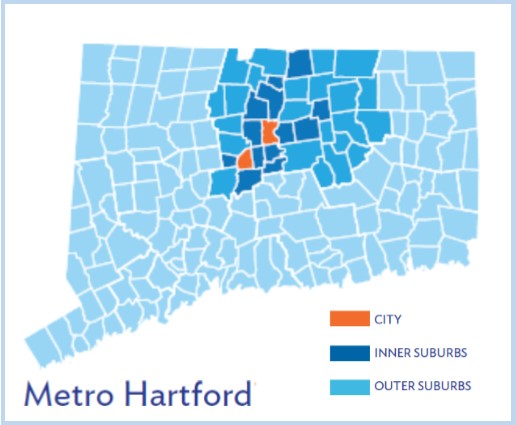
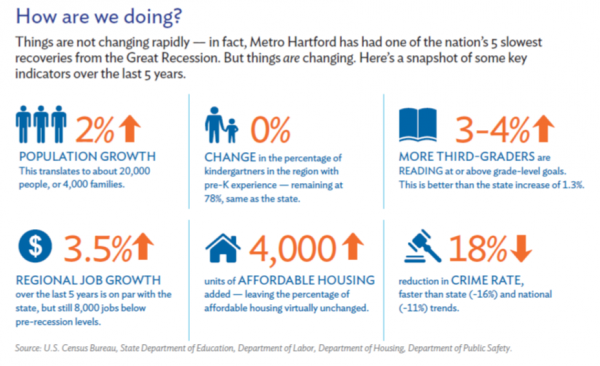
Of the 4,000 affordable housing units added to the 38-town Greater Hartford region over the past five years, nearly half (47 percent) have been in Hartford and New Britain – almost as many as were added in all of the other 36 towns in the region combined. That stark statistic is among the points emphasized in the second edition of Metro Hartford Progress Points, an analysis of data compiled by the Hartford Foundation for Public Giving and a coalition of community and regional organizations.  The inaugural report was released last year, and the new edition updates some of that initial data, as well as revealing new information about the region’s demographics, opportunities and challenges.region

Regarding the fact that much of the housing is being developed in municipalities that face considerable economic challenges, the report notes that those 36 towns have lost over 9,000 students in local schools during the past five years, despite having school districts that perform more than 30 points higher and standardized testing than those in Hartford and New Britain.  The report indicated, for example, that for every 100 children born in the region’s outer ring suburbs (such as Glastonbury), 113 enroll in local public school five years later, as opposed to 81 who enroll in city schools and inner ring suburbs (such as Bloomfield).

The second edition of Progress Points “takes a deeper look at key issues impacting our communities and how they are connected. The report asks how we can build on our strengths and fully utilize the assets that the region has to provide access to opportunity for all,” officials explained.  Using key indicators to identify opportunities for action, the 2015 report focuses on three regional priorities: 1) Access to better schools, 2) Access to better jobs, and 3) Access to stronger neighborhoods.

progress pointsLooking at five year trends, the report found that the region’s population of about 1 million people has grown by 2 percent, which translates to about 20,000 people or about 4,000 families.  Regional job growth, 3.5 percent, is on par with the state, but remains about 8,000 jobs below pre-recession levels.  The crime rate across the Greater Hartford region has been reduced by about 18 percent during the past five years, faster than the state (-16%) and national (11%) trends.
The study determined that there are more people living in poverty in the region than 10 years ago.  “Suburban communities have seen a major increase in the population living in low-to-mid-poverty neighborhoods,” the report said.   “Poverty is a regional, not an urban, problem.  Addressing poverty requires improved coordination among towns to better connect transportation and other services to increase access to opportunity.”

In education, the report also notes that about 4 percent more third-graders are reading at or above grade-level goals, a faster improvement than statewide (1.3 percent).  There has been no change in the percentage of kindergartners in the region starting school with pre-K experience.  That level, 78 percent, is the same in the region as statewide.  Focusing on declining enrollment, officials indicated that some of the region’s highest-performing school districts are seeing the greatest decrease in enrollment as a result of declining birth rates: Simsbury at 13 percent, Tolland at 16 percent, Granby at 14 percent. Avon and Glastonbury both are experiencing a decline of 8 percent.

Metro Hartford Progress Points was introduced “in order to identify and better understand the critical education, income and opportunity gaps that exist in our region. This year, we’re continuing the discussion, looking for ways to improve access to better schools, better jobs and stronger neighborhoods for everyone in the region,” officials indicated.  “Access to better jobs builds stronger neighborhoods. Stronger neighborhoods help to connect families to better schools. And better education ensures that workers are ready to take on those jobs — increasing prosperity, growth and quality of life for all.”stats

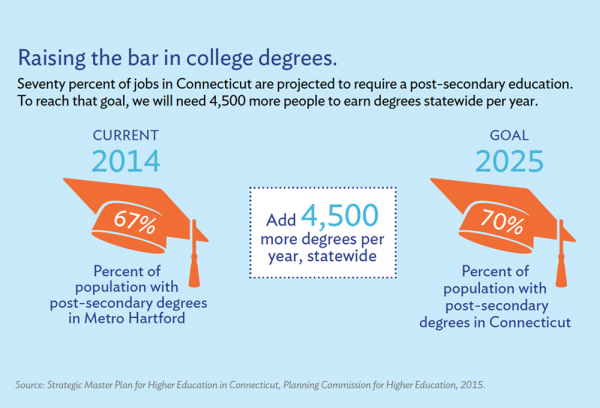
Regarding preparation for college, the report indicates that “almost 50 percent of all students entering community college or Connecticut state universities require remedial coursework and training, even those from high-performing districts.”  The report notes “this means paying for additional courses, which only increases student debt.” The report indicates that 70 percent of jobs in Connecticut are projected to require a post-secondary education by 2025.  To reach that level, it is estimated that an additional 4,500 people will need to earn degrees statewide per year.  Currently, 67 percent of the population in Greater Hartford has a post-secondary degree.

collegeLargePartner organizations in developing the report include the Hartford Foundation for Public Giving, Capital Workforce Partners, Capital region Council of Governments, Metro Hartford Alliance, Hispanic Health Council, United Way of Central and Northern Connecticut, Urban League of Greater Hartford, Center for Urban and Global Studies at Trinity College, and the City of Hartford.
AARP, The Hartford Aim to Assist Low Income Seniors Become Entrepreneurs

The Hartford has committed $1.4 million to the AARP Foundation to extend the Foundation’s Back to Work 50+ initiative to help low-income older adults assess opportunities to become entrepreneurs and create microenterprises. The three-year sponsorship, which broadens The Hartford's long-standing relationship with AARP, is part of The Hartford’s national philanthropic program. Communities with HART aims to "nurture the well-being of America’s communities by inspiring new generations of business leaders, enabling underserved neighborhood business owners to achieve growth and engaging the community in neighborhood business support," highlights the program description. “We are thrilled to sponsor the Back to Work 50+ program to educate and inspire older Americans who are interested in developing their own small businesses,” said Diane Cantello, vice president of Corporate Responsibility at The Hartford. “By encouraging entrepreneurship among older Americans, this program will help foster small business growth and contribute to the vibrancy of our communities.”1287788340353

“Older adults are redefining traditional approaches to work and careers,” said Lisa Marsh Ryerson, president of AARP Foundation. “While many want to continue to work or advance in their current jobs, a growing number want to generate income by using their talents and skills to start their own business or microenterprise. Through this effort, AARP Foundation stands ready to help by equipping them with the information and skills they need to achieve their goals.”aarp-logo

The recent announcement of this new sponsorship follows the one-year anniversary of The Hartford’s Communities with HART Program, a five-year initiative aimed at benefitting small businesses and supporting students through partnerships with the Accion U.S. Network (Accion) and Junior Achievement USA (JA).  In its first year, The Hartford announced a $1.25 million partnership with Accion to help small business owners who experience difficulty in accessing the traditional loans they need to sustain and grow their businesses. Accion manages the loan process, which focuses on community-oriented businesses in low-and-moderate income areas that hire and source locally, deliver social value and make a positive difference in their neighborhoods. With an initial focus in four key markets - Chicago, Hartford, San Antonio and San Diego – Communities with HART also provides training and web resources to help small business owners succeed.

The Hartford is also helping to inspire the next generation of small business owners as the title sponsor of the JA Company Program®, which includes a new online blended learning model and offers students the opportunity to launch their own small business while learning the basics of entrepreneurship, financial literacy and work readiness. With the help of a $1.5 million investment, JA has already seen more than a 25 percent increase in the number of JA Company Programs being conducted since the new program was rolled out across the country at the end of last year, according to company officials.


New Haven’s Prometheus Research Receives Federal Funding, Industry Selection

New Haven-based Prometheus Research will be receiving one million dollars in additional support from the National Institutes of Health (NIH) and health-focused private philanthropies for their work developing open-source integrated registry software and related clinical research informatics data standards. "The ability to use a single integrated registry platform for both observational and interventional research projects will be a boon to every research center and academic medical center trying to improve data quality while controlling costs," said David Voccola, Chief Business Development Officer at Prometheus.pr2014fishbowlmy

Prometheus Research provides data management services and web-native data-management software to biomedical researchers investigating autism and other neurodevelopmental disorders, specializing in designing and building systems capable of accelerating complex interdisciplinary research and of multiplying the value of research data.

A previous grant from the U.S. Small Business Administration, a Small Business Innovation Research (SBIR) award, provided support for observational research being conducted in the field of autism.  Building on the success of their Phase I SBIR award from NIH, the new NIH awards provide significant additional funding for enhancing Prometheus' Research Exchange Database (RexDB®) platform with features that are required in interventional research.american-optometric-association-490x336

Prometheus Research also recently announced that the company has been chosen by the American Optometric Association (AOA) to build a state-of-the-art registry aimed at enhancing care delivery and outcomes for the millions of patients treated by AOA members each year. AOA's Measures and Outcomes Registry for Eyecare (MORE) will leverage Prometheus' open source RexRegistry™ platform, and will securely facilitate efficient secondary uses of essential health and operations data, according to the company.

"Imagine every optometrist in the country being able to collaborate on outcomes for glaucoma management, amblyopia treatment, contact lens-induced ulcers, myopia progression and more using evidence-based outcomes to improve our patient's care instead of waiting years for clinical trials," Dr. Jeffrey Michaels, chair of the AOA's Quality Improvement and Registries Committee, said. "As the primary eye care profession, this is a huge opportunity for optometry and the millions of patients we serve every year."logo

Prometheus Research builds integrated registries that support biomedical research, quality improvement, education, and advocacy. The company’s registries use flexible, open source technologies.

Young Professionals Honored Across CT; Emerging Leaders Earn Plaudits in Many Fields

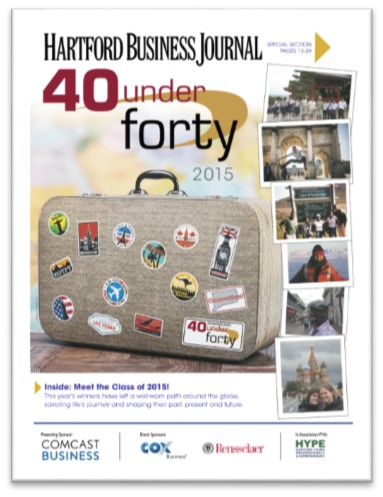
There appears to be no shortage of outstanding young professionals in Connecticut, as a glimpse at business publications this month clearly shows. Hartford Business Journal has named “the 40 best young professionals in Greater Hartford,” and Fairfield County Business Journal has honored its top choices, with their annual 40 Under 40 Awards recognizing emerging business leaders. Candidates are judged on their contributions to their specific industry or the position of authority they have achieved in their career.  Leaders in business and non-profits of all sizes and industries were considered, according to the publication.80 under 40

HBJ Managing Editor Brad Kane explains that “HBJ’s 40 Under Forty awards identifies young leaders who have already had success but who also have the potential to lead the professional world of tomorrow.  These individuals want to lead both in the board room and in life.”

The Fairfield County Business Journal’s 11th annual event, held recently, honored 40 people working in industries including law, real estate, medicine, nonprofits and others in Fairfield County. More than 300 people attended the event at the Maritime Aquarium at Norwalk.

Norwalk Mayor Harry Rilling congratulated the Fairfield County group at the awards ceremony, “You’re the rising stars of Connecticut, and we thank you for what you do,” Rilling said.

Hartford Business Journal reveals its selections from a sizable pool of candidates in the current issue, and will present its awards at an event to be held at the CT Convention Center in Hartford on September 30.

Greater Hartford’s 40 Under 40, as published by the Hartford Business Journal:hbj

Julianne Avallone, Ford & Paulekas

Stephanie Higgins Bealing, Replacement Lens Express

David Bittner, St. Francis Hospital & Medical Center

Anthony Byers, Hartford Youth Scholars

Michael Byrne, UBS Global Asset Management

Megan Carannante, Pullman & Comley

Rebekah Castagno, The Village for Families & Children

Aidan Charles, Charles Coaching & Nutrition Services

Dan Clark, Clark Insurance

Endia DeCordova, Manchester Community College

Jocelyn DeMaio, The Hartford Financial Services Group

Stephanie Dumont, Comcast

David Elder, ConnDOT

Stephen Frenkel, Cigna

Ryan T. Gardner, Fiduciary Investment Advisors

Jacquelynn Garofano, United Technologies Research Center

Tara Gerber, Travelers Championship

Daniel Gottfried, Hinckley Allen

Jaclynn Hart, Hartford Performs

Jennyfer Holmes, Hartford Foundation for Public Giving

Elizabeth Johnson, Post University

Jonathan Kaplan, Pullman & Comley

Alex Koenigsberg, Creative Living Community of CT

Melissa Lambright, SIGHT Eye Health

Lori-Ann Marchese, Body Construct

Michelle McDade, The Hospital of Central Connecticut

Kristina Miner, Hartford Steam Boiler Inspection & Insurance

Karraine Moody, Hartford Area Habitat for Humanity

Quentin Phipps, Charter Schools for Excellence

Kathryn Redican, Berkshire Hathaway HomeServices

Todd R. Regan, Robinson+Cole

Natasha Roggi, Hartford Sweat

Jacquelyn Santiago, COMPASS Youth Collaborative

Kathryn Shafer, Partnership for Strong Communities

Anthony Shannon, Shipman & Goodwin

Steven C. Taylor, Webster Bank

Joseph Turbessi, Finished: What's Next?

Rebecca Wareing, Management Search

Robert Zanlungo, Primary Residential Mortgage

Mark S. Zatyrka, American Homecare Federation


Fairfield County 40 Under 40, as published by the Fairfield County Business Journal:fairfield

Joshua Aferzon, CEO, Orthozon Technologies

Megan Baroni, counsel, Robinson & Cole LLP

Eliot Bassin, partner, Bregman & Company PC

Assaf Z. Ben-Atar, associate counsel, Pullman & Comley LLC

Kelly Berwick, deputy assistant public defender, Division of Public Defender Services

Paul A. Bonomo, CFO and COO, Cannondale Generators Inc.

Peter M. Bryniczka, partner, Schoonmaker, George & Blomberg PC

James Calkins, executive chef and owner, Seasonal Sweets & Catering

Anthony A. Carpentieri, private wealth manager, Private Banking & Investment Group at Merrill Lynch

Nate Checketts, co-founder, Rhone Apparel

Joseph Cichowski, vice president of sales and marketing, Ash Creek Enterprises Inc.

Mario F. Coppola, Esq., partner and corporation counsel for the city of Norwalk, Berchem, Moses & Devlin PC

Jessica Curtis, senior managing director, Newmark Grubb Knight Frank

Sergio DaSilveira, vice president, banking center manager, Webster Bank

Lara Devgan, plastic surgeon, Greenwich Hospital

Steven Fusco, sales consultant, Paychex Inc.

Emily Goldschmid, clinical director of children’s services, Kids in Crisis

Nicole Licata Grant, economic development specialist, UIL Holdings Corporation

Benjamin Healey, associate director, clean energy finance, Connecticut Green Bank

Jason Jaronko, senior program director, Westport Weston Family YMCA

Sean Keating, senior manager, McGladrey LLP

Bryan J. Kelsey, vice president, senior market manager, People’s United Bank

Christiane Kinseley, licensed clinical social worker, A Whole Recovery LLC

Dr. Daniel T. Ksepka, curator of science, Bruce Museum

John Lim, CEO, Life in Mobile

Patrick B. McKiernan, account executive, Abercrombie Burns McKiernan & Company Insurance Inc.

Katrina V. Melei, bariatric surgery program coordinator, Greenwich Hospital

Kathryn Scheinberg Meyer, staff attorney, education success project, Center for Children’s Advocacy

Nick Nguyen, portfolio manager, Cambridge Hanover

Carrie O’Connell, director of employment services, day services and transportation, Ability Beyond

Thomas P. O’Connor, partner, Whitman Breed Abbott & Morgan LLC

Douglas Polistena, general manager, Amber Room Colonnade

David Sansone Jr., project manager, A.P. Construction

Paul Santos, director, information technology and operations, The Center for Family Justice Inc.

Lindsay Clauss Sheehy, sales associate, Houlihan Lawrence

Alison Smith, housekeeper, global messenger, Stern Village, The Kennedy Center, Special Olympics

Dave Stambone, vice president, senior mortgage banker, Total Mortgage Services LLC

Laurie Stefanowicz, vice president, managing partner, Catamount Wealth Management

Jamie Toole, general manager, Bridgeport Bluefish Professional Baseball

Kristen L. Zaehringer, attorney, Murtha Cullina LLP


First-Time Home Purchases Poised for Increase Nationwide; Buyers Market in Connecticut

Nearly one-in-five potential first-time home buyers nationwide are actively looking to buy and nearly two-thirds would like to provide a sizable down payment of 20 percent or more. Nearly two-thirds, 62 percent, of potential first-time home buyers think they will purchase a home within the next two years. Among millennial survey respondents, this number is slightly higher, rising to 67 percent. New research from TD Bank, with 75 locations in Connecticut, indicates that “consumers are gaining confidence in the economy and many are looking to enter the housing market within the next two years,” explained Scott Haymore, Head of Pricing and Secondary Markets, TD Bank.  The bank polled more than 1,000 Americans looking to purchase their first home within the next five years, producing the TD Bank First-Time Home Buyer Pulse report. for sale

Connecticut, with the strongest inventory of homes on the market in the New England region, is especially attractive to first-time home buyers, points out Maryruth Ryan, TD Bank's Regional Mortgage Sales Manager for Massachusetts, Rhode Island, Connecticut and southern New Hampshire.  “Rates are at historical lows, mortgage programs are good.  It’s a good time to buy in Connecticut,” Ryan said.

The Connecticut Association of Realtors reported earlier this month that single-family house sales across Connecticut rose nearly 14 percent in June, compared with June 2014, with the median sale price dropping just under one percent.  There were 3,756 homes sold in Connecticut last month, 459 more than during the same month a year ago.

Ryan said that as the millennial generation looks to first-home purchases, they “have done their research, they are more prepared, they know what they need to do to qualify for a mortgage for their first home.”

When asked what is preventing them from purchasing their first home, respondents most often cited needing to save money for a down payment (64 percent) and needing to pay down debt (45 percent).  For millennials, the entry to homeownership is even tougher: 70 percent of millennial respondents said they need to save for a down payment and 52 percent said they need to pay down debt. Millennials are more likely to purchase their first home with a partner or spouse (70 percent) compared to potential first-time home buyers of other generations 49 percent.TD Bank

"Many first-time buyers today are finding it difficult to save for a large down payment, especially young adults who are saddled with substantial student loan debt," said Haymore. “Many lenders today are offering home affordability and down payment assistance programs so it's important for these buyers and potential buyers to shop around for a mortgage and learn more about the options available to them."

StatsInfographicJune2015The survey noted that more than two-thirds of consumers (68 percent) looking to purchase their first home are interested in move-in ready homes while one-third would like to buy a fixer-upper. And when it comes to amenities, respondents are most interested in their first home having a backyard or pool and an attractive design, followed by energy efficient / smart homes technologies.

The top four financing options first-time buyers consider include cash savings, 30-year mortgage, and an affordability program and government loan.  Ryan points out that financial institutions such as TD Bank provide consumer education about the mortgage process, discussing aspects including budgeting and affordability with prospective home buyers. "The right lender will help first-time buyers understand what they can afford and share information on the different loan options available,” Haymore added.stats

Some Connecticut home purchases are now including a contingency clause, Ryan indicated, something that isn’t happening at the same frequency elsewhere.  The so-called “Hubbard Clause” is a contingency in a purchase agreement that expressly conditions the buyer's offer upon their ability to sell and close on another home or property, most often their current residence.

Because of the strong inventory currently in Connecticut, rather than more than one buyer lining up to purchase a house and an ensuing bidding war, as is happening in other parts of New England and around the country, first-time home buyers here tend to be able to select the home they’d prefer, and often are the only bidder seeking to make the purchase.  The Greater Hartford Board of Realtors reported that home sales rose for the fifth consecutive month in June in the 75-town region, and that sales increased and prices dropped during the first six months of 2015, compared with a year ago.

The TD Bank First-Time Home Buyer Pulse isavailable at http://mediaroom.tdbank.com/homebuyer.  The survey was conducted by Vision Critical, June 11-16.

Six Connecticut Businesses Earn Honors from U.S. Commerce Department for Export Efforts

Four Connecticut companies - Dymotek of Ellington, Jonal Laboratories, Inc. of Meriden, Mutualink of Wallingford and Proton OnSite of Wallingford – were among 26 companies nationwide to receive the President’s “E” Award for Exports, as determined by the U.S. Department of Commerce.  In addition, Stamford-based Finacity Corporation and Hartford-based law firm Shipman and Goodwin were among 12 firms in the U.S. to earn an “E” award for Export Service. presidents_e_award U.S. Commerce Secretary Penny Pritzker honored a total of 45 American companies and organizations, many of which are small- and medium-sized enterprises (SMEs), at the 2015 President’s “E” Awards ceremony, held earlier this year.  The six Connecticut businesses were among the 45 honored.

Among the 45 businesses, Arizona joined Connecticut with the most businesses earning the “E” designation, with four.  Texas had three; Tennessee, Illinois and North Carolina each had two.  This year’s honorees represent 20 states, with 35 SMEs and 21 manufacturers receiving awards.finacity

The “awardees have made substantial contributions to increasing U.S. exports, which are critical to spurring economic growth and job creation,” said Commerce Secretary Penny Pritzker. “Exports continue to be a driver of our economy, supporting more than 11.7 million jobs in cities and communities across the country. Furthermore, these exporters are examples of the historic progress in our export growth. In 2014, U.S. exports hit an all-time high of $2.34 trillion, accounting for 13.4 percent of GDP. By exporting more Made-in-America goods and services, U.S. businesses are growing faster, hiring more workers, and paying better wages.”

dymotechProton Onsite makes hydrogen and nitrogen generators.  Mutualink manufactures equipment used to facilitate collaborative communication between public safety and first response teams at the scene of emergencies.  Jonal Laboratories makes sealant used in the aerospace industry.  Dymotek manufactures custom injection molded plastic and silicone parts for electronics, plumbing valves and juice dispensers. jonalLaboratories

Finacity is a world-class expert in accounts receivable securitizations, specializing in structuring, administration and reporting.

Twelve companies thamutalinkt assist and facilitate export activities were honored with the “E” Award for Export Service. Four firms received the “E” Star Award for Exports, which recognizes previous “E” Award winners who have reported four years of additional export growth. And, three companies were awarded the “E” Star Award for Export Service, which recognizes previous “E” Award winners that have shown four years of continued support of exporters since first winning the “E” Award.shipman

protononsiteThis year marks the 53rd anniversary of the “E” Awards presentation, which recognizes companies and organizations that make a significant contribution to the expansion of U.S. exports.  In 1961, President Kennedy signed an executive order reviving the World War II “E” symbol of excellence to honor and provide recognition to America's exporters. The President’s “E” Award is the highest recognition any U.S. entity can receive for making a significant contribution to the expansion of U.S. exports.

“Only a small percentage of America’s 30 million companies export, and of U.S. companies that do export, 59 percent export to only one country. Increasing this number can have a big impact on the U.S. economy,” Pritzker added.