Manufacturing Businesses, Not Only GE, Being Courted to Move As Fewer Praise CT's Quality of Life

Connecticut’s state government has been working diligently to boost manufacturing and manufacturers in the state, but the latest statewide survey suggests there remain significant obstacles on the road to realizing the goal of growing and sustaining a vibrant manufacturing sector. Among manufacturers, 94 percent handle their production in Connecticut, according to the just-released 2015 Survey of Connecticut Businesses by the Connecticut Business and Industry Association and BlumShapiro. While the survey analysis describes that number as encouraging, it also notes that 28% have production facilities in other parts of the U.S., and 24% in other countries—“which means they may be more likely to consider expanding or shifting more of their production elsewhere.”cover
The report indicates that the “factors that drive site location include access to key inputs; proximity to suppliers and customers; access to skilled labor; cost of labor; occupancy costs; affordable energy; and where companies are in their life cycle (e.g., mature companies are often likely to disperse geographically to reduce costs).

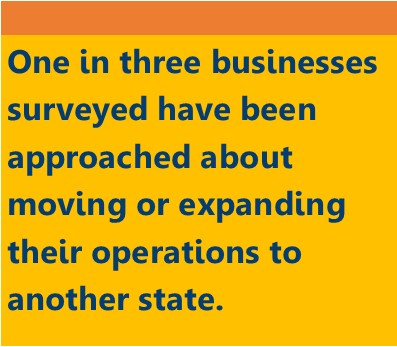
Although the courting by Governors from across the nation of General Electric’s corporate management has garnered much media and political attention, it is certainly not the only company that is the subject of someone else’s attention.  The CBIA-BlumShapiro report said that one in three businesses surveyed have been approached about moving or expanding their operations to another state.

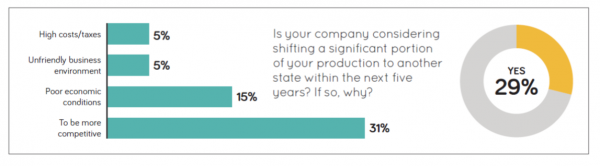
Of those, the analysis continued, “nearly one in four are planning on moving to that state, 29 percent are considering shifting significant production to another state within five years, and 31 percent are weighing expansion in another state within five years.aother state
Although the report shows that 63 percent of businesses surveyed showed a profit this past year—the best this survey has seen since 2006 - the report indicated that “a primary area of concern” is the expansion of businesses over the next five years, and whether that expansion will take place in Connecticut or elsewhere.
quoteWhether perception drives reality or reality is drives perception, the opinions stated by business surveyed are less than encouraging, according to the report.  Primary reasons cited for moving or expanding outside Connecticut are the state’s high costs (including taxes) and its “anti-competitive business environment,” reflecting an oft-stated CBIA viewpoint.  More than three-quarters say Connecticut’s business climate is subpar compared with other states in the Northeast, and the nation.

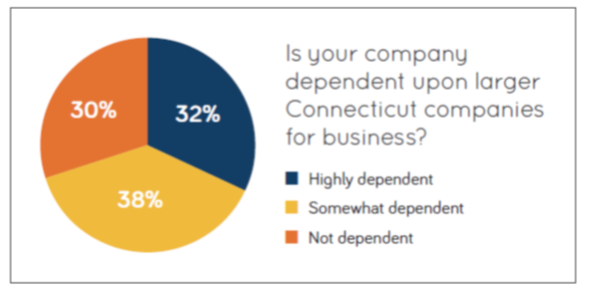
The report also noted the significant number of state companies that depend on other Connecticut businesses.  “The vast majority of companies surveyed (70 percent) are somewhat or highly dependent on larger Connecticut companies or businesses,” the analysis highlighted, “which raises concerns when tax hikes threaten to push large companies out of state.”

CBIA’s surveys consistently find that personal reasons also factor significantly in location decisions.  “Many business leaders point to Connecticut’s quality of life and the desire to work close to where they live as the main reason for locating and/or staying in-state. However, we are slipping here,” the report said.dependant
In a survey of Hartford-New Haven-Springfield businesses conducted earlier this year, quality of life—traditionally the number-one benefit to operating a business in this region— surprisingly emerged as less of a competitive advantage today.  In fact, there has been a steady decline in the percentage of company leaders citing quality of life as the greatest benefit of operating a business here: 47 percent in 2009, 43 percent in 2011, 40 percent in 2013, and just over a third (35 percent) in 2015.


Innovation Summit Seeks Companies to Showcase Entrepreneurship, Connect with Investors

It is billed as Connecticut’s “ultimate gathering of entrepreneurship and innovation,” as the Connecticut Technology Council honors tech and non-tech startups representing early stage and emerging growth companies at The Innovation Summit, to be held on November 10 featuring a Pitch Fest, Funding Fair, Poster Expo, and Awards Ceremony. The well-attended annual event includes 100 exhibiting Tech Companies To Watch, 40 pitching companies, and more than 400 attendees. The Council has begun  accepting applications and will continue selecting companies, on a rolling basis. The application deadline is September 30.

The  Innovation Summit is held in conjunction with Angel Investor Forum, BEACON, Crossroads Venture Group, CURE and Connecticut Innovations.

IS2012-logo_with CTC One of the key features at the 9th Annual Innovation Summit will be the Funding Fair, where angels, VCs, investment bankers, lenders, family offices, private investors, and other resources are on-hand to offer individual guidance and advice to attendees. The Funding Fair also offers fledgling businesses opportunities to connect with incubators and co-working spaces.

“Our Tech Companies To Watch are the focus of this event making it crucial that we offer a variety of valuable opportunities to those selected,” said Bruce Carlson, President and CEO of the Connecticut Technology Council. “Connecticut’s growing companies are looking for resources that will enable them to thrive in today’s economy. This year’s Innovation Summit is the place for them to find everything they’re looking for; a one-stop-shop for talent, funding, mentors, and peer support.”summit

In the Pitch Fest, selected Tech Companies To Watch will deliver a three-minute pitch to a live audience of investors, entrepreneurs, and other interested parties, and panel of judges.  The TCTW Expo affords an opportunity for entrepreneurs to show off their companies and ideas to potential partners, customers, investors, and talent.  The awards will be presented to the next generation of high-growth companies in Connecticut, honored for their potential in their respective industry categories.

Workshops will be offered in a variety of focus areas. “We’ve added workshops, some of which will focus on funding, raising alternative forms of capital, and understanding each stage of financing. Other workshop will be geared toward growth company needs like marketing and talent recruitment,” said Carlson.

Companies will be notified by October 9 if they are selected to participate. There is no charge to apply, however there is a discounted registration fee of $90 for admission and an exhibitor table.  The Innovation Summit will be held on Tuesday, November 10, 2015, 10:00am - 5:00pm, at the Connecticut Convention Center, a new location for the event reflecting the need for a larger venue as the number of participating companies increases.

The Connecticut Technology Council is a statewide association of technology oriented companies and institutions, providing leadership in areas of policy advocacy, community building and assistance for growing companies. Speaking for 2,500 companies that employ some 200,000 residents, the Connecticut Technology Council seeks to provide a strong and urgent voice in support of the creation of a culture of innovation.


https://youtu.be/EKpko3oppMk

Social Skills Increasingly Needed in Workplace, Study Finds

Between 1980 and 2012, the number of workplace tasks requiring social skills jumped 24%, those requiring math skills rose just 11%, and tasks requiring routine skills have steadily declined, according to Harvard Graduate School of Education associate professor David Deming. A faculty research fellow at the National Bureau of Economic Research, Deming shows that “the labor market increasingly rewards social skills. Since 1980, jobs with high social skill requirements have experienced greater relative growth throughout the wage distribution. Moreover, employment and wage growth has been strongest in jobs that require high levels of both cognitive skill and social skill.”NBERLogo-BlueLarge

The data show that social skill tasks grew by 24% from 1980 to 2012, compared to only about 11% for math-intensive tasks. While the latter has slightly declined since 2000, the importance of social skills has grown by about 2% since the turn of this century, as jobs characterized by routine work have continued to decline.deming_website2

Deming stresses ‘the growing return to social skills is pervasive and not restricted to management and other top-paying jobs. Moreover, the strongest wage and employment growth has been in occupations that require high math and high social skills,” he points out in describing the research on his website.

Harvard Business Review Associate Editor Nicole Torres writes on HBR.org in her roundup of the research that people with both social and math skills tend to be winners in today's job market. But ultimately, having social skills allows a person to be flexible and adapt to changing circumstances at work, which is a huge advantage.social skills

The research paper explains three things about the growing importance of social skills, according to HBR.org: 1) social skills are valued in jobs across the entire wage distribution, 2) social skill and cognitive skill complement each other, and 3) jobs that require low levels of social skills are also likely to be routine jobs (filing clerks, factory jobs) at high risk of automation.

Deming notes that “the slow growth of high-paying jobs in the U.S. since 2000 and rapid advances in computer technology have sparked fears that human labor will eventually be rendered obsolete. Yet while computers perform cognitive tasks of rapidly increasing complexity, simple human interaction has proven difficult to automate.”

While it still pays to be good at math in today’s labor market, Torres writes, it’s often no longer enough. “The days of being able to plug away in isolation on a quantitative problem and be paid well for it are increasingly over,” Deming told Torres. “You need of have both types of skills.”social skills e

Deming, an Associate Professor of Education and Economics,  has presented his research at universities throughout the country of economic and labor topics, including at Yale University and the University of Connecticut in recent years.

Norwalk Joins Stamford, Bridgeport in Rebranding Efforts to Attract Business

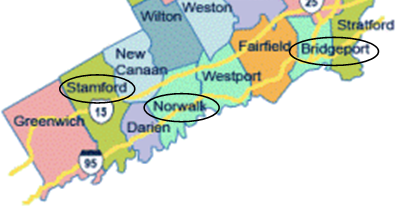
Norwalk Mayor Harry Rilling and Economic Development Director Elizabeth Stocker have selected South Norwalk-based branding and design firm, Zunda Group, to develop a strategic marketing plan that will include a brand implementation program.. With this week's announcement, Norwalk becomes the third major municipality in Fairfield County to turn to a rebranding initiative to boost business prospects and spark interest among potential developers. Bridgeport and Stamford have similar efforts either underway or in the planning stages.rebranding

Mayor Rilling said that “Norwalk recognizes the power of presenting the city with a strong brand image” and is moving forward as part of his recently released economic development action plan, which aims to capitalize on the city’s assets, attract and sustain new business, develop its workforce, and to continually improve its quality of life.

Rilling stated that “essential to the plan’s success is the city’s ability to communicate and build local pride around an ownable brand position that brings to life Norwalk’s unique personality and benefits.   Norwalk has an eye on the future and the new brand will elevate its position as a destination to live, work and play.”  The new branding and marketing communication is targeted to launch in early 2016.

Norwalk doesn’t need to look far to see other municipal branding efforts underway. map

Thomas Madden, Stamford’s economic development director, told the Fairfield County Business Journal this summer that the city Office of Economic Development is working on a multiphase plan to make Stamford more attractive to businesses in a nationally competitive market. Initiatives include conducting research on Stamford’s economic landscape, outreach, rebranding and improving digital resources, the business paper reported.

“It puts us on par with a lot of the economic development corporations to make sure we have the right information out there to make businesses look at Stamford,” Madden said, noting that it is the first time this type of project has been undertaken in Stamford. Planning began about a year ago, and the nonprofit Stamford Partnership, a civic organization, is leading the effort with Stamford-based brand development company Daymon Worldwide handling the marketing.

Daymon is to conduct surveys and focus groups in Stamford and in the tristate area exploring people’s views on Stamford. The data will guide which industries Stamford should focus on and provide guidance to the city’s Office of Economic Development regarding information about income level, incentives, taxes and transportation that can be highlighted in brochures to distribute to businesses considering Stamford as a location. It is anticipated that Stamford will begin using a new logo and launch a marketing campaign as part of the initiative.mq1

In Bridgeport, the administration of incumbent Mayor Bill Finch is already working with a pair of companies -- Mandate Media of Oregon and Gum Spirits of Maine – on an advertising campaign launched late last year, “Better Every Day.”  Mandate has created an economic development website, www.bridgeportbettereveryday.com, along with a digital and web-based marketing strategy for the city.  Ads have been seen not only locally but in statewide media, such as the website CT Capitol Report.  Gum Spirits was to develop radio and television spots focused on local success stories and revitalization efforts, according to plans for the initiative, and a series of videos are currently posted on the website.

According to the website, which touts the Park City as a “great place” to live, “Bridgeport is a city on the way up. We've got a lot of work to do, but we're investing in the future, making our city a place where our kids and grandkids will choose to live, work and raise their families. We're improving the city by building schools, re-opening parks, making downtown more vibrant, and developing the waterfront.”  The website is separate and distinct from the official Bridgeport government website, which features a range of city services traditionally highlighted on municipal sites.

In Norwalk, Zunda Group is owned and managed by longtime Norwalk business leaders Charles Zunda and Gary Seve Esposito. In announcing the selection, the city stressed that the firm “has enjoyed a 35 year history of building and positioning strong, relevant brands.”  Zunda Group has proven success with Connecticut based brands like Newman’s Own, start-up brands like Chobani, and global brands such as Dove, city officials pointed out.  The local Norwalk community is invited to share their feedback about Norwalk by completing a voluntary public survey that is available from September 8 through September 22 at www.norwalkct.org/survey


https://youtu.be/-77lj-hO2Xc

CT Ranks 35th in Economic Clout of Women-Owned Businesses

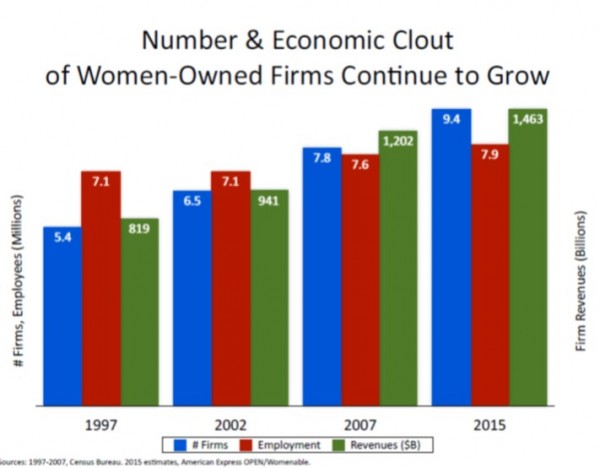
Connecticut ranks 35th in the economic clout of women-owned businesses over the past 18 years, according to a newly released analysis.  Women now run more than 9.4 million businesses in the United States, 30 percent of the nation’s businesses, with just over 100,000 of them in Connecticut Between 1997 and 2014, the number of women owned businesses in Connecticut grew by 42.1 percent, ranking the state 43rd in the nation.  Total revenue growth of 80.2 percent ranked Connecticut 28th, and employment growth of 20.9 percent among women owned business placed the state 22nd among the 50 states. cover

Nationwide, the number of women-owned firms grew from 5.4 million in 1997 to an estimated 9.4 million this year, an increase of 73 percent over the nearly two decades.  Employment in those businesses grew by 12 percent and sales by 78 percent, nationally.  The number of women-owned firms is increasing at a rate 1.5 times the national average.swob-report-weeks-openforum-embed1

In Connecticut, the number of businesses owned by women climbed from 72,393 in 1997 to 102.900 by this year.  Employment increased from 78,598 to an estimated 95,000, and sales grew from just over $9 million to nearly $17 million.

The industries with the highest concentration of women-owned firms nationally are healthcare and social assistance (53 percent of firms in this sector are women-owned, compared to a 30 percent share overall), educational services (45 percent), other services (42 percent), and administrative support and waste management services (37 percent).

The states with the fastest growth in the number of women-owned firms during the 18 year period are Georgia, Texas, North Carolina, North Dakota and New York.  The slowest growth has taken place in Alaska, West Virginia, Iowa, Kansas and Maine.

Since 1997, the number of female-run businesses has grown by 74 percent, well above the national growth rate of 51 percent for all firms. In 2014, women opened the doors of 887 new businesses every day, on average, up from 602 in 2011.

Women of color contributed to more than half of that growth last year, opening on average nearly 500 businesses daily, according to the new 2015 State of Women-Owned Businesses Report, prepared with U.S. Census data by Womenable, a research organization supporting women's entrepreneurship, and commissioned by American Express OPEN.

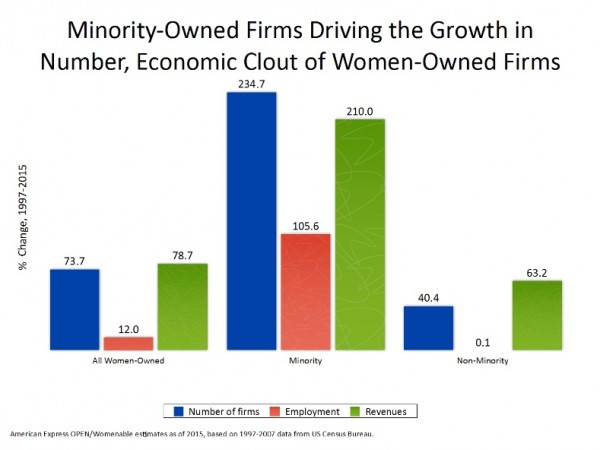
chartOf the nation’s women-owned businesses, African-American women own 1.3 million, Latinas 1 million, and Asian women more than 700,000. Businesses owned by women of color tend to be smaller in terms of their average employment and revenue, the report indicated. But their growth, both in numbers and in their economic clout—the combined average of their growth, revenue, and employment—continues to outpace that of their white peers, the data indicates.

“Back in 1997, there were just under one million firms owned by non-Caucasian women, representing one in six (17 percent) women-owned firms. Nlogoow, there are an estimated 3.1 million minority women-owned firms, representing one in three (33 percent) women-owned firms,” pointed out Julie Weeks, President and CEO of Womenable.  “The growing diversity of women-owned firms is one of the most remarkable trends of the past decade.”

WTIC-AM License Renewal, Filed in November 2013, Remains on Enforcement Hold

The license renewal application of WTIC-AM, filed in November 2013, remains on “enforcement hold” at the Federal Communications Commission, as the agency’s Enforcement Bureau  considers “an alleged violation of FCC rules,” according to an FCC official. Until the enforcement hold is lifted, the agency’s Media Bureau cannot proceed with a decision on whether or not to renew the station’s broadcast license.  The Enforcement Bureau must first determine whether or not a violation of FCC rules has occurred.  If the allegation is substantiated, the agency has a range of options, such as warning that the violation not be repeated or imposing a monetary fine on the station, according to FCC officials.fcc-logo_dark-blue

An FCC spokesman said in late August that the FCC’s Enforcement Bureau began expediting its review of complaints that hold up license renewals last year.  That expedited review of a backlog of pending complaints enabled the Media Bureau to grant over 950 license renewals in the last few months of 2014.  WTIC-AM was not among them.  The accelerated pace has continued, but officials would not predict when the complaint filed related to the pending WTIC-AM renewal would be considered.

WTIC-AM, which is licensed to Hartford but operates from studios in Farmington, can continue broadcasting under the broadcast license that expired 17 months ago, on April 1, 2014, until the FCC acts on its renewal application.  The renewal application was filed by the station nearly two years ago, on November 27, 2013. Stations must file an application for license renewal four months prior to the expiration date of the station’s license.

Precisely what the allegation under review involves is not made known to the public.  That information is only made available to the licensee or their attorney, according to an FCC official. The agency can, and often does, communicate with the station as part of their review process.  WTIC has previously declined to comment on the ongoing review process at the FCC.

Officials say it is not unusual for a license renewal to be on enforcement hold for an extended period of time.  Stations in such a status routinely continue to operate without any interruption until a decision on license renewal is made.

WTIC-AM-2When the license renewal application does reach the agency’s Media Bureau, they will consider “how the allegation of violation was resolved,” as well as a range of other factors in deciding whether or not to renew the station’s license.  The other, more routine, factors include whether any other objections have been raised about the station, whether the station has been adequately serving the public in their area of license, their history of compliance with FCC regulations, and their overall performance.  License renewals for radio stations are issued by the FCC for a period of eight years.
Connecticut by the Numbers first reported the FCC’s enforcement hold nearly a year ago, in September 2014.  Subsequently, Hartford Attorney Ken Krayeske filed an informal objection on October 1, 2014 to WTIC’s broadcast license renewal, alleging that the station “demonstrated serious malfeasance” and “helped conceal violations of federal law,” related to former Governor John Rowland’s use of the WTIC radio program he hosted to promote the Congressional campaign of Lisa Wilson-Foley. Krayeske had filed a previous complaint in 2012 that did not result in FCC action against the station.

CT Ranks 25th in Telecommuting Jobs; Nationwide 37 Percent Say They’ve Telecommuted

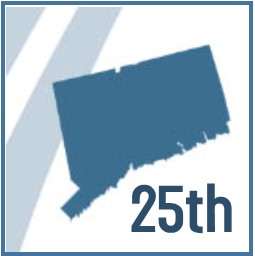
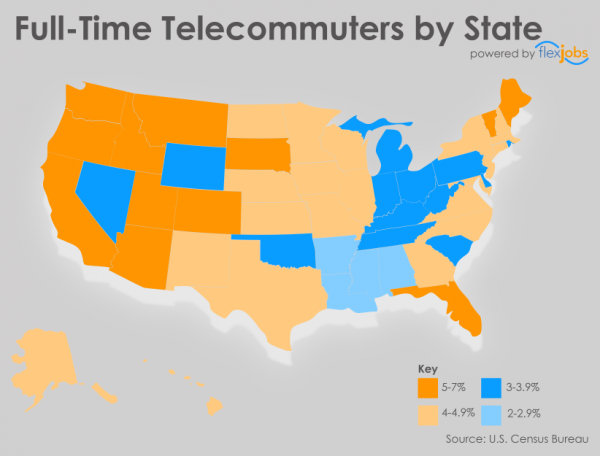
Thirty-seven percent of U.S. workers say they have telecommuted, up slightly from 30 percent last decade but four times greater than the 9 percent found in 1995, according to a newly released Gallup poll.  Connecticut ranks 25th in the nation in full-time telecommuters, data compiled by the website flexijobs.com indicates. The leading states for full-time telecommuters, based on percentage of workforce, are Colorado (6.9%), Vermont (6.8%), Oregon (6.3%), Montana (6%), Maine (5.7%), Arizona (5.5%), Idaho (5.5%) and New Hampshire (5.4%).  In Connecticut, 4.3 percent of the workforce are telecommuters.25th

Based on years of researching companies that hire for telecommuting, part-time, flextime, or freelance jobs, FlexJobs has compiled the best list of 100 of companies located in Connecticut that specifically have hired for jobs with at least one of these flexible working options.

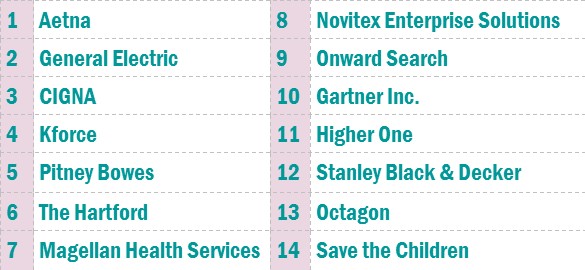
Connecticut’s top companies for flexible jobs are Aetna, General Electric, CIGNA, Kforce, Pitney Bowes, The Hartford, Magellan Health Services, Novitex Enterprise Solutions, Onward Search, Gartner Inc, Higher One, and Stanley Black & Decker.Full-Time-Telecommuters-by-State-by-FlexJobs-2015

The percentage of telecommuters nationwide is based on Gallup's annual Work and Education poll, conducted earlier this month, Aug. 5-9, 2015. Technology has made telecommuting easier for workers, and most companies seem willing to let workers do their work remotely, at least on an occasional basis if the position allows for it, the Gallup analysis points out. Even though telecommuting has become more common, the growth in the practice appears to have leveled off in recent years, according to Gallup.

The survey indicated that U.S. workers say they telecommute from home rather than go into the office about two days per month, on average. Nine percent of workers say they telecommutop companieste more than 10 workdays -- meaning at least half of all workdays -- in a typical month.  The majority of Americans, including both those employed and not employed, believe workers who work remotely are just as productive as those who work in a business office.



CT Tax on Cigarettes is Nation’s 4th Highest, Headed Toward 2nd Highest

Connecticut’s cigarette tax, $3.40 per pack, is the 4th highest in the nation.  State cigarette tax rates vary widely, ranging from 17 cents per pack in Missouri to $4.35 in New York, according to a report published in Governing magazine. When Connecticut’s tax increases to $3.65 per pack on October 1, the state will surpass the Massachusetts tax of $3.51 per pack, moving into 3rd place.  Rhode Island, at $3.75 per pack, ranks 2nd, behind New York State.  Should the scheduled increase of another 50 cents occur a year from now, Connecticut would have the nation’s second highest tax on cigarettes. cigarette

Rounding out the top 10 states with the highest cigarette taxes are Hawaii (5), Vermont (6), Washington (7), Minnesota (8), New Jersey (9), Wisconsin (10).

Policymakers often support tax increases on tobacco products as a means of raising revenue or improving public health by encouraging smokers to quit, the Governing analysis points out.  A handful of states passed cigarette tax hikes in the 2015 legislative session. Nevada lawmakers approved the single largest cigarette tax increase, raising the rate from 80 cents to $1.80 per pack, the publication indicates.

While noting that Connecticut's tax rate is set to increase to $3.65 per pack in October, the publication indicated that earlier proposals in the Pennsylvania and New Hampshire legislatures also included cigarette tax increases, but the two states have yet to pass budgets.

Kansas and Louisiana pushed cigarette taxes up by 50 cents and Ohio increased that state’s tax by 35 cents. Earlier this month, Alabama’s legislature voted down a proposal to increase that state’s tax by 25 cents per pack from the current 42.5 cents per pack, the third lowest tax in the nation.  Only Georgia, Virginia and Mississippi have lower taxes on cigarettes.smoking cigarette

The National Taxpayers Union Foundation reported that tobacco tax collections failed to meet initial revenue targets in 72 out of 101 recent tax increases, Governing reported, and as of 2011, only two states were funding tobacco control programs at levels recommended by the Centers for Disease Control and Prevention, which much of the tax revenue funneled into state general funds.

In Connecticut, the cigarette tax increased 61 cents in 2002 to $1.11 per pack, by another 40 cents in 2003, an additional 49 cents in 2007 and $1.00 in 2007 to reach $3.00 per pack.  In 2011, the tax increased by another 40 cents to the current $3.40 per pack.


New CT Consumer Confidence Survey Shows More Residents Likely to Stay, Although Outlook Relatively Unchanged

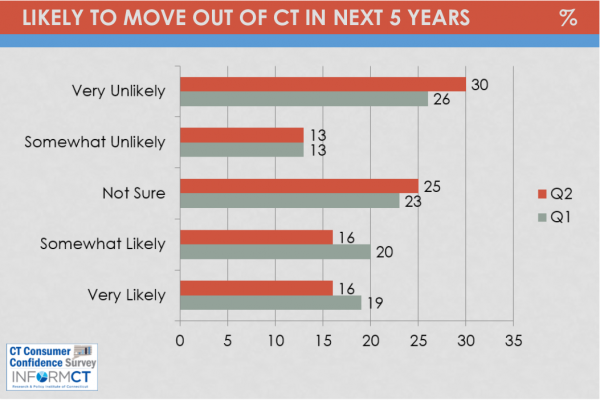
Fewer Connecticut residents now expect to move out of the state in the next five years, according to the results of the 2015 Connecticut Consumer Confidence Survey released today by InformCT, covering the second quarter of the calendar year. In the first quarter, the percentages were even, with 39 percent saying it was likely they’d move from the state during the next five years and the same percentage saying a move out of state was unlikely.  In the new survey, 32 percent said it is likely they will move out of state in the next five years, a slight drop, while the percentage who say it is unlikely has grown to 43 percent.CTConsumConfSurveyLOGO

Overall, Connecticut residents’ confidence in the state’s economy and their personal financial prospects are nudging along tentatively and unevenly, but relatively unchanged in the year’s second quarter compared with the first few months of the year.

Results of the Q2 Survey (April-June 2015) tend to reinforce what was found in Q1 (January-March).  Consumers see little change in what is perceived as a sluggish economy and do not envision any change in the next 6 months. This is also reflected in their attitudes toward the job market, with 6 in 10 feeling that there are insufficient jobs for the available workforce.move out

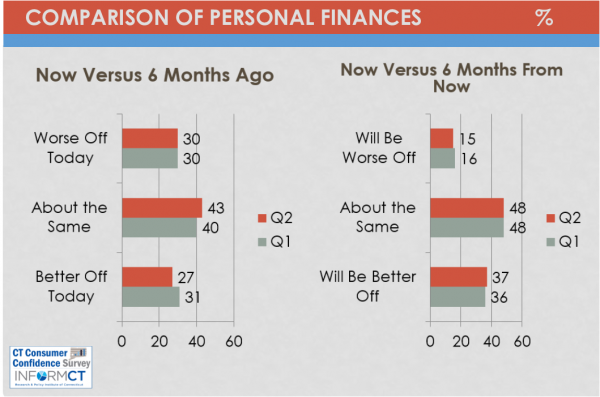
Regarding personal finances, slightly fewer state residents felt they were better off today than six months ago, but slightly more felt they would be better off six months from now.  A plurality, however, felt that their personal finances were about the same as six months ago, and were unlikely to change in the next six months.

Inform CT is a public-private partnership that provides independent, non-partisan research, analysis, and public outreach to help create fact-based dialogue and action in Connecticut.  The survey is designed to generate an ongoing measure of consumer confidence in the Connecticut economy.  The survey also found that:

  • Fairfield County residents are the most likely (32%) to think that business conditions are better.
  • Residents of Litchfield (36%) and Windham (34%) counties are the most likely to feel that jobs are very hard to get.
  • Residents of Tolland County (38%) are the most likely to feel that they are better off.

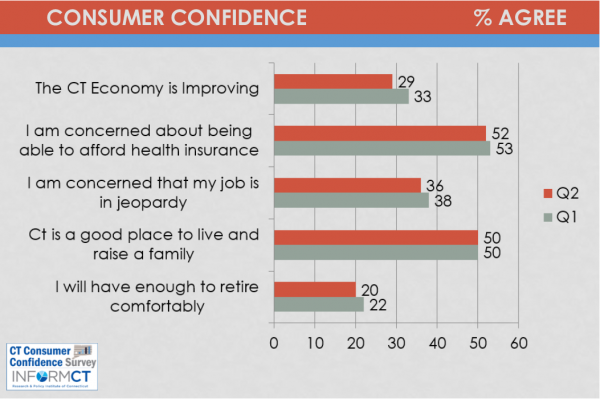
Concerns that survey respondents “job may be in jeopardy” dropped slightly from the first to second quarter, as did concerns “about being able to afford health insurance.”  However, slightly fewer people felt they had “enough to retire comfortably,” or that the state’s economy was improving.  On the question of whether Connecticut is a “good place to live and raise a family,” for the second consecutive quarter, the split was 50-50.  As income increases, respondents are more likely to agree that Connecticut is a good place to live and raise a family, the survey results showed.

personal financesThe survey is being administered for InformCT by the Connecticut Economic Resource Center, Inc.(CERC) and Shelton-based Smith & Company. The analysis, which is based on the responses of 400 randomly selected Connecticut residents (roughly 50 per county), addresses key economic issues such as overall confidence, reactions to housing prices, upscale consumer purchases, leisure spending and current investments. InformCT is a public-private partnership that currently includes staff from CERC and the Connecticut Data Collaborative.
The results also indicated that women (78%) are significantly more likely than men (52%) to indicate that they are likely to move out of Connecticut, and respondents with household incomes of $50,000 or less are significantly more likely to indicate that they will move out of Connecticut, according to survey officials.

More than 60 percent of state residents said they plan to take a vacation outside Connecticut (22% very likely, 39% somewhat likely) and 44 percent said they planned to vacation in Connecticut (26% very likely, 18 percent somewhat likely).  The most likely vacation location appears to be state parks, with 43 percent indicating that such a visit was likely in the next six months.  Forty-one percent planned to visit a casino, outdistancing visits planned to aquariums (27%), the Connecticut Science Center (13%) and other state attractions.

Regarding plans for major purchases in the next six months, often considered a harbinger of economic strength, 28 percent said they planned to make a “major consumer expenditure,” 22 percent anticipated purchasing a new car, and 15 percent said they were planning to refinance or purchase a new home. consumer confidence

CERC, based in Rocky Hill, is a nonprofit corporation and public-private partnership that provides economic development services consistent with state strategies, leveraging Connecticut’s unique advantages as a premier business location. Smith & Company LLC is a market research firm.  More information about the survey, and subscribing, can be found at www.informct.org.

“This research provides a measure of the strength of our economy as well as a gauge of select economic factors,” stated Alissa DeJonge, Vice President of Research at CERC.  “It is a valuable and cost-effective strategic planning tool for any company or organization that wishes to take the temperature of the Connecticut consumer.”

“Whether you are a financial services institution, health care provider, insurer, developer, utility, trade association, or advertiser, those who wish to subscribe to this regular information can add proprietary questions for their own purposes,” added Stephen A. Smith, President of Smith & Company.


Hartford's WPOP Goes Back to the Future with News, Talk Format

The goal, in the latest format change among local radio stations, is to become “the go-to station for news, weather and traffic” in the Hartford market.  WPOP, with a lengthy local history that features incarnations as a pop music station, all-news station, and sports talk station, has again assumed the moniker of “NewsRadio 1410 WPOP”, last used nearly two decades ago. Owned by iHeart radio, which has hired a new program director due in the Capitol City from a major market in the coming weeks, the newly rebranded station aims to make the transition to a news format that responds to and reflects the preferences of the local audience, according to Dave Symonds Sr., Vice President of Programming for iHeart Radio in Hartford.logo new WPOP

“There is a huge upside to the format change.  We did a lot of research and there was a high degree of dissatisfaction with the non-sports news talk programming” available in the Hartford market, Symonds said.  Regional Market President Steve Honeycomb added"It’s been almost 18-years since the all-news format was heard on WPOP 1410AM. We’re excited to bring back News Radio 1410 WPOP, an iconic brand and station focused on News, Traffic and Weather to serve the Hartford community, in the iHeartMedia line-up.”

The new WPOP-AM line-up will, at the outset, include mostly syndicated national programs including a daytime focus on financial news and The Vinnie Penn Project, which has been heard on WELI in New Haven since 2011.  The program will now be heard 6-9 AM on both stations, with an additional hour, 9-10 AM exclusively on WPOP.

“There are a lot of shared issues in New Haven and Hartford,” Symonds points out.  The program will originate in New Haven on some mornings, in Hartford on others. iHeart radio stations in Connecticut, formerly Clear Channel stations, include KC101, KISS95.7, The River 105.9, Country 92.5, 97.9 ESPN, and 960 WELI and WAVZ  in New Haven.

The new station's programming line-up will include: The Vinnie Penn Project    6-10 a.m. The Financial Exchange    10 a.m-12 p.m. Bloomberg  Radio               12:00p.m.-3 p.m. Howie Carr                            3-6 p.m. (based in Boston) Mark Levin                            6-9 p.m. America Now                        9 p.m.-12 a.m.

Most recently, the station had aired a sports/talk format including Fox Sports Radio content. Years ago, from 1956-1975, it was a pop music station, the inspiration for the station’s call letters.  The station routinely battled WDRC for the rock’n’roll music audience, before FM radio came to dominate that format.  In August 1972 it was announced that TV entertainer Merv Griffin's company, January Enterprises Inc., was buying WPOP for $2.75 million. Griffin, who came to town to visit the station, took control the following March, according to published reports.  Just a few years later, the music died on WPOP.  On June 30, 1975, WPOP abandoned music programming in favor of the new (and ultimately short-lived) NBC Radio News and Information Service.  But a news station in Hartford was born.

The station maintained an all-news format, which included local news/talk programming, for more than two decades, before the switch to sports talk programming in 1997 (first ESPN, than FOX in 2012).  Among the local newscasters who spent time at WPOP in its all-news heyday are Gerry Brooks, Scott Gray, and Joanne Nesti, whose careers blossomed at other radio and television stations in the market.  Numerous WPOP veterans went on to broadcast news careers around the country.

Those interested in hearing the new format can tune into News Radio 1410 WPOP on the station’s website, www.newsradio1410wpop.com, and through the iHeartRadio mobile app. Hartford is part of Nielsen radio market No. 52. WPOP is a 5 kW day/night station on 1410 kHz.

The Hartford market currently has other locally originated and syndicated news and talk programming.  Connecticut-based Connoisseur Media purchased a group of stations in the state including the WDRC-led “Talk of Connecticut” stations, anchored by the weekday morning locally originated Brad Davis Show.  The remainder of the broadcast schedule on WDRC-AM (as well as simulcast on WMMW Meriden, WWCO Waterbury and WSNG Torrington) consists of nationally syndicated programs, including Kilmeade & Friends, Dave Ramsey, The Savage Nation, The Schnitt Show, The Lars Larson Show and Overnight America.wpop newsradio

WTIC-AM 1080 broadcasts the local Ray Dunaway show and Jim Vicevich program weekday mornings, before moving to nationally syndicated programs, including Rush Limbaugh, for the remainder of the broadast day.

WNPR, part of the Connecticut Public Broadcasting Network, has locally originated talk programs including Where We Live, weekday mornings at 9 a.m. hosted by John Dankosky, the Colin McEnroe program each afternoon, and Faith Middleton’s long-running talk program weekday afternoons.

There is no word yet on whether WPOP will have local news reporters, as WTIC and WNPR, or news programming beyond local newscasts during the syndicated talk shows.  Those decisions will be made, officials say, as audience feedback to the new format is evaluated and the new program director settles in.  Although iHeart Radio has news and talk formatted stations in other markets across the country, Symonds said the approach taken for WPOP will be “customized for Hartford.”

[Logos for WPOP in its news formats - new logo above left, 1980's logo lower right.]