Connecticut Not Alone; Six States Have Held Special Sessions on Budget

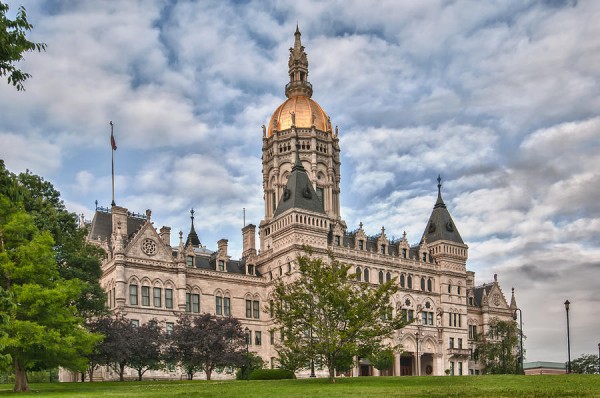
Connecticut, with a special legislative session a distinct possibility in the coming weeks, would not be alone in needing legislators to return to work on a state budget after their regular session had adjourned.  The states of Alabama, Alaska, Minnesota, Washington and Wisconsin all have conducted special sessions on budget issues this year, and New Mexico had a special session to discuss capital budget and supplemental appropriations, according to the National Conference of State Legislatures (NCSL).ct-state-capitol-building-guy-whiteley Alabama’s special session – the first in five years - was held over the summer, convening on July 13 and ending in disarray in mid-August, with a second special session on the state budget convened and concluded in mid-September.  Among the budget cuts, according to published reports: the Alabama Department of Environmental Management saw its appropriation drop from $1.2 million to $200,000, and the state’s hospitals, nursing homes, smokers and students took a hit.alabama

Alaska’s two special sessions to deal with that state’s budget, as well as other issues, ran for just under a month, adjourning on June 11, costing the state nearly $900,000, according to published reports.  That state’s deficit was driven by lower-than-expected oil revenue.

Minnesota had a two day session in June to work on the state budget, capital investments, and other issues and Washington State had a series of special sessions in April, May and June.  Wisconsin’s special session on budget and other issues convened in July.  Some in that state are urging another special session be convened this fall.

A number of states have had special session on other issues, including Congressional redistricting, Medicaid expansion, prison construction and the state’s child support system.
Official_Logo_mdDemocratic legislative leaders and Republican legislative leaders are scheduled to meet with Connecticut Gov. Dannel Malloy on Monday, Oct. 26, for their first budget discussion, in the run-up to an anticipated special legislative session to close the state’s projected budget deficit.

There are two main types of legislative sessions in states across the country, according to NCSL —regular and special (sometimes known as extraordinary). A regular session is the annual or biennial gathering of legislators, the starting date (and often, the length) of which is set by constitution or statute. Unlike regular sessions, there is no specific timing for special (or extraordinary) sessions. They occur intermittently to deal with the specific issues or topics.  Usually, the scope of a special session—that is, the topics that may be taken up—is limited to the issues specified in the notice calling for the special session, the NCSL website explains.

In 34 states, including Connecticut, a special session of the legislature can be called by either the Governor or the legislature.  In 16 states, only the Governor has that authority.  Connecticut’s regular legislative session, according to the state constitution, runs from early January to early June in odd numbered years and early February to early May in even numbered years.

house

12 Reach Connecticut Broadcasters Hall of Fame

The 60th annual convention of the Connecticut Broadcasters Association (CBA) this week featured more than an array of informative seminars for radio/tv sales, news, programming, production, engineering, and technology professionals.  The attention-grabber was the first-ever induction ceremony for the newly launched CBA Hall of Fame. The honorees were a who’s who of broadcasting history in the state, including some very familiar names, and some less so.  Earning their place in the Hall of Fame were NBC Connecticut anchor Gerry Brooks, WFSB anchor Denise D’Ascenzo, WDRC talk show host Brad Davis, FOX 61's Al Terzi, WWUH general manager John Ramsey, WMRD sportscaster Bill Glynn, Radio Cumbre Broadcasting president/CEO Pablo de Jesus Colon Jr., NBC CT engineer Joe DiMaggio, Cox Radio's Rick Ferguson. Recognized posthumously were WTIC sportscaster Arnold Dean, WCCC and WHCN veteran Boyd Arnold, and WMRD’s Ed Henry.Medallion Front Color

“The Connecticut Broadcasters Association has served the common interests of radio and television broadcasters in our state since 1955 and, ultimately, the Connecticut community statewide,” Klarn DePalma, chair of the Connecticut Broadcasters Association, said in announcing the group of inductees earlier this year. “We have created this ‘Connecticut Broadcasters Association Hall of Fame’ to honor remarkable individuals for their long and particularly distinguished service to the broadcasting industry and to the people of Connecticut.”

Boyd Arnold was one of the founders of the Hartford Radio Association and a longtime board member. He was a partner and VP/GM of Beck-Ross Communications’ WHCN(FM), and later, for Marlin Broadcasting’s WCCC(FM). A mentor for numerous radio professionals, Boyd was involved with the Connecticut Broadcasters Association for as a board member, treasurer and president.

In addition to his TV work at WFSB and NBC Connecticut, Gerry Brooks began his career as news director for WAVZ(AM) radio in New Haven, and as a reporter for WMAS radio in Springfield, Mass. He then worked as sports director at WPOP news radio in Hartford while also serving as weekend sports Anchor for WVIT and provided color for University of Connecticut basketball games on the Connecticut Radio Network.

Pablo de Jesus Colon Jr. pioneered Hispanic radio in Connecticut. He spent two decades at WLVH in the roles of radio announcer, PD, sales manager and executive vice president. In 1989, he co-founded Radio Cumbre Broadcasting, WCUM in Bridgeport, and today is its president and CEO.

Denise D’Ascenzo is a nine-time Emmy Award and seven-time Associated Press-winning journalist who also has earned distinction as the longest serving news anchor at a single TV station. She came to Channel 3 in 1986 and is host of “Advancing Medicine.”

Brad Davis began working at a radio station in Chicopee, Mass., in 1956. He was hired by Channel 3 (then WTIC) to host “The Brad Davis Show” for 11 years. Prior to joining WDRC, he also did radio work at WTIC-AM. And, since 1977, he has continuously hosted his own early morning talk show on WDRC that now also is heard on WMMW Meriden, WWCO Waterbury and WSNG Torrington, on the Talbroadcastersk of Connecticut network.

Arnold Dean, joined WTIC-AM in 1965, was its sports director and the originator of the station’s nightly sports talk program, and did play-by-play for a range of live sports broadcasts. He also hosted music shows on the station.

Joe Dimaggio began his engineering career at WVIT in 1968. When he started in the industry he worked on 16mm and black & white film as a camera operator. He has done everything from lighting shows to operating master control, and then to his long career in engineering management.

Richard Ferguson retired in May 2006 after more than 40 years in radio. He served as chief operating officer and later as EVP of Cox Radio starting when Cox acquired NewCity Communications, a radio group he co-founded and led as president/CEO. He was a member of the Cox Radio Board from 199cba7 through 2006, and continues to consult. He has also served multiple terms as chairman of the NAB. Prior to founding NewCity Communications, he was president of Katz Broadcasting Co.
Bill Glynn of Wethersfield is the “voice” of high school sports and minor league baseball in Connecticut. He began his broadcasting career with WMRD in Middletown (originally WCNX).

Ed Henry hosts “Polish Melodies Show,” which airs every Sunday on WMRD and WLIS(AM), Old Saybrook, for 65 consecutive years.

John Ramsey, of West Hartford, entered the industry as a part-time announcer at the University of Hartford’s WWUH(FM) in 1970, and became a broadcast engineer in 1978. He currently is general manager of WWUH and is secretary of Chapter 14 of the Society of Broadcast Engineers, president of the Torrington Community Radio Foundation (licensee of WAPJ-FM in Torrington), and is the webmaster for HartfordRadioHistory.com.

Al Terzi has news anchored at three of Connecticut’s TV network affiliates over the past 47 years. He began his career at WTIC as a staff announcer in 1968. He stepped down as a daily anchor last year, but still co-hosts the station’s weekly political show “The Real Story.”

Established in 1955, the Connecticut Broadcasters Association is celebrating its 60th year as a respected industry leader in legal, governmental, education and community issues on both the State and National levels. Members include broadcast TV stations, radio stations, vendors and companies with a business interest in broadcasting, educational facilities, and individuals with involvement in the broadcasting industry.

Member radio and TV stations also participate in Connecticut Broadcasters Association public service campaigns supporting the work of the Connecticut Department of Public Safety’s Office of Statewide Emergency Telecommunications – Emergency Alert System (EAS) and AMBER Alert programs, among other efforts.

Highlight videos for the 12 inductees:

https://youtu.be/ffPKNJPtwek?list=PLJyWxh-cfxLshUszNWljlpPGNA4f0hbAu

CBIA and reSET Go Head-to-Head Celebrating Business in Connecticut on Oct. 29

It’s not quite Christmas past and Christmas future, but observers of Connecticut’s business landscape will be forgiven if that’s the take-away from two simultaneous events the evening of October 29 in the state’s Capitol City of Hartford. The Connecticut Business and Industry Association, the state’s leading business membership organization, will be marking 200 years of “Connecticut innovation and ingenuity” at an historic anniversary gala at the Hartford Marriott Downtown, with MSNBC’s Joe Scarborough and Mika Brzezinski the featured guests.  Attendees will have an opportunity to “mix with Connecticut’s most successful and enterprising business leaders at this not-to-be-missed networking event,” according to the advance publicity.

The program is to be preceded by a brief CBIA business meeting. Governor Malloy is schedule to be among the speakers, along with CBIA President & Chief Executive Officer Joe Brennan. Tickets are now available for the celebratory event.

Meanwhile, across town at the Society Room, reSET, the Social Enterprise Trust, whose mission is advancing the social enterprise sector, will be highlighting the unfolding efforts of 12 impact businesses selected as honorees of the 2015 reSET Impact Challenge. Stressing social enterprise, the event has been described as “the future of business.”CBIA 200

The competition, now in its fifth year, recognizes the most innovative, impactful, and viable early stage ventures and start-ups from all industries. For the first time this year, the Challenge was opened to entrepreneurs throughout New England. Award winners will receive unrestricted seed capital, expert professional services, and public recognition. Nine of the 12 finalists are from Connecicut.

“This year’s short list was chosen from the over 100 enterprises that applied. That’s almost double that of last year, and a 700 percent increase since The Challenge launched in 2011. The talent pool gets stronger every year and narrowing it down this time around proved to be quite challenging,” said Rosie Gallant, Director of Programs at reSET.reSET

A panel of expert judges will decide the overall winners who will be revealed at an open-to-the-public celebration, starting at 5pm.   To hear the honorees’ stories and to cast your vote for the “People’s Choice Award,” people are urged to visit www.TheImpactChallenge.org/PeoplesChoice.  The honorees are:

  • Asarasi, Inc. (CT)
  • BookBugs (NH)
  • Beautiful Day / The Providence Granola Project (RI)
  • Daily General Counsel (MA)
  • Dream See Do (CT)
  • FRESH Farm Aquaponics (CT)
  • Harford Prints (CT)
  • Hugo & Hoby (CT)
  • LOTUS Alliance LLC (CT)
  • Movia Robotics (CT)
  • Parrot MD (CT)
  • Planet Fuel Beverage Company (CT)

Connecticut Public Radio host John Dankosky will moderate a panel at the celebration about how social innovation is transforming industries. The panel will feature Disruptive Innovators Jean Hammond, co-founder and partner of LearnLaunch; Makaela Kingsley, director of Wesleyan’s Patricelli Center for Social Entrepreneurship; and a co-founder of tech startup Send Help Back Home.  Tickets to the celebration next month may be purchased at www.ResetImpactAwards.Eventbrite.com.

A separate Impact Venture Showcase will begin at 4pm, with eight early stage, impact-driven startups pitching to an audience of investors, advisors, and guests seeking both social and financial returns. Seating for this pre-celebration event is limited. Separate tickets are required, available at: www.ResetImpactAwards.Eventbrite.com.

With both events spotlighting innovation and ingenuity, the state Department of Economic and Community Development’s statewide theme, “Still Revolutionary,” comes to mind.

This year’s Challenge and Awards are being made possible by a large community of supporters, including a fair number who may also be represented at the CBIA celebration.  The reSET even sponsors include Aeton Law Partners; Bank of America; BNY Mellon; Cantor Colburn; Carter Realty; Central Connecticut State University; Clark Insurance; Comcast Business; Community Investment Corporation; Connecticut Department of Economic and Community Development; Connecticut Innovations; Farrell & Farrell Consulting Services; Fiondella, Milone & LaSaracina; Health Educated, Inc.; HealthyCT; HEDCO Inc.; Murtha Cullina; Powerstation Events; Pullman & Comley, LLC; Qualidigm; Quinnipiac University; Remarkable Technologies; Tariq Farid Foundation; The City of Hartford; The Hartford; The Walker Group; Travelers; Trinity College; and Updike, Kelly & Spellacy.

https://youtu.be/07vC9ohKyyg

https://youtu.be/8hg7nUBL4P4

https://youtu.be/DR1KfGFqG5U

CT’s Manufacturing Report Card Features Every Grade, From A to F

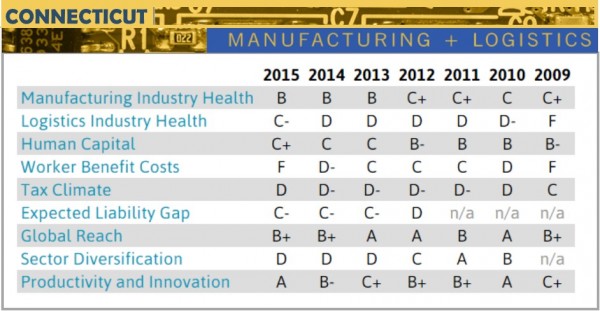
Connecticut’s report card on Manufacturing and Logistics is a mixed bag, according to data compiled by Indiana’s Ball State University Center for Business and Economic Data.  The state’s grades in nine categories range from an A in the Productivity and Innovation category to an F in Worker Benefit Costs. The other categories were Manufacturing Industry Health, Logistics Industry Health, Human Capital, Tax Climate, Expected Liability Gap, Global Reach and Sector Diversification. Overall the state received one A, one B+, one B, one C+, two C-, two D, and one F. manufac data

Connecticut’s manufacturing industry is 8.1 percent of the state economy, according to the report. The total personal income in Connecticut is $203,703,411,000 and earnings from manufacturing total $16,591,678,000, the report stated.

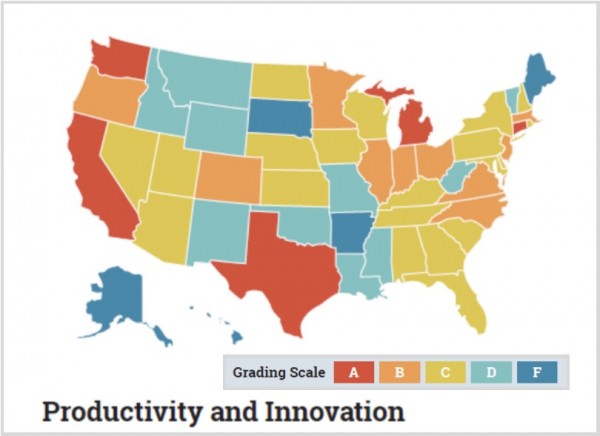
The state’s top grade was in Productivity and Innovation.  The researchers described that category as “the value of manufactured goods per worker – productivity – as well as firm access to inventions and innovations,” which “is critical to the long-term performance of a firm and the industry as a whole.”  To measure productivity and innovation, they used manufacturing productivity growth, industry research and development expenditures on a per capita basis, and the per capita number of patents issued annually.  Connecticut was one of five states to earn an A; the others were California, Michigan, Texas, and Washington State.

Compared with 2009, Connecticut’s grades improved in the categories of Productivity and Innovation, Manufacturing industry Health, and Logistics Industry Health, and declined in Tax Climate and Human Capital.  In Tax Climate, the state dropped from a D last year to a D- on 2015’s report card. Sector Diversification, which received an A in 2011, dropped to a C the following year, and has been mired at a D in each succeeding year.report card logo

The report authors note that “states that concentrate their manufacturing activity in a single sector typically suffer higher volatility in employment and incomes over a business cycle and are also more likely to experience greater effects of structural changes to the economy involving a single sector.

Connecticut’s Tax Climate grade has been a steady D or D- since 2010, after earning a C in 2009.

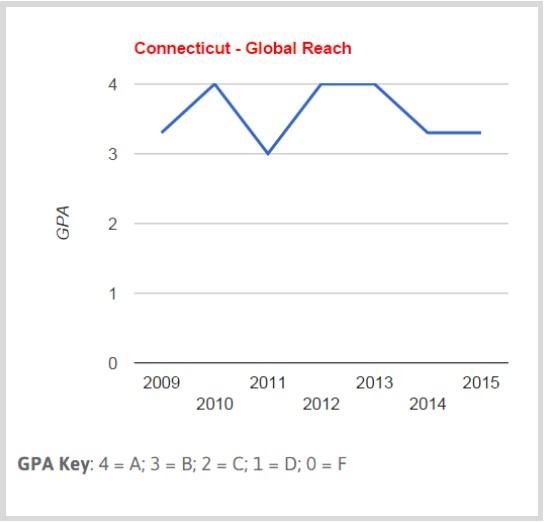
In the Global Reach category, in which Connecticut received a B+, only South Carolina, Ohio, Indiana, and Delaware received a higher grade.  Connecticut’s grade matched New Hampshire, placing Connecticut in the top six in that category.  The Ball State researchers indicated that “the level of international trade (in both imports and exports) is a robust measure of competitiveness in the production, movement and distribution of consumer durable and non-durable goods.”global reach

The university’s national report provided report cards to all fifty states in each of the categories.

The Center for Business and Economic Research is an economic policy and forecasting research center at Ball State University.  CBER research includes public finance, regional economics, manufacturing, transportation, and energy sector studies.

productivity and innovation

New Haven’s Square 9 Softworks Ranks #20 Among Nation’s Top 100 Inner City Businesses

The Inner City 100 are among the nation’s fastest-growing urban firms.  The list of the city-based businesses, thriving from coast to coast, is compiled by Initiative for a Competitive Inner City (ICIC) and featured in Fortune magazine.  The top firms range from a Philadelphia glass blowing outfit, to an Oakland-based 3D printing shop, from a high-end Brooklyn chocolatier to a New Haven software company, the only Connecticut company to earn a spot on the list. “America's urban core is filled with a wildly diverse array of fast-growing businesses,” Fortune points out in presenting this year's 100 fastest-growing inner city companies. Ranking at number 20 is Square 9 Softworks, a leading developer of innovative, business-centric software solutions, headquartered in New Haven. Square_9_Softworks_Logo

Education is paramount at Square 9 Softworks, the write-up by ICIC points out. The document management software maker “has led a number of tech-focused workshops for entrepreneurs in New Haven, as well as creating inner-city scholarships and business intern programs, while recruiting talent from local schools.”

DCIM100GOPRO

According to ICIC, half its employees are under 35 and come from area universities, and Square 9 plans to nearly double its workforce in two years. Clients and partners include Priceline, New York Life Insurance Company, Ohio State University, and Konica Minolta. According to Fortune and ICIC, the company’s 5-year growth rate is 489 percent, with 2014 revenue of $7.45 million.

The companies listed on “Inner City 100” list among the fastest-growing American companies in any location. Although based in the inner city, these companies derive more than half their revenues from regional, national and international sales, the ICIC explains.  The median firm is 11 years old with over $8 million in annual revenue, 45 full-time employees and a five-year compound annual growth rate (CAGR) of 39 percent.

The Inner City 100 Companies, according to the website listing, are producing jobs in their local communities, competitive advantage for their business partners and profits for their investors. Across all sectors, Inner City 100 firms are more productive than their sector peers throughout the U.S., according to U.S. Census data.

The top 10 companies:  Bithenergy (Baltimore); BWI (Indianapolis); Caduceus Healthcare (Atlanta); Rise Interactive (Chicago); Business Resource and Security Services (Washington DC); StreamLink Software (Cleveland); Concrete Constructors, Inc. (Jackson, MS); Impact Makers, Inc. (Richmond,VA); Creative Business Solutions, Inc. (Washington, DC); and The Onyx Company (Chicago).globalLogo

Square 9 Softworks is a privately held Connecticut-based corporation whose management team consists of tenured ECM industry professionals, according to the company’s website. Last month, Square 9 Softworks, announced that Buyers Laboratory LLC (BLI), the world’s leading independent evaluator of document imaging products and solutions, awarded Square 9’s “SmartSearch 4.2” the 2015 Summer Pick Award.

“SmartSearch is one of the few document management solutions that can be ideal for both large and small organizations,” said BLI Senior Editor, Jamie Bsales. “Unlike many document management systems, SmartSearch includes most functionality in the standard product, rather than requiring extra-cost add-ons. This makes SmartSearch much less expensive when matched feature-for-feature with other leading systems. Square 9’s SmartSearch has demonstrated to BLI its ability to satisfy complex business needs, streamline daily processes and increase productivity.”software

Square 9 is fully owner managed and as such is not subject to the direction of the markets or private equity, the website emphasizes. As a privately held corporation Square 9 has assumed a long term position of expanded growth and profitability, realizing triple digit growth in each of the four years from 2008 – 2011 while recording profitability in sixteen straight quarters, the website points out.2015-BLI

The Initiative for a Competitive Inner City (ICIC) is a nonprofit research and strategy organization and the leading authority on U.S. inner city economies and the businesses that thrive there. Founded in 1994 by Harvard Business School Professor Michael Porter, ICIC strengthens inner city economies by providing businesses, governments and investors with the most comprehensive and actionable information in the field about urban market opportunities. It is led by CEO Steve Grossman, a former Massachusetts State Treasurer and gubernatorial candidate.

https://youtu.be/5Z8qWU_nqLg


Four CT Businesses Among Finalists in Martha Stewart American Made Competition

Four Connecticut small businesses owners and entrepreneurs are among the finalists selected in the Martha Stewart American Made contest, which highlights the creativity in design, crafts, food and style that is thriving nationwide.  Members of the public can vote on-line for their favorites, with the winners to be announced later this month.  The Connecticut-based finalists operate in Hartford, Bridgeport, East Lyme and Stafford Springs. “Made in America” means that “all or virtually all” of the product has been made in America—that is, all significant parts, processing, and labor that go into the product must be of U.S. origin. Products should not contain any—or should contain only negligible—foreign material. logo-am-stacked

The descriptions of the Connecticut-based finalists:

  • American Woolen (Stafford Springs - Design Finalist) is re-introducing excellence in domestic textile manufacturing and re-establishing the American "Metropolitan" style aesthetic. American Woolen occupies a red brick, textile mill in northeastern Connecticut. Originally constructed in 1853 and subsequently extended in 1919, the building offers textured surfaces and colors that provide continuous inspiration for our fabric collections.
  • Paloma's Nest (East Lyme - Design Finalist) creates new traditions for modern families- heirloom gifts that celebrate wedding, baby, home & holiday. It is the creative work of husband and wife team Jose Vasquez-Corbalan and Caroline Colom Vasquez. Designing together since the day they met (literally designing furniture on cocktail napkins), the pair handcrafts each and every Paloma's Nest item in their coastal Connecticut studio from fine wood and clay materials.studio2
  • Raw Material (Bridgeport - Crafts Finalist) is one part street, one part rural Americana. The business’s DIY Knit Kits let anyone create luxe fashion with American-spun merino and alpaca yarn.  Raw Material is a collaboration between mill, woodworker and knitwear maker, using American fiber, spun in an artisan mill. The business works out of a studio in Bridgeport, CT in the American Fabrics Art Building.
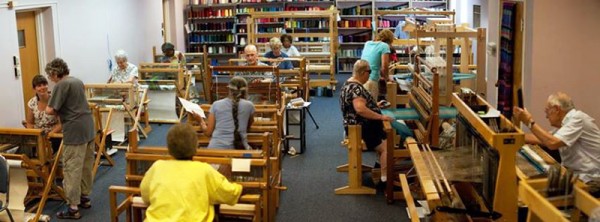
  • Hartford Artisans Weaving Center’s (Hartford - Crafts Finalist) mission is to promote the craft of hand weaving in a supportive and creative community to individuals with low or no vision or senior in age. People may enroll in the program to get out of the house, to learn a new craft, or to earn extra income; however, “they find far more at our center. They form social bonds, dispelling the loneliness and isolation so common among sight-impaired, blind, and/or senior people,” the website points out.

OLYMPUS DIGITAL CAMERA

Creative entrepreneurs and small business owners were encouraged to enter the Martha Stewart American Made Choice competition. From all the published nominees, up to 1,000 finalists have been selected to compete for the American Made Awards across the categories of crafts, design, food, and style. Of these finalists, up to 500 will be handpicked by a panel of judges. From the entire pool of finalists, one winner will be selected. Voting ends on October 19, 2015 at midnight.  The Audience Choice Award Winner will be announced on or about October 23, 2015.

American Made “spotlights the maker, supports the local, and celebrates the handmade,” according to the competition’s website.  The program is made up of people and communities that have “turned their passion for quality craftsmanship and well-designed goods into a way of life.” The categories are Crafts, Design, Food and Style.

Martha Stewart and the executive editorial team of Martha Stewart Living will serve as category judges and oversee the selection process of the finalists. The judges will base their selections on the following criteria: Innovativeness, demonstrated creativity, and originality of idea; workmanship; appearance; and embodiment of an American made theme.

https://youtu.be/9i56efixOLY

https://youtu.be/jadOiFFFA5Q

Shelton's Wiffle Ball Being Pitched for National Toy Hall of Fame

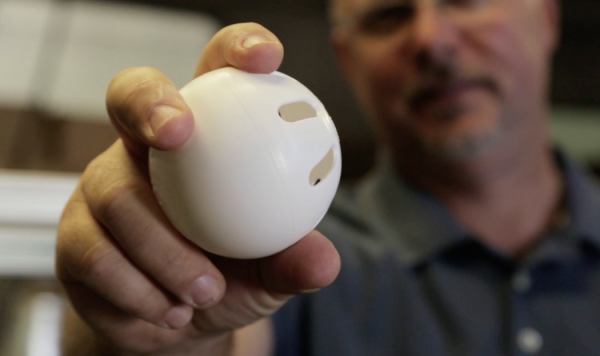
A Connecticut native is being considered for induction into the National Toy Hall of Fame.  The Strong National Museum of Play in Rochester, N.Y. has announced its twelve finalists for this year's induction into the National Toy Hall of Fame, and the Wiffle Ball – invented and still manufactured in Connecticut - is among them.Screen-Shot-2015-09-17-at-11.10.28-AM-1050x623 It all began in the summer of 1953, when David N. Mullany, grandfather of the current company owners (brothers David and Stephen) was watching his 12 year old son and a friend play a game in their backyard in Fairfield, using a perforated plastic golf ball and a broomstick handle. They had given up on baseball and softball - not enough players for two teams, not enough space for a field, and too many broken windows.


After some trial and error, the wiffle ball was invented, and the rest is history – perhaps Hall of Fame worthy history. Even with the abundance of toys and rapidly expanding new technology available to today’s youth, the Wiffle Ball business remains strong, with millions manufactured in Shelton and distributed world-wide every year.wiffle

The competition is tough, including favorites from more recent decades and some with origin generations ago.  Among the other toy finalists for 2015: American Girl dolls, Battleship, coloring book, Jenga, PLAYMOBIL, puppet, scooter, Super Soaker, Teenage Mutant Ninja Turtles, top, and Twister. Only two of these iconic toys will be inducted into the Hall of Fame. The finalists are chosen by historians and curators at The Strong. From there, a national panel of judges made up of inventors, educators, psychologists and others choose the winners.

strongEstablished in 1998, the National Toy Hall of Fame serves to recognize toys that have stood the test of time, remaining popular with kids generation after generation. The 12 toys are chosen on the advice of an advisory committee, and the winner will be announced at the Strong Museum in Rochester next month - on Thursday, November 5 at 10:30 a.m.

Inducted toys are selected on the basis of the following criteria:

  1. Icon-status: The toy is widely recognized, respected, and remembered.
  2. Longevity: The toy is more than a passing fad and has enjoyed popularity over multiple generations.
  3. Discovery: The toy fosters learning, creativity, or discovery through play.
  4. Innovation: The toy profoundly changed play or toy design. A toy may be inducted on the basis of this criterion without necessarily having met all of the first three.

If the Wiffle Ball wins, it will join toys such as bubbles, Candy Land, checkers, Crayola Crayon, Mr. Potato Head, Barbie, Monopoly, Easy-Bake Oven, G.I. Joe, the Frisbee, View-Master and Hot Wheels, just to name some of the 56 toys that have been inducted so far.  Last year’s selections were the Rubik's Cube, bubbles and Little Green Army Men.  The previous year, Chess and the Rubber Duck were inducted.

The Strong Museum is also running an internet-based poll asking viewers to select their preferred toy.  (One vote permitted every day.)   With 4,500 votes cast as of this week, the Whiffle Ball is in the lead among the 12 finalists, with 854 votes, about 18 percent of the total votes cast; followed by the puppet, the coloring book and Teenage Mutant Ninja Turtles.

https://youtu.be/iPrFiBxCX-s

Medical Device Tax Seen as Inhibitor to Innovation, Repeal Sought

Emerging technologies that can develop breakthrough medical devices are at the intersection of innovation and tax policy, and a growing list of businesses and organizations are urging Congress to repeal a tax, instituted as part of the Affordable Care Act, that they say is harmful to industries with the potential to improve lives and boost local economies.  The issue has particular resonance in Connecticut, where efforts to grow technology, precision manufacturing and the medical and pharmaceutical industries have accelerated in recent years. tech Medical technology creates more than two million jobs directly and indirectly across the United States. The industry is one of the few U.S. manufacturing sectors that is a net exporter, and its innovations help reduce the human and economic burden of chronic disease.  Industry officials point out that while U.S. leads the world in the development of new medical technology, the device tax “threatens that leadership.”

Earlier this year, a bipartisan majority of the U.S. House of Representatives voted to repeal the medical device tax.  The fate of the proposal in the Senate is unclear.  A growing coalition of research advocates, disability rights leaders, patient groups and others support repeal of the device tax because, they say, it drains critical resources away medical innovation.  According to a 2015 study by opponents of the tax, two-thirds of med-tech companies that were surveyed said they had to either slow or halt job growth at their companies because of the medical device tax.backpain_skeleton-165x300

Between 2002 and 2012, the number of jobs in the Medical Equipment and Supplies Manufacturing industry in Connecticut increased by 10.75 percent, with the addition of about 700 jobs, according to the Connecticut Economic Resource Center (CERC).  CERC’s research indicated that jobs in the field were almost twice as concentrated in Connecticut in comparison to the United States, with average wages above the national average, with more than 150 companies in the medical equipment and supplies manufacturing business.

Connecticut’s medical device industry continues to see new entries.  Just two years ago, a company launched by a 2011 UConn graduate, Orthozon Technologies, received local notice for its newly developed “minimally invasive tool for spine surgeons,” which led to the company’s quickly “gaining momentum in the medical device field,” the Fairfield County Business Journal reported that year.

The Stamford-based company’s Lumiere™ is a state-of-the-art minimally invasive surgical retractor that provides “access and visibility for physicians as well as faster and less painful recovery time for patients,” according to the company website.  Utilizing a patented technology with powerful unobstructed fiber optic lighting, translucent retractor blades, full medial access, and an expandable field of view, the medical device provides surgeons with a tool “for quicker and more efficient spinal decompressions.”

Earlier this month, when the state’s fastest growing technology firms were honored at the 2015 Marcum Tech Top 40, in partnership with the Connecticut Technology Council, medical devices were among the technologies highlighted. chart

One of the leading categories included “Medical Devices companies manufacturing medical instruments and devices including medical diagnostic equipment (X-ray, CAT scan, MRI), medical therapeutic devices (drug delivery, surgical instruments, pacemakers, artificial organs), and other health related products such as medical monitoring equipment and handicap aids.”

Among the companies selected was Guilford-based Bio-Med Devices, which designs, manufactures, and markets a complete line of critical care and transportable respirators/ventilators, air - oxygen blenders, ventilation monitors,  disposable and reusable breathing circuits, and accessories.

Connecticut Innovations. The state’s leading source of financing and ongoing support for Connecticut’s innovative, growing companies, highlights six Connecticut companies in the medical device industry within its investment portfolio, with some investments dating back to 2007.

Nationwide, an aging population, people with disabilities living longer lives, and chronic disease rates growing at faster rates, lead advocates of repeal say now is the time for more—not less—resources to advance cures and treatments that help people live longer and healthier lives.  The industry survey indicated that 85 percent of respondents plan to reinstate forgone R&D projects if the tax is repealed.

https://youtu.be/uqTdNffOaas

Votes to Decide if Hartford Journalism & Media Academy Will Receive $100,000 Grant

The Hartford Journalism & Media Academy is one of six education programs in New England vying for a $100,000 grant to further their student-centered learning approach to education.  Voting is now underway via the internet – and the deadline to cast a vote is September 30. JMA-for-webThe Lawrence W. O’Toole Award is given out each year to an individual, organization, school or district exhibiting great leadership through innovation or courage in moving student-centered approaches to learning forward in New England. The winner will receive a $100,000 grant from the Nellie Mae Education Foundation.

The Students at the Center Hub – a relatively new website - was created through a partnership between the Nellie Mae Education Foundation and Jobs for the Future. It is a resource for educators, families, students and communities interested in learning more about student-centered approaches to learning. Visitors to the site can “explore the research behind it; the practices that nurture it; policies that support it; and how to communicate about it.”  Details on each of the nominated programs are included on the site.media

The mission of the Hub is to help raise the visibility of student-centered learning in New England and beyond, offer a centralized location for tools and resources on student-centered learning approaches, and provide a user-friendly, interactive space for practitioners, implementers and supporters of student-centered approaches to learning.

vote_pdga-193x193At the Hartford Journalism and Media Academy (JMA), students are learning first-hand how storytelling and student voice can transform education. Students at JMA attend a satellite campus at Connecticut Public Broadcasting Network (CPBN) in Hartford, where they are working alongside seasoned journalists to produce content for the station while gaining 21st skills like creativity, collaboration and communication. As part of the station’s Education Reporting Initiative, students are investigating the impact of student-centered learning policies and practices in the public education system.

The Nellie Mae Education Foundation is working to reshape public education across New England to be more equitable and more effective – so every student graduates from high school ready to succeed in college or the workplace – and contribute to their communities as informed citizens.

In addition to the Hartford Journalism & Media Academy, in the running for the grant are Portland Empowered (Maine), Burlington High School (Vermont), The Highlander Institute (Rhode Island), Sanborn Regional School District (New Hampshire) and Youth on Board (Boston).

Voting is open to one vote per email address. As of Monday morning, the Hartford Journalism & Media Academy was running fifth in the voting.  A total of nearly 11,000 votes had been cast.

https://youtu.be/Qq8w3mj4NZI

Got Drugs? Take 'Em Back

There will be 64 locations across Connecticut collecting drugs on Saturday, September 26.  It is part of National Prescription Drug Take-Back Day, an initiative of the U.S. Department of Justice Drug Enforcement Administration’s (DEA) Office of Diversion Control.  The aim is to get unused prescriptions and other drugs out of closets, medicine cabinets, glove compartments, and random shelves and drawers, as well as off the streets, before they end up causing harm. In Connecticut, state police barracks and many local police departments are serving as drop off points.  The collection sites will be open as part of the initiative from 10:00 AM to 2:00 PM on Saturday. (See the full list here.)pills20

States around the country are participating, and all but Pennsylvania and Delaware, which held their collection days on September 12, are doing so on September 26. According to a public service announcement prepared by the DEA, “prescription drug abuse is an epidemic in this country, and the source of these drugs is often the home medicine cabinet.”

The National Prescription Drug Take-Back Day aims to provide a safe, convenient, and responsible means of disposing of prescription drugs, while also educating the general public about the potential for abuse of medications.got-drugs-2

“Prescription drug abuse is a huge problem and this is a great opportunity for folks around the country to help reduce the threat,” DEA Acting Administrator Chuck Rosenberg said.  "Please clean out your medicine cabinet and make your home safe from drug theft and abuse.”

In the previous nine Take-Back events nationwide from 2010-2014, 4,823,251 pounds, or 2,411 tons of drugs were collected, officials reported.  Saturday’s event will be the 10th national effort.

Many Americans are not aware that medicines that languish in home cabinets are highly susceptible to diversion, misuse, and abuse, according to officials. Rates of prescription drug abuse in the U.S. are at alarming rates, as are the number of accidental poisonings and overdoses due to these drugs, they point out.

dea-logoOfficials cite studies that show many abused prescription drugs are obtained from family and friends, including from the home medicine cabinet. In addition, manyAmericans do not know how to properly dispose of their unused medicine, often flushing them down the toilet or throwing them away – both potential safety and health hazards.


takeback-collection-hover