Hartford’s Innovation, Manufacturing History Highlighted in Exhibits at Smithsonian and State Capitol
/On Wednesday, July 13, the Smithsonian Institution’s National Museum of American History will make public a special portion of their collection with “Objects Out of Storage: Hartford, CT.” The special exhibit, led by curator Susan Tolbert and historian Eric Hinz, will take place at noontime in the Lemelson Center for the Study of Invention and Innovation in the nation’s Capitol. Describing Hartford’s prominent manufacturing history, Hinz said “Hartford, CT, is a classic story in the history of American technology. If you have ever wondered why people refer to “Yankee ingenuity,” this is what they are talking about.” He adds, “In the mid and late 1800s, the United States overtakes Great Britain as the world’s foremost economic superpower, largely on the strength of its prowess in inventing and manufacturing new technologies. Hartford is at the center of that revolution.”
Hartford, described as “one of the birthplaces of American mass production,” is well represented in the ongoing exhibit, Places of Invention, which “takes visitors on a journey through time and place to meet people who lived, worked, played, collaborated, adapted, took risks, solved problems, and sometimes failed—all in the pursuit of something new.”
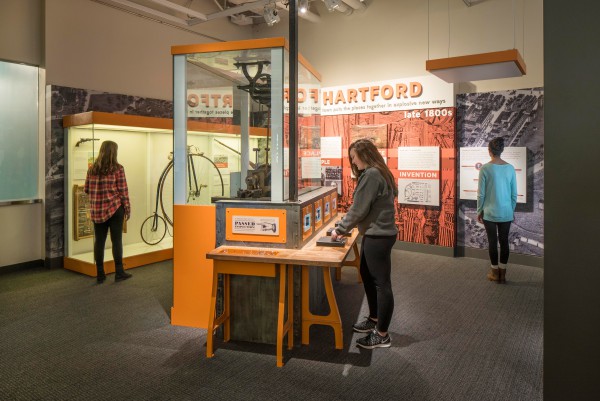 The exhibit notes that by the 1850’s “Hartford became the center of production for a wide array of products—including firearms by Colt, Richard Gatling and John Browning; Weed sewing machines; Royal and Underwood typewriters; Columbia bicycles; and even Pope automobiles.”
The Lemelson Center is located at the Smithsonian's National Museum of American History, Constitution Avenue between 12th and 14th Street NW, in Washington, DC. The Lemelson Hall of Invention and Innovation is located on the Museum's first floor in its Innovation Wing. In the exhibit, which debuted last summer, Hartford is featured with Silicon Valley and just four other locations: Hollywood, home of Technicolor; the Medical Alley of Minnesota, where cardiac innovations of the 1950s flourished; the Bronx, N.Y., birthplace of hip-hop in the 1970s; and the current, clean-energy innovations of Ft. Collins, Colo.
Among the featured innovations on display is the bicycle, manufactured for the first time in the United States in Hartford. As the Smithsonian historian explains, “sensing a commercial opportunity, Albert Pope began importing bicycles from England and hatched a plan to produce them domestically in 1877. Within a year, Pope rode the train from Boston to Hartford, then, ‘to the amazement of the city’s onlookers, 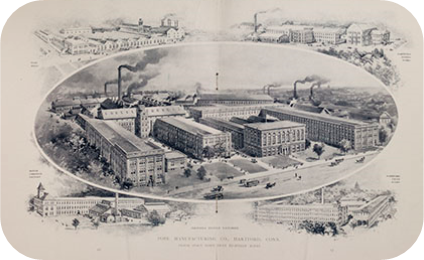 rode his high-wheeler from the station down Capitol Avenue to the Weed Sewing Machine Company.’”
The history continues: “Pope approached factory superintendent George Fairfield with a proposal: would Weed agree to build a test run of 50 bicycles under contract? When Fairfield agreed, Pope (via the Weed Sewing Machine Company) became the first domestic manufacturer of bicycles in the United States. By 1895, Pope’s expanded Hartford operations included five factories set on 17 acres, employing 4,000 workers, making him Hartford’s largest employer.” Pope manufactured bicycles, motorcycles, and automobiles.
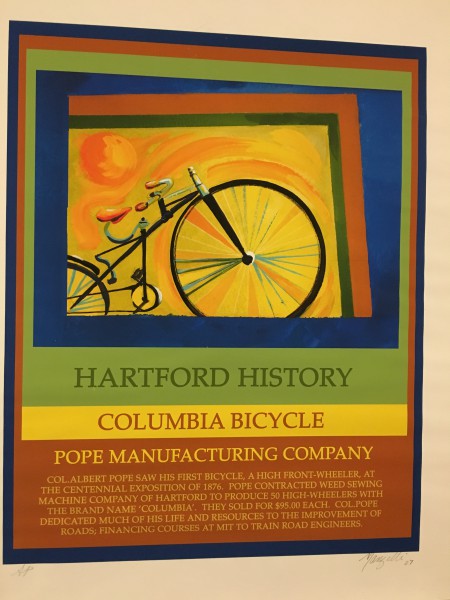
That chapter in Hartford history has recently captured the imagination of a well-known Hartford artist, whose cut-paper recreations of that chapter of the city’s transportation and recreation breakthrough is now available for display, having just completed an exhibition at the Connecticut State Capitol.
 Jeanne Manzelli, a resident of Windsor, has a
  BFA in Sculpture from the Massachusetts College of Art and her MED in Art Education from the University of Massachusetts, Amherst. Her experience includes a 20 year career in design, manufacture, appraisal and sale of jewelry, two decades as mural artist working closely with interior designers as an industry professional, and 14 years teaching basic and advanced drawing, sculpture and 3D design as well as color theory at Tunxis Community College.
Her latest endeavor is a departure, and a salute to an innovation from a century and a half ago. The intricate designs, accompanied by information panels highlighting the history, are now available to be displayed at public facilities, such as schools, libraries, and community centers. Manzelli looks forward to sharing her work (and is seeking a sponsor to underwrite the exhibit), as well as stimulating a conversation about innovation in Hartford, then and now.
 The site said of
  s, including:


 The analysis points out that the type of land in a given area has a significant impact on its worth. Agricultural and other largely undeveloped areas are generally worth significantly less than cities and suburbs land. Developed land, or land where housing, roads, and other structures are located, is valued at an estimated $106,000 per acre, while undeveloped land was estimated at $6,500 per acre, and farmland at only $2,000 per acre, according to the analysis.

 In addition to its impact on drivers, the AMA notes that blue-rich LED streetlights operate at a wavelength that most adversely suppresses melatonin during night. It is estimated that white LED lamps have five times greater impact on circadian sleep rhythms than conventional street lamps, the AMA indicated. Recent large surveys, according to the AMA, found that brighter residential nighttime lighting is associated with reduced sleep times, dissatisfaction with sleep quality, excessive sleepiness, impaired daytime functioning and obesity.
 The Conversation website is a collaboration between editors and academics to provide "informed news analysis and commentary that’s free to read and republish." It
  PHOTO: Traditional street lighting (left) vs. LED lighting (right).


 “Wholesome Wave is thrilled by the innovations that USDA is supporting through the new FINI grants, which are taking the work of increasing affordable access to healthy food to even greater levels of impact,” said Michel Nischan, CEO & Founder of Wholesome Wave. “So many SNAP shoppers are working parents with limited time to source healthier food choices. Through the new Farm-to-Grocery model, our partners in Connecticut and Vermont will be able to expand affordable access to SNAP consumers in a way that allows them to find and purchase more healthy food from a variety of retailers.”

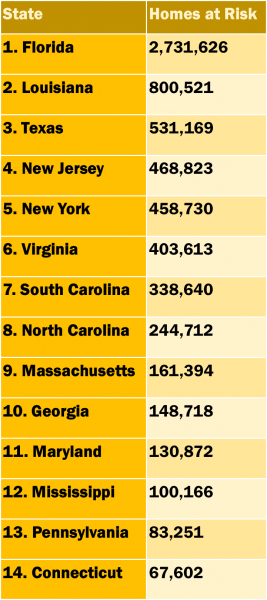 Among neighboring states, Connecticut ranked behind Massachusetts, New York and New Jersey.




 xpert guest lecturers from Connecticut companies will speak regarding subjects and crafts not included in the general curriculum. Officials indicate that upon successful completion of the DMCT, trainees will have completed a portfolio worthy project consistent with their selected track and representative of their work and learning. They will also receive a certificate of completion from the Connecticut Office of Film, Television & Digital Media for their selected track.
 The state’s Office of Film, Television and Digital Media supports and enhances Connecticut’s film, television and digital media industry. The film office is the statewide contact for motion picture, television and digital media production and serves as liaison between production companies, state agencies, municipalities, production facilities, local crew and vendors. The Office also administers the tax credit programs designed to incentivize the development of the industry here in Connecticut.