New Haven Chamber Spotlights Millennial Leaders in Region

The Greater New Haven Chamber of Commerce has recognized 12 distinctive millennial leaders who are "making an outstanding difference in the professional and outside world." In making their selections, the Chamber indicated that "from organizing community events, working with charities on weekends or holidays, or tireless public outreach - these are the people that lead by example to the entire millennial generation and the rest of us."

The Chamber's young professional organization, PULSE, made the selections from those nominated for the recognition.  The announcement was made at a reception at the conclusion of the Chamber's day-long business expo, The Big Connect, held Thursday at the Oakdale Theater in Wallingford.

The millennial move makers for 2016 are:

Jack Yeung, a serial entrepreneur, attended St. John’s University for his Doctorate of Pharmacy degree. He started his own pharmacy in 2010, after noting he could offer services that other pharmacies were not offering, such as delivery. Jack who now owns pharmacies in Southbury, Danbury and one in the Bronx, started the Panic Room: Escape Room Entertainment in Norwalk, CT, which challenges participants while providing a safe and fun real-life adventure. Jack’s latest business venture is the opening of The Halal Guys Restaurant in New Haven this fall.

Ashley Calabrese is responsible for developing and implementing effective lobbying strategies and grassroots advocacy campaigns to best suit her clients’ interests. She works with the state legislature, the executive branch, municipal leaders and the Connecticut congressional delegation. Her efforts have created better insurance coverage for more advanced forms of breast tissue scmillennialreening, including coverage for ultrasound and MRI screening. Through volunteer efforts, Ashley has advanced legislative efforts for ‘Are You Dense Advocacy’ to ensure that women with dense breast tissue have access to an early breast cancer diagnosis. She helped form the Danny Gilman Scholarship in memory of one of their peers. Ashley serves as President of the Association of Connecticut Lobbyists.
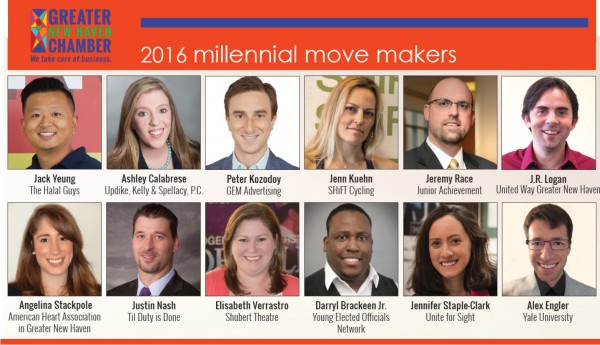
Peter Kozodoy is an author, speaker, serial entrepreneur, and the Chief Strategy Officer of GEM Advertising. His work at GEM has been featured in CNBC, Yahoo!, Bloomberg, Reuters, MarketWatch and more, and has earned Telly, Pixie, Communicator, Aurora, Davey and W3 awards in U.S. and international branding, advertising and production. He has spoken for Microsoft, the US Department of Commerce, and CEO Clubs of America on topics like millennials, and global advertising. He serves on the boards of the Greater New Haven Chamber and Junior Achievement in Connecticut. He is also a SAG/AFTRA professional actor, a three-time New England Champion in Men’s Figure Skating, and a black belt in Taekwondo.

Jenn Kuehn began SHiFT Cycling with a vision to create a workout experience that is accessible yet challenging to every rider, no matter where they are in their fitness levels. She left the high-powered world of corporate sales to create an inspirational local fitness experience. In less than a year, Jenn built a reputation for inspiring effective workouts in a judgment-free environment. Still sensing a missing need for a greater connection between motivation, mind and body, she launched SHiFT Cycling in March 2014. In 2015, Jenn and the team evolved and created SHiFT New Haven. In 2016 Jenn launched her newest fitness concept SHiFT Balance, a studio designed for barre, yoga, kickboxing, strength and mediation classes.

Jeremy Race is the President and CEO of Junior Achievement Southwest New England.  Through Junior Achievement, Jeremy is helping young people dream big about their futures and teaching them the strategies to achieve those dreams. Each year, Jeremy has the pleasure of working closely with several JA students in preparation for their speaking roles at JA’s annual Partners in Achievement breakfasts in Hartford and New Haven. At last year’s event, Jeremy was proud to watch Josslyn, a student from New Britain who at one point was on track to not graduate from high school, stand up in front of 400 guests and state that thanks to JA, “I will graduate high school. I will attend college.  I will be successful.” It was a moving moment and Jeremy will never forget.

J.R. Logan has worked as a volunteer to organize the establishment of a trail along the Mill River in New Haven. He serves on the boards of the New Haven Land Trust and Eli Whitney Museum. He led Cluefest for several years and is a cofounder and Chief Maker at MakeHaven, a community makerspace where anyone can participate in 3D printing, laser cutting, wood working, sewing, metal milling, electronics fabrication, programming, mold making, bike repair and more. In this role, he fosters a community of more than 100 entrepreneurs, artists and craftspeople. J.R. is also employed as Director of Digital Resources for United Way of Greater New Haven, where he works to implement organizational learning and technology locally as well as being a significant contributor to technology advancement in the worldwide United Way network.big-connect-logo-2016

Angelina Stackpole is a Director at the American Heart Association in Greater New Haven, where she oversees corporate fundraising and wellness initiatives in Greater New Haven. She is responsible for the Greater New Haven Heart Walk, which raises awareness and funds for cardiovascular diseases and stroke. In the past five years, Angelina has increased annual revenue from the event by 50%, and has grown participation to nearly 5,000 area professionals and community members. She is also responsible for starting an annual Connecticut-wide event that provides fun activities, support, and networking to families who have children suffering from congenital heart disease. Angelina currently serves as Chair on the PULSE Board of Directors.

Justin Nash, following his graduation from West Point in 2001, was commissioned as an Infantry Officer where he led an infantry platoon deployed to serve in Afghanistan. He was awarded the Bronze Star Medal, Army Commendation Medal, Army Achievement Medal, and Global War on Terrorism Expeditionary and Service Medals. His military career was cut short due to injuries sustained in the line of duty. He has also served as a project manager in the energy industry where he delivered complex projects over $10 million. Justin is the founder of Veteran Construction Services LLC and serves as president of Til Duty is Done, an organization he founded to help restore and improve the lives of veterans through supportive housing and employment opportunities.

Elisabeth Verrastro has a passion and drive to make live performance accessible to everyone and loves seeing her work come to life when the curtain rises and the audience erupts into applause. She is the Shubert Theatre’s Director of Development & Communications. Over the past eight years, Elisabeth has worked tirelessly to tackle the world of development, while giving birth to two children and exceeding expectations by raising over $1.2 million each year while implementing a campaign to raise over $8 million to celebrate the Shubert’s 100th Anniversary and complete Phase 1 of the Centennial Improvement Project. It is Elisabeth’s mission to continue her work to make Shubert’s Phase 2 of renovations a reality.

Darryl Brackeen Jr. was elected in 2014 to the New Haven Board of Alders (City Council), where he is the first African-American and youngest Alder to have been elected from Westville 26th district. While in office, he has championed the passage of the City of New Haven’s Clean Air Resolution, Domestic Workers Bill of Rights & Janitors Bill of Rights, and supported passage of a Connecticut student loan bill of rights, and countless other pieces of legislation and initiatives. In December 2015, he was named the CT State Director for the Young Elected Officials Network. Darryl serves on the Board of Directors for Greater New Haven Green Fund.

Jennifer Staple-Clark founded Unite For Sight in her dorm room in 2000 as a sophomore at Yale University. Unite For Sight is now a leader in both global health education and in providing cost-effective care to the world’s poorest people. Jennifer is the author of journal articles and book chapters about social entrepreneurship, best practices in global health, and community eye health. Additionally, she serves as a judge in social entrepreneurship competitions, including the Canadian Government’s Grand Challenges in Health. Jennifer is a member of the Yale University President’s Council on International Activities, and on the Operating Board of the Yale Entrepreneurial Institute.

Alex Engler is a Ph.D. student and NSF Graduate Research Fellow in Biomedical Engineering at Yale University. While at Dartmouth College for undergraduate studies, Alex’s research focused on developing biomaterials for orthopedics. Outside of the classroom, he led multiple music groups and mentored local middle schoolers for science competitions. Between Dartmouth and Yale, Alex worked in the heart of Boston’s hospital network developing medical devices to treat infants born with birth defects. Alex’s current research focuses on whole lung regeneration and tissue engineering. Outside of lab, he serves as a Director of the Science in the News program. He is also actively involved with the Yale Pathways to Science program and the New Haven Science Fair.


Stamford-based Harman to be Acquired by Samsung

Even as Connecticut’s economic development leaders toil diligently to retain and attract industry-leading businesses to the Land of Steady Habits, market forces at times pull in different directions.  That is again in evidence as Samsung has announced it will buy Stamford-based Harman for $8 billion. The acquisition of will make Samsung a major player in automotive technology, and removes an independent corporate headquarters from the state’s roster. Earlier this year, Harman was one of four Connecticut-based companies to be named among the most innovative companies by Fast Company magazine.  Harman ranked seventh on the Fast Company ranking of the 10 most innovative companies in the automotive sector.harman_logo_thmb

Upon closing, Harman will operate as a standalone Samsung subsidiary, and continue to be led by Dinesh Paliwal and Harman’s current management team, both companies indicated in a news release.  Harman has a workforce of approximately 30,000 people across the Americas, Europe, and Asia and reported sales of $7.0 billion during the 12 months ended September 30, 2016.

“Samsung is pursuing a long-term growth strategy in automotive electronics, and plans to retain Harman’s work force, headquarters and facilities, as well as all of its consumer and professional audio brands.  Samsung believes the combination will increase career development and advancement opportunities for the employees of both companies,” the news release stated. harmanmicrosoft_mid

“This compelling all-cash transaction will deliver significant and immediate value to our shareholders and provide new opportunities for our employees as part of a larger, more diversified company,” Harman Chairman, President and CEO Dinesh Paliwal said.

For Samsung, it is the biggest overseas acquisition ever by a South Korean firm, according to the news service Reuters. The Harman acquisition is subject to regulatory approvals and is expected to close in mid-2017, reports indicate. The agreement has been unanimously approved by the boards of directors of both companies.

1516092_871290752969831_1531732641_nHarman's products, which provide infotainment, telematics, connected safety and security services, are used in more than 30 million vehicles made by automakers such as BMW, Toyota Motor Corp and Volkswagen, according to its website. Harman’s portfolio of audio brands includes AKG®, Harman Kardon®, Infinity®, JBL®, Lexicon®, Mark Levinson®and Revel®

Harman executives will be at the Fleet Europe Forum and Awards on November 16 in Barcelona, Spain to highlight Harman's premium products for the fleet industry , which caters to businesses, government agencies and other organizations that purchase or lease groups of vehicles to support their services.samsung

CT's Science and Technology Ranking Rises to 6th in the Nation

Following three consecutive finishes ranking ninth in the nation in the State Technology and Science Index (STSI), Connecticut has moved up to number six in 2016, it’s highest finish in more than a decade.  The state ranked ninth in 2010, 2012 and 2014 in the analysis produced every other year by the Milken Institute, following a 7th place ranking in 2008 and 10th in 2004.  The ranking was the highest for the state in all seven releases of the STSI index. The STSI benchmarks states on their science and technology capabilities and broader commercialization ecosystems that contribute to company growth, high-value-added job creation, and overall economic growth, the institute’s website explains.  ct-ranks-6th

“We view the STSI as a measure of a state's innovation pipeline. The index isn't intended to be a measure of immediate economic impact, but rather to demonstrate that the return on science and technology assets will accrue in future years.”

The top five states in 2016 are Massachusetts, Colorado, Maryland, California and Washington.  Rounding out the top 10, after Connecticut, are Minnesota, Utah, Virginia and Delaware.

In specific categories, the state’s ranking varied, with considerable improvement in some categories. In the Technology and Science Workforce composite index, Connecticut ranked 10th, an improvement from rankings of 16th in 2014, 13th in 2012 and 14th in 2010.  This composite measures the relative presence of high-end technical talent, and consists of 18 eighteen various indicators.

stsi-reportThe STSI's 107 individual indicators are sorted into five composites: Research and Development Inputs, Risk Capital and Entrepreneurial Infrastructure, Human Capital Investment, Technology and Science Workforce, and Technology Concentration and Dynamism.  The report indicated that "Connecticut showed major improvement in the Technology Concentration and Dynamism index, going from 21st to 10th. This dramatic rise marks one of the larger overall changes on this index. While modest increases were seen in the Research and Development Inputs index and Human Capital Investment index, these two indices have a much heavier focus on stock measures, and Connecticut’s aerospace and defense sectors help anchor the state’s performance in these areas."

Connecticut also ranked 10th in the Technology Concentration and Dynamism composite index, the state’s highest ranking in that category, and largest jump from two years ago.  In 2014, Connecticut ranked 21st.  In the two previous analyses, Connecticut was 12th in 2012 and 18th in 2010.

logoIn the Human Capital Investment composite index, Connecticut ranked third, as it did in 2014 and 2012, after ranking fifth in 2010.  In Research & Development, Connecticut placed eighth, its second highest finish, after ranking tenth, seventh and seventh in previous indexes.  Connecticut ranked 11th in Risk Capital and Entrepreneurial Infrastructure, up from 14th two years ago, but not as high as sixth place in 2012 and third in 2010.


The Human Capital Investment composite index looks at how much is invested in developing the workforce—the most important intangible asset of a regional or state economy. Twenty-one indicators are included in this composite index.  The R&D composite examines a state's R&D capacity to see if it has the facilities that attract funding and create innovations that could be commercialized and contribute to economic growth, and includes eighteen indicators.  The Risk Capital and Entrepreneurial Infrastructure Composite Index determines the success rate of converting research into commercially viable products and services. It includes 12 indicators.

While Connecticut was gaining ground, other states were bottom dwellers.  The analysis raised alarms regarding the prospects for those states.

map“The states with the weakest innovation assets and ecosystems for starting and growing innovative firms face a bleak future unless changes are made. West Virginia, Arkansas, Mississippi, Kentucky, and Louisiana make up the bottom five in this year's STSI. They are the least knowledge-intensive and their residents exhibit weak entrepreneurial skills. All of them have undertaken efforts to change their position in technology and science but have had limited success.”

Massachusetts remained in first place with a score of 83.7, retaining the position it has held since the inaugural STSI was released in 2002.

Wyoming, the most improved state, climbed 10 places, to 36th. The state had broad gains but benefited most from the broader definition of occupations in the Technology and Science Workforce category, which included its talent in mining engineering, the analysis pointed out. Missouri rose six spots, to 28th; seen as primarily attributable to a 24-place leap in Risk Capital and Entrepreneurial Infrastructure.

Pasta Making Business Continues to Grow, Government Continues to Help

Sometimes, home-grown businesses decide to stay in Connecticut.  That was the case this fall as Carla’s Pasta – an American Dream business success story – reportedly spurned an offer to relocate to a western state, and chose instead to expand in South Windsor, aided by a significant tax abatement. The company produces filled pastas, Italian sauces and pestos, appetizers, and entrees. The brainchild of Carla Squatrito, the business now employs 156 people, including her sons, Sandro Squatrito and Sergio Squatrito, who are vice presidents of business development and operations, respectively. The Italian food product manufacturer, which was launched in 1978, in Manchester and moved to South Windsor in 1997. carlas1

The latest expansion deal, as reported by the Journal Inquirer, will see the town give the family-run Carla’s Pasta a 70 percent tax abatement for seven years, reducing the company’s tax burden by well over $200,000 per year.  The planned expansion is expected to generate 60 to 100 new jobs, and is due to be completed next fall. In 2013, Carla's completed a 30,000-square-foot expansion of its South Windsor facility, the Hartford Business Journal reported.

Town Manager Matthew Galligan, the JI reported, said the state of Utah was courting the company, but Carla’s ultimately decided to stay in town as a result of the deal that was approved by the Town Council.

Carla, a native of the small Italian village of Madonna del’Olmetto, emigrated to the U.S. at age 27.  Her business began as a means of bringing “home-made filled pastas, Italian Sauces and Pestos, made from fresh ingredients, the flavors of her youth” to local customers, retail and later wholesale.  Since 2010, Carla has been recognized by the National Women Business Owners Corporation as an outstanding CEO.carla

The company distributes its pasta to restaurants, institutions and supermarkets. In 2012, the company estimated that it was making about 2 million pounds of pasta per month, with projections to increase that number by a third.

The company received a bridge loan of $2,175,000 from Connecticut Innovations that year to help purchase and install a fuel cell along with a $750,000 grant from the Connecticut Clean Energy Fund. The state assistance was aimed at supporting the company efforts to be environmentally conscious and energy efficient.

In Oct. 2015, the company launched its own retail brand, Cucina di Carla.  Among the distinctive products inspired by the season:  autumn-inspired cinnamon clove pasta ravioli filled with golden pumpkin, whole milk ricotta and Fall spices.

https://vimeo.com/150720277

Almond Joy, Born in Connecticut, Is State's Candy Sales Champion

Almond Joy, Milky Way and M&Ms are the likely candies to be greeting Connecticut trick-or-treaters as they move from door to door later this month.  That’s according to candystore.com, which sells bulk candy on-line, in their review of sales data from 2007 through 2015.ct-joy Connecticut's favorite Halloween candy is Almond Joy, with 2,619 pounds of it, on average, ordered each year, the website indicated. Milky Way is Connecticut's second favorite Halloween candy, with 1,366 pounds ordered. M&M's placed third, at 910 pounds on average.

Among Connecticut’s neighboring states, the candy favorite in Massachusetts is Butterfingers; in New York it is Sour Patch Kids, in Rhode Island candy corn topped the list.  Connecticut was the only state where Almond Joy ranked first in candy sales.

Industry research shows that since 2015, online candy sales have increased by 15 percent, according to candystore.com.

The Almond Joy candy bar was introduced in 1946, just after the World War II, when sugar, tropical coconuts and chocolate became more readily available, by the New Haven-based Peter Paul Manufacturing Company,  which was already well-known for its popular Mounds bar introduced in 1921. Today, the Peter Paul Candy Manufacturing Company is a candy-making division within the Hershey Company. It was originally founded in the Elm City in 1919 by six Armenian immigrants led by Peter Paul Halajian, with a manufacturing plant in nearby Naugatuck.

"Almond Joy has seen a resurgence in popularity over the past few years.  No where is that more apparent than Connecticut.  While it cracked the top 3 in a few other states (MN, SD, TX), it was the #1 candy in Connecticut, " said co-CEO of CandyStore.com, Tom Hoeck.

CandyStore.com is an industry leader in candy sales in the United States and Canada, and offers candies of all shapes, sizes, colors, and brands. To determine the best sellers by state, the company reviewed sales from 2007–2015, focusing on the three months leading up to Halloween.candy-map

“Since we sell candy to all 50 states (and Canada), it was easy for us to see a state-by-state breakdown of candy trends and top orders. And we have relationships with all the major candy companies, so they helped us verify as well. Based on this analysis, we determined the Halloween best-sellers that people all over the country love to use in Halloween crafts and treats and give out to trick-or-treaters.”

The company also provides “candy trivia” on its website, noting that during the 1981 inauguration of Ronald Reagan, three tons of jelly beans were served, candy corn is the top selling candy, and two-thirds of American candy bars were introduced more than 50 years ago.

Efforts to Improve Math Education in CT Don't Yet Add Up, Report Finds

If Connecticut students are to excel in math, it will take a concerted effort at the state and district level, revised curriculum by state colleges preparing math teachers, and greater community involvement.  That overall effort, according to a new state report, still has a ways to go. The 30-member Commissioner’s Council on Mathematics report, issued last week, outlines recommendations for educators, policy leaders, and community members to improve K-12 mathematics education in the state.  The report stresses several recommendations that are grounded in the lessons learned regarding strong leadership, quality professional development, dedicated time, and effective collaboration within, among, and beyond school districts.report

The council outlines several specific actions for the State Department of Education, individual school districts, higher education, and the community in the report that are distilled into four broad recommendations. Each recommendation is evidence-based, actionable, inclusive of all stakeholders, and measurable.

The four broad recommendations are:

  • develop a clear and consistent understanding of the Connecticut Core Standards-Mathematics (CCS-M) at the classroom, school, district, and state levels;
  • provide the support and training necessary to effectively implement the mathematics standards with fidelity in all classrooms, schools, and districts;
  • implement appropriate interventions and acceleration to support the needs of a diverse group of learners; and
  • engage all stakeholders in the process of putting the Connecticut Core Standards-Mathematics into practice through effective communication that keeps teachers, parents and community members informed and participating in the process.

kids-in-class“Every student deserves the opportunity to receive a math education that is rich and rigorous, and equips them with the skills needed to graduate from high school prepared to be successful in both college and career,” said Commissioner Wentzell. “These recommendations by the Council on Mathematics have created a clear path that will help the State Department of Education take the steps needed to ensure that every student in our state receives a high-quality mathematics education.”


Next steps identified in the report include that “all stakeholders need to work and learn more in the area of mathematics education,” specifically as it relates to the following:

  • instructional support necessary for students with special needs to access the standards;
  • instructional support necessary for English learners to access the standards;
  • interconnectedness of curriculum, instruction, and assessment; and
  • teacher evaluation and certification requirements.

The framework for the recommendations was a logic model described as four buckets: Deep Knowledge of the CCS-M, Curriculum Development and Implementation, Intervention and Acceleration, Community and Family Engagement.

The Commissioner’s Council on Mathematics was initiated by Commissioner Wentzell in 2015 in response to the Smarter Balanced test results in mathematics. The council was convened to spearhead the state’s efforts to improve supports in mathematics by identifying best practices and exploring promising innovations in mathematics instruction.

Communities are urged, in some of the recommendations, to establish partnerships with local districts to create internships for high school students with businesses that require mathematics skills, use social media and distribution lists to promote the importance of the CCS-M, and urge community members to attend and participate in state- and district-provided workshops that deliver information about the standards.

Among a series of recommendations aimed at higher education, colleges are urged to:kids-computer

  • Increase mathematics coursework for elementary pre-service teachers.
  • Increase coursework that focuses on the mathematical practices at all levels.
  • Collaborate with district partners to ensure that pre-service teachers’ field experience is with a teacher who exhibits conceptual understanding, deep content knowledge, and effective use of the practices.
  • Mentor teachers and provide training specific to mathematics content and pedagogy to teachers who will be assigned a pre-service teacher.
  • Create professional learning workshops for in-service teachers to interact with professors at the university to make the connections of what is being taught at the K-12 level and how it is used in higher education.
  • Build relationships with high schools by promoting early college experiences in high schools
  • Require coursework in family engagement strategies for pre-service teachers.

math-quizCouncil members included parents, teachers, curriculum specialists, principals, superintendents, board of education members, higher education professors, business leaders, and State Department of Education staff members with the purpose of closely examining the current state of mathematics education in Connecticut.

The Commissioner selected the members through recommendations made by various stakeholder groups across the state, including the Connecticut Parent Teacher Association (CT-PTA), the American Federation of Teachers-Connecticut (AFT-CT), the Connecticut Education Association (CEA), the Connecticut Association of Schools (CAS), the Connecticut Business & Industry Association (CBIA), and the Connecticut State Department of Education (CSDE).  They met monthly from February 2016 to June 2016, and the recommendations were developed with the input of local school districts, higher education, and experts in family and community relations, according to the report.

First Niagara Transitions to KeyBank This Weekend

For customers of the soon-to-be-history First Niagara Bank, this will be a holiday weekend of banking transition, as KeyBank becomes the new name on the door on Tuesday morning after a host of changes inside. First Niagara branches, converting to KeyBank, will close at 3 p.m. Oct. 7 and reopen for business the morning of Oct. 11, the day after Columbus Day. The company promises a smooth transition, and has been providing customers of the bank’s more than 60 branches in Connecticut with step by-step previews of what to expect. The changes represent the completion of the $4.1 billion KeyCorp purchase of First Niagara.logo-lockup

“As KeyBank and First Niagara come together you can continue to bank as you currently do, using your same account number, checks, debit card, ATM card, credit card, telephone banking, online access and branches,” the company website points out.

First Niagara has 65 branches in Connecticut that will be transitioned to KeyBank branches. There were no existing KeyBank branches in the state prior to the merger, so there was no overlap that required branch closings, as is often the case with bank mergers.

Headquartered in Cleveland, KeyBank’s footprint includes 15 states via a network of more than 1,200 branches and more than 1,500 KeyBank ATMs. The company’s roots trace back 190 years to Albany, New York. Since then, KeyCorp has grown into one of the nation's largest bank-based financial services companies, among the top 15, with assets of approximately $135 billion, according to the company.

keybank-mapIn recent months, First Niagara did consolidate five Connecticut branches (Woodstock, Dayville, Hamden, East Haven and Madison), and all of the employees who worked at those branches were offered positions within the bank, officials indicated, and no layoffs were associated with that consolidation.

"By asset size, this is the largest bank merger since the financial crisis,” Beth E. Mooney, Key’s chairwoman and CEO, told the Buffalo News last month, during a visit to Key’s Northeast regional headquarters in Buffalo, which had been First Niagara’s corporate headquarters.

“So there is a significance and an importance for us to do it well that’s critical for our communities, our clients, our employees and our shareholders. But from an industry perspective, this is actually one that there’s a fair amount of eyes on us, as well.”

The conversion of First Niagara accounts and services to KeyBank will begin at with a 3 p.m. close of business on Friday, October 7.  Due to Online Banking updates, customer balances that appears online on Thursday, October 6 at 11:59 p.m. will not change until Saturday, October 8, at 6 a.m., so any purchases or deposits made during that time will not be reflected on online balances until Saturday. Customers can continue to use current First Niagara ATM/debit card, account numbers and PINs will not change.

The acquisition of First Niagara by Keycorp was announced on Oct. 30, 2015, and includes the addition of approximately 300 First Niagara branches in New York, Pennsylvania, Connecticut and Massachusetts.  First Niagara had entered the Connecticut market in 2011 with the purchase of New Alliance Bank.

Global Health and Innovation Conference, World's Largest, in New Haven in April

The Innovation Prize is a $10,000 and a $5,000 cash prize that is awarded to the two best social impact pitches that are presented at the 2017 Global Health & Innovation Conference, to be held in New Haven at Yale University on April 22-23, 2017. The Global Health & Innovation Conference (#GHIC) is the world's leading and largest global health conference as well as the largest social entrepreneurship conference, with 2,200 professionals and students from all 50 states and more than 55 countries, according to conference organizers.

The conference was developed by Unite for Site, a 501(c)(3) nonprofit global health delivery organization that is free of commercial interests and committed to promoting high-quality health care for all. GHIC 2017 will be Unite For Sight's 14th annual conference, having grown from a conference of about 100 participants in its first year.unite-for-sight-logo

Unite For Sight, headquartered on Church Street in New Haven, supports eye clinics worldwide by investing human and financial resources in their social ventures to eliminate patient barriers to eye care. Unite For Sight applies best practices in eye care, public health, volunteerism, and social entrepreneurship to achieve our goal of high-quality eye care for all. The programs are locally led and managed by ophthalmologists at Unite For Sight's partner eye clinics.

unite-2Unite For Sight's international eye care services with partner local eye clinics are provided year-round and are comprehensive, including examinations by local eye doctors, diagnosis and care for treatable conditions, education, and preventative care. The organization’s website indicates that Unite For Sight has provided eye care services to more than 2.1 million people worldwide, including more than 93,166 sight-restoring surgeries.

The conference is expected to include 300 speakers, including keynote addresses from:

  • Vanessa Kerry, Founder and CEO, Seed Global Health
  • Jeffrey Sachs, PhD, Director of Earth Institute, Columbia University; Quetelet Professor of Sustainable Development, Professor of Health Policy and Management, Columbia University; Special Advisor to Secretary-General of the United Nations Ban Ki-moon
  • Sonia Sachs, Director, Health Sector, Earth Institute, Columbia University; Health Coordinator, Millennium Village Project
  • Leana Wen, Baltimore City Health Commissioner

Unite for Sight was founded in 2000 by Jennifer Staple-Clark, then a sophomore at Yale University, in her dorm room. Unite For Sight is now a leader both in global health education and in providing cost-effective care to the world's poorest people. Staple-Clark, the organization’s Chief Executive Officer, is being honored in November by the Greater New Haven Chamber of Commerce as a Millennial Move Maker.unite

She is the recipient of the 2011 John F. Kennedy New Frontier Award, presented by the John F. Kennedy Library Foundation and the Institute of Politics at Harvard's Kennedy School of Government to "an individual whose contributions in the realm of community service, advocacy or grassroots activism have elevated the debate or changed the landscape with respect to a public issue or issues." In 2015, Middlebury College's Center for Social Entrepreneurship presented Jennifer with the Vision Award "to recognize leadership and vision in the world of social entrepreneurship."

Topics at the April conference will also include design thinking; education and school-based programs; environment health, energy, food and agriculture; healthcare delivery, university education initiatives; health policy, mental and neurological health; patient-centered initiatives; marketing communications; social entrepreneurship; surgery & global health; technology in global health; and non-communicable diseases.

unite-3The conference also includes Social Impact Labs, which provide an opportunity for selected speakers to present their new idea in the format of a 5-minute pitch. All of the presentations are ideas that are being developed, meaning that the ideas are in the brainstorming, early development, or early implementation stage.  Following each presenter’s 5-minute pitch, there is a 15-minute period for discussion and coaching with two expert speakers, questions, answers, and feedback from the audience.


For Innovation Prize at the 2017 GHIC, there are two categories: Early Stage (idea, program, or organization is less than 3 years old, and ideas in the brainstorming stage are also eligible) and Established Stage (program or organization is 3-6 years old). A newer program (0-6 years old) that is within an established (7+ year old) organization qualifies for the Social Impact Lab category as well.

https://youtu.be/Lt818tE5AUc

https://youtu.be/NtTtFAv-uTQ

State Resident Published by National Magazine Concludes "Connecticut's Bad for Business"

The headline in the story posted over the weekend at the National Review website says simply, “Connecticut’s Bad for Business.” The article explains that “the state’s perpetual budget crisis has continued unhindered, with no resolution on the horizon,” and points to “a long list of causes” for the adverse business climate: “burdensome regulations, the second-highest tax burden in the country, restrictive zoning rules, high costs of labor, a lack of meaningful regional cooperation, clogged highways, crowded trains, and overall inadequate public transportation.”

The National Review focus on Connecticut launches into a discussion of “the educational disparities that characterize the school systems” including this spending review:national-review

“New Haven, featuring a perpetually beleaguered and fairly depleted school system, spends $17,200 per student. Fairfield, the wealthy town right next door to Bridgeport, actually spends less — just under $16,000. Waterbury, one of the poorest cities in the state, spends $15,000 per student; West Hartford, regarded by all as some sort of suburban Zion, spends $500 less. Hartford spends $19,400 per student, more than the New York exclaves of New Canaan and Darien and more than the shoreline oases of Madison and Guilford.”

The article suggests that among the factors adversely impacting the quality of education in urban districts is “stunningly dysfunctional boards of education” that feature “bitterly personal partisan acrimony” and “an inability to rise above petty, factionalist squabbling.”  Some examples are outlined.

Education funding, likely to be front and center in the 2017 state legislative session following a sweeping court decision now being appealed by the state, drew this observation:  “Wealthy towns may, on average, spend more per student than poorer towns and cities do, but it’s not a hard-and-fast rule; sometimes poor towns spend more, and sometimes they spend less. In any case, spending can’t explain it all.”

bearingsRecent articles by The New York Times and Atlantic are referred to, noting that they also reflected poorly on the state’s current condition.  National Review adds to the journalistic observations of a state filled with seemingly intractable dilemmas, noting that “Connecticut’s tax system is currently so dependent on the incomes of Fairfield County high-earners — as Governor Malloy has often made clear — that even the slightest variations can trigger a budget crisis.”  The article adds, however, that “finance lies somewhere near the bottom of a long list of factors in explaining the current state of Connecticut.”

The article suggests that GE’s departure and Sikorsky’s recent decision to stay in the state both reflect Connecticut’s weakness.

“That Sikorsky probably would have followed GE’s path out of the state without (state subsidies) suggests to me that Connecticut just isn’t a good place for business anymore — unless the state opens the coffers. The lack of middle-class jobs in Connecticut cannot be explained by an overreliance on finance in one of the state’s eight counties; rather, it has far more to do with Connecticut’s long-decaying business climate.”

The article was authored by National Review intern Noah Daponte-Smith, who is also a Yale University student and staff reporter and writer for the Yale Daily News, described as a “student of modern history and politics.”  Smith has also written - last summer - for Forbes, focusing on “British politics in the domestic and European spheres.” He is a graduate of the Hopkins School in New Haven.

Daponte-Smith indicates that Connecticut’s “problem can be solved,” but concludes that “blaming inequalities in education funding or the prominence of finance in Fairfield County’s economy are poor places to start.”

Some Businesses Anticipate More Hiring in CT, But Employers Expectations Lower than Last Quarter, Last Year

Employers in Connecticut expect to hire at an “upbeat pace” during the fourth quarter of 2016, according to the Manpower Employment Outlook Survey, but hiring intentions are weaker than in the previous quarter, and a year ago. Nearly one in five Connecticut employers, 18 percent of the companies interviewed, plan to hire more employees between October and December, while 6 percent expect to reduce their payrolls. Another 73 percent expect to maintain their current workforce levels and 3 percent are not certain of their hiring plans. This yields a Net Employment Outlook of 12 percent, according to Manpower, which produces the quarterly surveys of business hiring plans.

q4Those numbers are not as strong as in previous surveys, taken  in advance of the third quarter of this year, and prior to the fourth quarter a year ago. Nationwide, the trend is in the opposite direction.  Employers indicate a slight increase in hiring plans for the final three months of 2016.

“Hiring intentions are weaker compared to Q3 2016 when the Net Employment Outlook was 15 percent,” Manpower spokesperson Betty Gooding said about the Connecticut numbers. “The hiring pace is expected to slow down compared to one year ago when the Net Employment Outlook was 16 percent.”

Among metropolitan areas in Connecticut among the top 100 surveyed nationwide, 16 percent of Bridgeport area employers anticipate more hiring in the fourth quarter, compared with 8 percent of Hartford region employers, according to the survey data.

For the coming quarter, job prospects appear best in Transportation & Utilities, Wholesale & Retail Trade, Information, Financial Activities, Professional & Business Services, Education & Health Services, Leisure & Hospitality and Government.ct-usa  Employers in Durable Goods Manufacturing, Nondurable Goods Manufacturing and Other Services plan to reduce staffing levels, while hiring in Construction is expected to remain unchanged, according to the survey.

Connecticut’s employers’ hiring projections are also slightly lower than the nationwide numbers.  Of the more than 11,000 employers surveyed in the United States, 22 percent expect to add to their workforces, compared with 18 percent in Connecticut, and 6 percent expect a decline in their payrolls during Quarter 4 2016. Sixty-nine percent of employers anticipate making no change to staff levels, and the remaining 3 percent of employers are undecided about their hiring plans.

net-ctIn the Northeast, 20 percent of employers surveyed anticipate stronger hiring activity in Quarter 4 2016.  Connecticut employers expectations are somewhat lower.

Heading into the fourth quarter, the states with the most optimistic hiring outlook are Hawaii, Tennessee, Utah, Montana, Florida and Arizona.  The most pessimistic are Alaska, New Jersey, Wyoming, Puerto Rico and Indiana.

The Manpower Employment Outlook Survey is conducted quarterly to measure employers’ intentions to increase or decrease the number of employees in their workforces during the next quarter. The Manpower Employment Outlook Survey’s United States results are based on interviews with 11,000 employers located in the 50 states, the District of Columbia and Puerto Rico, which includes the largest 100 Metropolitan Statistical Areas based on number of business establishments.