CT Unemployment Rate in Construction Industry Improving, But Remains Among Highest in US

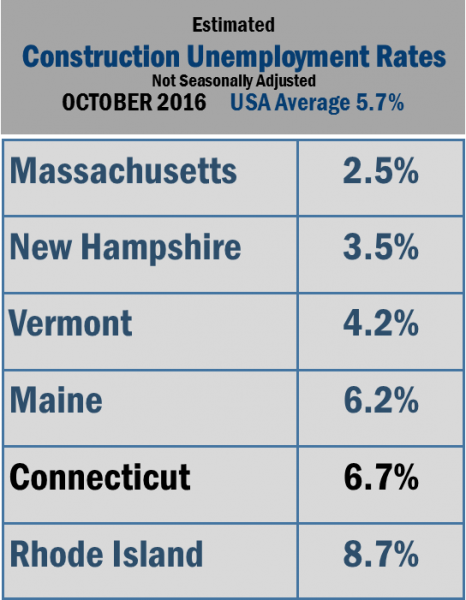
Connecticut’s unemployment rate in the construction industry remained among the highest in the U.S., ranked 39th among the 50 states in October, although the year-over-year change was the 12th best in the country.  Connecticut’s October unemployment rate in the industry was 6.7 percent, higher than the U.S. average of 5.7 percent, according to data released by the Associated Builders and Contractors (ABC). construction The state’s construction industry unemployment rate nudged downward from 7.1 percent in September, but was 6.4 percent in July 2016.  In recent years, the rate ballooned to 18.1 percent in October 2010, at the height of the recession, from a low of 5.8 percent in October of 2008.

Overall, the U.S. construction industry added 19,000 net new jobs in November and has now added jobs for three consecutive months, according to analysis of U.S. Bureau of Labor Statistics data compiled by Associated Builders and Contractors. rates

Industry employment is up by 2.4 percent on a year-over-year basis, considerably faster than the overall economy’s 1.6 percent job growth rate. Construction industry employment growth would likely be much sharper if more suitably skilled or trainable workers were available to fill available job openings, according to the ABC.

The data indicate that skilled labor shortage nationally appears to be impacting nonresidential activity more than residential. The nonresidential sector added 1,100 net new jobs in November, while the residential sector added 19,600 positions. Heavy and civil engineering lost 2,100 jobs for the month.

“The demand for construction talent was strong before the election, and the outcome has improved the near-term outlook for private and public construction activity,” said ABC Chief Economist Anirban Basu.  “The implication is that demand for construction workers is positioned to remain high, which will translate into gradual reduction in industry unemployment and significant wage pressures.statece

In the state-by-state numbers, calculated for October, the states with the lowest estimated not-seasonally-adjusted construction unemployment rates were North Dakota, Massachusetts, Colorado, Utah, New Hampshire and South Dakota. October not seasonally adjusted (NSA) construction unemployment rates were down in 33 states, including Connecticut, on a year-over-year basis.  Connecticut's October 2015 unemployment rate in the construction industry was 8.0 percent.

North Dakota’s unemployment rate in the industry was 2.4 percent, with Massachusetts at 2.5 percent.  New Hampshire’s construction industry unemployment rate was 3.6 percent.  Elsewhere in New England, Rhode Island’s unemployment rate in the construction industry was fourth highest in the nation, at 8.7 percent in October.

The unemployment rate for all U.S. industries fell to 4.6 percent in November, the lowest rate since mid-2007 and 0.3 percentage points below October’s rate. The labor force lost 226,000 persons for the month, but is still more than 2 million people larger than at the same time one year ago, officials pointed out.

EpiPen in Connecticut: Costs Vary, Concerns Continue; New Congressional Hearing Possible

Obscured in recent months by the intense presidential campaign, the furor over the price of pharmaceutical company Mylan’s life-saving EpiPen may be moving back to center stage in Washington as questions continue about Connecticut’s policy and the varying impact on school districts across the state.  The EpiPen is the widely used medical device that quickly administers a dose of epinephrine to counter allergic reactions. The cost of EpiPens to Connecticut schools - which keep EpiPens in their nurses’ offices in case a student has a severe allergic reaction - may be defrayed or eliminated by Mylan’s “EpiPens4Schools” program, which gives some schools two twin packs of the medical devices for free.  But that is not uniformly true, according to a recent survey by CT by the Numbers, and questions are being raised about the program’s future. pens

A report by Connecticut’s Office of Legislative Research found that “over the last decade, Mylan has continuously increased the EpiPen’s cost, from approximately $60 in 2007 to over $600 in 2016 for a pack of two pens. The device requires a prescription and must be replaced annually.”

North Haven, which has participated in the free program, warns that “if the free program is discontinued, it will be a significant financial burden” for the school district.  “To satisfy the Connecticut mandate, we must stock one box each of EpiPen Jr. and EpiPen Sr., bringing the total cost to $1,600 x 7 schools = $11,200/year!!!”

In Chaplin, officials have also been using the free program, but note “we will not always be eligible year-to-year,” anticipating “the cost increasing by at least $300 or greater per school.”

Now, the chairman of the U.S. Senate Judiciary Committee says he is considering a subpoena or another method of compelling testimony from Mylan and federal officials, the Associated Press is reporting.  Mylan says it agreed to pay $465 million to settle allegations it overbilled Medicaid for EpiPen, but Sen. Charles Grassley says the Justice Department has said there is no "executed settlement."  At issue is whether the product should have been classified as generic.map

Published reports indicate that Mylan acquired the decades-old product in 2007, when pharmacies paid less than $100 for a two-pen set, and has since been steadily raising the wholesale price. In 2009, a pharmacy paid $103.50 for a set. By July 2013 the price was up to $264.50, and it rose 75 percent to $461 by May 2015. This past May the price spiked again to $608.61, according to data provided by Elsevier Clinical Solutions’ Gold Standard Drug Database.

At a December 1 health forum sponsored by Forbes, Mylan CEO Heather Bresch said “We absolutely raised the price and take full responsibility for that, ” insisting that Mylan’s price increases were justified by improvements the company made on the product.

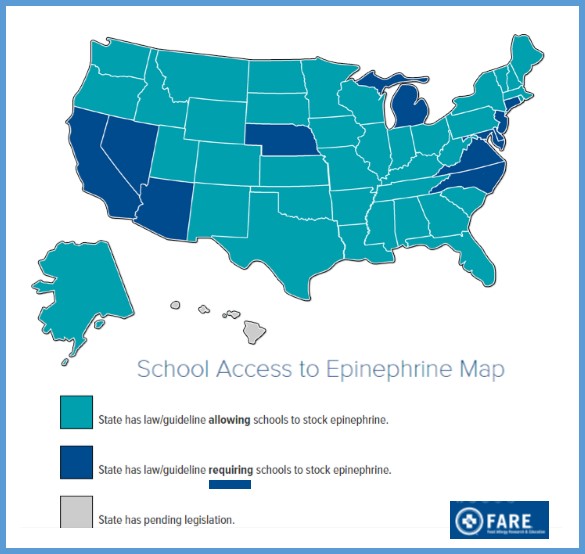
As the increases were being imposed, Mylan intensified efforts to have states require that EpiPens be made available in schools.  Connecticut was among 11 states which passed such a law.  The Connecticut General Assembly approved a bill in June 2014 that required all state primary and secondary schools to carry a supply of EpiPens. The new law also allowed school personnel other than a school nurse – if they were properly trained – to administer the epinephrine.  Published reports indicate that other states have approved laws allowing student to bring the dispensers with them to classes or encouraging schools to stock the drug.

The Connecticut Department of Education said it does not know how much the new mandate cost the state’s more than 1,300 primary and secondary schools, because the drug is purchased at the local level at a number of approved pharmacies throughout the state, officials told CT Mirror earlier this year.

A number of districts indicated to CT by the Numbers that they had EpiPens on hand in their schools even before passage of the state requirement, and at least one that had participated in the free program previously did not do so this year.

In Eastford, officials purchased one .15 mg dose and one .30 mg dose EpiPen in each of the past three years.  The costs increased steadily, from $599.90 in 2021-13 to $740 in 2015-16.   In the Region 9 (Easton, Redding) school district, for example, officials indicated that they paid $325 each for three EpiPen twin-packs for the Helen Keller Middle School this year.

Northwestern Regional School District 7 and Regional School District 12, both participants in the free program, have not incurred any costs for EpiPens in recent years.  Bolton school officials report that costs have increased in recent years, to approximately $600 per package of two” for a total of $1800 for the year.  Region 16 reports that they budget for EpiPen purchases each year, in case the free program is no longer available to them.  As of last year, they indicated, the twin-pack price was $535, but they were able to benefit from the company’s free program.

In Cromwell, schools have received 2 twin-packs per school through the free program for the past three years; previously they were purchased by the school district, officials said. In Ansonia, some were provided at no cost, others were purchased. The last time that North Haven paid for the EpiPens was in 2012, when the cost was about $190 each.

statIn 2015 the legislature considered, but did not pass, a bill requiring the insurance commissioner to study and report on health insurance coverage of and out-of-pocket expenses for EpiPens, according to the OLR report.  The 2014 legislation requires (a) schools to designate and train nonmedical staff to administer EpiPens to students having allergic reactions who were not previously known to have serious allergies and (b) the public health and education departments to jointly develop an annual training program for emergency EpiPen administration.

The website STAT, which focuses on health and medicine, reports that Mylan Pharmaceuticals has been selling the devices to schools at a discounted price for years, giving them a break from rising costs. But the program also prohibited schools from buying competitors’ devices — a provision that experts say may have violated antitrust law.

Mylan’s “EpiPen4Schools” program, begun in August 2012, offers free or discounted EpiPens to schools. Over 65,000 schools receive free EpiPens through the program; an unknown number of schools buy the epinephrine auto-injectors at a discount. Laws in at least 11 states require schools to stock epinephrine, and keeping a stockpile is incentivized by federal law across the country.

As of last year, the EpiPen4Schools discounted price was $112.10, according to company documents reported by STAT, although the prices cited by Connecticut districts vary.


America’s Best States to Live In: Connecticut Ranks Second

The only state that is a better place to live in than Connecticut is Massachusetts, according to a new survey of key data.  Connecticut was ranked second when the website 24/7 Wall St. reviewed three statewide social and economic measures — poverty rate, educational attainment, and life expectancy at birth — to rank each state’s living conditions.  Based on the data analyzed, the state’s motto could easily be “live long and prosper.” Massachusetts, home to one of the nation’s wealthiest and most highly educated populations, followed by neighboring Connecticut, lead the nation in quality of life. Mississippi, the poorest state in the country, trails the other 49 states.

Among the key stats for Connecticut:

  • 10-year population growth: 5.8% (10th lowest)
  • Unemployment rate: 5.1% (19th highest)
  • Poverty rate: 10.5% (6th lowest)
  • Life expectancy at birth: 80.4 years (2nd highest)

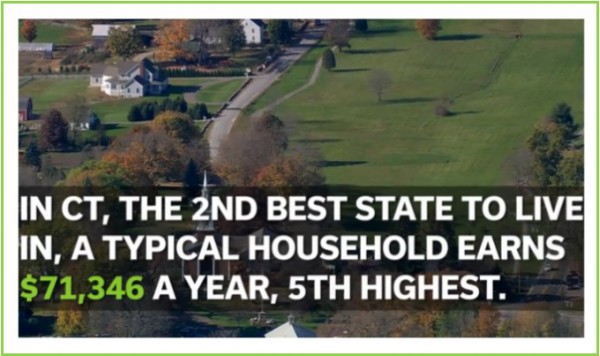
ct-2Quality of life in the United States is heavily dependent on financial status, the survey summary points out. As a consequence, the nation’s best states to live in often report very high incomes. With a median household income of $71,346 a year, fifth highest of all states, Connecticut is the second best state to live in and an especially good example of this pattern, the description of Connecticut’s ranking explains.

The publication notes that “While satisfactory living conditions are possible with low incomes, this is true only to a point. Once incomes fall below the poverty line, for example, financial constraints are far more likely to diminish quality of life.”

Rounding out the top five:  New Hampshire, Minnesota, and New Jersey.  At the bottom of the list: Alabama, Arkansas, Louisiana, West Virginia and Mississippi.

Education levels are another major contributor to a community’s living conditions — not just as a basis of economic prosperity, but also as a component of an individual’s quality of life. Due in part to the greater access to high paying jobs that often require a college degree, incomes also tend to be higher in these states. In all of the 15 best states in which to live, the typical household earns more than the national median household income of $55,775, 24/7 Wall St. pointed out.ct-2nd

Like the vast majority of states on the higher end of the list, Connecticut is described as relatively safe. There were 219 violent crimes reported for every 100,000 state residents in 2015, among the lowest rates of all states, the survey stated.  Housing markets are also indicative of quality of living. A high median home value, for instance, frequently means high demand for housing in the area. Nationwide, the typical home is worth $194,500. In most of the 25 top states, the median home value far exceeds the nationwide median.

The survey did not take into account more subjective conditions such as climate preference, the presence of friends and family, and personal history.

To identify the best and worst states in which to live, 24/7 Wall St. devised an index composed of three socioeconomic measures for each state: poverty rate, the percentage of adults who have at least a bachelor’s degree, and life expectancy at birth. The selection of these three measures was inspired by the United Nations’ Human Development Index. Poverty rates and bachelor attainment rates came from the U.S. Census Bureau’s 2015 American Community Survey. Life expectancies at birth are from the Centers for Disease Control and Prevention and are as of 2012, latest year for which data is available. Unemployment rates are from the Bureau of Labor Statistics, and are for October 2016, the most recent available month of data.

CT Residents See Improving Economy, Even As Jobs Remain in Short Supply; Millennials Most Upbeat About Business Conditions

Seven in 10 Connecticut residents say overall business conditions in the state are either better or the same as six months ago, according to the quarterly Inform CT Consumer Confidence Survey, and 75 percent expect conditions to either remain the same or improve in the next six months. The latest survey, covering the third quarter of 2016, also found residents are more willing to spend on major consumer items – a sign of a strengthening economy – and less concern about immediate job security.  The survey also found that millennials, ages 22-25, are the demographic most upbeat about the state’s economic progress, with 41 percent saying overall business conditions were better than six months ago.  Those ages 18-21 and 26-35 had the next most positive views.

block-logoIn a reversal from the previous quarter, 42 percent of state residents surveyed said they were unlikely to move out of state in the next 5 years, compared with 34 percent who described such a move as likely.  In the previous survey, conducted in the second quarter of this year, the numbers were reversed with 42 percent saying that it was likely they’d be moving out of state within five years, compared with only 32 percent who said such a move was unlikely.

The quarterly survey is released by InformCT, a public-private partnership that provides independent, non-partisan research, analysis, and public outreach to help create fact-based dialogue and action in Connecticut.

Tempering upbeat views is the continuing widely-held opinion that there are “some jobs in Connecticut, but not enough.”  Those expressing that view increased to 63 percent in the third quarter, the highest percentage since the survey began.  An additional 24 percent view jobs as “very hard to get.”  Thus, nearly nine in ten view the number of available jobs as insufficient in the state.  The survey also found:

  • Less concern about job security: Only one-third (35%) expressed concern that their job or the job of their spouse/partner is in jeopardy, down from 39 percent in the previous quarter and 42 percent in the first quarter this year.
  • Continuing strong concern about health insurance costs: Nearly two-thirds of state residents (64%) say they are concerned about being able to afford health insurance.
  • Continuing concern about retirement savings: Overall, 50 percent of those surveyed disagreed with the statement “I will have enough money to retire comfortably,” compared with 23 percent who agreed.  Those currently of working age are most concerned about retirement savings.
  • Connecticut is a good place to raise a family: Overall, fifty percent of those surveyed expressed that view, compared with 28 percent who disagreed, a ratio that has been relatively consistent in the quarterly surveys.  The two age groups that agree most are now, or will likely soon be, starting families – 62 percent of those ages 22-25 and 60 percent of those ages 26-35.
  • Personal financial situation improving: 30 percent of survey respondents said their personal financial situation was better today than six months ago, compared with 28 percent who said they were worse off.

chart-3Residents of Windham and Fairfield counties were more likely to view overall business conditions as being better now than six months ago, the survey found.  Twenty-nine percent of Windham residents held that view as did 28 percent of Fairfield residents.  Residents of the state’s other six counties, Middlesex (23%), New London (20%), New Haven (20%), Litchfield (16%), Tolland (16%) and Hartford (16%) had fewer residents expressing that opinion.

Among other consumer survey findings:

  • Nearly three-quarters of those surveyed (73%) said that in the next 6 months they were likely to take a vacation outside the state, the highest proportion since the survey began nearly two years ago, and the fourth consecutive quarterly increase.
  • The proportion of respondents likely to make a major consumer expenditure for furniture or another product also was the highest in seven quarters, at 43 percent, up from 26 percent a year ago.
  • The percentage of respondents who indicated they were likely to buy or refinance their home (16%) or purchase a new car (26%) were both at levels higher than in the 3rd quarter of 2015.

Administered by researchers from the Connecticut Economic Resource Center, Inc. (CERC) and Smith & Company, the analysis is based on the responses of 510 residents across Connecticut and addresses key economic issues, providing a glimpse of the public’s views.  The survey has a margin of error of 5 percent.

Public Hearings Conclude; State Spending Cap Commission Seeks Definitions to Impact Spending Decisions

“Stop with the financial games and own up to the problem.”  That was the succinct comment provided to the 24-member state Spending Cap Commission by Darien resident Ken Weil at a public hearing this fall.  Small business owner Justin Higgins, of Orange, added that citizens should “always know where we stand financially without loopholes and political gamesmanship.” The Commission has held 18 meetings, beginning in March and most recently on November 14, as well as five public hearings during the past two months, during which nearly two dozen people filed testimony.  With the state anticipating an estimated $3.1 billion deficit for the next two fiscal years, dollars and sense will be front and center when the legislature, with 30 new members and a dead-even split in the State Senate, convenes in January.

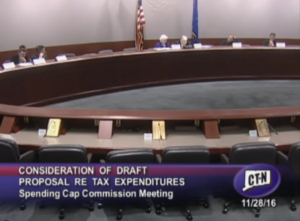
The Commission next meets on Nov. 28, according to CT-N.  Public Act 15-1, December Special Session (Section 24) established the Spending Cap Commission, charged with creating, for the purposes of the state's constitutional general budget expenditures requirements, proposed definitions of (1) "increase in personal income", (2) "increase in inflation", and (3) "general budget expenditures".

What the commission has been asked to address is two decades in the making - definitional questions with fiscal implications that have influenced policy and budget balancing since the passage of the state income tax in the early ‘90’s.  The Director of UConn’s Center for Economic Analysis, Fred Carstensen, said in an article published this month that “the spending cap as designed has been an unmitigated disaster, fiscally and economically.” spending-cap

The Commission is chaired by William Cibes, a former state legislator and Secretary of the Office of Policy and Management when the income tax was imposed and state spending cap was approved by voters, and Patricia Widlitz, also a veteran former legislator.  Members include Republicans and Democrats currently serving in the legislature, and others who have extensive experience with state government, in the public or private sector.  It is likely that the incoming state legislature will be looking to the Commission’s findings, as it grapples with the way forward for state finances.

As the public hearings approached in October, the Commission voted to include the following proposed definitions to be addressed:

  • “Increase in personal income” means the compound annual growth rate of personal income in the state over the preceding five calendar years, according to United States Bureau of Economic Analysis data
  • “Increase in inflation” means the increase in the consumer price index for urban consumers, all items less food and energy, during the preceding calendar year, calculated on a December over December basis, according to United States Bureau of Labor
  • The Commission is still considering potential optional language for the third proposed definition – “general budget expenditures” – it is charged with creating. That language may concern, among others, such expenditures as payments for bonds, notes and other evidences of indebtedness, court orders, federal mandates, grants to distressed municipalities, as well as the use of federal funds and monies contained in the budget reserve fund. Proposed language pertaining to these and other additional topics pertaining to general budget expenditures may also be suggested at the public hearing, and considered by the Commission.

Some of the comments received by the Commission, at hearings in Hartford, New Haven, Bridgeport, Willimantic and Waterbury, are quite clear on what the result ought to be done, even if precise wording is not offered:

connecticut-state-capitolLouise DiCocco, Assistant Counsel for the Connecticut Business & Industry Association, noted that “24 years ago, more than 80 percent of Connecticut votes overwhelmingly approved a spending cap to keep the cost of state government within the taxpayers’ means to afford it.  Voters demanded the cap as an offset to the persona income tax in Connecticut.  The state must enact a spending cap that is ironclad and works.”

Added the MetroHartford Alliance in testimony by Vice President Patrick McGloin: “Adoption by the legislature of well-crafted spending cap definitions will clearly demonstrate to our fellow residents and private sector employers that we have the political will to be fiscally disciplined.”  DiCocco noted that “the spending cap has always had a safety valve or escape mechanism.  They include bonded debt service, aid to distressed municipalities and first year costs of federal or court ordered mandates.”

The Connecticut affiliate of the National Federation of Independent Businesses pointed out that “reasonably understood, clear definitions of the key terms that will lead to additional budget transparency, predictability and ultimately cap state spending on an annual basis in a way that aptly reflects the will of the voters,” adding that “business owners feel that the legislature absolutely needs to stop allowing excessive spending to be an option and to recognize the ‘new economic reality’, just as small business owners have had to do. Achieving that goal is the most effective economic development policy we could have, and we believe that implementing the constitutional spending cap, and properly defining component terms, would go a long way in this regard.”

Westport resident Tom Lasersohn observed that “In business you learn that for every one customer that complains, there are many you have already lost as customers. For every citizen who gives testimony to this Commission, there are many who are so disgusted with the State’s fiscal mismanagement and chicanery that they will leave at the earliest convenient opportunity. Many outside the State peer in and resolve ‘no, not for me until the State gets its fiscal act together.’ A responsible definition for ‘general fund expenditures’ will communicate to both current and prospective residents and businesses that we are serious about fixing our problems.”

official_logo_mdState Senator Toni Boucher of Danbury told the Commission:  “I hope that the commission to adopt a definition of general budget expenditures that is comprehensive and gives a complete and realistic account of all the money that the state spends… it is equally critical that the legislature not be allowed to move what was once an expenditure included under the cap to bonding or fund it with a revenue intercept for the purpose of undermining the cap’s integrity.”

The final form of Commission recommendations remains unclear.  Minutes of the Commission’s most recent scheduled meetings, on October 31 and November 14, have not yet been posted to the Commission’s website, nor has an agenda for the Nov. 28 meeting (as of Nov. 27).

While Boucher is not a member of the Commission, a number of her legislative colleagues are.  The definitions – and the implications for the state’s budget and taxpayers – may soon be theirs to decide.  A decade ago, a UConn report observed that “the spending cap is only as restrictive as the legislative process decides it should be; its strictures are not written in stone.”

ct-nUPDATE: 

link to Agenda for Commission's Final Meeting on Nov. 28, 2016 and CTNewsJunkie article reporting on meeting.

link to CT-N video of Commission's Meeting on Nov. 28  at the Legislative Office Building in Hartford; Next meeting scheduled for Dec. 5

CT Ranked 9th Among Small States in "Main Street Entrepreneurship," Showing Improvement

Improvements in Connecticut’s “Main Street Entrepreneurship” has pushed the state’s ranking to 9th among the nation’s 25 smaller states, up from 12th a year ago, in the latest analysis from the Kauffman Foundation. The nation as a whole and most states and metro areas are experiencing higher rates of small business activity, according to the 2016 Kauffman Index of Main Street Entrepreneurship.  Nationally, there was a sharp uptick in the survival rate of businesses in the last year. At the same time, Main Street entrepreneurship activity gained ground in 47 states and 38 of the 40 largest metropolitan regions.kauffman

Among the nation’s smaller states, the top ranked entrepreneurial states were South Dakota, Vermont, Montana, North Dakota, Maine, Iowa, Nebraska, New Hampshire.  After Connecticut, Oregon rounded out the top ten.  Connecticut was one of only two states to move up three positions in the ranking.

The state’s rate of business owners was 6.55 percent; the percentage of the adult population that owns a business as their main job, according to the survey data.

The number of established (older than four years) small (less than fifty employees) businesses per 1,000 firms was 649.9 in Connecticut.  In Massachusetts, which ranked third among the nation’s 25 larger states, it is 684.7.  The top ranked larger states were Minnesota, Wisconsin, Massachusetts, Colorado, Pennsylvania, Maryland, Ohio, Louisiana, California and Illinois. state

"The Main Street Entrepreneurship Index provides additional evidence that U.S. small business activity has rebounded from the downturn and continues to gather strength," said Arnobio Morelix, senior research analyst at the Kauffman Foundation. "More new businesses are making it through their first five years of operation. While this could indicate that a lack of dynamism is allowing less-productive firms to hang on longer, overall the entrepreneurial increases bode well for the established, small businesses that underpin much of our economy."

Among the larger states, the rate of businesses surviving through their first five years ranges from 44 percent in Arizona to 53.3 percent in Pennsylvania. Among the smaller states, the business survival rate ranges from 43.4 percent in Nevada to 58.1 percent in North Dakota.  In Connecticut, the rate is 51.35 percent, the 8th highest among the 25 smaller states.

In start-up activity, Connecticut ranked 22nd out of 25 smaller states, a drop of two positions since last year.  The Survival Rate of American businesses is the main driver of the recent improvements in Main Street Entrepreneurship in the United States, and has reached a three-decade high of 48.7 percent—meaning that almost half of new businesses make it to their fifth year of operation.chart

U.S. Census Bureau business statistics show that established small businesses represent almost 68 percent of all employer firms in the country.   The five metros with the highest Main Street entrepreneurship activity are Pittsburgh, Boston, Portland, San Francisco and Washington, D.C.

The Kauffman Index of Main Street Entrepreneurship captures business activity in all industries and is based on both a nationally representative sample size of roughly 900,000 responses each year and the universe of all employer businesses in the United States, in a dataset that covers approximately five million businesses.

New Haven Chamber Spotlights Millennial Leaders in Region

The Greater New Haven Chamber of Commerce has recognized 12 distinctive millennial leaders who are "making an outstanding difference in the professional and outside world." In making their selections, the Chamber indicated that "from organizing community events, working with charities on weekends or holidays, or tireless public outreach - these are the people that lead by example to the entire millennial generation and the rest of us."

The Chamber's young professional organization, PULSE, made the selections from those nominated for the recognition.  The announcement was made at a reception at the conclusion of the Chamber's day-long business expo, The Big Connect, held Thursday at the Oakdale Theater in Wallingford.

The millennial move makers for 2016 are:

Jack Yeung, a serial entrepreneur, attended St. John’s University for his Doctorate of Pharmacy degree. He started his own pharmacy in 2010, after noting he could offer services that other pharmacies were not offering, such as delivery. Jack who now owns pharmacies in Southbury, Danbury and one in the Bronx, started the Panic Room: Escape Room Entertainment in Norwalk, CT, which challenges participants while providing a safe and fun real-life adventure. Jack’s latest business venture is the opening of The Halal Guys Restaurant in New Haven this fall.

Ashley Calabrese is responsible for developing and implementing effective lobbying strategies and grassroots advocacy campaigns to best suit her clients’ interests. She works with the state legislature, the executive branch, municipal leaders and the Connecticut congressional delegation. Her efforts have created better insurance coverage for more advanced forms of breast tissue scmillennialreening, including coverage for ultrasound and MRI screening. Through volunteer efforts, Ashley has advanced legislative efforts for ‘Are You Dense Advocacy’ to ensure that women with dense breast tissue have access to an early breast cancer diagnosis. She helped form the Danny Gilman Scholarship in memory of one of their peers. Ashley serves as President of the Association of Connecticut Lobbyists.
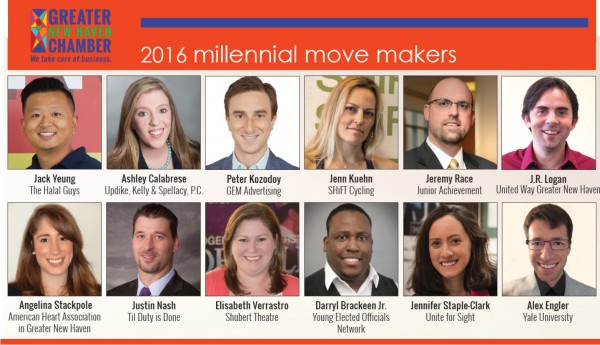
Peter Kozodoy is an author, speaker, serial entrepreneur, and the Chief Strategy Officer of GEM Advertising. His work at GEM has been featured in CNBC, Yahoo!, Bloomberg, Reuters, MarketWatch and more, and has earned Telly, Pixie, Communicator, Aurora, Davey and W3 awards in U.S. and international branding, advertising and production. He has spoken for Microsoft, the US Department of Commerce, and CEO Clubs of America on topics like millennials, and global advertising. He serves on the boards of the Greater New Haven Chamber and Junior Achievement in Connecticut. He is also a SAG/AFTRA professional actor, a three-time New England Champion in Men’s Figure Skating, and a black belt in Taekwondo.

Jenn Kuehn began SHiFT Cycling with a vision to create a workout experience that is accessible yet challenging to every rider, no matter where they are in their fitness levels. She left the high-powered world of corporate sales to create an inspirational local fitness experience. In less than a year, Jenn built a reputation for inspiring effective workouts in a judgment-free environment. Still sensing a missing need for a greater connection between motivation, mind and body, she launched SHiFT Cycling in March 2014. In 2015, Jenn and the team evolved and created SHiFT New Haven. In 2016 Jenn launched her newest fitness concept SHiFT Balance, a studio designed for barre, yoga, kickboxing, strength and mediation classes.

Jeremy Race is the President and CEO of Junior Achievement Southwest New England.  Through Junior Achievement, Jeremy is helping young people dream big about their futures and teaching them the strategies to achieve those dreams. Each year, Jeremy has the pleasure of working closely with several JA students in preparation for their speaking roles at JA’s annual Partners in Achievement breakfasts in Hartford and New Haven. At last year’s event, Jeremy was proud to watch Josslyn, a student from New Britain who at one point was on track to not graduate from high school, stand up in front of 400 guests and state that thanks to JA, “I will graduate high school. I will attend college.  I will be successful.” It was a moving moment and Jeremy will never forget.

J.R. Logan has worked as a volunteer to organize the establishment of a trail along the Mill River in New Haven. He serves on the boards of the New Haven Land Trust and Eli Whitney Museum. He led Cluefest for several years and is a cofounder and Chief Maker at MakeHaven, a community makerspace where anyone can participate in 3D printing, laser cutting, wood working, sewing, metal milling, electronics fabrication, programming, mold making, bike repair and more. In this role, he fosters a community of more than 100 entrepreneurs, artists and craftspeople. J.R. is also employed as Director of Digital Resources for United Way of Greater New Haven, where he works to implement organizational learning and technology locally as well as being a significant contributor to technology advancement in the worldwide United Way network.big-connect-logo-2016

Angelina Stackpole is a Director at the American Heart Association in Greater New Haven, where she oversees corporate fundraising and wellness initiatives in Greater New Haven. She is responsible for the Greater New Haven Heart Walk, which raises awareness and funds for cardiovascular diseases and stroke. In the past five years, Angelina has increased annual revenue from the event by 50%, and has grown participation to nearly 5,000 area professionals and community members. She is also responsible for starting an annual Connecticut-wide event that provides fun activities, support, and networking to families who have children suffering from congenital heart disease. Angelina currently serves as Chair on the PULSE Board of Directors.

Justin Nash, following his graduation from West Point in 2001, was commissioned as an Infantry Officer where he led an infantry platoon deployed to serve in Afghanistan. He was awarded the Bronze Star Medal, Army Commendation Medal, Army Achievement Medal, and Global War on Terrorism Expeditionary and Service Medals. His military career was cut short due to injuries sustained in the line of duty. He has also served as a project manager in the energy industry where he delivered complex projects over $10 million. Justin is the founder of Veteran Construction Services LLC and serves as president of Til Duty is Done, an organization he founded to help restore and improve the lives of veterans through supportive housing and employment opportunities.

Elisabeth Verrastro has a passion and drive to make live performance accessible to everyone and loves seeing her work come to life when the curtain rises and the audience erupts into applause. She is the Shubert Theatre’s Director of Development & Communications. Over the past eight years, Elisabeth has worked tirelessly to tackle the world of development, while giving birth to two children and exceeding expectations by raising over $1.2 million each year while implementing a campaign to raise over $8 million to celebrate the Shubert’s 100th Anniversary and complete Phase 1 of the Centennial Improvement Project. It is Elisabeth’s mission to continue her work to make Shubert’s Phase 2 of renovations a reality.

Darryl Brackeen Jr. was elected in 2014 to the New Haven Board of Alders (City Council), where he is the first African-American and youngest Alder to have been elected from Westville 26th district. While in office, he has championed the passage of the City of New Haven’s Clean Air Resolution, Domestic Workers Bill of Rights & Janitors Bill of Rights, and supported passage of a Connecticut student loan bill of rights, and countless other pieces of legislation and initiatives. In December 2015, he was named the CT State Director for the Young Elected Officials Network. Darryl serves on the Board of Directors for Greater New Haven Green Fund.

Jennifer Staple-Clark founded Unite For Sight in her dorm room in 2000 as a sophomore at Yale University. Unite For Sight is now a leader in both global health education and in providing cost-effective care to the world’s poorest people. Jennifer is the author of journal articles and book chapters about social entrepreneurship, best practices in global health, and community eye health. Additionally, she serves as a judge in social entrepreneurship competitions, including the Canadian Government’s Grand Challenges in Health. Jennifer is a member of the Yale University President’s Council on International Activities, and on the Operating Board of the Yale Entrepreneurial Institute.

Alex Engler is a Ph.D. student and NSF Graduate Research Fellow in Biomedical Engineering at Yale University. While at Dartmouth College for undergraduate studies, Alex’s research focused on developing biomaterials for orthopedics. Outside of the classroom, he led multiple music groups and mentored local middle schoolers for science competitions. Between Dartmouth and Yale, Alex worked in the heart of Boston’s hospital network developing medical devices to treat infants born with birth defects. Alex’s current research focuses on whole lung regeneration and tissue engineering. Outside of lab, he serves as a Director of the Science in the News program. He is also actively involved with the Yale Pathways to Science program and the New Haven Science Fair.



Stamford-based Harman to be Acquired by Samsung

Even as Connecticut’s economic development leaders toil diligently to retain and attract industry-leading businesses to the Land of Steady Habits, market forces at times pull in different directions.  That is again in evidence as Samsung has announced it will buy Stamford-based Harman for $8 billion. The acquisition of will make Samsung a major player in automotive technology, and removes an independent corporate headquarters from the state’s roster. Earlier this year, Harman was one of four Connecticut-based companies to be named among the most innovative companies by Fast Company magazine.  Harman ranked seventh on the Fast Company ranking of the 10 most innovative companies in the automotive sector.harman_logo_thmb

Upon closing, Harman will operate as a standalone Samsung subsidiary, and continue to be led by Dinesh Paliwal and Harman’s current management team, both companies indicated in a news release.  Harman has a workforce of approximately 30,000 people across the Americas, Europe, and Asia and reported sales of $7.0 billion during the 12 months ended September 30, 2016.

“Samsung is pursuing a long-term growth strategy in automotive electronics, and plans to retain Harman’s work force, headquarters and facilities, as well as all of its consumer and professional audio brands.  Samsung believes the combination will increase career development and advancement opportunities for the employees of both companies,” the news release stated. harmanmicrosoft_mid

“This compelling all-cash transaction will deliver significant and immediate value to our shareholders and provide new opportunities for our employees as part of a larger, more diversified company,” Harman Chairman, President and CEO Dinesh Paliwal said.

For Samsung, it is the biggest overseas acquisition ever by a South Korean firm, according to the news service Reuters. The Harman acquisition is subject to regulatory approvals and is expected to close in mid-2017, reports indicate. The agreement has been unanimously approved by the boards of directors of both companies.

1516092_871290752969831_1531732641_nHarman's products, which provide infotainment, telematics, connected safety and security services, are used in more than 30 million vehicles made by automakers such as BMW, Toyota Motor Corp and Volkswagen, according to its website. Harman’s portfolio of audio brands includes AKG®, Harman Kardon®, Infinity®, JBL®, Lexicon®, Mark Levinson®and Revel®

Harman executives will be at the Fleet Europe Forum and Awards on November 16 in Barcelona, Spain to highlight Harman's premium products for the fleet industry , which caters to businesses, government agencies and other organizations that purchase or lease groups of vehicles to support their services.samsung

CT's Science and Technology Ranking Rises to 6th in the Nation

Following three consecutive finishes ranking ninth in the nation in the State Technology and Science Index (STSI), Connecticut has moved up to number six in 2016, it’s highest finish in more than a decade.  The state ranked ninth in 2010, 2012 and 2014 in the analysis produced every other year by the Milken Institute, following a 7th place ranking in 2008 and 10th in 2004.  The ranking was the highest for the state in all seven releases of the STSI index. The STSI benchmarks states on their science and technology capabilities and broader commercialization ecosystems that contribute to company growth, high-value-added job creation, and overall economic growth, the institute’s website explains.  ct-ranks-6th

“We view the STSI as a measure of a state's innovation pipeline. The index isn't intended to be a measure of immediate economic impact, but rather to demonstrate that the return on science and technology assets will accrue in future years.”

The top five states in 2016 are Massachusetts, Colorado, Maryland, California and Washington.  Rounding out the top 10, after Connecticut, are Minnesota, Utah, Virginia and Delaware.

In specific categories, the state’s ranking varied, with considerable improvement in some categories. In the Technology and Science Workforce composite index, Connecticut ranked 10th, an improvement from rankings of 16th in 2014, 13th in 2012 and 14th in 2010.  This composite measures the relative presence of high-end technical talent, and consists of 18 eighteen various indicators.

stsi-reportThe STSI's 107 individual indicators are sorted into five composites: Research and Development Inputs, Risk Capital and Entrepreneurial Infrastructure, Human Capital Investment, Technology and Science Workforce, and Technology Concentration and Dynamism.  The report indicated that "Connecticut showed major improvement in the Technology Concentration and Dynamism index, going from 21st to 10th. This dramatic rise marks one of the larger overall changes on this index. While modest increases were seen in the Research and Development Inputs index and Human Capital Investment index, these two indices have a much heavier focus on stock measures, and Connecticut’s aerospace and defense sectors help anchor the state’s performance in these areas."

Connecticut also ranked 10th in the Technology Concentration and Dynamism composite index, the state’s highest ranking in that category, and largest jump from two years ago.  In 2014, Connecticut ranked 21st.  In the two previous analyses, Connecticut was 12th in 2012 and 18th in 2010.

logoIn the Human Capital Investment composite index, Connecticut ranked third, as it did in 2014 and 2012, after ranking fifth in 2010.  In Research & Development, Connecticut placed eighth, its second highest finish, after ranking tenth, seventh and seventh in previous indexes.  Connecticut ranked 11th in Risk Capital and Entrepreneurial Infrastructure, up from 14th two years ago, but not as high as sixth place in 2012 and third in 2010.


The Human Capital Investment composite index looks at how much is invested in developing the workforce—the most important intangible asset of a regional or state economy. Twenty-one indicators are included in this composite index.  The R&D composite examines a state's R&D capacity to see if it has the facilities that attract funding and create innovations that could be commercialized and contribute to economic growth, and includes eighteen indicators.  The Risk Capital and Entrepreneurial Infrastructure Composite Index determines the success rate of converting research into commercially viable products and services. It includes 12 indicators.

While Connecticut was gaining ground, other states were bottom dwellers.  The analysis raised alarms regarding the prospects for those states.

map“The states with the weakest innovation assets and ecosystems for starting and growing innovative firms face a bleak future unless changes are made. West Virginia, Arkansas, Mississippi, Kentucky, and Louisiana make up the bottom five in this year's STSI. They are the least knowledge-intensive and their residents exhibit weak entrepreneurial skills. All of them have undertaken efforts to change their position in technology and science but have had limited success.”

Massachusetts remained in first place with a score of 83.7, retaining the position it has held since the inaugural STSI was released in 2002.

Wyoming, the most improved state, climbed 10 places, to 36th. The state had broad gains but benefited most from the broader definition of occupations in the Technology and Science Workforce category, which included its talent in mining engineering, the analysis pointed out. Missouri rose six spots, to 28th; seen as primarily attributable to a 24-place leap in Risk Capital and Entrepreneurial Infrastructure.

Pasta Making Business Continues to Grow, Government Continues to Help

Sometimes, home-grown businesses decide to stay in Connecticut.  That was the case this fall as Carla’s Pasta – an American Dream business success story – reportedly spurned an offer to relocate to a western state, and chose instead to expand in South Windsor, aided by a significant tax abatement. The company produces filled pastas, Italian sauces and pestos, appetizers, and entrees. The brainchild of Carla Squatrito, the business now employs 156 people, including her sons, Sandro Squatrito and Sergio Squatrito, who are vice presidents of business development and operations, respectively. The Italian food product manufacturer, which was launched in 1978, in Manchester and moved to South Windsor in 1997. carlas1

The latest expansion deal, as reported by the Journal Inquirer, will see the town give the family-run Carla’s Pasta a 70 percent tax abatement for seven years, reducing the company’s tax burden by well over $200,000 per year.  The planned expansion is expected to generate 60 to 100 new jobs, and is due to be completed next fall. In 2013, Carla's completed a 30,000-square-foot expansion of its South Windsor facility, the Hartford Business Journal reported.

Town Manager Matthew Galligan, the JI reported, said the state of Utah was courting the company, but Carla’s ultimately decided to stay in town as a result of the deal that was approved by the Town Council.

Carla, a native of the small Italian village of Madonna del’Olmetto, emigrated to the U.S. at age 27.  Her business began as a means of bringing “home-made filled pastas, Italian Sauces and Pestos, made from fresh ingredients, the flavors of her youth” to local customers, retail and later wholesale.  Since 2010, Carla has been recognized by the National Women Business Owners Corporation as an outstanding CEO.carla

The company distributes its pasta to restaurants, institutions and supermarkets. In 2012, the company estimated that it was making about 2 million pounds of pasta per month, with projections to increase that number by a third.

The company received a bridge loan of $2,175,000 from Connecticut Innovations that year to help purchase and install a fuel cell along with a $750,000 grant from the Connecticut Clean Energy Fund. The state assistance was aimed at supporting the company efforts to be environmentally conscious and energy efficient.

In Oct. 2015, the company launched its own retail brand, Cucina di Carla.  Among the distinctive products inspired by the season:  autumn-inspired cinnamon clove pasta ravioli filled with golden pumpkin, whole milk ricotta and Fall spices.

https://vimeo.com/150720277