MA Overtakes CT, Jobs on Horizon for EB - Bad News, Good News for State Economy
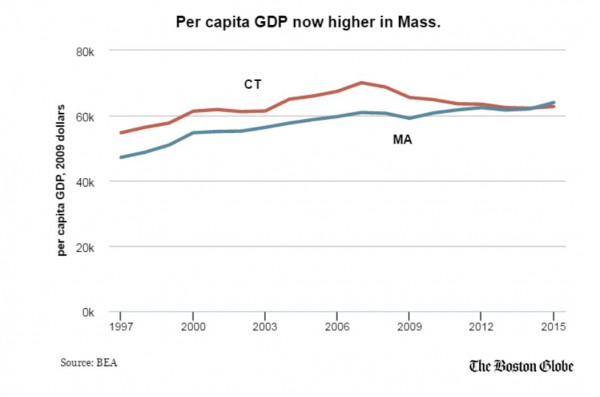
/Connecticut is “in a rut”according to one regional newspaper, while another is reporting on plans by a local company to hire 14,000 workers during the next decade. Bad news and good news, simultaneously. “Ten years ago, it was the undisputed economic king of New England, with average incomes 13 percent higher than Massachusetts and 40 percent above third-ranked New Hampshire,” the Boston Globe's data reporter says of Connecticut. “Throughout the 1990s and 2000s, low- and middle-wage workers in Connecticut consistently took home bigger paychecks than their Massachusetts peers. In the past few years all these economic advantages have disappeared. Unemployment is now far lower in Massachusetts. And Bay State employees get the best wages — whether you look at low-earners, top-earners, or those in the middle.”
The Globe cites recent housing data to underscore the point.
“Of all the cities tracked by the National Association of Realtors, 90 percent have seen their housing prices rise since 2010. That leaves just 17 metropolitan areas still trying to claw back from the recession. Four of those underwater markets are in Connecticut — and they extend to virtually every corner of the state, from Stamford in the southwest to New London in the east and as far north as Hartford.”
“Among the biggest changes in the Massachusetts economy,” the Globe column points out, “has been the explosion of professional, scientific, and technical services — think architects, engineers, software designers, consultants, and scientific researchers. Since 2000, this sector has grown by nearly 50 percent in Massachusetts, which is a key reason the state as a whole has performed so well. In Connecticut, these same fields have expanded by just 6 percent.”
Globe reporter Evan Horowitz, who writes the paper’s Quick Study column using data to discuss policy, notes that “without a hub like Boston, Connecticut can’t simply pull pages from the Massachusetts playbook.” He suggests that “a Trump-fueled surge in corporate profits and stock valuations could provide a much-needed boost to the state’s fortunes. But if there’s one lesson of recent years, it’s that counting on Wall Street excess to compensate for other economic ills is a dangerous strategy; bubbles burst, recessions happen, and in the absence of a long-term economic strategy, Connecticut could once again find itself floundering.”
A brighter ray of potential economic sunshine is reported by the Day of New London, outlining plans by General Dynamics Electric Boat in Groton for a massive decade-long hiring spree resulting from an increase in submarine orders by the U.S. Navy, spurred by “strong Congressional support.”
 “The company will hire 14,000 new employees over the next 13 years,” the Day reports. “Those employees will fill new positions and those being vacated by retirees and those who leave for other reasons. The burst in new hires will take EB from its workforce of 14,500 today to 18,000 in 2030. This year alone, the company hired 1,600 new full-time employees. Another 800 received conditional job offers and are in the process of applying for a security clearance or awaiting that clearance.”
Reporter Julia Bergman indicates that “six different submarines are currently under construction there. Another is in for its ‘50,000 mile checkup.’ And an eighth is undergoing a major overhaul.”
The work – and the jobs – extend beyond EB.
“While the engineering workforce has neared its peak, EB will continue to hire a larger number of shipyard personnel such as welders, machinists, and electricians,” the Day reports. “About 40 percent of this year’s new hires were tradespeople.” Training programs and local colleges are straining to meet the demand, the newspaper reports.
Underscoring the importance of healthcare to Connecticut’s economy, there is a new number one employer (by number of employees) in the state, according to published reports. A year ago, United Technologies was the largest employer in Connecticut, according to 24/7 Wall Street. After selling its helicopter division, Sikorsky, UTC’s employee headcount dropped from around 24,500 to an estimated 16,000. With 20,396 total employees, Yale New Haven Health is now the largest employer in Connecticut, the publication notes. Yale New Haven Health includes Bridgeport Hospital, Greenwich Hospital, Yale New Haven Hospital, Yale New Haven Children's Hospital, Smilow Cancer Hospital at Yale New Haven and Yale New Haven Psychiatric Hospital. The Hartford Business Journal last year ranked Hartford Healthcare, with 18,000 employees, just behind Yale New Haven Health. Hartford Healthcare acute care facilities include Backus Hospital, Hartford Hospital, The Hospital of Central Connecticut, MidState Medical Center and Windham Hospital.


 this book, education is the ultimate determinate of success. In order for Hartford to excel, the population must be educated. The emerging majority must be able to support itself and children require cutting edge educational opportunities.”
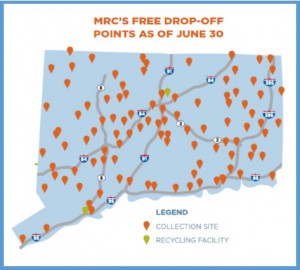
 The Mattress Recycling Council (MRC), a non-profit organization established by the mattress industry that created and manages the program in Connecticut, California and Rhode Island, presented its inaugural
  “We are pleased with the program’s productive start and will continue to work with city leaders, businesses and the state to improve the program, expand the number of communities served, and increase the volume of mattresses recycled,” said Ryan Trainer, President of MRC and the International Sleep Products Association.

 As of June 28, 2016, there were 2,007 bakery-cafes in 46 states and in Ontario, Canada operating under the Panera Bread, Saint Louis Bread Co. or Paradise Bakery & Cafe names. Published reports indicate the company has 97,000 employees nationwide and saw a 3.4 percent growth in sales in its third quarter this year. In 2015, it reportedly generated roughly $2.7 billion in revenue. Founder and CEO Ron Shaich
 Each monthly addition of New Haven Living was nearly identical to Hartford Magazine, usually with a handful of New Haven-focused articles and features added. The Courant reported that it made the decision while evaluating opportunities to invest in higher-growth areas and the cost of distribution in Greater New Haven.
 A limited number of promotional copies will be limited “based on a proprietary algorithm for the support of our advertisers,” Young noted. He also indicated that plans are in the works to expand the publication’s
  The state’s construction industry unemployment rate nudged downward from 7.1 percent in September, but was 6.4 percent in July 2016. In recent years, the rate ballooned to 18.1 percent in October 2010, at the height of the recession, from a low of 5.8 percent in October of 2008.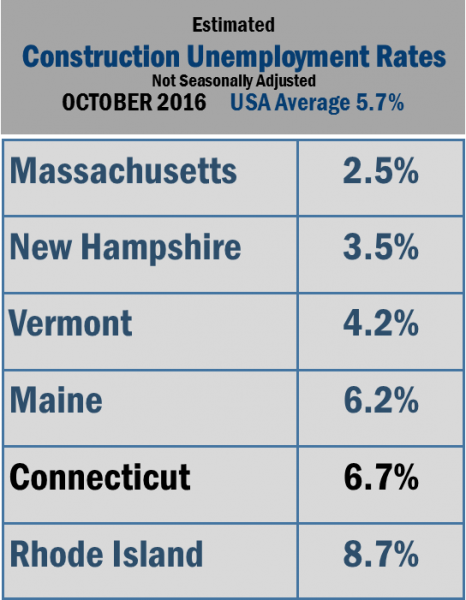


 In 2015 the legislature considered, but did not pass, a bill requiring the insurance commissioner to study and report on health insurance coverage of and out-of-pocket expenses for EpiPens, according to the OLR report. The 2014 legislation requires (a) schools to designate and train nonmedical staff to administer EpiPens to students having allergic reactions who were not previously known to have serious allergies and (b) the public health and education departments to jointly develop an annual training program for emergency EpiPen administration.
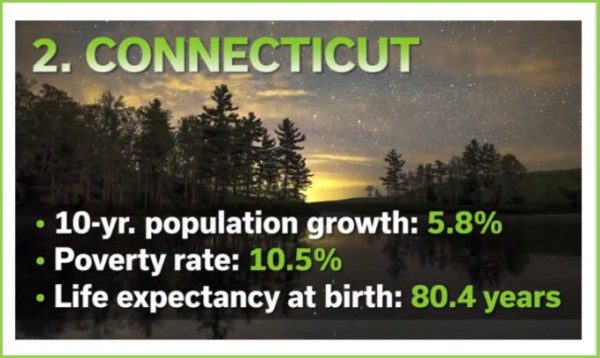 Quality of life in the United States is heavily dependent on financial status, the survey summary points out. As a consequence, the nation’s best states to live in often report very high incomes. With a median household income of $71,346 a year, fifth highest of all states, Connecticut is the second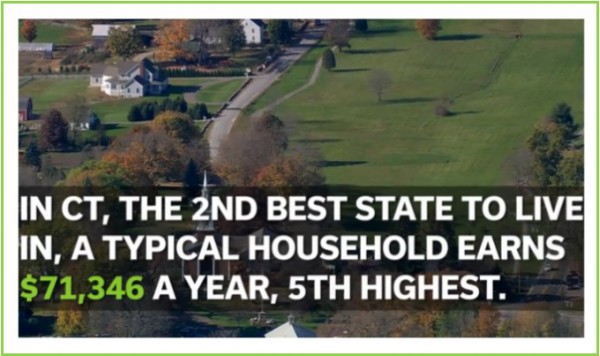
 In a reversal from the previous quarter, 42 percent of state residents surveyed said they were unlikely to move out of state in the next 5 years, compared with 34 percent who described such a move as likely. In the previous survey, conducted in the second quarter of this year, the numbers were reversed with 42 percent saying that it was likely they’d be moving out of state within five years, compared with only 32 percent who said such a move was unlikely.
 Residents of Windham and Fairfield counties were more likely to view overall business conditions as being better now than six months ago, the survey found. Twenty-nine percent of Windham residents held that view as did 28 percent of Fairfield residents. Residents of the state’s other six counties, Middlesex (23%), New London (20%), New Haven (20%), Litchfield (16%), Tolland (16%) and Hartford (16%) had fewer residents expressing that opinion.
 Louise DiCocco, Assistant Counsel for the Connecticut Business & Industry Association, noted that “24 years ago, more than 80 percent of Connecticut votes overwhelmingly approved a spending cap to keep the cost of state government within the taxpayers’ means to afford it. Voters demanded the cap as an offset to the persona income tax in Connecticut. The state must enact a spending cap that is ironclad and works.”
 State Senator Toni Boucher of Danbury told the Commission: “I hope that the commission to adopt a definition of general budget expenditures that is comprehensive and gives a complete and realistic account of all the money that the state spends… it is equally critical that the legislature not be allowed to move what was once an expenditure included under the cap to bonding or fund it with a revenue intercept for the purpose of undermining the cap’s integrity.”