State Steps Up to Help Residents Locate What’s Lost

Connecticut’s Office of State Treasurer has long been responsible for what is described as “unclaimed property” – assets that rightful owners have lost track of – as well as efforts to reunite people with their money.  Now, the State Department of Insurance is getting into the “lost and found” business, too. Insurance Commissioner Katharine L. Wade has announced that the Department is offering a free online service to help consumers search for a deceased family member’s lost life insurance policies and annuities.connecticut-insurance-department-logo-2

“It can be a frustrating and overwhelming process at times to locate a missing policy. Whether you are settling the estate of a deceased loved one or trying to help an elderly relative sort out his or her affairs, the Department has resources to help,” Commissioner Wade said. “We are pleased to offer this latest tool that will streamline and simplify the process while protecting confidentiality.”

The Department’s  Frequently Asked Questions    will help consumers through the process. Consumer requests to find a lost policy are encrypted and secured to maintain confidentiality. Participating insurers will compare submitted requests with available policyholder information and report all matches to state insurance departments through the locator. Companies will then contact beneficiaries or their authorized representatives within 90 days.

The Life Insurance Policy Locator, developed by the National Association of Insurance Commissioners (NAIC), provides free nationwide access for help in finding old policies and annuities. There are an estimated $1 billion in benefits and life insurance policies that are unclaimed in the U.S.

ct-big-list-logoAlso this month, the State Treasurer’s office is closing the year with a push urging consumers to check the agency’s CT Big List to determine if misplaced assets can be claimed.  State Treasurer Denise L. Nappier said the special online publication is one component of the Treasury’s efforts to reunite rightful owners with their unclaimed property and is available through its homepage, www.ott.ct.gov.

The mission of the Treasury’s Unclaimed Property Division is to safeguard assets until rightful owners step forward to claim them. Unclaimed property includes money from uncashed payroll checks, bank accounts and utility deposits, insurance proceeds, liquidated assets from safe deposit boxes, stocks, and bonds.

The electronic special edition at www.CTBigList.com has 49,729 names with property valued between $50 and $100; 36,467 names with property valued between $100 and $500; 4,941 names with property valued between $500 and $1,000; 3,538 names with property valued between $1,000 and $5,000; and 551 names with property valued greater than $5,000. Five owners have unclaimed property valued at more than $100,000, with two having property valued at more than $250,000.

The Treasury’s interactive website, www.CTBigList.com, contains the complete list of about 1.5 million names of individuals and entities that may be entitled to as much as $807 million in unclaimed property. The website features a searchable database -- updated with new names weekly -- that makes it easy for residents to find their names. Often, people are unaware that they have inherited money, and others may simply have forgotten an old savings account or payroll check that went uncashed, officials point out.

Treasurer Nappier emphasized, “Searching the Treasury’s unclaimed property website is free.” She said that state residents are regularly contacted by firms, often called “finders,” offering search services for fees that go as high as 10 percent of assets recovered – and that some individuals hire these firms, believing it is the only way to recover lost assets.

“But that’s not true. My advice is that before you send your hard earned money to strangers, check out the CT Big List first – there is no charge for this public service,” Treasurer Nappier said.

Seven CT Businesses Among 500 Fastest Growing Tech Companies in US

Where in Connecticut are the fastest growing technology companies?  New Haven, Branford, Trumbull, Madison, Norwalk, and Farmington. Seven Connecticut companies earned a ranking rank on the recently released 2016 Technology Fast 500 rankings of the fastest-growing tech companies in North America, compiled by professional-services firm Deloitte.  That’s the same number of Connecticut firms on last year’s list.

Four of the state’s representatives produce software, aligning with the dominance of that sector, with some 58 percent of this year’s Fast 500 companies in software. Two of the Connecticut companies work in biotechnology, which comprised the second-most represented segment on the list, covering 13 percent of firms.tech-list

New Haven-based Achillion Pharmaceuticals ranked highest among Connecticut companies, at No. 43, posting 2,436 percent growth. It was ranked #12 among biotechnology/Pharmaceutical companies. Achillion Pharmaceuticals, Inc. is a "science-driven, patient-focused company leveraging its strengths across the continuum from drug discovery to commercialization to provide better treatments for people with serious diseases," according to the company website.  achillion-color-logo

Following at No. 239, Farmington-based Evariant Software recorded a 303 percent increase. Next came HPOne, a Trumbull health-insurance solutions firm, which recorded 199 percent growth.  Madison's Clarity Software Solutions was No. 385, Norwalk-based software company etouches ranked No. 461, with 132 percent growth.  Rounding out the Connecticut tech firms earning a slot among the top 500 were Branford-based Core Infomatics at No. 469 and Alexion Pharmaceuticals, now headquartered in New Haven, at No. 473.

New York City and California firms accounted for nine of the top 10 companies on the list. By region, the San Franciso Bay area had 20 percent of the companies, New York 17 percent,  Los Angeles 8 percent,  Washington 6 percent and New England 5 percent.

Los Angeles-based Loot Crate, which delivers entertainment and pop culture-themed collectibles, ranked No. 1 overall, with 66,661 percent growtdeloitteh between 2012 and 2015. Founded in 2012, Loot Crate has more than 650,000 subscribers worldwide in 35 countries. The ranking summary points out that "Loot Crate’s position at the top of this year’s list showcases how innovation isn’t always about new technology and invention, but also about ingenuity, the recombining of existing assets, and know-how in new ways to maximize value."

Yieldbot, a New York City-based company focused on media, ranked No. 2.

"Amid a fierce business climate, there seems to be no shortage of new and established companies that are unlocking a seemingly unlimited potential for growth and advancement through technology’s continued disruption and proliferation across industries," said Sandra Shirai, principal, Deloitte Consulting LLP and US Technology, Media, & Telecommunications leader.

mapThe focus of the Connecticut firms that made this year’s list reflected the overall composition of the rankings, which were based on companies’ revenue growth between 2012 and 2015.  Software continues to have the greatest impact across technology sectors, representing 58 percent of the entire list and five of the top 10 winners overall.
"Combining technological innovation, entrepreneurship, and rapid growth, Fast 500 companies—large, small, public, and private—hail from cities far and wide across North America and are disrupting the technology industry," the introduction to the rankings emphasized.sector


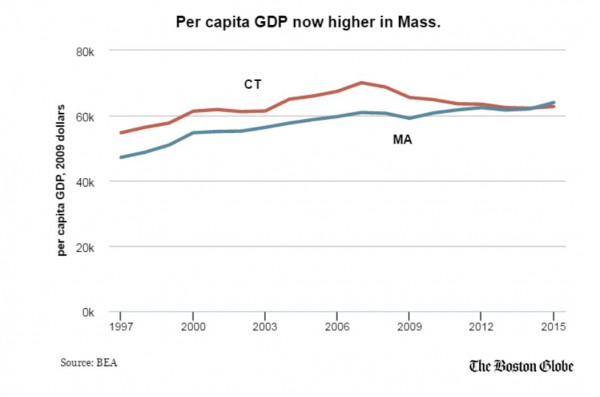
MA Overtakes CT, Jobs on Horizon for EB - Bad News, Good News for State Economy

Connecticut is “in a rut”according to one regional newspaper, while another is reporting on plans by a local company to hire 14,000 workers during the next decade.  Bad news and good news, simultaneously. “Ten years ago, it was the undisputed economic king of New England, with average incomes 13 percent higher than Massachusetts and 40 percent above third-ranked New Hampshire,” the Boston Globe's data reporter says of Connecticut.  “Throughout the 1990s and 2000s, low- and middle-wage workers in Connecticut consistently took home bigger paychecks than their Massachusetts peers.  In the past few years all these economic advantages have disappeared. Unemployment is now far lower in Massachusetts. And Bay State employees get the best wages — whether you look at low-earners, top-earners, or those in the middle.”

The Globe cites recent housing data to underscore the point.

“Of all the cities tracked by the National Association of Realtors, 90 percent have seen their housing prices rise since 2010. That leaves just 17 metropolitan areas still trying to claw back from the recession. Four of those underwater markets are in Connecticut — and they extend to virtually every corner of the state, from Stamford in the southwest to New London in the east and as far north as Hartford.”economy

“Among the biggest changes in the Massachusetts economy,” the Globe column points out, “has been the explosion of professional, scientific, and technical services — think architects, engineers, software designers, consultants, and scientific researchers. Since 2000, this sector has grown by nearly 50 percent in Massachusetts, which is a key reason the state as a whole has performed so well. In Connecticut, these same fields have expanded by just 6 percent.”

Globe reporter Evan Horowitz, who writes the paper’s Quick Study column using data to discuss policy,  notes that “without a hub like Boston, Connecticut can’t simply pull pages from the Massachusetts playbook.”  He suggests that “a Trump-fueled surge in corporate profits and stock valuations could provide a much-needed boost to the state’s fortunes. But if there’s one lesson of recent years, it’s that counting on Wall Street excess to compensate for other economic ills is a dangerous strategy; bubbles burst, recessions happen, and in the absence of a long-term economic strategy, Connecticut could once again find itself floundering.”

A brighter ray of potential economic sunshine is reported by the Day of New London, outlining plans by General Dynamics Electric Boat in Groton for a massive decade-long hiring spree resulting from an increase in submarine orders by the U.S. Navy, spurred by “strong Congressional support.”

chart“The company will hire 14,000 new employees over the next 13 years,” the Day reports.  “Those employees will fill new positions and those being vacated by retirees and those who leave for other reasons. The burst in new hires will take EB from its workforce of 14,500 today to 18,000 in 2030.  This year alone, the company hired 1,600 new full-time employees. Another 800 received conditional job offers and are in the process of applying for a security clearance or awaiting that clearance.”

Reporter Julia Bergman indicates that “six different submarines are currently under construction there. Another is in for its ‘50,000 mile checkup.’ And an eighth is undergoing a major overhaul.”

The work – and the jobs – extend beyond EB.sub

“While the engineering workforce has neared its peak, EB will continue to hire a larger number of shipyard personnel such as welders, machinists, and electricians,” the Day reports. “About 40 percent of this year’s new hires were tradespeople.”  Training programs and local colleges are straining to meet the demand, the newspaper reports.

Underscoring the importance of healthcare to Connecticut’s economy, there is a new number one employer (by number of employees) in the state, according to published reports.  A year ago, United Technologies was the largest employer in Connecticut, according to 24/7 Wall Street.  After selling its helicopter division, Sikorsky, UTC’s employee headcount dropped from around 24,500 to an estimated 16,000. With 20,396 total employees, Yale New Haven Health is now the largest employer in Connecticut, the publication notes.  Yale New Haven Health includes Bridgeport HospitalGreenwich HospitalYale New Haven HospitalYale New Haven Children's HospitalSmilow Cancer Hospital at Yale New Haven and Yale New Haven Psychiatric Hospital.  The Hartford Business Journal last year ranked Hartford Healthcare, with 18,000 employees, just behind Yale New Haven Health.  Hartford Healthcare acute care facilities include Backus HospitalHartford HospitalThe Hospital of Central ConnecticutMidState Medical Center and Windham Hospital.

Education Is Key to Improving State of Black Hartford, New Report Says

"The State of Black Hartford,"  published more than two decades after a landmark sociological text originally published in 1994, squarely focuses on education as the overriding issue on which Hartford’s future, and Connecticut’s, will be determined, flatly stating that “the future of Hartford rests with how we educate our children so they can contribute to the state and survive as productive citizens.” “The mis-education of children is a human rights struggle. Children of color are our children and the thousands that are failing can no longer be tolerated. We have a moral, ethical and economic responsibility to educate children in Hartford. Hartford’s future is our children and they deserve an opportunit to compete and survive,” the new report’s conclusion states.

The report, published in recent weeks and unveiled at a public session in Hartford, points out that “the city remains challenged with high unemployment rates, uneven public education, missed opportunities in economic development, and a work force that is not adequately prepared to achieve sustainable living wages.  There are new forms of discrimination where children graduate from high school without a real education to support themselves.”

Observing that “education in Hartford has been a priority for many years,” the report goes on to suggest what should happen next.  “Leaders with great intentions have tried, but it is time to require and invite the involvement and participation from parents and families as partners in their children’s education. There is no other way to address the needs of children. Our society has made it very clear it will not take care of them.”state-of-black-hartford-spotlight-2

The 220 page report, made possible through a $36,000 grant from the Hartford Foundation for Public Giving, was written by volunteers from a diverse group of disciplines, including educators, social workers and ministers. It was published by the Urban League of Greater Hartford, Inc.  Stanley F. Battle, director of the University of St. Joseph's master's of social work program was Editor; Ashley L. Golden-Battle was content editor.

The State of Black Hartford 2016 addresses challenges that African Americans face at both the national and local level through a series of briefs and chapters.  The chapter authors “pay close attention to how Blacks are perceived by the public” and “incorporate barriers to education, economic stability, health and welfare.”  Metrics and case studies are used "to better understand Black Hartford."  Chapter authors include Peter Rosa, Amos Smith, U.S. Sen. Chris Murphy, Maris Dillman, Rodney L. Powell, Yan Searcy, Kimberly Hardy, Yvonne Patterson, Eunice Matthews, Clyde Santana, Trevor Johnson, and Rev. Shelley Best.

Noting that Hartford holds the “distinction of being both the capital for one of the wealthiest states in the country and being one of the poorest cities in country,” among the key observations highlighted in the report:

  • “We need family stability, livable wages, economic development, and education to fully bridge the achievement gap.”
  • “Hartford is a great place to work—the Greater Hartford community is aware of this fact. It is important to make sure that Hartford residents receive some of those benefits.”
  • “Economic growth and business development are the foundation for Hartford’s survival. With downtown development and the presence of universities, it is time to develop new business incubators in the arts, home repair, healthcare, biotechnology, and business.”
  • “In Hartford, 37 percent of the population is Black yet they make up only 10 percent of the population throughout the rest of Connecticut and 12 percent of the population in the United States (DHHS, 2012). The population of Hartford is younger than other Connecticut and U.S. cities with over 70 percent of the residents being under 45 years old (DHHS, 2012).”
  • “The lifeblood of Hartford depends on education, business, employment, economic status and mortality, housing and food.”

Issues including criminal justice, housing, healthcare, child welfare are also discussed in depth in the report.  Case studies, anecdotal evidence and data are highlighted throughout the report.  The central role of faith, and religious institutions is also the focus of the report, in the context that “presently Black Churches are still striving to meet increasing demands with decreasing resources.” urban-league

That uphill effort is reflected in the report indicating that “the Black Church cannot continue to operate as an independent agent with sparse budgets drawn from the meager donations of an already struggling congregation.  Clergy and congregations need to build coalitions with other churches…”  The importance is underscored as the report stresses that “active involvement of faith leaders as community leaders in the ongoing struggle for social, political, and economic justice is no less necessary now than it has ever been.”

The report bluntly states that “…if we do not educate children from urban school districts, the future of this state will be at serious risk. The achievement gap continues to expand with little improvement. It is true that there has been some improvement in graduation rates. However, many graduating seniors from urban school districts must endure remedial work if they decide to attend a two or four-year institution.”

Education is viewed as essential to solving a range of persistent challenges facing the city’s African-American community and city residents: “The challenges that confront Hartford include the overarching issue of poverty.  While some efforts to address economic development, crime, and financial stability have been discussed inchart this book, education is the ultimate determinate of success.  In order for Hartford to excel, the population must be educated. The emerging majority must be able to support itself and children require cutting edge educational opportunities.”

Among the data points:

  • One half of high school graduates need help when they start a community college or a state university. Sixty-three percent of Hartford high school graduates require a remedial coursework.
  • Slightly less than one third of Black males and slightly more than one third of Latino males to begin college education at public institutions of higher education complete their education within six years.

The report notes that “Frequently, urban youth can’t afford to attend community colleges, so how will they be able to earn a four- year degree?  Hartford has the right idea to focus on education and economic development. Children need their parents, grandparents, aunts, uncles and the community to be successful.”

The report also calls for crime and homicide rates to be addressed at the community level. “There are families who have lived in Hartford for over 30 years and all of their children graduated from the Hartford Public school system. Their children are successful.  How did they do it and why don’t we ask them?”

Economic development, the report explains, is another pivotal area that requires attention that differs from past efforts: “Blacks must become a major part of the growth strategy of these neighborhoods. The promise will only work if there is a diverse group of investors with Black investors in these zones. Black people must become owners in the city in greater numbers.”

Dr. Stanley F. Battle, educator, author and civic activist is currently Director/Professor of the MSW Program in the Department of Social Work and Latino Community Practice at the University of Saint Joseph.  Previously, Dr. Battle was the Interim President at Southern Connecticut State University, Chancellor at North Carolina Agricultural and Technical State University (NCA&T) and President of Coppin State University in Baltimore.

The mission of the Urban League of Greater Hartford is “To reduce economic disparities in our communities through programs, services and educational opportunities.”

Mattress Recycling Has Solid First Year in Connecticut

Saying bye-bye to a used mattress in Connecticut has changed dramatically during the past year-and-a-half, as Connecticut became one of only three states in the nation to institute a statewide mattress recycling program. The initiative, approved by the state legislature two years ago and underway since May 2015, has gained a solid foothold here, according to its first annual report. mattressrecycling The Mattress Recycling Council (MRC), a non-profit organization established by the mattress industry that created and manages the program in Connecticut, California and Rhode Island, presented its inaugural Annual Report of the Connecticut Bye Bye Mattress Program to Connecticut municipal leaders and state regulators last month. The report summarized the Program’s performance from its inception through the end of the state’s 2016 fiscal year (June 30).
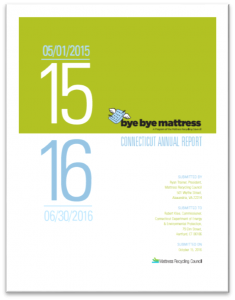
The Connecticut program has “exceeded, met or is on pace to achieve nearly all benchmarks” set in its plan, which was approved by the state in 2014. Highlights include:

  • Recycled 150,000 mattresses.
  • Recovered more than 2,800 tons of steel, foam and other materials that will be made into new useful products.
  • Expanded the collection network to 101 free drop-off sites throughout the state.

report-15-16“We are pleased with the program’s productive start and will continue to work with city leaders, businesses and the state to improve the program, expand the number of communities served, and increase the volume of mattresses recycled,” said Ryan Trainer, President of MRC and the International Sleep Products Association.
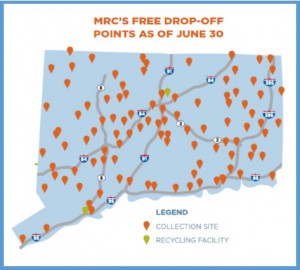
Bye Bye Mattress allows Connecticut residents to drop-off used mattresses at participating collection sites, collection events and recycling facilities free of charge. This collection network is made possible by the $9 recycling fee that Connecticut consumers pay when they buy a new mattress or box spring. The fee provides for collection containers, transporting the discarded mattresses and recycling costs.

Industry-led recycling programs like Bye Bye Mattress will play an important part in helping Connecticut reach its goal to divert 60 percent of materials from disposal by 2024, officials indicated in the 59-page report.

“We applaud the mattress industry for developing a successful statewide program under the mattress stewardship law that has already recycled thousands of mattresses in an environmentally sound manner,” said Robert Klee, Commissioner of Connecticut’s Department of Energy and Environmental Protection.  “This program has created jobs, recovered vast quantities of resources to be reused, saved municipalities $1.5 million in disposal costs and given residents an easy way to recycle a cumbersome item.”mrc-logo

MRC is also working with more than 130 other public and private entities, including mattress retailers, hotels, military bases, universities and healthcare facilities in Connecticut to divert their discarded mattresses from the solid waste stream.  The MRC website indicates that the organization continues to enroll interested municipal transfer stations in the program and work with those interested in hosting recycling events.

Connecticut’s Public Act 13-42 (enacted in 2013 and amended in 2014) required the mattress industry to create a statewide recycling program for mattresses discarded in the state. Connecticut residents can find their nearest participating collection site, collection event or recycling facility at www.ByeByeMattress.com.

map-recycling

Panera in Connecticut: State of Flux

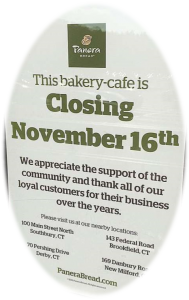
If you’re looking for a Panera location in Connecticut, check twice before you head out for a sandwich.  There may be a new location opening nearby, or the locale you’re familiar with may have already closed its doors. The churn at Panera may not be unusual, but it did come as an unwelcome surprise to regulars at the Newtown location when it abruptly closed in mid-November, with a sign on the door saying farewell (and please visit other locations.)   And later this month, the long-time location in Darien will be closing.

The Darien store has been renting 3,754-square-feet — the entire first floor of its building, since 2007, when it became the first Panera Bread restaurant to open up in Connecticut, according to published reports.closing

The chain now has more than 2,000 locations, including in Connecticut – some owned by the company, most by franchisees.  While the departure from Newtown was an unexpected surprise to customers, plans to leave the Darien location have been known since June, when it was first reported by local media.

Last fall, a Panera location closed in Meriden and a location in nearby Wallingford opened. Also on the plus side, a Panera opened earlier this year at Evergreen Walk shopping plaza in South Windsor.  As of this spring, there were 17 Panera Bread locations in Connecticut, all across the state.  The Downtown Hartford location, its first in the city, opened in 2013.

paneraAs of June 28, 2016, there were 2,007 bakery-cafes in 46 states and in Ontario, Canada operating under the Panera Bread, Saint Louis Bread Co. or Paradise Bakery & Cafe names. Published reports indicate the company has 97,000 employees nationwide and saw a 3.4 percent growth in sales in its third quarter this year. In 2015, it reportedly generated roughly $2.7 billion in revenue. Founder and CEO Ron Shaich attended college at Clark University in Worcester in the 1970’s.

Earlier this year, Fortune magazine reported that the company estimated that over 20% of orders would be produced and paid for digitally by the end of 2016, up from 16%. In some markets, digital sales are making up more than a third of retail sales, according to the company. The restaurant chain says digital orders could make up half of the total business down the road, the magazine reported.

According to the industry website Fast Casual, Panera Bread does not sell single-unit franchises, so it is not possible to open just one bakery-cafe. Rather, the company has chosen to develop by selling market areas which require the franchise developer to open a number of units, typically 15 bakery-cafes in a period of 6 years.

Panera says it serves 3 to 4 percent of all Americans every week.

panera

Changes on the Way in New Haven Media Coverage

The news media focused on New Haven is undergoing some changes, as one publication ends, a new electronic weekly business news round-up is about to begin, and a longtime local business paper is changing its subscription system, reducing the number of non-paying subscribers. New Haven Living magazine, published by the Hartford Courant Media Group in recent years, will cease publication with its January edition, the company recently announced.  The New Haven-focused edition of the weekly CTNOW. an entertainment section, will also cease publication, last publishing on Dec. 29, the company said.

The Courant plans to continue publishing Hartford Magazine and the Hartford edition of CTNOW.  new-havenEach monthly addition of New Haven Living was nearly identical to Hartford Magazine, usually with a handful of New Haven-focused articles and features added.  The Courant reported that it made the decision while evaluating opportunities to invest in higher-growth areas and the cost of distribution in Greater New Haven.

Business New Haven, which began publication in 1993, announced in its latest issue that “we are changing our publishing approach” in an open letter to readers from veteran publisher Mitchell Young, under the headline “The Time Has Come To Decide.  Do You Want Business New Haven?”

Young says that “only paid subscribers will be guaranteed” to be included on the newspaper’s circulation list beginning with the next issue.  Subscriptions to the monthly print edition will be $24 per year.

“We believe in the value of quality local publications and we hope you find us worth the cost of a lunch – perhaps that is a way of saying there is No Free Lunch,” the full-page letter said.

bnhA limited number of promotional copies will be limited “based on a proprietary algorithm for the support of our advertisers,” Young noted.  He also indicated that plans are in the works to expand the publication’s CONNTACT.com website in the next year, as “we try to build our subscriber base” for the print edition.  Business New Haven also publishes the monthly New Haven Magazine.

The Hartford Business Journal (HBJ), which prints a weekly print edition in the Hartford region and has a roster of electronic news publications and business-oriented events, added a statewide daily email aimed at business executives statewide in 2013.  The  paper recently announced that for those doing business in New Haven and Middlesex Counties, a weekly news round-up, New Haven Biz, will be added to the HBJ e-mail line-up on February 1.

The email is slated to deliver a weekly roundup of business news and information from the Elm City and beyond, the paper’s website explains. The Hartford Business Journal recently had a prominent location at the Greater New Haven Chamber of Commerce Big Connect annual business-to-business event to promote the upcoming news service.

The publication also emails HBJ Today each weekday at noontime highlighting the day’s lead business stories.  Subscriptions to the email-delivered news products, which also include the CT Health Care Weekly and CT Green Guide Weekly, are free.   CT Morning Blend includes the top business stories from online news sources around the state and the nation “to keep business decision-makers ahead of the competition.” It also includes a stock market snapshot and a business calendar.

HBJ, with a strong local presence in Greater Hartford for more than two decades, is published by New England Business Media, which also publishes the Worcester Business Journal and MaineBiz.  It also sponsors the annual CT Business Expo at the Connecticut Convention Center and numerous business programs and events in the region.

CT Unemployment Rate in Construction Industry Improving, But Remains Among Highest in US

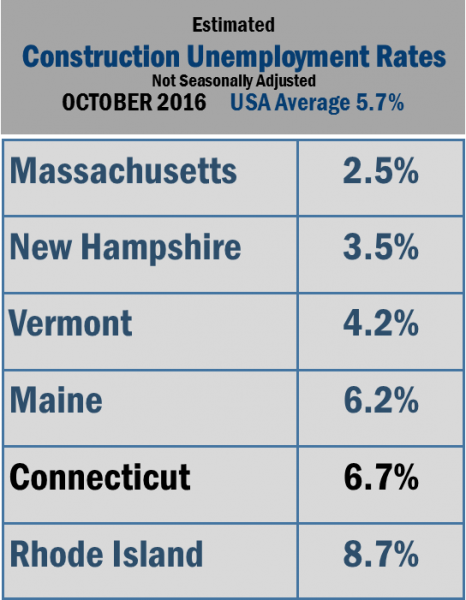
Connecticut’s unemployment rate in the construction industry remained among the highest in the U.S., ranked 39th among the 50 states in October, although the year-over-year change was the 12th best in the country.  Connecticut’s October unemployment rate in the industry was 6.7 percent, higher than the U.S. average of 5.7 percent, according to data released by the Associated Builders and Contractors (ABC). construction The state’s construction industry unemployment rate nudged downward from 7.1 percent in September, but was 6.4 percent in July 2016.  In recent years, the rate ballooned to 18.1 percent in October 2010, at the height of the recession, from a low of 5.8 percent in October of 2008.

Overall, the U.S. construction industry added 19,000 net new jobs in November and has now added jobs for three consecutive months, according to analysis of U.S. Bureau of Labor Statistics data compiled by Associated Builders and Contractors. rates

Industry employment is up by 2.4 percent on a year-over-year basis, considerably faster than the overall economy’s 1.6 percent job growth rate. Construction industry employment growth would likely be much sharper if more suitably skilled or trainable workers were available to fill available job openings, according to the ABC.

The data indicate that skilled labor shortage nationally appears to be impacting nonresidential activity more than residential. The nonresidential sector added 1,100 net new jobs in November, while the residential sector added 19,600 positions. Heavy and civil engineering lost 2,100 jobs for the month.

“The demand for construction talent was strong before the election, and the outcome has improved the near-term outlook for private and public construction activity,” said ABC Chief Economist Anirban Basu.  “The implication is that demand for construction workers is positioned to remain high, which will translate into gradual reduction in industry unemployment and significant wage pressures.statece

In the state-by-state numbers, calculated for October, the states with the lowest estimated not-seasonally-adjusted construction unemployment rates were North Dakota, Massachusetts, Colorado, Utah, New Hampshire and South Dakota. October not seasonally adjusted (NSA) construction unemployment rates were down in 33 states, including Connecticut, on a year-over-year basis.  Connecticut's October 2015 unemployment rate in the construction industry was 8.0 percent.

North Dakota’s unemployment rate in the industry was 2.4 percent, with Massachusetts at 2.5 percent.  New Hampshire’s construction industry unemployment rate was 3.6 percent.  Elsewhere in New England, Rhode Island’s unemployment rate in the construction industry was fourth highest in the nation, at 8.7 percent in October.

The unemployment rate for all U.S. industries fell to 4.6 percent in November, the lowest rate since mid-2007 and 0.3 percentage points below October’s rate. The labor force lost 226,000 persons for the month, but is still more than 2 million people larger than at the same time one year ago, officials pointed out.

EpiPen in Connecticut: Costs Vary, Concerns Continue; New Congressional Hearing Possible

Obscured in recent months by the intense presidential campaign, the furor over the price of pharmaceutical company Mylan’s life-saving EpiPen may be moving back to center stage in Washington as questions continue about Connecticut’s policy and the varying impact on school districts across the state.  The EpiPen is the widely used medical device that quickly administers a dose of epinephrine to counter allergic reactions. The cost of EpiPens to Connecticut schools - which keep EpiPens in their nurses’ offices in case a student has a severe allergic reaction - may be defrayed or eliminated by Mylan’s “EpiPens4Schools” program, which gives some schools two twin packs of the medical devices for free.  But that is not uniformly true, according to a recent survey by CT by the Numbers, and questions are being raised about the program’s future. pens

A report by Connecticut’s Office of Legislative Research found that “over the last decade, Mylan has continuously increased the EpiPen’s cost, from approximately $60 in 2007 to over $600 in 2016 for a pack of two pens. The device requires a prescription and must be replaced annually.”

North Haven, which has participated in the free program, warns that “if the free program is discontinued, it will be a significant financial burden” for the school district.  “To satisfy the Connecticut mandate, we must stock one box each of EpiPen Jr. and EpiPen Sr., bringing the total cost to $1,600 x 7 schools = $11,200/year!!!”

In Chaplin, officials have also been using the free program, but note “we will not always be eligible year-to-year,” anticipating “the cost increasing by at least $300 or greater per school.”

Now, the chairman of the U.S. Senate Judiciary Committee says he is considering a subpoena or another method of compelling testimony from Mylan and federal officials, the Associated Press is reporting.  Mylan says it agreed to pay $465 million to settle allegations it overbilled Medicaid for EpiPen, but Sen. Charles Grassley says the Justice Department has said there is no "executed settlement."  At issue is whether the product should have been classified as generic.map

Published reports indicate that Mylan acquired the decades-old product in 2007, when pharmacies paid less than $100 for a two-pen set, and has since been steadily raising the wholesale price. In 2009, a pharmacy paid $103.50 for a set. By July 2013 the price was up to $264.50, and it rose 75 percent to $461 by May 2015. This past May the price spiked again to $608.61, according to data provided by Elsevier Clinical Solutions’ Gold Standard Drug Database.

At a December 1 health forum sponsored by Forbes, Mylan CEO Heather Bresch said “We absolutely raised the price and take full responsibility for that, ” insisting that Mylan’s price increases were justified by improvements the company made on the product.

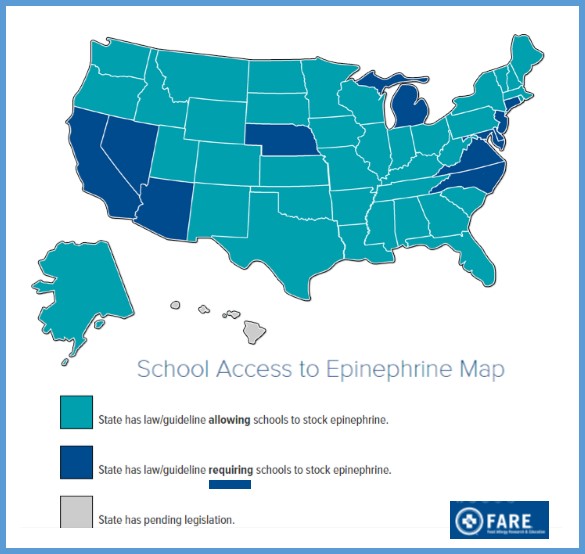
As the increases were being imposed, Mylan intensified efforts to have states require that EpiPens be made available in schools.  Connecticut was among 11 states which passed such a law.  The Connecticut General Assembly approved a bill in June 2014 that required all state primary and secondary schools to carry a supply of EpiPens. The new law also allowed school personnel other than a school nurse – if they were properly trained – to administer the epinephrine.  Published reports indicate that other states have approved laws allowing student to bring the dispensers with them to classes or encouraging schools to stock the drug.

The Connecticut Department of Education said it does not know how much the new mandate cost the state’s more than 1,300 primary and secondary schools, because the drug is purchased at the local level at a number of approved pharmacies throughout the state, officials told CT Mirror earlier this year.

A number of districts indicated to CT by the Numbers that they had EpiPens on hand in their schools even before passage of the state requirement, and at least one that had participated in the free program previously did not do so this year.

In Eastford, officials purchased one .15 mg dose and one .30 mg dose EpiPen in each of the past three years.  The costs increased steadily, from $599.90 in 2021-13 to $740 in 2015-16.   In the Region 9 (Easton, Redding) school district, for example, officials indicated that they paid $325 each for three EpiPen twin-packs for the Helen Keller Middle School this year.

Northwestern Regional School District 7 and Regional School District 12, both participants in the free program, have not incurred any costs for EpiPens in recent years.  Bolton school officials report that costs have increased in recent years, to approximately $600 per package of two” for a total of $1800 for the year.  Region 16 reports that they budget for EpiPen purchases each year, in case the free program is no longer available to them.  As of last year, they indicated, the twin-pack price was $535, but they were able to benefit from the company’s free program.

In Cromwell, schools have received 2 twin-packs per school through the free program for the past three years; previously they were purchased by the school district, officials said. In Ansonia, some were provided at no cost, others were purchased. The last time that North Haven paid for the EpiPens was in 2012, when the cost was about $190 each.

statIn 2015 the legislature considered, but did not pass, a bill requiring the insurance commissioner to study and report on health insurance coverage of and out-of-pocket expenses for EpiPens, according to the OLR report.  The 2014 legislation requires (a) schools to designate and train nonmedical staff to administer EpiPens to students having allergic reactions who were not previously known to have serious allergies and (b) the public health and education departments to jointly develop an annual training program for emergency EpiPen administration.

The website STAT, which focuses on health and medicine, reports that Mylan Pharmaceuticals has been selling the devices to schools at a discounted price for years, giving them a break from rising costs. But the program also prohibited schools from buying competitors’ devices — a provision that experts say may have violated antitrust law.

Mylan’s “EpiPen4Schools” program, begun in August 2012, offers free or discounted EpiPens to schools. Over 65,000 schools receive free EpiPens through the program; an unknown number of schools buy the epinephrine auto-injectors at a discount. Laws in at least 11 states require schools to stock epinephrine, and keeping a stockpile is incentivized by federal law across the country.

As of last year, the EpiPen4Schools discounted price was $112.10, according to company documents reported by STAT, although the prices cited by Connecticut districts vary.


America’s Best States to Live In: Connecticut Ranks Second

The only state that is a better place to live in than Connecticut is Massachusetts, according to a new survey of key data.  Connecticut was ranked second when the website 24/7 Wall St. reviewed three statewide social and economic measures — poverty rate, educational attainment, and life expectancy at birth — to rank each state’s living conditions.  Based on the data analyzed, the state’s motto could easily be “live long and prosper.” Massachusetts, home to one of the nation’s wealthiest and most highly educated populations, followed by neighboring Connecticut, lead the nation in quality of life. Mississippi, the poorest state in the country, trails the other 49 states.

Among the key stats for Connecticut:

  • 10-year population growth: 5.8% (10th lowest)
  • Unemployment rate: 5.1% (19th highest)
  • Poverty rate: 10.5% (6th lowest)
  • Life expectancy at birth: 80.4 years (2nd highest)

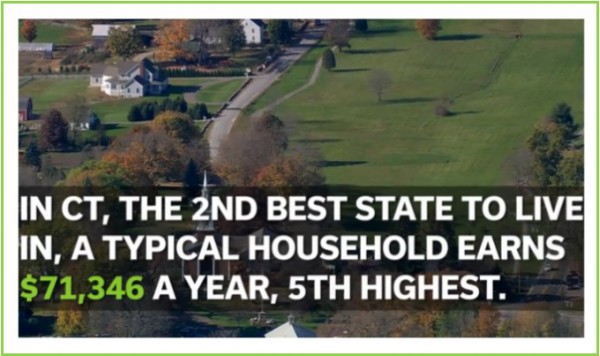
ct-2Quality of life in the United States is heavily dependent on financial status, the survey summary points out. As a consequence, the nation’s best states to live in often report very high incomes. With a median household income of $71,346 a year, fifth highest of all states, Connecticut is the second best state to live in and an especially good example of this pattern, the description of Connecticut’s ranking explains.
The publication notes that “While satisfactory living conditions are possible with low incomes, this is true only to a point. Once incomes fall below the poverty line, for example, financial constraints are far more likely to diminish quality of life.”

Rounding out the top five:  New Hampshire, Minnesota, and New Jersey.  At the bottom of the list: Alabama, Arkansas, Louisiana, West Virginia and Mississippi.

Education levels are another major contributor to a community’s living conditions — not just as a basis of economic prosperity, but also as a component of an individual’s quality of life. Due in part to the greater access to high paying jobs that often require a college degree, incomes also tend to be higher in these states. In all of the 15 best states in which to live, the typical household earns more than the national median household income of $55,775, 24/7 Wall St. pointed out.ct-2nd

Like the vast majority of states on the higher end of the list, Connecticut is described as relatively safe. There were 219 violent crimes reported for every 100,000 state residents in 2015, among the lowest rates of all states, the survey stated.  Housing markets are also indicative of quality of living. A high median home value, for instance, frequently means high demand for housing in the area. Nationwide, the typical home is worth $194,500. In most of the 25 top states, the median home value far exceeds the nationwide median.

The survey did not take into account more subjective conditions such as climate preference, the presence of friends and family, and personal history.

To identify the best and worst states in which to live, 24/7 Wall St. devised an index composed of three socioeconomic measures for each state: poverty rate, the percentage of adults who have at least a bachelor’s degree, and life expectancy at birth. The selection of these three measures was inspired by the United Nations’ Human Development Index. Poverty rates and bachelor attainment rates came from the U.S. Census Bureau’s 2015 American Community Survey. Life expectancies at birth are from the Centers for Disease Control and Prevention and are as of 2012, latest year for which data is available. Unemployment rates are from the Bureau of Labor Statistics, and are for October 2016, the most recent available month of data.