Norwalk, Stamford Gain New Businesses, Taking From Each Other

Octagon Inc., a sports and entertainment marketing and talent management agency, is relocating its headquarters to the Shippan Landing complex in Stamford. The company, which is moving from Norwalk, has signed an 11-year lease to occupy 57,009 square feet across the entire third floor and a section of the second floor of the property at 290 Harbor Drive along the Stamford waterfront. The move apparently comes without state financial incentives, and comes months after another corporate citizen made the reverse move – from Stamford to Norwalk – with a boost from state incentives.  Less than 15 miles and 15 minutes apart, two of Fairfield County’s leading cities are experiencing the corporate version of “Trading Places.”

Crius Energy, through its wholly owned subsidiary Regional Energy Holdings, announced plans last year to move its headquarters from Stamford to Norwalk, placing 200 jobs in the city and committing to add 225 more over the next four years, according to an announcement in May from the Governor’s Office.

Officials said the company – launched in Connecticut – has become one of the largest independent energy retailers in the United States, supplying electricity, natural gas and solar energy products to more than 900,000 customers across 19 states and the District of Columbia, including 100,000 in Connecticut. According to officials, Crius also has operations in Florida, Texas and Australia.  They had outgrown their Stamford facility, which led to plans for a $29 million project in Norwalk, to include the renovation of 48,000 square feet of an existing building. 

To encourage the move, the state Department of Economic and Community Development (DECD) said it would provide a 10-year, $8 million low-interest loan to support the project, funding that can be used for fixtures and equipment and leasehold improvements. Crius is also eligible for up to $2 million in tax credits through the Urban and Industrial Sites Reinvestment Tax Credit Program, as well as a $100,000 grant to train employees, according to state officials.

The Crius Energy website points out that “Although based in Connecticut, many members of our leadership team have relocated great distances to become a part of Crius Energy. Together, they bring more than a century of combined industry and functional expertise as well as a deep-rooted passion for transforming the retail energy sector.”

It was a year and a half ago, in May 2015, that the first lease signing was announced for the then newly-renovated five story, 185,000 s/f office building within the 17-acre Shippan Landing waterfront office park in Stamford. That tenant was Stamford-based Workpoint, a provider of co-working environments geared to the needs of media firms along with independents and professionals.

Published reports indicated that since being acquired in 2012 by George Comfort & Sons in a partnership venture with Angelo Gordon & Company, the six-building, 758,000 s/f office park, formerly known as Harbor Plaza, saw an extensive repositioning and modernization program, which was then nearing completion. Workpoint leased a total of 15,173 s/f, including a 1,000 s/f multicamera studio with green screen, control room, and editing facilities on the building’s second floor, according to published reports at the time.

“Shippan Landing continues to be the preferred destination for some of the nation’s top creative companies and we are pleased to welcome Octagon to our tenant roster,” said Peter S. Duncan, president and CEO of George Comfort & Sons.  Among Octagon’s many clients are household names from the sports world - Stephen Curry of the Golden State Warriors, members of the World Series champion Chicago Cubs and other major league players, current and retired, and Olympic gymnast Simone Biles.

Shippan Point offers what the company describes as “truly is the best business location in the Stamford area,” with “spectacular grounds and magical stretching views.”

Back in 2013, the state Bond Commission approved $1 million in borrowing to help an emergency home repair company move its headquarters from Stamford to Norwalk.  The bonding was aimed at assisting the HomeServe USA Corporation in relocating its headquarters as part of an agreement to create 130 jobs and maintain another 109. In addition to a $1 million grant, the company was also eligible for a $3 million, partially forgivable, loan and up to $5 million in tax credits, local media reported.  The company’s customer call center is located in Tennessee.

And last May, the State Bond Commission approved $22 million in grants and loans for the world's largest hedge fund despite what press reports described as bipartisan complaints that the wealthy company can afford the move without state incentives.  The commission voted 7-2 to award the package to Bridgewater Associates, a financial industry powerhouse operated by Greenwich billionaire Ray Dalio, one of the nation's wealthiest individuals.

At the time, state officials indicated that the financial package helped to prevent the company from potentially relocating from Connecticut to nearby Westchester, N.Y.  The money was expected to be used to renovate and expand the firm's Westport headquarters, along with operations in Wilton and Norwalk, published reports explained. In addition to the loan, Bridgewater was said to also be eligible for two grants: $3 million for energy-efficiency upgrades and $2 million for job-training efforts.  The state apparently initially offered Bridgewater $130 million in loans and grants but the amount was scaled back after the company scrapped plans to build a new corporate complex in Stamford, south of I-95, in the face of local opposition, reports indicated.

https://youtu.be/7mfWZhlN4rE
 

Percentage of Unbanked, Underbanked Households Continues to Climb in CT, Now Exceeds 1 in 5 Households

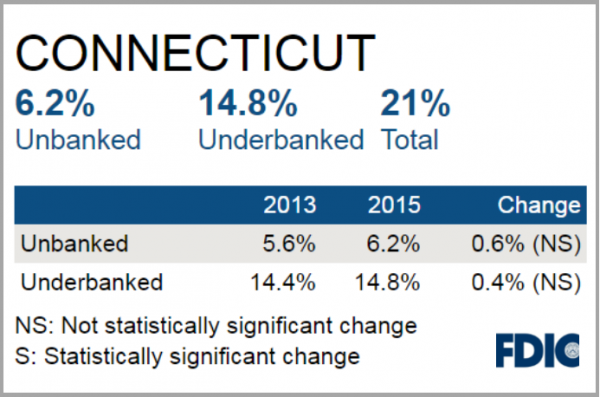
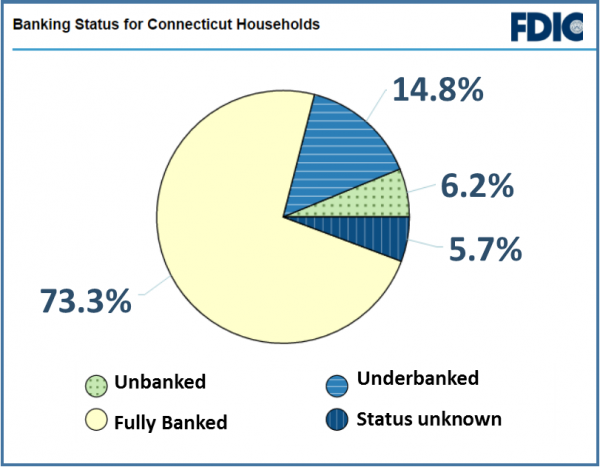
One in five Connecticut households is unbanked or underbanked, according to data compiled by the Federal Deposit Insurance Corporation, and the percentage of residents unbanked – those that do not have an account at an insured institution - has climbed in the state over the past six years. The percentage of Connecticut households considered unbanked has risen steadily, from 5.3 percent in 2009 to 6.2 percent in 2015, the most recent year for which data is available.  Connecticut ranked 21st in the nation in the percentage of unbanked households. 

Overall, the percentage of state households thatare either unbanked or underbanked increased slightly, from 20 percent to 21 percent between 2013 and 2015.  Those considered unbanked had a checking or savings account but also obtained financial products and services outside of the banking system.

Connecticut’s percentage of unbanked and underbanked individuals is better than the national average, which is 26.9 percent.  Nationally, 68 percent are considered to be fully banked, with an account or accounts at an insured institution, compared with 73.3 percent in Connecticut.

To assess the inclusiveness of the nation’s banking system, and in partial fulfillment of a statutory responsibility, the FDIC conducts biennial surveys of households to estimate the proportion of households that do not fully participate in the banking system.  The survey provides estimates of the proportion of U.S. households that do not have an account at an insured institution, and the proportion that have an account but obtained (nonbank) alternative financial services in the past 12 months.

Estimates from the 2015 survey indicate that 7.0 percent of households in the United States were unbanked in 2015. This proportion represents approximately 9.0 million households. An additional 19.9 percent of U.S. households (24.5 million) were underbanked,

The 2015 FDIC National Survey of Unbanked and Underbanked Households presents new data and insights on the size of unbanked and underbanked markets at the national, regional, state, and large metropolitan statistical area (MSA) levels. This is the fourth installment of the report.

In the Hartford-East Hartford-West Hartford metropolitan statistical area, a slightly higher percentage of households are unbanked or underbanked – 25.6 percent.  In the New Haven-Milford MSA, that percentage is slightly lower than statewide, at 19.5 percent.  The Bridgeport-Stamford-Norwalk MSA is lower still, at 18 percent.

Lembo Develops Plan Aimed at Bringing Drug Costs Within Reach

State Comptroller Kevin Lembo, after what was described as “exhaustive research and consultation with representatives across all sectors of the health care industry,” has developed a five-point plan to address “skyrocketing pharmaceutical drug costs.” Lembo’s proposed legislation, which is to be considered by legislators in the five-month session that began earlier this month, aims to be comprehensive in addressing a range of interrelated issues.  Those issues include requiring justifications for sharp price increases, establishing oversight of drug costs that exceed certain thresholds, ensuring that consumers benefit from rebate savings, promoting insurance plans that emphasize affordable co-pays and preventive care, and eliminating incentives that perversely encourage providers to prescribe the most expensive drugs.

“In a divided country,” Lembo said, “when we’re desperate to find common ground, virtually everyone can agree that prescription drug costs are out of control and must be fixed.  This rise in patient cost share, combined with the rising prices of pharmaceuticals is creating a significant financial burden for Connecticut residents,” Lembo added, noting that “consumers are increasingly bearing a greater share of those costs.”

Lembo, who served as Connecticut’s first Healthcare Advocate prior to being elected State Comptroller in 2010, currently administers the state health plan on behalf of approximately 200,000 people.  The plan includes:

  • Require pharmaceutical manufacturers to justify launch prices and price increases over a certain threshold

To address rising drug prices that appear to be arbitrary and unjustifiable, Lembo proposes a requirement that when drug manufacturers increase prices beyond certain thresholds, (for example, list prices increase over 50 percent in the last five years or 15 percent in the last year or launch prices 30 percent or more above the average price for other drugs in a therapeutic class) they must provide the state with information about total costs for producing specific drugs and costs for research and development, marketing, different prices charged for the drug, total profit from specific drugs, research and development efforts that have not resulted in any approved drugs, details about discounts and rebates provided and, of course, a justification for the launch price or the price increase in question.

The findings of a state review would be reported to the legislature and governor to evaluate the appropriateness of the price increases in question.



  • Limit the launch price and annual increases of certain high cost drugs

Establish a working group to evaluate the potential of using the information reported above to regulate drug prices in certain egregious instances through the creation of a state-level drug price review board. The authority would review the launch prices of new drugs and annual increases of existing drugs that exceed certain thresholds. The working group should recommend a process for determining if the launch prices or price hikes are justified and recommend possible state actions to take when increases are deemed unjustified.

  • Promote the adoption of value-based insurance design

The state Department of Insurance (DOI) and the state health exchange should be required to promote the adoption of plans that use a value-based insurance design. Value-based insurance for prescription drugs generally encourage medication adherence by reducing or eliminating co-payments and deductibles for drugs that help control chronic conditions.  Better managed chronic diseases reduce in-patient hospital stays and emergency room visits by individuals with chronic diseases. The state employee plan has seen significant increases in medication adherence since adopting a lower co-pay structure for maintenance drugs through the state Health Enhancement Plan.

  • Allow consumers to benefit from negotiated drug rebates.

Require health plans to base co-insurance and deductible payments on the net price of the drug, post rebate, rather than the list price, allowing the consumer to share in rebate savings negotiated by the pharmacy benefit manager or plan administrator.  For certain highly rebated drugs the list price can be as much as three times more than the final price paid by a health plan after manufacturer rebates.

  • Remove incentives for physicians to administer higher cost drugs.

In 2004, Medicare began to reimburse physicians 6 percent of the acquisition cost of drugs for administration. Commercial payers, which often base their reimbursement policies off Medicare, quickly followed suit. The new policy created a perverse incentive in which physicians were paid more for using more expensive drugs even when lower cost equally effective alternatives were available. It also incentivized drug manufacturers to significantly increase prices. As a result, many physician-administered drugs have seen massive price increases since 2004, with many oncology drugs well in excess of $100,000 per regimen. The state should require state-regulated insurance plans to completely delink the reimbursement for physician-administered drugs with the costs of the drugs administered in order to eliminate such perverse incentives.

“This plan emphasizes transparency, accountability and common-sense health care policy that puts quality and wellness for everyone above the corporate profits of big Pharma,” Lembo said in recommending the five-part plan.

Over the past several years, Lembo has been working with state leaders and Connecticut’s congressional delegation to investigate flaws in the pharmaceutical market and implement policies to address the problem.   Last year, he co-hosted a forum at the State Capitol with the Connecticut State Medical Society (CSMS) that brought together physicians, pharmaceutical companies, academicians, patient advocates and other industry experts to address the skyrocketing cost of medications.

Lembo also serves on a working group of the NASHP (National Academy for State Health Policy), which recently issued a report recommending proposed state action, some of which is reflected in Lembo’s legislative proposal.  The Office of the Healthcare Advocate, which Lembo led for six years a decade ago, is an independent agency that helps consumers when they have disputes with their health insurance company. They also educate people about their health care rights and serve as a watchdog over Connecticut’s healthcare marketplace.

Nominations Open for State's First Connecticut Entrepreneur Awards

A consortium of public and private associations and agencies, higher education institutions and entrepreneur-assisting nonprofit and for-profit organizations is launching the CT Entrepreneur Awards, designed to celebrate “the entrepreneurs and support system that make Connecticut work.” The inaugural awards, to be presented this spring, will recognize a variety of individuals and organizations that connect, collaborate and communicate amongst each other to help entrepreneurs succeed, according to organizers of the initiative. Nominations are now open for the CT Entrepreneur Awards, which will recognize the individuals and organizations that are instrumental in running the state’s ecosystem. From community builders and events to government officials and advisors that continuously support entrepreneurs, the awards are intended to highlight local leaders “that make a difference.”

Award categories include: Venture, Community Builder, Program, Space, Event, Education, Funding, Corporate/Institutional, and Government.

The CT Entrepreneur Awards are described as “community driven,” reflecting the easy online nomination form. The nine main categories were established in an effort to gather and honor “a broad array of leaders that create the foundation for entrepreneurs to succeed.” Individuals are asked “to nominate as many leaders that deserve recognition for their work in the community.”

During January, nominations are being sought and collected. From that broad list, the consortium will narrow the field and hold final online voting in February. Plans are to hold an awards in late March or early April, with event serving to “bring together all of the people dedicated to supporting entrepreneurs throughout the state.”

The CT Entrepreneur Awards are a product of the CT Entrepreneur Event Organizers consortium, an all-volunteer cooperative effort of people and organizations that host and facilitate entrepreneur facing events in throughout the state.  Proceeds from the CT Entrepreneur Awards will be directed to fund the statewide Entrepreneur Events Calendar, www.ctevents.co.

Consortium members include Accelerated Ventures, Axis 901, Baypath University, BEACON, Bridgeport Innovation Center, Business New Haven, CBIA, CCSU, ColoDesk.com, Congressman Jim Himes, Connecticut Economic Resource Center, Inc., Connecticut Innovations, CTNEXT, Connecticut Small Business Development Center, Connecticut Technology Council, CountMeIn!Hartford, Crossroads Venture Group, CT Entrepreneur Meetup, CT Hackerspace, CT Invention Convention, CT User Experience, Design Professionals CT ,Women's Small Business Development Council, CURE, and Danbury Hackerspace.

Consortium members also include the state Department of Economic & Community Development, Digital Surgeons, Economic Development Corp of New Haven, Enhanced Capital, Entrepreneurship Foundation, Fairfield University, Founderstood, Goodwin College, Hartford Business Journal, Help CT Grow, Innovate Hartford, Innovation Destination: Hartford, Launch EZ, LEARN TO PROGRAM MEDIA, LootScout, M5 Information Services, Madison Mott, MakeHaven, MakerspaceCT, Metro Hartford Alliance, Miles Finch Innovation, and MJX Asset Management

Also participating in support of the initiative are National Invention Convention, New Haven Chamber of Commerce, New Haven Lean Startup Meetup, Remarkable Technologies, reSET, SCORE – Hartford, SCORE - Western Connecticut, Senator Chris Murphy’s office, Spark, SPARK MakerSpace, Stamford Innovation Center, Stamford Tech Meetup, Startup Grind - New Haven, Startup Hartford, TAN2000 International, Test My Pitch, The Business Council of Fairfield County, The Diversion, The Grove, The Refinery, Thrise, Town of Old Saybrook, and Transactions Marketing, Inc.

Members also include the U.S. Small Business Administration, University of Connecticut, UConn - Connecticut Center for Entrepreneurship and Innovation, UConn - Entrepreneurship and Innovation Consortium, UConn - School of Business, UConn - School of Engineering, UConn - Technology Incubation Program, University of Hartford - Entrepreneurial Center, University of Hartford - Women's Business Center at Entrepreneurial Center, University of New Haven - Tagliatela College of Engineering, Wesleyan University, Western Connecticut State University, Westfair Communications, Whitneyville Cultural Commons, Yale Center for Molecular Discovery, Yale Entrepreneurial Institute, Yale Office of Cooperative Research & Yale Entrepreneurial Institute, Yale School of Management, and Yale University.

State’s First Law Incubators Set to Launch in Hartford, Bridgeport

Connecticut’s first law incubators are due to open early this year at the Center for Family Justice, a Bridgeport-based nonprofit, and at UConn School of Law,  being established to provide affordable legal services to people who need them and help lawyers establish solo practices. The Connecticut Community Law Center, an initiative of the law school and the Hartford County Bar Association, aims to help people who have traditionally been underserved by the justice system: low- and moderate-income clients who don’t qualify for legal aid but can’t afford standard legal fees, the UConn School of Law announced this month.

“Too many people face legal problems concerning essential human needs without proper representation because they fall into the growing access-to-justice gap, between the very poor who qualify for legal aid and those with the financial means to pay a private lawyer,” said attorney Mark Schreier, who was appointed director of the Connecticut Community Law Center. “Standing alone and without professional guidance, those individuals enter our justice system at a tremendous disadvantage.”

The incubator is set to open in February in William F. Starr Hall on the UConn Law campus in Hartford. In addition to the services of the director, the law school will provide office space and support – including training, guidance, and legal research resources – for up to six solo practitioners. The Hartford County Bar Association and the law school faculty will provide mentors, and Greater Hartford Legal Aid will help with training and referrals.

The subsidized working environment will allow participating lawyers to provide legal services at a modest cost that is lower than standard legal fees, with each lawyer setting the fee on a case by case basis. Schreier said he expects cases to involve a wide range of legal problems, including family, consumer, probate, housing, bankruptcy, employment, immigration, and other general civil matters.

In Bridgeport, the Center for Family Justice, a Bridgeport-based nonprofit that provides services to trauma survivors affected by domestic violence, sexual assault or child abuse, will house the incubator.

The Center is working with Connecticut law schools to help build the center’s legal apparatus, Fairfield County Business Journal reported, with several professors from Quinnipiac University on the steering committee to help develop the parameters of the program.  Four attorneys are being sought.

Lawyers in the incubator program at the Center will provide the legal advices services and representation needed by victims of domestic violence, including restraining orders, divorce proceedings, child custody and support, housing and immigration issues.  An Open House was held in September to interest local attorneys in participating.

“A legal incubator is like a business incubator,” Jennifer Ferrante, who joined the Center for Family Justice staff as the coordinator for the new service, told the Journal.  At the center’s office at 753 Fairfield Ave., “We are going to be housing four attorneys here on site,” she said. Two of the first attorneys who applied and were accepted in the program are recent law school graduates.

The American Bar Association counts more than 60 lawyer incubators around the country, three-fourths of them established since 2014. The Connecticut Community Law Center and the Justice Legal Center at the Center for Family Justice in Bridgeport, will be the first in Connecticut.

Participating lawyers will spend 18 to 24 months at the Connecticut Community Law Center before moving on with their practices. The training and experience they receive will not only help them jump-start their practices, it will spread seeds of innovation in the delivery of legal services at an affordable cost, UConn Law Dean Timothy Fisher said.

Clients who qualify for services at the Hartford incubator will be those whose incomes exceed the limits for legal aid but fall within three times the federal poverty level. For a family of four, this would mean a maximum household income of $72,900. Clients wishing to apply for services may do so beginning in February, when information will be available at the center’s website: cclc.law.uconn.edu.
“I think it will give the low- and moderate-income community a real chance in getting their legal needs met and ending their cycles in abuse and poverty,” Ferrante said of the new Bridgeport center.

Planning for the legal incubator has been ongoing since 2009. Although the Center for Family Justice is focused on serving six Fairfield County municipalities – Bridgeport, Easton, Fairfield, Monroe, Stratford and Trumbull – it also welcomes those seeking help from elsewhere in the state, officials said.

CT Seen As Hiding Bad Budget News

In an article headlined “Bad Budget News? Some States Just Bury It.” Connecticut is one of two states selected as a poster child for what a national publication describes as “hindering transparency.” The Connecticut policy that brought the unwelcome attention was put in place last year.  As Governing explains:

“Connecticut ended its practice of current services projections. That’s a boring-sounding way of talking about how much programs will cost over time, assuming there are no policy changes. It’s a baseline against which to compare any proposed cuts or increases in spending.”

Ben Barnes, Connecticut’s budget director (Secretary of the Office of Policy and Management), said last year that it didn’t make sense to project shortfalls or surpluses into the future, Governing explains. “There’s no such thing, in my view, as a deficit or a surplus in years in which there is no appropriation in place,” said Barnes, whose photo accompanies the article.

Some legislators complained that the new rules would be a blow against transparency in the budget. The change was adopted anyway, the publication noted, adding that a majority of states already choose not to publish current services projections.

“There is kind of a tendency for policymakers to focus on the immediate and not the future,” Liz McNichol of the Center on Budget and Policy Priorities, told Governing. “This reduces the outside pressure to look beyond one year.”

The publication’s report notes that Connecticut “will have to fill a shortfall of more than $1 billion in its budget this year.”

The other state highlighted in the article is Kansas, where a state task force recommended that the department stop releasing monthly budget reports after numerous reports indicated that the state had fallen short of anticipated revenues.   The Governor’s administration also “decided to kill a quarterly economic report that was also habitually filled with bad numbers.”

Governing is the nation's leading media platform covering politics, policy and management for state and local government leaders.


CT Employers Less Optimistic About Hiring in First Quarter

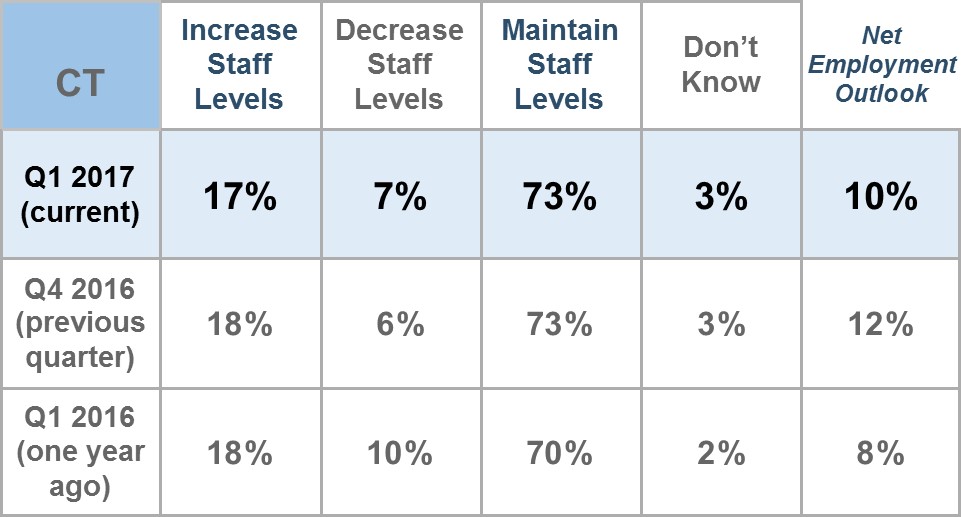
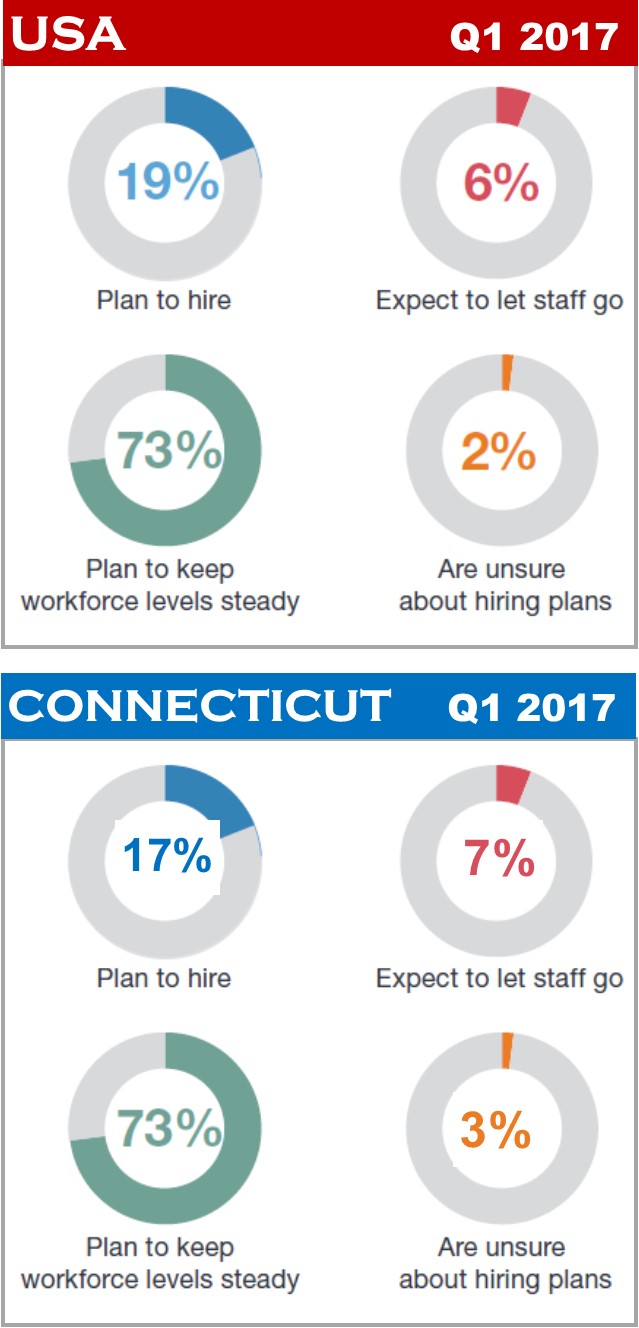
Employers nationwide are slightly more optimistic about hiring in the first quarter of 2017 than employers in Connecticut, according to the ManpowerGroup Employment Outlook Survey, although both expect to hire at a favorable pace during the first quarter of 2017. From January to March, 17 percent of Connecticut companies interviewed plan to hire more employees, while 7 percent expect to reduce their payrolls. Another 73 percent expect to maintain their current workforce levels and 3 percent are not certain of their hiring plans. This yields a Net Employment Outlook* of 10 percent.
For the coming quarter, job prospects appear best in Durable Goods Manufacturing, Nondurable Goods Manufacturing, Transportation & Utilities, Wholesale & Retail Trade, Financial Activities, Professional & Business Services, Education & Health Services, Leisure & Hospitality and Government. Employers in Construction, Information and Other Services plan to reduce staffing levels.


“Hiring intentions are weaker compared to Q4 2016 when the Net Employment Outlook was 12%,” said ManpowerGroup spokesperson Betty Gooding said about the Connecticut outlook. “The hiring pace is expected to pick up compared to one year ago when the Net Employment Outlook was 8%.” Of the more than 11,000 employers surveyed in the United States, 19 percent expect to add to their workforces, and 6 percent expect a decline in their payrolls during Quarter 1 2017. Seventy-three percent of employers anticipate making no change to staff levels, and the remaining 2 percent of employers are undecided about their hiring plans.

When seasonal variations are removed from the data, the Net Employment Outlook is +16 percent, a slight decrease compared to the Quarter 4 2016 Outlook, +18 percent.  That’s a somewhat more optimistic view than employers in Connecticut, the survey found.

State Steps Up to Help Residents Locate What’s Lost

Connecticut’s Office of State Treasurer has long been responsible for what is described as “unclaimed property” – assets that rightful owners have lost track of – as well as efforts to reunite people with their money.  Now, the State Department of Insurance is getting into the “lost and found” business, too. Insurance Commissioner Katharine L. Wade has announced that the Department is offering a free online service to help consumers search for a deceased family member’s lost life insurance policies and annuities.connecticut-insurance-department-logo-2

“It can be a frustrating and overwhelming process at times to locate a missing policy. Whether you are settling the estate of a deceased loved one or trying to help an elderly relative sort out his or her affairs, the Department has resources to help,” Commissioner Wade said. “We are pleased to offer this latest tool that will streamline and simplify the process while protecting confidentiality.”

The Department’s  Frequently Asked Questions    will help consumers through the process. Consumer requests to find a lost policy are encrypted and secured to maintain confidentiality. Participating insurers will compare submitted requests with available policyholder information and report all matches to state insurance departments through the locator. Companies will then contact beneficiaries or their authorized representatives within 90 days.

The Life Insurance Policy Locator, developed by the National Association of Insurance Commissioners (NAIC), provides free nationwide access for help in finding old policies and annuities. There are an estimated $1 billion in benefits and life insurance policies that are unclaimed in the U.S.

ct-big-list-logoAlso this month, the State Treasurer’s office is closing the year with a push urging consumers to check the agency’s CT Big List to determine if misplaced assets can be claimed.  State Treasurer Denise L. Nappier said the special online publication is one component of the Treasury’s efforts to reunite rightful owners with their unclaimed property and is available through its homepage, www.ott.ct.gov.

The mission of the Treasury’s Unclaimed Property Division is to safeguard assets until rightful owners step forward to claim them. Unclaimed property includes money from uncashed payroll checks, bank accounts and utility deposits, insurance proceeds, liquidated assets from safe deposit boxes, stocks, and bonds.

The electronic special edition at www.CTBigList.com has 49,729 names with property valued between $50 and $100; 36,467 names with property valued between $100 and $500; 4,941 names with property valued between $500 and $1,000; 3,538 names with property valued between $1,000 and $5,000; and 551 names with property valued greater than $5,000. Five owners have unclaimed property valued at more than $100,000, with two having property valued at more than $250,000.

The Treasury’s interactive website, www.CTBigList.com, contains the complete list of about 1.5 million names of individuals and entities that may be entitled to as much as $807 million in unclaimed property. The website features a searchable database -- updated with new names weekly -- that makes it easy for residents to find their names. Often, people are unaware that they have inherited money, and others may simply have forgotten an old savings account or payroll check that went uncashed, officials point out.

Treasurer Nappier emphasized, “Searching the Treasury’s unclaimed property website is free.” She said that state residents are regularly contacted by firms, often called “finders,” offering search services for fees that go as high as 10 percent of assets recovered – and that some individuals hire these firms, believing it is the only way to recover lost assets.

“But that’s not true. My advice is that before you send your hard earned money to strangers, check out the CT Big List first – there is no charge for this public service,” Treasurer Nappier said.

Seven CT Businesses Among 500 Fastest Growing Tech Companies in US

Where in Connecticut are the fastest growing technology companies?  New Haven, Branford, Trumbull, Madison, Norwalk, and Farmington. Seven Connecticut companies earned a ranking rank on the recently released 2016 Technology Fast 500 rankings of the fastest-growing tech companies in North America, compiled by professional-services firm Deloitte.  That’s the same number of Connecticut firms on last year’s list.

Four of the state’s representatives produce software, aligning with the dominance of that sector, with some 58 percent of this year’s Fast 500 companies in software. Two of the Connecticut companies work in biotechnology, which comprised the second-most represented segment on the list, covering 13 percent of firms.tech-list

New Haven-based Achillion Pharmaceuticals ranked highest among Connecticut companies, at No. 43, posting 2,436 percent growth. It was ranked #12 among biotechnology/Pharmaceutical companies. Achillion Pharmaceuticals, Inc. is a "science-driven, patient-focused company leveraging its strengths across the continuum from drug discovery to commercialization to provide better treatments for people with serious diseases," according to the company website.  achillion-color-logo

Following at No. 239, Farmington-based Evariant Software recorded a 303 percent increase. Next came HPOne, a Trumbull health-insurance solutions firm, which recorded 199 percent growth.  Madison's Clarity Software Solutions was No. 385, Norwalk-based software company etouches ranked No. 461, with 132 percent growth.  Rounding out the Connecticut tech firms earning a slot among the top 500 were Branford-based Core Infomatics at No. 469 and Alexion Pharmaceuticals, now headquartered in New Haven, at No. 473.

New York City and California firms accounted for nine of the top 10 companies on the list. By region, the San Franciso Bay area had 20 percent of the companies, New York 17 percent,  Los Angeles 8 percent,  Washington 6 percent and New England 5 percent.

Los Angeles-based Loot Crate, which delivers entertainment and pop culture-themed collectibles, ranked No. 1 overall, with 66,661 percent growtdeloitteh between 2012 and 2015. Founded in 2012, Loot Crate has more than 650,000 subscribers worldwide in 35 countries. The ranking summary points out that "Loot Crate’s position at the top of this year’s list showcases how innovation isn’t always about new technology and invention, but also about ingenuity, the recombining of existing assets, and know-how in new ways to maximize value."

Yieldbot, a New York City-based company focused on media, ranked No. 2.

"Amid a fierce business climate, there seems to be no shortage of new and established companies that are unlocking a seemingly unlimited potential for growth and advancement through technology’s continued disruption and proliferation across industries," said Sandra Shirai, principal, Deloitte Consulting LLP and US Technology, Media, & Telecommunications leader.

mapThe focus of the Connecticut firms that made this year’s list reflected the overall composition of the rankings, which were based on companies’ revenue growth between 2012 and 2015.  Software continues to have the greatest impact across technology sectors, representing 58 percent of the entire list and five of the top 10 winners overall.

"Combining technological innovation, entrepreneurship, and rapid growth, Fast 500 companies—large, small, public, and private—hail from cities far and wide across North America and are disrupting the technology industry," the introduction to the rankings emphasized.sector


MA Overtakes CT, Jobs on Horizon for EB - Bad News, Good News for State Economy

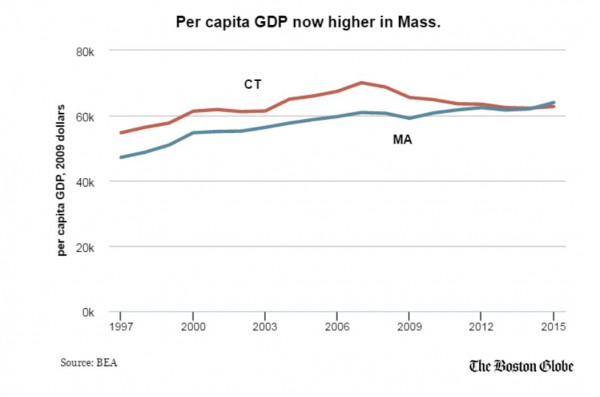
Connecticut is “in a rut”according to one regional newspaper, while another is reporting on plans by a local company to hire 14,000 workers during the next decade.  Bad news and good news, simultaneously. “Ten years ago, it was the undisputed economic king of New England, with average incomes 13 percent higher than Massachusetts and 40 percent above third-ranked New Hampshire,” the Boston Globe's data reporter says of Connecticut.  “Throughout the 1990s and 2000s, low- and middle-wage workers in Connecticut consistently took home bigger paychecks than their Massachusetts peers.  In the past few years all these economic advantages have disappeared. Unemployment is now far lower in Massachusetts. And Bay State employees get the best wages — whether you look at low-earners, top-earners, or those in the middle.”

The Globe cites recent housing data to underscore the point.

“Of all the cities tracked by the National Association of Realtors, 90 percent have seen their housing prices rise since 2010. That leaves just 17 metropolitan areas still trying to claw back from the recession. Four of those underwater markets are in Connecticut — and they extend to virtually every corner of the state, from Stamford in the southwest to New London in the east and as far north as Hartford.”economy

“Among the biggest changes in the Massachusetts economy,” the Globe column points out, “has been the explosion of professional, scientific, and technical services — think architects, engineers, software designers, consultants, and scientific researchers. Since 2000, this sector has grown by nearly 50 percent in Massachusetts, which is a key reason the state as a whole has performed so well. In Connecticut, these same fields have expanded by just 6 percent.”

Globe reporter Evan Horowitz, who writes the paper’s Quick Study column using data to discuss policy,  notes that “without a hub like Boston, Connecticut can’t simply pull pages from the Massachusetts playbook.”  He suggests that “a Trump-fueled surge in corporate profits and stock valuations could provide a much-needed boost to the state’s fortunes. But if there’s one lesson of recent years, it’s that counting on Wall Street excess to compensate for other economic ills is a dangerous strategy; bubbles burst, recessions happen, and in the absence of a long-term economic strategy, Connecticut could once again find itself floundering.”

A brighter ray of potential economic sunshine is reported by the Day of New London, outlining plans by General Dynamics Electric Boat in Groton for a massive decade-long hiring spree resulting from an increase in submarine orders by the U.S. Navy, spurred by “strong Congressional support.”

chart“The company will hire 14,000 new employees over the next 13 years,” the Day reports.  “Those employees will fill new positions and those being vacated by retirees and those who leave for other reasons. The burst in new hires will take EB from its workforce of 14,500 today to 18,000 in 2030.  This year alone, the company hired 1,600 new full-time employees. Another 800 received conditional job offers and are in the process of applying for a security clearance or awaiting that clearance.”

Reporter Julia Bergman indicates that “six different submarines are currently under construction there. Another is in for its ‘50,000 mile checkup.’ And an eighth is undergoing a major overhaul.”

The work – and the jobs – extend beyond EB.sub

“While the engineering workforce has neared its peak, EB will continue to hire a larger number of shipyard personnel such as welders, machinists, and electricians,” the Day reports. “About 40 percent of this year’s new hires were tradespeople.”  Training programs and local colleges are straining to meet the demand, the newspaper reports.

Underscoring the importance of healthcare to Connecticut’s economy, there is a new number one employer (by number of employees) in the state, according to published reports.  A year ago, United Technologies was the largest employer in Connecticut, according to 24/7 Wall Street.  After selling its helicopter division, Sikorsky, UTC’s employee headcount dropped from around 24,500 to an estimated 16,000. With 20,396 total employees, Yale New Haven Health is now the largest employer in Connecticut, the publication notes.  Yale New Haven Health includes Bridgeport HospitalGreenwich HospitalYale New Haven HospitalYale New Haven Children's HospitalSmilow Cancer Hospital at Yale New Haven and Yale New Haven Psychiatric Hospital.  The Hartford Business Journal last year ranked Hartford Healthcare, with 18,000 employees, just behind Yale New Haven Health.  Hartford Healthcare acute care facilities include Backus HospitalHartford HospitalThe Hospital of Central ConnecticutMidState Medical Center and Windham Hospital.