WalMart Dominates National Map, But Not in Connecticut

Connecticut’s largest employers – after the state itself – are Yale New Haven Health Systems, Hartford Healthcare, Yale University and United Technologies Corp, General Dynamics Electric Boat, and the University of Connecticut, according to a list published last year by the Hartford Business Journal.  Wal-Mart Stores ranks eighth in the state, followed by Sikorsky (Lockheed Martin) and Travelers and The Hartford Financial Services Group. Connecticut is one of a dozen states where the dominant employer is the healthcare.  The others include Rhode Island, Massachusetts, Vermont, Alaska, Delaware, Minnesota, North Dakota, South Dakota, Oregon, Idaho, and Utah, according to data published by Visual Capitalist.

In nearly as many – 11 states – higher education institutions are the largest employer, including New York, Michigan, Wisconsin, Iowa, Nebraska, New Mexico, California, Maryland, Pennsylvania, and North Carolina.

Maine’s largest employer is Hannaford Supermarkets.  In New Jersey it is Wakefern Food Corporation, the largest supermarket cooperative in the United States, including ShopRite and PriceRite stores in Connecticut.

In an era where Amazon steals most of the headlines, it’s easy to forget about brick-and-mortar retailers - especially Walmart, which remains dominant across much of the nation's retail landscape.  The company is the biggest private employer in America in a whopping 22 states -  and employs 1.5 million people nationwide.

In New England, Wal-Mart is the largest employer in New Hampshire, with more than 8,000 employees.

In Walmart’s home state of Arkansas, the company employees 53,310 people, or about 4% of the non-farm work force. That includes about 18,600 jobs at the HQ in Bentonville, AR.

Despite the company’s obvious influence in the state where it was founded, Walmart is also the largest employer across the South in general. Whether it is Texas (171,531 employees) or Virginia (44,621), there are Walmarts aplenty in the states surrounding Arkansas.


Eversource Hartford Marathon Brought $14.5 Million in Economic Benefit to Region in 2017

Just four years ago, in 2014, there was a title sponsor changing-of-the-guard at Connecticut’s premier spectator sporting events, as Eversource took over sponsorship of the Hartford Marathon, Travelers stepped in to save the state’s PGA Tour event (now the Travelers Championship), and United Technologies took the lead sponsorship that same year of what had been the Pilot Pen tennis tournament, now renamed as the Connecticut Open. Aside from a source of pride in maintaining marquee sporting events, the economic impact of the events continue to underscore the significance of local corporations coming through to sustain the events.

The latest evidence comes with news that the Hartford Marathon Foundation’s 2017 Eversource Hartford Marathon, Half Marathon, Team 26.2 Relay and Charity 5K brought an estimated $14.5 million of economic value to the area over the course of race weekend.  That figure is up from an estimated $13.6 million in 2015.  Eversource is signed on as title sponsor through 2019.

Official indicated that the Hartford Marathon Foundation (HMF) spent approximately $1 million to produce the Saturday, October 14th race in 2017, primarily working with local vendors and service providers.

In addition to a local economic boost to the city of Hartford and surrounding communities, the marathon drew 71,780 spectators, participants and volunteers to the area. Officials point out that runners, friends and families stayed in Hartford lodging, shopped in the area and dined in local restaurants. Significantly, 87 percent of participants visited Hartford primarily for the event. Of those traveling from out of state, 44 percent were visiting the city for the first time, officials specified.

Thousands of runners are motivated to use the race to raise funds on behalf of various charities and causes. Through these efforts more than $288,000 was raised and reported by the event’s 20 official charities and other groups, although charity fundraising is not required to be reported, so the true numbers may be higher.

The annual Travelers Championship has an annual economic impact on the state of $68.2 million, according to a recent study by Connecticut Economic Resource Center, Inc. (CERC). An economic impact study conducted a decade ago, in 2008, found that the tennis tournament predecessor to the Connecticut Open contributed approximately $26 million to the regional economy, including $10 million in local economic impact.

The Hartford Marathon will mark its 25th running on October 13, 2018.  The 2018 Travelers Championship, will be held June 18-24 at TPC River Highlands in Cromwell.  The Connecticut Open, at the Connecticut Tennis Center at Yale, will be held August 17-25 in 2018.

“We’re proud to host people from across the country to achieve personal goals and celebrate their accomplishments,” said Beth Shluger, CEO of the Hartford Marathon Foundation and Race Director of the Eversource Hartford Marathon and Half Marathon. “We are able to highlight the best of what the capitol region has to offer in a positive and truly inspiring event that allows tens of thousands to run, walk, volunteer or spectate. We are excited to be celebrating our 25th running in October 2018 and hope to create an even bigger positive impact through this milestone event.”

The Hartford Marathon Foundation also produces more than 30 events through the year, many that contribute to other organizations’ community fundraising goals.  The 2017 Mystic Half Marathon and 10K in May 2017 generated $28,000 to benefit the charitable works of the Mystic Rotary Club.  Additional fundraising events HMF was contracted to produce races for in 2017 include the Mahoney Sabol 5K to benefit Hospital for Special Care, CT Race in the Park to benefit CT Breast Health Initiative, Zero Prostate 5K to benefit ZERO - The End of Prostate Cancer, Achilles CT Hope & Possibility 5K & 10K to benefit Achilles International – CT Chapter, Pumpkin Run/Walk to benefit Youth & Family Services of Haddam-Killingworth, Inc. and the Norwich Winterfest 5K to benefit Reliance Health, Inc.

Hartford Rail Line May Bring Jobs, Opportunity for Key Populations, Study of Public Transit Suggests

As Connecticut moves closer to a significant increase in rail service connecting communities from New Haven to Springfield, MA, with the introduction of the Hartford line, anticipated in May, a report by Demos underscores the potential impact on economic opportunity and segments of the state’s population. The report, “To Move is to Thrive:  Public Transit and Economic Opportunity for People of Color,” which looked at public transportation in metropolitan areas across the country, presents a series of findings on the use of public transit by people of color and on the potential jobs benefits that people of color can gain from investments in public transit.

Its key findings on the use of public transit are:

  • Racial, ethnic, and class inequities in the access to and funding of public transit continue today.
  • Latino and Asian-American workers are twice as likely as white workers not to have a vehicle at home. African American workers are three times as likely. These disparities are heightened in certain metropolitan areas; Latino and black workers lack a private vehicle at as much as six times the rate of white workers in some areas.
  • Asian-American and African-American workers commute by public transit at nearly four times the rate of white workers. Latino workers commute by public transit at nearly three times the white rate.
  • Workers of color are overrepresented among public transit commuters with “long commutes”—one-way commutes of 60 minutes or longer.

The key findings on the jobs benefits from investment in public transit are:

  • America’s employment rates are still low relative to 2000, and there is a strong racial hierarchy in employment rates.
  • The majority of the jobs created from infrastructure investments can be non-construction jobs.
  • All racial and ethnic groups gain jobs from large infrastructure investments and, generally, the larger the investment, the more jobs for each group.
  • Investments in public transit show good returns in terms of the shares of the total jobs going to workers of color.

The report also noted that “growing numbers of Americans rely on public transit in their daily lives. In 2015, passengers took 10.5 billion trips on transit systems, up 33 percent from 20 years ago. Public transit ridership has grown faster than the population. But our public transit infrastructure, like much of our infrastructure generally, is old and decrepit. And many of our transit systems were not designed to handle such heavy use.”

While Connecticut’s cities are not as large as many of the nation’s largest metropolitan areas, they do have populations with larger numbers of people of color than mnay surrounding suburbs.  Providing greater ease of mobility to station stops along the Hartford line could offer impacts suggested by the study.

The Hartford line, which is focused on increasing the frequency of station stops from Springfield to New Haven, will also see additional stations constructed in the coming years.  When the CTrail Hartford Line service launches in May, it will consist of both expanded Amtrak service and new regional trains operated by the Connecticut Department of Transportation and will offer more frequent, convenient and faster passenger rail service between New Haven, Hartford and Springfield.

Plans call for an increase in the number of round trip trains from six daily Amtrak intercity and regional trains to a total of 17 round trip trains a day to Hartford, and 12 trains per day to Springfield. In addition, trains will operate at speeds up to 110 mph, reducing travel time between Springfield and New Haven. Stops are to include rail stations in Windsor Locks, Windsor, Hartford, Berlin, Meriden, Wallingford and New Haven.   New stations are to be added, refurbished or relocated in North Haven, Newington, West Hartford, Windsor, Windsor Locks and Enfield by 2020.

Projections include more than 4,500 construction related jobs and over 8,000 total jobs, including both direct and indirect jobs.  Transit-oriented development, including housing is also anticipated along the route. Recently, plans to convert a long-vacant factory into housing was announced in Windsor Locks.

The national data indicates that workers of color are roughly 2 to 3 times as likely as white workers not to have a private vehicle at home: only 2.8 percent of white workers do not have a vehicle at home, but 6.9 percent of Asian-American workers, 7 percent of Latino workers, and 9.5 percent of African-American workers do not have a vehicle at home.

Nationally, 3.1 percent of white workers use public transit, while 7.8 percent of Latino workers, 11 percent of Asian-American workers, and 11.1 percent of African-American workers commute using public transit. In other words, Latino workers are almost 3 times as likely, and Asian-American and African-American workers are almost 4 times as likely as white workers to commute by public transit, the report indicated.

Based in New York, Boston and Washington D.C., Demos is a public policy organization “working for an America where we all have an equal say in our democracy and an equal chance in our economy.”

New Requirements for Data and Analysis Due in Economic Development Report on February 1

A new state law is making changes to the annual report of the state Department of Economic and Community Development (DECD), due to be completed by February 1.  The law changes the mix of data and analyses DECD must include in the report, eliminating many types of previously required information but also requiring more data and analyses about the impact of all economic development programs, not just those DECD administers, according to the Office of Legislative Research (OLR). The analysis of each program in the DECD annual report must now include:

  1. an analysis of the program’s impact on the state’s economy, including, if available, the number of new jobs it created and its estimated impact on the state’s annual revenues;
  2. an assessment of whether the program is meeting its statutory and programmatic goals and, if possible, the obstacles preventing it from meeting those goals;
  3. recommendations about whether the program should be continued, modified, or repealed and the reasons for each recommendation;
  4. recommendations for additional data that must be collected to improve the evaluation; and
  5. a description of the methodologies used and the assumptions made to analyze the program.

DECD must also include how much it cost the state to borrow funds to finance them.

Public Act 17-219 also requires DECD to include:

  • an overview of its tourism, arts, and historic preservation activities and
  • an economic impact analysis of each state economic development business assistance or incentive program, including those administered by other agencies that had 10 or more recipients or awarded over $1 million in assistance during the prior fiscal year.

Examples of economic development programs administered by other agencies include the Labor Department’s Subsidized Training and Employment Program and Connecticut Innovations’ Angel Investor Tax Credit.

Instead of submitting a separate report about film industry tax credits, as was done previously, DECD must report about them in the annual report. In doing so, the law passed in 2017 requires DECD to summarize its efforts concerning media and motion picture production in Connecticut and indicate the total (1) amount of credits it issued during the reporting period and (2) production costs and expenses credit recipients incurred in Connecticut.

The law also requires DECD to submit the report annually, by February 1 to the governor, the auditors, and the legislative review committees. Under prior law, it had to submit the report to the governor and the entire legislature annually by that date. Beginning March 1, 2018, OLR indicates, the law requires the legislature’s review committees to hold one or more separate or joint annual hearings on DECD’s report, focusing on the analyses of DECD’s community development projects and DECD’s efforts to promote international trade.  The new law also calls for the Appropriations; Commerce; and Finance, Revenue and Bonding committees to hold hearings periodically on the economic impact of state economic development programs.

The law further requires DECD to analyze the First Five Plus program’s net return to the state and include that analysis in its biannual report on the program, which, by law, it must submit to the Commerce and Finance, Revenue and Bonding committees.   It also requires the committees to hold a hearing exclusively on the program, which combines financing and tax incentives under various programs into a comprehensive assistance package for business development projects that meet specified investment and job creation targets.

OLR also notes that among other things, the law approved by the state legislature last year eliminates the requirement that the report include data about specific businesses, municipalities, and projects that received DECD funding and instead requires the report to identify the website where this information can be found.

Connecticut, Massachusetts Economies on Divergent Paths

Connecticut and Massachusetts share a border but diverge dramatically in economic standing.  The stark contrast was evident this week in local updates provided by the Boston Globe and Connecticut Business and Industry Association newsfeeds. First, Connecticut:

Connecticut lost 3,500 jobs in November, extending a five-month slide that now marks a crisis point for the state's struggling economy.  The state has lost 15,300 jobs since reaching a post-recession employment high in June—a trend that stands in stark contrast to what's happening in the region and the country.

Connecticut has lost 15,300 jobs since hitting a post-recession employment high in June.

CBIA economist Pete Gioia noted that after an encouraging start to 2017, Connecticut's year-over-year job growth is now flat.

The New England states average 1.2% growth over the last 12 months, while U.S. growth is at 1.4%.

"You can't deny the fact that we now have a full-blown crisis in jobs," Gioia said.  "It's difficult to define the glass as half full when we see continued job losses like this."

Next, Massachusetts:

The Massachusetts unemployment rate dropped to 3.6 percent in November, from 3.7 percent in October, the fourth consecutive monthly decline – the Executive Office of Labor and Workforce Development reported.  The state jobless rate remained one-half percentage point below the national average of 4.1 percent, according to the Massachusetts Department of Unemployment Assistance.

An estimated 6,700 jobs were added to payrolls statewide.  In the private sector, most of the gains occurred in areas that included leisure and hospitality education and health services, construction and manufacturing.  The state labor force dropped by 8,200 from October and is now at more than 3.6 million.

The U.S. Bureau of Labor Statistics estimates that Massachusetts has added 65,200 jobs since last November.


New England Colleges Prepare Report on Employability of Students; Draft Recommendations Outlined

December 22 is the deadline for those seeking to comment on the draft report and recommendations of the Commission on Higher Education & Employability, established earlier this year by the New England Board of Higher Education (NEBHE).  The Commission, which includes nine representatives of institutions and organizations in Connecticut, released its preliminary findings at a day-long Summit in Boston. “Despite the region’s strength in postsecondary institutions, employers remain concerned about a lack of qualified, skilled workers, particularly in technology-intensive and growth-oriented industries,” the draft report notes. “The Commission has proposed a draft action agenda, policy recommendations, strategies and next steps to align institutions, policymakers and industry behind increasing the career readiness of graduates of New England colleges and universities—and facilitate their transitions to work and sustained contributions to the well-being and competitiveness of the region.”

In addition to five strategic priorities,  the draft report includes specific recommendations are being considered in five areas:  Labor Market Data & Intelligence; Planning, Advising & Career Services; Higher Education-Industry Partnerships; Work-Integrated Learning; Digital Skills; and Emerging Credentials.

Among the recommendations being considered are a call for higher education institutions to incorporate employability into their strategic plans/priorities; determine their effectiveness in embedding and measuring employability across the institution; and develop a regional partnership for shared purchasing and contracting of labor market data, information and intelligence services.

The proposed recommendations also call on the New England states to “collaborate to launch multistate, industry-specific partnerships beginning with three of the top growth-oriented sectors, including: healthcare, life and biosciences and financial services.” It further urges the states to explore “implementing policies (public and institutional) that incentivize businesses (through tax credits or other means) to expand paid internships.”  The draft report also calls for the establishment of a New England Planning, Advising and Career Service Network.

The draft report calls on the states to “confront notable college-attainment gaps and the related personal and societal costs,” and “consider specific employability strategies to target and benefit students who are at risk of not completing postsecondary credentials, including underrepresented populations.”

Eastern Connecticut State University President Elsa Núñez led a session at the Summit about the Commission's “Equity Imperative.” Officials indicate that Commission's workforce vision serves all New Englanders ... “as a matter of social justice, but also as a matter of sound economics in the slow-growing region.”  Núñez highlighted her internship work with students who may not have cars or other resources to capitalize on off-campus work-integrated learning.

In addition to Núñez, the nine members of the Commission from Connecticut are:

  • Andrea Comer, Vice President, Workforce Strategies, Connecticut Business & Industry Association Education and Workforce Partnership
  • Freddy Cruz, Student, Eastern Connecticut State University
  • Maura Dunn, Vice President of Human Resources & Administration, General Dynamics Electric Boat
  • Mae Flexer, State Senator
  • Tyler Mack, Student Government Association President, Eastern Connecticut State University
  • Mark Ojakian, President, Connecticut State Colleges & Universities
  • Jen Widness, President, Connecticut Conference of Independent Colleges
  • Jeffrey Wihbey, Interim Superintendent, Connecticut Technical High School System

The commission also includes six members from Vermont, seven members from New Hampshire and Maine, 11 from Massachusetts, 12 from Rhode Island, as well as two regional members and six representatives of NEBHE. The Commission's Chair is Rhode Island Governor Gina Raimondo.  The proposed recommendations, developed during the past six months, have broad implications, according to officials, “critical to building a foundation for moving forward the Commission's efforts toward strengthening the employability of New England's graduates.”

At Eastern Connecticut State University—which is about 30% students of color—lower-income, minority and first-generation students often had no cars, so had difficulty traveling off campus to internships. White students got most of the internships, President Elsa Núñez told the NEHBE Journal earlier this year.

The Journal reported that Eastern’s Work Hub eliminates that need, allowing students to develop practical skills doing real-time work assignments without having to travel off campus, and providing the insurance company Cigna with a computer network and facility where its staff could provide on-site guidance and support to Eastern student interns.

The draft report’s strategic priority recommendations include:

  • New England state higher education systems, governing and coordinating boards, together with New England’s employers, should make increased employability of graduates a strategic priority—linked to the strategic plans, key outcomes, performance indicators and accountability measures for the higher education institutions under their stewardship.
  • New England higher education institutions should incorporate employability into their strategic plans/ priorities supported by efforts to define, prioritize and embed employability across the institution and in multiple dimensions of learning and the student experience—both curricular and extracurricular.
  • New England should make strategic efforts and investments—at the state, system and institution level— to expand research, data gathering, assessment capacity and longitudinal data systems to enable more effective understanding and documentation of key employability-related measures and outcomes.
  • New England higher education institutions should undertake formal employability audits to review the strategic, operational and assessment-oriented activities related to employability–and their effectiveness in embedding and measuring employability across the institution.
  • To confront notable college-attainment gaps and the related personal and societal costs, states must consider specific employability strategies to target and benefit students who are at risk of not completing postsecondary credentials, including underrepresented populations.

The Boston-based New England Board of Higher Education promotes greater educational opportunities and services for the residents of New England. Comments on the recommendations are accepted on-line through Dec. 22.

CT Companies Praxair and Xerox Are Named to Top 100 Corporate Citizens

Two Connecticut-based companies have been named among America’s Best Corporate Citizens.  Danbury-based Praxair and Xerox, with headquarters in Norwalk, both reached The Just 100, published by Forbes magazine. Praxair, Inc., which ranked at #31 on the Just 100, is an industrial gas supplier in North and South America, with 26,000 employees in more than 50 countries.  It designs, engineers, manufactures and operates facilities that produce and distribute industrial gases. The North America segment operates production facilities in the U.S., Canada, and Mexico. The Europe segment has production facilities primarily in Italy, Spain, Germany, the Benelux region, Scandinavia, and Russia which include approximately 60 cryogenic air separation plants. The company was founded in 1907.

At #54 is Xerox, which provides business process and document management solutions. It provides document technology, services, software and supplies for graphic communication and office printing environments of any size. Xerox, founded in 1906, operates through three segments: Services, Document Technology, and Other. The Services segment is comprised of business process outsourcing and document outsourcing. The Business process outsourcing provides multi-industry offerings such as customer care, transaction processing, finance and accounting, and human resources, as well as industry focused offerings in areas such as healthcare, transportation, financial services, retail and telecommunications.

“The most admired companies understand their responsibilities are twofold – deliver a premium return on assets and make a positive impact on society,” Xerox CEO Jeff Jacobson wrote in the company’s Global Citizenship Report. “The way we see it, we have a responsibility that goes beyond our primary, economic role to helping the people living in our communities to grow and thrive.”

The top 10 were Intel, Texas Instruments, NVIDIA, Microsoft, IBM, Accenture, Cisco Systems, Alphabet, Salesforce.com, and Symantec.

According to a survey of 72,000 Americans, being a “just” company means producing quality goods, treating customers well, minimizing environmental impact, supporting the communities businesses operate in, committing to ethical (and diverse) leadership, and above all, treating workers well, Forbes explained.

With these seven metrics in mind, Forbes — in partnership with Just Capital —analyzed nearly 1,000 of the nation’s largest publicly-traded companies to determine which have the best and most just business behavior.  The result is the Just 100 rankings, which will be featured in the December 26, 2017 issue of Forbes magazine.

https://youtu.be/ambJ_O93Wro

https://youtu.be/F4_eJIoN2us

Economic Impact of Travelers Championship Doubles in Past Six Years, Analysis Finds; 2017 Tournament is PGA Tour’s Best

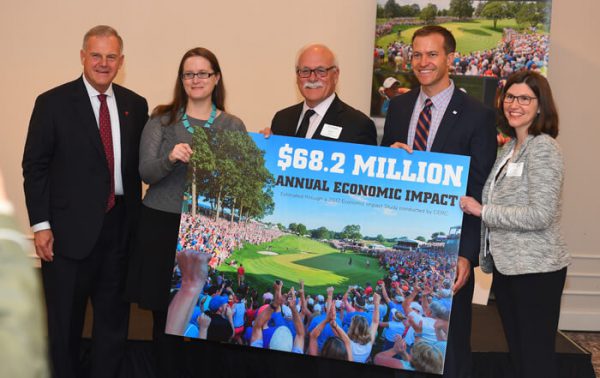
The Travelers Championship has an annual economic impact on the state of $68.2 million, according to a recent study by Connecticut Economic Resource Center, Inc.(CERC)  – and the recognition of its success is not only local, but national.  The tournament has been selected by the PGA tour as recipient of the prestigious “Tournament of the Year” award for 2017. The Travelers Championship also won awards for “Most Fan-Friendly Event,” “Best Sales” and the inaugural “Players Choice.” CERC first conducted an impact analysis of the tournament in 2011, and completed another impact analysis for the Travelers Championship in 2017.  The results were compared, to look at the changes over time and factors that may have influenced changes in the tournament’s economic effects.

The results: The economic impact had more than doubled between 2011 and 2017, due to two primary factors; a much larger total number of spectators, especially the increased number of individuals from outside the state, and increased spending by the tournament in preparing for and administering the increased number of events that occur during the tournament week.

“The Tournament activities and events, along with all of its associated events throughout the year has grown substantially over the past few years, which has resulted in a large increase in the number of spectators from Connecticut and beyond its borders,” said Alissa DeJonge, Vice President of Research, CERC. “Attendance increased dramatically, which increased spending at the event and among the local businesses.”

With record attendance, sales and fan engagement, the 2017 Travelers Championship raised the bar across the board through a strategic approach that focused on providing a first-class experience for fans, players, sponsors, volunteers and charity, officials pointed out. This marks the first time that the Travelers Championship has been recognized as “Tournament of the Year.”

The Travelers Championship, which donates 100 percent of its net proceeds to charity, announced last month that the 2017 tournament generated $1.72 million for more than 165 local charities, including The Hole in the Wall Gang Camp, the primary beneficiary of this summer’s tournament. With approximately 4,000 volunteers worked over 80,000 hours.

It is the largest core amount raised in the history of the tournament, officials pointed out. The record-setting 2017 total brings the total money generated to $14.7 million since Travelers became title sponsor in 2007. More than 750 charities have received funds from the tournament over that time.

“We’re proud of the partnerships we’ve built with local organizations that need help,” said Travelers Championship Tournament Director Nathan Grube. “Handing out these checks to so many worthy charities is the highlight of our year. We won’t forget the week we had at TPC River Highlands, with Jordan Spieth winning in such dramatic fashion and the celebration that ensued. But knowing that more than $1.7 million is being given to such a wide spectrum of nonprofits this year reminds us why we do this. It inspires us.”

As the “Most Fan-Friendly Event,” the tournament provided options for fans of all ages, including affordable access, more than 18 food and beverage locations, fan and kid zones and public on-site concerts. The tournament increased fan engagement by 441 percent through creative video and dynamic content, and following Spieth’s thrilling hole-out to win, the tournament handle trended on Twitter for nearly four hours and the video reached YouTube’s front page within 24 hours.

The tournament continued to enhance the player and caddie experience, providing a complimentary charter flight from the preceding event, healthy food options and a variety of special features including caddie appreciation day, a performance by Kevin Nealon and multiple off-site events. To determine the new “Players Choice” category, TOUR players were asked to vote for one event based on tournament services, hospitality, player and family amenities, community support and attendance.

“We work hard on making sure everyone who attends or participates in our event has a world-class experience, so no detail toward that goal is too small,” said Andy Bessette, Executive Vice President and Chief Administrative Officer of Travelers. “We are proud to associate our brand with the PGA Tour and this event, and are honored by this tremendous recognition. The best part is that any success we have means more money and attention raised for so many local charities that partner with the tournament.”

The 2018 Travelers Championship, will be held June 18-24 at TPC River Highlands in Cromwell.

Andy Bessette, Executive Vice President and Chief Administrative Officer of Travelers; Sarah Ficenec and Bob Santy, CERC; Nathan Grube, Tournament Director at Travelers Championship; and Alissa DeJonge, CERC

CT's Mattress Recycle Program Collecting 14,000 Per Month

Connecticut mattress recycling program collected more than 162,000 mattresses and diverted more than 2,300 tons of material from disposal during the 2016-17 fiscal year, according to a recently released report on the state's program. The mattress industry created the Mattress Recycling Council (MRC), a non-profit organization, in 2013 to develop and administer a recycling program, which was dubbed the Bye Bye Mattress Program.  It is  funded through a $9 fee collected from consumers on all mattress and box spring sales in the state.

The program officially began operating on May 1, 2015 in accordance with a new state law. It now averages recycling 14,000 mattresses a month. MRC collects mattresses from 125 communities and 169 public and private entities that dispose of large volumes of discarded mattresses.

On average, 70 percent of a mattress is recycled.  Officials are pushing to increase that percentage to 75 percent.  Program materials suggest that 80 percent of a mattress can be recycled.  In the program’s first two years, a total of 313,661 mattresses were collected for recycling.

Among the leading municipalities, according to the 54-page report:  Hartford - 336 tons, Bridgeport - 197 tons, Manchester - 138 tons, East Hartford - 84 tons, and Southington - 62 tons.

MRC’s education and outreach efforts are designed to inform consumers, mattress retailers, and other stakeholders about the Bye Bye Mattress Program, that the fee is mandated by state law, why the fee is needed, what the fee funds, how to recycle through the Program, and that some parties have obligations.

In addition to Connecticut, MRC operates programs in Rhode Island and California.

Among the many locations across making use of the program is the Naval Submarine Base in New London.  The Base used the program to assist with the recycling and transportation of 692 mattresses from barracks, submarines, and Navy hotel lodging facilities connected to the Base. MRC collected mattresses from the Base in New London three times during the fiscal year.

Despite the program’s achievements to date, one objective is not being met.  Based on MRC’s experience during the past two years, the report points out, it became clear that the healthcare facility goal was “impractical.”

Mattresses discarded by healthcare facilities are not recycled for two primary reasons: biological contamination and mattress residual value, according to the report. In addition, a strong secondary markets exist for specialty hospital mattresses discarded by healthcare facilities. As a result, discarded units are frequently resold domestically or exported, the report explained.

“Therefore, those units are not being landfilled or incinerated in Connecticut and are not available for recycling. Furthermore, healthcare mattresses with breached outer ticking or physical contamination may pose health risks, and are instead disposed of as solid or biological waste due to liability concerns,” the report points out.

https://youtu.be/L9QMPy4VT_Y


Please Grow Up to Be An Entrepreneur, Parents Say; Teens Not So Sure

Nearly nine-in-ten parents (88%) would be extremely or very likely to support their teen's interest in becoming an entrepreneur as an adult, but less than one-in-three teens (30%) demonstrate that same level of enthusiasm for starting a business. That’s according to a new national survey conducted by ORC International on behalf of Junior Achievement (JA) and EY. For teens, the greatest concerns for starting a business include it being "too risky" (31%) and "not enough money in it" (22%). Only 16 percent of teens indicate they have no concerns about trying. Conversely, 53 percent of parents have no concerns about their teen starting a business as an adult. Those citing concerns focused on it being "too risky" (27%) and there being "not enough money in it" (9%).

The survey was released during November, which is National Entrepreneurship Month.

"These results speak to some of the challenges facing the nation when it comes to business creation," said Jack Kosakowski, President and CEO of Junior Achievement USA. "Since the Great Recession in 2008, the country has been experiencing a net decline in business start-ups. Today's young people grew up in the shadow of the Financial Crisis, which may explain their risk-aversion when it comes to taking the entrepreneurial leap. This is why we need to promote the benefits of entrepreneurship early and often."

The survey was conducted to coincide with EY's support of Junior Achievement's JA Launch Lesson, a program delivered by community entrepreneurs whereby high school students gain firsthand knowledge about starting a business and the entrepreneurial journey. JA Launch Lesson is a 50-minute educational experience that creates a point-of-entry for students, volunteers, and educators.

The new program will be delivered by entrepreneurs in classrooms, after-school facilities, and other student venues across the United States, beginning this month. Entrepreneurs are given the opportunity to connect with students, provide relevant information about their company and entrepreneurial journey, and share advice and next steps for students who are interested in starting their own business.

Teens were also asked what they would need in order to consider becoming an entrepreneur. About half said they would need "more information on what it takes to be successful" (51%), "investors" (50%) and "support from parents" (49%). About a third said they would need "a role model who is a business owner" (35%) and "friends with a similar interest" (32%).

Promoting entrepreneurship is not a new endeavor for JA Southwest New England, which last year reached 43,000 students, the second consecutive year reaching the most students in the history of the organization, and a 24% increase over two year period.

In Connecticut this year, JA worked with Pratt & Whitney to launch the JA Entrepreneurial Academy.  The after-school program taught students firsthand about manufacturing and entrepreneurship, to better prepare them to join the workforce and perhaps plan their own companies with this insider knowledge.

Jeremy Race, president and CEO of Junior Achievement of Southwest New England, said “Through this program, young people gain a deeper understanding of how businesses are founded and operate…to help free the entrepreneurial spirit and hopefully serve as a catalyst for future business growth in Connecticut.”

In addition to manufacturing- related entrepreneurship, the academy also introduced students to an array of other entrepreneurial skills including leadership and how to pitch a business concept. Volunteers from both Goodwin College and Pratt & Whitney worked with the students to show how lessons learned in the classroom are deployed in the real world, and how the value of experience added to education makes for unequaled talent.

Also this past spring, JA Southwest New England partnered with the Junior League of Hartford for the third consecutive year to implement the JA Career Connections for Young Women program.  It is an intensive after-school curriculum, bringing together a handful of high school students from the Greater Hartford area to undergo ten sessions that are aimed at providing young women with practical advice and wisdom about the world of work, from how to get hired to learning about their own personal brand.

Students hear first-hand from female professionals on how to develop valuable soft skills, gain confidence on the job, perfect their public speaking skills and the do’s and don’ts of a job interview.  They also identify a career cluster of interest and, in groups, visit a job site in that chosen field, getting an opportunity to imagine their future selves at work.

The new JA Launch Lesson in another initiative aimed to sharing the how-to of entrepreneurship and business with young students.

"Entrepreneurs are the driving force behind growth and positive change, and at EY we believe it is vital to help enable our future generation of innovators," said Randy Cain, Vice Chair and Southwest Region Managing Partner, Ernst & Young LLP, and JA USA board member. "Creative, hands-on programs such as JA Launch Lesson are critical to providing our youth with the tools, information and resources necessary to succeed when starting their own business."

This report presents the findings of surveys conducted among a sample of 1,007 parents of children ages 13-17 and a sample of 1,005 13-17-year-olds.  The surveys were live nationwide, October 3-8, 2017.

Junior Achievement is the world's largest organization dedicated to giving young people the knowledge and skills they need to own their economic success, plan for their future, and make smart academic and economic choices. JA reaches more than 4.8 million students per year in 109 markets across the United States, with an additional 5.6 million students served by operations in 100 other countries worldwide. JA Southwest New England, which includes much of Connecticut, is at www.jaconn.org