High School Ambulance Corps Gains Prominent Supporter, Urges CPR Training

Local resident Scott Pelley is prominently featured in efforts to alert Darien neighbors  of an upcoming opportunity to learn how to save a life.  Pelley, widely known as the anchor of the CBS Evening News and a lead correspondent on 60 Minutes, has recorded a video in support of Darien Emergency Medical Services Post 53, which is presenting Hands for Life, a day of training in hands-only CPR, open to local residents on September 29.

In the video that appears on the Post 53 website, Pelley notes that the local ambulance service, founded in Darien in 1970, is “possibly the only one in the country” staffed predominantly byscott pelley high school studentsPost 53 and the Darien YMCA are coordinating the training day.

Each year approximately 20 high school students, at least 14 years of age, are selected to be members of Post 53 from53 a large pool of applicants. Over the course of their four-year career at Post 53, members progress through five roles: Candidate, Radio Roomie, Rider, State-Certified EMT, and then Driver, usually by their senior year, according to the organization’s website.

The mission of Post 53 is to provide emergency medical services to the Darien community at the highest level of excellence, using Darien High School students and adult volunteers. The members of Post 53 are committed to achieving and maintaining the highest level of training and skill in providing pre-hospital care and transport to the citizens of Darien.

The young aduHFL-DARIEN_logo_Hlts staff the ambulance on a 24-hour/day, 7-day/week basis, except during regular school hours (7:30 AM - 2:30 PM, Monday-Friday during the school year).  During those times, the adult advisors staff the first response ambulance and are the primary support unit for Darien.  In the event that two calls occur which overlap during the school day, the second response young adult crew is paged out.  Darien High School supports the commitment of the Post 53 young adults and there is a mutual obligation to support the emergency medical needs of Darien while minimizing the impact on the school work of the young adults.

Post 53 is considered one of the finest emergency ambulance services in the United States for its consistently high quality pre-hospital emergency care, accambulanceording to the website.  In total, over 550 Darien High School students have served their community as members of Post 53 since its inception four decades ago.  Darien EMS-Post 53 does not rely on any government funding for the annual operating budget.

Each year, nearly 785,000 Americans suffer from a heart attack. Nearly 300,000 of these people suffer sudden cardiac arrest at the time of their heart attack, outside of a hospital setting. Less than one in four receive CPR from a bystander, and only about 5 percent of cardiac arrest victims survive, the Post 53 website points out.

Studies show that survival rates fall 10 percent each minute without CPR before emergency medical assistance, often with a fatal outcome. The Post 53 website points out that if more people knew how to provide effective, simple-to-apply Hands-Only CPR, more victims could be helped, doubling or even tripling their chances of survival.

The September 29 day of CPR training for members of the community is free of charge and open to people of all ages. It is being held, 10AM – 4PM, at the YMCA in Darien.  No appointment is necessary.

Benefit Corporations Find a Home in Delaware, Connecticut to Try Again Next Year

During the summer, progress was made on efforts to advance social benefit corporations – businesses that aim to impact their communities in addition to making a profit – but that progress did not come in Connecticut.

Delaware became the 19th state (plus the District of Columbia) to enact benefit corporation legislation in July.  Similar legislation did not make it through the Connecticut legislature in 2013, despite widespread support and no known opposition.

Delaware, as corporate home venture-backed businesses, 50 percent of all publicly-traded companies, and 64 percent of the Fortune 500, is considered by advocates to be among the most important states for businesses that seek access to venture capital, private equity, and public capital markets.

The goal of the legislation is to create in state law a new type of corporation—the benefit corporation—that best meets the needs of entrepreneurs alcertified B ogond investors seeking to use business to solve social and environmental problems.  Benefit corporations operate the same as traditional corporations but with higher standards of corporate purpose, accountability, and transparency, advocates say.  The new designation provides business leaders with legal protection to pursue a higher purpose than profit, and they offer investors and the public greater transparency to protect against pretenders, supporters point out.

In Connecticut, despite being introduced earlier this year with the backing of Governor Dannel Malloy, overwhelming support in the state House where it passed by a lopsided 128-12 on May 20, and co-sponsorship by the legislature’s four top leaders, legislation establishing the “benefit corporation” as a new type of corporate entity never came up for a vote in the State Senate, and thus it died when the session ended in June.

Among the leading advocates of the proposal in Connecticut, the reSET Social Enterprise Trust has vowed to renew the effort next year, a commitment echoed by a broad coalition of supporters in the private sector and in government economic development circles. “In the next legislative session, reSET will re-double its efforts to secure passage of tsocial benefit corp maphis much-needed legislation,” the organization emphasizes, pointing out that the bill “drafted in cooperation with the Connecticut Bar Association and BLab, is the most comprehensive of its type proposed in the United States.”

In recognition of the milestone achievement in Delaware, more than 600 businesses around the country signed an Open Letter inviting their peers to join the movement to redefine success in business.

The letter stated, in part, “we see this as a big market opportunity, because a large and increasing number of people want to support a better way to do business -- better for our workers, better for our communities, better for our environment.  Until recently, corporate law has not recognized the legitimacy of any corporate purpose other than maximizing profits. That old conception of the role of business in society is at best limiting, and at worst destructive. By serving a higher purpose and by meeting higher standards of transparency and accountability, we build our most important asset -- trust. This trust enables us to attract the best talent and turn customers into evangelists, helping us make money and make a difference.

Delaware Governor Jack Markell, writing in the Huffington Post, said “These new Delaware public benefit corporations will harness the power of private enterprise to create public benefit. In the short term, they will create high quality jobs and improve the quality of life in our communities. In the long term, as many enter the public capital markets, they will help combat the plague of short termism that we have seen over the last five years can undermine a shared and durable prosperity.”

Markell noted that the new public benefit corporations will “have three unique features that make them potential game changers” – “concern corporate purpose, accountability, and transparency.”  Prior to serving in government, Markell, now in his second term as Governor, was senior Vice President for Corporate Development for Nextel, having been one of the first fifteen people hired by the company.

Among those advocating for benefit corporation legislation across the country – including Connecticut - is the nonprofit organization behind the Certified B Corporation designation.  B Lab is a 501(c)3 nonprofit that serves a global movement of entrepreneurs using the power of business to solve social and environmental problems. B Lab serves these entrepreneurs through three interrelated initiatives that provide them the legal infrastructure and help them attract the customers, talent, and capital to scale.

Benefit Corporations and Certified B Corporations are distinct terms. They share much in common and have a few important differences. Certified B Corporation is a certification conferred by the nonprofit B Lab. Benefit corporation is a legal status administered by a state government, such as the case this summer in Delaware (and almost in Connecticut).  Benefit corporations do NOT need to be certified.

Certified B Corporations have been certified as having met a high standard of overall social and environmental performance, and as a result have access to a portfolio of services and support from B Lab that benefit corporations do not.  The B Lab website indicates more than 800 companies in 27 countries and 60 industries have earned the designation.


More People Working From Home in Connecticut, Nationally

“Technologically-enabled opportunities for telework could be one factor contributing to the reduction in driving,” according to a report issued by ConnPIRG which has identified a drop in driving frequency in nearly every state in the nation, including Connecticut.

The report, “Moving Off the Road: A State-by-State Analysis of the National Decline in Driving,” notes that “the internet and other communications technologies have enabled many people to perform work from home that could only be done in an office previously. Email, conference calls, videoconferencing, and shared digital files have made it far easier for people to “telecommute” from home. In this way, telework might reduce household driving by eliminating commuting trips.”

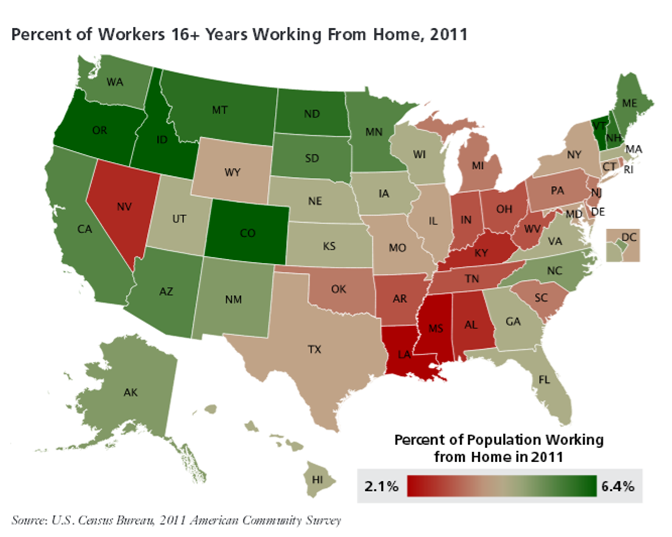
The number of people who work from home a majority of the time stood at 4.3 percent in 2011.Counting a broader measure of all workers who report that they perform some of their job from home at least one day a Home-iconweek, 9.5 percent did so by 2010, up from 7 percent in 1999.

The most recent National Household Travel Survey indicates that 9 percent of city commuters telecommute even once per month, compared to 14 percent of suburban commuters and 10 percent of rural and town commuters, the report indicated.

According to the report, it is more common for people to work from home in New England and the entire West, except Nevada. One reason for differences may be the industrial make up of states, since working from home is more feasible in some types of work than others. The following figure bears out the ambiguous relationship between working from home and the volume of driving.

 ConnPIRG Education Fund, a 501(c)(3) organization, works to protect consumers and promote good government. ConnPIRG Education Fund offers an independent voice that works on behalf of the public interest, investigating problems, crafting solutions, educating the public, and offering meaningful opportunities for civic participation.

The new ConnPIRG analysis and report found that after sixty years of almost constant increases iworking from home mapn the annual number of miles Americans drive, since 2004 Americans have decreased their driving per-capita for eight consecutive years. Driving miles per person are down especially sharply among Millennials, America’s largest generation that will increasingly dominate national transportation trends.

The website Global Workplace Analytics reports that regular telecommuting grew by 73% between 2005 and 2011 compared to only 4.3% growth of the overall workforce (not including the self-employed). Growth within different sectors of the workforce varied widely:

  • Federal employees - 424% growth
  • State government employees - 114% growth
  • Not-for-profit employees - 85% growth
  • For profit employees - 63%
  • Local government employees - 67%

While many conjectured that telecommuting would decline during the recession, it actually grew by 11.4% from 2008 to 2011.   Based on current trends, with no growth acceleration, regular telecommuters will total 4.9 million by 2016, a 69% increase from the current level, according to Global Workplace Analytics, which conducts independent research and consult on emerging workplace issues and opportunities.

CT is Among Leaders in Long Marriages, Less Popular for Divorcees

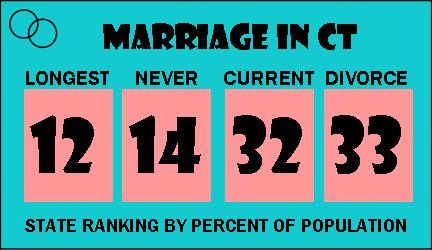
It seems that Connecticut is a great place for a long marriage and those who have never been married, and not so popular for divorced individuals.  Data indicate that Connecticut ranks #12 in longest married residents, #14 in never-married residents, #32 in currently married residents and #33 in divorced residents –as a percentage of population, comparing the 50 states and Washington, D.C.

Bloomberg Visual Data ranked the U.S. states and the District of Columbia based on the median duration of current marriages in years which was calculated by averaging the medians for males and females for each state, using the 2011 U.S. Census American Community Survey data.marraige stats

The top ten states for longest marriages, based on the median duration of current marriages in years, were South Dakota (23.1 years), West Virginia (23.0), Maine (22.8) , North Dakota, Pennsylvania and Vermont (22.4), Iowa (22.1) Montana, Wisconsin(21.8), Nebraska (21.7) and Delaware 21.5).  Tied with Connecticut at #12 is Michigan, at 21.4 years.

In every state in the nation, at least a quarter of residents ages 15 and older have never married.  Far outdistancing the field is the District of Columbia, where 58 percent have never married – the only instance where that number exceeds half the population.  Next highest is New York, with 37.7 percent, followed by California, Massachusetts, Rhode Island, Maryland, Illinois, Louisiana, New Jersey Mississippi, Delaware, Pennsylvania, Georgia.  Connecticut is next, with a third of the population – 33.1 percent – never having been married.Wedding_rings

When comparing the estimated percentage of those currently married, Connecticut ranks at #32, with 48.4 percent.  Topping the list is Utah with 56.2 percent, Idaho at 55.5 percent and New Hampshire at 53.6 percent.

New Jersey and New York have the lowest percentage of divorced people in the U.S., at #49 and #50 respectively in the estimated percentage of divorced residents.  Connecticut ranked at #33, with 10.7 percent of the population (age 15+) being divorced.  The most divorced residents?  Nevada at 14 percent, followed by Maine at 13.7 percent and Arkansas and New Mexico, tied at 13.4 percent.

New Audio Service To Help Students Challenged by Reading; Innovative Pilot is First in Nation

As students across the state return to begin a new academic year, the Connecticut Radio Information System (CRIS) is launching a first-of-its-kind service for schools, providing instant access to audio versions of educational materials, the Common Core State Standard text exemplars, and children’s magazines on any mobile device, including tablets, smartphones, and MP3 players, or computers with Internet access.

CRISKids™ For Schools is geared for students who are visually impaired or are print-challenged for any reason including a learning, physical, intellectual or emotional disability. The new service also provides custom recordings to fit the needs of the students.cris-logo

Nearly a dozen schools have signed up to participate in the pilot of CRISKids For Schools.  Student outcomes will be submitted for evaluation by the U.S. Department of Education.  CRISKids For Schools is the only extensive line-up of audio versions of children’s magazines, educational materials and the Common Core State Standards featuring human narration in the nation.

Early results of the new initiative have been impressive, officials say, noting that teachers report that students participating in the CRISKids pilot are reading and enjoying it more. Megan O’Brien, a Grade 5 teacher at Clover Street School in Windsor, has noticed a transformation with her reluctant Grade 5 readers since using MP3 players downloaded with CRISKids.

“They think it’saudio board awesome,” she said, noting that the students are far more motivated to read now with the help of CRISKids.

Support for CRISKids for Schools comes from the generous funding of several foundations, including Help for the Blind of Eastern Connecticut, Fund for Greater Hartford, The Gibney Family Foundation, and the Hartford Foundation for Public Giving.

The Connecticut Radio Information System is Connecticut's only radio reading service, and is registered with the state of Connecticut as a private, nonprofit 501(c)(3) charitable organization. CRIS broadcasts 24 hours a day, 7 days a week, from a broadcast center in Windsor, and regional satellite studios in Danbury, Norwich, Trumbull, and West Haven.

The programs broadcast on CRIS Radio are available to individuals who, because of vision loss, learning disability or physical handicap, are unable to read printed material.   CRIS Radio's live programming is provided free of charge and is available on specially tuned radios (provided free), cable providers, your telephone and online.  In addition, in recent years CRIS has become available on an iPhone, iPad/tablet, Internet radio or downloaded onto an iPod/MP3 player.

Earlier this year, the organization launched CRISKids™ Magazines, which provides audio versions of more than a dozen children’s magazines, and brought the initiative directly to children’s hospital beds.  In another first-in-the-nation initiative, Connecticut Children’s Medical Center teamed with CRIS Radio to offer the audio service to their patients  unable to turn the pages of magazines due to their medical condition or while receiving treatment.

Connecticut Ranks #4 in Back-to-School Stores

With students now settling into their classrooms and the hectic back-to-school shopping mostly in the rear view mirror, we learn that Connecticut ranks #4 among the nation’s states in the number of back-to-school retail stores per square mile.

The Land of Steady Habits is outpaced only by New Jersey, Rhode Island and Massachusetts as retail meccas for pre-school year shoppers, just ahead of Maryland, Delaware, New York and Florida.

Connecticut has 3,477 back-to-school retailers, for an average per square mile of .718, according to a Bloomberg Visual Data using NAICS data.  The data defines an establishment is a single physical location at which business is conducted. Retail totals were only for establishments identified in the following NAICS sectors and subsectors: electronics and appliance stor4es; clothing and clothing accessory stores; sporting goods stores; hobby, toy and game stores; musical instrument and supplies stores; bookstores; general merchandise stores; and office supply and stationery stores.

Alaska and Wyoming had the smallest number of retailers, at 661 and 678 respectively, as well as the smallest number per square mile. (Alaska was .001)

Connecticut’s annual tax-free week for clothing and footwear under $300 was conducted Aug. 18 through Aug. 24 at stores across the state, just prior to the start of the school year in most communities. On average, it is estimated that families spend nearly $700 on back to school purchases. The state expects to lose about $7 million to $8 million in revenue from the week of tax-free shopping.

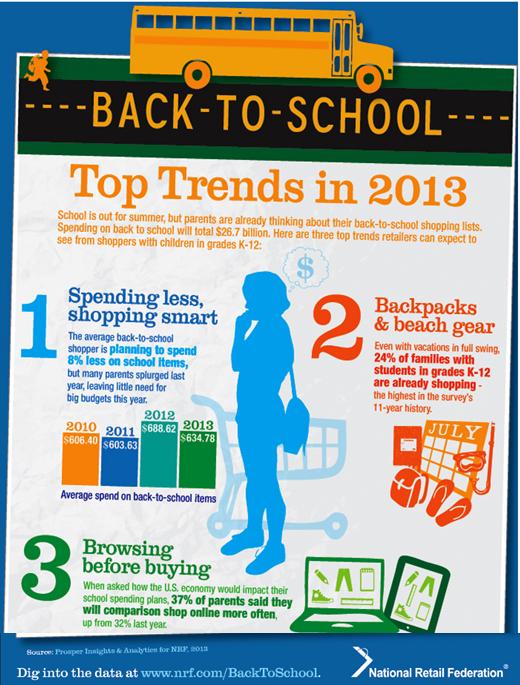
According to the National Retail Federation projections prior to the back-to-school shopping season, the biggest portion of back-to-school shoppers’ budgets will go toward new apparel and accessories: 95.3 percent of those with school-age children will spend an average of $230.85 on fall sweaters, denim and other chic pieces of attire. Additionally, families will spend on shoes ($114.39) and school supplies ($90.49). Fewer families with children in grades K-12 will purchase electronics (55.7%), and those that are going to invest in a new tablet or smartphone are going to spend slightly less than last year.

back to school

“Hometown” Banks Continue to Locate Away From Home

Apparently hometown pride and banking are mutually exclusive – or at least travel well.  The volume of banks bearing a community’s name that are opening branches far, far away from home continues to grow, which suggests that banks have clear and convincing evidence that the distant moniker just isn’t an issue for consumers.

The latest: Vernon-based Rockville Bank is asking state approval to open a Hamden branch, its first retail incursion into New Haven County, the Hartford Business Journal hasbank-vault reported.  The bank is planning to establish a 2,000-square-foot, full-service retail branch near the commercial- and residential-loan production office the bank opened in July 2011.  Earlier this year Rockville Bank crossed the Connecticut River to open a high profile branch in thriving West Hartford Center.

Connecticut by the Numbers has previously reported on the increasing number of banks with the name of a Connecticut town within the bank’s name that have opened branches – and many of them – in other towns.  An increasing number are opening in towns far afield, and last month, Massachusetts-based Westfield Bank opened a branch in Granby, CT.

Already, the list of town names doing double-duty as bank names is lengthy, with the institutions numbering two dozen:  Fairfield, New Canaan, Groton, Darien, Essex, Farmington, Greenwich, Suffield, Guilford, Jewett City, Litchfield, Milford, Naugatuck, Putnam, Rockville, Salisbury, Danbury, Simsbury, Stafford, Thomaston, Torrington, Wilton and Windsor.  And those are only the Connecticut towns, of course.

Among the town-line-jumping trendsetters:  Farmington Bank in South Windsor, Essex Savings Bank in Madison,  Jewett City Savings Bank (“your hometown bank”) in Brooklyn, Simsbury Bank in Bloomfield, and the Savings Bank of Danbury in Waterbury.  There are many more.

Although there are 25 out-of-state banks connecticutwith a presence in Connecticut, only Rhode Island-based Newport Federal Savings Bank, with an office in Stonington, included the name of a town – until the arrival of Westfield Bank.  Other well-known names, evoking out-of-state regions, include Bank of New York, Berkshire Bank (which is now in the process of purchasing 20 Bank of America branches in New York State), First Niagra Bank, and Hudson Valley Bank.

To look back at the CT by the Numbers hometown bank story, click here:

http://ctbythenumbers.info/2013/04/17/hometown-names-go-beyond-hometown-for-connecticut-banks/

To review the list of banking institutions in Connecticut, see the state Department of Banking list:

http://www.ct.gov/dob/cwp/view.asp?a=2228&q=296954

Connecticut's Green Report Card: Needs Improvement

Connecticut’s state government received mixed grades in the new edition of the Connecticut Green Guide, published by Hartford Business Journal.  The publication reviewed state policy in our areas – microgrids, gasoline taxes, wind turbines and greenhouse gas reduction efforts – and graded the state’s efforts.

Connecticut received an “A” for recently announcing an $18 million grant program with nine microgrid projects in eight Connecticut communities, “adding protection from power outages and moving away from a centralized electriciMalloy aParkvillety system.”  Just a week ago, Gov. Malloy was joined by the White House Chair of the Council on Environmental Quality to highlight one of the state’s microgrid sites, in the Parkville neighborhood of Hartford.

The state received an “F” because of a moratorium on wind turbines, which has been in place since 2001, according to the Green Guide.  “Because of poorly written legislation and prolonged bureaucracy,” the publication explained, several projects have been delayed.  Another poor grade, a D+, was assigned because state taxes on gasoline rose 4 cents on July 1, “giving Connecticut the third highest taxes on motor vehicle fuel in the country.”  The publication noted that while “higher prices might egreen guilde logoncourage conservation, very little of the tax revenue goes toward fixing the aging transportation system, leading to vehicle inefficiencies and congestion.”

Connecticut fared better. earning a B+, in the analysis of the state’s participation in the Regional Greenhouse Gas Initiative, along with the other eight states in the region, which will “further lower the cap on power plant pollution,” which should, according to the publica50 statestion’s review, “make the air cleaner, and the proceeds will aid the clean energy industry.”

The publication also noted that Connecticut became the first state in the country to mandate mattress recycling, with a new law approved by the legislature this year, also adding a new paint recycling requirement to existing laws that call for recycling of electronic waste and mercury thermostats.  The state’s move toward a greater emphasis on “product stewardship,” is characterized by an increasing obligation imposed on consumers to recycle designated products, which helps the environment and provides business opportunities in the recycling of those products.

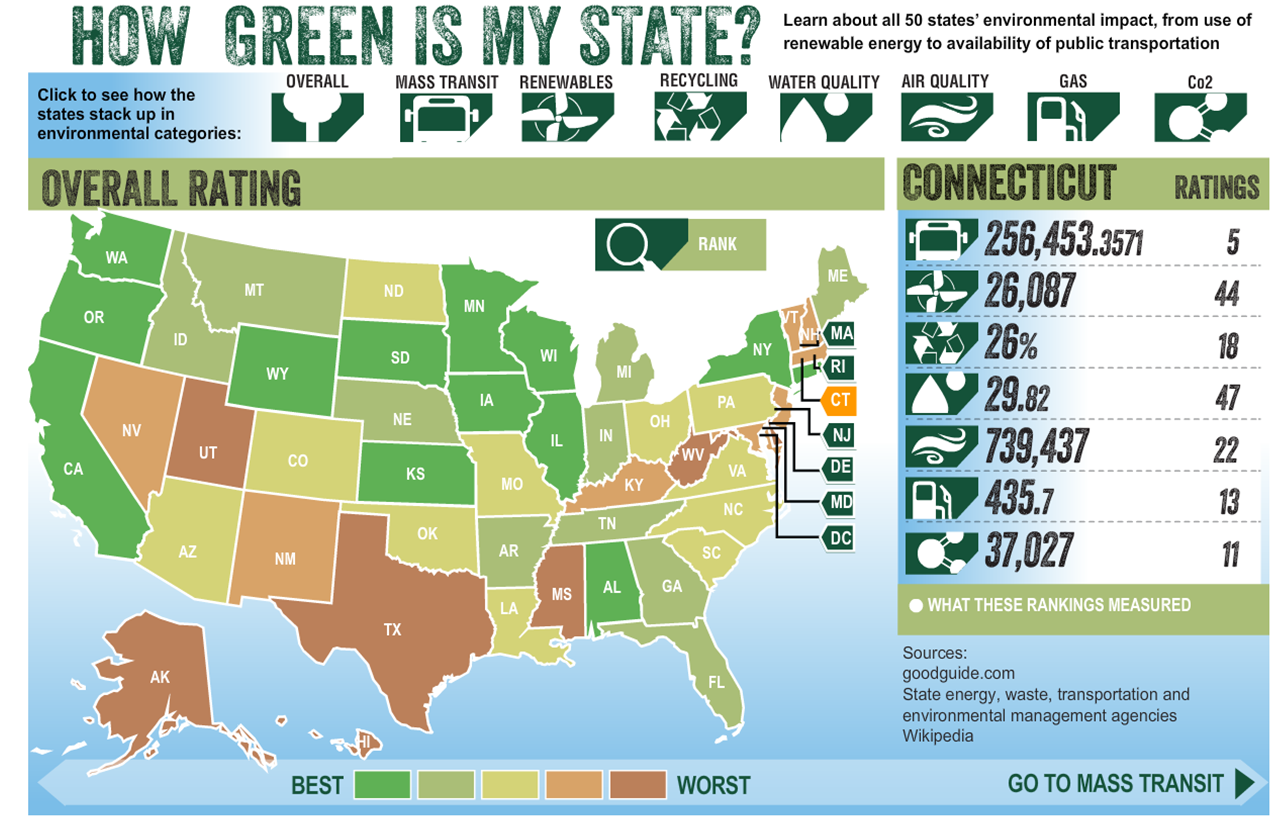
In a report on the green initiatives across all 50 states, published by Forbes magazine in July, Connecticut excelled in the areas of mass transit, ranking 5th among the states, in CO2 controls, ranking 11th, and recycling, ranking 18th.  The state was 44th in use of renewables and 47th in water quality.  That's according to this recent green ranking of states from MPHOline.org, a website that provides information on a variety of public health topics.

Data from the green product rating site GoodGuide was used to assess air and water quality, information from Wikipedia was the basis of the comparison on the number of mass transit systems in each state, and state agencies were used to provide information on the other categories.

Time Short to Nominate State’s Top Librarians; CT Seeks Another Stand-out Year

Nominations for the 2013 Carnegie Corporation of New York/New York Times I Love My Librarian Awards are open through September 6.  For Connecticut librarians, last year’s success will be tough to top.

The I Love My Librarian Award encourages library users to recognize the accomplishments of exceptional public, school, college, community college, or university liblove my librarianrarians. It is a collaborative program of Carnegie Corporation of New York, The New York Times and the American Library Association.

Ten librarians in 2012 – including two from Connecticut - received a $5,000 cash award, a plaque and $500 travel stipend to attend an awards reception hosted by The New York Times. A plaque was also given to each award winner’s library.

Rachel Hyland, a reference and collection development librarian at Tunxis Community College in Farmington, and Rae Anne Locke, library/media specialist at the Saugatuck Elementary “Secret Garden” Library in Westport, were two of the 10 recipients a year ago.  The others worked at libraries in New Mexico, California, North Carolina, New York and Florida.

In order to be eligible, each nominee must be a librarian with a master’s degree from a program accredited by the ALA in library and information studies or a master’s degree with a specialty in school library media from an educational unit accredited by the National Council for the Accreditation of Teacher Education.

rachel-hyland135rae-anne-locke135Nominees must be currently working in the United States in a public library, a library at an accredited two- or four-year college or university or at an accredited K-12 school.

Hyland (left), nominated by Sally Terrell, is described as “a rock-star librarian.  The intelligence, wit, energy she brings to her work has changed the way all of us – from students to faculty to administrators – think about information literacy.”  Locke (right) , nominated by Melissa Augari, has “poured her heart and soul into planning, creating and growing the SES Secret Garden Library, a vibrant, warm and inviting place that is much more than a school library. It is truly the learning hub for our entire school community.” Her collaborative projects “often reach out beyond the school community” and one student said simply, “it’s magical.”

In order to nominate a librarian, five questions must be answered on the contest’s website:

  • What sets him/her apart?
  • Please list a few ways in which the nominee has helped you and made your experience of the library a positive one. For instance, did the nominee inspire in you a love for literature; assist you in a project or finding other information?
  • How has the librarian made a difference in the community?
  • How has the library, and the nominee, improved the quality of your life?
  • How does the nominee make the library a better place?

More information is available at www.ilovelibraries.org. Nominations must be submitted using the online form, and submitted in their entirety.


love librarians

Cost of Raising A Child Is Highest in Northeast U.S., Including CT

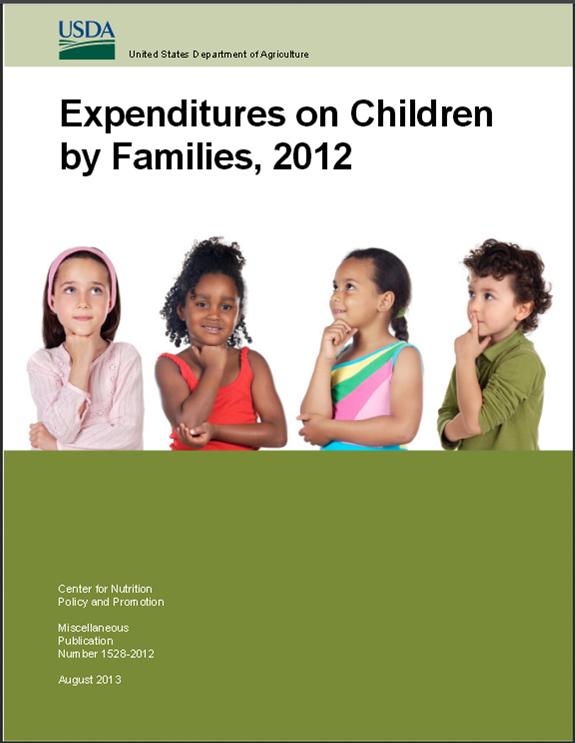
The cost of raising a child:  priceless.  Well, no, there is a price-tag.  The U.S. Department of Agriculture (USDA) released its annual report, Expenditures on Children by Families, which shows that a middle-income family with a child born in 2012 can expect to spend about $241,080 ($301,970 adjusted for projected inflation*) for food, shelter, and other necessities associated with child-rearing expenses over the next 17 years.

There was an overall 2.6 percent increase from 2011.  Expenses for child care, education, health care, and clothing saw the largest percentage increases related to child rearing from 2011. However, there were smaller increases in housing, food, transportation, and miscellaneous expenses during the same period. The 2.6 percent increase from 2011 to 2012 is also lower than the average annual increase of 4.4 percent since 1960.

The report notes geographic variations in the cost of raising a child, with expenses the highest for families living in the urban Northeast  - the 9-state northeast region, which includes Connecticut, Maine, Massachusetts, New Hampshire, New Jersey, New York, Pennsylvania, Rhode Island, and Vermont -followed by the urban West and urban Midwest. Families living in the urban South and rural areas have the lowest child-rearing expenses.report child expense

The report, issued annually, is based on data from the Federal government's Consumer Expenditure Survey, the most comprehensive source of information available on household expenditures. There is also  an interactive web version of the report where individuals can easily enter the number and ages of their children to obtain an estimate of costs through age 17.

Housing accounted for the largest share of total child-rearing expenses. For the middle and highest income groups (for households with the expense), child care and education was the second largest expenditure on a child, accounting for 18 and 23 percent of child-rearing expenses, respectively. For the lowest income group, child care and education accounted for 14 percent of total child-rearing expenses (again, for households with the expense). For lower income families, child care may be provided by relatives or friends at no cost due to affordability issues, the report pointed out.

Expenses per child decrease as a family has more children. Families with three or more children spend 22 percent less per child than families with two chchild expensesildren. As families have more children, the children can share bedrooms, clothing and toys can be handed down to younger children, food can be purchased in larger and more economical quantities, and private schools or child care centers may offer sibling discounts.

Among the largest potential costs in child-rearing is the cost of a college education, which was not included in this study, which only included direct parent expenses through age 17. The College Board estimated that in 2012-2013, annual average (enrollment-weighted) tuition and fees were $8,655 at 4-year public colleges (in-State tuition) and $29,056 at 4-year private (non-profit) colleges; annual room and board was $9,205 at 4-year public colleges and $10,462 at 4-year private colleges. For 2-year colleges in 2012-2013, annual average tuition and fees were $3,131 at public colleges. These college costs may be offset by financial aid.

The report concluded, as only a government report could, by stating: “The direct and indirect costs of raising children are considerable, absorbing a major share of the household budget. On the other hand, these costs may be outweighed by the benefits of children.”

The full report is available on the web at www.cnpp.usda.gov. A video highlighting the report is at http://www.youtube.com/watch?v=Di14Y3kTbHE