Pay Equity Gap Between Men and Women Begins As Children, Studies Show

The stubborn pay equity gap between men and women – larger in Connecticut than some neighboring states – apparently has its roots in childhood. National surveys indicate that parents are more likely to give their sons an allowance than their daughters. Among all young people surveyed, 67 percent of boys compared with 59 percent of girls say they get an allowance from their parents, according to Junior Achievement USA® (JA) and The Allstate Foundation’s 2014 Teens & Personal Finance Survey.allowance hand

A study by the University of Michigan Institute for Social Research found that girls do two more hours of housework a week than boys, while boys spend twice as much time playing. The same study confirmed that boys are still more likely to get paid for what they do: they are 15 percent more likely to get an allowance for doing chores than girls.  Study Director Frank Stafford indicated that the trend continues into adulthood. allowance graphic

Writing this month in the National Journal, Connecticut Congresswoman Rosa DeLauro pointed out that “right now, women make less than men in nearly every occupation for which wage data are tracked. One year out of college, women are paid 18 percent less than their male counterparts. Ten years out of college, the wage gap leaves women earning 31 percent less.  Over a 35-year career, these earnings discrepancies swell to exceedingly large sums. Across the entire workforce, the average career-long pay gap is $434,000. For college-educated women, the pay deficit averages $654,000.”

Earlier this year, CT Mirror reported that “women in Connecticut earn about 78 percent of what men make.  Numbers from the 2012 Census show that Connecticut's gender wage gap is wider than in many other states in the Northeast; and that, within the state, the gender difference varies as well. The most pronounced gap…is in Fairfield County.”

In a November 2013 report, the Governor’s Gender Wage Gap Task Force indicated that “Connecticut still has a long way to go before the gender wage gap is eliminated.”  The 14-member task force found that that “more mothers than ever before are the sole or primary breadwinners of their families. Yet, women in Connecticut are more likely than men to live in poverty and below the self-sufficiency standard. 24% of households in Connecticut headed by women with children fall below the federal poverty level. Eliminating the wage gap would provide critical income to these families.”

The report also indicated that “among all full-time, year-round workers, Connecticut women earn, on average, 22%-24.2%less than men. This gap is even more pronounced among minority women. Understanding this inequity is not a simple matter. Many factors contribute to the overall wage gap including education and skills, experience, union membership, training, performance, hours worked and the careers women and men choose. However, even after these factors are controlled for, an estimated wage gap of 5-10% remains.”

In 2012, the National Partnership for Women and Families reported that “If the wage gap were eliminated, a working woman in Connecticut would have enough money for approximately:

  • 109 more weeks of food
  • 7 more months of mortgage and utilities payments
  • 14 more months of rent
  • 44 more months of family health insurance premiums
  • 3,410 additional gallons of gas

The Connecticut Task Force issued a series of recommendations to address the pay equity gap, focused on current workplaces, businesses, training and education.  Apparently, efforts need to begin sooner, when youngsters begin household chores and ask for an allowance.


gender gap map

Summer Sandwiches: Lobster Roll is Connecticut Standout, Zagat Says

When Zagat’s decided to take a bite into the uniqueness of sandwiches during August (It is national sandwich month! Who knew?) – highlighting particularly noteworthy culinary endeavors in every state in the nation – the focus in Connecticut landed squarely on the lobster roll. Their review of “delicious regional sandwiches” found in each state had some overlap (Maine was also noted for its Lobster Roll, for example) and some regional favorites with a national following. And some surprises (see bison, reindeer, and marshmallow, below). zagat_logo

“While many consider the cold, mayonnaise-driven Maine lobster roll to be the quintessential version of the sandwich, the first lobster roll was actually a hot, buttered one served at a restaurant called Perry’s in Milford, Connecticut, in the 1920s,” Zagat’s explained. “This version is usually simpler, featuring just lobster meat, butter, and maybe some black pepper or lemon juice on a grilled, split-top hot dog bun, and served with potato chips or French fries. “

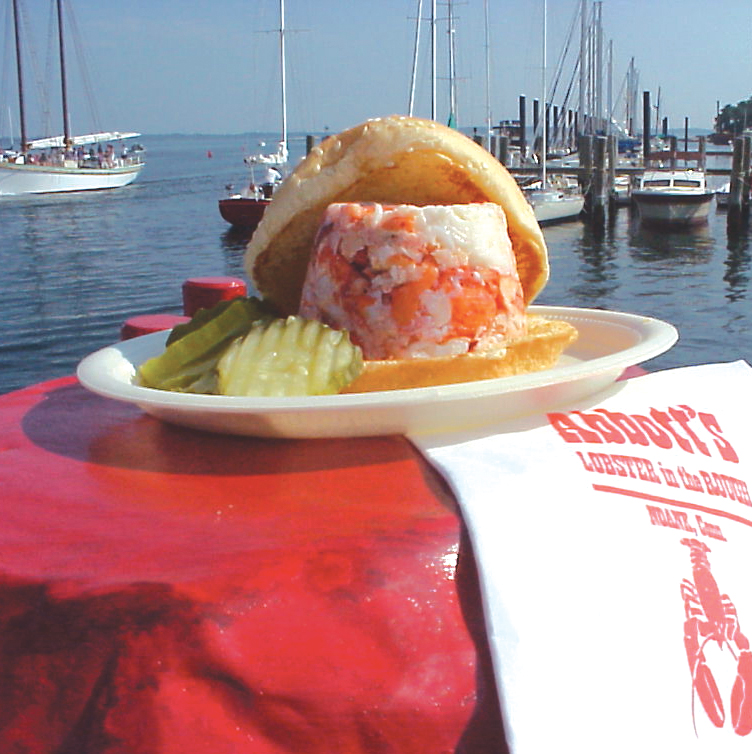
Cited by the Zagat surveyhotlob600 was Abbott’s Lobster in the Rough in Noank, founded in 1947. “They take the simplicity of the Connecticut-style hot lobster roll and turn it into an art form. Their award-winning sandwich is made with a full quarter-pound of lobster meat (more than is found in the average small lobster) drenched in melted creamery butter and heaped onto a bun. It’s a sandwich so opulent, it’s well worth the trip to this far-off-the-beaten-path lobster pound to get one (not to mention the crowds you have to battle to order).”

Noteworthy in the region were the Italian Sub in New Jersey and the Italian Grinder in Rhode Island. (A distinction without a difference?) In Massachusetts, the Zagat selection was the Fluffernutter: “The delectable marshmallow fluff was in fact invented in Somerville, Massachusetts, in 1917. A man named Archibald Query sold it door-to-door before he sold the recipe, though who it is that thought to pair it with peanut butter on white bread is not as clear. Nevertheless, the fluff is celebrated to this day with a Fluff Festival in Somerville” in September.

New Hampshire was noted for its “Beer-Battered Fish Sandwich” and Vermont for the aptly-named Vermonter, a “ sweet-and-savory sandwich that typically includes either turkey or ham (sometimes both), sharp Vermont cheddar cheese, thinly-sliced green apples and honey mustard, although there are many different variations (including a decent number that come with cranberry mayonnaise instead of honey mustard).”

In case you were wondering, in Alaska it is the Reindeer Sausage Sandwich, in Wyoming the Bison Reuben, in Alabama the Chicken Sandwich with White Sauce, and in Arkansas the Fried Bologna Sandwich, and Mississippi the Elvis sandwich (peanut butter, fried banana and bacon). The Zagat’s  reporting (and tasting) was conducted for the August 2013 observance of National Sandwich Month, with a tip of the plate to the notable Earl of Sandwich.

Hartford Region Improves Among Nation's Best Performing Cities in 2013

The Hartford region was the state’s only metropolitan area to improve its ranking relative to other metropolitan areas around the country in an analysis of job growth and regional economic factors in 2013 that ranked the nation’s top 200 Best Performing Cities. The top ranked Connecticut metropolitan area was Hartford-West Hartford-East Hartford, which ranked #85 among the nation’s top 200, an improvement in ranking from #93 the previous year.state map

Connecticut’s other major metro areas dropped in the rankings: Bridgeport-Stamford-Norwalk dropped to #106 from #94 in 2012, New Haven-Milford fell to #142 from #109 , and Norwich-New London ranked #187, falling from #152 the previous year.

Best Performing Cities Index Report (PDF)The 2013 Milken Institute Best-Performing Cities Index ranks U.S. metropolitan areas by how well they are creating and sustaining jobs and economic growth. The components include job, wage and salary, and technology growth.

Topping the list of Large Cities were Austin-Round Rock–San Marcos, Texas and Provo-Orem, Utah followed by San Francisco-San Mateo-Redwood City, CA, San Jose-Sunnyvale-Santa Clara, CA and Salt Lake City, UT. Rounding out the top 10 were the metropolitan areas of Seattle, Dallas, Houston, Boulder, and Greeley, CO.

Biggest gainers on the list include Hagerstown-Martinsburg, Md.-W.V. (70th, up 100 slots); Tulsa, Okla., (42nd, up from 118th), and Phoenix, (66th, up from 122nd). Within the top 25 metro areas, Texas claimed seven spots; Colorado and California each had four.

The website interactive features offer a means of comparing cities in the various economic factors.  In most years, according to the study authors, the factors evaluated in the index give a good indication of the underlying structural performance of regional economics.

A nonprofit, nonpartisan economic think tank, the Milken Institute works to improve lives around the world by advancing innovative economic and policy solutions that create jobs, widen access to capital, and enhance health.

New Haven - Milford Has Nation's Highest Concentration of Italian Heritage

The New Haven-Milford metropolitan area has the highest concentration of individuals of Italian heritage in the nation. In an analysis that ranked ancestries on the estimated percentage of U.S. population and then identified the three metropolitan areas with the highest concentration of each ancestry or origin, Bloomberg Businessweek determined that the concentration of individuals of Italian heritage made up just under 24 percent of the population in the New Haven – Milford area. The next highest concentration was in Kingston, New York, and Poughkeepsie – Newburg – Middletown, New York, each with just over 20 percent of their population of Italian heritage. Overall, the largest eHello-my-name-is_1267913358thnic populations across the country are German (15.6% of the population), Irish (11%), Mexican (10%), English (8%), Italian (5%), Polish (3%) French (2%) Scottish (1% and Puerto Rican (1%).

The Census Bureau defines ancestry as a person’s ethnic origin, heritage, descent or “roots,” which may reflect their place of birth, place of birth of parents or ancestors and ethnic identities that have evolved within the United States. Data for European, Middle Eastern, Arab and Sub-Saharan African ancestries were directly captured by ancestry questions in the Census Bureau’s American Community Survey.

The largest concentration of individuals of German descent was in Bismark, ND (60%) and the largest population of Irish was in Ocean City, New Jersey (30%) – followed by Barnstable, MA at 27 percent and Boston-Cambridge-Quincy at 24 percent.

Bangor, Maine had the highest concentration of individuals of Scottish ancestry, at 6 percent and the largest Puerto Rican population by percentage was in Vineland, Millville-Bridgetown, New Jersey at 14 percent and Orlando-Kissimmee-Sanford, Florida, at 12 percent.

In the data, South American ancestries were calculated using data from the "Hispanic or Latino origin by specific origins" tables, while Asian ancestries were calculated from "Asian race & ethnicity" tables. American Indians and Alaskan Native ancestries were counted only if individuals identified with specific tribes. Spaniards only included people who specifically identified their ancestry as Spaniard.

CT Ranks 4th in Participation in Summer Meal Programs for Low-Income Children

Participation in Summer Meal Programs for low-income children increased in Connecticut in 2013 as compared with the previous summer, with 26.4 percent of low-income children receiving summer meals on an average day in July 2013. This represents an increase of 2.4 percent from the previous summer and ranks CT 4th in the nation for participation. summerfoodwebbutton2012The numbers are increasing nationally as well as in Connecticut. In 2013, for the first time in a decade, the number of low-income children eating summer meals saw a substantial increase year-over-year, according to a report by the Food Research and Action Center (FRAC). Nearly three million children participated in the Summer Nutrition Programs in July 2013, an increase of 161,000 children, or 5.7 percent, from July 2012.
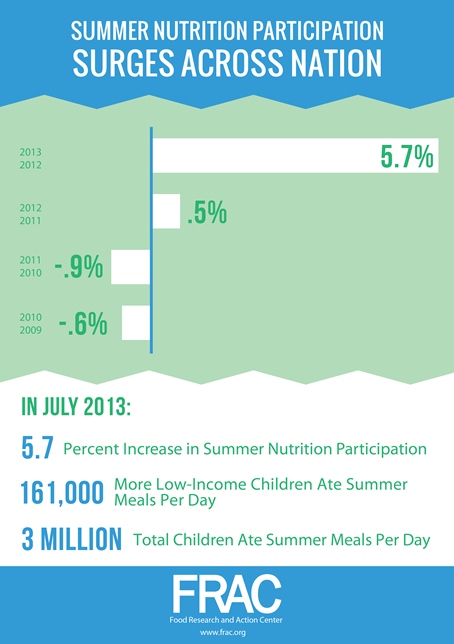
FRAC measures the success of Summer Nutrition Programs at the national and state levels by comparing the number of children receiving summer meals to the number of low-income children receiving school lunch during the regular school year. The programs grew to serve 15.1 children for every 100 low-income children who participated in school lunch during the 2012-2013 school year, a modest increase from the 14.3 per 100 served in the 2011-2012 school year.

Print

End Hunger Connecticut! noted that summer meals in Connecticut still only reached 26.4 students for every 100 low-income children who received regular school year school meals in the 2012-2013 school year. The number of sites increased slightly, from 217 to 236.

“When the school year ends, millions of low-income children lose access to school meals, including about 147,587 in Connecticut. It is in Connecticut’s best interest to ensure that such children have adequate nutrition during the summer so they stay healthy, active and return to school in the fall ready to learn,” Lucy Nolan, Executive Director, End Hunger Connecticut!, said. “While we are extremely proud of our place nationally, we still have a lot of work to do.”

Ranked just above Connecticut in participation were the District of Columbia, New Mexico and New York. Rounding out the top 10 were Vermont, Arkansas, Idaho, Delaware, Maine and Massachusetts.

To further increase the number of Connecticut children who participate in summer meals programs, End Hunger Connecticut! convened partners, community leaders and volunteers to distribute multilingual flyers, posters and other promotional materials at the start of the summer to promote Connecticut’s federally funded free summer meals program.

This year marks the third consecutive year that End Hunger Connecticut! has coordinated ‘blitz days’ in communities across the state to drive summer meals participation. Results of the initiative will be known later this year.

Increasing participation means more nutritious food for hungry children, but it also means more federal funding for communities, officials noted. If every state had reached the goal of 40 children participating in Summer Nutrition in July 2013 for every 100 receiving free or reduced-price lunch during the 2012-2013 school year, an additional 4.8 million children would have been fed each day, and states would have collected an additional $365 million in child nutrition funding in July alone, they point out.

FRAC reportThe Summer Nutrition Programs, which include the Summer Food Service Program and the National School Lunch Program, are designed to fill the food gap for the thousands of low-income Connecticut children who rely on school breakfast and lunch during the school year. These programs provide free meals at participating summer sites at schools, parks, other public agencies, and nonprofits for children under 18.
Connecticut families can find nearby summer meal sites at www.ctsummermeals.org, by calling toll free2-1-1 or by texting ‘CTMeals’ to 877-877.These tools are instrumental for families to find the closest free meals in their communities.

FRAC measures national summer participation during the month of July, when typically all children are out of school throughout the month and lose access to regular school year meals. The national report, including Connecticut data, is available online at www.frac.org

Celebrated DJ Who Started at WCCC Going Strong as Station's Rock Era Ends

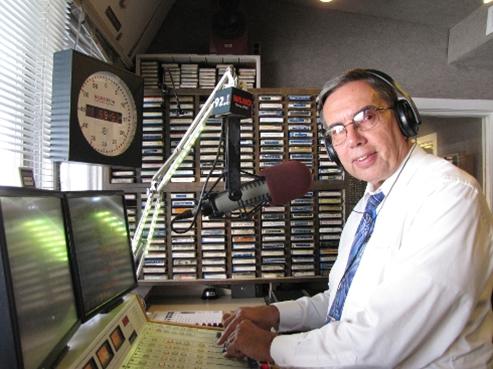
There were two milestones in radio broadcasting during the past 12 months that connected to the career of on-air personality and Hartford native Rusty Potz. Last week, Potz’ former radio home, WCCC in Hartford, was sold to new owners who abruptly ended the station’s decades-long rock-n-roll format. It was in the early ‘70’s that Potz was a leading DJ at the Hartford station, which later that decade featured a DJ named Howard Stern. Potz was well known in Hartford, moving on, like Stern, to new opportunities. That’s where the other milestone draws attention. Potz didn’t move too far – to radio station WLNG in Sag Harbor on Long Island. And he has been there ever since – from 1975 though the station’s 50th anniversary celebration last year, and continues on the air six days a week.

As WCCC has slipped away, WLNG is going strong. The station’s oldies format, local news coverage, and community orientation has loyal listeners in high places, as was evident in March this year.

The Sag Harbor Exprrusty potzess reported this spring that WLNG was the prime topic of conversation on the Tonight Show with Jimmy Fallon. Mr. Fallon asked Mr. Joel to join him in crashing Sag Harbor’s oldies station WLNG 92.1 and the singer, a longtime resident of Sag Harbor, enthusiastically agreed, the newspaper reported. The celebrities plugged the small station in front of a nationwide audience—over four million— resulting in a flood of listeners and website traffic for WLNG.

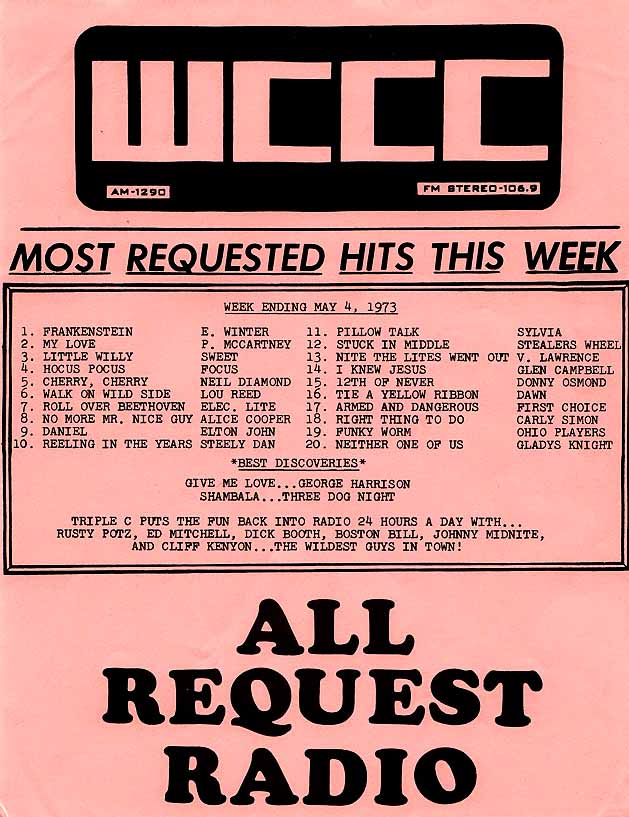
“We’re a nostalgia station,” Potz told the Sag Harbor Express last year. He is the executive vice president and has been with the station for 38 years. “We’re a part of people’s lives… People like a station that’s familiar. They want to know what they can expect. The oldies we play, we have just about every hit that ever came out.”WCCC All Request Radio

Potz earned his degree from the University of Hartford, and has been in radio since 1963 - on 20 different radio stations, most of them in Hartford, New Haven, and Springfield, MA.  At one time, he worked at four stations simultaneously.

In 1967, at WPOP Rusty's show was the top rated evening show in Connecticut, his station biography reports.  In 1969 WAVZ in New Haven received the TV-RADIO MIRROR award for Rusty's show as the top show on the east coast. Rusty was the program director at WCCC in Hartford for many years, including the years when the station featured the "All Request Radio" format, and came to WLNG on September 1, 1975.

The history of WCCC counted numerous broadcasters who went on to enduring careers. Howard Stern is perhaps the best known nationally. But for listeners in Eastern Long Island, Rusty Potz remains a household name.

An additional Connecticut connection was apparent recently. One of Potz’ guests on his WLNG program last month was former Channel 8 newscaster and ESPN broadcaster George Grande. Both were quite prominent on the Connecticut broadcast scene in the ‘70’s. Grande hosted the first edition of SportsCenter on ESPN in 1979, going on to a sportscasting career in New York, Cincinnati and as host of the annual Baseball Hall of Fame induction ceremony for more than two decades.


Child Support Caseloads Climb; Distributions to Families, Children Drop - Opposite of National Trend

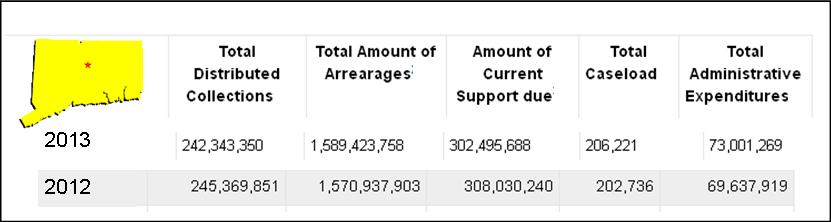
From fiscal year 2012 to fiscal year 2013, Connecticut’s child support caseload increased, administrative expenditures climbed, and collections distributed to children and families dropped, setting the state apart from national trends. During the FY2013, total child support collections nationwide increased by one percent from the previous year, to $31.9 billion. The amount distributed to children and families increased by 1.7 percent over FY2012, according to data compiled by the federal Office of Child Support Enforcement and reported by the National Conference of State Legislatures. child support chart

Connecticut’s caseload – 206,221 total cases – ranked the state 28th in the nation, the same position as a year ago. The previous year, Connecticut’s caseload was 202,736. Total distributed collections dropped to $242,343,350 in FY2013 from $245,369,851 in FY201child support wall2.

Nearly 95 percent of the amount collected was distributed to the family while just 5 percent was retained by the state as reimbursement for public assistance, according to the nationwide data. At the same time, caseloads and administrative expenditures decreased nationwide.

In Connecticut, however, the volume of cases increased by just under 3,500. Expenditures climbed from $69,637,919 to $73,001,269.

The largest caseloads in FY2013 were in Texas (1.42 million), California (1.29 million), Michigan (996,000), New York (918,000), Ohio (899,000), and Florida (855,000).

Each year, the federal Office of Child Support Enforcement (OCSE) releases a report detailing information about financial and statistical program achievements based on quarterly and annual data. OCSE compiles this information from status reports submitted by states and tribes detailing program performance.

The complete OCSE FY2013 Preliminary Report is available online.

Best Places for Home Ownership? Glastonbury, Enfield, Terryville Top List

The best places for home ownership in Connecticut are in Glastonbury, Enfield and Plymouth, according to an analysis that included home ownership rates, monthly homeowner costs, median household income, home value and population growth. Glastonbury Center, the Southwood Acres section of Enfield and the Terryville section of Plymouth were ranked as the top three slices of Connecticut for home ownership in the analysis by the website nerdwallet.com, which provides analysis on financial and consumer issues. Rounding out the top 10 were the Kensington section of Berlin, Simsbury Center, Cos Cob, Trumbull, Windsor Locks, Orange and North Haven.home map

NerdWallet looked at 60 communities in Connecticut with populations of at least 5,000 to determine what places were the best for homeownership. Overall, the pointed out that “although its median home value is substantially higher than the national average, Connecticut’s proximity to New York and Massachusetts, and its many commuting options, make the state a top destination for homeownership.”

Of the top three, the website pointed out:

  • With a two-year population growth of 6.95% and an unemployment rate of just 1.4%, Glastonbury Center has all the signs of a top home destination.
  • Up north, near the border with Massachusetts, Southwood Acres is within driving distance of Hartford and Springfield, Mass., and boasts the highest homeowner rate among our top 10.
  • Terryville is the largest village within the town of Plymouth. It has shown relatively strong population growth (2.57%), and is the most affordable median home value among our top 10.

The next ten on the list of best places for home owneership in Connecticut include: 11. Shelton (city), 12. Newington, 13. Stratford, 14. Wethersfield, 15. West Hartford, 16. Bethel, 17. Riverside section of Greenwich, 18. East Haven, 19. Milford (city), and 20. Winsted.

The analysis focused on three main questions:

Are homes available? They looked at the area’s homeownership rate to determine the availability of homes. Areas with a high homeownership rate led to a higher overall score. (A low homeownership rate was seen as indicating competitive inventory, more options for renters rather than buyers and expensive housing.)

Can you afford to live there? They looked at median household income, monthly homeowner costs and median home value to assess affordability and determine whether residents could live comfortably in the area. Monthly homeowner costs were used to measure cost of living. Areas with high median incomes and low cost of living scored higher.

Is the area growing? The website’s analysis measured population growth to determine if the area is attracting new residents and showing signs of solid growth. This was seen as a signal of a robust local economy - another attractive characteristic for homebuyers.

Homeownership rate and population change from 2010 to 2012 each made up 33.3% of the total score, using data from the U.S. Census American Community Survey 5-year estimates. Selected monthly owner costs as a percentage of median household income made up 16.7% of the total score, and median home value made up 16.7% of the total score.


top 20

Most Exciting in Connecticut? New Haven, New London, Hartford Lead the Way

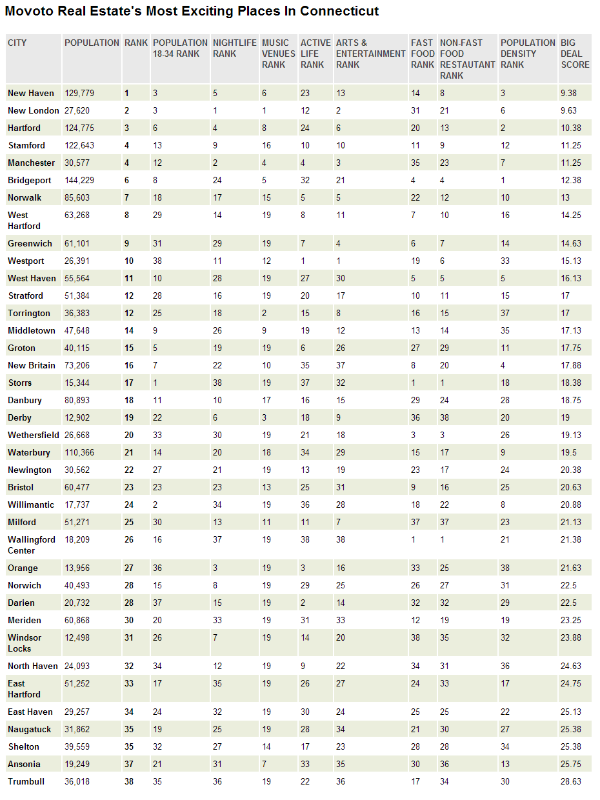
Wondering where the most exciting places are in Connecticut? If New Haven is the first place that comes to mind, you’re right. New Haven was named the “Most Exciting Place in Connecticut,” followed by New London, Hartford, Stamford, and Manchester in an analysis by the real estate website Movoto. Described as “the most thrilling, the most rousing, and the most downright exciting,” the top 10 list for Connecticut includes five Fairfield County municipalities and many of the state's largest cities: TOP10

1. City of New Haven 2. City of New London 3. City of Hartford 4. City of Stamford (tie) 4. Town of Manchester (tie) 6. City of Bridgeport 7. City of Norwalk 8. Town of West Hartford 9. Town of Greenwich 10. Town of Westport

The website’s analysis pointed out that “New Haven had a ton of nightlife and music venues per capita” and was “much more densely populated than most other places in the state.” New London scored points in the website’s analysis for its “high percentage of young folks (just like New Haven, 36 percent between 18 and 34), and for its high number of nightlife options, music venues, and arts per capita.” New London ranked No. 1 in both nightlife and music venues, and No. 2 for its arts.

The highlights for Hartford noted that the Capitol City is “the second-most densely populated place in Connecticut; a good portion of that population is between the ages of 18 and 34- 31 percent, to be exact. With bars like Pourhouse and the Russian Lady, music venues like Webster Theatre, and so many museums, galleries, and festivals we can’t even name them all, Hartford is certainly way more exciting than just insurance.”

In order to come up with the list of 10, the website started out with a list of all the places in Connecticut with populations of 10,000 or more, according to the U.S. Census (2010), which provided 38 towns and cities. Then, they used the Census and business listings to assess:

  • Nightlife per capita (bars, clubs, comedy, etc.)
  • Live music venues per capita
  • Active life options per capita (parks, outdoor activities, etc.)
  • Arts and Entertainment per capita (movie theaters, festivals, galleries, theaters, etc.)
  • Fast Food restaurants per capita (the fewer the better)
  • Percentage of restaurants that are not fast food (the higher the better)
  • Percentage of young residents ages 18 to 34 (the higher the better)
  • Population density (the higher the better)

The municipalities were then ranked with scores from one to 38, where the lower the score, the more exciting the place.

Two Greater Hartford communities, in addition to the city, made the list – Manchester and West Hartford.

“Manchester also scored highly for its number of arts and entertainment options per capita, like the unique MCC on Main,” a program of Manchester Community College located on Main Street in the heart of the town. West Hartford, the website reported, “seemed to find its excitement, not in the nightlife … but in lots of healthy options,” including sports stores, gyms, galleries, theaters and “tons of restaurants.” Westport “really shined” in the number of yoga studios, sports stores, running clubs, parks, and places to get fit.”

Falling just outside the top 10 were West Haven, Stratford, Torrington, Middletown, Groton, New Britain, Storrs, Danbury, Derby and Wethersfield.

exciting

Jonathan's Dream Reimagined to Kick-Off Next Chapter

The original Jonathan's Dream playground, inspired by the Barzach family of West Hartford and built in 1996 as what would become the prototype for Boundless Playgrounds across the country, an inclusive, accessible play space for families and children of all abilities. It was a vibrant playground until 2013, when time and heavy usage of the wooden playground necessitated that it be taken down. But now, community leaders are back at it again, developing plans for what is described as “Jonathan's Dream Reimagined” – a new playground that will be accessible to children of all abilities - and include some new innovations for today's children.  Sunday, July 27, from 12 Noon to 3 PM,  will be the kick-off for the new effort, with free activities for children at the Mandell Jewish Community Center, site of the playground.

The new Jonathan's Dream will be designed to extend the original legacy with an engaging playground that keeps children of all ages and abilities active and moving. Leadership Greater Hartford (LGH) has convened a taskforce of alumni JD_NewLogo from its Quest and Third Age Initiative programs to help rebuild the new Jonathan's Dream, working with the Mandell JCC.. The project is also supported by Shane’s Inspiration and Jumpstart, along with a “Dream Team” of local agencies and individuals who have joined forces to advance the initiative.
Jonathan’s Dream Re-Imagined will be rebuilt three to six months after the needed funds are raised. Donations to help rebuild Jonathan’s Dream will be accepted at the July kick-off event. The project to rebuild Jonathan’s Dream is expected to cost $950,000 and, once funds are raised, will take three to six months to complete.JDEntrance

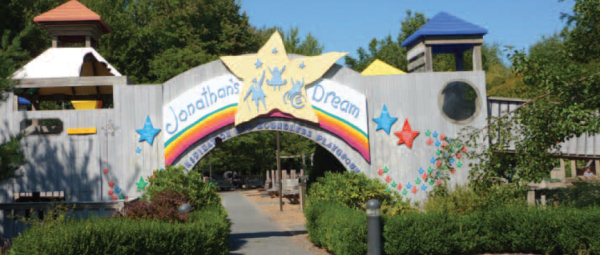
The original Jonathan’s Dream (photo at right), a wooden, wheelchair- accessible, inter-generational playground, was built by more than 1,000 volunteers in 1996 in memory of Jonathan Barzach, who died before his first birthday. Had Jonathan lived, he would have needed to use a wheelchair for his entire life. His family imagined that in Jonathan’s dreams, he would have wanted children of all abilities to be able to play and celebrate together.

Jonathan’s Dream was one of the first inclusive playgrounds in the country.  It led the way for the nonprofit organization Boundless Playgrounds, which coordinated the construction of similar playgrounds throughout the country.  Today, more than 100,000 children play on more than 200 Boundless Playgrounds in 31 states.

It began in Connecticut, with the inspirational leadership of Amy Barzach, Jonathan's mom. Back in 1994, she was at a playground with her two sons when she noticed a little girl in a wheelchair who could not join in the fun because the playground was not accessible to her.  A year later, she remembered that little girl when disability, then tragedy, reached her family, with Jonathan's passing.  With husband Peter and son Daniel, they began the effort to build an inclusive playground, and called it Jonathan's Dream.

To learn more about Jonathan’s Dream Reimagined please visit www.jonathansdreamreimagined.org.