CT’s Regional Planning Agencies Consolidate, Realign and Disappear

As the Central Connecticut Regional Planning Agency (CCRPA) prepares to go out of existence, the newly formed Naugatuck Valley Council of Governments is advertising for an Executive Director.  It’s all part of a major shake-up of regional planning agencies in central Connecticut, prompted by the state legislature’s decision to reduce the number of regional planning agencies in the state from 15 to 9, as of January 1.  Among the by-products:  Bristol and New Britain are parting company. The realignment is breaking up long-term relationships going back decades, and forcing municipalities to decide on new partners.  Regional planning agencies deal with a range of issues, but generally focus on transportation, land use, brownfield cleanup and environmental projects. For communities between two large cities that serve as anchors of regional planning agencies, it often comes down to deciding it they’d like to align to the east or the west.

The Central Connecticut Regionnew map RPAsal Planning Agency (CCRPA), for example, has been the regional and metropolitan planning organization for the cities of Bristol and New Britain and the towns of Berlin, Burlington, Plainville, Plymouth, and Southington. For over 45 years, CCRPA has worked with government, business, and the public to develop a vision for the region and resolve its challenges.  It will cease to exist at the end of the year.
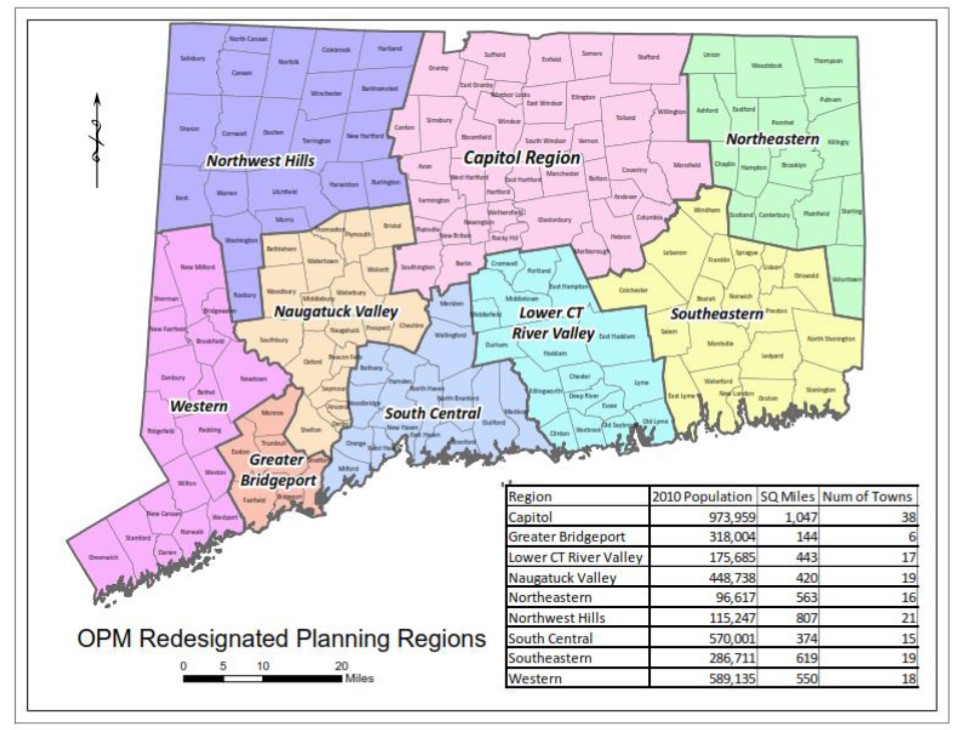
The newly formed Naugatuck Valley Council of Governments (NVCOG) will replace the Council of Governments of Central Naugatuck Valley and the Valley Council of Governments plus add two towns from the Central Connecticut Regional Planning Agency – Bristol and Plymouth.

The other CCRPA towns, including New Britain, are headed elsewhere. Most of the towns in the CCRPA have opted to join with Hartford area municipalities in the Capitol Region Council of Governments, but Bristol officials decided to join the Waterbury agency instead.  New Britain is one of eight municipalities to join CRCOG in recent months, as part of the CCRPA break-up.250px-CT_regions

CRCOG will have grown to 38 member municipalities, with a total population of just under one million, and 1,047 square miles, the largest of the state’s regional planning agencies.  Joining CRCOG since July 1 are Berlin, Columbia, Coventry, Mansfield, Plainville, Southington, Willington and New Britain.  The new Naugatuck Valley Council of Governments will represent 19 towns and cities with a population of 448,738, over 420 square miles.

Ed Edelson and Kurt Miller, the current chairmen of the two councils of governments that had been covering the Naugatuck Valley, which will be subsumed by the new Council, said recently that “although our two current organizations have done high-quality work over the past four decades, we recognize they each have had different strengths and areas of focus.”

Edelson, the Democrat first selectman of Southbury, and Miller, the Republican first selectman of Seymour, added “we believe this step to align the 19 cities and towns around the urban center of Waterbury provides the best opportunity for all of our communities to combine resources, and bring significant new investment and cost savings to each of our communities.”  NVCOG held its first organizational meeting in late summer, and launched their Executive Director search last week.new map

Bristol Mayor Ken Cockayne recently said he “looks forward to strengthening existing ties to neighbors and building new relationships and cooperation with communities that share many of Bristol’s priorities and challenges.”

They also said they “recognize the importance of our new region’s major cities — such as Waterbury, Bristol and Shelton — as the economic engines. Their economic and social future is critical to all of the surrounding towns. We are all dynamically linked.”

For those who may be interested in the Executive Director position, topping the list of characteristics for the “ideal candidate” – “honest, trustworthy, diplomatic and ethical.”  And leading the “opportunities and challenges” – managing the consolidation, “sensitive to the cultural differences” of bringing the 19 towns together as a new council of governments.

The next challenge for the state, according to Edelson and Miller, is the consolidation of the Metropolitan Planning Organizations (MPOs), which are the federal regions that plan transportation systems and jointly allocate federal funds for these projects with the Connecticut Department of Transportation. There currently are eight MPOs in Connecticut, and the aim is to have fewer MPOs with boundaries that coincide with the new councils of governments’ boundaries.

Alternate College Ranking System Reveals Surprises for CT Colleges

It turns out that the oft-heralded and increasingly criticized U.S. News & World Report college rankings aren’t the only game in town.  Washington Monthly magazine has developed a rating system with a different emphasis, and very different results.  Among the Connecticut institutions making the list:  UConn, Yale, Wesleyan, and Trinity – but not necessarily in familiar places. The publication uses three main categories of evaluation for its analysis.  Social Mobility (recruiting and graduating low-income students), Research (producing cutting-edge scholarship and PhDs), and Service (encouraging students to give something back to their country). The publ1409.cover.220x286ication sets out to “identify the most public-minded institutions,” utilizing the three criteria and a handful of specific measures in each.


“Instead of crediting colleges that reject the most applicants, we recognize those that do the best job of enrolling and graduating low-income students,” the magazine pointed out.  The rankings also “measure both pure research spending and success in preparing undergraduates to earn PhDs.”  In addition, by “giving equal weight to public service, we identify colleges that build a sense of obligation to their communities and the nation at large,” the publication explained in the cover feature of the September/October issue.

Connecticut did not have an institution reaching the Top 30 National Universities.  That list was led by four University of California institutions in the top five slots, along with Texas A&M and Stanford University.  Harvard University placed tenth.

Yale University ranked #57 on the full list of National Universities. UConn ranked #82 - the only other school in the state listed among 277 institutions.  (Yale is ranked #3 in the U.S. News rankings; UConn places 19th)

The magazine also compiled a series of specialty lists ranking the institutions.

The only Connecticut school to reach the nation’s Top 30 Liberal Arts Colleges was Wesleyan University, which ranked #16.  (Wesleyan is ranked #15 on the U.S. News listing.) Further down the list, Trinity College ranked #184.

Among the “best-bang-for-the-buck” colleges, the University of Connecticut ranked #76, the only Connecticut college to break into the top 100.  That list was topped by three City University of New York colleges.colleges

Four Connecticut schools were among the Top 50 “Affordable Elite” institutions, according to the list compiled by the magazine.  Yale University ranked #33, Wesleyan University placed #40, UConn ranked #97 and Trinity College in Hartford just made the list at #98.

In the good news department, there were no Connecticut school reaching the “worst colleges” lists complied by the magazine.

The Social Mobility category includes four components including the percentage of students receiving Pell Grants, the cost of attendance, and the anticipated rate of graduation.   The five Research factors include research expenditures and the number of bachelors degree recipients who go on to earn PhDs  The Service category includes five factors including the number of alumni who serve in the Peace Corps, student participation in community service and the number of staff supporting community service.

Signaling the importance of the Washington Monthly rankings to colleges across the nation, a total of 47 institutions ran advertisements in the issue.  The advertisers did not include any colleges from Connecticut.

students

License Renewal of WTIC-AM on “Enforcement Hold” at FCC

The Federal Communications Commission has the pending license renewal of WTIC-AM radio on “enforcement hold,” nearly six months after the station’s broadcast license technically expired.  The station can continue broadcasting under the license that expired on April 1, 2014 until the FCC acts on its renewal application, which was filed last year on November 27, just days ahead of the renewal application deadline. In the wake of the corruption conviction earlier this month of former Governor and former WTIC talk show host John G. Rowland, questions have been raised about the radio station that employed Rowland.  Although FCC officials say that “while it is too late to file a formal Petition to Deny the license renewal,” because the renewal date has passed, “an informal objection can still be filed to the license renewal” at any time prior to action on the pending renewal application.WTIC_1080_AM_Radio_logo

The FCC explains that an "informal objection," which is an official process, “may take the form of a letter signed by the objector” and should “contain sufficient information to establish any violation alleged.”   FCC officials indicate that no objections to the station’s renewal have been filed as of this week.  If the station’s license renewal is granted, it would be for an 8-year period.

There is no indication when the hold was placed on the renewal application by the FCC’s enforcement division, what the reason was, or when it might be lifted.  FCC officials indicate that most often enforcement holds are instituted due to a complaint being filed that requires investigation, but they would not confirm whether that was true in this instance.  That information is only made available to the licensee or their attorney, according to an FCC official. FCC

Action on the license renewal application remains possible at any time.  Should an informal objection be filed, the FCC would, in most instances, need to deal with any issues raised in the objection before it would act on the license renewal application.

In April 2014, Rowland resigned as a WTIC-AM radio host as his drive-time talk show, with a federal indictment imminent related in part to Rowland’s relationship with the campaign of then-Congressional candidate Lisa Wilson-Foley. Rowland had remained on the air on WTIC, even after it was revealed that his relationship with the Wilson-Foley campaign had sparked a federal grand jury investigation.

During this month’s trial, according to published reports, a former campaign operative for Wilson-Foley described ways Rowland allegedly coordinated topics on his WTIC talk show with the messages he wanted the campaign to get out.

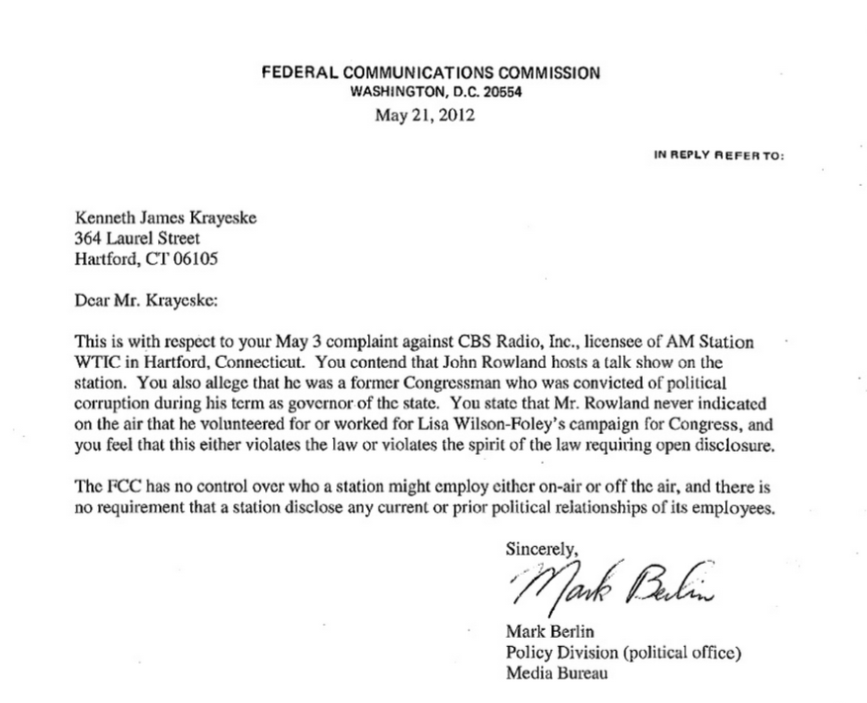
In May 2012, responding to a complaint filed that month by Kenneth James Krayeske to the FCC regarding Rowland’s unstated relationship with the Wilson-Foley campaign, Mark Berlin of the FCC’s Policy Division Media Bureau indicated that “the FCC has no control over who a station might employ either on-air or off the air, and there is no requirement that a station disclose any current or prior political relationship of its employees.”May2012FCCletter

“We accept Mr. Rowland’s decision to step down at this time," Jenneen Lee, the station's program director, said in a statement posted on the station's website soon after Rowland went off the air earlier this year, CT Mirror reported.  The Rev. Will Marotti, who was Rowland's spiritual adviser and served as his co-host when Rowland went on the air at the station in September 2010, took over as host of the weekday afternoon program and remains on the air.

Back in 2012, the Torrington Register-Citizen reported that “according to a WTIC-AM representative, former Gov. Rowland disclosed the fact that he was working with Republican Lisa Wilson-Foley’s campaign ‘months ago,’ but said the 5th congressional district race is avoided on air, intentionally. ‘He actually stays away from it on purpose,’ Jeneen Lee said. ‘To date, there’s been no conversation on the air about the campaign.’”  Editorials published in the months following the campaign-related revelations called for additional disclosure by WTIC.

CBS Radio horizontal color EPSRowland, who resigned as Governor a decade ago in a corruption scandal and served 10 months in prison, was convicted this month of federal charges that he conspired to hide payment for work on two congressional campaigns, in 2010 and 2012, including the Wilson-Foley campaign.

WTIC is owned by CBS Radio.

Student Chapter from Eastern Connecticut Earns Top Honors from Nonprofit "Best Buddies"

The Best Buddies chapter at Eastern Connecticut State University has been named Overall Outstanding Chapter in the United States.  The recognition came at the Best Buddies International Leadership Conference held at Indiana University. Best Buddies is a nonprofit, worldwide organization that helps create friendships for people with intellectual and developmental disabilities. Katharine Ferrone, chapter president, accepted the award on behalf of the club’s members and faculty advisor Charles Wynn, professor of chemistry at Eastern. Over 2,000 student leaders, volunteers, and staff from Best Buddies International programs around the world, participated in the 25thAnnual Leadership Conference  in Bloomington this summer.314112_10150786601893488_169246690_n

“The vision of Best Buddies is to put itself out of business by promoting a world that no longer requires an organization to help create friendships with people with disabilities,” said Ferrone, a senior from Wallingford. “Now five years old, Eastern’s chapter spiraled to the top thanks to the inspiration and dedication of many fine student leaders and volunteers.  It is demonstrating to both the university and community that people with disabilities are more like us than different.”

In Connecticut, Best Buddies is on the following college campuses: Connecticut College, Eastern Connecticut State University, Fairfield University, Quinnipiac University, Sacred Heart University, Southern Connecticut State University, Trinity College, University of Connecticut, University of Hartford, Wesleyan University and Yale University. The most enduring goal of the organization is to provide opportunities for one-to-one friendships. 1972343_712334228816599_428022073_n

Best Buddies programs engage participants in each of the 50 United States, and in 50 countries around the world.  Best Buddies’ seven formal programs – Best Buddies Middle Schools, High Schools, Colleges, Citizens, e-Buddies, Jobs and Ambassadors – positively impact nearly 700,000 individuals with and without disabilities worldwide. The chapter at Eastern holds a variety of events each year, from dances to friendship walks, to help close social gaps.

Anthony Kennedy Shriver is the Founder and Chairman of Best Buddies International, which he created in 1989 to foster one-to-one friendships between people with and without intellectual disabilities. Recognizing the tremendous volunteer potential of university students, Shriver first inspired his college peers to personally collaborate in expanding the realm of opportunities that persons with intellectual disabilities should experience.  Best Buddies has grown into a leading nonprofit entity with increasing international reach across six continents, establishing a global volunteer movement that creates opportunities for one-to-one friendships, integrated employment and leadership development for people with intellectual and developmental disabilities.

The Best Buddies Connecticut office is located in North Haven.

photo

Photo:  ( left to right)  Anthony Kennedy-Shriver, founder of Best Buddies; Katharine Ferrone, chapter president from Wallingford, CT, in green shorts holding the award; club members Amber Heim from East Hartford in white shorts, Kaitlyn Murphy from Mansfield in blue shorts and Monica Mordowanec from Seymour; Connecticut Best Buddies Director Angelo Santiago of Willimantic; and Kyrie Irving of the Cleveland Cavaliers.

CT Ranked #1 in Exceeding Goal in Year One of Affordable Care Act

An analysis of how states fared in the inaugural year of the Affordable Care Act, based on targets for enrollment developed by the Obama Administration, shows that Connecticut leads the list. According to the analysis published by the Wall Street Journal using data from the Department of Health and Human Services, Connecticut ranked #1, attaining 140 percent of the sign-up goal.  The only other states that did better than expected were Rhode Island (137%), New Hampshire (112%) and Florida (106%).

Rounding out the top dozen states, based on their performance compared with expectations, were Maine (92%), Idaho (90%), North Carolina (87%), Wisconsin (77%), Delaware (76%), New York (70%), Virginia (70%), New Jersey (69%), Michigan (69%).

The Journal reported that the lessons learned in the first roll-out of the health care program will be utilized when the next enrollment period begins on November 15.  The newspaper noted that more than eight million people got private insurance for 2014 through the law's insurance exchanges, which were plagued with technical problems when they opened in October 2013 but stabilized toward the end of the six-month sign-up period.

The next enrollment period runs through February 2015, and it is expected that marketing campaigns will stress testimonials from real people, more emphasis on deadlines, and an increased focus on in-person help.  Individuals can sign up at the federal website, HE-AA089_ENROLL_J_20140910143015healthcare.gov, to receive updates, focused by individual states.

Connecticut’s official health insurance marketplace, Access Health CT, is reminding state residents that Enrollment in Medicaid (HUSKY) and the Children's Health Insurance Plan (CHIP) is open year round for eligible persons and families.

The website points out that individuals may also still be eligible to enroll in coverage throughout the year “if you or a member of your household has experienced a Special Enrollment Qualifying Life Event in the past 60 days or you will in the next 60 days.” Qualifying Life Events may include: child birth, adoption, death of a member of the household, marriage, loss of current health care coverage, loss or reduction in employer insurance contributions, new legal CT or U.S. residency, or U.S. lawful presence. Individuals that qualify may not need to wait until November to enroll, and can call 855-805-4325 for additional information.

Earlier this month, Access Health CT CEO Kevin Counihan took his Connecticut experience to Washington, accepting a position overseeing the federal health exchange.  Counihan joined the federal Centers for Medicare & Medicaid Services team as Marketplace Chief Executive Officer, where he will lead the federal Marketplace, manage relationships with state marketplaces and run the Center for Consumer Information and Insurance Oversight, which regulates health insurance at the federal level.  He'll be in position when the next enrollment period gets underway later this fall.gov_access_health

“We are proud of what we’ve accomplished here—we’re a national leader with more than 280,000 people enrolled in affordable health insurance,” said Lieutenant Governor Nancy Wyman, Chair of the Access Health CT Board.

At the other end of the spectrum, according to the analysis, the states that fared well below expectations were Massachusetts (-87%), Oregon (-71%), Kentucky (-62%), Nevada (-61%) and New Mexico (-61%).

Anti-Texting Enforcement Intensifies as Study Indicates Law Can Save Lives

An unprecedented anti-texting enforcement effort by the Connecticut Department of Transportation’s Highway Safety Office, part of the “U Drive. U Text. U Pay.” campaign, concludes this week on September 24.  The nearly month-long enforcement mobilization marked the first time the state has used dedicated federal funds to curb texting while driving. Connecticut was the only state in the nation to receive $2.3 million in federal Distracted Driving prevention funds from the National Highway Traffic Safety Administration (NHTSA). The joint effort by state and local police enforces Connecticut’s law that prohibits motorists from texting and/or using hand-held cell phones while driving. Under Connecticut’s cell phone and texting law, violations involve heavy fines, ranging from $150 for a first offense and $300 for a second violation to $500 for each subsequent violation.u-drive-u-text-u-pay-logo

Using data from the Governor’s Highway Safety Administration, the National Conference of State Legislatures summarizes state cellular phone use and texting while driving laws.

  • Hand-held Cell Phone Use Ban: 13 states, D.C., Puerto Rico, Guam and the U.S. Virgin Islands prohibit all drivers from using hand-held cell phones while driving.
  • All Cell Phone ban: No state bans all cell phone use for all drivers, but 37 states and D.C. ban all cell phone use by novice or teen drivers, and 20 states and D.C. prohibit any cell phone use for school bus drivers.
  • Text Messaging ban: 44 states, D.C., Puerto Rico, Guam and the U.S. Virgin Islands ban text messaging for all drivers. Four states prohibit text messaging by novice or teen drivers and three states restrict school bus drivers from texting.

cell photoTexting bans can reduce teen traffic fatalities by as much as 11 percent, according to a new study of the effect of such state laws.  Texting bans aimed at teens and that allow primary enforcement of the law —they don’t require officers to have another reason for the traffic stop — have had the most dramatic effect, a team of researchers at the University of Alabama at Birmingham School of Public Health found in a study published in the August edition of the American Journal of Public Health.

“[O]ur results provide strong evidence that the primarily enforced texting laws seem to be reaching the intended subpopulations who are most at risk for texting while driving,” the researchers indicated.

According to the website distraction.gov, the official U.S. government website for distracted driving, Connecticut law includes:

  • Handheld ban for all drivers (Primary law)
  • Ban on all cell phone use (handheld and hands-free) for bus drivers (Primary law)
  • Ban on all cell phone use (handheld and hands-free) for novice drivers (Primary law)
  • Ban on texting for all drivers (Primary law)

Connecticut defines novice drivers as those under the age of 18 or with a learner's permit.public health

In the recently published research, the team examined 11 years of data from the 48 contiguous states. They controlled for other factors that may influence crash risk, such as economic, legal and population-specific indicators. (Unemployment, for example, can influence risk because fewer workers means fewer drivers on the road. Income and gas prices can affect how much people drive, again exposing them to more risk.)

Just having a texting law was linked to a 2.3 percent decline in overall traffic fatalities for all drivers.

“Our results indicate that states that have not enacted any primarily enforced texting bans are missing out on opportunities to prevent avoidable roadway deaths,” said one of the authors, Alva O. Ferdinand.ferdinand-alva175

The first of the researchers’ three main findings was that primary enforcement really matters.  At the time of this study, Alva O. Ferdinand, Nir Menachemi, Bisakha Sen, Justin L. Blackburn, and Michael Morrisey were with the Department of Health Care Organization and Policy, University of Alabama at Birmingham. Leonard Nelson was with the Cumberland School of Law, Samford University, Birmingham, AL.

While the focused enforcement mobilization will end Sept. 24, the Transportation Department says enforcing Connecticut’s tough hand held mobile phone ban remains a priority.

In-Person Explanations of New Health Insurance Program Outperform Web, Phone

In an era increasingly dominated by technology, a new study has underscored the importance of person-to-person assistance in a critical realm:  health insurance for chronically underserved populations. Consumers found it easier to get and use information from in-person assistance, and rated information from in-person assistance significantly better compared to information from a telephone helpline or the website of Access Health CT, Connecticut’s health insurance marketplace. In-person assisters played a crucial role in enrolling hard-to-reach, underserved populations, according to a study conducted by the Community Alliance for Research and Engagement at the Yale School of Public Health for the Universal Health Care Foundation of Connecticut.capture1

The evaluation examined the enrollment experiences of people from underserved urban areas of Connecticut, and sought to evaluate the outreach and enrollment process from the perspective of consumers and the in-person assisters and navigators who worked with them.  In-person assistance provided a critical service for consumers who were unable to navigate the helpline and website, the study found.

As trusted resources in the communities where they worked, assisters were clearly valued by their customers.  The study shows high rates of satisfaction overall with the enrollment process and emphasizes that in-person assistance was preferred by customers when they were asked to compare it to their interactions with the website or helpline.

Consumers mostly heard about AHCT through ‘word of mouth’ and ‘family and friends’.  Other sources of initial awareness, cited less frequently, were news programs, tv commercials, newspaper ads, library, internet and radio commercials. heard about

Satisfaction with the application and enrollment processes was high among survey participants. Ninety-five percent of respondents reported that the application and enrollment process was "definitely" or "somewhat" easy.  Twenty-nine percent reported some dissatisfaction with the amount of time required to enroll in a health plan.

The study found thta 90 percent would "definitely" recommend Access Health CT (AHCT), and an additional 9 percent would "probably" recommend AHCT.

During the open enrollment period of Octogetinfober 1, 2013, to March 31, 2014, the federal government was the major funder of in-person assistance, providing over $2.5 million in funding to the program.  The reported noted that “This level of funding is no longer available, yet, the need for assistance, both for the upcoming open enrollment period (November 15, 2014, to February 15, 2015) and beyond, is great.”  Plans for continuing in-person assistance, offered at store-front facilities, are under consideration according to published reports, with specifics uncertain.
Consumers most often wanted to learn about the cost of plans and the availability of financial assistance for insurance premiums. Of consumers who did not enroll, the most common reason was the need for more information, according to the study.

The report also noted that "because Connecticut is a national leader in the implementation of the US health insurance marketplace, the Connecticut experience may inform policy in other states and at the federal level."

Connecticut Ranks #9 in MacArthur Fellows, Shows Net Gain of “Geniuses”

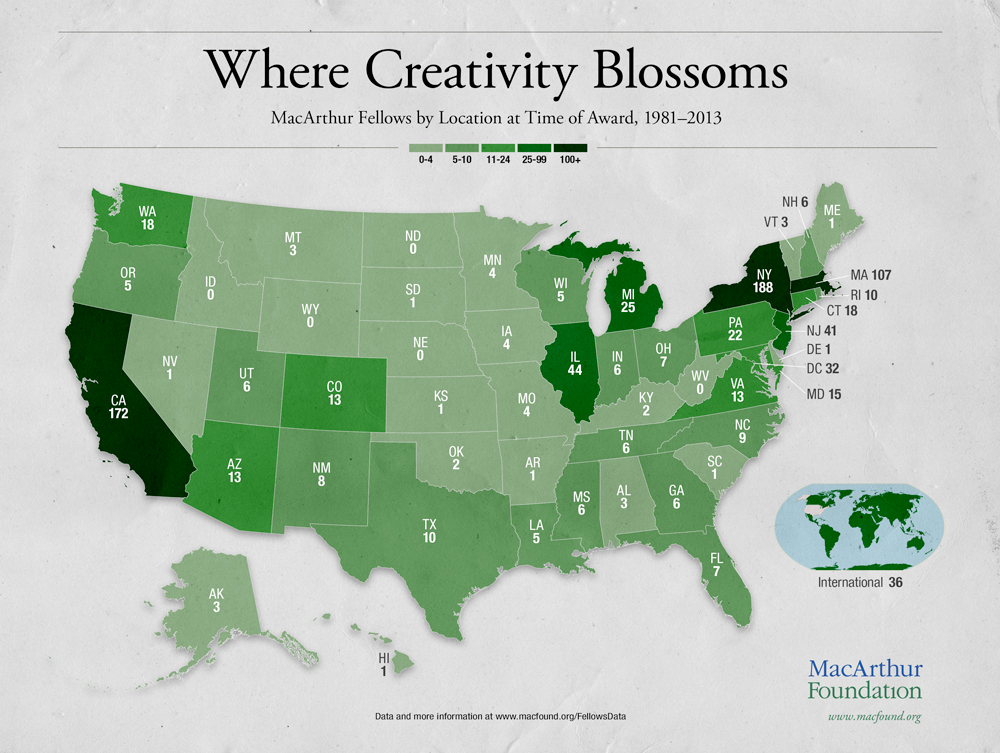
Each year, the MacArthur Foundation provides grants to some of the most talented minds in the country to provide them with the resources to pursue incredibly creative projects that just might change the world.  That’s why they’re often called the “genius awards.”  And it turns out that Connecticut ranks in the top 10 in recipients. Connecticut, with 18 recipients living in the state at the time of the award, ranks behind only New York (188), California (172), Massachusetts (107), Illinois (44), New Jersey (41), District of Columbia (32), Michigan (25), and Pennsylvania (22).  Tied with Connecticut ranking 9th is Washington state (18).

at time of _AwardThe MacArthur Foundation recently released data that shows where the 897 exceptionally creative individuals who have been recognized since 1981 were born, where they lived at the time they received the award and how mobile they are. This is the first time the data has been compiled and made publicly available.
This year's recipients will be announced on Sept. 17. The MacArthur Fellows Program awards unrestricted $625,000 fellowships to talented individuals who have shown extraordinary originality and dedication in their creative pursuits and a marked capacity for self-direction. Chicago-based MacArthur is one of the nation's largest independent foundations.

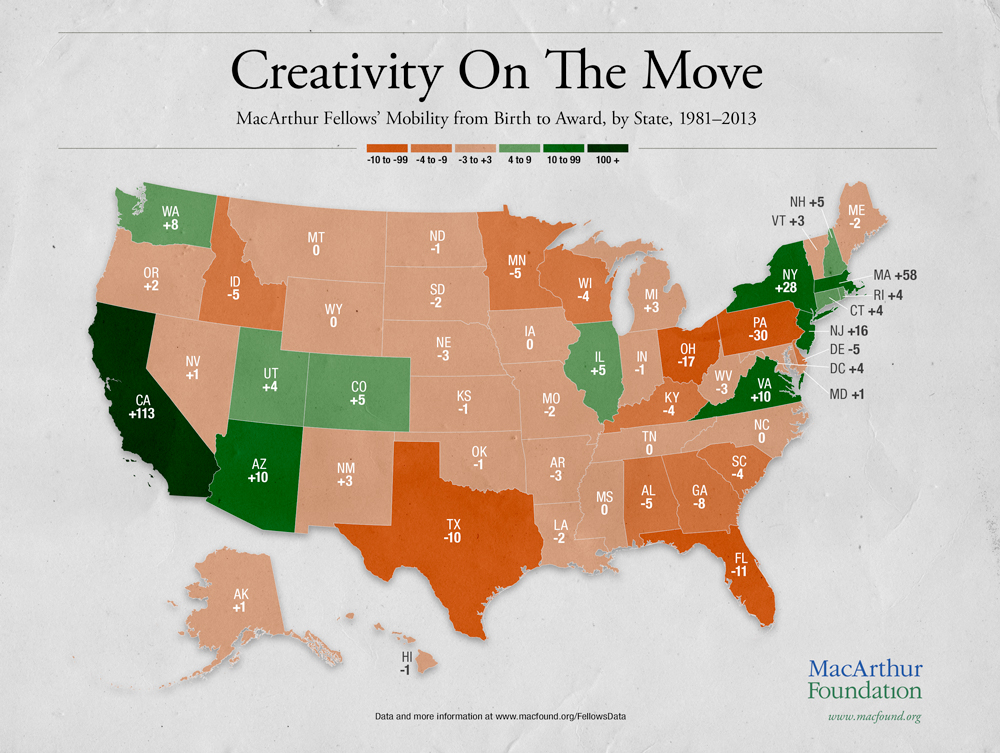
Another interesting finding is that MacArthur Fellows tend to not stay in one place. They will more likely end up somewhere other than their birthplace by the time they receive their award. California is the most popular state for fellows to move to with 113 new residents, followed by Massachusetts (58), New York (28), New Jersey (16) and a tie between Virginia and Arizona (10 each).  Connecticut also shows a net gain, at plus four.  Nationwide, 20 states reflect net gains, the remaining states have tended to lose future geniuses.

Nevada, Wyoming and Vermont, are the only states never to have produced a MacArthur Fellow.

The most recent Connecticut recipient is Daniel Spielman, a computer scientist at Yale University, selected in 2012. As the Henry Ford II Professor of Computer Science, Mathematics and Applied Science, Spielman “is a theoretical computer scientist studying abstract questions that nonetheless affect the essential aspects of daily life in modern society—how we communicate and how we measure, predict, and regulate our environment and our behavior,” according to the MacArthur profile of his selection.

In 2009, Richard Prum, an ornithologist at Yale University was among the 24 selected.  In his work, Prum draws from a wide spectrum of disciplines, including developmental biology, optical physics, molecular genetics, phylogenetics, paleontology, and behavior ecology, to address central questions about bird development, evolution, and behavior.

Officials note t hat innovative people tend to cluster near cultural centers and hotbeds of technological and scientific research, such as states with large cities like New York, California and Massachusetts, which may explain the mobility patterns of the fellows.  That may also have influenced Connecticut push in recent years into the biotechnology field and related disciplines.on the move  net plus

The data also highlight the contribution of immigrants to the creative culture of the United States. Nearly a quarter of MacArthur Fellows were born outside of the country. Though Fellows must be citizens or residents of the United States, their countries of origin span the globe.

Historian and 2003 Fellow Anders Winroth was born in Sweden and was teaching at Yale University at the time of the award, for example. The data indicates that 79% of the Fellows lived, at the time of the award, outside the state where they were born.  By way of comparison, according to recent U.S. Census Bureau data, approximately 30% of the general population and 42% of the college-educated population live outside the state where they were born.

An overwhelming number (169) of fellows were born in New York.  Other top states include California (59), Pennsylvania (52), Massachusetts (29) and Illinois (39). However, if you look at the data by per capita, those states are joined by Connecticut, Delaware, Rhode Island, Idaho, Montana and South Dakota, due to their relatively small populations.

The John D. and Catherine T. MacArthur Foundation, according to its website, “supports creative people and effective institutions committed to building a more just, verdant, and peaceful world. In addition to selecting the MacArthur Fellows, the Foundation works to defend human rights, advance global conservation and security, make cities better places, and understand how technology is affecting children and society.”

Daniel Spielman VIDEO (You Tube)     Richard Prum VIDEO (You Tube)


Fan Likes? Patriots Nation, Giants Country, Jets Nowhere

Although undefeated thus far this season, the New York Jets, it turns out, are nowhere.  At least nowhere on a nationwide, country-by-county map released by Facebook of the National Football League “likes” of Facebook users.tristate The breakdown showed Patriots dominance throughout New England and most of Connecticut – with the exception of Fairfield and New Haven counties, which remain Giants country.

The Jets were the only NFL team not to “win” a single county.

Months ago, The New York Times published a similar breakdown of major league baseball fans, which was especially interesting in breaking down the Red Sox-Yankees rivalry, but also highlighted the interest in the Yankees all across the country.

Unlike the MLB baseball map, there’s no clear “national” team, the Atlantic reported in analyzing the data.  Love for the the Bronx Bombers bubbled up in the absence of a prominent popular local franchise, appearing not only in greater New York City but also in far-reaching locations including North Carolina, Nebraska, Nevada and New Mexico. NoNewYorkJets

nation countryThat’s just not reflected in the NFL map. The Cowboys come closest, but they’re not “America’s team” as unambiguously, despite the longstanding public relations effort. Beyond Texas and its neighbors, the only isolated pockets of Cowboys fandom are in southern Nevada and southeastern Virginia. That’s it.

After the Cowboys, the Broncos control a huge region in the upper mid-west. Rivaling the Broncos are the 49ers, which rule almost all of California; and the Patriots, Seahawks and Saints, who all dominate their regions – at least on Facebook, if not in the NFL standings.

Connecticut, as it is in baseball, is divided in allegiances between New York and Boston professional teams.  But as is true throughout the tri-state region, the Jets don’t quite exceed Giants or Patriots fans – according to Facebook – anywhere.


NFL fan map

Remembering Connecticut's Enduring Loss on 9/11

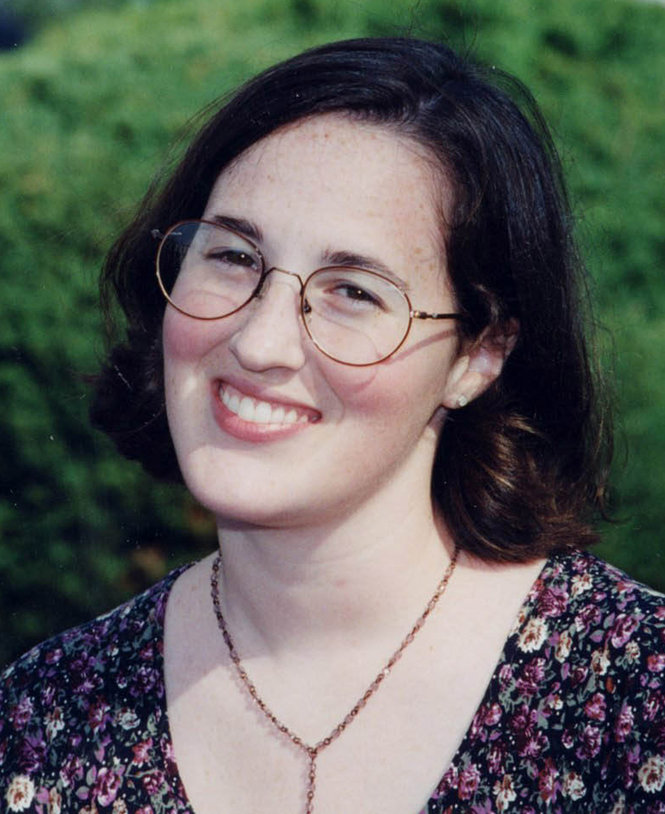
“Jeff Gonski does not need a network television special or a commemorative newspaper edition to remember what he cannot forget: It has been 10 years since Amy Toyen, his 24-year-old fiancée, vanished in a cloud of toxic smoke and twisted steel at the tip of lower Manhattan. When American Airlines Flight 11 slammed into the North Tower of the World Trade Center, Amy was on the 106th floor preparing to make a presentation at a trade show for Boston-based Thomson Financial.” Boston magazine, in 2011, began its feature article with that stark recollection.  Legacy.com begins its remembrance by describing how that morning began.

“To catch her early flight on Sept. 11, Amy E. Toyen arose in Boston at 4 a.m. so she could arrive in New York City at 6:45 a.m., in plenty of time to attend the trade show in Windows on the World at 1 World Trade Center. Ms. Toyen, 24, was demonstrating a software product of her company, Thomson Financial in Boston, when her fiancé, Jeffrey Gonski, got a call at 8:58 a.m. — his caller ID showed it was her cellphone — but when he answered, no one was there.

Mr. Gonski haAmy Toyend met Ms. Toyen, who grew up in Avon, Connecticut, at their alma mater, Bentley College in Waltham, Mass., and had managed to pull off an elaborate proposal.

"We had just ordered her wedding dress," recalled her father, Martin Toyen. "She was so happy in her life — a woman in love, who loved her job." The wedding was set for June 16, 2002.

Toyen had lost a coin flip among business colleagues to decide who made the trip on Sept. 11; the night before, her flight from Boston to New York was canceled due to bad weather – but she was able to book a flight out of Logan International Airport at 6:00 the next morning.

After her death, Toyen’s parents would reflect on the luck that placed her in the worst part of the 110-story skyscraper, at the worst possible moment, the website MassLive reported. “It’s as if fate was telling her not to go,” said her father, adding that his daughter’s diligence pushed her to rebook the flight to get to the twin towers on time.

Since 9/11, Amy Toyen is remembered by those who knew her and loved her, those whose paths crossed hers along life’s journey, and by countless others, in her hometown of Avon, her native state of Connecticut, and well beyonddoc4e6796b9ae0265012592171.

A life size sculpture of a young Amy, funded by the student government of Avon High School, sits in the garden of the Avon Public Library.   Canton artist Marilyn Parkinson Thrall designed and executed the 22-inch bronze statue depicting Amy, sitting cross-legged on a bench and cradling a teddy bear as she reads a book on her lap.  Amy’s family sorted through many pictures in order to help Thrall capture her essence, incorporating her favorite daisy-print dress, tiny sneakers, and ponytails tied with pompom rubber bands. The statue sits upon a granite bench with a plaque that tells the full story.

Amy Elizabeth Toyen is one of the 2,977 people whose lives were tragically and abruptly ended on September 11, 2001, and one of 153 individuals named on Connecticut’s official memorial at Sherwood Island at Long Island Sound.

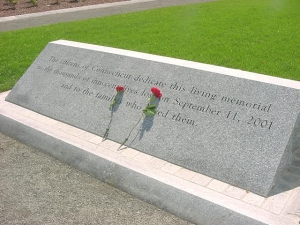
When the viewer faces the inscription on the state’s memorial stone they are oriented across the Sound to the site of the former World Trade Center in New York City, which had been visible from that scenic location. The inscription reads, "The citizens of Connecticut dedicate this living memorial to the thousands of innocent lives lost on September 11, 2001 and to the families who loved them."

9-11-Living-Memorial-2