Jewel Mullen: Public Health Commissioner At Center of State's Ebola Response

Described on the Yale School of Public Health website as “a leader in building effective community-based chronic disease prevention programs,” Connecticut’s Commissioner of Public Health, Dr. Jewel Mullen, has a long academic association with Yale, even as both were catapulted into the breaking news spotlight with a possible case of the Ebola virus in a patient under care at Yale-New Haven Hospital. Mullen is also well-acquainted with the U.S. Centers for Disease Control and Prevention, having served on public health advisory committees, appointed by the CDC and the U.S. Department of Health and Human Services.  Little known by state residents outside of the public health community, she is well regarded within those circles.Dr. Jewel Mullen
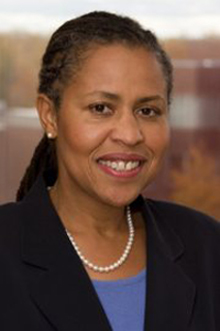
She is the New England regional representative to the Association of State and Territorial Health Officials (ASTHO) Board of Directors and chairs ASTHO’s Prevention Policy Committee. In 2013, she was appointed to the Institute of Medicine’s Committee on Quality Measures for the Healthy People Leading Health Indicators.

Appointed as Commissioner by Governor Dannel Malloy at the start of his administration in 2011, Dr. Mullen has combined clinical work, research, teaching and administration throughout a career focused on improving the health of all people, especially the under served. Board certified in internal medicine, Dr. Mullen received her Bachelor (1977) and Master (1996) of Public Health degrees from Yale University where she also completed a post-doctoral fellowship in psychosocial epidemiology.dph-color_bigger
Earlier this month, Malloy declared a public health emergency in Connecticut, issuing a precautionary and preparatory order that allows state public health officials to coordinate a targeted quarantine in case Ebola arrives in the state, with decision-making authority residing in Commission Mullen.  Without the Governor’s declaration, there would not be a statewide ability to isolate or quarantine – instead, the authority would have remained with individual local public health directors.

Prior to joining the Department of Public Health, Dr. Mullen was director of the Bureau of Community Health and Prevention at the Massachusetts Department of Public Health. In 2012 the CDC appointed Dr. Mullen to its advisory committee on health disparities, a subcommittee of the Advisory Committee to the Director.  Earlier in her career, she was the medical director of Baystate Mason Square Neighborhood Health Center in Springfield, Massachusetts. She graduated from the Mount Sinai School of Medicine where she was elected to AOA, the National Medical Honor Society, after which she completed her residency at the Hospital of the University of Pennsylvania.

In addition to being a physician, Mullen is also an educator, who has taught medicine at several different universities including New York University, the University of Virginia, Yale and Tufts University. . She also holds a Master in Public Administration degree from Harvard University’s John F. Kennedy School of Government. She is currently listed as a lecturer in epidemiology (chronic diseases) and in public health by the Yale School of Public Health and is an ex-officio member of the state Board of Regents for Higher Education.

Her priorities at the Connecticut Department of Public Health, according to the Department website, include chronic disease and injury prevention, health care quality and safety, health equity, and supporting local efforts to create healthy communities.  She has lived in Connecticut since 1992.

View From Abroad: Connecticut, Land of Opportunity

Connecticut, seen from afar, is the land of opportunity.  At least that would appear to be the view of people from all over the world who moved into the Constitution State from outside the U.S. - an increase of 23,862 residents - during a recent five-year period. Data from the U.S. Census Bureau’s American Community Survey indicates that between 2008 and 2012, each of Connecticut’s eight counties saw an influx of people moving here from abroad.

The new Connecticut residents from beyond the nation’s borders landed mostly in Fairfield, Hartford and New Haven counties, but each county in the state saw new arrivals from abroad  during the five-year survey period.

Here is the county-by-county breakdown:translations-globe-300x300

Fairfield County                +8,569

Hartford County               +5,848

New Haven county         +5,510

New London County      +1,356

Tolland County                  +959

Middlesex County           +804

Litchfield County              +412

Windham County             +404

According to the Migration Policy Institute, 13.8 percent of Connecticut's overall population in 2012 was foreign born, up from 10.9 percent in 2000.  Of the 2012 immigrant population, 8.9 percent came to the United States after 2010, 31.6  percent between 2000 and 2009, and 22 percent between 1990 and 1999.

The American Community Survey (ACS) is a mandatory, ongoing statistical survey by the U.S. Census that samples a small percentage of the population every year -- giving communities the information they need to plan investments and services. The Migration Policy Institute is an independent, nonpartisan, nonprofit think tank in Washington, DC dedicated to analysis of the movement of people worldwide.


ctcountymap

CT's Captive Insurance Program Ranks #2 in US

The Connecticut Insurance Department’s Captive Insurance Program has been ranked the #2 program in the nation by an industry trade publication in only its third year of operations.   A captive insurer is an insurance company that is organized and owned by a parent firm or association to manage the owners’ risk and control costs. Captive insurance has become an increasingly important tool used by companies to manage their business risk and promote strategic initiatives.  Captives are best described as a form of self-insurance, but with all the advantages of traditional insurance. Once an alternative to the commercial insurance market, captives have evolved into strategic financial vehicles used for many different enterprises, such as manufacturing and health care, officials explain.captive association

Earlier this fall, the Connecticut Captive Insurance Association, along with the state Insurance Department and prominent industry sponsors, held the 2014 Symposium on Captive Insurance in Stamford.  The conference, “Captives Done Right:  Revolutionary Strategies for Optimizing Capital,” included sessions on risk mitigation strategies, corporate governance, risk retention and healthcare captives.  Participants included the chief financial officer of Frontier Communications, director of finance of the Archdiocese of Hartford, Chief Scientist Emeritus atcaptive Pitney Bowes, Senior Legal Counsel at Swiss Re America Holdings, and president & CEO of JANUS Associates.

According to the symposium’s website, the advantages of captive insurance include the opportunity to earn an underwriting profit, improved risk management and loss control, coverage for unusual or hard to place risks, direct access to reinsurance, and potential tax savings.

One of 37 states and U.S. territories that allow captives, Connecticut was ranked the second leading domicile by Captive Review, behind Vermont, in the magazine’s U.S. Captive Service Awards announced this week.  The annual awards recognize captive industry professionals who have demonstrated the highest levels of excellence over the past year.With 5,660 companies registered in captive domiciles across the world, according to the publication, the captive insurance sector remains a vital alternative risk transfer (ART) option and a significant part of the insurance sector.  Delaware was top-ranked a year ago.ctInsuranceDept

Connecticut currently has four licensed captive insurers and several more applications pending.

“Connecticut is taking a unique approach to the captive market,” said Connecticut Insurance Department Captive Unit Manager John Thomson. “We are working beyond a pure regulatory regime and are focusing on helping captive owners create sustainable risk financing vehicles. It is not about the CAPTIVE_web-300x81number of licensed captives but about an informed professional regulatory response.”

For 3rd Consecutive Year, Connecticut Resident Is Named White House Fellow

Lindsay Rodman, a Captain in the United States Marine Corps,  judge advocate, and foreign area officer (Latin America) from Kent, Connecticut, has been named as one of 15 White House Fellows for 2014-15. She is the only Connecticut resident named to the prestigious fellowship for the coming year, and the third state resident in the past three years.  The Fellows come from diverse backgrounds, varied professions, and have demonstrated a strong commitment to public service and leadership.1373887640000-IMG-3564-1307150728_4_3

Rodman most recently served as Deputy Legal Counsel in the Office of the Legal Counsel to the Chairman of the Joint Chiefs of Staff, where her portfolio included military justice, space law and human rights law issues. Her placement during her service as a White House Fellow will be with the National Security Council.

Before moving to the Joint Staff, Lindsay was assigned to Judge Advocate Division, Headquarters Marine Corps. From 2010-2011, she was deployed to Afghanistan as an operational law attorney. She previously served as a defense counsel and legal assistance attorney in Okinawa, Japan.

Founded in 1964, the President’s Commission on White House Fellowships is one of America’s most prestigious programs for leadership and public service. White House Fellowships offer exceptional young men and women first-hand experience working at the highest levels of the Federal government.

Selected individuals typically spend a year working as a full-time, paid Fellow to senior White House Staff, Cabinet Secretaries and other top-ranking government officials. Fellows also participate in an education program consisting of roundtable discussions with renowned leaders from the private and public sectors, and trips to study U.S. policy in action both domestically and internationally. Fellowships are awarded on a strictly non-partisan basis.white house fellows

Prior to joining the Marine Corps, Rodman worked as an associate at Arnold & Porter LLP in Washington, DC. In early 2014 she was selected as a Center for New American Security Next Generation National Security Leader. She has been a member of the Warlord Loop, and a term member at the Council on Foreign Relations.

Rodman graduated in 2003 from Duke University with an A.B. in Mathematics and in 2007 from Harvard Law School with a J.D. and the Kennedy School of Government with a Masters in Public Policy.  She has volunteered at the DC Rape Crisis Center, and authored an article on sexual assault in the military that was published in 2013 by the Wall Street Journal.

The class of White House Fellows for 2014-15 includes individuals from New York, San Diego, San Francisco, Woodside (CA), Naperville (IL), Miami, Norfolk (VA), Midland (MI), Missoula (MT), Los Angeles, Voorhees (NJ), Penn Valley (PA), McAllen (TX), and Irvine (CA).

It is the third consecutive year that Connecticut has had a resident appointed as a White House Fellow.  Last year, Justin Finnegan of Darien was selected, following Anne O’Connell of West Haven the preceding year.

The first class of White House Fellows, in 1965, included William R. Cotter, later elected to Congress representing Connecticut’s First District.  He was joined in that class by Robert E. Patricelli, who would go on to become one of Connecticut’s prominent health care entrepreneurs and business leaders.  The Patricelli Center for Social Entrepreneurship at Wesleyan University bears his name.

More information on the White House Fellows program is available at whitehousefellows@whf.eop.gov 

See White House Fellow video. 


CT’s Regional Planning Agencies Consolidate, Realign and Disappear

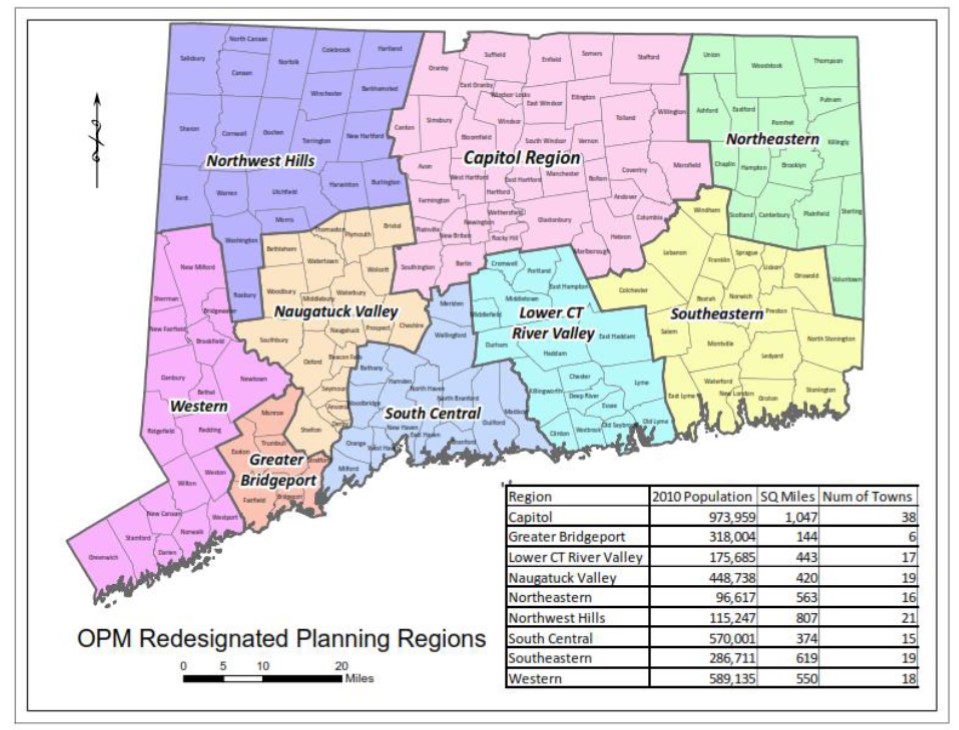
As the Central Connecticut Regional Planning Agency (CCRPA) prepares to go out of existence, the newly formed Naugatuck Valley Council of Governments is advertising for an Executive Director.  It’s all part of a major shake-up of regional planning agencies in central Connecticut, prompted by the state legislature’s decision to reduce the number of regional planning agencies in the state from 15 to 9, as of January 1.  Among the by-products:  Bristol and New Britain are parting company. The realignment is breaking up long-term relationships going back decades, and forcing municipalities to decide on new partners.  Regional planning agencies deal with a range of issues, but generally focus on transportation, land use, brownfield cleanup and environmental projects. For communities between two large cities that serve as anchors of regional planning agencies, it often comes down to deciding it they’d like to align to the east or the west.

The Central Connecticut Regionnew map RPAsal Planning Agency (CCRPA), for example, has been the regional and metropolitan planning organization for the cities of Bristol and New Britain and the towns of Berlin, Burlington, Plainville, Plymouth, and Southington. For over 45 years, CCRPA has worked with government, business, and the public to develop a vision for the region and resolve its challenges.  It will cease to exist at the end of the year.

The newly formed Naugatuck Valley Council of Governments (NVCOG) will replace the Council of Governments of Central Naugatuck Valley and the Valley Council of Governments plus add two towns from the Central Connecticut Regional Planning Agency – Bristol and Plymouth.

The other CCRPA towns, including New Britain, are headed elsewhere. Most of the towns in the CCRPA have opted to join with Hartford area municipalities in the Capitol Region Council of Governments, but Bristol officials decided to join the Waterbury agency instead.  New Britain is one of eight municipalities to join CRCOG in recent months, as part of the CCRPA break-up.250px-CT_regions

CRCOG will have grown to 38 member municipalities, with a total population of just under one million, and 1,047 square miles, the largest of the state’s regional planning agencies.  Joining CRCOG since July 1 are Berlin, Columbia, Coventry, Mansfield, Plainville, Southington, Willington and New Britain.  The new Naugatuck Valley Council of Governments will represent 19 towns and cities with a population of 448,738, over 420 square miles.

Ed Edelson and Kurt Miller, the current chairmen of the two councils of governments that had been covering the Naugatuck Valley, which will be subsumed by the new Council, said recently that “although our two current organizations have done high-quality work over the past four decades, we recognize they each have had different strengths and areas of focus.”

Edelson, the Democrat first selectman of Southbury, and Miller, the Republican first selectman of Seymour, added “we believe this step to align the 19 cities and towns around the urban center of Waterbury provides the best opportunity for all of our communities to combine resources, and bring significant new investment and cost savings to each of our communities.”  NVCOG held its first organizational meeting in late summer, and launched their Executive Director search last week.new map

Bristol Mayor Ken Cockayne recently said he “looks forward to strengthening existing ties to neighbors and building new relationships and cooperation with communities that share many of Bristol’s priorities and challenges.”

They also said they “recognize the importance of our new region’s major cities — such as Waterbury, Bristol and Shelton — as the economic engines. Their economic and social future is critical to all of the surrounding towns. We are all dynamically linked.”

For those who may be interested in the Executive Director position, topping the list of characteristics for the “ideal candidate” – “honest, trustworthy, diplomatic and ethical.”  And leading the “opportunities and challenges” – managing the consolidation, “sensitive to the cultural differences” of bringing the 19 towns together as a new council of governments.

The next challenge for the state, according to Edelson and Miller, is the consolidation of the Metropolitan Planning Organizations (MPOs), which are the federal regions that plan transportation systems and jointly allocate federal funds for these projects with the Connecticut Department of Transportation. There currently are eight MPOs in Connecticut, and the aim is to have fewer MPOs with boundaries that coincide with the new councils of governments’ boundaries.

Alternate College Ranking System Reveals Surprises for CT Colleges

It turns out that the oft-heralded and increasingly criticized U.S. News & World Report college rankings aren’t the only game in town.  Washington Monthly magazine has developed a rating system with a different emphasis, and very different results.  Among the Connecticut institutions making the list:  UConn, Yale, Wesleyan, and Trinity – but not necessarily in familiar places. The publication uses three main categories of evaluation for its analysis.  Social Mobility (recruiting and graduating low-income students), Research (producing cutting-edge scholarship and PhDs), and Service (encouraging students to give something back to their country). The publ1409.cover.220x286ication sets out to “identify the most public-minded institutions,” utilizing the three criteria and a handful of specific measures in each.


“Instead of crediting colleges that reject the most applicants, we recognize those that do the best job of enrolling and graduating low-income students,” the magazine pointed out.  The rankings also “measure both pure research spending and success in preparing undergraduates to earn PhDs.”  In addition, by “giving equal weight to public service, we identify colleges that build a sense of obligation to their communities and the nation at large,” the publication explained in the cover feature of the September/October issue.

Connecticut did not have an institution reaching the Top 30 National Universities.  That list was led by four University of California institutions in the top five slots, along with Texas A&M and Stanford University.  Harvard University placed tenth.

Yale University ranked #57 on the full list of National Universities. UConn ranked #82 - the only other school in the state listed among 277 institutions.  (Yale is ranked #3 in the U.S. News rankings; UConn places 19th)

The magazine also compiled a series of specialty lists ranking the institutions.

The only Connecticut school to reach the nation’s Top 30 Liberal Arts Colleges was Wesleyan University, which ranked #16.  (Wesleyan is ranked #15 on the U.S. News listing.) Further down the list, Trinity College ranked #184.

Among the “best-bang-for-the-buck” colleges, the University of Connecticut ranked #76, the only Connecticut college to break into the top 100.  That list was topped by three City University of New York colleges.colleges

Four Connecticut schools were among the Top 50 “Affordable Elite” institutions, according to the list compiled by the magazine.  Yale University ranked #33, Wesleyan University placed #40, UConn ranked #97 and Trinity College in Hartford just made the list at #98.

In the good news department, there were no Connecticut school reaching the “worst colleges” lists complied by the magazine.

The Social Mobility category includes four components including the percentage of students receiving Pell Grants, the cost of attendance, and the anticipated rate of graduation.   The five Research factors include research expenditures and the number of bachelors degree recipients who go on to earn PhDs  The Service category includes five factors including the number of alumni who serve in the Peace Corps, student participation in community service and the number of staff supporting community service.

Signaling the importance of the Washington Monthly rankings to colleges across the nation, a total of 47 institutions ran advertisements in the issue.  The advertisers did not include any colleges from Connecticut.

students

License Renewal of WTIC-AM on “Enforcement Hold” at FCC

The Federal Communications Commission has the pending license renewal of WTIC-AM radio on “enforcement hold,” nearly six months after the station’s broadcast license technically expired.  The station can continue broadcasting under the license that expired on April 1, 2014 until the FCC acts on its renewal application, which was filed last year on November 27, just days ahead of the renewal application deadline. In the wake of the corruption conviction earlier this month of former Governor and former WTIC talk show host John G. Rowland, questions have been raised about the radio station that employed Rowland.  Although FCC officials say that “while it is too late to file a formal Petition to Deny the license renewal,” because the renewal date has passed, “an informal objection can still be filed to the license renewal” at any time prior to action on the pending renewal application.WTIC_1080_AM_Radio_logo

The FCC explains that an "informal objection," which is an official process, “may take the form of a letter signed by the objector” and should “contain sufficient information to establish any violation alleged.”   FCC officials indicate that no objections to the station’s renewal have been filed as of this week.  If the station’s license renewal is granted, it would be for an 8-year period.

There is no indication when the hold was placed on the renewal application by the FCC’s enforcement division, what the reason was, or when it might be lifted.  FCC officials indicate that most often enforcement holds are instituted due to a complaint being filed that requires investigation, but they would not confirm whether that was true in this instance.  That information is only made available to the licensee or their attorney, according to an FCC official. FCC

Action on the license renewal application remains possible at any time.  Should an informal objection be filed, the FCC would, in most instances, need to deal with any issues raised in the objection before it would act on the license renewal application.

In April 2014, Rowland resigned as a WTIC-AM radio host as his drive-time talk show, with a federal indictment imminent related in part to Rowland’s relationship with the campaign of then-Congressional candidate Lisa Wilson-Foley. Rowland had remained on the air on WTIC, even after it was revealed that his relationship with the Wilson-Foley campaign had sparked a federal grand jury investigation.

During this month’s trial, according to published reports, a former campaign operative for Wilson-Foley described ways Rowland allegedly coordinated topics on his WTIC talk show with the messages he wanted the campaign to get out.

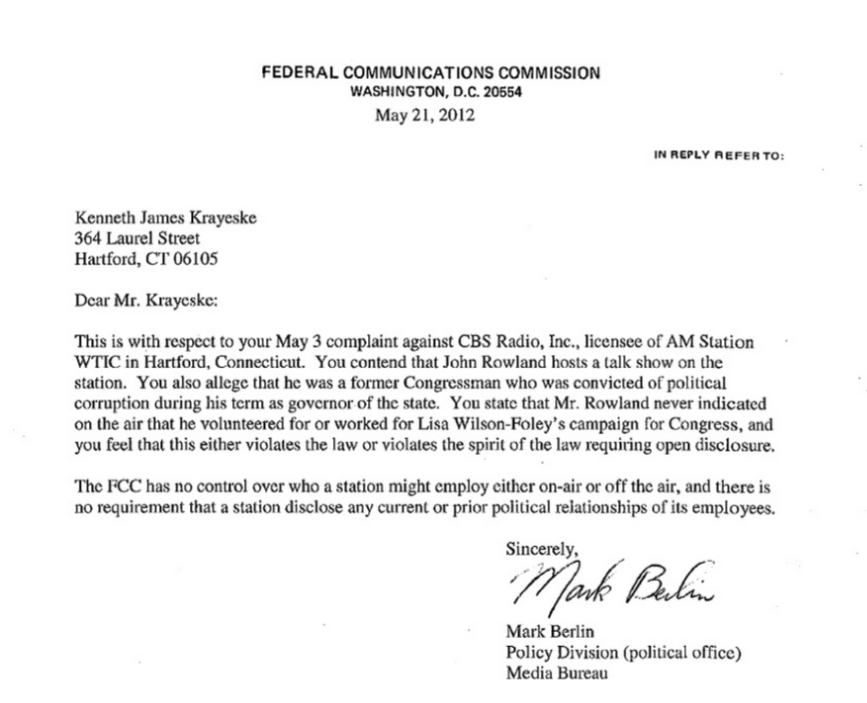
In May 2012, responding to a complaint filed that month by Kenneth James Krayeske to the FCC regarding Rowland’s unstated relationship with the Wilson-Foley campaign, Mark Berlin of the FCC’s Policy Division Media Bureau indicated that “the FCC has no control over who a station might employ either on-air or off the air, and there is no requirement that a station disclose any current or prior political relationship of its employees.”May2012FCCletter

“We accept Mr. Rowland’s decision to step down at this time," Jenneen Lee, the station's program director, said in a statement posted on the station's website soon after Rowland went off the air earlier this year, CT Mirror reported.  The Rev. Will Marotti, who was Rowland's spiritual adviser and served as his co-host when Rowland went on the air at the station in September 2010, took over as host of the weekday afternoon program and remains on the air.

Back in 2012, the Torrington Register-Citizen reported that “according to a WTIC-AM representative, former Gov. Rowland disclosed the fact that he was working with Republican Lisa Wilson-Foley’s campaign ‘months ago,’ but said the 5th congressional district race is avoided on air, intentionally. ‘He actually stays away from it on purpose,’ Jeneen Lee said. ‘To date, there’s been no conversation on the air about the campaign.’”  Editorials published in the months following the campaign-related revelations called for additional disclosure by WTIC.

CBS Radio horizontal color EPSRowland, who resigned as Governor a decade ago in a corruption scandal and served 10 months in prison, was convicted this month of federal charges that he conspired to hide payment for work on two congressional campaigns, in 2010 and 2012, including the Wilson-Foley campaign.

WTIC is owned by CBS Radio.

Student Chapter from Eastern Connecticut Earns Top Honors from Nonprofit "Best Buddies"

The Best Buddies chapter at Eastern Connecticut State University has been named Overall Outstanding Chapter in the United States.  The recognition came at the Best Buddies International Leadership Conference held at Indiana University. Best Buddies is a nonprofit, worldwide organization that helps create friendships for people with intellectual and developmental disabilities. Katharine Ferrone, chapter president, accepted the award on behalf of the club’s members and faculty advisor Charles Wynn, professor of chemistry at Eastern. Over 2,000 student leaders, volunteers, and staff from Best Buddies International programs around the world, participated in the 25thAnnual Leadership Conference  in Bloomington this summer.314112_10150786601893488_169246690_n

“The vision of Best Buddies is to put itself out of business by promoting a world that no longer requires an organization to help create friendships with people with disabilities,” said Ferrone, a senior from Wallingford. “Now five years old, Eastern’s chapter spiraled to the top thanks to the inspiration and dedication of many fine student leaders and volunteers.  It is demonstrating to both the university and community that people with disabilities are more like us than different.”

In Connecticut, Best Buddies is on the following college campuses: Connecticut College, Eastern Connecticut State University, Fairfield University, Quinnipiac University, Sacred Heart University, Southern Connecticut State University, Trinity College, University of Connecticut, University of Hartford, Wesleyan University and Yale University. The most enduring goal of the organization is to provide opportunities for one-to-one friendships. 1972343_712334228816599_428022073_n

Best Buddies programs engage participants in each of the 50 United States, and in 50 countries around the world.  Best Buddies’ seven formal programs – Best Buddies Middle Schools, High Schools, Colleges, Citizens, e-Buddies, Jobs and Ambassadors – positively impact nearly 700,000 individuals with and without disabilities worldwide. The chapter at Eastern holds a variety of events each year, from dances to friendship walks, to help close social gaps.

Anthony Kennedy Shriver is the Founder and Chairman of Best Buddies International, which he created in 1989 to foster one-to-one friendships between people with and without intellectual disabilities. Recognizing the tremendous volunteer potential of university students, Shriver first inspired his college peers to personally collaborate in expanding the realm of opportunities that persons with intellectual disabilities should experience.  Best Buddies has grown into a leading nonprofit entity with increasing international reach across six continents, establishing a global volunteer movement that creates opportunities for one-to-one friendships, integrated employment and leadership development for people with intellectual and developmental disabilities.

The Best Buddies Connecticut office is located in North Haven.

photo

Photo:  ( left to right)  Anthony Kennedy-Shriver, founder of Best Buddies; Katharine Ferrone, chapter president from Wallingford, CT, in green shorts holding the award; club members Amber Heim from East Hartford in white shorts, Kaitlyn Murphy from Mansfield in blue shorts and Monica Mordowanec from Seymour; Connecticut Best Buddies Director Angelo Santiago of Willimantic; and Kyrie Irving of the Cleveland Cavaliers.

CT Ranked #1 in Exceeding Goal in Year One of Affordable Care Act

An analysis of how states fared in the inaugural year of the Affordable Care Act, based on targets for enrollment developed by the Obama Administration, shows that Connecticut leads the list. According to the analysis published by the Wall Street Journal using data from the Department of Health and Human Services, Connecticut ranked #1, attaining 140 percent of the sign-up goal.  The only other states that did better than expected were Rhode Island (137%), New Hampshire (112%) and Florida (106%).

Rounding out the top dozen states, based on their performance compared with expectations, were Maine (92%), Idaho (90%), North Carolina (87%), Wisconsin (77%), Delaware (76%), New York (70%), Virginia (70%), New Jersey (69%), Michigan (69%).

The Journal reported that the lessons learned in the first roll-out of the health care program will be utilized when the next enrollment period begins on November 15.  The newspaper noted that more than eight million people got private insurance for 2014 through the law's insurance exchanges, which were plagued with technical problems when they opened in October 2013 but stabilized toward the end of the six-month sign-up period.

The next enrollment period runs through February 2015, and it is expected that marketing campaigns will stress testimonials from real people, more emphasis on deadlines, and an increased focus on in-person help.  Individuals can sign up at the federal website, HE-AA089_ENROLL_J_20140910143015healthcare.gov, to receive updates, focused by individual states.

Connecticut’s official health insurance marketplace, Access Health CT, is reminding state residents that Enrollment in Medicaid (HUSKY) and the Children's Health Insurance Plan (CHIP) is open year round for eligible persons and families.

The website points out that individuals may also still be eligible to enroll in coverage throughout the year “if you or a member of your household has experienced a Special Enrollment Qualifying Life Event in the past 60 days or you will in the next 60 days.” Qualifying Life Events may include: child birth, adoption, death of a member of the household, marriage, loss of current health care coverage, loss or reduction in employer insurance contributions, new legal CT or U.S. residency, or U.S. lawful presence. Individuals that qualify may not need to wait until November to enroll, and can call 855-805-4325 for additional information.

Earlier this month, Access Health CT CEO Kevin Counihan took his Connecticut experience to Washington, accepting a position overseeing the federal health exchange.  Counihan joined the federal Centers for Medicare & Medicaid Services team as Marketplace Chief Executive Officer, where he will lead the federal Marketplace, manage relationships with state marketplaces and run the Center for Consumer Information and Insurance Oversight, which regulates health insurance at the federal level.  He'll be in position when the next enrollment period gets underway later this fall.gov_access_health

“We are proud of what we’ve accomplished here—we’re a national leader with more than 280,000 people enrolled in affordable health insurance,” said Lieutenant Governor Nancy Wyman, Chair of the Access Health CT Board.

At the other end of the spectrum, according to the analysis, the states that fared well below expectations were Massachusetts (-87%), Oregon (-71%), Kentucky (-62%), Nevada (-61%) and New Mexico (-61%).

Anti-Texting Enforcement Intensifies as Study Indicates Law Can Save Lives

An unprecedented anti-texting enforcement effort by the Connecticut Department of Transportation’s Highway Safety Office, part of the “U Drive. U Text. U Pay.” campaign, concludes this week on September 24.  The nearly month-long enforcement mobilization marked the first time the state has used dedicated federal funds to curb texting while driving. Connecticut was the only state in the nation to receive $2.3 million in federal Distracted Driving prevention funds from the National Highway Traffic Safety Administration (NHTSA). The joint effort by state and local police enforces Connecticut’s law that prohibits motorists from texting and/or using hand-held cell phones while driving. Under Connecticut’s cell phone and texting law, violations involve heavy fines, ranging from $150 for a first offense and $300 for a second violation to $500 for each subsequent violation.u-drive-u-text-u-pay-logo

Using data from the Governor’s Highway Safety Administration, the National Conference of State Legislatures summarizes state cellular phone use and texting while driving laws.

  • Hand-held Cell Phone Use Ban: 13 states, D.C., Puerto Rico, Guam and the U.S. Virgin Islands prohibit all drivers from using hand-held cell phones while driving.
  • All Cell Phone ban: No state bans all cell phone use for all drivers, but 37 states and D.C. ban all cell phone use by novice or teen drivers, and 20 states and D.C. prohibit any cell phone use for school bus drivers.
  • Text Messaging ban: 44 states, D.C., Puerto Rico, Guam and the U.S. Virgin Islands ban text messaging for all drivers. Four states prohibit text messaging by novice or teen drivers and three states restrict school bus drivers from texting.

cell photoTexting bans can reduce teen traffic fatalities by as much as 11 percent, according to a new study of the effect of such state laws.  Texting bans aimed at teens and that allow primary enforcement of the law —they don’t require officers to have another reason for the traffic stop — have had the most dramatic effect, a team of researchers at the University of Alabama at Birmingham School of Public Health found in a study published in the August edition of the American Journal of Public Health.

“[O]ur results provide strong evidence that the primarily enforced texting laws seem to be reaching the intended subpopulations who are most at risk for texting while driving,” the researchers indicated.

According to the website distraction.gov, the official U.S. government website for distracted driving, Connecticut law includes:

  • Handheld ban for all drivers (Primary law)
  • Ban on all cell phone use (handheld and hands-free) for bus drivers (Primary law)
  • Ban on all cell phone use (handheld and hands-free) for novice drivers (Primary law)
  • Ban on texting for all drivers (Primary law)

Connecticut defines novice drivers as those under the age of 18 or with a learner's permit.public health

In the recently published research, the team examined 11 years of data from the 48 contiguous states. They controlled for other factors that may influence crash risk, such as economic, legal and population-specific indicators. (Unemployment, for example, can influence risk because fewer workers means fewer drivers on the road. Income and gas prices can affect how much people drive, again exposing them to more risk.)

Just having a texting law was linked to a 2.3 percent decline in overall traffic fatalities for all drivers.

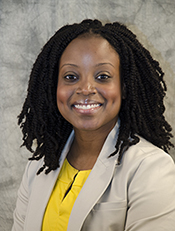
“Our results indicate that states that have not enacted any primarily enforced texting bans are missing out on opportunities to prevent avoidable roadway deaths,” said one of the authors, Alva O. Ferdinand.ferdinand-alva175

The first of the researchers’ three main findings was that primary enforcement really matters.  At the time of this study, Alva O. Ferdinand, Nir Menachemi, Bisakha Sen, Justin L. Blackburn, and Michael Morrisey were with the Department of Health Care Organization and Policy, University of Alabama at Birmingham. Leonard Nelson was with the Cumberland School of Law, Samford University, Birmingham, AL.

While the focused enforcement mobilization will end Sept. 24, the Transportation Department says enforcing Connecticut’s tough hand held mobile phone ban remains a priority.