Pedals for Progress Sends Bicycles Overseas to Boost Opportunity, Improve Economic Conditions

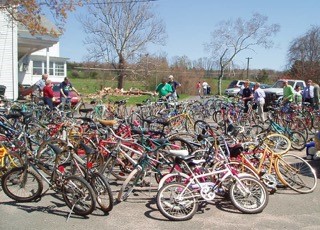
Area residents with an adult or child’s bicycle in repairable condition are urged to consider a donation to Pedals for Progress (P4P) in West Granby this weekend.  The national organization rescues bicycles destined for overburdened U.S. landfills and ships them to developing countries where they are sorely needed and highly valued. Last year, bike collections were sponsored by approximately 41 community partners in six states, including Connecticut. P4P bikes are put to work not only as basic transportation, but are used as a supplement to school and community programs. The bikes are adapted for use as trash haulers, produce trucks, taxis, and farm machinery.bicycle 1

With overseas partners, the bicycles take on an even greater significance – to keep the bikes working, maintenance is necessary. Children and adults are trained in bicycle maintenance and repair, and the bicycles are sold within the community, fostering the development of a local economy. If a person would like to have a bicycle but cannot pay for it, that person has to work for the shop (and learn a new skill) in order to cover the cost of the bicycle.

P4P also arranges for the bicycle shops to have a supply of tools, parts, accessories, and lubricants for maintaining the bikes. With Pedals for Progress, a bicycle becomes a valuable commodity for trade, employment, transportation, local government – the list goes on.

Sponsored by Jackie Rubell Johnson with support from Holcomb Farm, bikes can be dropped off from 12 noon to 3 PM on Saturday May 23, 2015, rain or shine at Holcomb Farm, 113 Simsbury Road, in West Granby. [“Bikes for parts” or disassembled bikes are not accepted.] It costs $40 to collect, process, ship, rebuild and distribute each bicycle. A donation toward shipping costs is necessary.  Organizers ask for a minimum $10 donation with each bike or sewing machine to help cover the cost of shipping. Receipts are offered for value of donation including cash.

P4P collects 5,000 to 7,000 bicycles annually and transfers this material wealth to those in need. To date, more than 140,000 have been shipped to developing countries in Latin America, Africa and Eastern Europe.  Last year, the bicycles were donated to recipients in Nicaragua, Guatemala, Albania, Moldova, and Madagascar. Pedals1

In these countries the bikes are reconditioned by partner agencies and distributed at low cost to poor working adults. These bikes provide reliable transportation for commuting to work, transporting product to market, or accessing health care and other services. Steady employment for is vital to the development and success of these economies.

In 2014, Pedals for Progress shipped a total of 3,634 bicycles, 274 sewing machines, and approximately $360,000 in bicycle parts and accessories, to seven nonprofit agency partners in seven developing countries. That brought the cumulative donations shipped in the last 24 years, since the organization’s inception in 1991, to 142,437 bicycles, 2,860 sewing machines, and over $12 million in parts and accessories donated to 38 countries.

Among the organizations providing support are the Clif Bar Family Foundation, FedEx and Thulé.   Connecticut organizations that participated in collecting bicycles in 2014, in addition to Jackie Rubell Johnson with support from Holcomb Farm in West Granby, include Newtown Rotary Club, Old Greenwich Presbyterian Church, and the Wilton High School Spanish Honor Society.

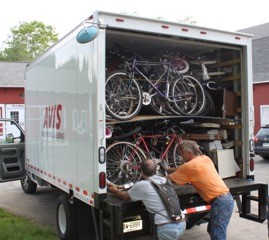
bicycle 2The organization also accepts working portable sewing machines and P4P seeks donations of wrenches for their overseas shops. All cash and material donations are fully deductible and a receipt will be available at the collection site.

Pedals for Progress is a 501 © (3) corporation and a registered charity in the states of New Jersey, Pennsylvania, Vermont, Iowa and Connecticut.  More information about the organization is available at  www.p4p.org; for information about the May 23 pick-up in West Granby, call 860 653 7758.

https://www.youtube.com/watch?v=U0qfStNmS6k&feature=youtu.be


States Under Pressure to Raise Gas Tax to Support Infrastructure Repair

In nearly two-thirds of states, state-imposed fuel taxes have not kept up with inflation for two decades, according to a Governing analysis of state gas tax data reported to the U.S. Census Bureau. That is forcing legislators around the country to consider raising gas taxes or exploring other ways to increase transportation spending, as Congressional action on adjusting the federal portion of the gas tax to meet infrastructure needs remains stalled. As Connecticut – with among the nation’s highest gas taxes - contemplates embarking on a decades-long comprehensive transportation infrastructure upgrade, how to fund the likely record-setting fiscal requirements has been assigned to a task force to consider and propose recommendations.  Earlier this month, Michigan voters resoundingly defeated a measure -- 80 percent voted “no” -- to hike gas taxes and make many other changes to boost state transportation spending, Governing reported. Last fall, Massachusetts voters recinded (with 53% of the vote) a law that would have automatically tied gas tax rates to inflation.  The law had been passed by the state legislature in 2013. Gas-pump-image

Connecticut’s gas tax, increased most recently by about 4 cents per gallon in July 2013, based on legislation approved previously – a step not taken by many other states in recent years. The Institute on Taxation and Economic Policy reported earlier this year that 22 states hadn’t raised their gas taxes in more than a decade, according to Governing.  Connecticut is not among them.

At the federal level, the gas tax was last increased in 1993. Since then, inflation, fuel-efficient vehicles and changing driving habits are all undermining the per-gallon charges that are the country’s main source for transportation funding to repair roads, bridges, and related infrastructure.  In most states, just as nationally, those problems grow because lawmakers rarely adjust fuel taxes, Governing noted. Connecticut, as other states, has also seen funds derived from the gas tax diverted from transportation-related purposes through the years, adversely impacting the status of transportation infrastructure.

In January, USA Today and 24/7 Wall Street reported that Connecticut’s state fuel tax of 43.2 cents per gallon was the fifth highest in the nation, and as a percentage of the gas price, the state was third highest.  At the time, Connecticut’s gas price was the sixth highest in the nation.  Gas prices nationwide and in Connecticut have risen since January, and Connecticut continues to rank near the top of most gas price surveys.

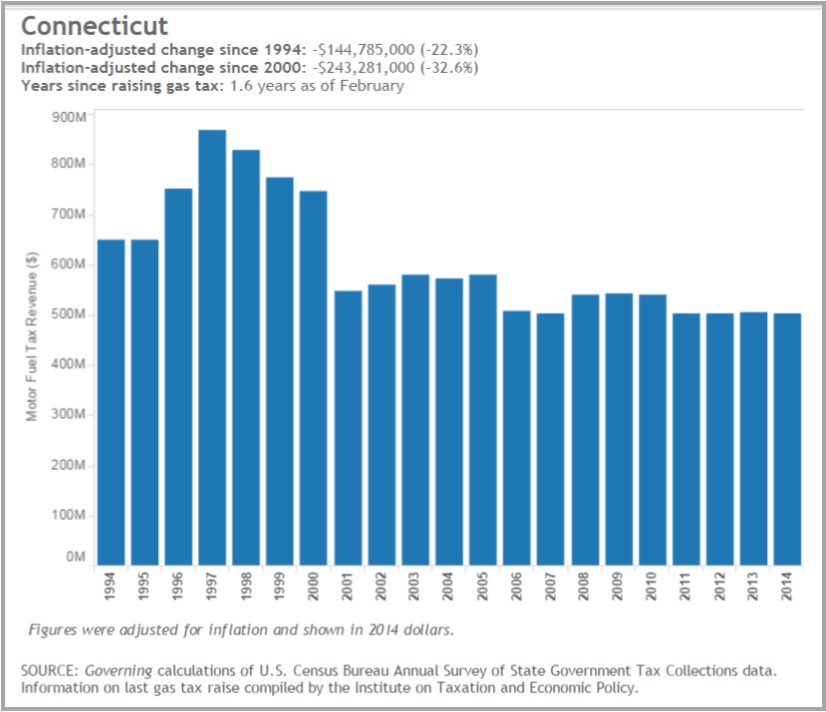
CT gas taxIn Connecticut, the inflation-adjusted change is a reduction of in the value of the dollars provided by the tax of 32.6 percent since 2000 and 22.3 percent since 1994, according to the Governing analysis, using data from the U.S. Census Bureau and the Institute on Taxation and Economic Policy.  Earlier this year, Governor Malloy announced a two-part transportation plan consisting of a five-year ramp-up that utilizes $10 billion capital funding, and leads up to a 30-year vision utilizing $100 billion in funding.  The Transportation Finance Panel he appointed to  recommend options the state can utilize to finance the infrastructure transformation is due to report this summer (see members below).

The federal government’s 18.4-cent gasoline tax brought in a fifth less, in inflation-adjusted dollars, in 2013 than in 1993, Governing reported. The federal government’s buying power peaked in 1994, immediately following its gas tax hike. The purchasing power of states fuel taxes peaked five years later, in 1999. In 37 states, inflation-adjusted revenues from fuel taxes slipped since 2000.

At the federal level, fuel taxes have been flat for more than 20 years, starving the Highway Trust Fund of revenue used for rising infrastructure repair costs, according to Reuters.  According to Forbes, the Congressional Budget Office (CBO) has estimated that in 2024 alone the Highway Trust Fund will spend $18 billion more than it brings in, Forbes has reported. The CBO estimates the cumulative shortfall over the next decade will top $160 billion.

A year ago, when gas prices nationwide were at their lowest levels in years, Republican Senator Bob Corker of Tennessee and Democrat Chris Murphy of Connecticut proposed raising federal gasoline and diesel taxes by 12 cents a gallon over two years– to bring the tax where it would have been had it kept up with inflation for the past two decades.  As in the past, the prospect of a federal tax increase in the gas tax – even to address needed transportation infrastructure repairs – did not gain significant support.

At the time, it was estimated that American drivers pay an average of $94 a year to access over 11,618 miles of highways, roads and bridges.  Based on data from the Government accountability Office, the National Stone, Sand & Gravel Association pointed out that “with a growing number of potholes, cracked roads and traffic jams plaguing America, we need a common-sense and responsible way to pay for improving our infrastructure.”

The Governor’s Transportation Finance Panel, appointed earlier this spring, includes:
  • Cameron Staples (Chair): President and CEO, New England Association of Schools and Colleges; Former Co-Chair of the Finance, Revenue and Bonding Committee, Connecticut General Assembly
  • Beth Osborne: Senior Policy Advisor, Transportation for America; Former Acting Assistant Secretary for Transportation Policy, U.S. Department of Transportation
  • William Bonvillian: Director, Massachusetts Institute of Technology’s Washington, D.C. Office
  • Joan Carty: President and CEO, Housing Development Fund
  • Bert Hunter: Chief Investment Officer, Connecticut Green Bank
  • Oz Griebel: President and CEO, MetroHartford Alliance
  • Paul Timpanelli: President and CEO, Bridgeport Regional Business Council
  • Stanley Mickus: Marketing and Public Affairs, Cross Sound Ferry Services
  • Emil Frankel: Consultant on transportation policy; Former Commissioner, Connecticut Department of Transportation (1991-1995); Former Assistant Secretary for Transportation Policy, U.S. Department of Transportation (2002-2005)

AngelRiders Bicycle Across Connecticut to Help Children with Life Threatening Diseases

AngelRiders will pedal from the northwest hills of Connecticut down to the Mystic shoreline — totaling 135 miles over a two day stretch. It is a charity bike ride like no other, according to organizers, with the goal to raise money to support children who are battling life threatening diseases. More than 300 riders from across Connecticut are expected to participate in the 12th Annual AngelRide (#AngelRide #NeverStopClimbing), which will be held over Memorial Day weekend. Adult riders have the option to participate in a one or two day trek, May 23 and 24. There are also shorter rides for teens and children on Sunday.logo-tag

The charity ride — named for Angela "Angel" Uihlein of Westbrook — began in 2004 with 32 riders raising $67,000. Angela was diagnosed with leukemia at the age of 12 and attends the ride each year with her family. She has been in remission since the ride started and is now a registered nurse.

Growing steadily year after year, AngelRide has raised $4.6 million to benefit the Hospital Outreach Program (HOP) run by the Hole in the Wall Gang Camp in Ashford. HOP brings the hopeful, playful spirit of camp to children and families in a hospital setting. In 2014, HOP covered 39 hospital sites in Connecticut Massachusetts, New Jersey, New York, Pennsylvania and Rhode Island, where 28 specialists made nearly 32,000 hospital visits to sick children in need of joy and laughter.

“There is no other bike challenge like this one,” said Lynn McCarthy, AngelRide co-founder of Lyme. “We have been able to grow primarily by word of mouth because of the amazing experience it offers. We pay attention to the details, serve great food along the way and provide an overnight adventure at the Hole in the Wall Gang Camp.” AngelRide is the only organization that has been granted the privilege to stay overnight at the camp.

angel photoConnecticut riders return year after year to the AngelRide — some to ride and some to volunteer for the statewide event.  Westbrook resident Dan Shapiro was the first rider to register in 2004, and he has been participating in the AngelRide every year since. “I couldn’t imagine Memorial Day weekend without AngelRide,” said Shapiro. “The spirit of this ride is off the charts. We are all trying to do something bigger for the kids.”

West Hartford resident Keith Knowles has been involved with AngelRide for the last 10 years, either as a rider, volunteer or web site developer. This year, his 8-year-old daughter Emily will become an AngelRider. “I am going to ride six miles because I had a sister who passed away from cancer when she was only 5 years old. She is my motivation and inspiration for doing this,” said Emily.

Knowles sees the ride as a metaphor for the journey of sick children. “The hills we face are nothing compared to the hills the kids face. I'm not a cyclist. I don't train too much. Pedaling through the climbs one slow churn at a time and reaching the finish line is humbling experience. I know it's not nearly as difficult as battling cancer or some other life threatening disease,” he said.

There are many options for AngelRiders:

  • Two-Day Ride: Ride 135.4 miles across Connecticut over the course of two days. The two-day ride begins in Norfolk, and extends 85 miles to the Hole in the Wall Gang Camp in Ashford. angelDay two begins at camp and ends 50 miles away in Mystic.
  • One-Day Ride: Sunday only, ride 50 miles from the Hole in the Wall Gang Camp to Mystic.
  • Young Adult AngelRide: For ages 11-14, this 22-mile ride begins in Hopeville State Park on day two and ends in Mystic.
  • Young AngelRide: For ages 7 to 11, this is a 6.5 mile ride in Mystic.

Southington resident Tom Wood looks forward to ride each year and continues to recruit new people to either ride or volunteer. This year will be his eighth year as an AngelRider, which he does in honor of his brother who died of leukemia. “This is a great way to recharge your batteries. We have such an amazing and beautiful state. And it is not flat, so this is really a great challenge to undertake.”

“The renewal of body and spirit is exactly what the Hole in the Wall Gang Camp and HOP brings to a child with a life threatening condition,” said Dr. Brad Jubelirer, Assistant Clinical Professor of Pediatrics, UCONN School of Medicine in Farmington.

To find out more or to register for AngelRide, visit www.angelride.org . Registration remains open and encouraged; volunteers and donations are also welcome.

https://youtu.be/-r95hwj8DIw

National Voting Begins as Three Local Community Programs Try to Win $25,000 Grants

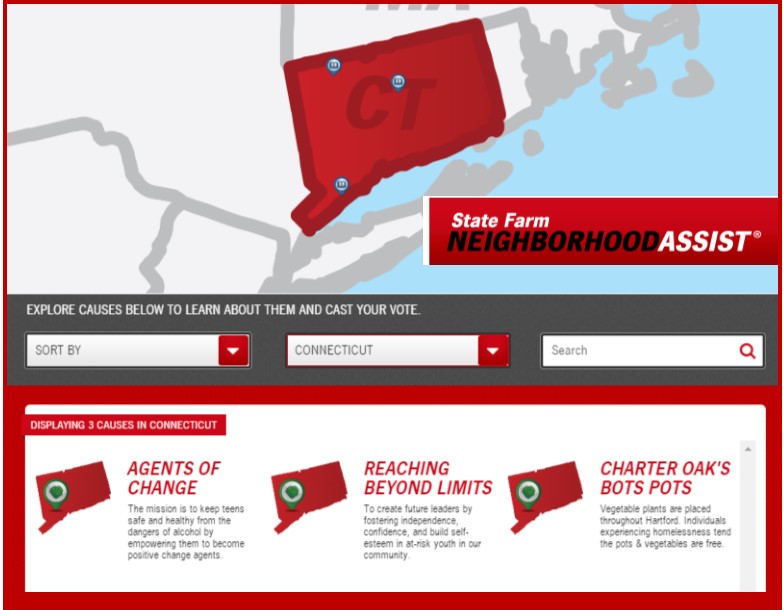
Three Connecticut-based “causes” are among 200 across the nation currently vying for one of 40 grants of $25,000 to be awarded by State Farm, with voting now open to the public via Facebook. Regional Youth Adult Social Action Partnership in Bridgeport, Northwest CT YMCA: Winchester Youth Service Bureau, and Charter Oak Cultural Center in Hartford – BOTS Pots initiative are the three organizations whose programs are in the running for the grants.   Individuals may vote up to 10 times each day from May 14 through June 3.  The Top 40 winners will be announced on June 16.

The State Farm Neighborhood Assist began in 2012, and the annual program has three phases. First, Facebook users submit causes that they think deserve a $25,000 grant. Next, the State Farm® Youth Advisory Board narrows down the submissions to the top 200. Finally, Facebook users vote to select the top 40. Voting opened this week at https://apps.facebook.com/sf_neighbor_assist/  The Facebook site includes a “leaderboard” indicating the top ranked programs based on public voting.statefarm

Details of the three Connecticut programs, as featured on the State Farm website:

Charter Oak Cultural Center in Hartford – BOTS Pots initiative

BOTS Pots-- named for Beat of the Street, Charter Oak Cultural Center’s “street” newspaper written by individuals experiencing homelessness and their allies-- places large potted organic vegetable plants throughout the City of Hartford. Individuals who are experiencing homelessness are hired and trained to tend the pots and the vegetables are provided for free to anyone in need, addressing hunger in Hartford. In addition, local artists volunteer to transform the pots into public art.

As far as we know, the program is the only one of its kind in the country, although the model has been sought out by other cities asking how they can bring it into their communities. BOTS Pots brings food, jobs and art to Hartford and provides much-needed work experience and a resume line item for individuals experiencing homelessness. Charter Oak Cultural Center hires, fully trains and compensates members of the homeless community to tend the pots, providing much-needed work experience and a resume line item. Because of the cycle of homelessness, members of this community often have a great deal of difficulty in obtaining job experience, another key job requirement for future work. The compensation they receive for their work tending BOTS Pots, in the form of gift cards, allows them to purchase food, clothing suitable for a job interview and other necessities to help them move to the next level of independence.

Regional Youth Adult Social Action Partnership in Bridgeport

The mission is to keep teens safe and healthy from the dangers of alcohol by empowering them to become positive change agents.  Community need this cause addresses:  Alcohol is the most commonly used drug among teens. Almost half of young people have gone to at least 1 drinking party during the year. Making alcohol less accessible is a prevention strategy that works! It is important that alcohol is kept out of the hands of people who are under 21. In Connecticut, on average youth pick up their first drink before their 12th birthday. Consider that- they take those first sips even before most begin middle school?! If youth pick up a drink before age 15, they are 4 times more likely to have alcohol dependency issues later in life. As teens get older, alcohol puts them at risk of other dangerous situations. By their senior year, 35 percent of high school students say they have been drink at least once in the past 2 weeks.

Northwest CT YMCA: Winchester Youth Service Bureau

The mission is to create future leaders by fostering independence, confidence, and build self-esteem in at-risk youth in our community. In Winchester, there is a need to support secondary school students. At this age, there is a significant rise in the amount of severe disciplinary offenses; this includes reports of substance use, assault, weapon, and inappropriate sexual behavior. The graduation rate is average. However due to the vast low SES population in the area, of the students who graduate, only 78% of students go onto higher education. This is 8.8% below the average and consequently the students are 11.6% more likely to go from high school to the work force. The hope is to create programs to support this age group; currently there are no positive youth programs that can guide them to having a positive adolescent experience. In this program, students will be able to build independence, confidence, and self-esteem through team-building, service projects, and positive social activities. Students will be given the knowledge to help them shape their own futures and foster their personal, academic, and social growth.

Picture2


Middle School Provides Clues on College Success; Americans Say College Grads Not Ready for Workforce

Summing up a new national Gallup poll, the analysis indicated that “If higher education was the auto industry, it would be forced to recall a quarter of all its graduates.”  But recent research also suggests that there are some early indicators that provide clues to the likelihood of college success – as early as middle school. The latest Gallup survey found that 96 percent of Americans say it is "somewhat" or "very" important for adults in the country to have a degree or certificate beyond high school. But the fourth annual Gallup-Lumina Foundation poll also indicated that only 13 percent of Americans strongly agree college graduates in this country are well-prepared for success in the workplace. That's down from 14 percent two years ago and 19 percent three years ago. The analysis described it as a "no confidence" vote in college graduates' work readiness.beaker

Readiness for college, as any college administrator or faculty member will tell you, impacts college success, and ultimately workforce readiness.  Connecticut is among the states that have taken steps to better align high school and college, and adjust remedial programs to save students time and money, as well as improving their chances to bridge the academic gaps in their preparation prior to college.

Interestingly – or perhaps alarmingly - Americans with college degrees are much less likely to strongly agree college grads are ready for the workforce than Americans without college degrees – 6 percent vs. 18 percent, respectively.  As the Gallup analysts point out, the survey found that “those of us who earned a coveted college degree have even less confidence than the rest of us that college grads are well-prepared for success in the workplace.”

A previous Gallup survey found that 1 in 4 college graduates missed the mark on all six critical emotional support and experiential elements of their student experience. These graduates' outcomes -- on measures such as their workplace engagement and overall well-being -- show they fail to thrive in their careers and lives.

New research by Matt Gaertner and Katie McClarty of Pearson’s Research & Innovation Network recently combined rich student- and school-level data to evaluate whether more information makes for more accurate college-readiness predictions.

The researchers used data from more than 11,000 students in the National Education Longitudinal Study (NELS) and 140 middle school variables to create six factors: achievement, behavior, motivation, social engagement, family circumstances and school characteristics. They then used these middle school factors to predict college readiness and college outcomes, the American Association of Community Colleges website reports.

They found some interesting results:

  • With respect to college readiness, all six factors were valuable predictors. Academic achievement was the strongest predictor (accounting for 17 percent of the variation in college readiness), but motivation (15 percent) and behavior (14 percent) followed closely. Together, they found, motivation and behavior contribute more to college readiness than achievement on its own.
  • With respect to college success, these six middle school factors predict college grades (cumulative GPA) and graduation better than the ACT or the SAT. In fact, using the six factors nearly doubles the ability to predict college graduation, compared with using test scores alone. Most notably, these predictions arrive in eighth grade — three years before the SAT or the ACT.

The results of this study have recently been published in Educational Measurement: Issues and Practice.cover

Research has long documented the importance of instilling a college-going culture starting in the middle grades, if not earlier, Pearson Research & Innovation Network points out.  According to ACT’s 2008 report, “The Forgotten Middle” the level of achievement that students attain by eighth grade has a larger impact on their college and career readiness than anything that happens academically in high school.

The Connecticut State Board of Education, in a draft report based on an Ad Hoc committee review, indicated that “it became clear that the middle school had a role to play in ensuring success for all students. Recent research of major urban school districts has identified that students who are at risk for completing high school begin to demonstrate these factors at about Grade 6.”

Beginning with the 2012 school year, a state law has required that each Connecticut student have a “Student Success Plan,” which begins in the 6th grade and continues through high school, to provide the student support and assistance in setting goals for social, emotional, physical and academic growth, meeting rigorous high school expectations, and exploring postsecondary education and career interests, according to the State Board of Education website.

Ten CT History Organizations Honored for Innovative, Effective Initiatives

When the Connecticut League of History Organizations (CLHO) hosts its annual conference and awards ceremony in Meriden on June 1, ten local organizations will be honored for their effective work in connecting state residents and history. The theme of the all-day conference is “Making History Collections Relevant in a Modern World.” Sessions will explore the many traditional and non-traditional ways that museums, historical societies, historic houses, and archives make their collections accessible and relevant to their communities.

The conferenceLOGO COLOR, which is open to the public,  includes an awards ceremony, as the CLHO presents Awards of Merit to institutions and individuals who demonstrate the highest of professional standards and who enhance and further the understanding of Connecticut history.  Along with opportunities for networking, there will be speakers, panel discussions, and how-to practical presentations.

The awards will be presented to the Wethersfield Historical Society, Weslyan University Press/Connecticut Explored/The Amistad Center, Norfolk Historical Society, Mattatuck Museum (Waterbury), Lyman Allyn Art Museum (New London), Kent Historical Society, Florence Griswold Museum (Old Lyme), Cheshire Historical Society, Bated Breath Theatre Company (Hartford), and Archaeological and Historical Services, Inc. (Storrs). [See details below]

Keynote speaker Rainey Tisdale is an independent curator specializing in city history. Tisdale led the consortium of local museums, libraries, and archives in collecting and interpreting the 2103 Boston Marathon Bombing, with emphasis on programming for the one-year anniversary in April 2014.

Tisdale’s most recent book, Creativity in Museum Practice, helps museum professionals unleash creative potential throughout their institution. She will discuss “The Poetry of Objects,” a wide-ranging meditation on the power of objects to move, inspire, and build community.

The awards ceremony features an award-winning performance by Bated Breath Theater Company, "Freedom In Three Acts." Admission to the conference is $75 per person, with discounts for members, students, and early registration, and covers all events of the day and lunch. Reservations  can be made at www.CLHO.org.

For over 60 years the Connecticut League of History Organizations has strengthened and built connections among those who preserve and share the stories and objects of our past by sharing knowledge and experience, and promoting best practices.

https://youtu.be/LM5xtk23cv0


The CLHO Awards of Merit will be presented to:

Archaeological and Historical Services, Inc. - Storrs, CT

Publication - Highways to History: The Archaeology of Connecticut’s 18th-Century Lifeways

Highways to History is a publication describing the lives of ordinary residents in 18th century colonial Connecticut. Based on a combination of historical and archaeological investigations at four buried homesteads, the book opens a new window into how people in Connecticut lived in colonial times. Distributed around the state, and made available online, Highways to History provides an accessible and engaging account of how ordinary colonial Connecticut citizens lived, and demonstrates the strength of combining archaeological and documentary evidence.

Bated Breath Theatre Company (a collaboration with The Amistad Center for Art & Culture) Hartford, CT

Educational Program - Freedom: In 3 Acts

Freedom: In 3 Acts is a collaborative performance between The Amistad Center for Art & Culture and Bated Breath Theatre Company. This innovative program responded to and amplified The Amistad Center’s exhibition, Emancipation! The three act performance incorporates song, movement and narrative to explore the struggle for freedom and justice for African Americans. Since its initial performance, Bated Breath Theatre Company has performed Freedom: In 3 Acts at a variety of venues, using its innovative and engaging approach to bring the original exhibit off the walls and out of the exhibit cases to engage audiences around Connecticut.

Cheshire Historical Society - Cheshire, CT

Educational Program - Cheshire Heritage Tour – An App for Mobile Devices

Looking to bring a traditional walking tour of the center of Cheshire alive, The Cheshire Historical Society developed an app that appeals to people of many ages and interest. Free to download, the app combines humor, seldom-seen images from the Historical Society’s collection, and contemporary photos and maps to guide the user around the center of town. With the help of two characters, Alonzo the Adventurer and Emmy, the Magical History Box, the Cheshire Heritage Tour keeps visitors engaged while learning about the history of the area.

Florence Griswold Museum - Old Lyme, CT

Project - Thistles and Crowns: The Painted Chests of the Connecticut Shore

In 2014 the Florence Griswold Museum presented the exhibition Thistles and Crowns: The Painted Chests of the Connecticut Shore to highlight the distinctive beauty and historical significance of a group of painted chests made in Old Saybrook and Guilford, Connecticut between 1700 and 1740. Bringing together a selection of these chests from six museums for the first time since 1950, the exhibit asked visitors to look at aspects of construction, decoration, use and history. Accompanied by a full-color catalog, Thistles and Crowns highlighted stories about Connecticut’s artistic, cultural, and historical legacies that can be found in unexpected places.

Kent Historical Society - Kent, CT

Project - Iron, Wood, and Water: Essential Elements of the Evolution of Kent

As the site of the second most valuable iron ore deposit in Connecticut, Kent became a desirable place to live for iron works, and the impact of their activities had deep influence on the evolution of Kent into the community it is today. While much scholarly research explores the technicalities of the iron making process and the entrepreneurs who ran the industry, the exhibition, Iron, Wood and Water: Essential Elements of the Evolution of Kent told the story of the common men who toiled daily in the mines, at the furnaces, and deep in the woods. It was these workers who left impressions on the community and played a large role in transforming Kent first from an untamed wilderness to a bustling industrial town, and later to a community of dairy farmers and finally to the home for artists and writers that it is today.

Lyman Allyn Art Museum and Stephen Fan, Guest Curator - New London, CT

Project - SubUrbanisms: Casino Company Town / China Town

In 2014 the Lyman Allyn Art Museum opened Suburbanisms: Casino Company Town/ China Town. Using a variety of approaches the exhibit documented and historicized the development of a suburban Chinatown surrounding the Mohegan Sun casino in Connecticut. Built up by a large number of Asian casino patrons and workers – many recent immigrants - this innovative exhibition presented an under-explored topic in Connecticut’s and the nation’s history. In addressing key themes in suburban, housing, labor, and immigrant history, the exhibit used history to bridge cultural divides and to question the future ecological, social, and economic sustainabilites of the ever-changing American suburban ideal.

Mattatuck Museum - Waterbury, CT

Project – The Way We Worked – Connecticut At Work

As one of seven venues selected to host The Way We Worked, a traveling exhibition created by the Smithsonian Institution in 2014, the Mattatuck Museum sought to create a parallel group of exhibitions and a series of programs to bring the story home to Connecticut audiences. Know as Connecticut At Work, the resulting local exhibitions, film series, lectures, and programs engaged broad and diverse audiences and addressed issues of immediate concern. Through providing a local backdrop for the Smithsonian’s exhibition, Connecticut At Work merged the national story with the regional one.

Norfolk Historical Society - Norfolk, CT

Project - From the Mills to the Main Street: The Irish in Norfolk

From the Mills to Main Street: The Irish in Norfolk was an inventive interpretive exhibition mounted by the Norfolk Historical Society in 2014. Using historical documents, artifacts, photographs, and ephemera, many not previously on view, the exhibit explored the contribution and assimilation of the Irish in the town of Norfolk from 1836 to 1920. The well-attended exhibit and related programming that included lectures, gallery talks, and walking tours, brought to life the importance of a significant immigrant group to the economic and cultural landscape of Norfolk.

Wesleyan University Press, Connecticut Explored, The Amistad Center - Middletown, CT

Publication - African American Connecticut Explored

African American Connecticut Explored is the first book published for a public history audience that provides the long arc of the African American experience in Connecticut with an emphasis on the African American perspective. Through more than 50 essays by more than 30 of the state’s leading historians, curators, and writers, the book covers a wide range of topics. Published by Wesleyan University Press, it was developed by Connecticut Explored, The Amistad Center for Art & Culture, and representatives from the State Historic Preservation Office.

Wethersfield Historical Society - Wethersfield, CT

Project - Castle on the Cove: the Connecticut State Prison and Wethersfield

Mounted in 2014, and on view through 2016 the exhibition Castle on the Cove: the Connecticut State Prison and Wethersfield, explores the Connecticut State Prison during its years of operation between 1827 and 1963 in Wethersfield, Connecticut. The prison was an integral component of the town’s identity during these formative years as Wethersfield transitioned from rural town to suburb. Exploring both previously undocumented and often requested materials the exhibit looks at the prison from the perspectives of the inmate, employee, and local resident to present the history of the prison within a broad context and to encourage visitors to consider the impact of the prison on these three groups.



National High School Mock Trial Championships to be in Hartford in 2017

The 2017 National High School Mock Trial Championship, promoting an understanding and appreciation of the American judicial system through academic competitions and related programs for high school students, will take place May 11-13, 2017 in Hartford. The national mock trial championship was initiated in 1984 in Des Moines, Iowa, with high school teams from Illinois, Iowa, Minnesota, Nebraska and Wisconsin participating. After the success of the inaugural tournament in Iowa, more states became interested in participating and the tournament became an "All-State" Tournament and now attracts competitors from across the country and internationally.

national_mock_trial_logo_0_1395406080The tournament is hosted annually by different states to ensure that the cost of running the tournament doesn't fall disproportionately on any particular state.

The Carolina Center for Civic Education is making final preparations for the 2015 National Championship, which will be held May 14-16 in Raleigh, North Carolina. Connecticut will be represented by the team from Weston High School, the 2015 High School Mock Trial State Champions.  The winning team was one of three from the school that participated in the statewide competition in March.  The finals were held in the State Supreme Court chamber in Hartford.  The students on the winning “Weston Red” team were Ursula Alwang, Cameron Edgar, Sam Glasberg, Zoe Howard, Alex Ishin, Scarlett Machson, Ben Muller, Jack Seigenthaler, Henry Tracey, and Micah Zirn, the Weston Forum reported.mocktrial-FI

The Idaho Law Foundation will host the 2016 National Championship in Boise, Idaho. Last year's competition in Madison, Wisconsin included a total of 46 teams, including Guam, South Korea, the Commonwealth of Northern Mariana Islands, and State Champion teams from across the country.

In Connecticut, the mock trial competition is sponsored by the nonprofit organization Civics First. Throughout its history, thousands of students and their teachers have participated in the program.  In recent years, the program has included over 700 students from more than 50 Connecticut high schools.

The high school mock trial competitions are held each year in the fall. Regional trials are held in early winter in superior courts throughout the state, followed by quarter-finals, and semi-final contests. The state final mock trial competition is held at the Connecticut Supreme Court in Hartford.

For the national competition, each state’s "official team" includes six to eight student team members; one primary teacher coach; one primary attorney coach, and the State Mock Trial Coordinator, for a maximum of 11 members of the "official" team.

In recent years, the competition has been held in Madison, Wisconsin (2014), Indianapolis, Indiana (2013), Albuquerque, New Mexico (2012), Phoenix, Arizona (2011), Philadelphia, Pennsylvania (2010), and Atlanta, Georgia (2009). The Executive Director of Civic First and state coordinator for the high school mock trials in Connecticut is Beth DeLuco.

CFCivics First is a private, non-profit association that promotes and conducts law-related education programs and projects in Connecticut's public and private schools, courtrooms and communities. Its goal is the incorporation of citizenship education into the curriculum of all schools, from kindergarten through high school.

Photo: The Weston High School Mock Trial Red Team won the Connecticut state championship . (This photo originally appeared in the Weston Forum.)


Connecticut Ranks #16, Above National Average in Online Job Ads for College Graduates

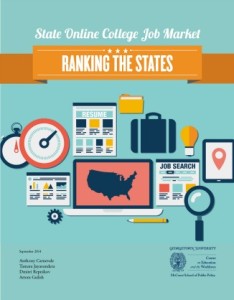
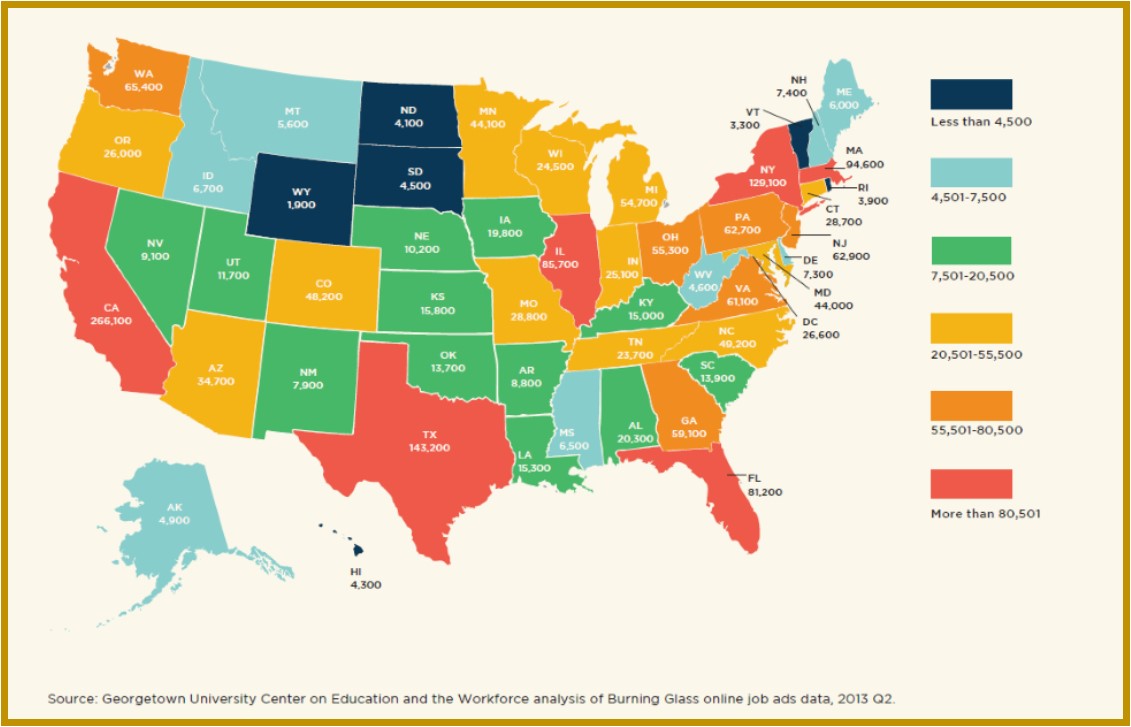
Connecticut ranks as the 16th best online college labor market in the U.S., according to data compiled by the Georgetown University Center on Education and the Workforce.  In Connecticut, 53 percent of online job ads seek college graduates.  That translates to 28,700 online job ads, and places Connecticut – just barely – in the top tier of the states. Massachusetts provides college graduates with the best odds of landing a job, according to the national survey. Using online job ads, the report provides information about where the jobs are for college graduates for each of the 50 states to help students, educators, and policymakers make better decisions.OCLM_Cover_326-234x300

The report ranks the states by how many job openings there are per college-educated worker overall and within industries and career fields. College graduates seeking work in science, technology, engineering, and mathematics (STEM) careers, for example, have the best odds in Delaware, Massachusetts, and New York.  Connecticut is in the middle of the pack.

Nationwide, between 60 and 70 percent of job openings are advertised online, and even though only 35 percent of workers have college degrees, nearly half of online job ads cater to college graduates.  The top five best online markets for college graduates are Massachusetts, Delaware, Washington, Colorado, and Alaska.

The survey found that in Connecticut:

  • 36% of online job adds for college graduates are for managerial and professional office occupations
  • 22% of online job ads are in the consulting and business services sector
  • The fastest growing occupational cluster for college graduates is in food and personal service, growing by 73 percent between the 1st quarter of 2010 and 2nd quarter of 2013
  • The fastest growing industry sector of college graduates is construction, with a 92 percent increase in employment between the 1st quarter of 2010 and 2nd quarter of 2013

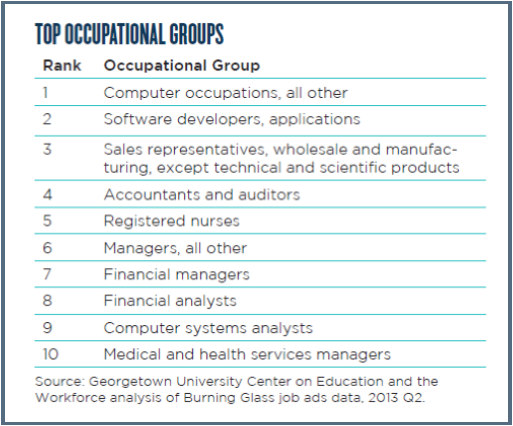
top occupationalThe top occupational groups reflected in the online job ads were 1) computer occupations, 2) software developers, 3) sales representatives,4) accountants and auditors, 5) registered nurses, 6) managers, 7) financial managers, 8) financial analysts, 9) computer system analysts and 10) medical and health services managers.
The distribution of online college job ads by occupational cluster shows that the largest percentage (24%) are in managerial and professional office occupations, followed by sales and office support (23%), STEM fields of science, technology, engineering and math (15%) and blue collar jobs (9%).

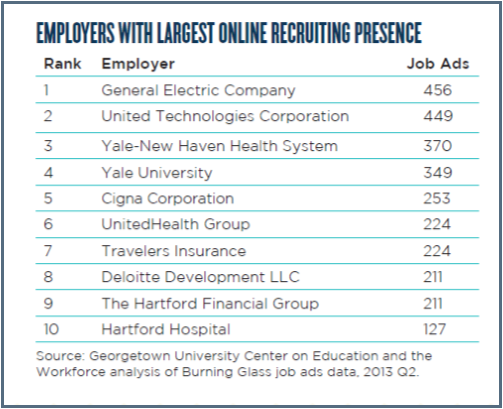
Connecticut employers with the largest online recruiting presence were General Electric Company, United Technologies Corporation, Yale-New Haven Health System, Yale University, Cigna Corporation, UnitedHealth Group, Travelers Insurance, Deloitte Development, The Hartford Financial Group, and Hartford Healthcare.

Across the country, college-educated workers will have the best odds of finding a job in STEM, managerial and professional office, and healthcare professional and technical occupations. The jobs of the new economy are prevalent for college graduates across the 50 states. Employers in information services, consulting and business services and financial services sectors post the most online job ads per college-educated worker.

largest employersThe Georgetown University Center on Education and the Workplace is affiliated with the McCourt School of Public Policy.  The study was done by Anthony Carnevale, Tamara Jayasundera, Dmitrirepnikov and Artem Gulish.
“The promise of this information is the ability to connect real people with real jobs in real time,” said Anthony P. Carnevale, the report’s lead author and director of the Center. “By combining information on online job ads with traditional employment data we are able to get a more complete picture of job opportunities available to college graduates in each state,” said Tamara Jayasundera, the report’s co-author.

In Massachusetts, 63 percent of job openings are for college graduates, while in West Virginia, only 36 percent of job openings are for college graduates.


college states

Weston High, Hotchkiss School Are Top High Schools in CT

Three Connecticut public high schools are ranked in the top 100 in the nation - Weston High School at #84 and New Canaan High School at #85, Staples High School in Westport at #94.  The rankings, compiled by the website Niche, focused on the overall student experience at the schools in developing the list.  Academics, health and safety, teachers, and student culture and diversity were aspects of the analysis.niche rankings banner 290px The top 15 public high schools in the state were Weston High School, New Canaan High School, Staples High School (Westport), Darien High School, Simsbury High School, Ridgefield High School, Wilton High School, Greenwich High School, Glastonbury High School, Amity Regional High School (Woodbridge), Conard High School (West Hartford), Farmington High School, Cheshire High School, Joel Barlow High School (Redding) and Daniel Hand High School (Madison).

Weston High School was named a National Blue Ribbon School for excellence in education by the U.S. Department of Education in 2013.  The school’s “greatest strength is the level of personalization that students receive during their four-year experience,” the Blue Ribbon citation indicated.

The Hotchkiss School in Lakeville is ranked as the top private school in Connecticut, and reached the top ten in the nation, at number seven.  It is the only Connecticut private school in the top 25.  The other Connecticut private schools in the top 50 nationally are Choate Rosemary Hall at #30 and Hopkins School in New Haven at #43. An independent boarding school founded in 1891, Hotchkiss School provides "an education of unsurpassed quality" to 600 students in grades 9 through 12, according  to the school website, which indicates that students come from across the United States and 34 foreign countries. best-overall_300x300 (1)

A high ranking in Overall Experience generally indicates that:

  • Students are very happy with their experiences in all aspects, including academics, teachers, health, safety, resources, facilities, extracurriculars, sports, and fitness;
  • The school is an exceptional academic institution in terms of teachers, students, resources for learning, and student outcomes;
  • The school is made up of a diverse population and fosters an accepting, positive school culture;
  • Students are actively involved in a variety of extracurriculars and sports the school offers.

The Best Public High Schools ranking provides what Niche describes as “a comprehensive assessment of the overall experience at public high schools in all 50 states, the District of Columbia, and Puerto Rico. It uses data sourced from various government and public data sets, Niche’s own proprietary data, and 4,625,227 opinion-based survey responses across a variety of topics from 287,560 current students, recent alumni, and parents.”

best-overall_300x300Factors considered in the analysis include:

  • Academics, which incorporates statistics and student, alumni, and parent surveys regarding academics at the school.
  • Health & Safety, which incorporates statistics and student, alumni, and parent surveys regarding health and safety at the school. R
  • Student Culture & Diversity, which incorporates statistics and student, alumni, and parent surveys regarding culture and diversity at the school.
  • Survey Responses, which consist of parent and student opinions about the overall experience at the high school they currently or recently attend(ed).
  • Teachers, which incorporates statistics and student, alumni, and parent surveys regarding teachers at the school.
  • Resources & Facilities, which incorporates statistics and student, alumni, and parent surveys regarding resources and facilities at the school.
  • Extracurriculars & Activities, which incorporates statistics and student, alumni, and parent surveys regarding clubs and activities at the school.
  • Sports & Fitness, which incorporates statistics and student, alumni, and parent surveys regarding athletics and general fitness at the school.

Niche-Rankings-CCA-GraphicAAmong private schools in Connecticut, according to the website analysis, the leaders are The Hotchkiss School in Lakeville, Choate Rosemary Hall in Wallingford, Hopkins School in New Haven, The Taft School in Watertown, Brunswick School in Greenwich, Greenwich Academy in Greenwich, Kent School in Kent, King Low Heywood Thomas School in Stamford, Greens Farms Academy in Westport and The Master’s School in West Simsbury.

According to the analysis, a high ranking indicates that “the school is an exceptional academic institution with a diverse set of high-achieving students who rate their experience very highly.”

The next ten private schools in the rankings are Westminster School in Simsbury, The Cheshire Academy, Miss Porter’s School in Farmington, Williams School in New London, The Loomis Chaffee School in Windsor, Canterbury School in New Milford, Marianapolis Preparatory School in Thompson, Kingswood-Oxford School in West Hartford, Avon Old Farms School  and Westover School in Middlebury.

Niche, based in Pittsburgh, was founded in 2002 by Carnegie Mellon University students as CollegeProwler.com, and has since “grown into one of the largest content startups in the country,” according to the company’s website.

Trees Sprouting Across Connecticut, 19 Municipalities Lead the Way

Tree City USA is an honor earned by cities and towns that meet four standards set by the Arbor Day Foundation and have their application approved the State Forester. Connecticut currently has 19 municipalities with the Tree City USA designation, which cover 31 percent of the state’s population. According to the Arbor Day Foundation, Connecticut’s longest running Tree City is Fairfield, which recently surpassed 26 years.  The largest community is Bridgeport, the smallest, by population, is Brookfieldthumb-grid-shaded-path

The four standards are having:

  • A tree board or department
  • A tree care ordinance
  • An urban forestry program with an annual budget of at least $2 per capita
  • An Arbor Day observance and proclamation

The other Tree City USA communities in Connecticut are Branford, Danbury, East Hartford, Groton, Hartford, Middletown, Monroe, New Canaan, New Haven, Norwalk, Ridgefield, Southbury, Stamford, West Haven, Wethersfield and Wilton.

Norwalk and Wethersfield, for demonstrating a higher level of tree care, have received Growth Awards from the organization.  Overall, there are 3,400 Tree City USA honorees across the country, with a combined population of more than 140 million.logo-tree-city-usa-color

Annual participation as a Tree City USA community provides the opportunity to educate people who care about their community about the value of tree resources, the importance of sustainable tree management and engage individuals and organizations in advancing tree planting and care across the urban forest.

The organization also offers on-line education courses for individuals interested in learning more about trees, or about serving in a citizen advisory role in their local community.

The Arbor Day Foundation indicates that an effective tree program can:

  • Reduce costs for energy, storm water management, and erosion control. Trees yield up to three times their cost in overall benefits to the city, averaging $273 per tree.
  • Cut energy consumption by up to 25%. Studies indicate that as few as three additional trees planted around each building in the United States could save our country $2 billion, annually, in energy costs.
  • Boost property values across your community. Properly placed trees can increase property values from 7-21% and buildings in woodedareas rent more quickly and tenants stay longer.

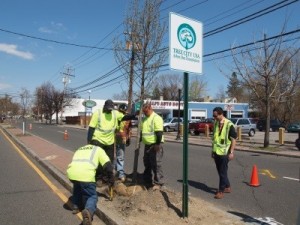
tree in BridgeportThe Arbor Day Foundation also has a campus program, designating colleges and universities as a Tree Campus USA.  The University of Connecticut is the only college in Connecticut to earn the designation.

The state Department of Energy and Environmental Protection's Urban Forestry Program is available to work with any community interested in exploring whether it qualifies as a Tree City USA and what is needed to earn that designation.

DEEP officials indicate that “many communities might be surprised at how close they are.”  Applications for next year's honor are due in December.  The program was initiated by the Arbor Day Foundation in 1976.

https://youtu.be/ol2_IcwaeDI