Best Suburbs to Raise A Family? In Connecticut, Most are in Fairfield County

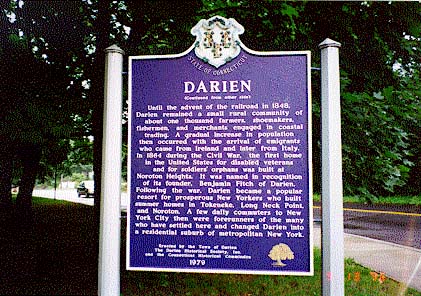
Connecticut’s top 20 suburbs to raise a family are led by the Fairfield County communities of Darien, Weston, New Canaan, Westport, and Wilton, taking the first five slots.  Rounding out the top 10 were Simsbury, Cheshire, Glastonbury, Madison, and Easton, according to the website Niche.  Also reaching the top 20 were Monroe, Avon, Farmington, Middlebury, Canton, Brookfield, Fairfield, Trumbull, Granby and Orange. Niche ranks U.S. suburbs based on age demographics, school ratings, crime rates, and access to affordable housing, child care, libraries, and grocery stores. A high ranking indicates that a suburb "attracts young families with good schools and a safe community.darien_plaque

In the New Haven area, the top 10 suburbs to raise a family are Cheshire, Madison, Monroe, Middlebury, Orange, Guilford, Woodbridge, Wolcott, North Branford, and Branford, according to the rankings.  In the Hartford area, the top 10 area Simsbury, Glastonbury, Avon, Farmington, Canton, , Rocky Hill, Old Saybrook, Suffield, Cromwell, South Windsor, Newington and Southington.

In addition to being the top-ranked suburb in Connecticut, Darien ranked #17 in the nation, followed closely on the national list by Weston at #20, the only suburban communities in Connecticut to reach the top 50.  New Canaan was #51 in the U.S. and Westport was #59, the only other towns from Connecticut reaching the top 100.

In determining the rankings, factors receiving a weight of 20 percent included crime & safety,  and education, weighted at 10 percent were access to libraries, “involvement and investment in the community,” honiche-logousing, residents between 35 and 44, and the percentage of residents under age 9.  The final two categories used in the calculation, access to day care and access to grocery stores, were weighted at 5 percent.

Founded in 2002 by Carnegie Mellon University students as CollegeProwler.com, Niche is described as having grown into one of the largest content startups in the country, providing students, families, and professionals with “insight into big life decisions.”  The Hartford area  list included Longmeadow, MA and Old Saybrook, communities that most residents would not consider as part of the Greater Hartford region.  The company is based in Pittsburgh.

Seniors Better Off Than Other Adults in CT; State’s Ranks #6 in Senior Advantage

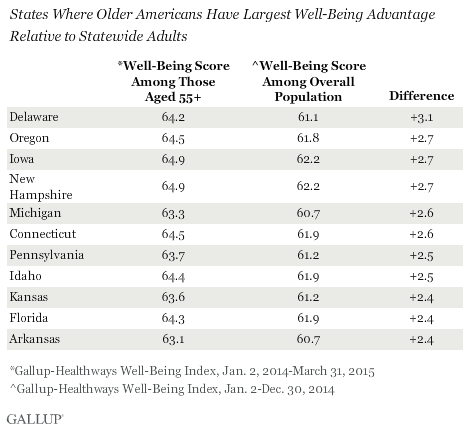
Older adults living in Delaware have the largest well-being advantage relative to the overall state population, followed closely by Oregon, Iowa, New Hampshire, Michigan and Connecticut.  A new state-by-state comparison examines the comparative well-being of Americans age 55 and older, and reveals that, nationally, people in that age category have higher well-being than the rest of the population. The inaugural report is based on data from the Gallup-Healthways Well-Being Index®. The growing percentage of the American population over the age of 55 — a trend largely driven by the Baby Boomers entering later life — has important implications for a variety of stakeholders, including families, employers, healthcare providers and policymakers, according to the report’s authors. “State Well-Being Rankings for Older Americans” aims to fill the research gap.older-americans-cover-thumb

The report focuses on five elements of well-being: purpose, social, financial, community and physical. These five elements, according to Gallup and Healthways, create a composite picture of the well-being of older Americans in each state.  rankingsThe Well-Being Index is calculated on a scale of zero to 100, where zero represents the lowest possible well-being and 100 represents the highest possible well-being.  Connecticut’s well-being score was 64.5 for those age 55+, compared with 61.9 for the overall adult population.  The difference of 2.6 was the sixth highest among the states.

The state where older Americans' well-being advantage is smallest is Wyoming, followed by Alaska, Oklahoma, Nevada, South Dakota, Maine and Vermont.

In an absolute sense, Hawaii, Montana, South Dakota, Alaska and Iowa are the top five states for overall well-being for older Americans -- states that also have high well-being rankings for the overall population.  The next five: New Hampshire, Utah, Oregon, New Mexico and Connecticut.

That places Connecticut in the top 10 in the overall rankings for well-being for older residents, and for the well-being advantage its seniors have above the overall adult population in the state.  Connecticut has the 7th oldest population in the nation. GallupHW_WBI_2C

States with the lowest well-being for older Americans are also those where well-being as a whole tends to lag behind the rest of the country: West Virginia, Kentucky and Oklahoma. . The report is based on self-reported data from 114,388 interviews with individuals age 55 and older, and was conducted in conjunction with the Massachusetts Institute of Technology (MIT) AgeLab.

“The greatest success of humankind is longer life. The challenge today for families and society is how to live longer, better with the highest state of well-being,” said Joseph F. Coughlin, director and founder of the MIT AgeLab. “Understanding our aging population, including Baby Boomers, the largest generation in our nation’s history, will be critical as we design policies and interventions to help older Americans thrive in all aspects of their lives.”

English Language Learners May Hold Key to Economic Vibrancy of Region, State

One-third of Hartford’s population is Puerto Rican, making it the 4th highest percentage of Puerto Rican people in the continental United States.  But the rapidly increasing diversity of the state’s Capitol City, and the region that surrounds it, only begins there – as do the linguistic and workforce challenges. A new report produced by The Hartford Foundation for Public Giving Latino Endowment Fund focuses on the issues faced by English Language Learners and highlights the opportunities and the challenges of increased cultural and linguistic diversity.report

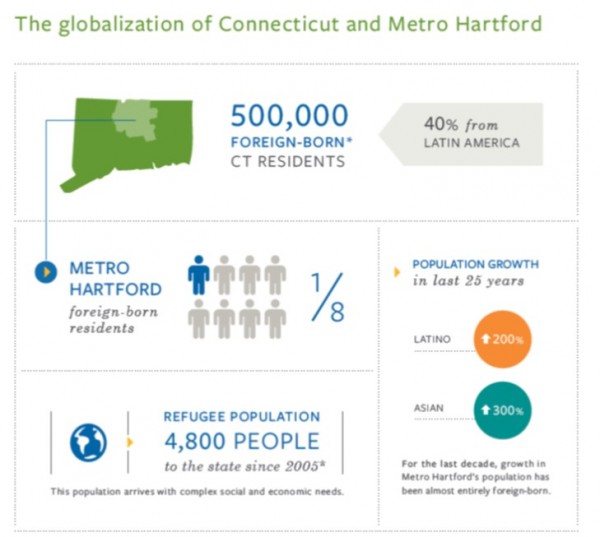
Approximately one-eighth of the Greater Hartford region’s population consists of foreign-born residents, including 4,800 people who have arrived in the state since 2005.  A total of 500,000 foreign-born residents are now living in Connecticut, including 40 percent who hail from Latin American countries.

During the past 25 years, population growth in the Hartford region has been “almost entirely” driven by foreign-born people taking up residence locally, according to the report. In the Hartford region, more than 1 in 5 people speak a language other than English at home.  About three-quarters of Connecticut English Language Learner (ELL) students speak Spanish.

The report found that the region’s “schools and communities are more diverse than ever, with more than 100 different languages spoken in homes throughout Greater Hartford.”  The report raises the question, “How can we harness the assets of a multilingual population to enhance our community and create stronger links to the global marketplace?”HFPG_VertLogo_rgb

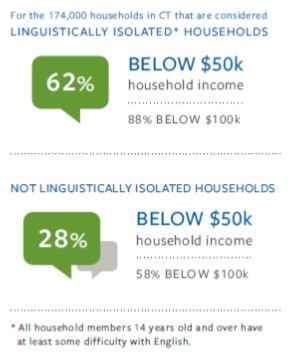
The report notes that “researchers believe that, on average, it takes 2 years to master conversational English, yet 5-7 years to master academic English.”  The report indicated that when analyzing education and workforce data, English Language Learners are far behind their English speaking peers in terms of educational attainment and income.Highlighting one of the challenges for ELL students, the reported found that over the last 4 years, two of the top three teacher shortages in Connecticut have been bilingual and world languages educators.  About 20% of all adult ELLs experienced poverty in the last year, about twice the rate in the state as a whole. In Connecticut, the earned income of ELL adults is $25,000 per year—less than half of English-speakers’ earnings.

population“The Latino Endowment Fund has offered this report as a means to expand the important discussion on efforts to support English Language Learners in our communities,” said Luis Cabán, chair emeritus of the Latino Endowment Fund Steering Committee. “This document provides us with an opportunity to reframe how we think about our increasingly global community and recognize the advantages of people speaking more than one language to enhance the richness of our community and create stronger links to the global marketplace.”

The number of Hispanic entrepreneurs in the United States has more than tripled since 1990 from 577,000 in 1990 to 2,000,000 in 2012, according to the report. Immigrant-owned businesses employ 10% of all American workers and generate 16% of the overall US business income.  Connecticut is home to 14,000 Latino-owned small businesses, which represents a 50 percent growth rate since 2007.

In Connecticut as of 2013, there were over 191,000 working-age adults with limited English proficiency.  This population has grown 32 percent since 20000 and now represents 10 percent of the total working-age population.  Over 58 percent of these are Spanish-speaking, the report indicated. teacher shortage

Some of the potential solutions highlighted in the report are:

  • Eliminating the state requirement that a district must have a minimum of 20 students requiring ELL support before receiving state funding. All districts that teach students who need ELL support should be eligible for state assistance.
  • Expanding dual-language immersion programs to build a more supportive multilingual environment that can cater to both urban and suburban families.
  • Developing an ESL/adult education curriculum for parents that focus on interactions with their children’s schools and teachers.
  • Providing additional support to create a smooth transition from adult education ESL classes to college-level ESL classes through the development of a coordinated curriculum.household income

“While we appreciate the recent actions by the legislature to support ELL students and their families, this report shows that much work needs to be done to assist the thousands of Connecticut children and adults who are not proficient in English,” said Nelly Rojas Schwan, chair of the Latino Endowment Fund and an assistant professor of social work and Latino community practice at the University of Saint Joseph. “The future of our state’s economy will largely be determined by how well we educate and train our English Language Learners and we hope this report will serve as a tool to aid in this discussion.”

Download a copy of the report.

White House Conference on Aging Has Connecticut Connections

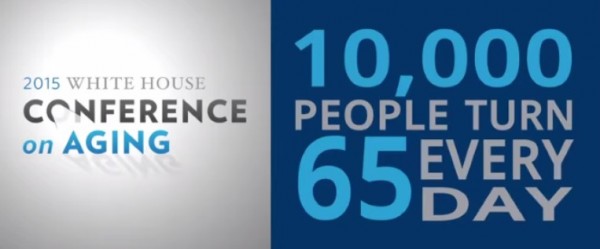
It is a once-a-decade event that will feature the President of the United States and other senior administration officials. The White House Conference on Aging (WHCOA), first held a half-century ago and a key driver of federal policy towards the nation’s seniors, will be a conference reliant on digital technology befitting 2015.WHCOA box Rather than having delegates from throughout the nation stream into Washington, D.C., Americans are asked to watch events unfold via live stream – either at home, or by getting together with co-workers or people from their local communities.  Officials note that more than 600 public and private Watch Parties—in every state—have been organized and registered with WHCOA.

According to the WHCOA website, there are four “watch party” sites in Connecticut, where people can gather to watch the live video feed together. The sites are in Hamden at the Whitney Center, in Norwalk at Home Care 100, in Waterbury at the Western CT Area Agency on Aging, and in West Hartford at Hebrew Healthcare.  The WHCOA has produced a Watch Party Discussion Guide to encourage dialogue during the event, in addition to listening to speeches emanating from the White House.65
Earlier this year, regional forums leading up to the WHCOA were held in Tampa, Phoenix, Seattle, Cleveland and Boston.  Lisa Ryerson, President, AARP Foundation President, moderated the panel in Boston, which explored the topics of healthy aging and long-term services and supports. Panelists included Jewel Mullen, Commissioner, Connecticut Department of Public Health and President, Association of State and Territorial Health Officials.  The Boston  Regional Forum, held on May 28, 2015, was the fifth and last in the series of regional forums, coordinated with the Leadership Council of Aging Organizations, a coalition of more than 70 of the nation’s leading organizations serving older Americans.photo
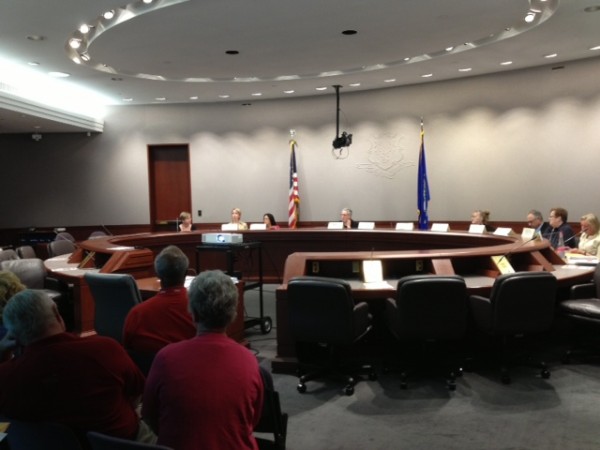
In addition, Connecticut’s Department on Aging, Legislative Committee on Aging and Commission on Aging held a public hearing in May at the Legislative Office Building highlighting issues impacting the state’s seniors, with the testimony from that day being shared with WHCOA officials. Connecticut officials noted that Connecticut is undergoing a “permanent and historic transformation” in its demographics, and currently has the nation’s 7th oldest population.  Between 2010 and 2014, Connecticut’s population of people age 65 and older is projected to grow by 57 percent, while at the same time the population of individuals between age 20 and 64 will grow by less than 2 percent.

Monday's WHCOA  begins with a welcome from Valerie Jarrett, Senior Advisor and Assistant to the President for Intergovernmental Affairs and Public Engagement, being introduced by Bernard Nash, Caregiving in America Panel.  An early morning panel is to be moderated by actor David Hyde Pierce and will include Secretary Robert A. McDonald, U.S. Department of Veterans Affairs; Ai-jen Poo, Caring Across Generations; Harry Leider, The Walgreen Company; Frank Fernandez, BluePlus, BCBS Minnesota Foundation; and Britnee Fergins, Caregiver.Obama

Remarks by President Barack Obama, will be followed by a panel on “Planning for Financial Security at Every Age” moderated by Secretary Tom PeRobin Diamonterez, U.S. Department of Labor.  The panel will include Jean Chatzky, AARP Financial Ambassador; Vickie Elisa, Mothers’ Voices Georgia; Robin Diamonte, United Technologies Corporation; and Andy Sieg, Merrill Lynch Bank of America.
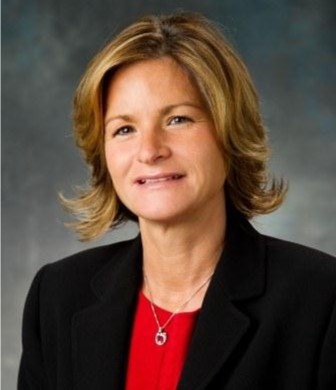
Diamonte, UTC’s Chief Investment Officer, was voted CIO of the Year in April by her peers in the Investor Intelligence Network (IIN), an online forum of senior financial decision-makers. IIN is part of Institutional Investor PLC, a leading international business-to-business publisher best known for its Institutional Investor magazine.  Diamonte is responsible for overseeing UTC’s $52 billion in global retirement assets, including $24 billion in domestic pension plans, $7 billion in foreign pension plans and $21 billion in the defined contribution plan.

Following the panel that includes Diamonte, viewers will hear remarks from Nora Super, Executive Director of the 2015 White House Conference on Aging and Cecilia Muñoz, Assistant to the President and Director of the Domestic Policy Council.

Also delivering rwhite hosueemarks or participating in panels are Secretary Tom Perez, U.S. Department of Labor; DJ Patil, White House Office of Science and Technology Policy; Secretary Tom Vilsack, U.S. Department of Agriculture; professional athlete Diana Nyad; Vice Admiral Vivek Murthy, U.S. Surgeon General; Director Richard Cordray, Consumer Financial Protection Bureau; and Stephanie Santoso, White House Office of Science and Technology Policy.

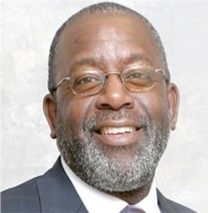
In addition, Kevin Washington, President and CEO of the YMCA, will be a member of a panel on The Power of Intergenerational Connections and Healthy Aging.  Washington, who formerly led the YMCA in Hartford, was honored last month by The Amistad Center for Art & Culture in Hartford for his leadership, noting that he is the first African American to lead the nation’s YMCA organization.Kevin Washington
Throughout the day, individuals are asked to “Tweet us your questions using #WHCOA and we will pass them along to our experts participating on panels at the conference.” People are also asked how they would finish the sentence: “Getting older is getting better because …”? A PDF form can be downloaded and then sent along to WHCOA officials.  Interviews with older adults can be uploaded to be archived in the Library of Congress, and people are encouraged to share their interviews on social media using the #WHCOA hashtag.

https://youtu.be/gdAWa6wNYXs

Sacrifice of Vietnam War Veterans Honored 50 Years Later at Weekend Events

A special two-day event to recognize and honor New England's Vietnam veterans and remember those who did not return is set for Saturday, July 11 and Sunday, July 12 from 9 a.m. to 5 p.m. on the grounds of the Connecticut Air National Guard Base in East Granby. "Connecticut's Vietnam 50th Celebration Weekend" will feature many vehicle and aircraft displays, rare helicopter rides in the famous UH-1D "Huey," nationally renowned speakers and authors, and a Saturday 1 p.m. concert performed by the U.S. Coast Guard Band. Other static air displays will be at the New England Air Museum at 36 Perimeter Rd. in Windsor Locks.

"This event is open to everyone and is designed to educate a new generation about the Vietnam War and the part it played in the lives of our friends, relatives and neighbors whose stories are the building blocks of American History," explains Eileen Hurst, Celebration Chair.title-picture

]The event is sponsored by the Central Connecticut State University Veterans History Project's Vietnam War Commemoration Committee. Collaborating partners include the Connecticut National Guard, Connecticut Department of Veterans' Affairs, and New England Air Museum.

Featured will be hands-on demonstrations, memorabilia, and a Veterans' Gathering tent where veterans can reunite and reconnect. There will static displays of a B-52, C-130, C-5, and other aircraft that include a CH-47 Chinook, UH-60 Blackhawk, and an F-15 Fighter Jet. Attendees can get close-up looks at a variety of vehicles and equipment operated by our armed forces during the Vietnam War.

There also will be programs specifically designed to remember and honor those who gave the "last full measure of devotion". Exhibits featuring "Voices From Vietnam," photo displays of veterans who were Killed in Action (KIA) or Missing in Action (MIA), and a special exhibit featuring Gold Star Families.

All events and activities held at the Connecticut Air National Guard base are free.  Admission to the New England Air Museum is free for all veterans; others pay $12 ($2 of each ticket benefits the Vietnam 50th weekend).  For those interested, there will also be $100 donation American Huey 369 helicopter rides that must be scheduled and paid for on-site.

There is no parking on the Connecticut Air National Guard base. Free parking and shuttle bus transportation to the base will be at UTAS (Hamilton Sundstrand) at One Hamilton Rd. South in Windsor Locks. All attendees must go through a security check upon arrival at the base; special instructions and a list of approved items can be found at: http://www.ccsu.edu/vietnam/parking.html

Learn more about the war in Vietnam (PDF) 

https://youtu.be/Fm2Dalx8oB0

Rich Towns in CT Have 8 Times the Resources of Poor Towns to Pay for Municipal Services, Study Finds

The most resource-rich towns in Connecticut had, on average, a per capita revenue capacity that was more than eight times the average of the most resource-poor communities’ capacity.  That conclusion, highlighted in a study by the Federal Reserve Bank of Boston, which pointed to “large non-school fiscal disparities across cities and towns in Connecticut.” “These disparities are driven primarily by differences in revenue-raising capacity,” the report, “Measuring Municipal Fiscal Disparities in Connecticut,” concluded. “Because municipalities in Connecticut rely almost exclusively on property taxes for own-source revenue, this is directly tied to the uneven distribution of the property tax base.”fed report

The study, issued in May, “found that municipal costs are driven by five key factors outside the control of local officials: the unemployment rate, population density, private-sector wages, miles of locally maintained roads, and the number of jobs located within a community relative to its resident population.”  Fiscal disparities exist when some municipalities face higher costs for providing a given level of public services or fewer taxable resources to finance those services than others, according the report synopsis.

The study explains that “in Connecticut, municipalities provide a range of services including education, public safety, public works, human services, and general government.  While educational fiscal disparities—and the effectiveness of the state’s Education Cost  Sharing (ECS) grant in addressing them—have received considerable attention in Connecticut, less is known about how municipalities’ underlying characteristics affect their ability to provide other vital public services and the degree to which state policies ameliorate differences.”

The highest-cost group of communities had average per capita municipal costs that were 1.3 times the average per capita costs of the lowest-cost group of cities and towns, the study found, noting that “variation in measured capacity stems from differences in resources, not choices about tax rates. In Connecticut, real and personal property taxes are virtually the only source of revenue that cities and towns are authorized to levy.”

Breaking down the state’s geography, the report indicated that “the highest capacity areas (darkest shades on the map) are located in the southwestern and northwestern corners of the state, and along the shoreline. Connecticut’s lowest-capacity municipalities (the lightest shades on the map) are mostly scattered through the central and eastern portions of the state. In general, communities in northeastern Connecticut also tend to have fairly low per capita revenue capacity.”map

The municipal gap data highlighted in the report is described as “the difference between the uncontrollable costs associated with providing public services and the economic resources available to a municipality to pay for those services.”  To calculate the per capita “gap” for each community, the study subtracted per capita revenue capacity from per capita cost for each municipality:

  • Thus, a “positive gap” indicates a municipality that lacks sufficient revenue-raising capacity to provide a given common level of municipal services, with larger gaps indicating a worse fiscal condition.
  • By contrast, a negative gap represents a municipality that has more than enough revenue-raising capacity to provide this common level of municipal services.

The study found “a wide range of municipal gaps among Connecticut’s 169 communities, indicating significant fiscal disparities across the state.” Although cost differences play a role, “these gaps are largely driven by the uneven distribution of revenue capacity across the state. This, in turn, is the direct result of the uneven distribution of the property tax base.”

  • The report indicated that “a total of 78 Connecticut municipalities had a positive fiscal gap, meaning there was insufficient revenue raising capacity, representing 46 percent of the state’s communities (and close to 60 percent of the state’s population).
  • The state’s remaining 91 communities had a negative fiscal gap (more than sufficient revenue-raising capacity) in the year studied, FY2011.

The state’s cities, with the notable exception of Stamford, tend to have the largest positive gaps, or insufficient capacity to raise funds to provide adequate municipal services. Most communities in northeastern Connecticut also have positive gaps. The largest negative gaps, the report found, —representing communities with high revenue-raising capacity—are generally located in lower Fairfield County, the northwestern corner of the state, and certain communities along the shore in eastern Connecticut.

The report was coordinated for the New England Public Policy Center of the Federal Reserve Bank of Boston by Bo Zhao and Jennifer Weiner and a team of researchers.  Bo Zhao is a Senior Economist in the New England Public Policy Center, specializing in public finance and urban and regional economics.   Jennifer Weiner is a Senior Policy Analyst with the New England Public Policy Center. Her work focuses on state and local public finance and has included research on state business tax credits, unemployment insurance financing, state debt affordability, transportation funding, and the fiscal systems of the New England states.


Income Inequality Around Bridgeport Has Grown, Among Nation’s Largest Gaps, Research Shows

Commuting zones surrounding Bridgeport are among the commuting regions in the United States where neighborhood income inequality has grown notably most severe over the past 20 years, according to a new analysis developed by the Urban Institute and published in Governing magazine. From 1990 to 2010, inequality in the United States increased in many ways, the report explains, highlighting that the income, wealth, and educational attainment of residents in the most privileged neighborhoods in the U.S. escalated rapidly over these two decades. Meanwhile, “residents of the most disadvantaged neighborhoods gained little; many of these neighborhoods grew poorer,” the report indicated.

WOrlds ApartAs a result, the study found that inequality between “top and bottom income” neighborhoods intensified in the great majority of commuting zones. Even where inequality dropped, the story was not always positive: it often occurred because top-neighborhood incomes fell in the wake of economic stagnation.
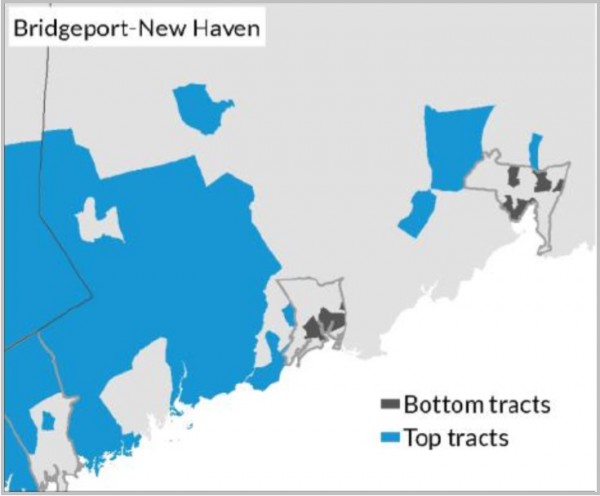
The research report, “World Apart:  Inequality between America’s Most and Least Affluent Neighborhoods,” found that “the national trend toward rising incomes among top-earning households” was reflected in the nation’s top tracts show growth from $123,000 to $138,300, over 12 percent” during the period 1990-2010.  Some top neighborhoods, including those surrounding Bridgeport, “had increases of over $30,000 at the top.”

Annual income in bottom tracts, meanwhile, grew from $36,800 to $37,150 – less than 1 percent over the twenty year period.  The average income of bottom tracts declined in 209 of the 570 commuting zones studied, the report indicated.  The most severe losses at the bottom among large commuting zones, the report found, occurred in Bridgeport, Newark and Dallas. Bridgeport is one of the ten cities with the largest “neighborhood inequality index.”

The report flatly stated that “Bridgeport, which includes the entirety of Connecticut, already was one of the most unequal commuting zones in 1990.  Its top and bottom neighborhoods pulled further apart in income between 1990 and 2010; practically all its top neighborhoods are still in the suburbs and practically all its bottom neighborhoods are in central cities.”bgpt NH

The only cities with commuting zones of over 250,000 people with a higher “neighborhood inequality index” than Bridgeport, as of 2010, are Austin, Baltimore, Birmingham, Columbus, Houston, Nashville, Richmond, and St. Louis.

As a result of changes at the top and bottom, the report noted, income inequality between top and bottom tracts grew from 1990 to 2010 in 433 of the 570 commuting zones. In 237 CZs, income inequality grew because of rapid increases at the top coupled with modest increases at the bottom.

To understand the differences between neighborhoods that share the same housing and labor markets, the Urban Institute analysis used commuting zones (CZs), county-based regions defined in the 1990s. Unlike metropolitan areas, commuting zones cover the entirety of the United States, and their definitions are constant over time.

The study ranked every CZ’s tracts from lowest to highest neighborhood advantage score. Then they identified the top 10 percent and the bottom 10 percent of tracts—the most advantaged and least advantaged neighborhoods in each CZ—for further exploration. There are described as top and bottom tracts. The study analyzed the 570 CZs that had at least 10 census tracts in 2010.

The nonprofit Urban Institute is dedicated to elevating the debate on social and economic policy. The organization’s website explains that “For nearly five decades, urban scholars have conducted research and offered evidence-based solutions that improve lives and strengthen communities across a rapidly urbanizing world. Their objective research helps expand opportunities for all, reduce hardship among the most vulnerable, and strengthen the effectiveness of the public sector.”

New Bicycle Safety Law Puts Bicyclists in Drivers Seat on Roadways in CT

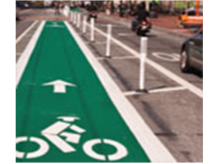
With the July 4th weekend now in the rear view mirror, summer is fully underway.  And for bicyclists and motorists this summer, there are some important new rules of the road, courtesy of the Connecticut state legislature. Changes to Connecticut's laws for cyclists took effect at the start of the month on July 1, 2015.  The Bicycle Safety bill (Senate Bill 502 and now Public Act 15-41) was passed in May with broad bipartisan support and signed into law on June 1.  The new law eliminates the confusing--and often unsafe--rule requiring cyclists to ride as far to the right as practicable, according to officials of the Bike Walk Connecticut, the statewide advocacy organization.bike walk

Instead, the law now requires cyclists to ride as close to the right side of the road as is safe, as judged by the cyclist.  Bike Walk Connecticut specifically advocated for that language, which is modeled on a best practice from Colorado as identified by the League of American Bicyclists.

Officials say that with the new law now in effect, cyclists don't have to ride as close to the right side of the road when:

  • Overtaking or passing another vehicle proceeding in the same direction;
  • Preparing for a left turn at an intersection or into a private road or driveway;
  • Reasonably necessary to avoid conditions, including, but not limited to, fixed or moving objects, parked or moving vehicles, bicycles, pedestrians, animals, surface hazards or lanes that are too narrow for a bicycle and a motor vehicle to travel safely side by side within such lanes;
  • Approaching an intersection where right turns are permitted and there is a dedicated right turn lane, in which case a bicyclist may ride on the left-hand side of such dedicated lane, even if the bicyclist does not intend to turn right;4062581
  • Riding on a roadway designated for one-way traffic, when the bicyclist may ride as near to the left-hand curb or edge of such roadway as judged safe by the bicyclist; or when
  • Riding on parts of roadways separated for the exclusive use of bicycles, including, but not limited to, contra-flow bicycle lanes, left-handed cycle tracks or bicycle lanes on one-way streets and two-way cycle tracks or bicycle lanes.

The new law also allows two-way bicycle lanes, buffered bike lanes, and cycle tracks to be designed in Connecticut and allows drivers to cross the double yellow line to pass slower-moving cyclists and other road users when it's safe to do so.

bike laneLater this month, Bike Walk CT is offering the League of American Bicyclist-designed Traffic Skills 101 program, a comprehensive day long course to give cyclists the skills, knowledge and confidence to handle on-road cycling.


Federal statistics indicate 722 bicyclist deaths occurred in 2012, up 6 percent from 2011 and 16 percent from 2010.  On a per capita basis, Florida recorded an annual average of about 5.7 cyclist deaths per million residents, by far the most of any state. The national bicyclist death rate for 2012 was approximately 2.3 deaths per 1 million.  In Connecticut, the rate was 1.8, ranking the state 18th in the nation.

The program this month will be offered in West Hartford; with the cost of the one-day program $50 for Bike Walk CT members and $65 for non-members.  The curriculum includes approximately 4 hours in class and 4 hours outside, split between skill drills and an on-road ride.  Among other things, participants will practice starting, stopping, shifting and scanning, learn how to ride in traffic, including proper lane and intersection positioning, and crash avoidance techniques.

Officials at Bike Walk CT note that bike lanes and greenways “aren’t just good for our health.  Since transportation is the biggest contributor to greenhouse gases in Connecticut, active transportation—biking and walking—must be a key piece of our climate action plan.  Bikeways are also an extremely cost-efficient way to manage traffic congestion.  Bike lanes, sidewalks and greenways cost a fraction of what it costs to build and maintain roads.  People tend to bike and walk more when they have the bike lanes, greenways and sidewalks.”

“Being bike-friendly isn’t just a ‘nice to have’ thing anymore,” observes Kelly Kennedy, Executive Director of Bike Walk Connecticut.  “Being bike-friendly is now essential to competitiveness.  In fact, not being bike-friendly is a competitive disadvantage. Connecticut's car-dependent lifestyle is not the lifestyle that millennials or the creative class have in mind.  A well-designed active transportation network will help bring millennials and the creative class to Connecticut and keep them here, strengthening our economy.”


New CT Law Raises Age, Strengthens Education for Towing People While Boating, Responding to Tragedy

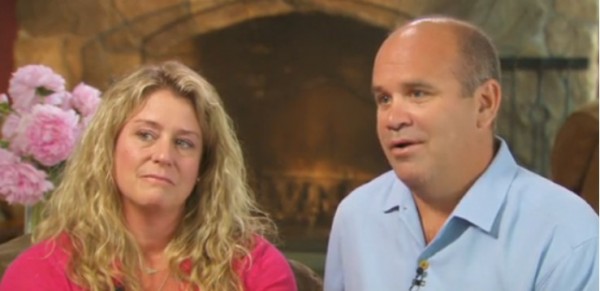
Emily Fedorko, a 16-year-old from Greenwich who died in a water-skiing related accident last summer, is the namesake of “Emily’s Law,” which, at the urging of her parents, was approved by the state legislature this year and signed into law by Governor Malloy. It prohibits children under-16 from piloting watercraft towing skiers or tubers, raising the age from 13, and requires a related safety course that specifically includes towing instruction. In testimony before the state legislature’s Environment Committee, which was considering the proposed legislation earlier this year, Emily’s parents, Joseph and Pamela Fedorko, said “What makes this so important is that current boating safety courses have very little on the topic of towing. This includes water skiing, tubing or boarding. Education is the leading way we can teach our young adults safety.”emily

“Our daughter Emily took her safety course along with my youngest daughter and wife on June 28th, 2014, five weeks before she passed. Emily took intense notes that day. My wife, Pam, can attest that there wasn’t anything taught regarding towing of water sports.”

“Education in the classroom is just part of it. Having the ability to make quick decisions comes with AGE and EXPERIENCE. Towing requires even more. The operator needs to be alert and aware of his/her surroundings. They also need to understand the responsibility of pulling a rider,” the Fedorko’s told legislators.

In addition to urging changes in state law to enhance boating safety, the Fedorko’s formed the Emily Catherine Fedorko Foundation to increase boating education in Connecticut and beyond.  The site includes a tutorial video detailing safe towing practices, which the Water Sports Industry Association indicates is the water sports activity with “the most injuries in recent years.”  The Foundation also provides a “safe boating packet” that includes a water resistant phone carrier, floating key chain safety tips and ignition switch sticker, all aimed at reminding water craft operators to turn off their engine when towing to enhance safety and prevent potential life-threatening hazards.

This new Connecticut law requires, with limited exceptions, a person who operates a vessel engaged in water skiing to:packet

  • be at least age 16;
  • hold a (a) valid U.S. Coast Guard-issued vessel operator license, (b) Department of Energy and Environmental Protection (DEEP)-issued safe boating certificate (SBC) or certificate of personal watercraft operation (CPWO), or (c) a boating safety certificate from a state with a reciprocal agreement with Connecticut; and
  • hold a DEEP-issued safe water skiing endorsement obtained after completing safe water skiing instruction.

The bill also prohibits a vessel owner from knowingly allowing someone under age 16 to operate the vessel while engaged in water skiing.

State Senator Scott Franz told his fellow legislators, “currently, a 13 year old with a Safe Boating Certificate is able to take a twin 350 horsepower engine boat out and tow water skiers and tubers. The record is miraculously good, but the risk given the general lack of on-the-water experience for this age group is large. With Senate Bill 699, there would be a requirement of a minimum age of 16 with a towing endorsement in order to legally tow.”

“On August 6, 2014, Emily went out with three of her best friends looking to have fun on the water. As a result of inexperience, she lost her life tubing while her best friend was driving,” her parents told legislators.  The Fedorko’s went on to ask: “We allow our kids to get their driving license at 16. This comes with many restrictions. So why wouldn’t we want to add some rules to anyone who is looking to drive a boat while towing someone? Boats don’t have a seat belt or brakes and riders are at the mercy of the operator. The age restriction for towing with a personal watercraft, or Jet Ski, is 16. Why would we not want the same age restriction for a boat with a propeller?”

Legislators answered by approving the proposal, which is now state law.  The restrictions and requirements are not in place in other states, and the Emily Catherine Fedorko Foundation is continuing efforts to promote stricter guidelines around the country.

NBC Nefoundation logows recently reported that there were more than 4,000 boating accidents in the U.S. in 2014, citing U.S. Coast Guard statistics.  The top three contributing factors, according to the report, were operator inattention, improper lookout and operator inexperience.

According to the United States Power Squadrons (USPS), boating laws and license requirements vary from state to state.  Eight states have no mandatory boater education law:  Alaska, California, Arizona, Idaho, Wyoming, South Dakota, Arkansas, and Maine.  USPS is a nonprofit, educational organization dedicated to making boating safer and more enjoyable by teaching classes in seamanship, navigation and related subjects.  The organization was among the agencies and individuals, including the state’s Department of Energy and Environment Protection, that supported approval of Emily’s Law in Connecticut.


fedorko

Largest Community Survey in U.S. Now Underway in Connecticut; 15,000 People to be Interviewed

The 2015 Community Wellbeing Survey is set to become the largest cross-sector community survey in the United States, interviewing 15,000 randomly-selected residents this spring and summer including individuals from every town and city in Connecticut. The initiative is creating the first-ever shared measures of quality of life, happiness, and community health across all neighborhoods, towns, regions, and the state as a whole. These interviews will reveal findings that are currently unavailable at a local level from any other public data source.

New Haven-based DataHaven is working with leaders from more than 100 statdatahavene and local government agencies, major health care and academic institutions, and community and philanthropic organizations to design and conduct the program.

The organization has combined many existing grassroots and regional efforts-including DataHaven's own 2012 Greater New Haven Wellbeing Survey-into a single, exceptionally high-quality survey covering all of Connecticut and a few adjacent sections of New York State.

Survey-takers are based at the Siena College Research Institute, a leading independent research organization near Albany with a staff of more than 100 highly-trained English- and Spanish-speaking interviewers. Calls began in April and will continue throughout the summer. (The survey calls will come from the 518 area code.)

“Our initial feedback from residents and our previous experience with this survey shows that people like to answer these questions,” says Mark Abraham, Executive Director of DataHaven, which is spearheading the campaign. “They are answering questions about their own happiness and health, their family’s financial security, and how their communities and neighborhoods are faring. These questions show that we care about how they feel.”

Seeing the potential impact of its results, dozens of Connecticut’s leading hospitals, government agencies, universities, and charities are backing the 2015 Community Wellbeing Survey with major donations. Supporters joining DataHaven include regional community foundations, United Ways, and health care providers located in Hartford, New Haven, Bridgeport, Stamford, Waterbury, New Britain, Norwalk, Danbury, Bristol, Derby, New London, and elsewhere.phone

This nationally recognized program provides neighborhood- and regional-level information not available from any other source on community vitality, health, family economic security, and individual happiness. Other topics such as civic engagement, transportation, housing,and employment – even satisfaction with government and community life – are included. The mission of the initiative is to produce the highest-quality, neighborhood-level information on issues that are most meaningful to local residents, and to foster collaboration between the hundreds of organizations, institutions, businesses, and agencies that are working to build stronger communities.

“With such a detailed snapshot, state and local community leaders will be able to better serve the health and well-being needs of our communities,” says Abraham.

Partners providing significant funding for the program are representative of each region of Connecticut:

  • In Fairfield County, $200,000 has been committed by leading organizations such as Fairfield County's Community Foundation, Bridgeport Hospital, Stamford Hospital, Greenwich Hospital, and the United Way of Coastal Fairfield County.
  • In south-central Connecticut, The Community Foundation for Greater New Haven along with Yale-New Haven Hospital, Workforce Alliance, United Way of Greater New Haven, and others have joined forces to commit over $100,000 in funding.
  • In Greater Hartford and New Britain, the program has drawn over $100,000 in support from the Hartford Foundation for Public Giving, Community Foundation of Greater New Britain, Trinity College Office of the President and Center for Urban and Global Studies, Saint Francis Hospital and Medical Center, Johnson Memorial Medical Center, and others.

wellbeingAdditionally, DataHaven has secured funding to ensure that residents of Connecticut's smaller cities and rural areas are included to the same degree as those living in its major metropolitan areas. Nearly $200,000 has been committed from organizations such as the Connecticut Community Foundation, Valley Community Foundation, Lawrence + Memorial Hospital, Ledge Light Health District, Community Foundation of Eastern Connecticut, Connecticut Housing Finance Authority, and others.


Results from the survey will be published in a series of local and statewide reports throughout late 2015 and 2016, helping to shed light on progress made toward various longstanding community priorities, including financial security for families and opportunities for children to succeed.

"We believe the 2015 Community Wellbeing Survey, the most comprehensive local level survey of its type in the United States, will be of great value to neighborhoods and organizations striving to make our cities and towns even better places to live and work,"says Abraham.

DataHaven is a non-profit organization with a 25-year history of public service to Greater New Haven and Connecticut. DataHaven’s mission is to improve quality of life by compiling, sharing, and interpreting public data for effective decision making. DataHaven is a formal partner of the National Neighborhood Indicators Partnership of the Urban Institute in Washington, DC. Last fall, the Community Indicators Consortium presented an “Impact Award”  to DataHaven’s Executive Director Mark Abraham, honoring Abraham with a trophy and opportunity to speak to the organization's annual assembly. Abraham illustrated how DataHaven and its partners across Connecticut have collected and used public data to advance community change.