Young Professionals Honored Across CT; Emerging Leaders Earn Plaudits in Many Fields

There appears to be no shortage of outstanding young professionals in Connecticut, as a glimpse at business publications this month clearly shows. Hartford Business Journal has named “the 40 best young professionals in Greater Hartford,” and Fairfield County Business Journal has honored its top choices, with their annual 40 Under 40 Awards recognizing emerging business leaders. Candidates are judged on their contributions to their specific industry or the position of authority they have achieved in their career.  Leaders in business and non-profits of all sizes and industries were considered, according to the publication.80 under 40
HBJ Managing Editor Brad Kane explains that “HBJ’s 40 Under Forty awards identifies young leaders who have already had success but who also have the potential to lead the professional world of tomorrow.  These individuals want to lead both in the board room and in life.”

The Fairfield County Business Journal’s 11th annual event, held recently, honored 40 people working in industries including law, real estate, medicine, nonprofits and others in Fairfield County. More than 300 people attended the event at the Maritime Aquarium at Norwalk.

Norwalk Mayor Harry Rilling congratulated the Fairfield County group at the awards ceremony, “You’re the rising stars of Connecticut, and we thank you for what you do,” Rilling said.

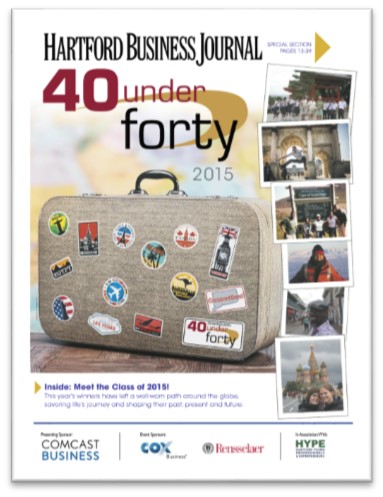
Hartford Business Journal reveals its selections from a sizable pool of candidates in the current issue, and will present its awards at an event to be held at the CT Convention Center in Hartford on September 30.

Greater Hartford’s 40 Under 40, as published by the Hartford Business Journal:hbj
Julianne Avallone, Ford & Paulekas

Stephanie Higgins Bealing, Replacement Lens Express

David Bittner, St. Francis Hospital & Medical Center

Anthony Byers, Hartford Youth Scholars

Michael Byrne, UBS Global Asset Management

Megan Carannante, Pullman & Comley

Rebekah Castagno, The Village for Families & Children

Aidan Charles, Charles Coaching & Nutrition Services

Dan Clark, Clark Insurance

Endia DeCordova, Manchester Community College

Jocelyn DeMaio, The Hartford Financial Services Group

Stephanie Dumont, Comcast

David Elder, ConnDOT

Stephen Frenkel, Cigna

Ryan T. Gardner, Fiduciary Investment Advisors

Jacquelynn Garofano, United Technologies Research Center

Tara Gerber, Travelers Championship

Daniel Gottfried, Hinckley Allen

Jaclynn Hart, Hartford Performs

Jennyfer Holmes, Hartford Foundation for Public Giving

Elizabeth Johnson, Post University

Jonathan Kaplan, Pullman & Comley

Alex Koenigsberg, Creative Living Community of CT

Melissa Lambright, SIGHT Eye Health

Lori-Ann Marchese, Body Construct

Michelle McDade, The Hospital of Central Connecticut

Kristina Miner, Hartford Steam Boiler Inspection & Insurance

Karraine Moody, Hartford Area Habitat for Humanity

Quentin Phipps, Charter Schools for Excellence

Kathryn Redican, Berkshire Hathaway HomeServices

Todd R. Regan, Robinson+Cole

Natasha Roggi, Hartford Sweat

Jacquelyn Santiago, COMPASS Youth Collaborative

Kathryn Shafer, Partnership for Strong Communities

Anthony Shannon, Shipman & Goodwin

Steven C. Taylor, Webster Bank

Joseph Turbessi, Finished: What's Next?

Rebecca Wareing, Management Search

Robert Zanlungo, Primary Residential Mortgage

Mark S. Zatyrka, American Homecare Federation


Fairfield County 40 Under 40, as published by the Fairfield County Business Journal:fairfield

Joshua Aferzon, CEO, Orthozon Technologies

Megan Baroni, counsel, Robinson & Cole LLP

Eliot Bassin, partner, Bregman & Company PC

Assaf Z. Ben-Atar, associate counsel, Pullman & Comley LLC

Kelly Berwick, deputy assistant public defender, Division of Public Defender Services

Paul A. Bonomo, CFO and COO, Cannondale Generators Inc.

Peter M. Bryniczka, partner, Schoonmaker, George & Blomberg PC

James Calkins, executive chef and owner, Seasonal Sweets & Catering

Anthony A. Carpentieri, private wealth manager, Private Banking & Investment Group at Merrill Lynch

Nate Checketts, co-founder, Rhone Apparel

Joseph Cichowski, vice president of sales and marketing, Ash Creek Enterprises Inc.

Mario F. Coppola, Esq., partner and corporation counsel for the city of Norwalk, Berchem, Moses & Devlin PC

Jessica Curtis, senior managing director, Newmark Grubb Knight Frank

Sergio DaSilveira, vice president, banking center manager, Webster Bank

Lara Devgan, plastic surgeon, Greenwich Hospital

Steven Fusco, sales consultant, Paychex Inc.

Emily Goldschmid, clinical director of children’s services, Kids in Crisis

Nicole Licata Grant, economic development specialist, UIL Holdings Corporation

Benjamin Healey, associate director, clean energy finance, Connecticut Green Bank

Jason Jaronko, senior program director, Westport Weston Family YMCA

Sean Keating, senior manager, McGladrey LLP

Bryan J. Kelsey, vice president, senior market manager, People’s United Bank

Christiane Kinseley, licensed clinical social worker, A Whole Recovery LLC

Dr. Daniel T. Ksepka, curator of science, Bruce Museum

John Lim, CEO, Life in Mobile

Patrick B. McKiernan, account executive, Abercrombie Burns McKiernan & Company Insurance Inc.

Katrina V. Melei, bariatric surgery program coordinator, Greenwich Hospital

Kathryn Scheinberg Meyer, staff attorney, education success project, Center for Children’s Advocacy

Nick Nguyen, portfolio manager, Cambridge Hanover

Carrie O’Connell, director of employment services, day services and transportation, Ability Beyond

Thomas P. O’Connor, partner, Whitman Breed Abbott & Morgan LLC

Douglas Polistena, general manager, Amber Room Colonnade

David Sansone Jr., project manager, A.P. Construction

Paul Santos, director, information technology and operations, The Center for Family Justice Inc.

Lindsay Clauss Sheehy, sales associate, Houlihan Lawrence

Alison Smith, housekeeper, global messenger, Stern Village, The Kennedy Center, Special Olympics

Dave Stambone, vice president, senior mortgage banker, Total Mortgage Services LLC

Laurie Stefanowicz, vice president, managing partner, Catamount Wealth Management

Jamie Toole, general manager, Bridgeport Bluefish Professional Baseball

Kristen L. Zaehringer, attorney, Murtha Cullina LLP


First-Time Home Purchases Poised for Increase Nationwide; Buyers Market in Connecticut

Nearly one-in-five potential first-time home buyers nationwide are actively looking to buy and nearly two-thirds would like to provide a sizable down payment of 20 percent or more. Nearly two-thirds, 62 percent, of potential first-time home buyers think they will purchase a home within the next two years. Among millennial survey respondents, this number is slightly higher, rising to 67 percent. New research from TD Bank, with 75 locations in Connecticut, indicates that “consumers are gaining confidence in the economy and many are looking to enter the housing market within the next two years,” explained Scott Haymore, Head of Pricing and Secondary Markets, TD Bank.  The bank polled more than 1,000 Americans looking to purchase their first home within the next five years, producing the TD Bank First-Time Home Buyer Pulse report. for sale

Connecticut, with the strongest inventory of homes on the market in the New England region, is especially attractive to first-time home buyers, points out Maryruth Ryan, TD Bank's Regional Mortgage Sales Manager for Massachusetts, Rhode Island, Connecticut and southern New Hampshire.  “Rates are at historical lows, mortgage programs are good.  It’s a good time to buy in Connecticut,” Ryan said.

The Connecticut Association of Realtors reported earlier this month that single-family house sales across Connecticut rose nearly 14 percent in June, compared with June 2014, with the median sale price dropping just under one percent.  There were 3,756 homes sold in Connecticut last month, 459 more than during the same month a year ago.

Ryan said that as the millennial generation looks to first-home purchases, they “have done their research, they are more prepared, they know what they need to do to qualify for a mortgage for their first home.”

When asked what is preventing them from purchasing their first home, respondents most often cited needing to save money for a down payment (64 percent) and needing to pay down debt (45 percent).  For millennials, the entry to homeownership is even tougher: 70 percent of millennial respondents said they need to save for a down payment and 52 percent said they need to pay down debt. Millennials are more likely to purchase their first home with a partner or spouse (70 percent) compared to potential first-time home buyers of other generations 49 percent.TD Bank

"Many first-time buyers today are finding it difficult to save for a large down payment, especially young adults who are saddled with substantial student loan debt," said Haymore. “Many lenders today are offering home affordability and down payment assistance programs so it's important for these buyers and potential buyers to shop around for a mortgage and learn more about the options available to them."

StatsInfographicJune2015The survey noted that more than two-thirds of consumers (68 percent) looking to purchase their first home are interested in move-in ready homes while one-third would like to buy a fixer-upper. And when it comes to amenities, respondents are most interested in their first home having a backyard or pool and an attractive design, followed by energy efficient / smart homes technologies.

The top four financing options first-time buyers consider include cash savings, 30-year mortgage, and an affordability program and government loan.  Ryan points out that financial institutions such as TD Bank provide consumer education about the mortgage process, discussing aspects including budgeting and affordability with prospective home buyers. "The right lender will help first-time buyers understand what they can afford and share information on the different loan options available,” Haymore added.stats

Some Connecticut home purchases are now including a contingency clause, Ryan indicated, something that isn’t happening at the same frequency elsewhere.  The so-called “Hubbard Clause” is a contingency in a purchase agreement that expressly conditions the buyer's offer upon their ability to sell and close on another home or property, most often their current residence.

Because of the strong inventory currently in Connecticut, rather than more than one buyer lining up to purchase a house and an ensuing bidding war, as is happening in other parts of New England and around the country, first-time home buyers here tend to be able to select the home they’d prefer, and often are the only bidder seeking to make the purchase.  The Greater Hartford Board of Realtors reported that home sales rose for the fifth consecutive month in June in the 75-town region, and that sales increased and prices dropped during the first six months of 2015, compared with a year ago.

The TD Bank First-Time Home Buyer Pulse isavailable at http://mediaroom.tdbank.com/homebuyer.  The survey was conducted by Vision Critical, June 11-16.

Six Connecticut Businesses Earn Honors from U.S. Commerce Department for Export Efforts

Four Connecticut companies - Dymotek of Ellington, Jonal Laboratories, Inc. of Meriden, Mutualink of Wallingford and Proton OnSite of Wallingford – were among 26 companies nationwide to receive the President’s “E” Award for Exports, as determined by the U.S. Department of Commerce.  In addition, Stamford-based Finacity Corporation and Hartford-based law firm Shipman and Goodwin were among 12 firms in the U.S. to earn an “E” award for Export Service. presidents_e_award U.S. Commerce Secretary Penny Pritzker honored a total of 45 American companies and organizations, many of which are small- and medium-sized enterprises (SMEs), at the 2015 President’s “E” Awards ceremony, held earlier this year.  The six Connecticut businesses were among the 45 honored.

Among the 45 businesses, Arizona joined Connecticut with the most businesses earning the “E” designation, with four.  Texas had three; Tennessee, Illinois and North Carolina each had two.  This year’s honorees represent 20 states, with 35 SMEs and 21 manufacturers receiving awards.finacity

The “awardees have made substantial contributions to increasing U.S. exports, which are critical to spurring economic growth and job creation,” said Commerce Secretary Penny Pritzker. “Exports continue to be a driver of our economy, supporting more than 11.7 million jobs in cities and communities across the country. Furthermore, these exporters are examples of the historic progress in our export growth. In 2014, U.S. exports hit an all-time high of $2.34 trillion, accounting for 13.4 percent of GDP. By exporting more Made-in-America goods and services, U.S. businesses are growing faster, hiring more workers, and paying better wages.”

dymotechProton Onsite makes hydrogen and nitrogen generators.  Mutualink manufactures equipment used to facilitate collaborative communication between public safety and first response teams at the scene of emergencies.  Jonal Laboratories makes sealant used in the aerospace industry.  Dymotek manufactures custom injection molded plastic and silicone parts for electronics, plumbing valves and juice dispensers. jonalLaboratories

Finacity is a world-class expert in accounts receivable securitizations, specializing in structuring, administration and reporting.

Twelve companies thamutalinkt assist and facilitate export activities were honored with the “E” Award for Export Service. Four firms received the “E” Star Award for Exports, which recognizes previous “E” Award winners who have reported four years of additional export growth. And, three companies were awarded the “E” Star Award for Export Service, which recognizes previous “E” Award winners that have shown four years of continued support of exporters since first winning the “E” Award.shipman

protononsiteThis year marks the 53rd anniversary of the “E” Awards presentation, which recognizes companies and organizations that make a significant contribution to the expansion of U.S. exports.  In 1961, President Kennedy signed an executive order reviving the World War II “E” symbol of excellence to honor and provide recognition to America's exporters. The President’s “E” Award is the highest recognition any U.S. entity can receive for making a significant contribution to the expansion of U.S. exports.

“Only a small percentage of America’s 30 million companies export, and of U.S. companies that do export, 59 percent export to only one country. Increasing this number can have a big impact on the U.S. economy,” Pritzker added.


Best Suburbs to Raise A Family? In Connecticut, Most are in Fairfield County

Connecticut’s top 20 suburbs to raise a family are led by the Fairfield County communities of Darien, Weston, New Canaan, Westport, and Wilton, taking the first five slots.  Rounding out the top 10 were Simsbury, Cheshire, Glastonbury, Madison, and Easton, according to the website Niche.  Also reaching the top 20 were Monroe, Avon, Farmington, Middlebury, Canton, Brookfield, Fairfield, Trumbull, Granby and Orange. Niche ranks U.S. suburbs based on age demographics, school ratings, crime rates, and access to affordable housing, child care, libraries, and grocery stores. A high ranking indicates that a suburb "attracts young families with good schools and a safe community.darien_plaque

In the New Haven area, the top 10 suburbs to raise a family are Cheshire, Madison, Monroe, Middlebury, Orange, Guilford, Woodbridge, Wolcott, North Branford, and Branford, according to the rankings.  In the Hartford area, the top 10 area Simsbury, Glastonbury, Avon, Farmington, Canton, , Rocky Hill, Old Saybrook, Suffield, Cromwell, South Windsor, Newington and Southington.

In addition to being the top-ranked suburb in Connecticut, Darien ranked #17 in the nation, followed closely on the national list by Weston at #20, the only suburban communities in Connecticut to reach the top 50.  New Canaan was #51 in the U.S. and Westport was #59, the only other towns from Connecticut reaching the top 100.

In determining the rankings, factors receiving a weight of 20 percent included crime & safety,  and education, weighted at 10 percent were access to libraries, “involvement and investment in the community,” honiche-logousing, residents between 35 and 44, and the percentage of residents under age 9.  The final two categories used in the calculation, access to day care and access to grocery stores, were weighted at 5 percent.
Founded in 2002 by Carnegie Mellon University students as CollegeProwler.com, Niche is described as having grown into one of the largest content startups in the country, providing students, families, and professionals with “insight into big life decisions.”  The Hartford area  list included Longmeadow, MA and Old Saybrook, communities that most residents would not consider as part of the Greater Hartford region.  The company is based in Pittsburgh.

Seniors Better Off Than Other Adults in CT; State’s Ranks #6 in Senior Advantage

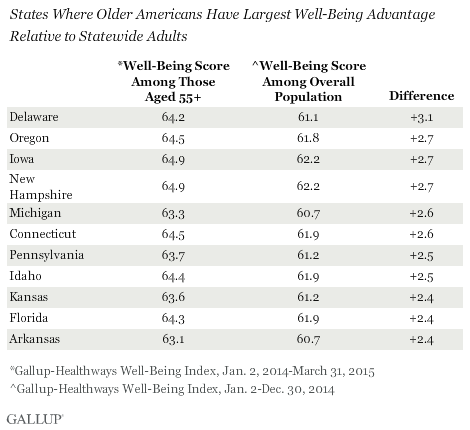
Older adults living in Delaware have the largest well-being advantage relative to the overall state population, followed closely by Oregon, Iowa, New Hampshire, Michigan and Connecticut.  A new state-by-state comparison examines the comparative well-being of Americans age 55 and older, and reveals that, nationally, people in that age category have higher well-being than the rest of the population. The inaugural report is based on data from the Gallup-Healthways Well-Being Index®. The growing percentage of the American population over the age of 55 — a trend largely driven by the Baby Boomers entering later life — has important implications for a variety of stakeholders, including families, employers, healthcare providers and policymakers, according to the report’s authors. “State Well-Being Rankings for Older Americans” aims to fill the research gap.older-americans-cover-thumb

The report focuses on five elements of well-being: purpose, social, financial, community and physical. These five elements, according to Gallup and Healthways, create a composite picture of the well-being of older Americans in each state.  rankingsThe Well-Being Index is calculated on a scale of zero to 100, where zero represents the lowest possible well-being and 100 represents the highest possible well-being.  Connecticut’s well-being score was 64.5 for those age 55+, compared with 61.9 for the overall adult population.  The difference of 2.6 was the sixth highest among the states.

The state where older Americans' well-being advantage is smallest is Wyoming, followed by Alaska, Oklahoma, Nevada, South Dakota, Maine and Vermont.

In an absolute sense, Hawaii, Montana, South Dakota, Alaska and Iowa are the top five states for overall well-being for older Americans -- states that also have high well-being rankings for the overall population.  The next five: New Hampshire, Utah, Oregon, New Mexico and Connecticut.

That places Connecticut in the top 10 in the overall rankings for well-being for older residents, and for the well-being advantage its seniors have above the overall adult population in the state.  Connecticut has the 7th oldest population in the nation. GallupHW_WBI_2C

States with the lowest well-being for older Americans are also those where well-being as a whole tends to lag behind the rest of the country: West Virginia, Kentucky and Oklahoma. . The report is based on self-reported data from 114,388 interviews with individuals age 55 and older, and was conducted in conjunction with the Massachusetts Institute of Technology (MIT) AgeLab.

“The greatest success of humankind is longer life. The challenge today for families and society is how to live longer, better with the highest state of well-being,” said Joseph F. Coughlin, director and founder of the MIT AgeLab. “Understanding our aging population, including Baby Boomers, the largest generation in our nation’s history, will be critical as we design policies and interventions to help older Americans thrive in all aspects of their lives.”

English Language Learners May Hold Key to Economic Vibrancy of Region, State

One-third of Hartford’s population is Puerto Rican, making it the 4th highest percentage of Puerto Rican people in the continental United States.  But the rapidly increasing diversity of the state’s Capitol City, and the region that surrounds it, only begins there – as do the linguistic and workforce challenges. A new report produced by The Hartford Foundation for Public Giving Latino Endowment Fund focuses on the issues faced by English Language Learners and highlights the opportunities and the challenges of increased cultural and linguistic diversity.report

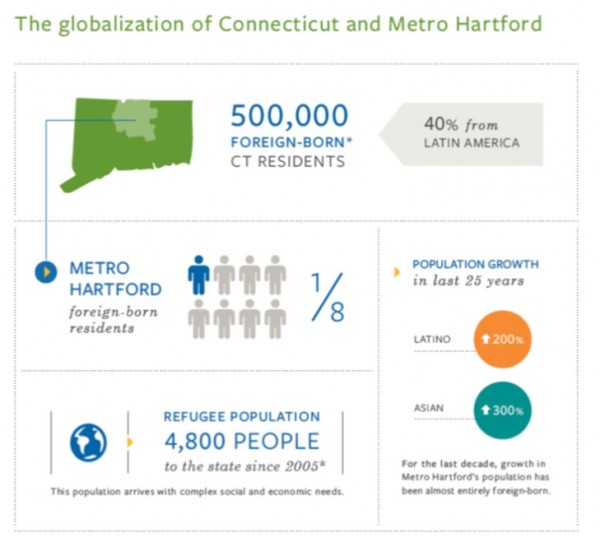
Approximately one-eighth of the Greater Hartford region’s population consists of foreign-born residents, including 4,800 people who have arrived in the state since 2005.  A total of 500,000 foreign-born residents are now living in Connecticut, including 40 percent who hail from Latin American countries.

During the past 25 years, population growth in the Hartford region has been “almost entirely” driven by foreign-born people taking up residence locally, according to the report. In the Hartford region, more than 1 in 5 people speak a language other than English at home.  About three-quarters of Connecticut English Language Learner (ELL) students speak Spanish.

The report found that the region’s “schools and communities are more diverse than ever, with more than 100 different languages spoken in homes throughout Greater Hartford.”  The report raises the question, “How can we harness the assets of a multilingual population to enhance our community and create stronger links to the global marketplace?”HFPG_VertLogo_rgb

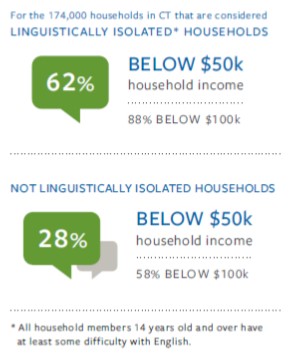
The report notes that “researchers believe that, on average, it takes 2 years to master conversational English, yet 5-7 years to master academic English.”  The report indicated that when analyzing education and workforce data, English Language Learners are far behind their English speaking peers in terms of educational attainment and income.Highlighting one of the challenges for ELL students, the reported found that over the last 4 years, two of the top three teacher shortages in Connecticut have been bilingual and world languages educators.  About 20% of all adult ELLs experienced poverty in the last year, about twice the rate in the state as a whole. In Connecticut, the earned income of ELL adults is $25,000 per year—less than half of English-speakers’ earnings.

population“The Latino Endowment Fund has offered this report as a means to expand the important discussion on efforts to support English Language Learners in our communities,” said Luis Cabán, chair emeritus of the Latino Endowment Fund Steering Committee. “This document provides us with an opportunity to reframe how we think about our increasingly global community and recognize the advantages of people speaking more than one language to enhance the richness of our community and create stronger links to the global marketplace.”

The number of Hispanic entrepreneurs in the United States has more than tripled since 1990 from 577,000 in 1990 to 2,000,000 in 2012, according to the report. Immigrant-owned businesses employ 10% of all American workers and generate 16% of the overall US business income.  Connecticut is home to 14,000 Latino-owned small businesses, which represents a 50 percent growth rate since 2007.

In Connecticut as of 2013, there were over 191,000 working-age adults with limited English proficiency.  This population has grown 32 percent since 20000 and now represents 10 percent of the total working-age population.  Over 58 percent of these are Spanish-speaking, the report indicated. teacher shortage

Some of the potential solutions highlighted in the report are:

  • Eliminating the state requirement that a district must have a minimum of 20 students requiring ELL support before receiving state funding. All districts that teach students who need ELL support should be eligible for state assistance.
  • Expanding dual-language immersion programs to build a more supportive multilingual environment that can cater to both urban and suburban families.
  • Developing an ESL/adult education curriculum for parents that focus on interactions with their children’s schools and teachers.
  • Providing additional support to create a smooth transition from adult education ESL classes to college-level ESL classes through the development of a coordinated curriculum.household income

“While we appreciate the recent actions by the legislature to support ELL students and their families, this report shows that much work needs to be done to assist the thousands of Connecticut children and adults who are not proficient in English,” said Nelly Rojas Schwan, chair of the Latino Endowment Fund and an assistant professor of social work and Latino community practice at the University of Saint Joseph. “The future of our state’s economy will largely be determined by how well we educate and train our English Language Learners and we hope this report will serve as a tool to aid in this discussion.”

Download a copy of the report.

White House Conference on Aging Has Connecticut Connections

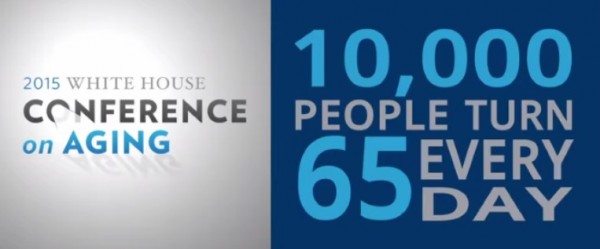
It is a once-a-decade event that will feature the President of the United States and other senior administration officials. The White House Conference on Aging (WHCOA), first held a half-century ago and a key driver of federal policy towards the nation’s seniors, will be a conference reliant on digital technology befitting 2015.WHCOA box Rather than having delegates from throughout the nation stream into Washington, D.C., Americans are asked to watch events unfold via live stream – either at home, or by getting together with co-workers or people from their local communities.  Officials note that more than 600 public and private Watch Parties—in every state—have been organized and registered with WHCOA.
According to the WHCOA website, there are four “watch party” sites in Connecticut, where people can gather to watch the live video feed together. The sites are in Hamden at the Whitney Center, in Norwalk at Home Care 100, in Waterbury at the Western CT Area Agency on Aging, and in West Hartford at Hebrew Healthcare.  The WHCOA has produced a Watch Party Discussion Guide to encourage dialogue during the event, in addition to listening to speeches emanating from the White House.65

Earlier this year, regional forums leading up to the WHCOA were held in Tampa, Phoenix, Seattle, Cleveland and Boston.  Lisa Ryerson, President, AARP Foundation President, moderated the panel in Boston, which explored the topics of healthy aging and long-term services and supports. Panelists included Jewel Mullen, Commissioner, Connecticut Department of Public Health and President, Association of State and Territorial Health Officials.  The Boston  Regional Forum, held on May 28, 2015, was the fifth and last in the series of regional forums, coordinated with the Leadership Council of Aging Organizations, a coalition of more than 70 of the nation’s leading organizations serving older Americans.photo

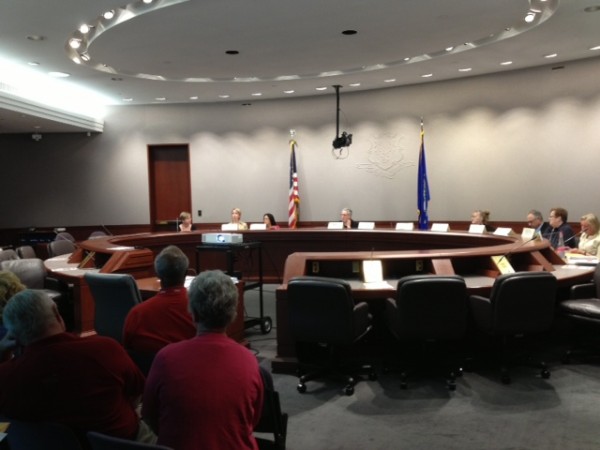
In addition, Connecticut’s Department on Aging, Legislative Committee on Aging and Commission on Aging held a public hearing in May at the Legislative Office Building highlighting issues impacting the state’s seniors, with the testimony from that day being shared with WHCOA officials. Connecticut officials noted that Connecticut is undergoing a “permanent and historic transformation” in its demographics, and currently has the nation’s 7th oldest population.  Between 2010 and 2014, Connecticut’s population of people age 65 and older is projected to grow by 57 percent, while at the same time the population of individuals between age 20 and 64 will grow by less than 2 percent.

Monday's WHCOA  begins with a welcome from Valerie Jarrett, Senior Advisor and Assistant to the President for Intergovernmental Affairs and Public Engagement, being introduced by Bernard Nash, Caregiving in America Panel.  An early morning panel is to be moderated by actor David Hyde Pierce and will include Secretary Robert A. McDonald, U.S. Department of Veterans Affairs; Ai-jen Poo, Caring Across Generations; Harry Leider, The Walgreen Company; Frank Fernandez, BluePlus, BCBS Minnesota Foundation; and Britnee Fergins, Caregiver.Obama

Remarks by President Barack Obama, will be followed by a panel on “Planning for Financial Security at Every Age” moderated by Secretary Tom PeRobin Diamonterez, U.S. Department of Labor.  The panel will include Jean Chatzky, AARP Financial Ambassador; Vickie Elisa, Mothers’ Voices Georgia; Robin Diamonte, United Technologies Corporation; and Andy Sieg, Merrill Lynch Bank of America.

Diamonte, UTC’s Chief Investment Officer, was voted CIO of the Year in April by her peers in the Investor Intelligence Network (IIN), an online forum of senior financial decision-makers. IIN is part of Institutional Investor PLC, a leading international business-to-business publisher best known for its Institutional Investor magazine.  Diamonte is responsible for overseeing UTC’s $52 billion in global retirement assets, including $24 billion in domestic pension plans, $7 billion in foreign pension plans and $21 billion in the defined contribution plan.

Following the panel that includes Diamonte, viewers will hear remarks from Nora Super, Executive Director of the 2015 White House Conference on Aging and Cecilia Muñoz, Assistant to the President and Director of the Domestic Policy Council.

Also delivering rwhite hosueemarks or participating in panels are Secretary Tom Perez, U.S. Department of Labor; DJ Patil, White House Office of Science and Technology Policy; Secretary Tom Vilsack, U.S. Department of Agriculture; professional athlete Diana Nyad; Vice Admiral Vivek Murthy, U.S. Surgeon General; Director Richard Cordray, Consumer Financial Protection Bureau; and Stephanie Santoso, White House Office of Science and Technology Policy.
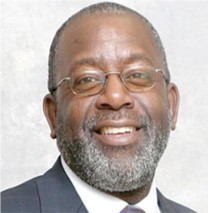
In addition, Kevin Washington, President and CEO of the YMCA, will be a member of a panel on The Power of Intergenerational Connections and Healthy Aging.  Washington, who formerly led the YMCA in Hartford, was honored last month by The Amistad Center for Art & Culture in Hartford for his leadership, noting that he is the first African American to lead the nation’s YMCA organization.Kevin Washington

Throughout the day, individuals are asked to “Tweet us your questions using #WHCOA and we will pass them along to our experts participating on panels at the conference.” People are also asked how they would finish the sentence: “Getting older is getting better because …”? A PDF form can be downloaded and then sent along to WHCOA officials.  Interviews with older adults can be uploaded to be archived in the Library of Congress, and people are encouraged to share their interviews on social media using the #WHCOA hashtag.

https://youtu.be/gdAWa6wNYXs

Sacrifice of Vietnam War Veterans Honored 50 Years Later at Weekend Events

A special two-day event to recognize and honor New England's Vietnam veterans and remember those who did not return is set for Saturday, July 11 and Sunday, July 12 from 9 a.m. to 5 p.m. on the grounds of the Connecticut Air National Guard Base in East Granby. "Connecticut's Vietnam 50th Celebration Weekend" will feature many vehicle and aircraft displays, rare helicopter rides in the famous UH-1D "Huey," nationally renowned speakers and authors, and a Saturday 1 p.m. concert performed by the U.S. Coast Guard Band. Other static air displays will be at the New England Air Museum at 36 Perimeter Rd. in Windsor Locks.

"This event is open to everyone and is designed to educate a new generation about the Vietnam War and the part it played in the lives of our friends, relatives and neighbors whose stories are the building blocks of American History," explains Eileen Hurst, Celebration Chair.title-picture

]The event is sponsored by the Central Connecticut State University Veterans History Project's Vietnam War Commemoration Committee. Collaborating partners include the Connecticut National Guard, Connecticut Department of Veterans' Affairs, and New England Air Museum.

Featured will be hands-on demonstrations, memorabilia, and a Veterans' Gathering tent where veterans can reunite and reconnect. There will static displays of a B-52, C-130, C-5, and other aircraft that include a CH-47 Chinook, UH-60 Blackhawk, and an F-15 Fighter Jet. Attendees can get close-up looks at a variety of vehicles and equipment operated by our armed forces during the Vietnam War.

There also will be programs specifically designed to remember and honor those who gave the "last full measure of devotion". Exhibits featuring "Voices From Vietnam," photo displays of veterans who were Killed in Action (KIA) or Missing in Action (MIA), and a special exhibit featuring Gold Star Families.

All events and activities held at the Connecticut Air National Guard base are free.  Admission to the New England Air Museum is free for all veterans; others pay $12 ($2 of each ticket benefits the Vietnam 50th weekend).  For those interested, there will also be $100 donation American Huey 369 helicopter rides that must be scheduled and paid for on-site.

There is no parking on the Connecticut Air National Guard base. Free parking and shuttle bus transportation to the base will be at UTAS (Hamilton Sundstrand) at One Hamilton Rd. South in Windsor Locks. All attendees must go through a security check upon arrival at the base; special instructions and a list of approved items can be found at: http://www.ccsu.edu/vietnam/parking.html

Learn more about the war in Vietnam (PDF) 

https://youtu.be/Fm2Dalx8oB0

Rich Towns in CT Have 8 Times the Resources of Poor Towns to Pay for Municipal Services, Study Finds

The most resource-rich towns in Connecticut had, on average, a per capita revenue capacity that was more than eight times the average of the most resource-poor communities’ capacity.  That conclusion, highlighted in a study by the Federal Reserve Bank of Boston, which pointed to “large non-school fiscal disparities across cities and towns in Connecticut.” “These disparities are driven primarily by differences in revenue-raising capacity,” the report, “Measuring Municipal Fiscal Disparities in Connecticut,” concluded. “Because municipalities in Connecticut rely almost exclusively on property taxes for own-source revenue, this is directly tied to the uneven distribution of the property tax base.”fed report

The study, issued in May, “found that municipal costs are driven by five key factors outside the control of local officials: the unemployment rate, population density, private-sector wages, miles of locally maintained roads, and the number of jobs located within a community relative to its resident population.”  Fiscal disparities exist when some municipalities face higher costs for providing a given level of public services or fewer taxable resources to finance those services than others, according the report synopsis.

The study explains that “in Connecticut, municipalities provide a range of services including education, public safety, public works, human services, and general government.  While educational fiscal disparities—and the effectiveness of the state’s Education Cost  Sharing (ECS) grant in addressing them—have received considerable attention in Connecticut, less is known about how municipalities’ underlying characteristics affect their ability to provide other vital public services and the degree to which state policies ameliorate differences.”

The highest-cost group of communities had average per capita municipal costs that were 1.3 times the average per capita costs of the lowest-cost group of cities and towns, the study found, noting that “variation in measured capacity stems from differences in resources, not choices about tax rates. In Connecticut, real and personal property taxes are virtually the only source of revenue that cities and towns are authorized to levy.”

Breaking down the state’s geography, the report indicated that “the highest capacity areas (darkest shades on the map) are located in the southwestern and northwestern corners of the state, and along the shoreline. Connecticut’s lowest-capacity municipalities (the lightest shades on the map) are mostly scattered through the central and eastern portions of the state. In general, communities in northeastern Connecticut also tend to have fairly low per capita revenue capacity.”map

The municipal gap data highlighted in the report is described as “the difference between the uncontrollable costs associated with providing public services and the economic resources available to a municipality to pay for those services.”  To calculate the per capita “gap” for each community, the study subtracted per capita revenue capacity from per capita cost for each municipality:

  • Thus, a “positive gap” indicates a municipality that lacks sufficient revenue-raising capacity to provide a given common level of municipal services, with larger gaps indicating a worse fiscal condition.
  • By contrast, a negative gap represents a municipality that has more than enough revenue-raising capacity to provide this common level of municipal services.

The study found “a wide range of municipal gaps among Connecticut’s 169 communities, indicating significant fiscal disparities across the state.” Although cost differences play a role, “these gaps are largely driven by the uneven distribution of revenue capacity across the state. This, in turn, is the direct result of the uneven distribution of the property tax base.”

  • The report indicated that “a total of 78 Connecticut municipalities had a positive fiscal gap, meaning there was insufficient revenue raising capacity, representing 46 percent of the state’s communities (and close to 60 percent of the state’s population).
  • The state’s remaining 91 communities had a negative fiscal gap (more than sufficient revenue-raising capacity) in the year studied, FY2011.

The state’s cities, with the notable exception of Stamford, tend to have the largest positive gaps, or insufficient capacity to raise funds to provide adequate municipal services. Most communities in northeastern Connecticut also have positive gaps. The largest negative gaps, the report found, —representing communities with high revenue-raising capacity—are generally located in lower Fairfield County, the northwestern corner of the state, and certain communities along the shore in eastern Connecticut.

The report was coordinated for the New England Public Policy Center of the Federal Reserve Bank of Boston by Bo Zhao and Jennifer Weiner and a team of researchers.  Bo Zhao is a Senior Economist in the New England Public Policy Center, specializing in public finance and urban and regional economics.   Jennifer Weiner is a Senior Policy Analyst with the New England Public Policy Center. Her work focuses on state and local public finance and has included research on state business tax credits, unemployment insurance financing, state debt affordability, transportation funding, and the fiscal systems of the New England states.


Income Inequality Around Bridgeport Has Grown, Among Nation’s Largest Gaps, Research Shows

Commuting zones surrounding Bridgeport are among the commuting regions in the United States where neighborhood income inequality has grown notably most severe over the past 20 years, according to a new analysis developed by the Urban Institute and published in Governing magazine. From 1990 to 2010, inequality in the United States increased in many ways, the report explains, highlighting that the income, wealth, and educational attainment of residents in the most privileged neighborhoods in the U.S. escalated rapidly over these two decades. Meanwhile, “residents of the most disadvantaged neighborhoods gained little; many of these neighborhoods grew poorer,” the report indicated.

WOrlds ApartAs a result, the study found that inequality between “top and bottom income” neighborhoods intensified in the great majority of commuting zones. Even where inequality dropped, the story was not always positive: it often occurred because top-neighborhood incomes fell in the wake of economic stagnation.
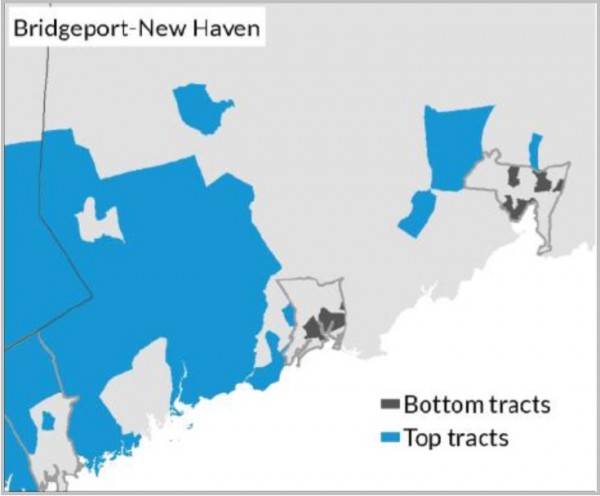
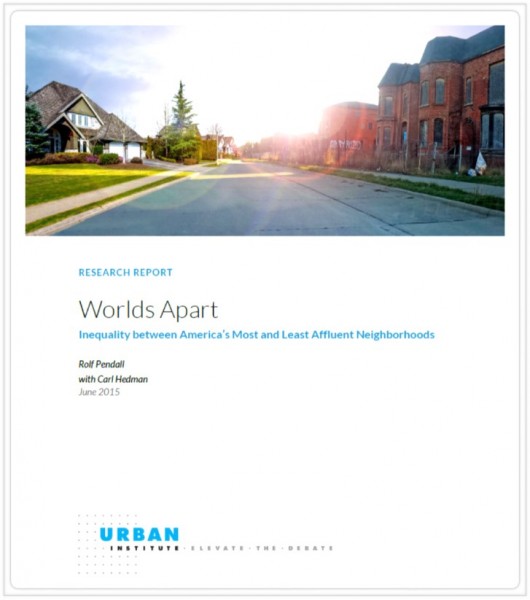
The research report, “World Apart:  Inequality between America’s Most and Least Affluent Neighborhoods,” found that “the national trend toward rising incomes among top-earning households” was reflected in the nation’s top tracts show growth from $123,000 to $138,300, over 12 percent” during the period 1990-2010.  Some top neighborhoods, including those surrounding Bridgeport, “had increases of over $30,000 at the top.”

Annual income in bottom tracts, meanwhile, grew from $36,800 to $37,150 – less than 1 percent over the twenty year period.  The average income of bottom tracts declined in 209 of the 570 commuting zones studied, the report indicated.  The most severe losses at the bottom among large commuting zones, the report found, occurred in Bridgeport, Newark and Dallas. Bridgeport is one of the ten cities with the largest “neighborhood inequality index.”

The report flatly stated that “Bridgeport, which includes the entirety of Connecticut, already was one of the most unequal commuting zones in 1990.  Its top and bottom neighborhoods pulled further apart in income between 1990 and 2010; practically all its top neighborhoods are still in the suburbs and practically all its bottom neighborhoods are in central cities.”bgpt NH

The only cities with commuting zones of over 250,000 people with a higher “neighborhood inequality index” than Bridgeport, as of 2010, are Austin, Baltimore, Birmingham, Columbus, Houston, Nashville, Richmond, and St. Louis.

As a result of changes at the top and bottom, the report noted, income inequality between top and bottom tracts grew from 1990 to 2010 in 433 of the 570 commuting zones. In 237 CZs, income inequality grew because of rapid increases at the top coupled with modest increases at the bottom.

To understand the differences between neighborhoods that share the same housing and labor markets, the Urban Institute analysis used commuting zones (CZs), county-based regions defined in the 1990s. Unlike metropolitan areas, commuting zones cover the entirety of the United States, and their definitions are constant over time.

The study ranked every CZ’s tracts from lowest to highest neighborhood advantage score. Then they identified the top 10 percent and the bottom 10 percent of tracts—the most advantaged and least advantaged neighborhoods in each CZ—for further exploration. There are described as top and bottom tracts. The study analyzed the 570 CZs that had at least 10 census tracts in 2010.

The nonprofit Urban Institute is dedicated to elevating the debate on social and economic policy. The organization’s website explains that “For nearly five decades, urban scholars have conducted research and offered evidence-based solutions that improve lives and strengthen communities across a rapidly urbanizing world. Their objective research helps expand opportunities for all, reduce hardship among the most vulnerable, and strengthen the effectiveness of the public sector.”