Putnam Pushing New Reputation as Arts and Culture Mecca, Gaining Recognition

When the Connecticut Main Street Center announced its Award of Excellence would go to the Town of Putnam, the Putnam Business Association, and the Putnam Arts Council for First Fridays in Downtown Putnam, there may have been more than one individual uncertain as to why. Many around the state may have been unaware of the northeastern Connecticut community’s goal of connecting artists, audiences, and arts and culture agencies to enhance the economic vitality of the community, while also showcasing downtown assets including a Bandstand and Outdoor Stage, the Downtown Farmers' Market Pavilion, and the local scenic River Trail.putnam

Driven by the vision to create a 'sense of place' and feature their downtown destination, the Town, the Business Association and the Arts Council collaborated to launch a monthly arts and culturally based Street Faire from May to October each year.  Now in its fifth year, the initiative has proven quite successful.

In 2014, approximately 3,000 people attended each event, with 15-20 street artisan vendors participating. The success of First Fridays has demonstrated the town's credentials as a 'destination' in Connecticut. Putnam was voted #4 Fan Favorite Town through the state Office of Tourism in 2013, and #2 Town in 2014 - the only town in the top 5 without waterfront. To overcome the obstacles of empty storefronts, the Putnam community worked diligently to reinvent itself as the arts and cultural hub of northeastern Connecticut, leading to recognition by Boston Magazine as "One of the Best 15 Small Towns to Visit in New England".

First Fridays define cultural diversity with a different theme each month. These themes are explored through dance, theatre & storytelling, architecture, song, food, and folklore.  Each monthly theme includes: 'Art Attacks' - random acts of art to surprise, entertain, and educate; 'Menu Celebrations' - local restaurants designing and creating menu specials to pair with the monthly theme; plus street bands, artisan vendors, and children events.arts

This year, the overarching theme is 'A Century of Art'.  To start this year, the monthly themes have been:  May - Turn of the Century; June - The Roaring 20's / The Jazz Age; July - The 1940's / WWII and the Arts; August - Pop Art of the 1960's;.  Still to come: September - The 1980's / Urban Art; and October - Turn of the Century / The Digital Age.

First Fridays "feature great live entertainment, a variety of art vendors lining the streets, fun and interactive art projects, and stimulating events" hosted by such downtown galleries as Arts & Framing and the Sochor Gallery, The Empty Spaces Project Gallery, Sawmill Potteryand Silver Circle Gallery, according to the event website. Officials say that since the inception of First Fridays, the exponential growth has been manageable only because of business partners, volunteers and partners stepping up to assist with the Town administration. Town employees provide services for sound systems, street closures and safety measures. Police traffic patrol has been set in place; corps of volunteers handle facilities management; and valet service companies have been hired by restaurants to assist with parking.

Putnam has begun to be described as “a mecca of revitalization and community pride.” Participants last year, for example, were given disposable cameras to take shots of Downtown architecture. The photos were then pieced to create a 9' X 3' collage spelling out the word "PUTNAM".  Educating and advocating through multi-disciplinary and inter-generational events has earned new found recognition for Putnam, and made First Fridays a destination for audiences from Northeast Connecticut, Rhode Island, and Massachusetts.  All of which makes the recognition from the Connecticut Main Street Center less surprising.

Three CT Counties Among the Nation's 244 Most Dense in Population, Comprising Half Nation's Residents

New York City's borough of Manhattan has about 1.6 million residents sharing just under 23 square miles of land. Meanwhile, 669 square mile Loving County, TX has just 86 residents, Business Insider reports in an analysis of U.S. Census Bureau data. According to the U.S. Census Bureau's population estimates and their tabulations of the land area of each county, 50.1 percent of the US population lives in the nation’s densest counties, indicated in dark purple on the illustrated map, which highlights the wide dispersion in the population density of the US's 3,142 counties. The 244 densest US counties are shown in dark purple, developed using U.S. Census Bureau data for 2014.US map pop

The nation's largest populations, by county, are in Los Angeles County, CA; Cook County, IL; Harris County, TX; Maricopa County, AZ, San Diego County, CA; Orange County, CA, Miami-Dade County, FL and Kings County, NY. CT

The most populous county in Connecticut, Fairfield County, ranked 51st by population (945,438) among the nation’s counties.  Just behind are Hartford County, ranked 59th (897,985) and New Haven County, ranked 64th (861,277).

All three are among the 244 densest U.S. counties that comprise just over half of the nation's population.

CT county population


Go Ask ALICE – Child Care Front and Center

The phrase “go ask ALICE” may have been a lyric a few decades ago, but today it is taking on renewed significance when assessing the day-to-day life challenges of a surprisingly large segment of Connecticut’s population, an updated report by Connecticut United Ways shows. In Connecticut, 1-in-4 households have earnings that exceed the Federal Poverty Level (FPL) but fall short of a basic cost of living threshold. The United Way has defined these households as ALICE-an acronym for Asset Limited, Income Constrained, Employed, and together with the 10% of Connecticut households in poverty, more than one-third of Connecticut households (35%) are struggling to make ends meet.MonthlyExpenses_Pie

The original analysis revealed last fall has now been updated and expended with new data, which indicates that cost of child care is a significant burden, and that child care is “often the single-largest expense for families with young children.”

The Connecticut ALICE Report estimates that the cost of child care for two children (1 preschooler and 1 infant) is at least 28% of the monthly expenses included in the Household Survival Budget for a family of four. In a newly released ALICE Update, the latest available cost data from 2-1-1 Child Care is used to examine the biggest child care challenges facing ALICE families in Connecticut:

  1. Child care is often the single-largest expense for families with young children, with limited options for affordable infant and toddler care posing a significant challenge. This is especially true for ALICE families.
  2. Child care subsidies are available for working families, but some ALICE families have earnings that exceed the eligibility threshold, and others struggle to cover the difference between the subsidy and the provider fee.
  3. Availability and cost of child care varies throughout the state, limiting options for ALICE families who may not be able to find child care providers they can afford that are located near where they work or live.
  4. There are limited child care options that are available during evening, night, or weekend shifts. 2nd shift, 3rd shift, and weekend hours are more common among low- to moderate-income ALICE workers. When work schedules are unpredictable, and vary from week to week, it can be hard for ALICE families to find child care when they need it.

ALICEForumSiteThe most recent fee data available from 2-1-1 Child Care estimates the statewide average cost of full-time child care in a licensed center-based day care setting is $211/week for 1 preschooler and $253/week for an infant, which adds up to $2,011 per month. This may be less than what many Connecticut families pay for child care each month, due to variations in cost and availability throughout the state, differences in family size, and other costs associated with child care that are not included—such as the cost of alternate care arrangements when the child care setting is closedChildCareFamily

The report indicates that statewide, the average weekly cost of Infant/Toddler care ranges from $135 to $400 in Home-Based settings and from $175 to $400 in Center-Based settings. The high cost of Infant/Toddler care creates the greatest burden, as the weekly cost amounts to the highest percentage of median income in both Home-Based (30.9%) and Center-Based (48.8%) settings in Hartford, where the median income is $29,430/year.

Adding to the challenge posed by the high cost of Infant/Toddler care is the fact that its availability varies throughout the state. There are six municipalities in the state that have no licensed Center- or Home-Based Infant/Toddler child care providers at all, and 15 that only have a single provider offering Infant/Toddler care in their town. A total of 52 Connecticut towns have two to five providers of Infant/Toddler care, and the remaining 96 municipalities have at least six providers who offer Infant/Toddler care.

The report also indicates that “there are limited child care options available during evening, night or weekend shifts, and it can be hard for ALICE families to find childcare when they need it.”  The vast majority of Center-Based child care providers in Connecticut do not offer evening or weekend care, according to the report. Another challenge for ALICE workers without stable, predictable work schedules is that child care providers are typically paid for a full week of care in advance, whether the care is ultimately used or not. When work schedules change from week to week or on short notice, ALICE families may end up paying for child care that they do not use.

In November 2014, Connecticut United Ways released the first statewide ALICE Report, a data-driven, comprehensive research project that quantifies the situation confronting many low-income working families across our state - in our urban, suburban and rural communities. The Report documents that the number of Connecticut households unable to afford all of life's basic necessities far exceeds the official federal poverty statistics.


Correctional Institutions or Institutions for the Mentally Ill? Governments Seek New Solutions

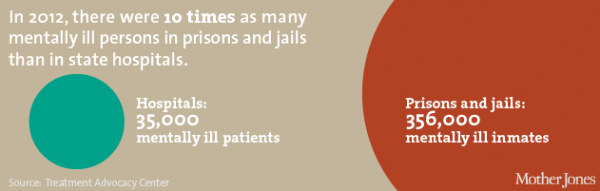
How to effectively respond to the fact that America’s prisons have rapidly become de facto institutions for the mentally ill is increasingly gaining attention in policy circles and the news media.  In recent days, The New York Times, Governing magazine, and other publications have focused both on the alarming statistics and some innovative approaches across the country. There are now 10 times as many mentally ill people in the nation’s 5,000 jails and prisons as there are in state mental institutions, according to a study last year by the National Sheriffs’ Association and the Treatment Advocacy Center, a nonprofit group that supports expanded access to treatment, the Times reported.

In Connecticut, out of the 16,154 inmates in state prisons, about 3,423 have a serious mental illness, 21 percent of the total prison population, Michael Lawlor, undersecretary for criminal justice policy and planning at the Office of Policy and Management, told the New Haven Register earlier this year. Just a few years ago, the National Alliance on Mental Illness (NAMI) estimated that approximately 16 percent of the state’s prison population consisted of persons with mental illness.

The State Department of Correction confirms that those defined as “seriously mentally ill” include 17 percent of the male population, 66 percent of the female population, and 20.8 percent of the overall prison population in the state.

According to the Council of State Governments, jails in the U.S. report that between 20 and 80 percent of their inmates suffer from a mental illness, Governing reported.   Today’s acute challenge has been decades in the making.  In the mid-1950’s, the publication indicated, more than 500,000 people were held in state psychiatric hospitals.  “By the 1980s that number had fallen to around 70,000.  During this period, the number of people with mental illnesses who were arrested and ended up in local jails surged.”

Chicago’s Cook County Jail, now referred to by local officials as the nation’s largest mental institution in the country, has 8,600 inmates – an estimated one-third of them suffering from mental illness.  The newly appointed warden of the facility is a clinical psychologist – underscoring “how much the country’s prisons have become holding centers for the mentally ill,” the Times reported.

imprisioned-mentally-illWriting in the Connecticut Law Review, Christina Canales observed that “Many supported deinstitutionalization because they believed that the mentally ill would benefit from being released from the state hospitals.  They believed that with the assistance of anti-psychotic medications, the mentally ill would be able to live independently in the community and that the community mental health centers would provide the additional care, treatment, and follow up services.

“Although a good plan in theory,” Canales concludes, “deinstitutionalization quickly became one of the main reasons for the substantial increase in mentally ill people in jails and prisons. Patients were ejected from state mental hospitals at a substantially faster rate than community mental health programs were created.”

The Law Review article, published three summers ago, concludes that “the United States faces a crisis in that prisons are among the largest mental healthcare providers. Some mentally ill individuals turned to crime after deinstitutionalization left them on the streets with no support system. Others wound up in prison because police officers lacked the proper training to identify persons as mentally ill and in crisis, or mistakenly believed that individuals receive adequate treatment in prison. The change in civil commitment laws also made it harder to commit the mentally ill, and society as a whole wants these individuals punished, mentally ill or not.”prison

Earlier this year, the Connecticut state legislature considered – but did not approve - a bill that would have established a pilot program to serve courts in New Haven, New London and Norwich to identify and track the mentally ill, along with homeless and addicted individuals entering the criminal justice system. The idea behind it was to get these individuals treatment and help as an alternative to incarceration and to prevent future arrests, according to published reports. The initiative also called for a formal assessment of its effectiveness.

In Chicago, the Times reported, “before becoming warden, Dr. Nneka Jones Tapia oversaw mental health care at the jail, and under her guidance, Cook County began offering services that would have been unthinkable a few years ago. All inmates upon arrival now see a clinician who collects a mental health history to ensure that anyone who is mentally ill gets a proper diagnosis and receives medication. The jail then forwards that information to judges in time for arraignments in the hope of convincing them that in certain cases, mental health care may be more appropriate than jail.”

According to a report by the Virginia-based Treatment Advocacy Center, 95 percent of the public psychiatric beds available in 1955 in the country were no longer available by 2005, the New Haven Register reported.  The Center recommends a minimum of 50 beds per 100,000 people, a standard that no state meets. Connecticut has about 20 public psychiatric beds per 100,000 people, according to the center’s website. Between 1995 and 2013, the number of inpatient psychiatric beds, at both public and private hospitals, decreased from 160,645 to 107,055 nationally, according to data from the American Hospital Association.

Connecticut, which recently approved a Second Chance Society Act proposed by Gov. Malloy that reduces some criminal sentences for nonviolent offenses and drug possession, is expected to reduce the number of people incarcerated for drug use, which officials expect will also reduce the number of mentally ill in prisons, “since drug use and mental health problems frequently coexist in a significant group” of the population.

The Governing article highlights a diversion system in Miami-centered Dade County in Florida, a post-booking alternative program that permits individuals arrested for “misdemeanor offenses and identified as having acute mental illnesses” to be transferred to mental health treatment facilities.  The results, according to the publication:

“About 80 percent of people offered the chance to participate in the program accepted it.  What was surprising was how many people stayed out of the system afterward.  An evaluation conducted soon after the program began found that recidivism rates one year out among participants who complete the program was just 20 percent.  In contrast, 72 percent of peers who did not participate in the program were back in jail within one year of their release.”

https://youtu.be/zSbFbv2Bs_0?list=PLQ9B-p5Q-YOP2OVnCPdYKLSmPkqLA2igT


Grit ‘N Wit Planning Underway for October Obstacle Course in Hartford

The Hartford Marathon will not be the only race in town in October. For those seeking an extra degree of challenge – both physical and mental – there’s another race course for you.  It’s called Grit ‘N Wit, New England’s first obstacle course to combine brain and brawn, and is the brainchild of a Connecticut-grown company “committed to the development of healthy, engaged communities.” 7E410F3A-B88F-9222-B96A76B9901A575B

Launched just two years ago by UConn law school graduate James Moher, the event, now held in Hartford’s Keney Park, is attracting a growing following of enthusiastic participants.  The goal is to take on 20-plus obstacles over a 3-mile course designed to challenge individuals both physically and mentally.

"Most competitions are one dimensional. If you do well at a race, that just tells you're fast. But if you do well at Grit 'N Wit, that tells you a whole lot more,” Moher explains.  "I've always thought that there should be a competition that should test the whole person. And there wasn't one...until now."

This year Grit ‘N Wit will take place October 24, 2015 from 9:00AM – 5:00PM. The event is open to the public in the morning and for college students in the afternoon.  It is open to all ages 10 & up.

Organizers have seen the event grow from 240 participants in its first year, to 420 last year.  This year, with improvements to both the physical and mental challenges, and strong support from local busoctober24inesses, they’re pushing the envelope - hoping to surpass 1,000 participants. gritwit

Last year’s event, for example, had participants memorize a pattern, then scale a hill and put the pieces of the puzzle together. After climbing over a series of inclined monkey bars and 5' walls, participants came to Ultimate Field Sobriety Test. There they had to get two golf balls through a maze while standing on an inclined balance beam. A post-race survey showed that 95 percent of participants like – or loved – the experience.

“The mental obstacles are designed to be fun and challenging - think Survivor, the Amazing Race or MTV's The Challenge - but without the bugs, plane ticket or a stint on the Real World,” organizers point out.  Rebekah Castagno, a two-time participant, said "It's the creative and physical combination that makes it such a fun and unique challenge."

As Grit ‘N Wit continues to grow, plans are in the works for it to be extended to other cities, and perhaps to college campuses, in the future – another Connecticut export that began as nothing more than an idea.  In addition, organizers say the event will support college students by offering scholarship awards and prizes in this year’s Hartford event.

Teams are not required, but are highly encouraged. Registration is currently $57 and increases the first of every month.  The website is www.gritwitrun.com  Volunteers are also welcome to help out for the day.


https://youtu.be/4ng_GKZsZo8

State Will Step Up Efforts to Respond to Needs of Women Veterans

The U.S. Department of Veterans Affairs estimates there are 16,545 veterans in Connecticut who are women. Some among them struggle with issues such as unemployment, homelessness and mental illness, and many more are unaware of the support services available to them.  That was the impetus for legislation approved this year by the General Assembly and recently signed into law by Gov. Malloy, requiring the Department of Veterans' Affairs to establish, within available resources, a Connecticut women veterans' program. 3D Connecticut Flag

The new women’s veterans program must:

  • reach out to women veterans to improve awareness of eligibility for federal and state veterans' benefits and services;
  • assess women veterans' needs for benefits and services;
  • review programs and research projects and other initiatives designed to address or meet Connecticut women veterans' needs; and
  • incorporate women veterans' issues in strategic planning on benefits and services.

The program must also annually submit recommendations for improving benefits and services for women veterans to the veterans' affairs commissioner and the Veterans' Affairs Committee of the legislature, beginning January 15, 2016.

Under the law’s provisions, a “veteran” is anyone discharged or released (under conditions other than dishonorable) from active service in the armed forces - U. S.  Army, Navy, Marine Corps, Coast Guard, and Air Force -and any reserve component of these branches, including the Connecticut National Guard operating under certain Homeland Security missions.

Jackie Evonison, the women veterans’ outreach coordinator with the American Legion Connecticut, told legislators considering the program that many female veterans are unaware of available services or don’t feel they’re qualified to receive them.vet

In 2012, there were   more than 2,600 women veterans residing in Hartford County, according to data included in a report from the Aurora Foundation. Women veterans face substantial and unique challenges readjusting to civilian life, the report pointed out, especially in the areas of housing, mental health, health care, employment and homelessness:

  • In Hartford County, approximately 8 percent of the population are veterans; females are 5 percent of this population (approximately 2,619 women vets in Hartford County).
  • Female veterans are almost four times more likely to become homeless than women who have not served in the military.
  • Only one of the three veterans’ housing facilities in the county house female veterans.

As a group, female veterans are younger than their male counterparts, with an average age of 48, compared to 63 for men. More than 80 percent of the female veterans are working age, compared to 55 percent for men, according to published reports.

Commissioner Sean Connolly of the state Department of Veterans Affairs said the mission of the program will be “to see what kinds of programs are out there, develop recommendations for improving benefits, and determining whether new programs and projects are necessary to meet the needs of our women veterans.”


Housing, Education, Poverty Among Greater Hartford Region's Challenges, Report Reveals

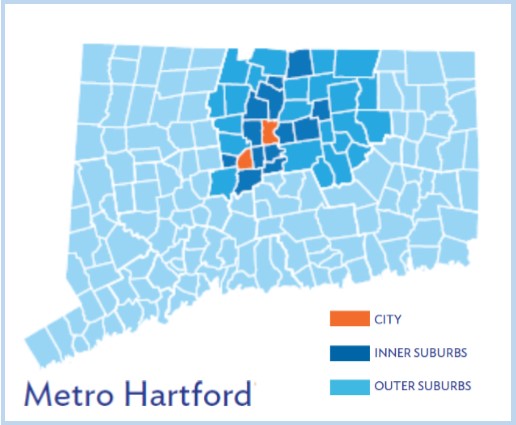
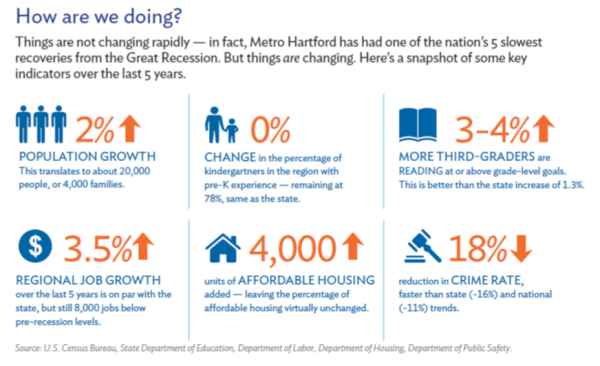
Of the 4,000 affordable housing units added to the 38-town Greater Hartford region over the past five years, nearly half (47 percent) have been in Hartford and New Britain – almost as many as were added in all of the other 36 towns in the region combined. That stark statistic is among the points emphasized in the second edition of Metro Hartford Progress Points, an analysis of data compiled by the Hartford Foundation for Public Giving and a coalition of community and regional organizations.  The inaugural report was released last year, and the new edition updates some of that initial data, as well as revealing new information about the region’s demographics, opportunities and challenges.region

Regarding the fact that much of the housing is being developed in municipalities that face considerable economic challenges, the report notes that those 36 towns have lost over 9,000 students in local schools during the past five years, despite having school districts that perform more than 30 points higher and standardized testing than those in Hartford and New Britain.  The report indicated, for example, that for every 100 children born in the region’s outer ring suburbs (such as Glastonbury), 113 enroll in local public school five years later, as opposed to 81 who enroll in city schools and inner ring suburbs (such as Bloomfield).

The second edition of Progress Points “takes a deeper look at key issues impacting our communities and how they are connected. The report asks how we can build on our strengths and fully utilize the assets that the region has to provide access to opportunity for all,” officials explained.  Using key indicators to identify opportunities for action, the 2015 report focuses on three regional priorities: 1) Access to better schools, 2) Access to better jobs, and 3) Access to stronger neighborhoods.

progress pointsLooking at five year trends, the report found that the region’s population of about 1 million people has grown by 2 percent, which translates to about 20,000 people or about 4,000 families.  Regional job growth, 3.5 percent, is on par with the state, but remains about 8,000 jobs below pre-recession levels.  The crime rate across the Greater Hartford region has been reduced by about 18 percent during the past five years, faster than the state (-16%) and national (11%) trends.
The study determined that there are more people living in poverty in the region than 10 years ago.  “Suburban communities have seen a major increase in the population living in low-to-mid-poverty neighborhoods,” the report said.   “Poverty is a regional, not an urban, problem.  Addressing poverty requires improved coordination among towns to better connect transportation and other services to increase access to opportunity.”

In education, the report also notes that about 4 percent more third-graders are reading at or above grade-level goals, a faster improvement than statewide (1.3 percent).  There has been no change in the percentage of kindergartners in the region starting school with pre-K experience.  That level, 78 percent, is the same in the region as statewide.  Focusing on declining enrollment, officials indicated that some of the region’s highest-performing school districts are seeing the greatest decrease in enrollment as a result of declining birth rates: Simsbury at 13 percent, Tolland at 16 percent, Granby at 14 percent. Avon and Glastonbury both are experiencing a decline of 8 percent.

Metro Hartford Progress Points was introduced “in order to identify and better understand the critical education, income and opportunity gaps that exist in our region. This year, we’re continuing the discussion, looking for ways to improve access to better schools, better jobs and stronger neighborhoods for everyone in the region,” officials indicated.  “Access to better jobs builds stronger neighborhoods. Stronger neighborhoods help to connect families to better schools. And better education ensures that workers are ready to take on those jobs — increasing prosperity, growth and quality of life for all.”stats

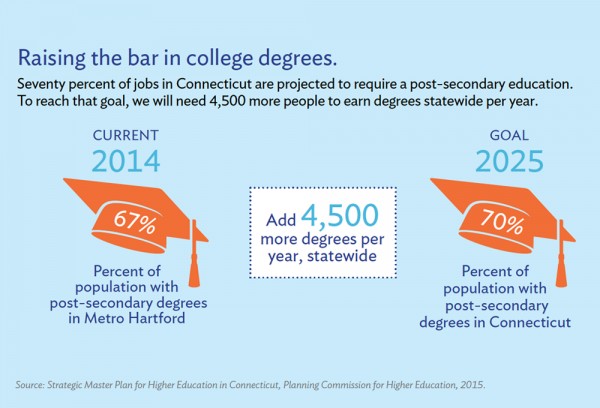
Regarding preparation for college, the report indicates that “almost 50 percent of all students entering community college or Connecticut state universities require remedial coursework and training, even those from high-performing districts.”  The report notes “this means paying for additional courses, which only increases student debt.” The report indicates that 70 percent of jobs in Connecticut are projected to require a post-secondary education by 2025.  To reach that level, it is estimated that an additional 4,500 people will need to earn degrees statewide per year.  Currently, 67 percent of the population in Greater Hartford has a post-secondary degree.

collegeLargePartner organizations in developing the report include the Hartford Foundation for Public Giving, Capital Workforce Partners, Capital region Council of Governments, Metro Hartford Alliance, Hispanic Health Council, United Way of Central and Northern Connecticut, Urban League of Greater Hartford, Center for Urban and Global Studies at Trinity College, and the City of Hartford.


AARP, The Hartford Aim to Assist Low Income Seniors Become Entrepreneurs

The Hartford has committed $1.4 million to the AARP Foundation to extend the Foundation’s Back to Work 50+ initiative to help low-income older adults assess opportunities to become entrepreneurs and create microenterprises. The three-year sponsorship, which broadens The Hartford's long-standing relationship with AARP, is part of The Hartford’s national philanthropic program. Communities with HART aims to "nurture the well-being of America’s communities by inspiring new generations of business leaders, enabling underserved neighborhood business owners to achieve growth and engaging the community in neighborhood business support," highlights the program description. “We are thrilled to sponsor the Back to Work 50+ program to educate and inspire older Americans who are interested in developing their own small businesses,” said Diane Cantello, vice president of Corporate Responsibility at The Hartford. “By encouraging entrepreneurship among older Americans, this program will help foster small business growth and contribute to the vibrancy of our communities.”1287788340353

“Older adults are redefining traditional approaches to work and careers,” said Lisa Marsh Ryerson, president of AARP Foundation. “While many want to continue to work or advance in their current jobs, a growing number want to generate income by using their talents and skills to start their own business or microenterprise. Through this effort, AARP Foundation stands ready to help by equipping them with the information and skills they need to achieve their goals.”aarp-logo

The recent announcement of this new sponsorship follows the one-year anniversary of The Hartford’s Communities with HART Program, a five-year initiative aimed at benefitting small businesses and supporting students through partnerships with the Accion U.S. Network (Accion) and Junior Achievement USA (JA).  In its first year, The Hartford announced a $1.25 million partnership with Accion to help small business owners who experience difficulty in accessing the traditional loans they need to sustain and grow their businesses. Accion manages the loan process, which focuses on community-oriented businesses in low-and-moderate income areas that hire and source locally, deliver social value and make a positive difference in their neighborhoods. With an initial focus in four key markets - Chicago, Hartford, San Antonio and San Diego – Communities with HART also provides training and web resources to help small business owners succeed.

The Hartford is also helping to inspire the next generation of small business owners as the title sponsor of the JA Company Program®, which includes a new online blended learning model and offers students the opportunity to launch their own small business while learning the basics of entrepreneurship, financial literacy and work readiness. With the help of a $1.5 million investment, JA has already seen more than a 25 percent increase in the number of JA Company Programs being conducted since the new program was rolled out across the country at the end of last year, according to company officials.


238 Organ Transplants in 2014 in CT; 1,467 on Current Waiting Lists in State

At the beginning of this month, there were 1,467 individuals registered for organ transplants in Connecticut, according to the U.S. Department of Health and Human Services Organ Procurement and Transplant Network.  The longest list was for a kidney transplant, with 1,259 names.  In addition the transplant waiting lists included 159 people seeking a liver transplant, 52 awaiting a heart transplant, 18 on the waiting list for a kidney/pancreas, and 10 for a pancreas. Among those on the heart transplant list, five individuals are between the ages of 18 and 34, eleven are between 35 and 49, 25 individuals are between age 50 - 64 and eleven are age 65 or older.  Forty-one are men, eleven are women.  The waiting time for a heart transplant, according to the data, is usually between one to six months, although in more than one-third of the cases, it is longer.Organ-transplant-300x193

In Connecticut in 2014, there were 238 transplants according to the data, a portion of the 29,376 kidney, pancreas, liver, heart, lung and intestine transplants nationwide.  Only 15 states had fewer transplant surgeries, including four states that did not have any (Idaho, Montana, Wyoming, Alaska).  The largest number of transplants occurred in California (3,454), Texas (2,626), New York (1,826), Pennsylvania (1,803), and Florida (1,803).  There were 796 transplants at hospitals in Massachusetts in 2014.

According to the state Department of Motor Vehicles,. Connecticut residents can join the Donor Registry at the DMV/AAA or online at Donate Life New England (www.donatelifenewengland.org). Donate Life New England is a joint endeavor of the organ procurement organizations that serve New England: LifeChoice Donor Services and the New England Organ Bank.

In Connecticut, only 43 percent of state residents over the age of 18 are included in the Donor Registry, which is below the national average of 48 percent.LifeChoice ECHO logo

Each year, more than 8,143 people donate organs after death, including organs for kidney transplant, liver transplant, heart transplant, or other organ transplant operations.  Anyone above 16 years old can register to be an organ and tissue donor in Connecticut. At the age of 18, the decision to donate is authorization for donation.  The DMV website points out that there are no age limits for organ donation, noting that “medical history is a far more important factor.”

The Association for Multicultural Affairs in Transplantation and Donate Life America joined forces this month to create a new nationwide observance called Donate Life ECHO, which stands for Every Community Has Opportunity.  Designed to reach multicultural communities, the new observance from July 12th – 25th had two objectives: to focus on the power of sharing one’s personal decision to register as an organ, eye and tissue donor with members of one’s community; and to encourage registered donors to ask members of their personal networks and extended communities to talk about donation and register as donors.

“When people share the life-affirming message of donation within their community, more lives will be saved and healed,” said Caitlyn Bernabucci, Public Education Specialist for LifeChoice.

Multicultural communities play a critical role in America’s transplant system.  They save and heal lives as donors of organs, eyes and tissue, need life saving kidney transplants in disproportionately high numbers, and serve patients and families as healthcare professionals. Organs are not matched according to race or ethnicity, officials explain, as people of different races often match one another.  However, there is a higher probability of a match when received from someone of the same ethnicity because compatible blood types and tissue markers—critical qualities for donor and recipient matching—are more likely.   Ultimately, a greater diversity of donors will increase access to organ and tissue transplantation for everyone, officials noted.

Yale-New Haven is CT's Top Hospital; Regional Rankings Include Eight Hospitals in State

The top ranked hospitals in Connecticut were Yale-New Haven Hospital, Hartford Hospital, and Danbury Hospital, followed by Greenwich Hospital, Middlesex Hospital, St. Francis Hospital and Medical Center, Waterbury Hospital and St. Vincent’s Medical Center in Bridgeport.  That is the status in the annual U.S. News and World Report ranking of the nation’s best hospitals, released this week. Only Yale-New Haven broke into the ranks of the nation’s best, earning national rankings in eight adult specialties – including to rankings among the nation’s ten best - and six pediatric specialties.  Among the adult specialties, Yale-New Haven ranked #8 in the nation in diabetes and endocrinology,#10 in psychiatry, #21 in pulmonology, #22 in Gastroenterology & GI Surgery and #25 in geriatrics.  Yale-New Haven’s national rankings in particular specialties also included #27 in gynecology, #42 in the nation in cancer, and #43 nationally in ear, nose & throat care.  hospitals

Yale-New Haven Hospital is a 1,571-bed general medical and surgical facility with 54,412 admissions in the most recent year reported, according to US News. It performed 16,886 annual inpatient and 22,990 outpatient surgeries, and its emergency room had 141,422 visits.

Among pediatric specialties, Yale-New Haven ranked #5 in diabetes & Endocrinology, and in the top 50 in cancer, gastroenterology & GI surgery, neonatology, neurology & neurosurgery, and pulmonology.hosp photo

Hartford Hospital, ranked second in the state, is a general medical and surgical hospital in the state's capital city.  It performed nearly at the level of nationally ranked U.S. News Best Hospitals in four adult specialties, according to the publication.  Hartford Hospital has 798 beds. The hospital had 37,997 admissions and performed 11,905 annual inpatient and 24,679 outpatient surgeries. Its emergency room had 99,811 visits. Like Yale-New Haven, Hartford Hospital is a teaching hospital.

Considerably smaller in size and scope, Danbury Hospital ranked third amongst Connecticut hospitals.  Danbury Hospital is a general medical and surgical hospital, with 344 beds. It is also a teaching hospital. Survey data for the latest year available shows that 70,622 patients visited the hospital's emergency room. The hospital had a total of 17,862 admissions. Its physicians performed 4,322 inpatient and 10,811 outpatient surgeries, according to data cited by U.S. News.logo_yale May 5

U.S. News analyzed over 5,000 hospitals for adult and pediatric care to find the best in the nation, based on critical criteria and patient outcomes.  Top-ranked hospitals include University of Texas MD Anderson Cancer Center in Houston (No. 1 in the nation in Cancer), the Cleveland Clinic in Ohio (No. 1 nationally in Cardiology & Heart Surgery) and the Hospital for Special Surgery in New York, New York (No. 1 in Orthopedics). They also include 15 hospitals that ranked among the top 20 nationally in at least half a dozen different specialties, earning them each a berth on the Best Hospitals Honor Roll. Massachusetts General Hospital in Boston topped that list.

The publication indicated that in all, just 137 hospitals – less than 3 percent of all of those in the nation – earned a national ranking in at least one specialty. But while those medical centers stand above the rest in providing complex specialty care, they aren't the only ones deserving of patients' attention according to the US News editorial team on the project.  The top hospitals - reaching the publication's Honor Roll of 15 hospitals - included Massachusetts General Hospital at #1, Mayo Clinic at #2, and Johns Hopkins at #3.  Another New England hospital making the Honor Roll, at #6, is Boston's Brigham & Women's Hospital.  HartfordHospital

Underscoring the frequency with which various medical procedures are done, US News highlighted the statistics:  “Over the next 12 months, more than 1 million Americans will have surgery to replace a hip or knee. Approximately 400,000 will have heart bypass surgery. About 900,000 will be hospitalized for congestive heart failure and another 700,000 or more for the respiratory condition called COPD.”  These are among the most common procedures and conditions that hospitals encounter, according to the publication, and the core of their rankings system.