Connecticut’s Presidential Primary Ballot to Take Shape for April 26

In the roller-coaster that is the presidential nomination process, with its progress of caucuses and primaries in states across the country, Connecticut’s card does not come up until late-April.  Who will reach the Connecticut ballot, and the order in which they will be listed, will be determined in the coming weeks by Secretary of the State Denise Merrill, in accordance with criteria outlined in state law. That process begins this Tuesday, February 16,  with the announcement of presidential candidates who have qualified for the Connecticut primary ballot.  The order in which candidates will appear on the ballot for the Republican and Democratic parties will not be known until March 22, when Secretary Merrill will “determine the order of all candidates by lot in a public ceremony.”  Connecticut law also requires that “Uncommitted” appear last on each party’s ballot.

april 26When Connecticut voters go to the polling places on Tuesday, April 26, voters in nearly two-thirds of the states will already have made their preferences known.  The same day as Connecticut, presidential primaries will also be held in Delaware, Maryland, Pennsylvania and Rhode Island.  The previous week, primaries will be held in New York, a state called home, at various times, by three of this year’s leading contenders – Hillary Clinton, Bernie Sanders and Donald Trump.

March 1 and March 15 are major dates on the presidential primary calendar this year.  Dubbed Super Tuesday, March 1 will see votes cast in Alabama, Alaska, Arkansas, Colorado, Georgia, Massachusetts, Minnesota, Oklahoma, Tennessee, Texas, Vermont, Virginia and Wyoming.  Two weeks later, the spotlight will fall on Florida, Illinois, Missouri, North Carolina, and Ohio.

Also prior to Connecticut, the states of Wisconsin, Wyoming, Washington, Hawaii, Arizona, Utah Idaho, Michigan and Mississippi will conduct their presidential primaries, according to the Council on State Governments.

According to Connecticut’s Office of Legislative Research, in August 2010, the Democratic National Committee and the Republican National Committee adopted rules prohibiting states, other than Iowa, New Hampshire, South Carolina, or Nevada from holding a presidential primary before the first Tuesday in March in the year in which a national convention is held (Democratic National Committee, Delegate Selection Rules, Rule 11(A) and Republican National Committee Rules, Rule No. 16(c)(1)).  In response, Connecticut delayed the date of its presidential primary from the first Tuesday in February to the last Tuesday in April (CGS § 9-464).voting

Reaching the Primary Ballot

In Connecticut, the political parties with the largest and second largest number of enrolled members conduct presidential preference primaries, according to the website Ballotpedia. There are two methods by which candidates can access the primary ballot:

  • The Connecticut Secretary of the State can order that a candidate's name be printed on the primary ballot if he or she "determines ... that the candidacy of such person for such party's nomination for president is generally and seriously advocated or recognized according to reports in the national or state news media." The secretary of state must publish a listing of such candidates at 10:00 a.m. on the 74th day preceding the primary.  (This year, that is Tuesday, February 16.)
  • A candidate who is not included on the Secretary of the State’s list can petition for placement on a party's primary ballot. A candidate may request the requisite forms from the secretary of the state’s office beginning at 12:00 p.m. on Tuesday. The petition must contain signatures equaling at least 1 percent of the total number of enrolled members in the candidate's party in the state, and must be submitted to "the registrar of voters of the party holding the primary in the town of voting residence of the signers thereof" by 4:00 p.m. on the 53rd day preceding the primary (March 4). The registrar of voters must verify the signatures and forward the petition to the secretary of state by 4:00 p.m. on the 49th day preceding the primary (March 11).

Among the states holding presidential primaries after Connecticut in May and June are Inpres primariesdiana, New Mexico, California, New Jersey, Nebraska, West Virginia, Oregon and Montana.  Most states have their Democratic and Republic primaries on the same day, although a handful hold party primaries on different days. South Carolina’s Republican primary will be on February 20, for example, and its Democratic primary on February 27.

Should any candidate whose name is set to appear on the Connecticut April 26 primary ballot decide to withdraw from the race, the deadline is March 21.  A letter indicating withdrawal must be received by the Secretary of the State by 12 Noon.  Petitioning candidates may not withdraw, according to state officials.

Absentee ballots for military and overseas voters become available on March 12.  Absentee ballots will be available as of April 5.  Only registered voters in a particular political party can vote in the presidential primary of that party.  The deadline for new voters, and for unaffiliated voters to mail in party affiliations is April 21.  The in-person deadline is April 25, the day before the primary, at 12 Noon.  On primary day April 26, the polls are open from 6 AM to 8 PM.


Firsthand Accounts of Effects of Hunger in Connecticut On Display at State Capitol

Hunger in Connecticut is described as a pervasive problem: one in seven Connecticut residents struggle with hunger; 14.3 percent of Connecticut families do not have adequate resources to purchase enough food; 68 percent of Connecticut food pantry and soup kitchen clients at one point had to choose between food and medical care. Those stark statistics come alive through the firsthand accounts of individuals in Witnesses to Hunger CT, a photovoice exhibit showcasing firsthand accounts of hunger in Connecticut, which has opened in the lower level concourse of the Legislative Office Building in Hartford and will run through Thursday, February 11.stats

“Connecticut is one of the wealthiest states in the nation but there are many who struggle every day to put food on the table,” Lucy Nolan, Executive Director, End Hunger Connecticut!, said. “The Witnesses recruited to participate in this project have been faced with choices that are hard to fathom – whether to eat low cost foods that could be harmful to their medical conditions or not eat at all, whether to pay for prescriptions or put food on the table, and whether to feed themselves or give extra food to their children. We hope this exhibit can serve as a reminder that many among us, often hidden, need the state’s support.”

The 15 Witnesses to Hunger CT come from Connecticut’s cities, suburbs and rural communities. Kimberly’s picture told the story of her teenage son who while grateful to have something to eat wished there was meat on the plate. Randy from Westport had a good job until struck by cancer and now gets many meals from the soup kitchen and pantry. In his photo he holds a grocery bag in his hands and says while he is grateful for that safety net he wishes there were more fresh foods available. The photos tell a story of everyday choices that must be made to survive.

The project is a collaboration of Connecticut nonprofit organizations, anti-hunger and anti-poverty advocates, and state agencies inspired by Witnesses to Hunger, a project of the Center for Hunger Free Communities at the Drexel University Dornsife School of Public Health.  Advocates point out that limited access to food leads to poor health outcomes, including stress, obesity, and inability to succeed in work or school.hunger map

“There are four main themes that emerged from this project and tell me a compelling story,” said State Senator Marilyn Moore, Bridgeport. “The Witnesses to Hunger CT show everyday struggles with health and wellness, food and nutrition, transportation and adequate shelter. If we want people to succeed we need to make sure we support them. I appreciate their bravery in shining a light on these themes.”

Connecticut is the last in the nation for the number of schools with a school breakfast program, according to End Hunger Connecticut! officials. They point out that 64.6 percent of schools participate, and 45 percent students participate in free and reduced price breakfast for every 100 in lunch.  Connecticut would receive an additional $9.6 million federal dollars if the participation rate of school breakfast reached 70 percent.

Connecticut’s SNAP (formerly Food Stamps) participation rate is 72 percent and 53 percent of the eligible working poor participate in the SNAP program. Many go to food pantries instead for food, organization officials said. They indicated that for every $1 spent on WIC funding, Connecticut saves $1.77-$3.13 on future medical costs.

“The members of Witnesses to Hunger are the real experts on hunger and poverty,” said Dr. Mariana Chilton, an associate professor at Drexel University’s Dornsife School of Public Health and founder of Witnesses to Hunger. “Too many decisions today are made without consulting with the people that are affected most by policies made in Washington. We are thrilled to have families from Connecticut join in the national movement of families speaking from first hand experiences to inform policy makers and the public about the true realities of America’s struggles and how to solve them.”

They noted that 11.9 percent of Connecticut residents are food insecure and 4.7 percent are very food insecure — a slight increase from 2008.

“Data shows the food insecurity rate among those living with a severe mental illness is 475 percent higher than those who are not battling mental illness,” said Billy Bromhunger exhibitage, MSW, Director of Community Organizing, Yale Program for Recovery and Community Health. “We know that good nutrition plays a key role in mental health and that’s why the mental health community is here today to support the Witnesses.”

Witnesses to Hunger CT is the second exhibit of its kind in the state. The first took place in New Haven in 2014 and was championed by Congresswoman Rosa DeLauro.  Witnesses to Hunger CT is a collaboration of:  Advocacy Unlimited, Connecticut Association for Basic Human Needs (CABHN), Center for Hunger Free Communities at the Drexel University Dornsife School of Public Health, Connecticut State Department of Mental Health and Addiction Services (DMHAS), Connecticut Food Bank, End Hunger Connecticut!, Foodshare, Immanuel Congregational Church/UCC, Hispanic Health Council, New Haven Food Policy Council, and the Yale Program for Recovery and Community Health.

The exhibit will be in the lower concourse of the Legislative Office Building (LOB) through February 11th. A booklet prepared for the exhibit can be found at http://www.endhungerct.org. The LOB is located at 300 Capitol Avenue, Hartford and is open weekdays 8:00 am to 5:00 pm.  Free parking is available (first come first served) at the LOB Garage, which is located directly behind the LOB.

https://youtu.be/e-9M4byq90w


Connecticut Leads the Nation in Preventative Health Care

Among the nation’s 34 most populous states, the rate of preventive health care visits was higher in Connecticut than any state in the nation.  Data released this month from the Centers for Disease Control and Prevention National Center for Health Statistics also found that the rate of preventive care visits to primary care physicians, among the 34 most populous states, exceeded the national rate in Connecticut more than elsewhere. Preventive care visits such as general medical examinations, prenatal visits, and well-baby visits give physicians and other health professionals the opportunity to screen for diseases or conditions, as well as to promote healthy behaviors that may delay or prevent these conditions and reduce subsequent use of emergency or inpatient care.nchs_fb_identifier

In this report, the rate of preventive care visits to office-based physicians is examined by state, patient demographics, and physician specialty. Estimates are based on data from the National Ambulatory Medical Care Survey (NAMCS), a nationally representative survey of visits to office-based physicians.

Overall, preventive care visit rates were higher for children under age 18 years (73.2 per 100 persons) and for those aged 65 and over (81.1 per 100 persons) than for adults aged 18–44 (53.2 per 100 persons) and 45–64 (51.8 per 100 persons).  The preventive care visit rates for women aged 18–44 (87.1 per 100 women) and 45–64 (60.5 per 100 women) exceeded the rates for men in those age groups (18.5 and 42.5 per 100 men, respectively).

doctorThe rate of preventive care visits in the 34 most populous states ranged from 33.1 visits per 100 persons in Arkansas to 120 visits per 100 persons in Connecticut.  Among those 34 states, the rate of preventive care visits was lower than the national rate in 11 states (Arkansas, Indiana, Iowa, Michigan, Missouri, North Carolina, Oklahoma, Oregon, Pennsylvania, South Carolina, and Washington).  The national average was 61.4 visits per 100 persons.  The data is from 2012, the most recent year available from the National Ambulatory Medical Care Survey.
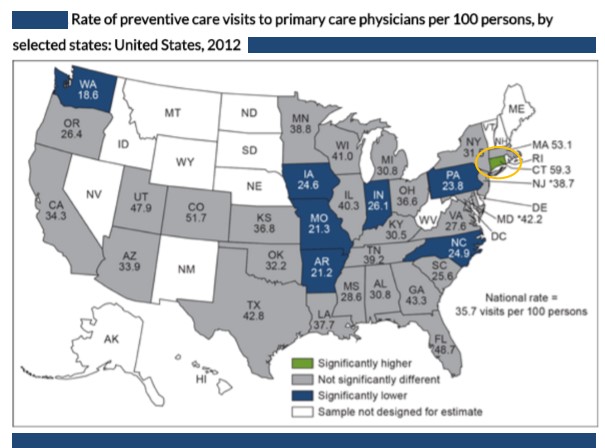
In 2012, 35.7 preventive care visits were made to primary care physicians for every 100 persons across the United States.  In Connecticut, primary care physician preventative care visits were made 59.3 times per 100 people, the highest percentage in the nation.  In Massachusetts, the rate was 53.1, in Colorado 51.7, in Florida 48.7 in Georgia 43.3, in Texas 42.8 and in Maryland 42.2.  Overall, 58.2 percent of preventive care visits were made to primary care physicians, according to the CDC data.  Primary care physicians include office-based physicians in the specialties of family or general medicine, internal medicine, and pediatrics.1u1-c15ecce858

The female rate (76.6 visits per 100 females) of preventative care visits exceeded the male rate (45.4 visits per 100 males) by 69 percent. The percentage of preventive care visits to primary care physicians, however, made by males (76.3%) exceeded those made by females (48.0%). The data suggests that women tend to make their preventative care visits to physicians other than their primary care physician, with the report’s summary suggestion. this “may be related to gynecological or obstetric care for women.”

In 2012, the NAMCS survey sample size was increased fivefold to allow for state-level estimates in the 34 most populous states for the first time.

preventative health map

New Casey Foundation Initiative Aims to Improve Job Prospects for Young Adults in Hartford

A total of up to $900,000 will be awarded over the next four years to a Hartford collaborative initiative to strengthen the next generation of workers and meet employer demand.  The Annie E. Casey Foundation has announced plans to award $6 million in grants to increase job opportunities for young adults from low income families in Hartford and four other communities - Cleveland, Indianapolis, Philadelphia, and Seattle. Hartford expects to receive up to $900,000 over the grant period for planning and implementation.cities

Through Generation Work, the Foundation aims to combine building relationships with businesses, factoring in their needs in the local economy, with youth development strategies to prepare young people for work, such as mentoring and on-the-job learning opportunities. Ultimately, the Casey Foundation hopes to help establish local networks of workforce development organizations that serve young job seekers and have strong connections with businesses.

The Hartford Generation Work initiative is led by United Way of Central and Northeastern Connecticut, working with five other community partners:

Hartford’s initiative will connect young adults, including those out-of-school or work or underemployed, with education, training and employment for careers in manufacturing and healthcare, officials said. The initiative also intends to improve coordination and collaboration among partners and youth initiatives.work

“The strength of our future workforce is one of our nation’s greatest assets and is critical to our ability to compete globally,” said Allison Gerber, a senior associate who oversees the Casey Foundation’s investments in improving job opportunities for low-income individuals and families. “The next generation is eager to work, but we must create more avenues for young adults to develop the knowledge and experience they need to succeed in the job market.”

While the Great Recession hit many hard, teens and young adults have experienced the most drastic drop in employment, data show. Millions of young people — particularly young people of color, justice-system involved, or aging out of foster care and from low-income families — face obstacles to employment or education, and the percentage of young people ages 18 to 29 in the job market nationwide has steadily declined in recent years. At the same time, employers often struggle to find workers with the right set of skills for available positions, Foundation officials point out.

Elder Abuse Prevention Recommendations Sent to State Legislature

Though precise definitions of elder abuse vary widely across jurisdictions, conceptually, elder abuse is any form of mistreatment that results in harm or loss to an older person. That, according to a report issued by Connecticut’s Legislative Commission on Aging, is at the core of a series of 15 recommendations being made to the state legislature and executive branch to respond to increasing concerns about the growing prevalence of elder abuse. The report explains that “it can be physical, financial, psychological, or include neglect or abandonment and it may take place in a home or institutional setting. Though often a hidden phenomenon, elder abuse is a significant human rights, public health and social justice issue that transcends race, ethnicity, religious affiliation, income and education levels.”report

Earlier this year, the legislature directed the Commission to conduct a study” concerning best practices for reporting and identification of the abuse, neglect, exploitation and abandonment of older adults.”  The report was submitted to the legislature, which convenes this week.

The Commission has also launched a new website focused on Financial Abuse & Exploitation, which includes a series video training videos and a range of resources.

Organized around the three areas of inquiry framed in Public Act 15-236, the report recommendations are:

To emulate national models for reporting abuse, neglect, exploitation or abandonment:

  1. Establish parameters for reasonable caseload standards for the Connecticut Department of Social Services Protective Services for the Elderly program (PSE);
  2. Establish an elder abuse resource prosecutor in the Office of the Chief State’s Attorney;
  3. Conduct a Connecticut-specific cost assessment to better understand the personal and state costs of financial exploitation; and
  4. Evaluate moving to an adult protective services model, for adults ages 18 and older, rather than a model only for adults ages 60 and older, balancing the import of retaining choice and control with ensuring that access to protective services is not restricted by age.

To advance standardization and uniformity in definitions, measurements and reporting mechanisms:

  1. Conduct a definitional crosswalk among and between state agencies and national guidelines and assess where legal, policy and practice changes can enhance alignment;
  2. Have Connecticut PSE develop a strategic plan to develop national voluntary consensus guidelines that have been developed nationally;
  3. Have Connecticut PSE modify its data collection process and explore predictive analytics modeling to improve outcomes and quality, to align with the dataset to be collected nationally, and to develop more targeted interventions; and in the interim, have PSE submit a more detailed report to the Connecticut General Assembly;
  4. Require Connecticut PSE to develop an online training module for mandated reports on the role of PSE, elder abuse red flags and reporting procedures to PSE; and
  5. Develop training and resources for law enforcement.

To promote and coordinate reporting communication among local and state government entities:

  1. Have Connecticut PSE formalize a system for consistent and uniform follow-up with all reporters of elder abuse;
  2. Enhance training for Connecticut PSE social workers and utilize consultants with specific subject matter expertise to provide guidance on investigation in certain highly specialized areas;
  3. Explore promising evidenced-based assessment tools and service models to make informed policy and practice decisions about how to direct and utilize limited resources on behalf of adults who need them most;
  4. Pursue federal funding for enhanced training and services to end abuse later in life program.
  5. Empower and support multidisciplinary teams (groups of regularly-meeting professionals to handle complex cases of elder abuse), as well as specialized teams such as financial abuse specialist teams, elder fatality review teams, and an elder abuse forensic center; and
  6. Support continued development of Connecticut’s criminal justice information system.

Connecticut’s Legislative Commission on Aging is a nonpartisan public policy and research office of the Connecticut General Assembly.  The report indicated that according to a study sponsored by the U.S. Department of Justice, 12.4 percent of adults age 60 and older reported at least one form of emotional, physical or sexual abuse or potential neglect and 11.7 percent reported financial exploitation by a family member or stranger.

Connecticut is the 7th oldest state in the nation, based on median age. It also has the third longest-lived constituency, with an average life expectancy of 80.8 years for residents born in Connecticut today. The report indicated that the “vast scope of elder abuse is especially concerning in light of the significant adverse health consequences for victims.”

More than one-third of Connecticut’s population is over the age of 50, and that proportion continues to rise. Between 2010 and 2040, Connecticut’s population of people age 65 and older is projected to grow by 57%, with less than 2% growth for people age 20 to 64 during the same period, according to the report.

https://youtu.be/b3Dr_sqJOYE

Insurance Department Recovers $6 Million for Policyholders, Taxpayers in 2015; Recoveries, Fines Both At 4-Year Low

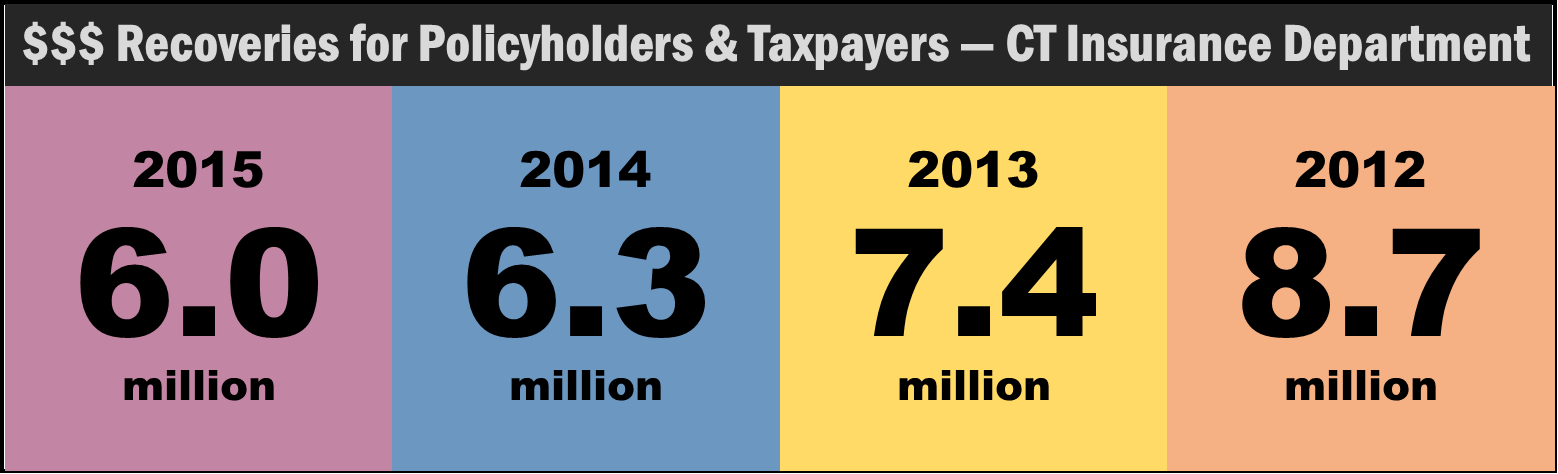
The Connecticut Insurance Department recovered approximately $6 million for policyholders and taxpayers in 2015, helping individuals and families with their claims and complaints.  The total dollar amount of the recoveries declined for the third consecutive year, down from a high of $8.7 million in 2012, $7.4 million in 2013 and $6.3 million in 2014. Officials indicated that the Department’s Consumer Affairs Unit (CAU) fielded more than 6,100 complaints and inquiries and helped policyholders recoup more than $4 million from January 1 to December 31, 2015.  The number of complaints and inquiries dropped slightly from the previous year, when 6,500 were handled, recouping $4.3 million for policy owners.  In 2013, policyholders saw $4.7 million returned.  In 2012, the numbers were virtually identical to 2015.ctInsuranceDept

“Behind these statistics are the individuals and families the Department was able to help through our intervention,” Commissioner Katharine L. Wade said. “In many cases we were able to make a real difference in their lives and I encourage anyone with questions or concerns about their insurance to contact the Department. We are here to help consumers.”

The department, in announcing the annual totals for 2015, also highlighted some individual recoveries, including:

  • $27,000 for home health care services for a senior citizen under her long-term care policy
  • $13,000 to pay for speech therapy for an autistic child
  • $16,000 paid to a policyholder for an inpatient stay at a skilled nursing facilityrecoveries
  • $37,000 in an additional payment to a homeowner to settle a claim

“Our staff makes certain that companies and agents comply with all state insurance laws and regulation and have extensive knowledge to answer a wide range of insurance questions,” the Commissioner said.

In addition to recoveries for policyholders, the Department’s Market Conduct division levied approximately $1.7 million in fines against carriers and returned that money to the state General Fund in 2015. The fines resulted from a variety of violations and settlements ranging from untimely claim payments to improper licensing. That was the lowest total for fines in recent years, perhaps signifying greater compliance.  In 2014, fines totaled $2.03 million, in 2013 the total was $2.7 million and in 2012 fines levied totaled $4.6 million.

The majority of the funds recovered for policyholders stemmed from complaints over health, accident, homeowners and life and annuities policies.

The following is the breakdown of funds recovered in 2015:

  • Accident, Health - $2.7 million, compared with $2.5 million in 2014
  • Auto - $430,000, compared with $381,000 in 2014
  • General Liability - $17,200, compared with $65,000 in 2014
  • Homeowners - $530,000, compared with $65,000 in 2014
  • Life, Annuities - $294,000, compared with $330,000 in 2014

Recoveries in 2013 were largely focused on homeowners, as a result of Superstorm Sandy-related claims. Department recoveries in 2012 reflect the impact of claims from 2011 Storm Irene and the late October snow-filled Nor’easter that landed in Connecticut.

The Department calculates its consumer recoveries based on what the policyholder received as a result of the Department’s intervention. The inquiries and complaints also help the Department identify industry trends that may adversely affect consumers and trigger investigation by the Market Conduct division, officials said.

In addition, complaint data also help determine topics for consumer education and serve as tools to help the Department monitor the industry.  The Market Conduct enforcement actions are posted on the Department’s web site at www.ct.gov/cid

Yelp Means Help for Three Hartford-Area Nonprofits

Three Hartford area nonprofit organizations have received a financial boost from the charitable foundation of Yelp, the website of business recommendations. This past fall, Yelp nominated three non-profit organizations in 75 cities around the country that support the Yelp Foundation’s mission of addressing the needs of local communities, including access to information, education, local economic development, and freedom of expression. In Hartford, those organizations were The Connecticut Forum, Literacy Volunteers of Greater Hartford and reSET Social Enterprise Trust. yelp

The Yelp Foundation announced it would grant $5,000 to the organization with the most votes at the end of a web-based public voting campaign. The second and third place winners would be granted $3,000 and $2,000 respectively. Individuals could vote once each day during the two-week web voting period.

The Foundation announced this week that the top-vote getter, The Connecticut Forum, will be receiving a $5,000 grant.  Literacy Volunteers of Greater Hartford will be receiving a $3,000 grant; reSET Social Enterprise Trust will receive $2,000.CT Forum

The Yelp Foundation's mission is to support charitable organizations and activities addressing the needs of local communities, including access to information, education, local economic development, and freedom of expression, and to promote a culture of philanthropy among employees of Yelp Inc. Nationwide, 225 organizations will be receiving grants totaling $750,000.

The Connecticut Forum presents live, unscripted conversations among renowned experts and celebrities, and community outreach programs including the Connecticut YOUTH Forum. The organization’s mission: “to encourage the free and active exchange of ideas in Forums that inform, challenge, entertain, inspire and build bridges among all people and organizations in our community.”

literacyLiteracy Volunteers of Greater Hartford is a private non-profit organization that has provided adult literacy services in Greater Hartford since 1972. Their “vision is to build a stronger, more resilient Greater Hartford by creating a community of fully literate adults.”  Annually, the organization now serves over 850 adults in 20 towns throughout the region.

reSET is a non-profit organization whose mission is to advance the social enterprise sector. Its strategic goals are threefold: to be the “go-to” place for impact entrepreneurs, to make Hartford the Impact City, and Connecticut the social enterprise state. reSET serves all entrepreneurs, but specializes in social enterprise ― impact drivenPicture3 business with a double and sometimes triple bottom line. In addition to providing co-working space and accelerator and mentoring programs, reSET aims to inspire innovation and community collaboration, and to support entrepreneurs in creating market-based solutions to community challenges.
reSETYelp was founded in 2004 to help people find great local businesses like dentists, hair stylists and mechanics.  Yelp had a monthly average of 89 million unique visitors who visited Yelp via their mobile device in the third quarter of 2015, according to the company, which also notes that “Yelpers” have written more than 90 million reviews since the company’s inception.

In 2011 Yelp Inc. established the Yelp Foundation with one percent of company equity to support charitable organizations and activities addressing the needs of local communities, including access to information, education, local economic development, and freedom of expression, and to promote a culture of philanthropy among employees of Yelp Inc.

The Foundation accomplishes its charitable goals by making grants to deserving nonprofits throughout the U.S. and matching donations made to charities by Yelp employees up to $1,000 per person per year, according to the Foundation website.   In 2014, the Foundation committed $1 million to charity.  To learn more about the Yelp Foundation, visit http://www.yelpfoundation.org/


Bullying Is Parents Top Concern, Depression Next

Across the country, parents with children under age 18 are most concerned about their child being bullied, with 6 in 10 expressing that concern.  The next most prevalent concern – expressed by a majority of those surveyed by the Pew Research Center – is that their child will struggle with anxiety or depression.  Fifty-four percent have that concern. Noting that comprehensive statistics on bullying are difficult to obtain, Pew referenced the 2013 Youth Risk Behavior Study (which covered only high-school students) finding that 19.6 percent had been bullied on school property in the previous 12 months, and 14.8 percent had been electronically bullied. In both cases, white teens and female teens were more likely to say they’d been bullied.FT_16.01.05_parentalConcerns

Connecticut’s statistics were higher than the national average in both categories.

In the 2012-13 school year, there were more than 1,400 incidents which an investigation was conducted and active bullying was concluded to have occurred, according to the state Department of Education.  The most recent data posted on the department’s website indicates that “21.9% of Connecticut students had been bullied on school property. Nationwide, the rate is 19.6%. In Connecticut, the prevalence of having been bullied on school property is significantly higher among females (26.1%) than among males (17.9%). The prevalence of having been bullied on school property is significantly higher in grade 11 among students in CT (22.8%) than in the US (16.8%).”

The Youth Risk Behavior Study also indicated that 17.5% of Connecticut students had been electronically bullied. Nationwide, the rate is 14.8%, according to the study report.youth risk report CT

Earlier this month, the parents of a high school freshman in Westport who died last month asked the local Superintendent of Schools to investigate reports that their son may have been the target of bullying and the nature of widespread social-media comments about his death among students.

In a letter to school officials, the parents wrote: “several current Staples High School students have reported observing bullying, humiliating or inappropriate behavior by one or more peer or peers toward others, and these students report that they do not know how to respond or intervene. They feel guilty and ashamed of their inaction and passive consent to the blatant behaviors. This is a critical area needed to stop these types of malevolent behaviors.”

Published reports indicate that police have found no evidence of bullying in the student's death.

The likelihood of their child facing anxiety and depression is also of great concern to parents, ranked second-highest in the survey.  About one-in-ten adolescents, or around 2.6 million, have experienced major depression in the past year, according to 2013 data reported by National Institute of Mental Health, the Pew report indicated; for 7.7 percent, their depression caused severe impairment.

Depression was three times as common among teen girls as teen boys (16.2% versus 5.3%). Available data suggest that a quarter of teens have experienced some sort of anxiety disorder (such as phobias, panic disorder or post-traumatic stress disorder) at some point in their lives, according to the National Institute of Mental Health.

The nationwide survey by the Pew Research Center survey also found that the nature of parental concerns varies considerably across demographic groups.  The research found, for example that:

  • low-income parents are more concerned about teen pregnancy and their kids getting in trouble with the law than are higher-income parents.
  • Black parents are more likely than white parents to worry about their children being shot, while white parents are more likely than black parents to worry tFT_15.12.21_parentalConcerns_shoothat their children will struggle with anxiety or depression.
  • Hispanic parents worry more than black or white parents in all eight areas of concern, from being bullied to having problems with drugs or alcohol

Pew Research Center points out that in 2014, the rate of firearm deaths for black youths was 4.26 per 100,000, almost three times the rate for white youths and nearly four times the rate for Hispanic youths. Hospital emergency departments, from which the Centers for Disease Control and Prevention gathers its injury data, don’t always obtain information on race and ethnicity for their patients, the report noted. But based on the 80 percent or so of nonfatal firearm injury cases involving juveniles in 2013 for which race and ethnicity data are available, the disparity among different subpopulations was stark: 1.68 per 100,000 for white youths, 5.3 per 100,000 for Hispanic youths and 24.67 per 100,000 for black youths, the Pew report indicated.

The report also indicated that every state in the nation, as well as the District of Columbia, has a lower teen birthrate than it did in the early 1990s. The birthrate for 15- to 19-year-olds (the metric tracked by federal researchers) has been dropping for decades, Pew pointed out, and hit a record low in 2014. There were just 24.2 births per 1,000 teen females that year, compared with 61.8 per 1,000 in 1991 and 41.5 as recently as 2007.


Rockies, Yard Goats Extend Relationship; Among Top 10 Farm Systems in MLB

When the Hartford Yard Goats take up residence at the new Dunkin’ Donuts Park later this spring, they will continue to be a Double-A farm team of the National League’s Colorado Rockies, which run one of major league baseball’s top 10 farm systems, according to a pre-season analysis  by the website minorleagueball.com. At the top of the rankings – the “elite” organizations – are the Chicago Cubs, Boston Red Sox, Minnesota Twins, Los Angeles Dodgers and Texas Rangers.  The next five, described as organizations that “should be considered very productive with a chance to move into the top group soon,” include the New York Mets, Pittsburgh Pirates, Toronto Blue Jays, Colorado Rockies and Houston Astros.  The New York Yankees farm system was ranked at #13. Primary_Logo_for_the_Hartford_Yard_Goats

The Hartford Yard Goats Double-A baseball club will launch its inaugural season at home in Hartford on May 31, a delayed opening due to stadium-construction delays.  The team will begin its season playing on the road in April and May.  The Yard Goats will play the Boston Red Sox affiliate Portland Seadogs in June and July of 2016, the New York Yankees affiliate Trenton Thunder in August, and the Binghamton Mets in July and August.

When they finally arrive home, it appears that the Rockies-Yard Goats relationship will not be short-lived.  This week, the Colorado Rockies announced a player-development contract extension for another two years with the Hartford Yard Goats. It will keep the two teams together through the 2018 season.  The original agreement signed in the fall of 2014 was set to expire at the conclusion of this season.

The Yard Goats recently announced the addition of a third founding sponsor.  Stamford's Frontier Communications, which has expanded its Connecticut telecom offerings through its $2 billion acquisition of AT&T landline assets last year, will pay an undisclosed sum for the right to display its signage inside and outside the $66 million stadium under construction in the Downtown North neighborhood.Colorado_Rockies_logo.svg

The company's name will also be on the Frontier Communications Stadium Club, and the deal includes provision of free Wi-Fi for fans at home games.  Frontier joins founding sponsors Travelers and The Hartford Financial Services Group. In addition, Dunkin' Donuts owns the naming rights to the stadium.

Playing lwpopast season as the New Britain Rock Cats, the team finished with a record of 69-71, a fourth place spot in the six-team Eastern League’s Eastern Division.

The Hartford Yard Goats have also announced that all 142 games (home and away) will be broadcast live on News Talk 1410AM (WPOP) and will be available for fans to listen on iHeartRadio. News Talk 1410AM will serve as the Yard Goats flagship station over the next three seasons, through 2018. Veteran broadcaster Jeff Dooley will be the "Voice of the Yard Goats" and lead play-by-play announcer for the games.

Caregiving Is Critical Issue as "Incredible Demographic Transformation" Continues, Aging Report Stresses

The United States continues to experience “incredible demographic transformation,” according to the Final Report of the White House Conference on Aging (WHCOA), a year-long, nationwide endeavor throughout 2015. In Connecticut, with the nation’s 7th oldest population, input was provided by legislative and executive branch agencies, which held hearings and offered expert testimony from organizations including AARP, the state Department on Aging, Legislative Committee on Aging and Commission on Aging. “No topic attracted more attention in the lead-up and follow-up to the 2015 WHCOA than caregiving. It echoed across all four of the conference issue areas,” the report indicated, referencing the four common themes that emerged as particularly important to older Americans: Retirement Security, Healthy Aging, Long-Term Services and Supports, and Elder Justice.cover  The final report noted the participation, at the Boston Regional Forum, of Connecticut’s Commissioner of the Department of Public Health, Jewel Mullen.

Among the findings in the report, issued by the White House, that will demand the attention of policy makers in the next decade:

  • Over 10,000 baby boomers are turning 65 every day, and the fastest growing demographic in the U.S. is women over age 85. The proportion of older adults representing racial and ethnic minorities is also increasing rapidly.
  • There is a need to break down the silos between housing, transportation, health care, and long-term services and supports in order to support healthy aging. The United States must also take advantage of an “increasing array of web-based technologies, robotics, and mobile devices” that “help older adults access the services they need, stay connected to family and friends, and remain active and independent.”
  • The majority of assistance for older Americans is generally provided at home by informal caregivers, especially family and friends, and are often the “primary lifeline, safety net, and support system for older adults.” Although rewarding, caregiving can be demanding, and “informal caregivers need to be supported and sustained with appropriate resources.”
  • With family structures changing as Americans are having fewer children and increasingly moving away from families of origin, the availability of family members to provide care is diminishing. “Direct care is a demanding profession with low wages, long hours, and limited benefits. It is critical for there to be efforts to recruit and retain a sufficient number of direct-care workers to keep pace with the growing need.”chart

The White House has held a Conference on Aging every decade, beginning in 1961, to identify and advance actions to improve the quality of life of older Americans. In 2015, the United States marked the 50th anniversaries of Medicare, Medicaid, and the Older Americans Act, as well as the 80th anniversary of Social Security. The White House Conference on Aging provided "an opportunity to recognize the importance of these key programs as well as to look ahead to the next decade."

At a public hearing in May at Connecticut's Legislative Office Building, state officials noted that Connecticut is undergoing a “permanent and historic transformation” in its demographics.  Statistics released as part of the WHCOA report echoed that observation.

65-600x249On July 13, 2015, President Obama hosted the sixth White House Conference on Aging, joining older Americans and their families, caregivers, and advocates at the White House and virtually through hundreds of watch parties across the country.

The July event built on a year-long dialogue; the White House Conference on Aging launched a website to share regular updates on its work and solicit public input; engaged with stakeholders in Washington, D.C. and listening sessions throughout the country; developed policy briefs on the emerging themes for the conference and invited public comment and input on them; and hosted regional forums with community leaders and older Americans in Tampa, Florida; Phoenix, Arizona; Seattle, Washington; Cleveland, Ohio; and Boston, Massachusetts.  Additional hearings, including those in Connecticut, were shared with conference officials.  Individuals and groups participated via live webcast in watch parties held in every State and were able to ask questions of panelists and others via Twitter and Facebook.

The Final Report, completed in late December and publicized by the White House this week, now goes to policy makers at the federal and state level to review findings and consider policy actions to respond the critical issues cited as requiring attention.

ph-whcoa-blog-collage