CT Ranked Third Best State for Working Moms

Despite ranking 37th in professional opportunities for women and 12th in child care, Connecticut has been ranked as the third best state for working moms on the strength of a number one ranking in “work-life balance," according to a new analysis from the financial website WalletHub. With Mother’s Day just days away, the WalletHub analysis revealed 2016’s Best & Worst States for Working Moms.mom at computer

The top five states were Vermont, Minnesota, Connecticut, North Dakota and Massachusetts.  Vermont also ranked first in child care, and was the top-ranked state (after D.C.) in professional opportunities.  At the bottom of the list, considered the worst states for working moms, were Alaska, Louisiana, South Carolina, Alabama and Nevada.top 10

The website also noted that “women still earn only $0.79 for every dollar that men make and have far less upward mobility, as evidenced by the fact that only 4 percent of S&P 500 companies’ chief executives are female.”

WalletHub’s analysts compared the attractiveness of each of the 50 states and the District of Columbia to a working mother, using 13 key metrics such as median women’s salary, female unemployment rate and day-care quality.

Connecticut’s ranking across the categories included in the survey ranked from second in parental leave policy to 24th in the ratio of female to male executives.  The state’s rankings by category, in the WalletHub analysis:working w

  • 2nd – Parental Leave Policy
  • 6th – % of Single-Mom Families in Poverty
  • 6th – Access to Pediatric Services
  • 8th – Length of Average Woman’s Workday
  • 9th – WalletHub’s “Best School Systems” Ranking
  • 24th – Ratio of Female Executives to Male Executives

3rdThe Child Care metrics included Day-Care Quality, Child-Care Costs, Access to Pediatric Services, and WalletHub’s “Best School Systems” Ranking.   The Professional Opportunities category included Gender Pay Gap, Ratio of Female Executives to Male Executives, Median Women’s Salary, Percentage of Families in Poverty, Female Unemployment Rate, and Gender-Representation Gap in Different Economic Sectors.   The Work-Life Balance category included Parental Leave Policy, Length of the Average Woman’s Work Week, and Women’s Average Commute Time.

Data used to create these rankings, according to WalletHub, were collected from the U.S. Census Bureau, Bureau of Labor Statistics, Child Care Aware® of America, Equal Employment Opportunity Commission, Council for Community and Economic Research, National Partnership for Women & Families and WalletHub research.


Link Literacy and Social-Emotional Skills to Improve Children’s Success in School, Report Urges

Experts agree that there is a deep connection between social-emotional development and literacy in children’s early school success including achieving reading proficiency in the early grades – and it turns out that the benefits of effectively making those connections sooner rather than later are significant, and can endure for a lifetime. A new report from the Child Health and Development Institute of Connecticut (CHDI), “Connecting Social and Emotional Health and Literacy: Critical for Early School Success,” explores the interplay between young children's social-emotional development and early literacy and language skills, and “elevates awareness of the connections between these essential competencies,” according to CHDI and the report’s researchers.report

The detailed 36-page report provides examples of linking strategies and outlines recommendations with the goal of accelerating actions by states and communities to advance children's readiness for school and successful educational achievement.

“Early cognitive and social-emotional skills are interactive and woven together - like strands of a rope,” notes Ann Rosewater, lead author of the report and co-leader of the Connecticut Peer Learning Pilot on Social-Emotional Development and Early Literacy. “The strategies and tools in this report will help communities implement approaches to align children’s literacy and social emotional health.”

The report urges a series of coordinated state actions to advance the linkage and integration of supports for children’s social-emotional health and learning:

  • Align systems that address social-emotional development and literacy
  • Increase support and education for parents
  • Invest in professional development for those working with young children
  • Institute universal and routine screening for social-emotional development and
  • appropriate follow-up
  • Expand the reach of evidence-based practices and programs
  • Focus attention on special populations

mom-baby-readingThe recommendations are drawn from the experiences of nine communities in Connecticut that explored researched-based strategies over the past year, to link supports for social-emotional and literacy skills. The effort was part of the Connecticut Peer Learning Pilot on Social-Emotional Development and Early Literacy, developed and led by the Campaign for Grade-Level Reading, in partnership with the National Center for Children in Poverty and with support from the Irving Harris Foundation and others.

Participating community teams represented Campaign for Grade-Level Reading and William Caspar Graustein Memorial Fund Discovery Initiative coalitions from Bridgeport, Colchester, Danbury, Enfield, Norwalk, Torrington, Vernon, West Hartford, and Winchester.  Their involvement, according to the report, “catalyzed notable progress in most participating communities, building on significant efforts their collaboratives had undertaken before engaging in the initiative.”  The communities “found reinforcement, inspiration and impetus to pursue as vigorously as their circumstances allowed strategies that recognized and promoted the relationship between children’s social-emotional health and literacy and language skills,” the report concluded.

In addition to urging state action, based on these experiences the report highlighted steps that can be taken at the community level to promote school success by reflecting the understanding that literacy and social-emotional development build on and reinforce each other.children

Promising strategies used by communities include the following:

  • Raise community awareness and reinforce community efforts to integrate social emotional and literacy skills fundamental to success in school and life
  • Promote nurturing parent-child relationships, which are essential to children’s social-emotional development and can simultaneously stimulate literacy learning
  • Screen for social-emotional competencies, with appropriate follow up and intervention
  • Enhance home visiting and book distribution programs
  • Incorporate professional development related to the connections between social-emotional development and literacy for those working with young children
  • Promote attendance in early education programs and the early grades
  • Support special populations, particularly children living in poverty, dual language learners or those faced with potentially unstable environments (foster care or homelessness)

chartThe report indicates that “Far too many children are at a disadvantage in their development because they lack the language and literacy competencies they need to enter kindergarten, significantly hobbling their success in reading proficiently by the end of third grade. Disparities begin as early as infancy and become more pronounced in the toddler years, with children from families below 200 percent of poverty scoring lower than children from higher income families on measures of cognitive development.”

The report goes on to state that “At kindergarten entry age, only 48 percent of poor children are ready for school, compared to 75 percent of children from families with moderate or high income.”

The Child Health and Development Institute of Connecticut (CHDI), a subsidiary of the Children’s Fund of Connecticut, is a not-for-profit organization established to promote and maximize the healthy physical, behavioral, emotional, cognitive and social development of children throughout Connecticut.  CHDI works to ensure that children in Connecticut, particularly those who are disadvantaged, will have access to and make use of a comprehensive, effective, community-based health and mental health care system.

Greater Hartford Grows as Regional Workforce Ecosystem

It may not be widely recognized, but the Greater Hartford area has become a dynamic, participatory, collaborative regional ecosystem.  And during National Workforce Development Week, which is celebrated nationally this week, that is an especially salient development. What exactly does that mean?  First, the definition: any time that partners within a region come together to solve problems, and meet regularly to answer new challenges, a regional ecosystem in is play.  An “ecosystem” is defined as a system, or a group of interconnected elements, formed by the interaction of a community of organisms with their environment. A “Regional Ecosystem” is just that –specific to a geographic region. WkDevWeek

In North Central Connecticut, the regional ecosystem is helping business grow, and find the talent they need, and it is affecting the greater welfare of society, even in these extremely challenging times with budget deficits, and economic pressures that abound.  So says Thomas Phillips, President and CEO of Capital Workforce Partners, among the drivers of progress underway across the 37-town region.

Regional ecosystems are like a chain of links, he explains, with each link playing a key role in holding the work together.  “In workforce development – the regional ecosystem is comprised of strategic partnerships with industry, education, economic development, community organizations, labor and business-led workforce boards – leading programs that are nimble, flexible, adaptable and generating economic opportunity for business and job seekers.”

Among the leading examples of the local regional ecosystems - focusing on workforce development - which use a set of common goals and outcomes:

  1. MoveUp! – a regional ecosystem addressing the challenges relating to adult literacy, with 26 partners working collectively
  2. Opportunity Youth – a regional ecosystem addressing the challenges of reconnecting out-of-work, out-of-school youth to education, training and careers, with over 50 partners and funders working collectively
  3. Best Chance – a regional ecosystem addressing the challenges of returning citizens – finding sustainable employment for former offenders, with 15 partners working collectivelyworkforce ecosystem
  4. The Hartford Coalition on Education and Talent (soon to be renamed) – a regional ecosystem designed to help more youth complete post-secondary education while closing the gap experienced by employers, with 8+ partners working collectively. “Be on the lookout for the work this group is doing – building pathways of success for the youth in our region,” says Paul Holzer, President of Achieve Hartford, spearheading this effort.
  5. The Knowledge Corridor – a region that crosses the Connecticut and Massachusetts border, this area is also a home to a robust regional ecosystem that includes 64,000 businesses, 41 colleges and universities, a labor force of 1.34 million and an international airport.

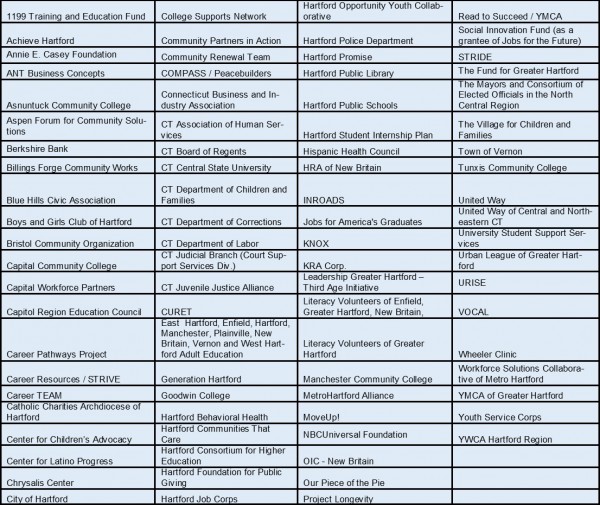
The organizations involved - scores of them - range from well-known names, such as Leadership Greater Hartford, Literacy volunteers, Capitol Region Education Council and the Hispanic Health Council, to those lesser known but just as vital.

“As ‘conveners,’ workforce development boards are often the ‘clasp’ of the chain, keeping all the links together, moving with changes in time,” says Phillips. “That means workforce development, economic development and education are responding collectively to work together toward sustainable jobs, talent creation and business growth.”

The number of organizations that collaborate continues to grow, with different organizations playing a lead role in select initiatives.  But there is definitely strength in numbers, they point out.cwp_logo_large

At the national level, officials note, the U. S. Conference of Mayors (USCM), Workforce Development Council is spearheading an effort to help each region have better access to best practices in building strong regional ecosystems.  The organizations is also working toward building more consistent communications and program focus that is designed to result in better outcomes.

That can best be accomplished region-by-region –addressing local area needs with locally based organizations.

Andrew McGough, Executive Director of the Portland, Oregon Workforce Development Board and Chair the USCM Workforce Development Committee, stresses that “Business-led local workforce boards lead the system through strategic partnerships with industry, education, community organizations, and labor, resulting in greater effectiveness and efficiency in serving businesses and job seekers in our communities.”

The Capital Workforce Partners website includes a list of participating community organizations.

community partners

Conversation in the Digital Age: Panel of Experts Will Discuss How We’re Changing

The topic of the evening is an exploration of conversation in the digital age, as two Hartford institutions come together to bring some perspective to how we communicate in the age of technology, and how we don’t. On Wednesday, May 4, The Connecticut Forum in partnership with the Mark Twain House & Museum will present DISCONNECT: Conversation in the Digital Age. The event is described as an (old-fashioned) conversation with three nationally-recognized digital experts to discuss “how social media and our ubiquitous devices have impacted the art of authentic conversation.”  They pose the question: if conversation is how we truly connect to others, what happens when face-to-face communication decreases?Forum, Twain

The panel will feature Dr. David Greenfield from the Center for Internet & Technology Addiction, Slow Tech Movement founder Janell Burley Hofmann, and tech ethicist David Ryan Polgar. Jamie Daniel, director of programming at The Connecticut Forum, will moderate the conversation.

Polgar says that opportunities for fluid conversations have diminished, to our detriment. “We have adapted technology faster than we can adjust our norms or our etiquette.  Do we ever have a prolonged conversation anymore?  There’s a difference between communication and conversation,” he suggests.

“We’re constantly packaging ourselves – exercising brand management in our conversations,” he observes.  “We’re so plugged in, we don’t do eye-to-eye communicating much anymore – there’s a need to increase facetime in our communication.”

Polgar is a frequent speaker and respected tech commentator/writer, and has been featured in The Boston Globe, Financial Times, BBC, SiriusXM, Sydney Morning Herald, VentureBeat, US News & World Report, TEDx, and Forbes, among other publications. He is also co-founder of the Digital Citizenship Summit, a global network of summits focused on safe, savvy, and ethical use of social media and technology. With a background as an attorney and educator, he examines tech use from an ethical, legal, and emotional perspective, providing a unique look into emerging trends and business insight.digital speakers

“We’re thrilled to collaborate with the Twain House on this timely event,” said Connecticut Forum Executive Director Doris Sugarman. “We welcome opportunities like this to facilitate and encourage dialogue about compelling topics that impact our communities and our lives.”

Individuals planning on attending can send in a question in advance of May 4, via a link  that provides a form for questions to be directed at a specific panelist, or the entire panel.

Janell Burley Hofman is the author of the book, iRules: What Every Tech-Healthy Family Needs to Know About Selfies, Sexting, Gaming and Growing Up. She is also a speaker and consultant on topics like technology, media, health, relationships and personal growth. She will be signing copies of her book after the program.

Dr. David Greenfield is the founder of The Center for Internet and Technology Addiction and an Assistant Clinical Professor of Psychiatry at the University of Connecticut School of Medicine. He is recognized as one of the world’s leading voices on Internet, computer, and digital media behavior, and a pioneer concerning compulsive and addictive use. He is the author of the Virtual Addiction, which rang an early warning bell with tech overuse when it came out in 1999.  He lectures to public and medical/psychiatric groups throughout the world, and has appeared numerous times on national media and publications.

“I am looking forward to hearing from this panel of experts on questions that we consider every day,” said Jamie Daniel, Director of Programming at The Connecticut Forum, who will be moderating the discussion.  “How is technology changing the way we make friends, fall in love, and parent our kids? How is our online discourse impacting the way we engage in politics? Connect with one another? Shape our communities? And how is social media changing our relationships - and our brains? This amazing panel will help us consider all of this, and more.”

-----

The Connecticut Forum is a (c)(3) nonprofit organization serving Connecticut and beyond with live, unscripted conversations among renowned experts and celebrities, and community outreach programs including the Connecticut YOUTH Forum.  The Mark Twain House & Museum has restored the author's home, where the author and his family lived from 1874 to 1891. In addition to providing tours of the National Historic Landmark, the institution offers activities and educational programs that illuminate Twain's literary legacy and provide information about his life and times.

Tickets for DISCONNECT are $10. ($5 for Mark Twain House & Museum members and Connecticut Forum subscribers) The program on Wednesday, May 4 begins at 7 PM.  Photo: (l to r) David Greenfield, Jannell Hofmann, David Ryan Polgar.

Meriden Re-Make Continues, Spurred by State Support; Additional Funds Sought to Implement Plan

The City of Meriden is seeking $2 million from the State of Connecticut to improve six roadway sections in downtown Meriden, to improve traffic flow, improve accessibility and increase safety for vehicles, bicyclists and pedestrians traveling within Meriden’s Transit Oriented Development (TOD) zoning district. The grant application is the latest effort as part of the city’s “Meriden 2020 Bringing It Together” initiative, which is focused on transit oriented development to recapture the luster of the “Silver City”  and has received a steady flow of state funds in recent months to boost the effort.

The roadway sections - including Colony Street, West Main Street, State Street, Perkins Square/South Colony and East Main Street - were selected and analyzed for improvements in prior studies and investigations.  The initiative is an outgrowth of a two State of Connecticut TOD Pilot grants, a US Dept. of Housing and Urban Development (HUD) Sustainable Challenge grant and a HUD Choice Neighborhoods Planning grant.Hub_site_Feb_2016

A website, meriden2020.com, highlights the numerous efforts underway to redevelop the city’s central business, including ways to resolve historic flooding issues, repurpose underutilized brownfield sites, remake the rail station area into a modern transportation center, and provide links to the regional trail system.

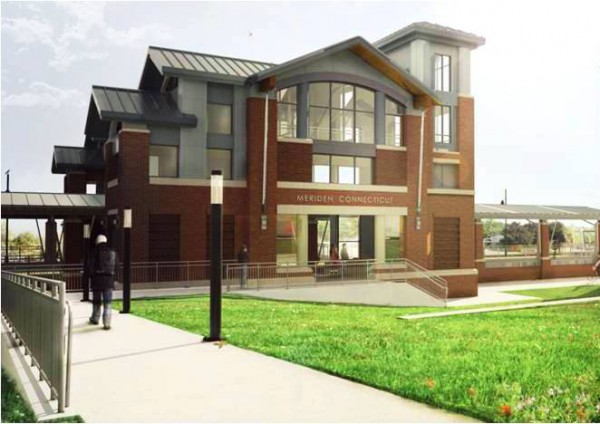
Meriden’s Transit Oriented Development program seeks to “transform the Meriden Transit Center (MTC) and the half-mile area around it into a vibrant neighborhood that includes new residential and commercial development, public spaces and improved access to public transportation.” Construction of the new transportation center is underway, and local officials recently initiated a study to examine planned ridership and usage by area residents and businesses.

Last week, the Connecticut Housing Finance Authority (CHFA) and Department of Housing (DOH) announced approval funds meridenfor a proposed mixed use development project at 161-177 State Street, which is phase one of a multi-phase project that includes demolition of the Mills public housing project and implementation of the Harbor Brook Flood Control project north of the Hub site.   The new building will be within walking distance of Meriden`s new Transit center.

The proposed project will have 75-units of mixed-income family housing, with ground level retail space and a preschool. The property will include eight supportive units and 60 units targeted for households with incomes of 60 percent or less of Area Median Income (AMI). In addition, 26 of the 60 units will be supported by project based Section 8.

sealsIn February, the Connecticut Small Business Development Center (CTSBDC), the City of Meriden and The Midstate Chamber of Commerce announced the opening of the newest CTSBDC office, to be located at Meriden City Hall.

The new office is offering professional, confidential business advising to entrepreneurs in every stage of business and all industry sectors in the City of Meriden. “This beneficial partnership between the Connecticut Small Business Development Center and the City of Meriden ensures that entrepreneurs of the city have access to the necessary resources available to assist with starting or growing their business. This allows for economic growth and job creation in this area,” said CTSBDC State Director Emily Carter. CTSBDC also has a “virtual” location at the Meriden Public Library, where individuals can connect with CTSBDC advisors online.

In January, Meriden was awarded $100,000 in state funds to further revitalization and redevelopment in the TOD and Choice Neighborhoods target areas. The funding came through the state Department of Economic and Community Development (DECD) Brownfield Area-Wide Revitalization (BAR) Grant program, a year-old state pilot program that encourages communities to consider areas such as neighborhoods, downtowns, waterfront districts, or other sections with multiple brownfields and develop strategies to assess, clean up, and reuse the parcels for business, housing, and public amenities that will generate jobs and revenues and revitalize the entire area.Transit Center

Weeks later, the Department of Economic and Community Development awarded the Meriden a $2 million grant for the demolition and remediation of the Mills Public Housing Complex.  The city plans to demolish the structures at 144 Mills Memorial as a prerequisite to implementing the Harbor Brook Flood Control Plan at the site.  While the 144 Mills Memorial site will be used for flood control purposes and will not be used for development, officials say the construction of the flood control plan at the site will allow for development to proceed at the adjacent sites, which include the Meriden Hub Site (located at 1-77 State Street) and at the Mills Megablock site (located at 161-177 State Street and 62 Cedar Street).

Meriden officials point out that commuter rail service to Hartford and New Haven is scheduled to begin later this year.  The new commuter rail service is expected to spur significant “transit oriented development” in the city center.  Once the rail service is operational, nearly 140,000 workers located within one mile of a rail station will be able to commute to Meriden within a 40-minute ride, the website points out.

Diversity Lacking Among Nation's Philanthropic Organization Leaders; Graustein Memorial Fund Cited As Model of Progress

Five years ago, America’s philanthropic community recognized it had a problem, not uncommon in board rooms nationwide – a lack of diversity.  More than a dozen organizations with connections to thousands of grantmakers came together to found the D5 Coalition to advance diversity, equity, and inclusion (DEI) in philanthropy. Now, the coalition’s final report on progress is out, and the picture is barely encouraging. In an op-ed published this month in the Chronicle of Philanthropy, the co-chairs of the D5 initiative Robert Ross, Luz Vega-Marquis and Stephen Heintz said bluntly that “philanthropy remains on a par with country clubs when it comes to exclusivity,” observing that “there have been pockets of progress in the last five years, but philanthropy still does not adequately reflect the diversity of our nation.”Sow15-231x300

“The only source we have on foundation demographics, shows that the proportion of CEOs of color among respondents has remained flat over the past five years at eight percent. The corresponding figure for senior executive staff is a tad more positive – 17 percent, compared to 14 percent five years ago – but there’s been a slight decline in program officers of color.”

The status quo, they emphasized, “is unacceptable.”  They point out that “as matters of inequality in income, employment, housing, public education, justice systems, and health care stake a growing claim on the national agenda, philanthropy must set the tone and pace for inclusiveness, and for who plays a key role in deciding where money goes.”

Robert Ross is the President and CEO of the California Endowment; Luz Vega-Marquis is the President and CEO of the Marguerite Casey Foundation; Stephen Heintz is the President of the Rockefeller Brothers Fund.  Heintz, a former Connecticut resident, served as a state commissioner in the 1980’s in the administration of Gov. William O’Neill at the outset of his career.

grausteinThe D5 final report features stories about leaders in foundations and other philanthropic organizations taking meaningful action to advance DEI.  “Storytelling is one of the most powerful ways to inspire action and change. We hope people working within foundations—whether they are a CEO, an HR manager or a program officer—draw on the important lessons from these stories, and apply them to their own unique situations,” said Kelly Brown, D5 Director. Kelly also cited statistics indicating that “when companies commit themselves to diverse leadership, they are more successful. Foundations and nonprofits,” she said, “have the opportunity to take a page from successful business playbooks.”

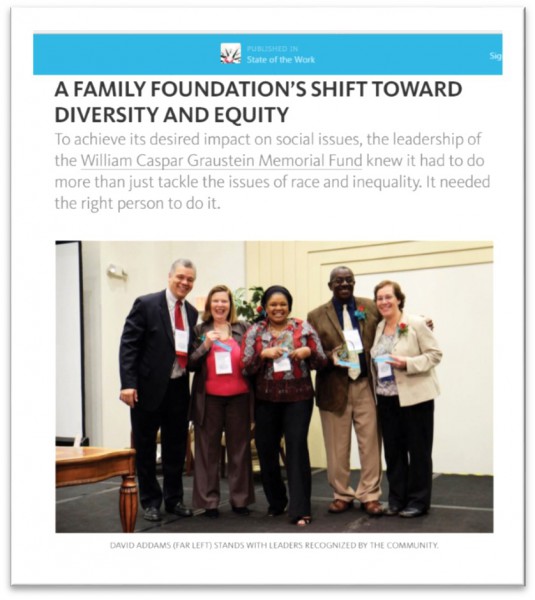
Among eight stories included in the final report which point to progress being made is one focused on Hamden-based William Caspar Graustein Memorial Fund, headlined “A Family Foundation’s Shift Toward Diversity and Equity.”  The story explained that “Bill Graustein and his trustees had come to feel that the Fund would not make the desired progress addressing social issues unless it more explicitly addressed issues of race and inequality. To oversee that transition, in 2014 it hired as executive director David Addams, a former director of diversity at the ACLU and Vice President of Special Initiatives at the New York Urban League, who had made a mark running the Oliver Scholars in New York City, which identifies promising minority students and prepares them to succeed in top independent high schools and colleges.”

The report goes on to highlight that “a new mission statement, unveiled in 2015, pledges the Fund “to achieve equity in education by working with those affected and inspiring all to end racism and poverty.” The article indicates that they “will continue to attack barriers to achievement within schools and school districts, but, in an interview, Addams says a new focus will be ‘the barriers outside schools that undermine kids and undermine communities.’ Board members and staff members are thinking hard about how to translate the mission statement into new programmatic activity; they hope to present guidelines for the next phase of grant giving by mid-2016.”

Asked in the feature story whether it was important that the Graustein Fund turn to a leader of color at this juncture, Addams, who is African American, responded: “I don’t know if it has to be an African American person, but it has to be someone who can bring a missing perspective to the Fund. Part of that is understanding racism as well as — for me — having had the direct experience of coming up from poverty, and experiencing the barriers, and having been raised by a single black mother.” Addams, the article indicated, “grew up on the South Side of Chicago, in a neighborhood that was, and remains, nearly all black.”D5

The co-chairs of the D5 initiative note that “proponents of diversity and inclusion are successfully broadening the definition of diversity, which has evolved from a focus primarily on race and gender to include sexual orientation and disability. This strengthens our ability to have constructive conversations and help everyone understand how to get more perspectives into philanthropy.”

D5 has worked to help foundations and other philanthropic organizations recruit diverse leaders, identify the best actions for organizations to take, increase funding to diverse communities and improve data collection and transparency. Launched in 2010 as a five-year initiative, D5 has worked to help foundations and other philanthropic organizations recruit diverse leaders, identify the best actions for organizations to take, increase funding to diverse communities and improve data collection and transparency.

West Hartford’s Newly Developed Complete Streets Policy is #2 in the Nation for 2015

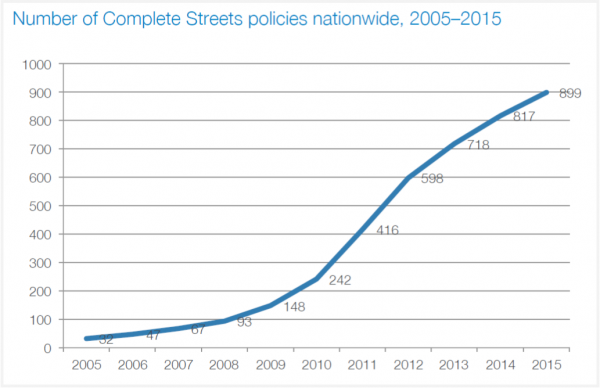
West Hartford’s Complete Streets policy, adopted in 2015, has been named the second best new policy in the nation by Smart Growth America and the Complete Streets Coalition. The coalition highlighted 16 communities nationwide for their outstanding new policies, among 82 communities that adopted Complete Streets policies during the year.  Nationwide, there are now a total of 899 Complete Streets policies in place in all 50 states, the organization announced this month. A Complete Streets approach creates an integrated transportation system that supports safe travel for people of all ages and abilities. This approach redefines what a transportation network looks like, which goals a public agency sets out to meet, and how communities prioritize their transportation spending. A Complete Streets policy is one of the best ways to set this approach into motion, Smart Growth American emphasized.

TOP 10 LISTThe U.S. Surgeon General and Secretary of Transportation both spoke out for more Complete Streets last year and Congress passed a transportation bill that included Complete Streets language for the first time ever.

The Complete Streets laws, resolutions, agency policies, and planning and design documents establish a process for selecting, funding, planning, designing, and building transportation projects that allow safe access for everyone, regardless of age, ability, income or ethnicity, and no matter how they travel.

Across the country, 32 state governments or agencies, 76 regional organizations, and 663 individual municipalities have all adopted such policies to create safer, multimodal transportation networks.

West Hartford’s policy is the result of a process that began in 2009 with the adoption of the Town’s 2009-2019 Plan of Conservation and Development,” according to town Deputy Mayor Shari Cantor.  She said the plan “promote[s] an integrated and balanced “complete street” transportation system which provides the best possible service, mobility convenience and safety while reinforcing a positive social, economic, and environmental influence on West Hartford.report

“Utilizing a comprehensive public participatory process, guided by the leadership of the Town Council; the advocacy efforts of various community groups in West Hartford including our Bicycle Advisory Committee, and the work of our Town staff; we were able to develop and adopt this tremendous Complete Streets Policy,” said Mrs. Cantor in response to the national recognition.

Each year, the National Complete Streets Coalition analyzes newly passed Complete Streets policies. The Coalition examines and scores policy language using the guidelines laid out in our ideal policy elements. Ideal policies state a community’s vision for transportation, provide for many types of users, complement community needs, and establish a flexible project delivery approach. Different types of policy statements are included in the Coalition’s review, including legislation, resolutions, executive orders, internal policies, and policies adopted by an elected board.

The Coalition ranks new Complete Streets policies to celebrate the people who developed exceptional policy language and to provide leaders at all levels of government with examples of strong Complete Streets policies.

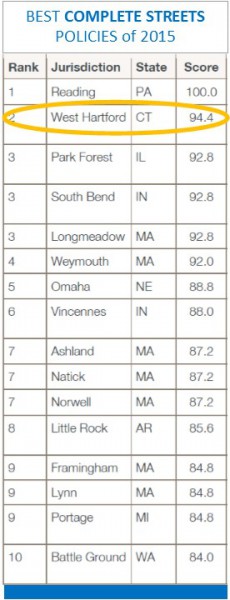
Sixteen agencies led the nation in creating and adopting comprehensive Complete Streets policies in 2015. Topping the list, with the first-ever score of 100, was Reading, PA, followed by West Hartford, Park Forest, IL and South Bend, IN.  Four of the next seven slots went to communities in Massachusetts:  Longmeadow, Weymouth, Ashland, Natick and Norwell.  The others were Omaha, NE and Incennes, IN.

Of the 663 municipalities with Complete Streets policies, 239 (or 36 percent) are suburban communities. Small towns, often in rural areas, have passed 111 policies, or 17 percent of all municipal policies. On the other end of the spectrum, 12 of the 15 most populous cities in the country have committed to Complete Streets with a policy, according to the organization’s 2015 report. Blue_Back_Square_in_West_Hartford,_Connecticut,_August_10,_2008

“A Complete Streets approach is about helping everyone stay safe on the road—no matter if they’re walking, biking, taking transit, using an assistive device, or driving,” said Emiko Atherton, Director of the National Complete Streets Coalition. “Passing a Complete Streets policy is one of the best actions communities can take toward achieving these goals.”

Connecticut became the 10th state in the nation to adopt a Complete Streets law, in 2009.  The law mandates “accommodations for all users shall be a routine part of the planning, design, construction and operating activities” of all state highways. Connecticut’s Complete Streets law has evolved, and now (Conn. Gen. Stat. §13-153f) requires pedestrians, cyclists, and transit users to be routinely considered in the planning, designing, construction and operation of all roads.

In 2014, Bike Walk Connecticut released a first-of-its-kind ranking of the state’s cities and towns on how bike- and walk-friendly they are. Simsbury (1), New Haven (2), New Britain (3), Glastonbury (4), and Middletown (5) claimed top honors as the five most bike- and walk-friendly communities.

Esga-logoarlier this year, the University of Connecticut released a study that shows how shared space, a design concept that encourages all users to share street space, can provide much greater vehicular capacity than conventional intersections and increases pedestrian convenience. The study found that by redesigning streets and intersections as human-scaled places and incorporating shared space concepts, communities of all sizes have successfully encouraged active transportation, stimulated their local economies, reduced accident severity, and lessened their environmental impacts. The study compared actual user delays at six shared space intersections to expected user delays using standard U.S. traffic modeling software.  The state Department of Transportation issued a policy document in 2014 consistent with the law.

The criteria used in the Complete Streets evaluation include:

  1. Vision: The policy establishes a motivating vision for why the community wants Complete Streets: to improve safety, promote better health, make overall travel more efficient, improve the convenience of choices, or for other reasons.
  2. All users and modes: The policy specifies that “all modes” includes walking, bicycling, riding public transportation, driving trucks, buses and automobiles and “all users” includes people of all ages and abilities.
  3. All projects and phases: All types of transportation projects are subject to the policy, including design, planning, construction, maintenance, and operations of new and existing streets and facilities.
  4. Clear, accountable exceptions: Any exceptions to the policy are specified and approved by a high-level official.
  5. Network: The policy recognizes the need to create a comprehensive, integrated and connected network for all modes and encourages street connectivity.
  6. Jurisdiction: All other agencies that govern transportation activities can clearly understand the policy’s application and may be involved in the process as appropriate.
  7. Design: The policy recommends use of the latest and best design criteria and guidelines, while recognizing the need for design flexibility to balance user needs in context.
  8. Context sensitivity: The current and planned context—buildings, land use, transportation, and community needs—is considered in when planning and designing transportation solutions.
  9. Performance measures: The policy includes performance standards with measurable outcomes.
  10. Implementation steps: Specific next steps for implementing the policy are described.

The National Complete Streets Coalition, a program of Smart Growth America, is a non-profit, non-partisan alliance of public interest organizations and transportation professionals committed to the development and implementation of Complete Streets policies and practices. A nationwide movement launched by the Coalition in 2004, Complete Streets is the integration of people and place in the planning, design, construction, operation, and maintenance of transportation networks.

national chart

Paid Family Medical Leave Has Broad Support in CT, Survey Shows

Eighty-two percent of registered Connecticut voters age 45-plus and a similar majority of voters age 25-plus, 83 percent, support a paid family medical leave plan now being considered by the state legislature, according to a recent survey by AARP Research.AARP-CT-logo The large majority is also present across the ideological spectrum, with 94 percent of registered Democrats, 79 percent of independents and 68 percent of Republicans indicating their support for state paid family medical leave to support Connecticut workers and family caregivers.

pie chartOne-thousand state voters age 25-plus were asked two questions about the paid family medical initiative, whether they supported such a plan, and whether they would support political candidates who did.

Among the 83 percent over age 45 who said they supported a paid family medical leave plan, 65 percent indicted they strongly supported such a plan, which would give employees an opportunity to contribute to and utilize a limited amount of paid leave from work to care for themselves or a loved one who is recovering from a serious medical condition.

“Connecticut voters overwhelmingly support paid family leave for workers,” said Nora Duncan, AARP CT state director. “We urge lawmakers to give serious consideration to passage of SB 221, An Act Concerning Paid Family and Medical Leave, in the remaining weeks of the 2016 legislative session. Voters are clearly interested in this policy and will make it a part of their considerations at the ballot box this fall.”

Asked if they would support a candidate for state elections who worked to implement a paid family leave plan that included working caregivers, 74 percent indicated their support, with half saying they would strongly support such a candidate. chart 2

SB 221 would create a statewide system of paid family and medical leave for workers needing time off to care for themselves, an ill loved one or a new baby. The system that’s being suggested would be fully funded by employees with no employer contribution. According to The Institute for Women’s Policy Research, the cost to Connecticut employees would be very low at just about one half of one percent of someone’s income.

Nearly half (46 percent) of registered voters in Connecticut ages 45-plus say they are currently providing or have provided unpaid caregiving to an adult loved one.  Among them, two in three (63 percent) say they have been employed either full or part time while providing that care, the survey found.

Versions of paid family medical leave laws have been approved in California, New Jersey, Rhode Island and Washington.  California's law took effect in 2004, New Jersey's in 2009 and Rhode Island's in 2014.  Washington's has yet to take effect.

Indiana Insurance Department to Hold Hearing on Anthem Acquisition of CIGNA on April 29

The Indiana Insurance Department will consider the proposed acquisition of Bloomfield-headquartered CIGNA Health Care by Indianapolis-based Anthem, Inc. at a public hearing on Friday, April 29 in Indianapolis.indiana “Any member of the public interested in the proposed acquisition of control may attend the hearing,” indicates a public notice of the hearing. In addition, “Any policyholder of Cigna HealthCare of Indiana, Inc., or other person whose interests may be affected by the proposed acquisition of control shall have the right to appear and become party to the proceeding.”

Officials indicated that written testimony could be mailed in lieu of an in-person appearance, and would be considered. Members of the public may make written submissions  without appearing in person at the hearing. Length of submissions should not exceed 5 pages, double-spaced. Officials indiated that submissions should be sent to John Murphy, outside counsel to the Commissioner in this matter, by close of business on April 26, 2016. Contact information is: John T. Murphy, ICE MILLER LLP, One American Square, Indianapolis, IN  46282, (317) 236-2292, john.murphy@icemiller.com  [this information was updated on 4/19]


Consumer Groups, State Comptroller Call for Full Review

Among those aligned in opposition to the acquisition is the American Medical Association, noting that the deal would make the combined firm the nation’s largest insurer by membership and also give the company a tremendous amount of leverage when negotiating with providers.  In a press release, AMA President Steven J. Stack, MD, said such proposed mergers threaten to reduce competition and choice. “To give commercial health insurers virtually unlimited power to exert control over an issue as significant and sensitive to patient health care is bad for patients and not good or the nation’s health care system.”

Anthem and CIGNA suggested that the deal will create new efficiencies that will make the healthcare market function more efficiently.  A website, www.betterhealthcaretogether.com, has been established to highlight the companies commitment to “drive health care innovation.”

Last month, a coalition of consumer and medical organizations in Connecticut called for greater public input into the Connecticut Insurance Department’s review of the proposed Anthem-CIGNA  mega-merger, expressing concerns about the potential “negative impact on both the cost and quality of care in Connecticut” of that acquisition and the proposed Aetna-Humana merger. The groups – Universal Health Care Foundation, Connecticut Citizen Action Group and the Connecticut State Medical Society – formed the “Connecticut Campaign for Consumer Choice” coalition and urged state Insurance Commissioner Katherine Wade to “ensure an open, transparent hearing process in Connecticut, where policy holders, physicians and other interested parties are given maximum opportunity to share their views.” The coalition has been conducting public information sessions, including one in Mansfield this week, to provide state residents with information on "what the proposed health care mergers will mean for Connecticut consumers."

A week ago, State Comptroller Kevin Lembo, in a letter to the Department, urged an open and thorough review in order to address significant concerns raised by health care consumers and providers.  Lembo expressed his support for the efforts of the Connecticut Campaign for Consumer Choice, noting that a merger between Anthem and Cigna would increase the Connecticut health insurance concentration over 40 percent.   Lembo indicated that only Georgia is expected to experience a more significant increase in market concentration.

CIGNA Questions Anthem; Feds Question CIGNA

A week ago, Modern Healthcare, a web publication focused on healthcare business news, raised questions about the absence of detail in the year since Anthem disclosed “what was by far the largest data breach in healthcare history.  The cyberattack—in which hackers stole the names, birth dates, Social Security numbers, home addresses and other personal information of 78.8 million current and former members and employees – caused consumers to question “whether Anthem and other healthcare organizations could manage the volumes of data they had,” according to the news report. anthem-cigna-logos-thumb-400

The publication also questioned whether state regulators would consider not only the breach, but CIGNA’s reaction to it at the time:

“Trust with customers and providers is critical in our industry, and Anthem has yet to demonstrate a path towards restoring this trust,” CIGNA CEO David Cordani and former Board Chairman Isaiah Harris Jr. wrote in a June 21, 2015 letter: “We need to understand the litigation and potential liabilities, operational impact and long-term damage to Anthem's franchise as a result of this unprecedented data breach, as well as the governance and controls that resulted in this system failure.”  It was estimated that in Connecticut, about 1.7 million people were affected.

In January, published reports indicated that U.S. regulators temporarily banned CIGNA-HealthSpring from offering certain Medicare plans to new patients after a probe uncovered issues with current offerings, citing that CIGNA’s deficiencies “Create a Serious Threat to Enrollee Health and Safety.”  CIGNA disclosed that the U.S. Centers for Medicare and Medicaid Services (CMS) had suspended the company from enrolling new customers or marketing plans for CIGNA Medicare Advantage and Standalone Prescription Drug Plan Contracts. CIGNA acquired HealthSpring in 2012.CMS_logo

In an enforcement letter, CMS accused CIGNA of "widespread and systemic failures," including the denial of health care coverage and prescription drugs to patients who should have received them. The actions "create a serious threat to enrollee health and safety," said CMS, which required CIGNA to appoint an independent monitor to audit its handling of the matter.

“Cigna has had a longstanding history of non-compliance with CMS requirements. Cigna has received numerous notices of non-compliance, warning letters, and corrective action plans from CMS over the past several years. A number of these notices were for the same violations discovered during the audit, demonstrating that Cigna has not corrected issues of non-compliance,” said the 12-page enforcement letter from the Director of the Medicare Parts C and D Oversight and Enforcement Group.

CIGNA, First in Connecticut

Nearly five years ago, in July 2011, CIGNA announced it was to receive $50 million in economic benefits from the Connecticut Department of Economic and Community Development with the promise of adding at least 200 jobs the following two years, which would increase the company’s employment in the state to more than 4,000.  CIGNA also declared Bloomfield its corporate headquarters in the United States, replacing Philadelphia which had been the company’s corporate headquarters since 1982.gov_first_five_a

CIGNA was the first company to receive economic incentives under Governor Dannel Malloy’s “First Five” program, which was designed to spur job growth and support Connecticut businesses in becoming more competitive in the global marketplace. “CIGNA is proof that these tools work and that Connecticut is open for business,” Malloy said at the time.

“Through this partnership with the Governor and the state, we are building upon our long history in Connecticut,” added CIGNA Chief Executive Officer David Cordani.

Anthem's application states it has "no current plans or proposals to reduce in any material respect the number of employees employed by the Cigna companies."  The $54 billion merger would increase Anthem's membership from 38 million to 53 million members nationwide.

Approval in Florida, Concerns in California

“There are no meaningful adverse impacts resulting from the acquisition,” Florida’s Insurance Commissioner said last week in approving the acquisition in his state. “The companies, individually or in combination, are an important part of, but not a dominant factor in, the Florida market, and their combination does not noticeably increase the market concentration across the broadly measured market on a statewide basis.”

In California, the combined membership of Anthem Blue Cross and Cigna would make it the largest insurer in the state with more than 8 million members.  At a public hearing in California last month convened by that state’s Insurance Department, consumer advocates and the AMA opposed the acquisition.

"This merger would create the nation's largest insurer, which could have a significant impact on California's consumers, businesses, and the healthcare marketplace," said California’s Insurance Commissioner. "I am considering what is best for consumers and the overall marketplace. Anthem and Cigna bear the burden of demonstrating this proposed merger is in the best interest of California consumers and the health-care marketplace."

Shareholders of Anthem and Cigna voted overwhelmingly in favor of the merger plan late last year, and regulators in 26 states where the companies operate are at various stages of considering the acquisition.  Attorneys General in a number of those states, including Connecticut, are looking into the proposed acquisition on anti-trust grounds, and the U.S. Department of Justice has the final authority to approve the deal, published reports indicate.California_Department_of_Insurance_seal

The news site Business Insurance reported soon after the acquisition was announced that “viewed in tandem with rival Aetna Inc.'s recent $37 billion merger agreement with Humana Inc.— as well as St. Louis-based health insurer Centene Corp.'s proposed acquisition of Woodland Hills, California-based Health Net Inc. for $6.3 billion — experts said regulators may be more stringent in examining the Anthem/Cigna deal's potential to dampen health insurer competition.”

Former Hometown Stamford, Public Television Launch Ken Burns' Documentary on Jackie Robinson

As the 2016 major league baseball season begins, the eyes of the nation – and his former hometown of Stamford – will once again turn to the remarkable legacy of Jackie Robinson. A new documentary by acclaimed film director Ken Burns, titled Jackie Robinson, premieres Monday, April 11 at 9 p.m. and continues Tuesday, April 12 at 9 p.m. on PBS and CPTV. To kick-off the program’s debut, the Connecticut Public Broadcasting Network (CPBN) will host a special tribute to Jackie Robinson at The Palace Theatre, Stamford on Friday, April 8 at 7 p.m. The event will include live jazz music by award-winning saxophonist Albert Rivera, and commentary and a Q&A session with ESPN commentator and former Major League Baseball player Doug Glanville.Jackie_Robinson_Title_878x494

Although not a Connecticut native, Robinson lived in Stamford for nearly 20 years, having moved to the community while a member of the Brooklyn Dodgers in 1954.  Robinson, known world-wide for breaking the color barrier in major league baseball in 1947, died of a heart attack in 1972, at age 53.

The evening will include an advance preview screening of the new two-part documentary by Ken Burns. The story of the first African American to play baseball in the major leagues features interviews with President Barack Obama, Harry Belafonte, Tom Brokaw, and others who share how Robinson’s determination and heroism influenced generations.12191994_10153655136803080_6232117043660408872_n

Upon arriving in Stamford, Robinson and his family lived with Richard Simon, co-founder of Simon and Schuster, and his wife, Andrea and their family at their North Stamford home before building a home on Cascade Road in North Stamford. The Simons’ daughter, singer/songwriter Carly Simon, recalled going with Robinson to Ebbets Field to see the Brooklyn Dodgers when she was young, the Greenwich Time recently reported.

parkStamford has a public park named in his honor, recalling that Robinson represented tolerance, educational opportunity, and the confidence that inspires personal achievement and success. A life-size bronze statue of Jackie Robinson with an engraved base bearing the words “COURAGE,” “CONFIDENCE,” AND “PERSEVERANCE” stands in the park located on West Main Street, the gateway to downtown Stamford.

Just weeks ago, Jackie Robinson’s daughter Sharon and her mother Rachel accompanied President Obama to Cuba, and joined him and the United States delegation at an exhibition baseball game.  She told mlb.com:

robinson“It brought back very personal memories of my father talking about his trip to Cuba in 1947, when the Brooklyn Dodgers trained in Havana. At the time, dad was a member of the Dodgers' farm team, the Montreal Royals. Branch Rickey arranged for him to fly to Cuba for an exhibition game, just a couple of months before he broke down baseball's color barrier in the United States. To me, this connection to my father almost brought me to tears. I was watching a baseball game in the same stadium nearly 70 years later.”

In the two-part documentary, Ken Burns “reveals fascinating stories about the legend’s life on and off the field.”  In part one, Robinson “rises from humble origins to integrate Major League Baseball, performing brilliantly despite the threats and abuse he faces on and off the field and, in the process, challenges the prejudiced notions of what a black man can achieve,” according to PBS.  In part two, Robinson” uses his fame to speak out against injustice, alienating many who had once lauded him for ‘turning the other cheek.’” After baseball, during his years in Stamford, “he seeks ways to fight inequality, but as he faces a crippling illness, he struggles to remain relevant.”

The documentary “paints the picture of a man who challenged institutional racism in the face of harsh criticism. It also delves into his close-knit relationship with his wife, Rachel, and their children through candid interviews and personal family photos.”

In 1997, Major League Baseball “universally” retired his uniform number, 42, across all major league teams; he was the first pro athlete in any sport to be so honored. Initiated for the first time on April 15, 2004, Major League Baseball has adopted a new annual tradition, “Jackie Robinson Day,” in which all players on all teams wear #42.

Of his interest in sharing Robinson’s story, director Ken Burns said, “There was so much more to say not only about Robinson’s barrier-breaking moment in 1947, but about how his upbringing shaped his intolerance for any form of discrimination and how after his baseball career, he spoke out tirelessly against racial injustice, even after his star had begun to dim.”

My dad once said, "A life is not important except in the impact it has on other lives," Sharon Robinson recently recalled.