How Does Your Health Insurance Plan Stack Up? There’s A Resource for That

Connecticut’s Insurance Department has issued its 2018 Consumer Report Card on Health Plans in Connecticut, providing consumers with an updated snapshot of 12 health carriers in the Connecticut marketplace.  The goal:  to help consumers make informed choices when choosing a health plan. “The Department’s annual Report Card is designed to deliver side-by-side comparisons of health carriers across a variety of quality measures, including coverage for mental health and substance abuse treatment,” Commissioner Katharine L. Wade said recently. The analysis includes health claims, mental healthcare, pregnancy coverage and preventative care, and reviews the reasons cited in instances of denial of coverage. 
Among the trends identified in the latest annual report care are:

  • Total enrollment over 2.2 million, a slight increase from 2016.
  • 5 percent of those covered (1.85 million people) get their insurance from large group plans
  • 131,000 people have individual plans (5.9 percent)
  • 235,000 people are covered under small group plans (10.6 percent)

The 72-page data-filled report card also notes that there was an increase in the number of primary care providers, specialists and pharmacies participating in health plan networks. There was a decline in the number of participating hospitals, officials indicated, but attributed it “primarily due to consolidations in the industry and not facilities closing.”

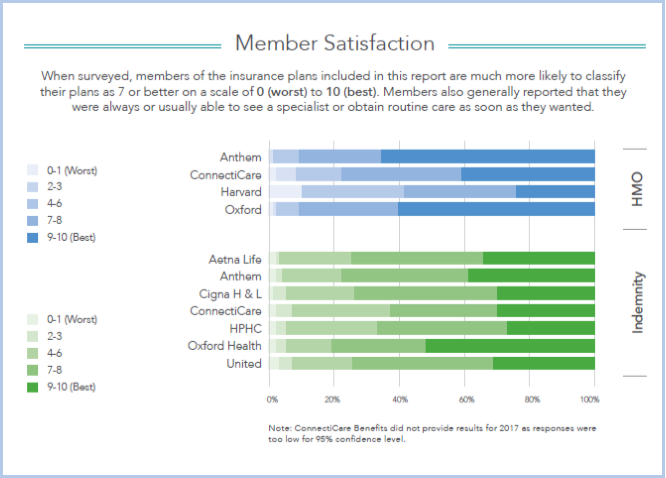
Customers surveyed said they were always or usually able to see a specialist or get routine care as soon as they wanted.  The enrollment breakdown in Connecticut is lopsided.  Among HMO's, Anthem has 81% of the market, ConnectiCare 17%, Oxford 2%.  Among indemnity enrollments, Anthem has 42%, followed by Aetna's 20%, CIGNA's 19%, United's 7% and ConnectiCare's 5%.

The report card, issued this fall,  includes “terms” that consumers should know, a series of frequently asked questions and answers, and results of a member satisfaction survey for HMO’s Anthem, ConnectiCare, Harvard Pilgrim and Oxford Health.  Indemnity insurers Aetna Life, Anthem, CIGNA, ConnectiCare, Harvard Pilgrim, United Health and Oxford Health also had members surveyed on a range of “satisfaction” queries.

This report includes three years of data, where available, to be informative for consumers, officials said.  The data utilized was through 2017.

The mission of the Connecticut Insurance Department is to protect consumers through regulation of the industry, outreach, education and advocacy. The Department recovers an average of $4 million yearly on behalf of consumers, according to officials, and regulates the industry by ensuring carriers adhere to state insurance laws and regulations and are financially solvent to pay claims.

Each year, the Department returns an average of $100 million a year to the state General Fund in license fees, premium taxes, fines and other revenue sources to support various state programs, including childhood immunization. The Department’s annual budget is funded through assessments from the insurance industry.

Individuals with questions or seeking further information may contact the Department at  insurance@ct.gov or 860-297-3900.
Most Expensive States for Car Insurance? CT Ranks Fifth in Survey of 50 States

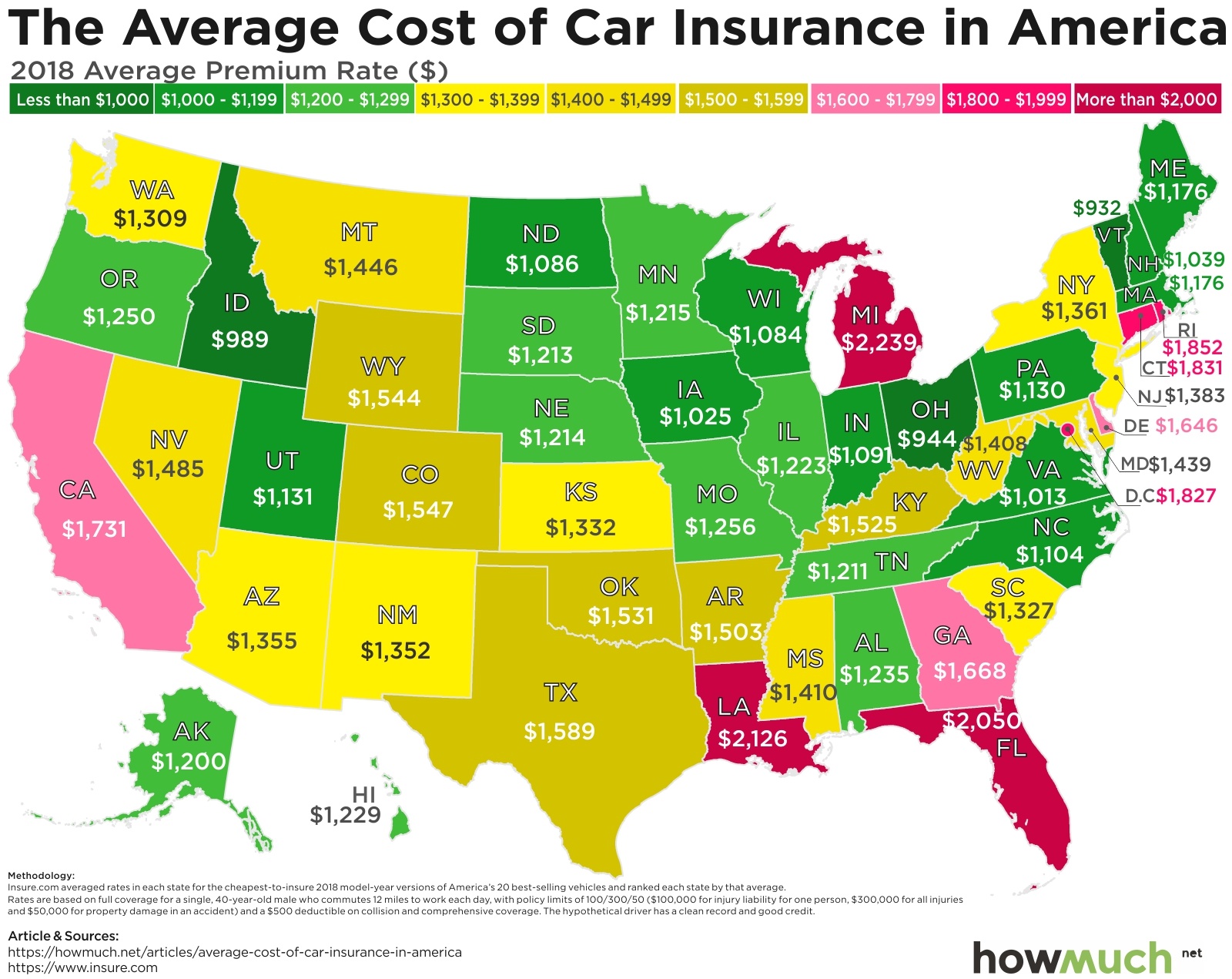
Connecticut is fifth, but Michigan has been first for five consecutive years in an annual comparison of car insurance rates.  Connecticut is 34 percent more expensive than the national average, according to the criteria used in the state-to-state comparison. When the website insure.com looked to compare car insurance rates, they worked with Quadrant Information Services to calculate car insurance rates for a 40-year old man seeking full coverage from six different major carriers. They tabulated the price quoted in 10 zip codes for every state, looking for the average of a 2018 model-year version of America’s 20 best-selling vehicles.

Their finding: car insurance rates can vary widely depending on the state you call home, and numerous other factors. Connecticut was near the top – in the middle of the top ten most expensive states for car insurance, based on this criteria.  A year ago, Connecticut ranked third.

The website’s analysis pointed out that high vehicle density is one culprit for higher than average premiums. They noted that Connecticut is the fourth densest state in the country and “tons of cars piled into a small space leads to accidents, which leads to claims, which ends in high car insurance rates.”

The top five states with the highest rates were Michigan ($2,239), Louisiana ($2,126), Florida ($2,050), Rhode Island ($1,852) and Connecticut ($1,831).  Rounding out the top ten most expensive states for car insurance, according to the survey, were Washington DC ($1,827), California (1,731), Georgia ($1,668), Delaware ($1,600), and Texas ($1,589).

Across the Northeast, Vermont ranks lowest in the entire country at just $932.  New Hampshire was also among the lowest, at $1,039.  Massachusetts ranked number 38, with an annual premium of $1,176.

Next Wave of Insurtech Startups Prepare to Descend on Hartford

Will insurance be as much the story of Hartford’s future as it was in the Insurance City’s past?  It is a distinct possibility if the combination of a strong insurance pedigree and receptivity to technological innovation come together as the organizers of the Hartford InsurTech Hub hope. Early next year, the city will witness the arrival of the next wave, as 10 startups arrive to participate in three months of activity, powered by Startupbootcamp, as part of the 2019 cohort for its acceleration program, hosted at Upward Hartford downtown.

Hartford InsurTech Hub is an initiative established in 2017 by Hartford insurance companies, the City of Hartford, and CTNext. The initiative is focused on addressing the need to attract new technologies and talent in insurance and technology into Hartford and the local ecosystem. Selected from more than 230 applications, each startup will relocate to Hartford for the start of the program in February and will remain for its three-month duration.

The chosen startups cover a wide range of abilities, from property insurance claims to peer-to-peer (P2P) insurance, and exhibit a variety of technologies and insurance types. Participating startup companies will receive support, resources, and industry and investor connections to help grow their businesses. With support from Startupbootcamp, the teams will be provided with access to an extensive range of partners, mentors, and investors from across the accelerator’s global network.

The 10 startups that will join the second year of the Hartford InsurTech Hub acceleration program will work closely with Hartford InsurTech Hub’s insurance corporate partners: Aetna, Capgemini, Cigna, Clyde & Co., Deloitte, The Hartford, Travelers, USAA, White Mountains and CTNext.

Sabine VanderLinden, CEO at Startupbootcamp InsurTech, explained that “The insurance industry is continuously evolving and technology is having a huge impact. InsurTech of the past has been about enhancing retail-based offerings with improved customer engagement. InsurTech of today is focused on business model innovation and reconfiguring value chains—something we are committed to developing in Hartford.”

The startups include:

  • Pineapple: Pineapple offers a fair, transparent, and affinity based P2P insurance and they’re coming to Hartford from South Africa.
  • handdii: Coming from Australia, handdii is a digital platform that automates the property insurance claim process from FNOL through to claim finalization.
  • Dream Payments: Dream Payments is a Fintech startup from Canada that powers digital and mobile payment services for business customers.
  • Pitch Gauge: Pitch Gauge, from Georgia, is a roofing estimating application using mobile devices to do property inspections.
  • Medyear: From New York, Medyear is a social network for healthcare collaboration. They connect consumers to over 190 health systems and 700k doctors for real-time chat, secure email, microblogging, and personal health records.
  • SkyWatch: SkyWatch is a licensed insurance broker in all 50 US states offering a holistic software solution for on-demand risk-aware solutions for connected, moving platforms. They’re originally from California.
  • Talem Health Analytics: Coming from Canada, Talem Health Analytics provides data driven insights on bodily injury claims cost.
  • See Your Box: See Your Box provides Industrial IoT tools to digitize supply chains. SYB is a tech-service platform that collects, analyses and extracts information related to goods across all steps of the supply chain and is coming to Hartford from Switzerland.
  • ClaimSpace: Coming from Australia, ClaimSpace is a platform that bridges the communication gap between customers, insurers and stakeholders during the claims process.
  • CareValidate: Powered by a life-saving light bulb called SafeLight, CareValidate provides health, safety, and quality of care telematics to transform workers’ compensation, senior living, long-term care, life, and health insurance products with plug-and-play insurtech solutions. They’re originally from Georgia.

VanderLinden added: “We have built strong foundations over the last 18 months and we’re on the way to transforming the city of Hartford into the InsurTech capital of the United States. There’s still much to do and I am therefore delighted to be welcoming some truly inspiring teams into the next program in Hartford to continue this transformation.”

The insurance industry employs just over  60,000 people in Connecticut, up 2.6 percent from last year, according to PwC’s 2018 Connecticut insurance market brief, released earlier this month.  The second Insurtech class of startups hopes to grow that number.  Some of the participants in the inaugural class a year ago are still in town, planting roots and Hartford and growing rapidly.

Hartford InsurTech Hub is part of Startupbootcamp, the award-winning global network of industry-focused accelerator programs that help startups gain access to relevant mentors, partners, and investors in their industries.


Connecticut Ranks Third in U.S. in Preventing Youth Homelessness; Grant to Support Efforts

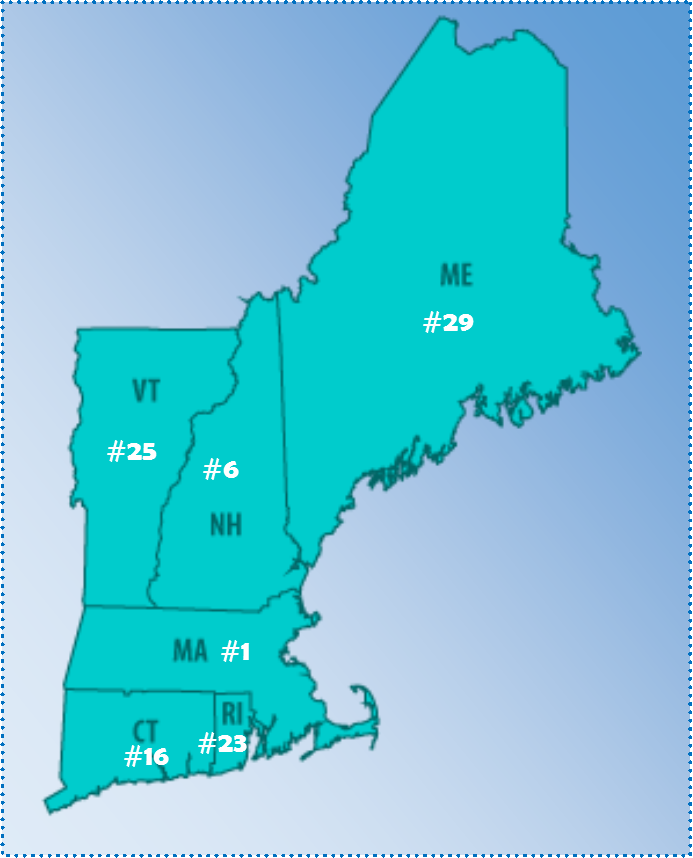
Washington, Massachusetts, and Connecticut are the most successful states at preventing youth homelessness, with Connecticut ranking third in the nation, according to the 2018 State Index on Youth Homelessness.  The report, by the True Colors Fund in partnership with the National Law Center on Homelessness & Poverty, analyzed 61 metrics in the 50 states and the District of Columbia. Homelessness is defined as experiences of sleeping in places not meant for living, staying in shelters, or temporarily staying with others while lacking a safe and stable alternative living arrangement. Alabama, South Carolina, Wyoming, and Arkansas were the least successful states at preventing youth homelessness.

In recent weeks, it was announced that Connecticut will use $6.5 million in federal grants to provide housing opportunities for homeless youth, building on its successful track-record. The grants will fund new, innovative housing assistance programs for young adults as part of a coordinated housing continuum that assures those in need can quickly obtain permanent housing and necessary supports, according to state officials.

The grants were allocated as part of a competitive process through the U.S. Department of Housing and Urban Development’s (HUD) new Youth Homelessness Demonstration Program (YHDP). To date, Connecticut has been awarded the largest grant of any jurisdiction in the country.

Building off the state’s nationally recognized progress in ending homelessness under the Malloy administration – which includes being the first state in the nation certified for ending chronic veteran homelessness, being one of only three states certified for ending general veteran homelessness, and matching all chronically homelessness individuals to housing – the state has set a goal of ending both youth and family homelessness by the end of 2020.

Speaking last week before a legislative working group, Gov. Malloy said “Nothing I suspect is more shattering as a child than to find oneself homeless – or even as a young adult – so I’m particularly happy over this past year that we’ve been able to fund a number of units designed specifically to meet the needs of younger homeless individuals.”

Overall, at the start of the year, homelessness in Connecticut was at a record low, according to a report from The Connecticut Coalition to End Homelessness.  It found that homelessness in the state has decreased for a fifth consecutive year and was at its lowest level to date. The report found that, as of Jan. 2018, roughly 3,300 people were homeless in Connecticut.  The Connecticut Coalition to End Homelessness states that overall homelessness in the state is down 25 percent from 2007.

Since 2011, the state Department of Housing and the Connecticut Housing Finance Authority have created, rehabilitated, or committed funding for nearly 25,000 units of housing – approximately 22,000 of which are affordable to low and moderate income individuals and families, officials point out. This represents a state investment of more than $1.42 billion, which has been matched by over $2.45 billion from other financial sources, including the private sector.


Hartford Ranked 3rd in U.S. for Women in Business

If you’re a woman in business, Hartford is among the best places in the nation to be.  That’s according to a new analysis by the website ShareFile, which ranked Hartford as the third best place in the U.S. for businesswomen.  Hartford ranked seventh a year ago. The “Businesswomen Power City Index” was developed by evaluating the 50 largest cities in the U.S. to determine where the best locations are for women to achieve business success, according to ShareFile.  The index ranks cities based on the percentage of women-owned businesses, executive jobs held by women, women vs. men wage gaps and the buying power of women, which is based on the cost of living and the average wages earned by women.

Hartford has jumped four places from 2017, as a result of a higher percentage of women-owned businesses (up 1.4%), according to the analysis.  Hartford’s ranking in the individual categories was:

  • 3rd (down from 2nd) in women’s buying power: 119
  • 6th (same as last year) in the percentage of women business executives: 31.9%
  • 16th (up from 22nd) in the wage gap between women and men: 18.1%
  • 31st (up from 42nd) in the percentage of women-owned businesses: 20.4%

The website points out that Hartford is home to the Women’s Business Center, located at the University of Hartford, which supports female entrepreneurs across the city and the state, offering advice, training, and events for women looking to expand their business.

Hartford is the only New England city in the top 20.  Providence, in the top 10 a year ago, fell out of the top 20.

Just ahead of Hartford, and retaining the top two positions in the ranking, were Baltimore and Tampa.  Rounding out the top 15 were Washington DC, Jacksonville, Raleigh, Denver, Orlando, Miami, Austin, Virginia Beach, Las Vegas, Sacramento, Los Angeles and Atlanta. Aside from the top two, no other city in the top 20 has remained in the same position as a year ago.

The analysis relies on data from four main sources, including the U.S. Census 2016 Annual Survey of Entrepreneurs, U.S Census Bureau 2015 American Community Survey 1-Year Estimates, Sperling’s Best Places and the Equal Employment Opportunities Commission. ShareFile is a cloud-based file sharing service, a Citrix Systems company, based in Raleigh.


Organizations Focused on Progress for Women and Girls Form Statewide Collective

It began as a casual conversation between Kate Farrar, Executive Director of the Connecticut Women's Education and Legal Fund (CWEALF) and Sharon Cappetta, Director of Development at The Community Foundation for Women and Girls, during the 2016 United State of Women Summit.  Now, it is a full-fledged and far-reaching network aimed at providing support and collaboration for organizations serving women and girls across Connecticut. The Connecticut Collective for Women and Girls (CCWG), launched last month with more than 20 members and six funders, gathered at Fairfield County’s Community Foundation to celebrate the beginning of the Collective. Members range from Girl Scouts to Planned Parenthood and the Commission on Women, Children and Seniors; the YWCA to The Alliance to End Sexual Violence and Connecticut Women’s Hall of Fame.

The Collective is a supportive network that unifies organizational members, facilitates collaboration, and bolsters their collective power to advance rights and opportunities for women and girls in Connecticut. CWEALF is the initiative's organizer.

“Now is the moment to come together to make progress for women and girls,” said Kate Farrar, Executive Director of CWEALF. “As the state’s leading champion for women and girls, CWEALF is thrilled to convene organizations across the state to increase our impact.”

Organizers say that while many organizations are doing critical work to transform the lives of women and girls in the state, too often, these organizations operate separately, leading to silos. The CCWG aims to “expand our strength as a collective force. It builds on participants’ individual assets with a community network of organizations that uplift and amplify each other’s work. The very act of coming together in this way increases each organization’s impact to advance rights and opportunities for women and girls in Connecticut.”

"Fairfield County’s Community Foundation’s Fund for Women & Girls is pleased to support the newly launched Collective. Collaboration, Diversity and Inclusion are core values of the Community Foundation’s. Through the Collaborative, partner organizations will develop a common language and requisite understanding of what is needed to advance gender equity," said Tricia Hyacinth, Director, Fund for Women & Girls. "Moreover, members, from all regions of the state, currently working independently, will achieve greater impact through their collective efforts."   

“The Community Fund for Women & Girls and The Community Foundation for Greater New Haven are delighted to support the Connecticut Collective for Women and Girls,” said Sharon Cappetta, Director of Development. “This emerging network of committed program providers are already doing great work with women and girls in the state. Together, working collectively, they strengthen their individual organizations and connect to potential partners, as well as bring attention and audiences to the gender implications of public policy in Connecticut. Our communities and our state benefit from targeted investments in nonprofit organizations, especially those who are working directly to advance women and girls.”

Other funders of the Collective are the Aurora Foundation for Women and Girls; The Community Foundation of Eastern Connecticut's Women and Girls’ Fund; the Women’s Fund at Connecticut Community Foundation; and the Main Street Community Foundation's Women & Girls’ Fund.  The Connecticut Collective for Women and Girls is guided by the following principles of gender equity, racial justice, LGBTQIA rights, civil rights, disability rights, ending and preventing violence, economic justice, reproductive rights, and immigrants’ rights.

Millennials Make the Most Money in Massachusetts; Connecticut Ranks 16th

If you were born between 1982 and 2000, and you live in Massachusetts, you’re making more money, on average, then people of your generation living elsewhere in the United States.  If you live in Connecticut, there are 15 states where the average salary for millennials is higher. Based on U.S. Census data analyzed by the website howmuch.com, the average salary for millennials in Connecticut is $69,600, compared with $80,307 in Massachusetts.  The states in between, reaching the top 10, are Minnesota ($77,090), North Dakota ($76,836), Washington, DC ($75,220), Maryland ($74,737), New Hampshire ($73,941), Wyoming ($73,345), Alaska ($72,374), New Jersey ($72,150), and Virginia ($71,397).

Also ahead of Connecticut are Utah ($71,284), South Dakota ($70,989), Nebraska ($70,870), Washington ($70,441), and Iowa ($69,739).

The analysis points out that millennials “are the most diverse generation in American history, more of them went to college than previous generations, and they are now the largest contingent in the workforce. Many of them also graduated in the middle of the Great Recession, which economists believe might have a lifelong impact on their wages.”

Geography also plays a role, according to the data.  The South, for example, “clearly stands out as a lackluster region for millennials in the labor market.”  In the Upper Midwest, salaries tend to be higher, and the same is true for much of the Northeast.

With the exception of Washington State, much of the west coast does not stand out.  “This highlights the fact that big tech companies are creating great jobs for a select group of skilled workers,” the analysis points out.

Millennials are making the least amount of money in Florida ($54,889), Mississippi ($53,269) and New Mexico ($51,893).

The data used is 2016 median household income for 25 to 44 year olds, taken from Census data and adjusted by Bureau of Economic Analysis regional price parity data, the most recent and comprehensive available.


CT Ranks 5th in Charitable Giving, Analysis Says

The residents of Connecticut are the fifth most generous in the nation, according to a new analysis.  The review of charitable giving by the financial website WalletHub, across the nation’s 50 states, found that Connecticut ranked:

  • 3rd – Percentage of Population Who Donated Money
  • 8th – Charities per Capita
  • 18th – Percentage of Donated Income
  • 19th – Volunteer Rate
  • 25th – Volunteer Hours per Capita

Overall, only Minnesota, Utah, New York and Maryland placed higher than Connecticut in the ranking of Most Charitable States.  Rounding out the top ten were Virginia, Georgia, Washington, New Hampshire and Wisconsin.

A year ago, Utah topped the list and Connecticut was just outside the top 10 at number 11.

The 18 key metrics used in the analysis were grouped in two categories weighed equally, Volunteering & Service and Charitable Giving.  Connecticut ranked 7th in the former and 14th in the latter.  The Volunteering & Service category included share of the population collecting or distributing food or clothes for people in need, volunteer hours per capita, and fundraising or selling items to raise money.  The Charitable Giving section included donating money and time, as well as the number of public charities, and share of the population donating time.

The least charitable states, according to the analysis, were Arizona, Rhode Island and Nevada.

Americans are among the world’s most generous people, WalletHub points out, ranking fourth out of 140 countries. U.S. donors in 2017 gave more than $410 billion to charity, with 70 percent of the funds coming directly from individuals, according to the National Philanthropic Trust.  In addition, nearly 63 million people volunteer in the U.S., serving a combined total of 7.9 billion hours per year, the equivalent of $184 billion of service.


https://youtu.be/t5lI9urlYkM


Impact of One Black Teacher Can Be Life-Changing, UConn Research Reveals

The influence of having a black teacher can significantly impact a black student’s life, and the effect begins early in an education.  Having just one black teacher in elementary school not only makes children more like to graduate high school – it also makes them significantly more likely to enroll in college, according to a new study co-authored by a University of Connecticut researcher. Black students who’d had just one black teacher by third grade were 13 percent more likely to enroll in college – and those who’d had two were 32 percent more likely.

The research paper, published this month by the National Bureau of Economic Research, observed that “Black teachers provide a crucial signal that leads black students to update their beliefs about the returns to effort and what educational outcomes are possible.”  In addition, “role model effects help to explain why black teachers increase the educational attainment of black students.”

The findings, from researchers at UConn, Johns Hopkins University, American University, and the University of California-Davis, were published recently in a working paper titled “The Long-Run Impacts of Same-Race Teachers.”  Another, related working paper by the same team titled “Teacher Expectations Matter,” also published by NBER, found teachers’ beliefs about a student’s college potential can become self-fulfilling prophecies.

In that research, every 20 percent increase in a teacher’s expectations raised the actual chance of finishing college for white students by about 6 percent and 10 percent for black students. However, because black students had the strongest endorsements from black teachers, and black teachers are scarce, they have less chance to reap the benefit of high expectations than their white peers, UConn Today reported.

“Black student students often don’t have parents or other black adults in their lives who have gone to college and gotten professional jobs,” Joshua Hyman told UConn Today.  Hyman, an assistant professor of public policy at UConn, who has a joint appointment in the Department of Educational Leadership in the Neag School of Education, co-authored the papers along with researchers from the three other universities.

“All it takes is one black teacher to influence a student,” he adds. “They see someone like them in their classroom and start to believe they can go to college too, and get a good job.”

The paper appears to be the first to document the long-term reach of the role model effect, UConn Today reported.  The researchers previously found that having at least one black teacher in elementary school reduced their probability of dropping out by 29 percent for low-income black students – and 39 percent for very low-income black boys.

In a New York Times op-ed last year, a ninth-grade teacher who has worked for 10 years in high schools and middle schools in the New York City area, and is Black, wrote this: “Black students need teachers who understand that they’re capable of the full range of anxieties and insecurities, greatness and success, hilarious moments and generous surprises. The amount of melanin in my skin is neither necessary nor sufficient for this: It’s not a magic formula. But I can remember a time when I looked and sounded like my students. That helps me see myself in them, and all they’re capable of. I hope they can see themselves in me.”

The latest findings are based on data from the Tennessee STAR class size reduction experiment that started in 1986 and randomly assigned disadvantaged kindergarten students to various sizes of classroom.  The researchers replicated the findings with similar data for North Carolina students.

The study found that black students who’d had a black teacher in kindergarten were as much as 18 percent more likely than their peers to enroll in college. Getting a black teacher in their first STAR year, any year up to third grade, increased a black student’s likelihood of enrolling in college by 13 percent.  Black children who had two black teachers during the program were 32 percent more likely to go to college than their peers who didn’t have black teachers at all.

“What’s very interesting about this paper is that it looks later in a student’s life,” says Hyman. “It’s impressive that the impression of having a black elementary school teacher last that long. It helps reduce the race gap.”

Additionally, students who had at least one black teacher in grades K-3 were about 10 percent more likely to be described by their 4th grade teachers as “persistent” or kids who “made an effort” and “tried to finish difficult work,” the researchers found. These students were also marginally more likely to ask questions and talk about school subjects out of class.

“One of the lingering issues of this paper is that we have to entice black people to enter the teaching areas,” Hyman points out. “In schools where there is a large black population, that has to be addressed.”


Failures in Federal Housing Policy Focus of Media Investigation, Hartford Concerns Highlighted

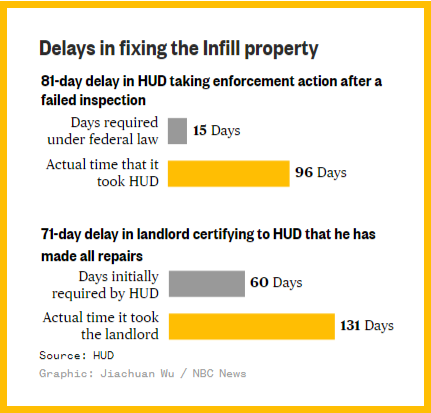
An NBC News investigation of the federal Department of Housing and Urban Development has found that more than 1,000 out of HUD’s nearly 28,000 federally subsidized multifamily properties failed their most recent inspection — a failure rate that is more than 30 percent higher than in 2016, according to an analysis of HUD records. When NBC broke the story last week of the agency’s dismal record of responding to conditions that at times have been described a “life-threatening,” the example cited most prominently was in Hartford.

The news report stated that “A federal housing inspection in February confirmed living conditions were abysmal … throughout the 52-unit Section 8 development known as the Infill apartments. The property scored only 27 points out of 100, far below the 60 points needed to pass the mandatory health and safety inspection.”  Infill is located in Hartford’s North End. 

“More than nine months after the inspection, federally mandated deadlines for action have come and gone, and residents say little has changed,” NBC’s Stephanie Gosk reported, despite “citations for exposed wiring, missing smoke detectors and bug infestations,” noted that “the Infill units racked up 113 health and safety violations — including 24 that HUD deemed ‘life-threatening.’”

“In one of Hartford’s poorest neighborhoods, a three-month investigation by NBC News found that HUD failed to comply with federal laws requiring prompt action against the owner of a property that authorities knew was unsafe, unhealthy and in disrepair, according to documents released through the Freedom of Information Act,” Gosk reported.

While the agency pointed out that 96 percent nationwide passed inspections, NBC reported that “HUD’s enforcement office, tasked with going after the worst landlords, now has the lowest staff levels since 1999, according to a federal watchdog.”

“In the case of Infill, though, HUD acknowledged that the landlord failed to deliver,” NBC News reported. “The owner provided certain assurances to our field folks that, in the end, did not happen,” HUD spokesman Brian Sullivan said in an email to NBC News. “That hasn't stopped the federal subsidies,” NBC News reported.

"It's a flow of money that continues to come," AJ Johnson, a local pastor who has helped the tenants organize, told NBC News.  “Whether it’s indifference or incompetence, the Trump administration’s failures in Connecticut and around the country cannot be excused. Someone must be held accountable,” said U.S. Sen. Chris Murphy, who led previous efforts to strengthen the HUD inspection process, NBC News reported. “Secretary [Ben] Carson owes it to these families to present a concrete plan for how he will make this better, and how he’ll make sure nothing like this ever happens again.”

Infill’s owner, meanwhile, is “set for years to come,” the NBC News report concluded.  “In July 2017, just seven months before the failed inspection, HUD renewed its contract with Isaacson for 20 years — a deal worth over $14 million.”

The NBC News investigation was reported, in addition to Gosk, by Suzy Khimm, Laura Strickler and Hanna Rappleye, and included interviews with numerous tenants of the property and other individuals in Hartford and Washington.