Connecticut College Earns Place on LGBT-Friendly List

Connecticut College in New London is included in the Campus Pride list of the top 50 LGBT-friendly colleges and universities for 2014, the only higher education institution in Connecticut to make the list. Campus Pride, founded in 2001, is a national nonprofit network of student leaders and campus groups devoted to improving college life for lesbian, gay, bisexual and transgender students across the United States.CC logo
This is the first time Campus Pride has expanded its "Best of the Best" list to 50 colleges. In previous years, the top 25 institutions were honored. Campus Pride executive director Shane Windmeyer said the larger number of honorees reflects the progress colleges and universities have made in improving safety and academic life for LGBT students.

The LGBTQ Resource Center on the Connecticut College campus “aims to serve the unique needs of Lesbian, gay, bisexual, transgender, queer and questioning students by providing a supportive space, resource library, social events and educational programming,” according to the school’s website.

“We are committed to understanding how homophobia and heterosexism interlink with sexism, racism, and classism to perpetuate oppression,” the Center website points out. The Center also serves as a resource for the entire College community to learn about issues related to sexuality and gender identity.CPIndexLogoStacked-1024x576

The Campus Pride top 50 list is based on data from the Campus Pride Index, which includes detailed reports on the policies, programs and practices toward LGBT students, faculty and staff at more than 425 college campuses.

Connecticut College received a top rating of five stars from Campus Pride, highlighting efforts to provide a safe and supportive academic life for LGBTQ students. Colleges are ranked on a scale of one to five stars by LGBT experts in higher education. The College first appeared on the list in 2013.

"I am delighted that Connecticut College has once again earned national recognition for one of our most deeply held values: our commitment to an inclusive campus community,” said Connecticut College President Katherine Bergeron. “Our learning environment is enhanced immeasurably through the diverse perspectives and experiences of each member of this campus."LGBTQ_Resource_Center_banner

"More than ever, colleges today want to be viewed as LGBT-friendly and a welcoming place for all students." Windmeyer said. "Upper-level administrators are now understanding how LGBT-friendliness is key to future institutional success."  Officials said the Campus Pride ranking has become a critical factor for LGBT students and their families when choosing a university.

Since the Resource Center opened on the Connecticut College campus in 2007, policies have improved every year, along with the number of services offered to the transgender community. Now transgender students are offered housing consistent with the personal identities and gender-neutral restrooms in campus residences and academic buildings. Training on transgender issues is readily available to students, faculty and staff.

Millennials Consider Company's Causes When Accepting A Job

Millennial employees – those born in the past 20 years - prefer joining a company-wide or team-specific volunteer project rather than merely donating to a fundraising campaign.  In addition, their decision to accept a job is influenced by the company’s connections to the community, and whether they are seen as making a difference in the world. Those are among the findings in the 2014 Millennial Impact Report, issued by Indianapolis-based Achieve.  millenials

The annual survey found that companies need to build relationships with millennial employees to spark their passions and create opportunities to engage both their professional and personal interests.  The findings indicated that employers should develop what was described as a triple platform of involvement – company-wide, department-based and interest-driven.

While only 39 percent of Millennials researched their company’s “cause work” prior to their interview, 55 percent said they were influenced to take their job after discussing cause work in their interview. Notably, 92 percent of the Millennials surveyed felt they were working for a company that was making a positive impact on the world.

In the Greater Hartford area, the survey findings would be no surprise to the leadership of HYPE (Hartford Young Professionals and Entrepreneurs).  Their mission, “to help young professionals become better engaged in community life,” responds to their generation’s strong desire to have a meaningful community connection, at work and in life.  HYPE, which is administered by the MetroHartford Alliance, has 4,000 members, and climbing.

Their efforts have been integral to Hartford’s efforts to promote a more vibrant downtown, and to boost involvement with a range of organizations and agencies that strengthen the fabric of the city.  The organization’s website offers nearly two dozen volunteer activities in the community for members, but makes clear that’s only the tip of the iceberg.  Greater New Haven has a similar organization, PULSE, a program of the Greater New Haven Chamber of Commerce and the Quinnipiac Chamber of Commerce.

Throughout the first four years of the Millennial Impact Project, the following trends emerged and evolved:report logo

  • Millennials engage with causes to help other people, not institutions.
  • Millennials support issues rather than organizations.
  • Millennials prefer to perform smaller actions before fully committing to a cause.
  • Millennials are influenced by the decisions and behaviors of their peers.
  • Millennials treat all their assets (time, money, network, etc.) as having equal value.
  • Millennials need to experience an organization’s work without having to be on site.millprefer-indep-cause-wk

The report indicates that "this is a generation that has grown up with a new way of learning. Asking questions in a non-linear fashion and then finding the answers -- all while connecting with their peers, friends and colleagues to make change happen. Today's Millennials are transforming communities, relieving suffering and pursuing social change in a way that may run counter to the traditional ways of organizing, but it's because they are wired to work differently -- collaboratively, transparently, interactively, and entrepreneurially -- to affect positive change in their local communities and around the world."

Achieve, in partnership with the Case Foundation, leads the national research team of The Millennial Impact Project, which they describe as the most comprehensive and trusted study on Millennial  (age 20-30) involvement with causes.

Connecticut Ranks #2 in Access to Justice, Report Concludes

The nonprofit National Center for Access to Justice has produced rankings on how well state court systems serve poor and disabled residents and other members of the public – and Connecticut is among the nation’s leaders. Connecticut ranks #2 overall in a composite index compiled by the organization, called the “Justice Index,” which includes a range of access factors.  The state ranks in the top 10 in each individual category, including access to attorneys, language assistance, disability assistance, and ease of self-representation.

The top 10 in the overall rankings (100 being highest), are:USA

  1. Washington, D.C. 80.9
  2. Connecticut 73.4
  3. Hawaii 69.9
  4. Minnesota 69.4
  5. New York 67.4
  6. Delaware 66.7
  7. Washington 65.6
  8. Colorado 65.6
  9. Wisconsin 65.2
  10. Tennessee 64.0

At the bottom of the list were Illinois (34.5), Kentucky (33.4) and Oklahoma (23.7).

The Justice Index is a snapshot of the degree to which certain selected best practices for ensuring access to the civil and criminal justice systems have been adopted across the country. The aggregate map shows summary views of the national and state-by-state commitment to providing access to the civil and criminal courts for some of the nation’s most vulnerable populations.  The report website includes maps illustrating state rankings in each of the categories.

Connecticut ranked #8 in the nation in the number of civil legal aid attorneys per 10,000 people in poverty.  The states ahead of Connecticut in the rankings were D.C., New York, Maryland, Hawaii, Arkansas, Massachusetts, and Oregon.  The data indicated that Connecticut also ranked in the top 10 (at #4, behind D.C., New York and Massachusetts) in the number of attorneys per 10,000 people, at 60.

NCAJThe report also indicated that more than 80% of litigants appear without lawyers in matters as important as evictions, mortgage foreclosures, child custody and child support proceedings, and debt collection cases. “Making courts user-friendly for these self-represented litigants is imperative if we are to keep the promise of equal justice for all,” the report indicated.  In comparing the 50 states’ systems for self-represented litigants, Connecticut ranked #9.  The top states were Hawaii, California, Delaware, Arizona, Iowa, Indiana, Washington, Massachusetts and Connecticut.

More than 25 million people in the United States have limited proficiency in the English language, according to the report.“ While many of these people use English at work and in their daily lives, understanding what happens in a courtroom can be more difficult. Many others have less facility with English and are lost in telling their story – whether inside the courtroom or speaking with court clerks – without the support of a trained and qualified interpreter and without translation of official court documents.” Here again, Connecticut’s justice system was among the best, ranking #3, behind only Delaware and Minnesota.legal system

In ranking the states for their support of people with disabilities, Connecticut joined five other states tied with a #1 ranking.  The other top-rated states were Colorado, Hawaii, Maine, Minnesota and Tennessee.  The report noted that ‘for those who cannot see, hear, speak or otherwise navigate a courthouse, or for those with emotional and cognitive challenges that make it difficult for them to participate in their own cases, access to justice depends on support from the justice system.”

The Justice Index was created by NCAJ with the pro bono help of Pfizer, Skadden Arps, other law firms in the Pfizer Legal Alliance, UBS, students at Cardozo School of Law and University of Pennsylvania Law School, Deloitte, and MSDS. The Justice Index measures selected elements of state justice systems and highlights statewide laws, rules, and policies.

Western CT State Ranks #1 in CT and #11 Nationwide in Promoting Social Mobility

The increasing gap between rich and poor in the United States has led CollegeNET and PayScale to create a social mobility index (SMI) to “comparatively assess the role of our higher education system in providing a conduit for economic and social advancement.” The results placed Western Connecticut State University #1 in Connecticut and #11 nationwide, in an analysis of more than 530 colleges and universities using these criteria.  The SMI survey measured five factors relating to higher education: cost of tuition, opportunities provided to low-income students, graduation rate, early career salary for graduates, and the status of the university’s endowment.western logo

Ranked at #11, Western was one of only three universities located in the New England states to break the Top 100 on the national list (the others were Babson College at #96 and Wentworth Institute of Technology at #98).

Western’s presence at the top of the list for Connecticut was by a sizable margin: the second-highest ranked Connecticut institution – UConn – came in at #143 on the national list, followed by Southern Connecticut State University at #195, the University of Hartford at #232, Sacred Heart University at #323, Connecticut College at #383 and Fairfiewestern studentsld University at #396.  Outside the top 400 from Connecticut were Wesleyan University, Yale University, Quinnipiac University and Trinity College.

“This analysis demonstrates that Western is indeed fulfilling its goal to change the lives of our students,” said Western President James W. Schmotter. “When we succeed at helping students succeed, we also create positive, long-lasting change in our state and the nation as these young people move into their communities as employees and citizens.”

According to the published findings of the study, a “high SMI ranking means that a college is contributing in a responsible way to solving the dangerous problem of economic immobility in our country.”

Western officials indicated that the university’s ranking reflects a “desirable combination of low tuition, enrollment of a high proportion of students from low-income families, a good graduation rate with students obtaining desirable early-career salaries, and a commitment from the university to disburse financial aid, scholarships and grants to level the playing field for students whose families might not otherwise be able to afford a college education.”

The top-ranked institutions on the newly developed SMI rankings were Montana Tech of the University of Montana, Rowan Universpayscaleity in New Jersey, Florida Agricultural and Mechanical University, Florida International University, and six institutions in California, including California State Polytechnic University, the University of California and Cal State.

The report indicated that “while the much publicized student debt overhang, now in excess of $1 trillion, imposes distress and financial burden on millions of students and families, it is a symptom of the much greater problem of economic and social divergence in our country. The good news is that colleges and universities carry great potential to powerfully address this problem.”

CT Ranks #7 in USA in Women in State Legislature; Number Unchanged in State, Drops Nationally

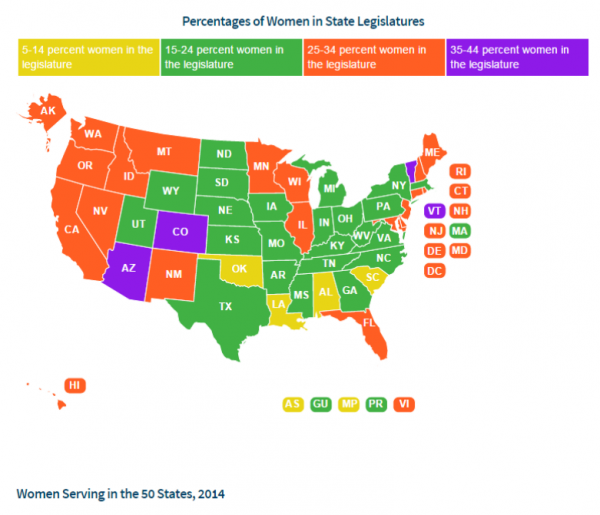
Election results indicate that there will be fewer women serving in state legislatures around the country  in 2015 than this year.  In Connecticut, the number remains unchanged from this year, slightly below the recent peak in 2009. Approximately 1,750 women legislators will be in office in 2015, compared to approximately 1,784.this year. The national percentage of female to male legislators will be approximately 23.7 percent, a slight decrease from the 2014 figure of 24.2 percent.

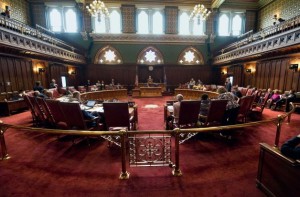
According to the National Conference of State Legislatures (NCSL), Connecticut will have 8 women in the State Senate and 45 women in the House of Representatives when the 2015 session opens. That is a total of 53 women holding 28.3 percent of the 187 seats, ranking the state tied at #7 in the number of women serving in the state legislature and at#14 in the percentage of women in the legislature.  Although a number of office-holders changed, the numbers remained constant from 2014 to 2015 in Connecticut.

The national percentage of female state legislatures reached 20 percent in the 1992 election, but has not grown more than 4.5 percentage points since then.  Colorado is expected to have the highest percentage, 43 percent, of women serving, and Oklahoma the lowest at 12.1 percent.  South Carolina, West Virginia and Wyoming will each have only one woman serving in their senates.

CT Senate

While the number of women in Connecticut's 36-seat Senate has remained relatively static for the past six years at 8 or 9, the representation of women among House members has dropped from 51 in 2009 to 45 in the upcoming 2015 session.  In 2013, there were 46 women in the House and 9 women in the Senate – 29.4 percent of legislators.  In 2009, the breakdown was 51 and 8, for a total of 59 – 31.6 percent of the legislature.

There will be one woman among legislative leaders.  State Rep. Themis Klarides of Derby was chosen by her House Republican colleagues as their caucus leader, the first woman to be selected to lead the KlaridesRepublicans.  The House Speaker, House Majority Leader, Senate President Pro Tempore Senate Majority Leader, and Senate Republican Leader for the 2015 session are men, as was true in the previous legislative session.  Connecticut has seen a woman Speaker of tCT Househe House, but there has not been a woman selected to serve as Senate President Pro Tempore or Majority Leader.

In other elected offices in Connecticut, three of the state’s six statewide Constitutional offices are held by women – Lieutenant Governor Nancy Wyman, Secretary of the State Denise Merrill and State Treasurer Denise Nappier.  All three were re-elected this year.  Of the state’s seven members of Congress, both U.S. Senators, Richard Blumenthal and Chris Murphy are men (and former state legislators) and two of five U.S. House members are women, Elizabeth Esty (a former state legislator) and Rosa DeLauro.  Both House members were re-elected this year, as were Congressmen Joe Courtney, Jim Himes and John Larson.

NCSL points out that conventional wisdom has held that one reason women are less likely to run for office is because of greater family caregiving responsibilities. A recent study, however, found that family situation had no effect on a potential candidate’s ambition to run for office—and this held true for both women and men. Other factors that may be at play include women’s perceptions of their qualifications (women tend to think they are less qualified than men), and political party systems of candidate recruitment.

Looking ahead to the 2015 legislative sessions, the highest percentage of women in legislative bodies are in Colorado (42%), Vermont (41%), Minnesota (33%), Washington (33%), Nevada (32%), Arizona (31%), Illinois (31%), Oregon (31%), Alaska (30%), Maryland (30%), New Jersey (29%), Maine (29%), Hawaii (29%) and Connecticut (28%).

Based on returns from the 2014 election earlier this month, when state legislatures convene early next year, New Hampshire will have 112 women, Vermont will have 74, Minnesota will have 67, Maryland 56,  Illinois 55, Maine 54, and Connecticut and Georgia, 53 each.

The partisan composition of women the nation’s 50 state legislatures is 683 Republicans and 1,058 Democrats.  (As well as 4 Third Party office-holders and 10 non-partisan in Nebraska.)

Permanent Commission on the Status of Women, comments by women legislators


women in legislature 2014


Economic Survival is Daily Struggle for 35 Percent of State Households, Report Reveals

For more than a generation, the federal poverty level has been the threshold driving policy conversations about the working poor nationwide.  Now, led by United Way agencies in six states including Connecticut, the income level below which working families cannot make ends meet is being redefined. The result reveals what is described as a more realistic income threshold that is three times higher than the traditional poverty level.  And that means more than one-third of Connecticut’s population (35 percent) is facing very real, daily financial hardship, struggling to make financial ends meet.

The numbers have been hiding in plain sight, official say. The first-of-its-kind report documents that the number of ConnecticuALICEt households unable to afford all of life’s basic necessities far exceeds the official federal poverty statistics. United Way calls this newly revealed demographic ALICE, an acronym for Asset Limited, Income Constrained, Employed.

Statewide, there are nearly half a million households (474,445) unable to pay for the costs of basic household needs in Connecticut, according to the study.

Every city and town in Connecticut has ALICE households. More than two-thirds of Connecticut's cities and towns have at least 1 in 5 households that fit the ALICE definition for financial hardship.  In four of Connecticut’s six largest cities – New Haven, Bridgeport, Hartford, and Waterbury – more than 50 percent of households have income below the ALICE threshold.

Even with one of the country's highest median hourly wages, 51 percent of all jobs in Connecticut pay less than $20/hour ($40,000/year if full-time). The average annual income needed by a family of four (2-adults with 1-infant and 1-pre-K child) in order to survive in Connecticut is $64,889. This is more thhousehold survivalan double the official U.S. poverty level.

Connecticut has joined with five other states (California, Florida, Indiana, Michigan, and New Jersey) to release statewide ALICE Reports in 2014. The Connecticut ALICE Report is sponsored by the sixteen Connecticut United Ways.  The original ALICE project was undertaken in New Jersey in 2009.  The reports are researched and coordinated by Rutgers University-Newark’s School of Public Affairs and Administration.

There are 35 municipalities in Connecticut with more than one quarter of their population under the ALICE threshold – struggling to pay for basic needs such as housing, healthcare, childcare, transportation and education.  They include the cities of Hartford, New Britain, New London, New Haven, Waterbury, Bridgeport, as well as communities including Windham, Ansonia, Norwich, North Canaan, West Haven, East Hartford, Putnam, Meriden, Killingly Torrington, Derby, Canaan, Naugatuck, Vernon and Groton.  Also among the 35 communities are Bristol, Winchester, Griswold, Sprague, East Haven, Middletown, Manchester, Thompson, Windsor Locks, Westbrook, Hamden, Plainfield, Canterbury and Southbury.

The ALICE threshold and report places a spotlight on a “large population of hardworking residents who work hard, but still struggle to make ends meet,” the report points out. “For some, this means not being able to save for their family's future or to weather an emergency without falling into poverty.”map

The 129-page report is the most comprehensive depiction of financial need in the state to date, using data from a variety of sources, including the U.S. Census and the American Community Survey. The Report unveils new tools based on income levels and expenses, that quantify the number of households in Connecticut's workforce that are struggling financially. And the ALICE Report also seeks to analyze in more detail why many working families continue to struggle.

A total of 332,817 Connecticut households fall into what the study describes as the ALICE population. These are households earning more than the official U.S. poverty level, but less than the basic cost of living.

Noting that “the cost of basic housing, child care, transportation, food, and health care in Connecticut increased by 13 percent during this 5-year period,” the report points out that “there are serious consequences for both ALICE households and their communities when these households cannot afford the basic necessities. ALICE households are forced to make difficult choices such as forgoing preventative health care, accredited child care, healthy food, or car insurance. These “savings” threaten their health, safety, and future – and they reduce Connecticut’s economic productivity and raise insurance premiums and taxes for everyone. The costs are high for both ALICE households and the wider community.”

Among the key areas of concern highlighted in the report is housing.  “The cost of housing is especially high in Connecticut, and the units that are affordable to ALICE households are often far from jobs or older and in disrepair,” the report explained. “Structural changes that make quality affordable housing more available would ease the housing burden on many Connecticut families.”

Watch You Tube video.

Latino Vote Increasing Battleground in Connecticut, Nation

If you wondered why the Governor of Puerto Rico and the former Governor of Puerto Rico both visited Connecticut in the waning days of the gubernatorial campaign to support the Democratic and Republican candidates, respectively, the numbers tell the story. Connecticut’s population is 14 percent Hispanic, the 11th largest Hispanic statewide population share nationally, according to data from the U.S. Census Bureau and the Pew Research Hispanic Trends Project.  There are 265,000 Hispanic eligible voters in Connecticut—the 16th largest Hispanic statewide eligible voter population nationally.

Hispanic eligible voters in Connecticut have a much different Hispanic origin profile than Hispanic eligible voters nationwide, the research indicates.  In Connecticut, 5 percent of Hispanic eligible voters are of Mexican origin, two-thirds (67 percent) are of Puerto Rican origin, and 28 percent claim other Hispanic origin. Among all Hispanic eligible voters nationwide, 59 percent are Mexican, 14 percent are Puerto Rican, and 27 percent are of some other Hispanic origin.PewHispanicResearchCenter-300x240Latino vote

One-in-ten Connecticut eligible voters are Hispanic, the 10th largest Hispanic statewide eligible voter share nationally. (New Mexico ranks first with 40 percent.) Just over half of the Hispanics in Connecticut (52 percent) are eligible to vote, ranking Connecticut 12th nationwide in the share of the Hispanic population that is eligible to vote. By contrast, more than three-quarters (78 percent) of the state’s white population is eligible to vote.

national exit poll taken last Tuesday in conjunction with NBC News, shows that Latinos made up an estimated 8 percent of voters this year.  Specific data on Connecticut was not available.   Nationwide, the share of Hispanics who voted remained unchanged from their estimated share in 2010 and 2006 despite the growing share of eligible voters (U.S. citizens ages 18 or older). This year, 11 percent of all eligible voters were Hispanic, up from 10.1 percent in 2010 and 8.6 percent in 2006.electorate

In several states where exit polling data for Hispanic voters is available, according to Pew Research, Democrats generally won the Hispanic vote in Senate and gubernatorial races. But in some states, Republicans did well among Hispanics, securing as much as 40 percent or more of the vote. In congressional races nationally, Democrats won the Latino vote by a margin of 62 percent to 36 percent.

In Florida, Republican Gov. Rick Scott won re-election with 38 percent of the Latino vote, a significant drop from the 50 percent he won in 2010.  In other gubernatorial races, including Texas and Georgia, the Democratic candidate won the Latino vote but lost the election.  In California, Gov. Jerry Brown was re-elected, winning won 73 percent of the Latino vote according to exit polls, up from 64 percent four years ago.


Municipal Equality Index Finds CT Above Average for LGBT Residents

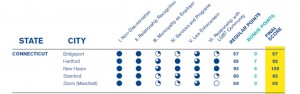
Connecticut cities continue to rank above-average when compared with municipalities across the country in the level of equality provided to lesbian, gay, bisexual, and transgender (LGBT) residents.  Bridgeport, Hartford, New Haven, Stamford and Storrs (Mansfield) were the five Connecticut municipalities included by the Human Rights Campaign (HRC), the nation’s largest LGBT civil rights organization, in an assessment of LGBT equality in 353 cities across the nation. index report

The 2014 Municipal Equality Index (MEI), the only nationwide rating system of LGBT inclusion in municipal law and policy, shows that cities across the country, including in Connecticut, continue to take the lead in supporting LGBT people and workers, even when states and the federal government have not.

The average score for the five municipalities in Connecticut was 74 out of 100 points, comfortably above the national average of 59.  The individual scores in Connecticut, largely unchanged from a year ago, were New Haven: 100, Hartford: 92, Stamford: 62, Storrs (Mansfield): 59, and Bridgeport: 57.  The scores earned by Hartford and Bridgeport dropped slightly from a year ago, and New Haven scored at 100 for the second consecutive year.  Because of changes in the legal landscape from year to year, the MEI report has revised the scoring assessment criteria, which has impacted scores in some municipalities.

Cities are rated on a scale of 0-100, based on the city’s laws, policies, benefits, and services. Key findings contained in the 70-page MEI report, issued in partnershiphrc-logo with the Equality Federation, provide “a revealing snapshot of LGBT equality in municipalities of varying sizes, and from every state in the nation,” the report noted.
The MEI rates cities based on 47 criteria falling under six broad categories:

  • Non-discrimination laws
  • Relationship recognition
  • Municipality’s employment policies, including transgender-inclusive insurance coverage, contracting non-discrimination requirements, and other policies relating to equal treatment of LGBT city employees
  • Inclusiveness of city services
  • Law enforcement
  • Municipal leadership on matters of equality

The cities researched for the 2014 MEI include the 50 state capitals, the 200 most populous cities in the country, the four largest cities in every state, the city home to each state’s largest public university, and an equal mix of 75 of the nation’s large, mid-size and small municipalities with the highest proportion of same-sex couples.

The report found that “momentum for municipal equality is not a coastal trend or mega-urban phenomenon – it is something cities of all sizes in all parts of the country are doing because the people in those cities demand equality of treatment for all.”  Cities had an opportunity to review the draft scorecard and offer feedback prior to publication.

Equality and Economic Development

The report also indicates that “a growing body of research has shown that cities that have vibrant gay and lesbian communities have higher levels of income, life satisfaction, housing values, and emotional attachment to their community as well as higher concentrations of high-tech business. The Fortune 500 has long recognized that top talent is attracted to inclusiveness. In fact, the private sector has been using fair workplaces as a tool to recruit and retain top talent.”

The report adds that “Businesses will increasingly have to evaluate the legal landscape offered by a potential new location in its calculation of where to expand operations.”  Connecticut’s state laws – such as marriage equity and non-discrimination protections – provide a hospitable environment for its cities to employ equitable practices, officials said, but municipalities also have the capacity to take the lead, in Connecticut and elsewhere.  In ten states, cities fare well despite restricbusinesstive state laws.

“From Mississippi to Idaho, mid-size cities and small towns have become the single greatest engine of progress for LGBT equality--changing countless lives for the better,” said HRC President Chad Griffin. “In just three years, the number of municipalities earning top marks for their treatment of LGBT citizens has more than tripled. Simply put, in this country there is an ongoing race to the top to treat all people, including LGBT people, fairly under the law, and it’s time our state and federal laws caught up.”

According to the report, the New England, Mid-Atlantic, and Western regions of the United States – where marriage equality states have predominated – tend to do better than the national average when it comes to municipal equality. The reported pointed out, however, that every region has at least one 100-point city, such as New Haven. For example, in the Southeast, Florida boasts three 100-point scores, and Atlanta repeats its perfect score again in 2014; in the Southwest, Austin repeats its perfect score; and in the Plains, Iowa City joins two perfect scores in Missouri with St. Louis and Kansas City.

Thirty-eight cities earned perfect 100-point scores, up from 25 in 2013 and 11 in 2012, the first year of the MEI. New Haven earned a 100-point score, helping to set a standard of LGBT inclusiveness with exemplary policies ranging from non-discrimination laws and equal employee benefits, to cutting edge city services.

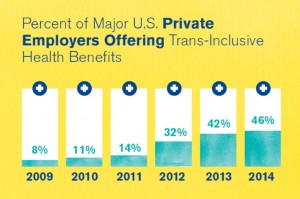
Among the report’s striking findings:  A dramatic increase in the number of cities offering transgender-inclusive healthcare benefits, and the fact that 32 million people have better protections from discrimination on the basis of gender identity at the local level then they do from state law. The full report is available online at www.hrc.org/mei.

CT stat

Nationwide Bicycle Fatalities Increase; CT Takes Steps to Improve Safety

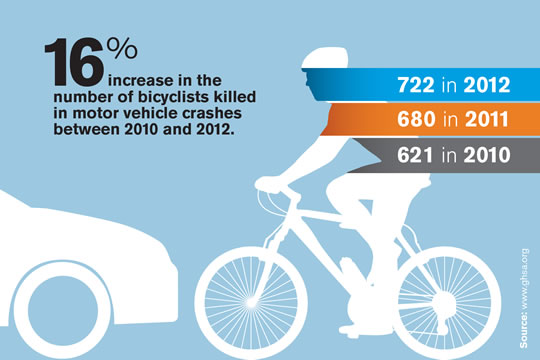
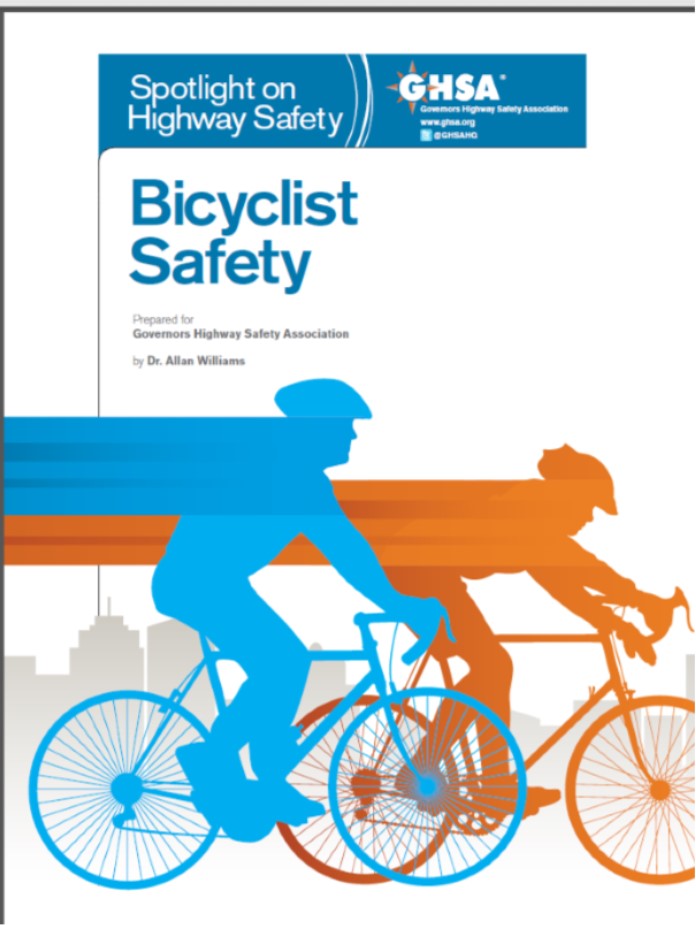
The number of bicyclists killed on U.S. roadways is increasing, according to a report by the Governors Highway Safety Association (GHSA). GHSA’s Spotlight on Highway Safety: Bicyclist Safety indicates that yearly bicyclist deaths increased 16 percent between 2010 and 2012, while overall motor vehicle fatalities increased just one percent during the same time period. While bicyclists killed in motor vehicle crashes increased in 22 states between 2010 and 2012, six states – California, Florida, Illinois, New York, Michigan and Texas – represented 54 percent of all fatalities.  In 2012, Florida had the highest proportion of motor vehicle related deaths that were bicyclists (5 percent), followed by California (4.3 percent) and Massachusetts (4.3 percent).2014_bike_increase

Connecticut, according to the report, had 7 bicyclist deaths in 2010, 8 in 2011 and 4 in 2012.  The state was one of 25 states to have the number of fatalities drop from 2011 to 2012.

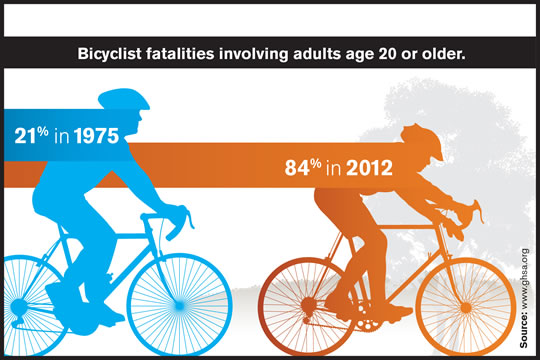
Bicycling is being used more for commuting, which is affecting the age of accident victims according to the study. In 2012, adults 20 and over comprised 84 percent of bicycle fatalities. That compares to adults making up only 21 percent in 1975.  Bicycle fatalities are increasingly an urban phenomenon, accounting for 69 percent of all bicycle fatalities in 2012, compared with 50 percent in 1975.

Until 2010, the number of cyclist fatalities annually had been dropping steadily since 1975 nationwide. The recent increase correlates with a 62 percent surge in bicycle commuting since 2000, according to 2013 Census Bureau data, as governments have promoted cycling as a way to reduce traffic, curb vehicle emissions and improve public health.2014_bike_adults

"The increase in cyclist fatalities on the road is tragic, but unsurprising, given the growth of the driving population and the number of cars on the road,” said Kelly Kennedy, Executive Director of Bike Walk Connecticut.   “Add to that the very real problems of distracted driving, aggressive driving, and street designs that put cyclists and pedestrians at risk. This is why we need complete streets, much better enforcement of speeding, distracted driving, and share the road laws, and the vulnerable user law that Connecticut just enacted."

Earlier this month, the state Department of Transportation (DOT)  issued a Complete Streets policy statement, which was praised by Bike Walk Connecticut.  The policy expressly promotes safe access for all users by providing a comprehensive, integrated, connected multi-modal network of transportation options.  DOT's policy is intended to improve safety and mobility and enhance Connecticut’s economic competitiveness by enabling communities to become livable, walkable, bikeable, drivable, efficient, safe and desirable.

report bThe new GHSA report indicated that in many states and urban areas, engineering measures are being adopted to accommodate bicycles on the road, “with the dual aim of protecting cyclists from collisions with motor vehicles, while encouraging cycling for its health and environmental benefits.”


In announcing the new Connecticut policy, DOT Commissioner James Redeker noted that Route 44 in East Hartford will undergo a “road diet” in 2015 to provide bike lanes, enhance vehicular safety and efficiency and improve pedestrian and transit accommodation throughout the corridor. The Department is also outfitting 50 train cars with bike racks on the New Haven Line operating between New Haven to New York City.

In its fifth year before the Connecticut legislature, the Vulnerable User bill passed earlier this year, and took effect on this month (on Oct. 1).  The new law requires a fine to be imposed on reckless motor vehicle drivers who cause the death or serious injury of a pedestrian, cyclist, wheelchair user, or other “vulnerable users” who were using reasonable care.

The GHSA report’s author, former Insurance Institute for Highway Safety Chief Scientist Dr. Allan Williams, analyzed current and historical fatality data to develop the bicyclist crash patterns.


13 CT High Schools in Nation’s Top 500, Up from 8 Last Year; Four CT Schools "Beat the Odds"

Thirteen Connecticut high schools rank among the nation’s top 500 according to a report compiled by Newsweek Magazine – an increase from eight schools a year ago. Connecticut did not have a school ranked in the top 100.  The highest ranked Connecticut school on the list is Amity High School in Woodbridge, which placed at #112, up from #667 last year.  Connecticut’s top-ranked high school in last year’s analysis, the Connecticut IB Academy in East Hartford, also ranked #112 that year.  This year the IB Academy was at #140, the second highest ranked school in Connecticut.bestschools-share

New to the top 500 from Connecticut this year were Litchfield High School, Greenwich High School, Daniel Hand High School in Madison, South Windsor High School, Fairfield Warde High School, East Lyme High School, Wolcott High School, East Lyme High School, Wolcott High School, Lyme-Old Lyme High School, Haddam-Killingworth High School, Pomperaug High School in Southbury and Cheshire High School. 

Every year Newsweek announces the nation’s best high schools that do an outstanding job of preparing students for college.  The magazine teamed up with a research group to compile the list.  They said their methodology was more stringent than ever with new measures of quality and a high standard of data, utilized a College Readiness Score that was based on the following six indicators:

  • Enrollment Rate—25 percenthigh school
  • Graduation Rate—20 percent
  • Weighted AP/IB composite—17.5 percent
  • Weighted SAT/ACT composite—17.5 percent
  • Holding Power (change in student enrollment between ninth and 12th grades; this measure is intended to control for student attrition)—10 percent
  • Counselor-to-Student Ratio —10 percent

The number one spot in the nation went to Thomas Jefferson High School in Alexandria, VA.  Connecticut’s 13 high schools ranked in Newsweek’s Top 500 include:

  • Amity High School in Woodbridge (#112)
  • Connecticut IB Academy in East Hartford (#140)
  • Litchfield High School (#164)
  • Greenwich High School (#168)
  • Daniel Hand High School in Madison (#179)
  • South Windsor High School (#226)
  • Fairfield Warde High School (#227)
  • East Lyme High School (#228)
  • Wolcott High School (#337)
  • Lyme-Old Lyme High School (#352)
  • Haddam-Killingworth High School  (#336)
  • Pomperaug High School in Southbury (#386)
  • Cheshire High School (#401)

A year ago, there were eight Connecticut high schools in the top 500.  The top-ranked school in the state was the Connecticut IB Academy in East Hartford, at #112.  Also ranking in the top 500 in 2013 were Weston High School at #190, Staples High School in Westport at #196, New Canaan High School at #227, Ridgefield High School at #270, Farmington High School at #405, and Valley Regional High School in Deep River at #441.  All but the Connecticut IB Academy fell out of the top 500 this year.

Among this year’s top 500, Greenwich High School was #573 a year ago, Daniel Hand High School in Madison ranked #589, Amity Regional High School in Woodbridge was #667, and East Lyme High School was #723.

"Beat the Odds" Schools

In a separate ranking of the nation’s top schools for low-income students, which Newsweek describes as "Beat the Odds Schools," the highest-ranked Connecticut high school was the Greater Hartford Academy of the Arts, which ranked #266.  It is one of four Connecticut high schools to reach the nation's top 500, according to the Newsweek analysis.  The Connecticut IB Academy was the second-ranked Connecticut high school on this list as well, coming in at #275.  Bunnell High School in Stratford was #290, and Common Ground High School in New Haven was #316.

With the list, Newsweek sought to “recognize schools that beat the odds, performing better than statistically expected for their level of poverty.” Schools were ranked on how well they prepare their students for college, taking students’ socio-economic background into account.