New England Colleges Prepare Report on Employability of Students; Draft Recommendations Outlined

December 22 is the deadline for those seeking to comment on the draft report and recommendations of the Commission on Higher Education & Employability, established earlier this year by the New England Board of Higher Education (NEBHE).  The Commission, which includes nine representatives of institutions and organizations in Connecticut, released its preliminary findings at a day-long Summit in Boston. “Despite the region’s strength in postsecondary institutions, employers remain concerned about a lack of qualified, skilled workers, particularly in technology-intensive and growth-oriented industries,” the draft report notes. “The Commission has proposed a draft action agenda, policy recommendations, strategies and next steps to align institutions, policymakers and industry behind increasing the career readiness of graduates of New England colleges and universities—and facilitate their transitions to work and sustained contributions to the well-being and competitiveness of the region.”

In addition to five strategic priorities,  the draft report includes specific recommendations are being considered in five areas:  Labor Market Data & Intelligence; Planning, Advising & Career Services; Higher Education-Industry Partnerships; Work-Integrated Learning; Digital Skills; and Emerging Credentials.

Among the recommendations being considered are a call for higher education institutions to incorporate employability into their strategic plans/priorities; determine their effectiveness in embedding and measuring employability across the institution; and develop a regional partnership for shared purchasing and contracting of labor market data, information and intelligence services.

The proposed recommendations also call on the New England states to “collaborate to launch multistate, industry-specific partnerships beginning with three of the top growth-oriented sectors, including: healthcare, life and biosciences and financial services.” It further urges the states to explore “implementing policies (public and institutional) that incentivize businesses (through tax credits or other means) to expand paid internships.”  The draft report also calls for the establishment of a New England Planning, Advising and Career Service Network.

The draft report calls on the states to “confront notable college-attainment gaps and the related personal and societal costs,” and “consider specific employability strategies to target and benefit students who are at risk of not completing postsecondary credentials, including underrepresented populations.”

Eastern Connecticut State University President Elsa Núñez led a session at the Summit about the Commission's “Equity Imperative.” Officials indicate that Commission's workforce vision serves all New Englanders ... “as a matter of social justice, but also as a matter of sound economics in the slow-growing region.”  Núñez highlighted her internship work with students who may not have cars or other resources to capitalize on off-campus work-integrated learning.

In addition to Núñez, the nine members of the Commission from Connecticut are:

  • Andrea Comer, Vice President, Workforce Strategies, Connecticut Business & Industry Association Education and Workforce Partnership
  • Freddy Cruz, Student, Eastern Connecticut State University
  • Maura Dunn, Vice President of Human Resources & Administration, General Dynamics Electric Boat
  • Mae Flexer, State Senator
  • Tyler Mack, Student Government Association President, Eastern Connecticut State University
  • Mark Ojakian, President, Connecticut State Colleges & Universities
  • Jen Widness, President, Connecticut Conference of Independent Colleges
  • Jeffrey Wihbey, Interim Superintendent, Connecticut Technical High School System

The commission also includes six members from Vermont, seven members from New Hampshire and Maine, 11 from Massachusetts, 12 from Rhode Island, as well as two regional members and six representatives of NEBHE. The Commission's Chair is Rhode Island Governor Gina Raimondo.  The proposed recommendations, developed during the past six months, have broad implications, according to officials, “critical to building a foundation for moving forward the Commission's efforts toward strengthening the employability of New England's graduates.”

At Eastern Connecticut State University—which is about 30% students of color—lower-income, minority and first-generation students often had no cars, so had difficulty traveling off campus to internships. White students got most of the internships, President Elsa Núñez told the NEHBE Journal earlier this year.

The Journal reported that Eastern’s Work Hub eliminates that need, allowing students to develop practical skills doing real-time work assignments without having to travel off campus, and providing the insurance company Cigna with a computer network and facility where its staff could provide on-site guidance and support to Eastern student interns.

The draft report’s strategic priority recommendations include:

  • New England state higher education systems, governing and coordinating boards, together with New England’s employers, should make increased employability of graduates a strategic priority—linked to the strategic plans, key outcomes, performance indicators and accountability measures for the higher education institutions under their stewardship.
  • New England higher education institutions should incorporate employability into their strategic plans/ priorities supported by efforts to define, prioritize and embed employability across the institution and in multiple dimensions of learning and the student experience—both curricular and extracurricular.
  • New England should make strategic efforts and investments—at the state, system and institution level— to expand research, data gathering, assessment capacity and longitudinal data systems to enable more effective understanding and documentation of key employability-related measures and outcomes.
  • New England higher education institutions should undertake formal employability audits to review the strategic, operational and assessment-oriented activities related to employability–and their effectiveness in embedding and measuring employability across the institution.
  • To confront notable college-attainment gaps and the related personal and societal costs, states must consider specific employability strategies to target and benefit students who are at risk of not completing postsecondary credentials, including underrepresented populations.

The Boston-based New England Board of Higher Education promotes greater educational opportunities and services for the residents of New England. Comments on the recommendations are accepted on-line through Dec. 22.

Senior Citizens Less Diverse, Growing in Percentage of State’s Population

Over 575,000 Connecticut residents are age 65 and older, making up an estimated 16 percent of the state’s total population of 3.6 million, according to U.S. Census data updated through 2016.  Those numbers are expected to grow – steadily and rapidly – during the next two decades, experts anticipate. Among Connecticut’s eight counties, the largest percentage of seniors is in Litchfield County, 19.7 percent, followed by Middlesex County, 18.8 percent, and New London County, 17.1 percent.  New Haven (16.3%) and Hartford (16.2%) counties are next, followed by Fairfield and Tolland Counties, both at 14.8 percent.

The data, highlighted by the Connecticut Office of Legislative Research (OLR)  in a recent report, also shows that “Connecticut’s senior population is less ethnically and racially diverse than the state as a whole.”

Just over 89 percent of the state’s seniors (age 65+) are white, compared with 77 percent of the state’s population as a whole.  While 10 percent of the state’s population are Black or African American, that is true of only 6.4 percent of seniors.  The state’s Asian population is 4.2 percent of the total; among seniors, less than half that, only 2 percent, are of Asian heritage.

While the total state population is almost evenly split between male (49%) and female (51%) residents, the senior population has a larger percentage of females (57%) compared to males (43%), the analysis found.  Connecticut seniors are more likely to be veterans (20% vs. 7% of all residents) and more likely to have a disability (32% vs. 11% of residents).

According to a recent report by the state’s Commission on Women, Children and Seniors, Connecticut is the 7th oldest state in the nation.  Roughly one-third of the state’s population are baby boomers, born between 1946 and 1964.  The state also has nearly 1,000 people over the age of 100.  As has been previously projected, the number of Connecticut towns with at least 20 percent of residents age 65 or older will dramatically increase between 2010 and 2020 (see maps below).  The 65 and older population is expected to grow by 56 percent in Connecticut between 2010 and 2040, compared with  1.5 percent growth in the population between ages 20 and 64.

Approximately 7 percent of Connecticut seniors had incomes which fell below the census poverty level, with an additional 8 percent of seniors having incomes between 100 percent to 149 percent of the threshold, the OLR report indicated. The most common source of income for Connecticut seniors is Social Security, with an average benefit of $20,591 per year, as of 2015. An estimated 90 percent of senior homeowners and renters receive Social Security benefits. The second most common source (50.7%) is personal retirement income, averaging $27,240 per year in 2015.

Of the more than 330,000 senior households, an estimated 76 percent are homeowners and 24 percent are renters. This represents higher home ownership rates than the state as a whole (67% of 1.35 million households).

The most common source of income for Connecticut seniors, the report indicated, is Social Security, with an average benefit of $20,591 per year in 2015. An estimated 90 percent of senior homeowners and renters receive Social Security benefits. The second most common source (50.7%) is personal retirement income, averaging $27,240 per year in 2015.

The demographic characteristics of Connecticut’s senior population (e.g. residents age 65 years and older) used by OLR were largely based on the 2011-2015 American Community Survey 5-Year estimates from the U.S. Census Bureau.

Better Outcomes from Female Surgeons, Study Finds; Local Hospital Highlights Their Own

In a study that has gained international attention and peaked interest locally, the patients of female surgeons tended to have lower death rates, fewer complications and lower readmissions to the hospital a month after their procedure, compared to the patients of male surgeons. The study, published in the BMJ (British Medical Journal), and highlighted in TIME magazine, was conducted in Ontario, Canada, and included all of the people in the province who had operations between 2007 and 2015.  The results are bringing some attention to female surgeons, and Connecticut Children’s Medical Center is shining a spotlight on their surgical staff in the aftermath of the study’s publication.

Connecticut Children’s which has nine female surgeons, including the surgeon-in-chief, is stressing not only that they are “leaders in this field,” but they are also “moms at home.”  They’re using the two roles to launch a social media campaign called #momsurgeons, and will be profiling each of the surgeons on social media, website and billboards in greater Hartford this week.

“We wanted to bring attention to the fact that we are moms too. We truly understand what our patient families are experiencing when their child is heading into surgery,” said Christine Finck, Surgeon-In-Chief at Connecticut Children’s. “We also understand the daily struggles many moms face trying to find that work-life balance.  It’s hard.  We get it.”

Finck, appointed surgeon-in-chief in 2016, previously served as Chief of the Division of Pediatric Surgery since 2007 and is an associate professor of pediatrics and surgery at UConn Health.  In announcing her appointment, Connecticut Children’s pointed out that through her research, Finck “revolutionized outcomes of pediatric and neonatal diseases, most specifically leading efforts focused on identifying and treating those that affect the lungs, esophagus and brain.” She was honored by The Group on Women in Medicine and Science, who awarded her the Outstanding Clinical Scientist Woman Faculty Award, last year.


After accounting for patient, surgeon, and hospital characteristics, the study concluded that “patients treated by female surgeons had a small but statistically significant” decrease in 30 day mortality and similar surgical outcomes (length of stay, complications, and readmission), compared with those treated by male surgeons.

The study’s authors noted that the findings “support the need for further examination of the surgical outcomes and mechanisms related to physicians and the underlying processes and patterns of care to improve mortality, complications, and readmissions for all patients.”

By drawing attention to this profession, officials said, “our #momsurgeons hope they can serve as role models for aspiring young ladies who also hope to one day enter the field.”

“Every time I operate, I stop and think about how I would want the operation to go if it my own child was in front of me,” said Meghna Misra, pediatric surgeon at Connecticut Children’s.

Surgery has long been a male-dominated occupation, TIME reported, “first because few women enrolled in medical school, and then because they weren’t perceived (by male surgeons, no less) to have the temperament needed to make the life-and-death decisions required in an OR.”

In the study, 104,630 patients were treated by 3,314 surgeons, 774 female and 2,540 male. Dr. Raj Satkunasivam, assistant professor of urology at Houston Methodist Hospital was leader of the study.

Connecticut Children’s Medical Center is the only hospital in Connecticut dedicated exclusively to the care of children and is ranked by U.S. News & World Report as one of the best children’s hospitals in the nation, with a medical staff of more than 1,000.

Population Density in Three CT Cities Reaches Top 100 in USA, Data Shows

Bridgeport’s population density, 9,138 people per square mile, is among the top 60 nationally, according to data compiled by Governing magazine for jurisdictions with populations of at least 50,000.  Bridgeport, the state’s largest city, had a population of just over 145,000 living in 16 square miles, the data indicated, ranking at number 58.  It is one of three Connecticut cities in the top 100. The “dense” top ten:  Union City, New Jersey; West New York, New Jersey; Hoboken, New Jersey; New York, New York; Passaic, New Jersey; Somerville, Mass.; Huntington Park, CA.; San Francisco; Jersey City; Paterson, New Jersey and Cambridge, MA.   Boston ranks at #19; Providence is #54. 

Lower on the list of America’s most dense population centers is Hartford, 17 square miles and a population of 123,000, with a population density of 7,091 people per square mile; New Haven, just three notches below Hartford at 6,956, in a city of 130,000 covering 19 square miles.  Both were in the 100 most dense cities; Hartford at #97, New Haven at #100.

They are followed later by New Britain with a land area of 13 square miles at 5,419; West Haven, at 5,071 population density over 11 square miles, and Norwalk, with a population density of 3,869 in an area covering 23 square miles.  Waterbury, at 29 square miles, has a population density of 3,796; Stamford’s population density is 3,430 in a city of 38 square miles.

The data is based on the U.S. Census Bureau, Population Division, estimates current through July 1, 2016.  Governing notes that “jurisdictions with the highest population densities tend to be concentrated in northern regions, particularly the New York metropolitan area.”

According to the 2010 Census, Connecticut overall ranked sixth in the nation in population density, with a population of 3,574,097 and 738 people per square mile.  The state’s population has dropped since that Census, and is now estimated at 3,568,174.  The nation’s densest populations, as of 2010, were in the District of Columbia, New Jersey, Puerto Rico, Rhode Island, and Massachusetts.

Best States for Aging? CT Ranks #18, Study Shows

Connecticut’ senior citizen population ranks 7th in the nation, but the state places at number 18 in an analysis of the nation’s “best states for aging.” As baby boomers move into their elder years, the nation's population – and Connecticut’s - is aging quickly. By 2050, the older adult population is expected to almost double to more than 87 million from 43 million in 2012, U.S. News points in an article highlighting the analysis, which was developed for the magazine by McKinsey & Company.

The Best States for Aging ranking determines which states are most effectively serving their senior citizens by keeping them healthy, financially secure and involved in their communities. States are scored relative to each other in 12 factors that average into one overall score.

The top 10 states were Colorado, Maine, Hawaii, iowa, South Dakota, Wisconsin, Minnesota, Vermont, New Hampshire and Florida.  Massachusetts ranked #12, and Rhode Island was #21.

Among the categories, Connecticut ranked first in "able-bodies", fourth in life expectancy and primary care, 44th in cost-of-living and 49th in cost of care.

Between 2010 and 2030, Connecticut's population of adults age 65 and older will increase by 57 percent, the state’s Legislative Commission on Aging testified in 2016. At least 20% of almost every town's population in Connecticut will be 65 years of age or older by 2025, with some towns exceeding. 40 percent, officials said.  The state has the 3rd longest-lived constituency and is home to more than 1 million baby boomers.

Data sources include: Centers for Disease Control and Prevention, Centers for Medicare and Medicaid, Genworth Cost of Care Survey, Kaiser Family Foundation, Missouri Economic Research and Information Center, U.S. Bureau of Labor Statistics, United Health Foundation.

Hartford Residents Younger, Danbury’s Older, Among State’s Largest Cities

The median age in Danbury is the highest among Connecticut’s largest cities, just slightly older than Stamford, and nearly nine years older than New Haven, according to a new analysis by TIME magazine. Across the country, Boca Raton, Fla., has a median age just over 50 years old — much higher than America’s median age of 37.9. At the opposite end of the spectrum, the college towns of Flagstaff, Ariz. and College Station, Texas have median ages near 23 years old, according to 2016 Census data for cities with more than 65,000 people.

Connecticut’s largest cities, by population, are Bridgeport, New Haven, Stamford, Hartford, Waterbury, Norwalk, Danbury, and New Britain.

Danbury, at 39.7, and Stamford’s at 37.9, the oldest among Connecticut’s largest cities, based on median age of their residents.  Stamford’s median parallels the U.S. as a whole.  The median age or residents of Norwalk is just slightly lower, at 37.7.

The median age in New Britain is 36, in Bridgeport and Waterbury it is 34.  Somewhat younger median ages are in Hartford, at 31, and in New Haven, nearly identical at 30.8.

Among the cities, Norwalk and New Britain have the largest percentage of their populations between age 60 and 79, both with 17 percent.  New Britain and Stamford each of 4 percent of their population age 80 or older; in Danbury it is 5 percent, the highest percent among the cities.

Hartford has the largest percentage of residents age 20-39, at 33 percent, and under age 19, at 30 percent.  That’s 63 percent of the population, nearly two-thirds, under age 39.  In Bridgeport that  percentage is 58 percent, in Norwalk it is 53 percent and in Danbury, just over half at 51 percent.

In each of the eight largest cities, with the exception of Danbury, the largest population block is those age 20-39.  The largest is in New Haven, at 34 percent.  Danbury’s largest block of residents is in the 40-59 age group, at 29 percent.

While college towns and retirement communities represent extremes, there are also age trends in urban and suburban areas, says William Frey, a senior fellow at the Brookings Institution’s Metropolitan Policy Program.

“Suburbs are aging more rapidly than cities, due to the fact that baby boomers were a big part of the suburbanization of the United States in the ’50s and ’60s,” he told TIME. “They grew up there, and now they’re like anchors of the suburbs.”

Cities, meanwhile, continue to draw millennials, though Frey believes that’s less about preference, and more about barriers to home ownership following the recession. “I think the jury’s still out on whether the millennial generation will move to the suburbs,” Frey says.

The Difference A Dollar Makes: UConn Research Finds Minimum Wage Increase Reduces Maltreatment of Children

It has been nearly a year since a study co-authored by UConn Assistant Professor of Public Policy Kerri M. Raissian appeared in the academic journal Children and Youth Services Review, but the interest hasn’t waned.  In fact, it now tops the list of downloaded articles in the past 90 days from the journal’s website. The article, which Raissian co-authored with Lindsey Rose Bullinger, asks – and answers – this question:  Does the minimum wage affect child maltreatment rates?

Short answer, according to their research:  yes. 

Raising the minimum wage by $1 per hour would result in a substantial decrease in the number of reported cases of child neglect, according to a study co-authored by Raissian and Bullinger.  They reviewed eleven years of records on child abuse and neglect and found that increases in the minimum wage correlate with declining child maltreatment rates.

A $1 increase would result in 9,700 (9.6 percent) fewer reported cases of child neglect annually as well as a likely decrease in cases of physical abuse, Bullinger explained on the website sciencedaily.com, where their study was featured earlier this year. This decline is concentrated among young children (ages 0–5) and school-aged children (ages 6–12); the effect diminishes among adolescents and is not significant, the study’s abstract points out.

“Our results suggest that policies that increase incomes of the working poor can improve children's welfare, especially younger children, quite substantially,” the authors conclude in their 70-page article on the study.

"Money matters," Bullinger noted on sciencedaily.com. "When caregivers have more disposable income, they're better able to provide a child's basic needs such as clothing, food, medical care and a safe home. Policies that increase the income of the working poor can improve children's welfare, especially younger children, quite substantially."

More than 30 states had minimum wages exceeding the federal requirement by an average of $1 during the study period, allowing the researchers to track changes in the number of reports to child protective service agencies with increases in the minimum wage.  Data from the National Child Abuse and Neglect Data System was used in the research.

The substantial decrease in child neglect cases is concentrated among toddlers and school-age children, but changes in the minimum wage had little impact on reports of neglect of teenagers. The researchers found no variation based on a child's race.

“Families with low incomes have a great ability to make a dollar go a long way. On average, the weekly SNAP (Supplemental Nutrition Assistance Program) food stamp benefit for a family of three is about $30. That’s about what a one dollar an hour minimum wage increase translates into for full-time workers. Other studies show that a $1,000 tax refund results in similar declines in child maltreatment – neglect, specifically. So for really low-income families that probably have pretty severe material deprivation or economic hardship, that extra dollar can make a really big difference,” Raissian told UConn Today.

Raissian’s research interests are linked by a common focus on child and family policy, according to the university’s website.  Her dissertation, “Assessing the Role and Impact of Public Policy on Child and Family Violence,” evaluated the efficacy of policies designed to reduce violence directed towards intimate partners, children, and other family members. Her professional background includes nearly 10 years of government and nonprofit sector experience, which focused on serving abused adults and children.

Bullinger is associate instructor in the school of public and environmental affairs at Indiana University at Bloomington.  Both attended Syracuse University’s Maxwell School of Citizenship and Public Affairs.

“Most of the states don’t have a minimum wage at or above $10; Connecticut does. It’s possible Connecticut may be at the threshold,” Raissian said in an interview featured in UConn Today. “It’s also really important to note that, while our study looks at the minimum wage, this could really be an income story – remember other studies find similar results when incomes are increased in other ways. Our very low-income families might be facing other reductions in their incomes that will be costly to us as a state. We should consider that, moving forward.”


More Changes Proposed as Enrollment Drops at State Colleges, Universities; Feedback Sought on Consolidation Plan

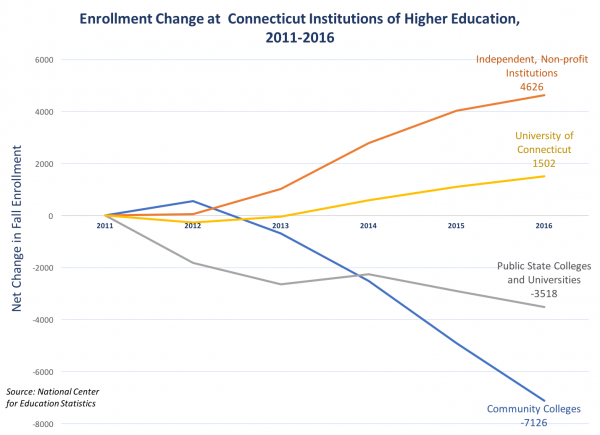
The recent decision by the Board of Regents of the Connecticut State Colleges & Universities (CSCU)  to begin offering students from New York and New Jersey the considerably lower in-state tuition rates in an effort to stem an increasing drop in enrollment at Western Connecticut State University may be the tip of the iceberg. Since 2011, enrollment numbers at higher education institutions in Connecticut have been moving in very different directions, according to data developed by the Connecticut Conference of Independent Colleges (CCIC) from the National Center for Education Statistics.

The data show that the state’s community college system has experienced a net loss of 7,126 students, and the state’s four regional universities – Western, Central, Southern and Eastern Connecticut – saw a net loss of 3,518 students between 2011 and 2016.

Trending in the opposite direction has been the University of Connecticut, with a net increase of 1,502 students, and the independent, non-profit institutions, was an increase of 4,626 students.

CCIC member institutions include Albertus Magnus College, Connecticut College, Fairfield University, Goodwin College, Mitchell College, Quinnipiac University, Rensselaer at Hartford, Sacred Heart University, St. Vincent's College, Trinity College, University of Bridgeport, University of Hartford, University of New Haven, University of Saint Joseph, Wesleyan University and Yale University.

Currently, in-state students pay $10,418 in annual tuition at Western, while out-of-state students pay $23,107.  Published reports indicate that enrollment at the university has dropped by more than 700 students over the past six years.  The university serves about 5,700 students, with more than 90 percent of them coming from Connecticut.

Similar initiatives at the other three colleges are less likely, as they are located in Willimantic, new Haven and New Britain, not adjacent to any state line.  Central Connecticut State University is the largest of four universities within the CSCU system, serving nearly 11,800 students--9,800 undergraduates, and 2,000 graduate students.

Last year, in a program that was promoted with radio advertising, the CSCU board approved a plan that permitted Asnuntuck Community College in Enfield to admit students from Massachusetts to enroll at in-state rates. And last spring, the board allowed six other community colleges located near state borders to do the same starting this fall.  The plan boosted enrollment at Asnuntuck; data on the other colleges is not yet available. 

Earlier this year, the CSCU system proposed merging the 12 community colleges into one college with 12 branch campuses, as a cost-saving measure, and, officials say, to direct more resources to students.  That plan is pending.  If approved, the change would make the newly named Connecticut Community College the fifth largest in the country with more than 52,000 students, reports indicate.  Officials indicate that "Only a few of these recommendations will require policy changes by the Board of Regents. The majority of the administrative recommendations can be implemented as soon as time and resources are available to complete."

Currently, the system is soliciting feedback on the proposal with an on-line poll on the CSCU website.  The survey asks respondents to offer opinions on the plans, as well as suggestions and opinions on strengths of the 12 into 1 plan.  The survey is open until Nov. 20.


Population Health Topics to Be Focus of Statewide Public Health Conference

“From Patient to Population Health - Disparities Matter” is the focus this year as the Connecticut Public Health Association (CPHA) expects approximately 300 public health practitioners from around the state to gather at the CPHA Annual Meeting and Conference, being held on October 30. The day-long conference will include more than 30 sessions on various public health topics, along with two keynote speakers and a range of professional development opportunities for attendees.  The keynote speakers will be Mark Masselli, Founder/President/CEO of Community Health Center, Inc., based in Middletown, and State Senator Doug McCrory of Hartford, Democratic Deputy President Pro Tempore, elected to the Senate this past year. 

Conference objectives include:

  • Understand how public health policies and programs influence health disparities throughout life for patients and populations.
  • Identify evidence-based strategies that can reduce health disparities and improve community health outcomes
  • Influence health policies in state and country through disparities research and dissemination of evidence
  • Promote the formation of collegial professional networks and the exchange of ideas among members of the public health community

Among the topics to be discussed in sessions throughout the day are youth suicide prevention, pregnancy screening in community-based settings, addressing the needs of people with complex social and health needs, substance abuse, health disparities, healthy eating and hunger, and nutrition education.  Sessions will also focus on early intervention, asthma, drinking water safety, intimate partner violence, and the impact of Federally Qualified Health Centers in improving health outcomes.

Represented among the presenters are the Community Health Center Association, UConn, the state Departments of Public Health and Mental Health and Addiction Services, the Connecticut Data Collaborative, Institute of Living, March of Dimes Foundation, Western Connecticut Health Network, Connecticut Hospital Association and the State Innovation Model Program Management Office.

A welcome address, via video, will be offered by U.S. Sen. Chris Murphy.

The Connecticut Public Health Association, which celebrated its 100th anniversary last year, has been committed to improving the quality of the public health profession and advocating for policies and programs that promote health and prevent disease.  The organization provides professional development and education, public health advocacy, mentorship and communications to members and the public. This year’s conference is being held at AquaTurf in the Planstville section of Southington.

Philanthropic Giving Levels in Connecticut Among Nation’s Lowest As Percentage of Income

Connecticut ranked 47th among the 50 states in philanthropic giving as a percentage of income, with a “giving ratio” of 2.4 percent, 25 percent lower than the national average, according to a new analysis by the Chronicle of Philanthropy. The giving ratio is the total of a locality’s charitable contributions as a share of its total adjusted gross income. Among the states in the region, Vermont ranked 45th, Massachusetts was 46th, and Rhode Island was 50th.

Nationally, the Chronicle report “How America Gives” highlighted the growing influence of the affluent in charitable giving across the country.  Although charitable donations rose for the third straight year in 2016, reaching $390.1 billion, according to "Giving USA," the Chronicle study indicates the sources of those donations are changing.

Donations from households earning $200,000 or more now total 52 percent of all itemized contributions. In the early 2000s, that number was consistently in the 30s, the Chronicle reported.  The report raises questions about the traditional habit of charitable donations among middle and low income individuals lessening, perhaps as a lingering after-effect of the recession.

Connecticut ranked 20th in total giving, despite having the 29th largest population among the states, with average giving per itemizer of $5,229, which placed the state squarely in the middle, ranking 25th.

The Chronicle provides an analysis of the giving patterns of Americans who earn $50,000 or more annually and who itemize charitable deductions on their income-tax returns. The itemized giving of these taxpayers, in 2015, represents nearly 80 percent of all individual charitable contributions and offers the best possible view into giving at local and regional levels, the Chronicle explains.

Nationally, only 24 percent of taxpayers reported a charitable gift, according to the Chronicle analysis of Internal Revenue Service data. That’s down from 2000 to 2006, years when that figure routinely reached 30 or 31 percent.  The Chronicle’s conclusion: “The number of households making room in their budgets for charitable giving is shrinking.”

In all but six states – including Connecticut – the percentage of those in the $200,000 plus bracket increased in 2015, the most recent year in which data was available. Only in Connecticut, South Dakota, Nebraska, Oklahoma, Texas, and Rhode Island was the percentage of those giving in that earnings bracket less that year, compared with 2012.

In Connecticut, individuals earning more than $200,000 gave 66.4 percent of all Connecticut giving, down 1.7 percent from 2012, according to the Chronicle analysis.  The portion of all givers in this income bracket in Connecticut down 0.2 percent while the giving per itemizer is down 20.6 percent.  In looking at the state’s major metropolitan areas, greater Bridgeport, Hartford, and New Haven, the analysis round that giving rates for taxpayers at four income levels fell below the average for the size group in each of the metropolitan areas.


The Chronicle reports that “Charity leaders say government funding has dwindled as corporate support has grown finicky. At the same time, America’s wealth has become more concentrated among the wealthy.”  The publication noted that “groups traditionally fueled by small gifts are also jumping into big-gift fundraising,” adding that “Middle-class woes and the country’s widening income disparity are undoubtedly partly to blame. But some fear that organizations are contributing to the problem by courting the well-heeled and slighting the small donor.”

The giving percentage varied across the state:  the Fairfield County giving ratio was 2.8%, New Haven County and Litchfield counties 2.1%, Hartford County 1.9%, New London County 1.8%, Middlesex and Tolland Counties 1.7%, and Windham County 1.6%.