Hartford Area Ranked #5 Up-and-Coming City for Tech Jobs

As tech grows to increasingly  impact almost every aspect of our lives, it’s not surprising that the industry is moving beyond its traditional home of Silicon Valley and taking root in regions across the nation.  Where that growth is happening is the subject of continual scrutiny and intense interest.  Now, a new analysis indicates that among the leading up-and-coming regions for tech jobs is Connecticut's Capitol Region of Hartford-East Hartford-West Hartford, which placed fifth in a review of tech jobs by ZipRecruiter. By analyzing the hiring trends nationwide, the company has compiled a list of the Top 10 Up-and-Coming Cities for Tech Jobs.  Greater Hartford was one of two regions in New England to make the top 10 list; the other is Manchester, New Hampshire, three slots behind Hartford.  They were the only Northeast cities to earn a position on the list.region

According to the company’s website, “although it once suffered the same decline characterizing many Rust Belt cities, Hartford has diversified into the insurance, healthcare, and tech industries and exhibited positive growth as of our latest jobs report.” While noting that “the city is home to headquarters for United Technologies,” ZipRecuiter also indicated that the region “continues to attract new companies with its population of entry level job seekers from local universities and excellent quality of life.”  UTC recently announced it would be moving its headquarters from Hartford to Farmington, CT, just one town west of West Hartford.

Top 5 technology jobs, according to the analysis, in the Hartford-West Hartford-East Hartford region are:

  • Applications Engineer
  • Systems Analyst
  • Infrastructure Engineer
  • Java Developer
  • Data Architect

Top-Tech-Jobs-Overall, the top 5 up-and-coming regions for tech jobs in the U.S. were 1) Austin-Round Rock, TX, 2) Raleigh-Cary, NC, 3) Provo-Orem, UT, and 4) Fort Collins-Loveland, CO.  Also reaching the top 10 were 6) Indianapolis-Carmel, IN, 7) Boise City-Nampa, ID, 8) Manchester-Nashua, NH, 9) Nashville-Davidson-Murfreesboro-Franklin, TN and 10) Eugene-Springfield, OR.

ZipRecruiter allows small businesses, individual employers and recruiters to easily reach the right candidates and make the best hiring decisions with single-click postings to 100+ leading job networks azipnd online interview tools, all while eliminating bulky and expensive software. Founded in 2010, ZipRecruiter is a privately held company based in Santa Monica, California.
 

Different Shelf Positions Prompt Different Types of Thinking, Buying by Consumers

If you ever wondered why store shelves are stocked as they are, or whether the location of various items impacts which ones make it into your shopping cart, new academic research is providing some answers. It turns out that looking up and looking down to survey store shelves can influence your purchasing decisions. When people have to look downward to see a product, their thinking becomes more concrete; when they have to look upward, it becomes more abstract, according to a research team led by Anneleen van Kerckhove, a researcher at Ghent University in Belgium.

JCR new coverAbstract processing has several effects on consumers, such as increasing their willingness to pay. The presumed source of the effect is that people are accustomed to looking downward to process nearby, concrete information and upward to absorb distant, more-abstract information, the researchers say.

Knowing how looking up or down impacts consumers can help businesses manage product displays. A product placed on a low shelf in a store may be evaluated in terms of specific features, cost, or the likelihood that the product will deliver on its promises. On the other hand, a product placed on a high shelf is more likely to be evaluated in terms of the general purpose it serves.

The research020, “The Floor Is Nearer than the Sky: How Looking Up or Down Affects Construal Level,” is published in the April 2015 edition of the Journal of Consumer Research.

“Consumers pay attention to different aspects of products depending on whether they are looking down or up when choosing between available products. People are used to paying detailed attention when looking down because everything that happens close to them could be important or dangerous. However, people are more likely to think about the big picture when looking up because they are used to looking at things from more of a distance (to get the full picture),” the researchers, Anneleen Van Kerckhove, Maggie Geuens, and Iris Vermeir, conclude.

Ghent University is one of the major Belgian universities with over 41,000 students and 9,000 employees.  It was founded in1817, current faculty conduct in-depth research in both exact and social sciences.

stocked shelvesA year ago, the website BizShifts-Trends pointed out that “Some of the hottest real estate in the country these days is on retail store shelves. Shelf space allocation is a serious issue in retail business. It’s an important tool for attracting customers’ attention, but getting a product on the shelf is no guarantee that it will sell.”   The website also noted that “most vendors are willing to pay significant premiums to obtain preferred retail locations on both a promotional and everyday basis.”

In addition, the website Real Results magazine reports that “Paired with growing private-label popularity, manufacturers are realizing that they must quickly differentiate themselves from their closest competitors by becoming more consumer centric at the shelf level.”

Now research suggests that the difference between looking up and looking down can also impact the chance of products moving off the shelf and into the grocery cart.

Pratt & Whitney’s Caitlin Oswald Among Most Creative in U.S. Business for Propelling Jet Innovation

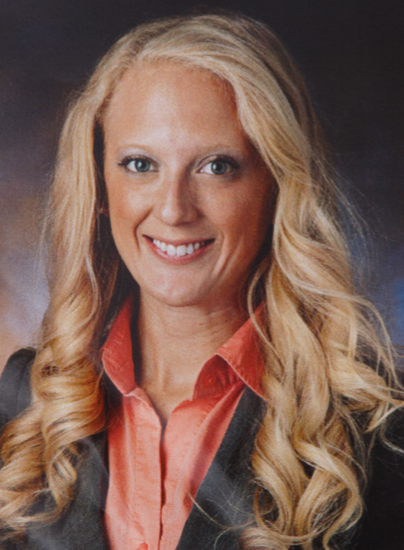
Pratt & Whitney additive manufacturing project manager Caitlin Oswald is one of the “100 Most Creative People in Business for 2015,” in a list compiled by Fast Company magazine featuring business and industry leaders well known – and some relatively obscure - from across the globe. The elite international list of scientists, fashion designers, app developers, architects and others from Nike, Evernote, IBM and Pepsico  and other well-known organizations are among those that Fast Company, the oft-cited media voice for innovation in business, keeps an eye on for the latest in technology and business models that have the potential to change the world.caitlin oswald photo

Oswald was recognized for her work in additive manufacturing, or "3D printing," especially as it has been applied to Pratt & Whitney's PurePower® Geared Turbofan™ (GTF) engine platform. She is credited with leading a team that incorporated additive manufacturing, specifically electron beam melting, through the development process and helping engineers approach challenges in a new way, according to the publication.sidebar-mcp-2015

As Fast Company explained Oswald’s business leadership:  “When a new fleet of Airbus regional jets take off later this year, they will feature something new under their wings: geared turbofan engines. Possibly the most sustainable jet engine ever built, the GTF will use 16 percent less fuel and significantly reduce CO2 emissions—a breakthrough that was only possible via advances in 3-D–printing technology.”

The publication indicated that “Caitlin Oswald led the team that incorporated 3-D printing into the design process, looking at each part of a jet engine to determine if it could be better developed with the new technique. As a result, engineers were able to approach challenges in a completely different way.”

"They’re able to print a part to scale and hold it in their hand," Oswald told Fast Company. "They can really understand what it looks like and what the capabilities and limitations are."

Added Oswald, a Design and Applied Technology Manager at Pratt & Whitney:  “This concept of additive manufacturing is this big, scary concept out there. Some people can take it and they look at it like it's the best thing since sliced bread and they're going to use it everywhere and let's forge ahead. Then there's the other side who thinks it's too risky; it's just a fad that's never going to gain any ground. My job is in this sweet spot where I'm able to take this big, scary concept and break it out into many bite-sized chunks.”

Pratt_&_WhitneyThe Fast Company top 10 include:  Charles Arntzen of Arizona State University’s Center for Infectious Diseases and Vaccinology; Rajan Anandan, Google’s Vice President and Managing Director for India and Southest Asia; Dao Nguyen, publisher of Buzzfeed; Maria Claudia Lacouture, president of ProColombia; Jens Bergensten, lead creative designer for Minecraft; and Leslie Dewan, CEO of Transatomic Power.

Oswald ranked #30 on the list, between Barbara Bush and Tracy Young.  Bush, the daughter of former President George W. Bush, is co-founder and CEO of Global Health Corps.  Young is co-founder of PlanGrid, which developed a software product allows a large team to share a master set of blueprints, so that each team member can add their own markings and see their changes reflected in real time.FCLA

The magazine’s awards were presented to the Most Creative People in Business recipients at a Fast Company conference in Los Angeles recently. Said Oswald of the experience: “What I really enjoyed was learning about how people use their passion for creativity to drive their goals."

Read the Fast Company profile of Caitlin Oswald


Transportation Seen As Key for Growing Senior Population in CT

Connecticut is the 7th oldest state in the nation with the 3rd longest-lived average life expectancy, at 80.8 years.  Transportation is “the vital link,” according to a new report, “that connects residents across the lifespan with their communities and the elements of a vibrant and engaged life.”  By 2025, at least 20 percent of the population in every Connecticut town (except Mansfield and New Haven) will be age 65 or older, according to projections. As the state considers a range of transportation options – all carrying considerable price-tags – the impact of various alternatives on the state’s fast-growing senior population was the focus of a statewide survey and report led by the Connecticut’s Legislative Commission on Aging.47 8

The Commission’s Transportation Policy Brief, issued last month, was prepared in partnership with the Connecticut Chapter of the American Planning Association and the Capitol Region Council of Governments. Among the key findings:

  • Connecticut’s older adults are currently more likely than any other age group to rely on their cars as their primary form of transportation. Currently, 82% of all Connecticut adults use their cars as their primary form of transportation, versus 92% of adults age 50 and older.
  • However, Connecticut residents want to become less car-dependent. Compared to today (82%), 10% fewer Connecticut adults (72%) plan to use their cars as their primary form of transportation in the future. Moreover, 47% of Connecticut adults reported currently living in a suburb where most people drive to most places, but only 8% of Connecticut adults want to live there in the future.bike

The report calls for the state and municipalities to create environments that promote equity, environmental sustainability and support healthier lifestyles for everyone; retrofitting car-dominated infrastructure for the safety of all users; rebuilding the street as a public space for social experience; supporting economic activity, and sustaining, coordinating and growing both fixed route and demand-responsive transportation options.

Connecticut residents, especially older residents, are looking for transportation alternatives, according to the online survey conducted for the Commission this year by the Harris Poll:

  • Connecticut residents intend to use public transit more in the future, especially older adults. Among adults 66 years of age and older, more (12 percentage point increase) plan to use the bus as their primary form of transportation in the future (14%), compared to today (2%).
  • More Connecticut residents plan to bike in the future, with the highest increases for the 50-65-year-old age group (13 percentage point increase) and 66 years and older age group (9 percentage point increase).
  • Creating a more walkable infrastructure is a top priority for Connecticut residents, second only to maintaining existing transportation systems (41%). Among new public investments, the strongest demand by Connecticut residents is for new sidewalks and pedestrians crossings (38%).

The survey also found that as economic uncertainty continues, 43% of Connecticut adults identified keeping transportation costs low to be a high priority.  The survey found that 28% of Connecticut adults said the quality of life, including community transportation features, was the single most important factor in choosing where to live, ranking higher than friends and family living there (17%) or job prospects (11%).

“The Commission recognizes that continued strategic investments, as well as critical policy expansions and transformations, are necessary to shape a transportation system that values community and much as it values mobility” said Julia Evans Starr, Executive Director of the Commission.

coupleFixed route transportation operates along a prescribed route and on a fixed schedule, and includes buses and light rail. In 2014 in Connecticut, buses provided over 43 million passenger trips and rail provided over 39 million passenger trips.  Demand-responsive transportation provides routes and scheduling more individually tailored to the needs of the user. The Americans with Disabilities Act (ADA) requires transit agencies to provide paratransit service, subject to certain parameters, to people with disabilities who cannot use the fixed route services. Paratransit ridership in Connecticut in fiscal year 2014 under the ADA totaled over one million rides, and dial-a-ride ridership neared 100,000 rides.

Among the report’s 12 recommendations were a call to “incentivize and enhance funding for municipalities to engage in transit-oriented development in conducive locations to ensure that compact, walkable, mixed-used, mixed-income cCommission on Agingommunities are located within a reasonable distance of quality, dependable public transportation.” In addition, policy makers were urged to “identify funding streams to sustain, coordinate, grow and make more convenient both fixed route and demand-responsive transportation options (including providing door-to-door service), and provide technical assistance to support regionalization efforts.”
The report also advocated efforts that would “enhance collaboration with non-transportation partners, including those in housing, health care, public health, planning and zoning, social services, law enforcement, and the business community, among others.”  Improved data collection regarding key risk factors in road traffic injuries, and research into self-driving vehicles were also recommended.

Between 2010 and 2040, Connecticut’s population of people age 65 and older is projected to grow by 57 percent, but its population of people age 20 to 64 is projected to grow by less than 2 percent.

For more information and to read the full report visit the Legislative Commission on Aging website at www.cga.ct.gov.coa


CT Drops in State Rankings of Startup Business Activity, Now 35th in US

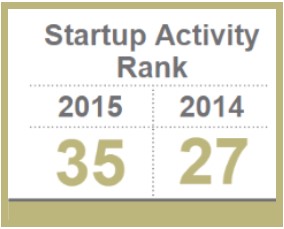
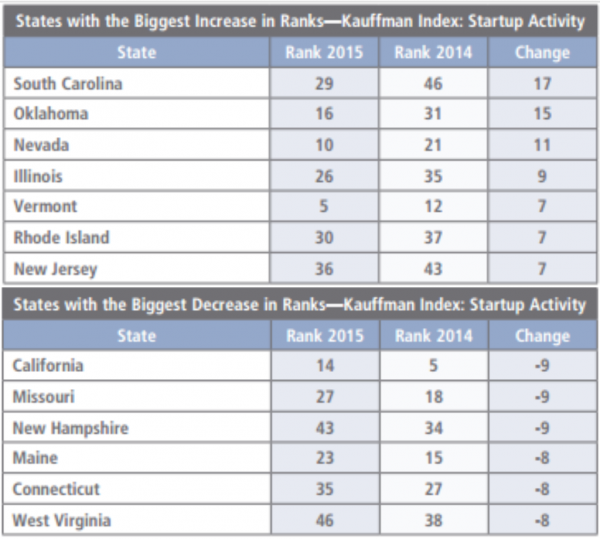
Connecticut dropped from number 27 a year ago to number 35 in the nation in business start-up activity, according to annual rankings developed by the Kauffman Foundation.  The drop of 8 positions was among the six worst among the 50 states, the analysis indicated.  Only New Hampshire, Missouri and California plummeted further, each dropping nine positions in the annual rankings. Nationally, the U.S. economy reversed a five-year downward trend in startup activity last year with a big jump in the number of new entrepreneurs - the largest year-over-year growth in two decades, according to the analysis.  New business creation increased in 32 states.  Connecticut was not among them.rank

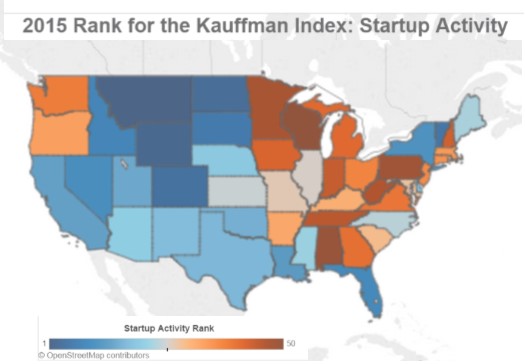
The largest leaps forward came in South Carolina, jumping from 46th to 29th, Oklahoma, from 31st to 16th and Nevada, from 21st to 10th in the 2015 rankings, based on 2014 data.  Three components were used to make up the rankings:  the rate of new entrepreneurs, the opportunity share of new entrepreneurs and startup density.

states_insertThe top ranked states were Montana, Wyoming, North Dakota, Colorado, Vermont, South Dakota, Alaska, Idaho, Florida, Nevada and New York.
Connecticut dropped in two of the three key measures of startup activity used by Kaufman in the analysis.  The “Opportunity Share of New Entrepreneurs” fell from 76.9% to 74.9%.  The stat is described as “the percent of new entrepreneurs starting businesses because they saw market opportunities.”  The “Rate of New Entrepreneurs” fell from .31% to .29%.  That measure is the percent of the adult population that became entrepreneurs in a given month.

The final measure in the Kauffman formula, Startup Density, saw a slight uptick for Connecticut.  The stat consists of the number of startup firms per 100,000 residents, defined as firms less than one year old employing at least one person besides the owner.  Connecticut moved from 105.3 in the previous year to 110.4.USA map

For the past 10 years, the Kauffman Index has been "a trusted, early indicator for entrepreneurship in the United States," used by entrepreneurs and policy makers, from the federal to state and local levels.

17 CT Companies Reach Fortune 500, From #8 GE (Fairfield) to #487 Amphenol (Wallingford)

Connecticut has a total of 17 companies headquartered in the state that are now ranked on the Fortune 500, as the latest annual business list is published by Fortune magazine this week.  That includes one company, General Electric, in the top 10, a total of seven companies in the top 250, and two that reached the Fortune 500 list this year. The nation's largest companies ranked in the newly updated Fortune 500 list earned combined total annual revenue of $12.5 trillion last year — an all-time high that's up 2.6 percent from the year before.  Total market value of firms that made the 2015 list reached $17.4 trillion as of March 31, also an all-time high that's up 7.7 percent from the previous year, the publication announced.  This year's list of U.S. companies ranked by their 2014 revenue also employ 2fortune500logo6.8 million employees in all, more than ever, according to Fortune, whose issue with the 61st annual ranking is out this week.

The top 10:  Walmart, ExxonMobil; Chevron; Berkshire Hathaway; Apple; General Motors; Phillips 66; General Electric; Ford Motor and CVS Health.  CVS Health made the top 10 for the first time.  There were 19 companies that made their debut on the 2015 list of the nation’s top 500 companies, including Netflix, Salesforce.com, Expedia and News Corp., as 26 firms dropped out of the updated ranking.  Facebook, in its third year on the list, jumped into the top 250, at number 242, up from number 341 a year ago.

The 7 companies headquartered in Connecticut that rank among the 250 top businesses on the list:

  • 8. General Electric of Fairfield (up from 9 last year)
  • 45. United Technologies of Hartford (same as last year)
  • 49. Aetna of Hartford (up from 57)
  • 90. Cigna of Bloomfield (up from 97)
  • 143. Xerox of Norwalk, down from 137.
  • 160. The Hartford Financial Services Group of Hartford (down from 113)
  • 249. Praxair of Danbury (down from 233)

The 8 Connecticut-headquartered companies that remained in the Fortune 500, and 2 companies that earned a slot for the first time:

  • 261. Stanley Black & Decker of New Britain (down from 255)
  • 317. Charter Communications of Stamford (up from 331)
  • 339. Priceline Group of Norwalk (up from 383)
  • 377. Terex of Westport (down from 358)
  • 385. W.R. Berkley of Greenwich (up from 409)
  • 421. EMCOR Group of Norwalk (down from 407)
  • 442. Starwood Hotels & Resorts of Stamford (down from 424)
  • 461. United Rentals of Stamford (up from 500)
  • 486. Harman International Industries of Stamford (up from 576)
  • 487. Amphenol of Wallingford (up from 533)

harmanLogoOne of the two new entries on this year’s list that are headquartered in Connecticut is Harman International Industries, based in Stamford, the parent company behind an array of world-renowned audio brands including AKG®, Harman Kardon®, JBL®, Mark Levinson®, Lexicon®, and Infinity®.  Well established for six decades, since it was launched by audio pioneer Sid Harmon, the company’s founder, the current Chairman, President and CEO is Dinesh Paliwal. states

Amphenol-Corporation-logoAmphenol World Headquarters is in Wallingford, and a number of the international company’s divisions are also based in Connecticut: Amphenol Nexus Technologies Division is in Stamford, Amphenol Times Microwave and Times Fiber Communications in Wallingford, Spectra Strip in Hamden and Amphenol RF in Danbury.  Amphenol, founded in 1932, is one of the largest manufacturers of interconnect products in the world. The Company designs, manufactures and markets electrical, electronic and fiber optic connectors, coaxial and flat-ribbon cable, and interconnect systems.  The primary end markets for the company's products are communications and information processing markets, including cable television, cellular telephone and data communication and information processing systems; aerospace and military electronics; and automotive, rail and other transportation and industrial applications. (see company video)

Fortune 500 companies had revenues last year that equaled 71.9 percent of U.S. GDP—up from 58.4 percent two decades ago, and 35 percent in 1955, according to Fortune. “To be sure, much of that revenue comes from overseas operations. But these companies are still the guts of the U.S., and the global, economy,” the publication points out.greatest challenge

As part of the magazine’s research for the list, they sent a survey to all the Fortune 500 CEOs. One question asked: What is your company’s greatest challenge? “The rapid pace of technological change” topped the list, besting “cybersecurity” (a close second), as well as other traditionally popular responses, such as “increased regulation,” “shareholder activism,” and a “shortage of skilled labor.” Interestingly, 94 percent of those who responded said their companies would change more in the next five years than in the past five, Fortune reported.

New York is the state with the most companies on the list with 55, followed by Texas with 54 and California with 53.  There are 33 companies headquartered in Illinois, 23 in Ohio, 20 in Georgia, 19 in New Jersey and Virginia, 18 in Pennsylvania, 16 in Florida, and 10 in Wisconsin.

Walmart takes the top spot for the third year in a row and the eleventh time ever.Only three companies have held the number 1 spot on the Fortune 500 since its creation in 1955: General Motors, Exxon Mobil and Walmart, according to published reports.


CT Ranks #15 in USA in Job Growth This Year

Connecticut’s job growth during the first four months of the year ranked fifteenth among the states, according to data compiled by Governing magazine.  Connecticut average employment between January 1 and April 30, 2015 increased by eight-tenths of one percent from the previous four-month period.  Average employment was 1,685,375, an increase of 13,500 from the four months ending 2014.jobs Idaho recorded the largest percentage increase over the four-month period (+2.2 percent), followed by Utah (+1.8 percent). The other leading job growth states, by percentage, were Washington, Oregon, Michigan, South Carolina, Florida, Nevada, California, North Carolina, Arizona and Vermont.  In West Virginia, Louisiana and Maine, average monthly employment declined slightly.

job growthMuch of how state economies are performing is due to the individual sectors making up their employment base, Governing reported, as several industries experienced weak growth to start the year. Nationally, construction and manufacturing employment expanded little over the first four months, and government employment (local, state and federal), similarly remained essentially unchanged since January, the analysis pointed out.

Nationally, total state and local government employment peaked during the early stages of the recession in the summer of 2008, reaching about 19.8 million jobs. The U.S. Labor Department's most recent estimates indicate the sector remains about 630,000 jobs below this level.  By sector nationally, construction jobs led the way, with government jobs the slowest growing sector.

In April in Connecticut, according to the state Department of Labor (DOL), the private sector lost 300 (-0.02%) positions, although Connecticut private sector firms have increased employment by 21,300 (1.49%) jobs from a year ago, according to state data.  Four of the ten major industry supersectors added jobs in April and just three declined, according to DOL. Financial Activities, Other Services, and Information came in unchanged. Government(1,500, 0.6%) led all industry supersectors in April, with local government (1,400, 0.9%) entities providing the majority of the increase. Manufacturing (1,400, 0.9%) also posted a good-sized monthly increase in April with the durable goods components (1,200, 1.0%) being the strongest performer. The combined Construction and Mining (1,300, 2.4%) supersector experienced healthy April gains as well in a potentially good sign for the home building sector, the DOL analysis pointed out. Education and Health Services (200, 0.1%) showed a small gain, primarily driven by private educational services (400, 0.6%).dol_v4_header_01

In a year-by-year comparison for the month of April, Connecticut (nonfarm) jobs have grown by a seasonally adjusted 9,100 in 2015, which compares to 11,000 in the first four months of 2014, 7,000 for the same timeframe in 2013, 5,000 for 2012, and 10,500 for 2011, according to DOL data.

Governor Travels to Iowa for Insurance Industry Keynote

When “attendees from around the world” convened in the “insurance hub of Des Moines, Iowa,” for the second annual Global Insurance Symposium, the keynote speaker was an individual from a state long considered as the hub of the industry, Governor Dannel Malloy of Connecticut. The symposium, being held this week, was designed to “provide a forum for insurance professionals and regulatory authorities to share insights into challenges facing the insurance industry,” and includes “some of the most knowledgeable experts in the insurance field and discuss important issues facing the industry, such as cybersecurity and big data,” according to conference organizers.

Why Des Moines, Iowa?  The conference website points out that “for decades, Iowa has been committed to policy that creates favorable conditions for the insurance industry to thrive. As home to more than 200 insurance companies, Iowa is uniquely suited to host the Global Insurance Symposium and assemble global leaders to discuss these important issues.”

The symposium will  also serve as a coming out for six start-ups completing Iowa's Global Insurance Accelerator, a fast-track business development program focused on insurance innovation. The accelerator brought together startups from Iowa, Nebraska, California, Germany and Brazil, for 100 days of fast-paced business development, and mentoring.  The initiative was launched in February.

global insuranceIowa Governor Terry Branstad provided opening remarks at Wednesday’s session, followed by Malloy’s keynote address.  Branstad, a Republican, and Malloy, a Democrat, were re-elected by voters in their respective states last fall.


The 2014 Connecticut Insurance Market Brief reports that Connecticut ranks #1 in the U.S. for insurance carrier employment as a percentage of total employment, #1 in the U.S. for insurance payroll as a percentage of total payroll (5.6 percent) and that one new job in the insurance industry results in 1.73 additional jobs to the Connecticut economy.  The insurance sector accounts for 5.7 percent of Connecticut’s Gross State Product, ranking #2 in the U.S. as a percentage per capita. CT map insurance

A 2012 report by the Connecticut Insurance and Financial Services (IFS) Cluster and PwC US indicated that an increase of $1 in insurance labor income puts an additional $0.78 into state commerce; and every year the insurance industry purchases an average of $2 billion in goods and services from other industries in Connecticut.

The Iowa Economic Development Authority reports that “Iowa’s insurance industry grew by 11 percent during the past 15 years, while industry throughout the entire U.S. was flat.”  The agency indicates that while Iowa has 1.6 percent of the nation’s finance and insurance jobs, it generates 2.9 percent of the nation’s insurance GDP.

FIT01_InsuranceLocationMap

In a op-ed co-authored by the two Governors and published in 2012 by the Connecticut Post, Malloy and Branstad pointed out that “in Connecticut and Iowa, the multibillion-dollar insurance industry remains one of the essential anchors for sustained prosperity and quality of life. Both states are among the top four in the nation for the share of insurance and financial services jobs when compared to the entire workforce. In addition, the U.S. insurance industry is a titan in the world marketplace, accounting for nearly 34 percent of the worldwide market share.”

“Unique and fundamentally stable, insurance would top the list of industries for any governor to nurture and grow in his or her state,” the states’ chief elected officials noted. “The industry attracts a well-educated, well-paid work force of actuaries, financial analysts, attorneys, certified accountants and skilled support staff.”

The text of remarks by Branstad and Malloy at the Global Insurance Symposium were not immediately available, but The Hartford Courant reported that Malloy advocated continued state regulation of the industry, rather than an increased federal regulatory scheme.  "Our states, our commissioners and our governors need to be more actively involved if we are going to protect our industry as we know it, and not be dictated to, not simply by people in Washington but people abroad as well," the Courant quoted Malloy as stridently urging those gathered for the symposium.

https://youtu.be/R_aApLrqy5o

https://youtu.be/CmDCxvRIC3I

Agencies, Organizations to be Honored for Efforts Advancing Local Downtowns

A high school AP economics class that engages students in proactive land-use planning, the owners of a downtown Segway tour company that let the community help name their new business, and the state’s Department of Transportation are among the organizations and initiatives chosen to receive a 2015 Award of Excellence from the Connecticut Main Street Center (CMSC). Seven recipients were selected for the prestigious award, representing initiatives in Mansfield, New London, Putnam, Simsbury, Waterbury, and Upper Albany in Hartford.segway

The other winning entries included a First Fridays series that draws thousands of visitors with its hands-on arts and cultural events; a massive, multi-cultural downtown gathering of dozens of ethnic groups to celebrate a common community pride; a multi-year, multi-million dollar public/private partnership to design and build a brand-new town center; and a local merchant who remains committed to the neighborhood and the state despite becoming an international success.

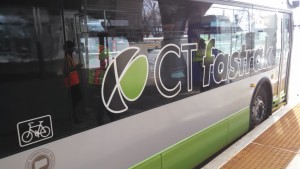
wpid-img_20150311_152459_058For the first time in the history of the awards program, a state agency was also selected to receive an award. The CT Department of Transportation received a special award for Starting a Revolution: Integration of Land Use and Transit in recognition of the progressive nature of CTfastrak, the bus rapid transit system opened earlier this year. The awards jury that selected the winners gave the award because they felt the new busway represents a cultural shift in how Connecticut views transit, and wanted to acknowledge the future promise of transit oriented development that will hopefully result around the station locations.



The Connecticut Main Street Awards annually celebrate and communicate the most successful and innovative efforts in Main Street revitalization in Connecticut. A jury comprised of industry-related professionals and CMSC staff judged the submissions on criteria that included innovation, replication, representation, partnerships utilized, and outcomes.20150507_townsquare_pavilion

"Our members continue to impress us with how they support, encourage and implement new ideas from the ground up," said CMSC President & CEO John Simone. "They're constantly forming partnerships with new groups, working to sustain local merchants, and tirelessly promoting how wonderful our downtowns and Main Streets are. We're proud of their efforts and excited to share their achievements with everyone else."putnam

The awards will be presented at the 2015 Connecticut Main Street Awards Gala on June 8th at Trinity-on-Main in downtown New Britain. This year's event will feature guided tours of downtown New Britain, including a Downtown Arts, Heritage & Culture tour, a tour of Walnut Hill Rose Garden & New Britain Museum of American Art, and a tour of CTfastrak in New Britain: Transportation, Housing & Main Street.

The full list of 2015 Awards of Excellence winners:

2015 Connecticut Main Street Awards of Excellence                 

Main Street Partnership

▪   Simsbury High School AP Economics Course, to Simsbury Main Street Partnership and Simsbury High School.

Planning

▪   Step by Step: Building a Downtown from Scratch (Storrs Center), to Mansfield Downtown Partnership, the Town of Mansfield, UConn, LeylandAlliance and the Citizens of Mansfield. (photo, above right)

Events & Programming  (Sponsored by Webster Bank)

▪    The Gathering (Downtown Waterbury), to the City of Waterbury, the Waterbury Observer, and Main Street Waterbury.

Award of Merit for Events & Programming

▪   First Fridays (Downtown Putnam), to the Town of Putnam, Putnam Business Association, and the Putnam Arts Council.

Business Owner of the Year

▪   Dawn & Kristin Harkness / Wheeling City Tours (New London), Submitted by New London Main Street.

2015 Main Street Pioneer: Outstanding Commitment to The Avenue  (Sponsored by Webster Bank)

▪    Vivian Akuoko / Evay Cosmetics (Upper Albany Avenue, Hartford), Submitted by Upper Albany Main Street.

Starting a Revolution: Integration of Land Use and Transitphoto_center_01

▪   CTfastrak, to the State of Connecticut Department of Transportation and the Capitol Region Council of Governments (CRCOG).

The Connecticut Main Street Awards of Excellence were created in 2003 to recognize outstanding projects, individuals and partnerships in community efforts to bring traditional downtowns and neighborhood commercial districts back to life, socially and economically.  In recent years, the Awards Gala has been held in New Haven, Hartford, Manchester, Torrington and Bridgeport.

Pedals for Progress Sends Bicycles Overseas to Boost Opportunity, Improve Economic Conditions

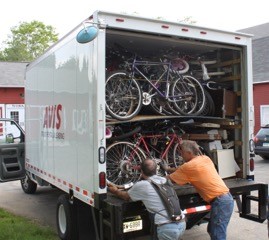
Area residents with an adult or child’s bicycle in repairable condition are urged to consider a donation to Pedals for Progress (P4P) in West Granby this weekend.  The national organization rescues bicycles destined for overburdened U.S. landfills and ships them to developing countries where they are sorely needed and highly valued. Last year, bike collections were sponsored by approximately 41 community partners in six states, including Connecticut. P4P bikes are put to work not only as basic transportation, but are used as a supplement to school and community programs. The bikes are adapted for use as trash haulers, produce trucks, taxis, and farm machinery.bicycle 1

With overseas partners, the bicycles take on an even greater significance – to keep the bikes working, maintenance is necessary. Children and adults are trained in bicycle maintenance and repair, and the bicycles are sold within the community, fostering the development of a local economy. If a person would like to have a bicycle but cannot pay for it, that person has to work for the shop (and learn a new skill) in order to cover the cost of the bicycle.

P4P also arranges for the bicycle shops to have a supply of tools, parts, accessories, and lubricants for maintaining the bikes. With Pedals for Progress, a bicycle becomes a valuable commodity for trade, employment, transportation, local government – the list goes on.

Sponsored by Jackie Rubell Johnson with support from Holcomb Farm, bikes can be dropped off from 12 noon to 3 PM on Saturday May 23, 2015, rain or shine at Holcomb Farm, 113 Simsbury Road, in West Granby. [“Bikes for parts” or disassembled bikes are not accepted.] It costs $40 to collect, process, ship, rebuild and distribute each bicycle. A donation toward shipping costs is necessary.  Organizers ask for a minimum $10 donation with each bike or sewing machine to help cover the cost of shipping. Receipts are offered for value of donation including cash.

P4P collects 5,000 to 7,000 bicycles annually and transfers this material wealth to those in need. To date, more than 140,000 have been shipped to developing countries in Latin America, Africa and Eastern Europe.  Last year, the bicycles were donated to recipients in Nicaragua, Guatemala, Albania, Moldova, and Madagascar. Pedals1

In these countries the bikes are reconditioned by partner agencies and distributed at low cost to poor working adults. These bikes provide reliable transportation for commuting to work, transporting product to market, or accessing health care and other services. Steady employment for is vital to the development and success of these economies.

In 2014, Pedals for Progress shipped a total of 3,634 bicycles, 274 sewing machines, and approximately $360,000 in bicycle parts and accessories, to seven nonprofit agency partners in seven developing countries. That brought the cumulative donations shipped in the last 24 years, since the organization’s inception in 1991, to 142,437 bicycles, 2,860 sewing machines, and over $12 million in parts and accessories donated to 38 countries.

Among the organizations providing support are the Clif Bar Family Foundation, FedEx and Thulé.   Connecticut organizations that participated in collecting bicycles in 2014, in addition to Jackie Rubell Johnson with support from Holcomb Farm in West Granby, include Newtown Rotary Club, Old Greenwich Presbyterian Church, and the Wilton High School Spanish Honor Society.

bicycle 2The organization also accepts working portable sewing machines and P4P seeks donations of wrenches for their overseas shops. All cash and material donations are fully deductible and a receipt will be available at the collection site.

Pedals for Progress is a 501 © (3) corporation and a registered charity in the states of New Jersey, Pennsylvania, Vermont, Iowa and Connecticut.  More information about the organization is available at  www.p4p.org; for information about the May 23 pick-up in West Granby, call 860 653 7758.

https://www.youtube.com/watch?v=U0qfStNmS6k&feature=youtu.be