CT is Among 24 States Seeing Weak Revenues, Highest Number Since Recession
/Connecticut is not alone. According to the National Association of State Budget Officers’ (NASBO) annual state spending survey, half of all states saw revenues come in lower than budgeted in fiscal 2016 and 24 states – including Connecticut - are seeing those weak revenue conditions carry into fiscal 2017.
 That is the highest number of states falling short of revenue projections since 36 states budgets missed their mark in 2010, according to the NASBO report and Governing. As a result, 19 states made mid-year budget cuts in 2016, totaling $2.8 billion, Connecticut among them. That number of states “is historically high outside of a recessionary period,” according to the report. The revenue slowdown is caused mainly by slow income tax growth, even slower sales tax growth and an outright decline in corporate tax revenue, the report explains, stating that “progress since the Great Recession has been uneven, and many states are seeing softening state tax collections.”
Overall, state spending totaled $786 billion last fiscal year, a 3.7 percent annual increase. Although it marks the seventh straight year of spending growth, it represents a slowdown from fiscal 2015 when spending increased by 4.4 percent.
“Weaker-than-anticipated revenue collections and resulting budget gaps in fiscal 2016 led some states to cut spending during the year,” the report indicated, with overall spending increasing just 1.8 percent to $781 billion in fiscal 2016, compared with the previous year’s growth of 5 percent. When accounting for inflation, 32 states are still spending less than they did before the Great Recession and total state spending also has yet to surpass pre-recession levels. Across the states, cuts enacted by legislatures come most often in K-12 education, an “all other” category, followed by Medicaid, higher education and corrections, according to data compiled for the NASBO report.
The state has an estimated $1.3 billion or $1.5 billion budget deficit, according to reports from the governor’s Office of Policy and Management and the legislature’s nonpartisan Office of Fiscal Analysis, CTNewsJunkie reported recently.
“Certainly a recession is coming sometime soon,” said NASBO President-elect Michael Cohen, who is also California’s finance director, told Governing. “But I think economists in all of the state offices would tell you that’s a really hard economic forecasting [task] of predicting when that’s going to happen.” NASBO had previously predicted that fiscal 2016 would mark the full recovery of state budgets from the recession, but the cutbacks and increased inflation has delayed that at least another year.
The report indicates that eight (including energy-producing states like Alaska, North Dakota and Oklahoma) planned to spend less in 2017, and 11 states planned to up their spending by 6 percent or more next year. In those states, sales tax increases have improved their revenue with Louisiana, for example, anticipating a 17 percent increase in revenue, driven by an expected $800 million increase in sales tax collections.
Most states have focused on strengthening their rainy day funds, according to the report, though some states – particularly energy-producing ones – have had to tap their reserves to help address budget shortfalls. Twenty-nine states increased their rainy day fund balances in fiscal 2016, and 25 states project increases in fiscal 2017. Since aggregate rainy day fund levels hit a recent low in fiscal 2010, 40 states had increased their amounts as of the end of fiscal 2016, at least in nominal terms, the report said.
“States will also have to contend with rising spending demands in areas such as health care and education, long-term pressures such as pensions and infrastructure, and increasing federal uncertainty,” the report predicted, “particularly concerning the prospects of tax reform and health care policy. In this environment, states are likely to be cautious in their spending and revenue forecasts, as they continue to focus on ensuring structurally balanced budgets.”
https://youtu.be/uAvz-zo9NQw
 “The company will hire 14,000 new employees over the next 13 years,” the
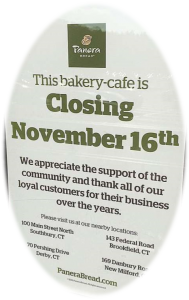
 As of June 28, 2016, there were 2,007 bakery-cafes in 46 states and in Ontario, Canada operating under the Panera Bread, Saint Louis Bread Co. or Paradise Bakery & Cafe names. Published reports indicate the company has 97,000 employees nationwide and saw a 3.4 percent growth in sales in its third quarter this year. In 2015, it reportedly generated roughly $2.7 billion in revenue. Founder and CEO Ron Shaich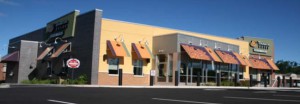
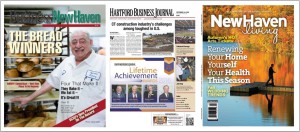 Each monthly addition of New Haven Living was nearly identical to Hartford Magazine, usually with a handful of New Haven-focused articles and features added. The Courant reported that it made the decision while evaluating opportunities to invest in higher-growth areas and the cost of distribution in Greater New Haven.
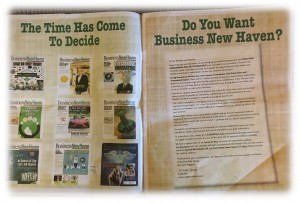 A limited number of promotional copies will be limited “based on a proprietary algorithm for the support of our advertisers,” Young noted. He also indicated that plans are in the works to expand the publication’s
  The state’s construction industry unemployment rate nudged downward from 7.1 percent in September, but was 6.4 percent in July 2016. In recent years, the rate ballooned to 18.1 percent in October 2010, at the height of the recession, from a low of 5.8 percent in October of 2008.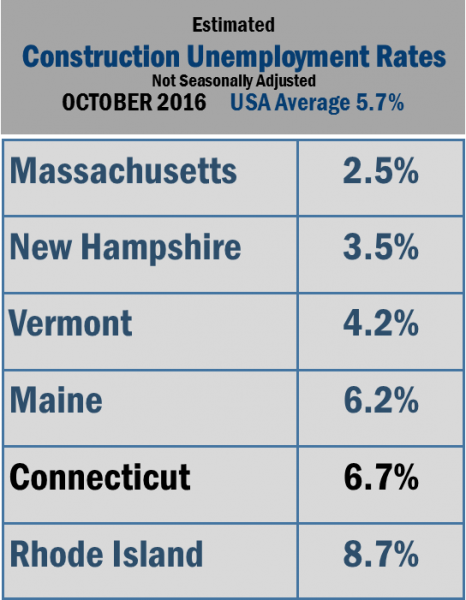
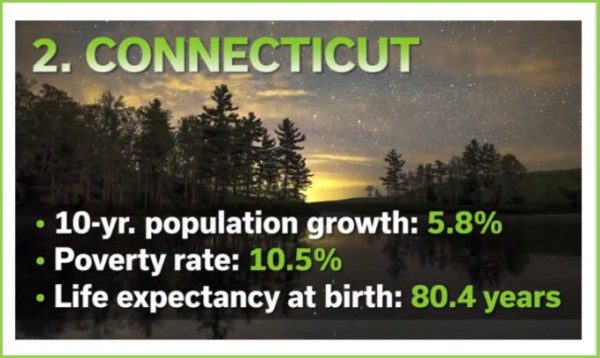 Quality of life in the United States is heavily dependent on financial status, the survey summary points out. As a consequence, the nation’s best states to live in often report very high incomes. With a median household income of $71,346 a year, fifth highest of all states, Connecticut is the second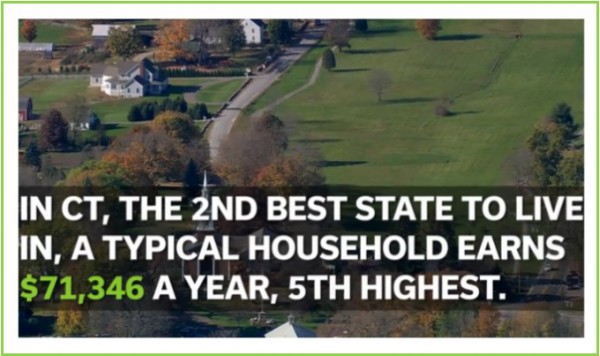
 In a reversal from the previous quarter, 42 percent of state residents surveyed said they were unlikely to move out of state in the next 5 years, compared with 34 percent who described such a move as likely. In the previous survey, conducted in the second quarter of this year, the numbers were reversed with 42 percent saying that it was likely they’d be moving out of state within five years, compared with only 32 percent who said such a move was unlikely.
 Residents of Windham and Fairfield counties were more likely to view overall business conditions as being better now than six months ago, the survey found. Twenty-nine percent of Windham residents held that view as did 28 percent of Fairfield residents. Residents of the state’s other six counties, Middlesex (23%), New London (20%), New Haven (20%), Litchfield (16%), Tolland (16%) and Hartford (16%) had fewer residents expressing that opinion.
 Louise DiCocco, Assistant Counsel for the Connecticut Business & Industry Association, noted that “24 years ago, more than 80 percent of Connecticut votes overwhelmingly approved a spending cap to keep the cost of state government within the taxpayers’ means to afford it. Voters demanded the cap as an offset to the persona income tax in Connecticut. The state must enact a spending cap that is ironclad and works.”
 State Senator Toni Boucher of Danbury told the Commission: “I hope that the commission to adopt a definition of general budget expenditures that is comprehensive and gives a complete and realistic account of all the money that the state spends… it is equally critical that the legislature not be allowed to move what was once an expenditure included under the cap to bonding or fund it with a revenue intercept for the purpose of undermining the cap’s integrity.”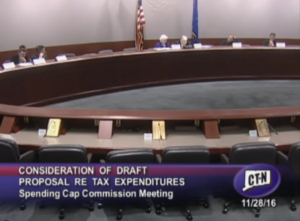


 ACM comprises one of the largest, most experienced concentrations of world-class aerospace companies, the world's AEROSPACE ALLEY! ® The organization points out that member firms grew up where aerospace was born. Today, precision components manufacturer in the state take to the skies every day, in every corner of the globe, as they have since the inception of powered flight.