The Difference A Dollar Makes: UConn Research Finds Minimum Wage Increase Reduces Maltreatment of Children
/It has been nearly a year since a study co-authored by UConn Assistant Professor of Public Policy Kerri M. Raissian appeared in the academic journal Children and Youth Services Review, but the interest hasn’t waned. In fact, it now tops the list of downloaded articles in the past 90 days from the journal’s website. The article, which Raissian co-authored with Lindsey Rose Bullinger, asks – and answers – this question: Does the minimum wage affect child maltreatment rates?
Short answer, according to their research: yes. 
Raising the minimum wage by $1 per hour would result in a substantial decrease in the number of reported cases of child neglect, according to a study co-authored by Raissian and Bullinger. They reviewed eleven years of records on child abuse and neglect and found that increases in the minimum wage correlate with declining child maltreatment rates.
A $1 increase would result in 9,700 (9.6 percent) fewer reported cases of child neglect annually as well as a likely decrease in cases of physical abuse, Bullinger explained on the website sciencedaily.com, where their study was featured earlier this year. This decline is concentrated among young children (ages 0–5) and school-aged children (ages 6–12); the effect diminishes among adolescents and is not significant, the study’s abstract points out.
“Our results suggest that policies that increase incomes of the working poor can improve children's welfare, especially younger children, quite substantially,” the authors conclude in their 70-page article on the study.
"Money matters," Bullinger noted on sciencedaily.com. "When caregivers have more disposable income, they're better able to provide a child's basic needs such as clothing, food, medical care and a safe home. Policies that increase the income of the working poor can improve children's welfare, especially younger children, quite substantially."
More than 30 states had minimum wages exceeding the federal requirement by an average of $1 during the study period, allowing the researchers to track changes in the number of reports to child protective service agencies with increases in the minimum wage. Data from the National Child Abuse and Neglect Data System was used in the research.
The substantial decrease in child neglect cases is concentrated among toddlers and school-age children, but changes in the minimum wage had little impact on reports of neglect of teenagers. The researchers found no variation based on a child's race.
“Families with low incomes have a great ability to make a dollar go a long way. On average, the weekly SNAP (Supplemental Nutrition Assistance Program) food stamp benefit for a family of three is about $30. That’s about what a one dollar an hour minimum wage increase translates into for full-time workers. Other studies show that a $1,000 tax refund results in similar declines in child maltreatment – neglect, specifically. So for really low-income families that probably have pretty severe material deprivation or economic hardship, that extra dollar can make a really big difference,” Raissian told UConn Today.
Raissian’s research interests are linked by a common focus on child and family policy, according to the university’s website. Her dissertation, “Assessing the Role and Impact of Public Policy on Child and Family Violence,” evaluated the efficacy of policies designed to reduce violence directed towards intimate partners, children, and other family members. Her professional background includes nearly 10 years of government and nonprofit sector experience, which focused on serving abused adults and children.
Bullinger is associate instructor in the school of public and environmental affairs at Indiana University at Bloomington. Both attended Syracuse University’s Maxwell School of Citizenship and Public Affairs.
“Most of the states don’t have a minimum wage at or above $10; Connecticut does. It’s possible Connecticut may be at the threshold,” Raissian said in an interview featured in UConn Today. “It’s also really important to note that, while our study looks at the minimum wage, this could really be an income story – remember other studies find similar results when incomes are increased in other ways. Our very low-income families might be facing other reductions in their incomes that will be costly to us as a state. We should consider that, moving forward.”
 Henkel is #158 on Forbes magazine’s Global 2000 list of Top Multinational Performers, and #307 on the list of America’s Best Employers. Charter Communications is #38 on the Forbes list of Growth Champions and ranks #107 on the Global 2000.
 Most Connecticut residents may also be unfamiliar with Charter Communications. Connecticut has 24 cable franchise areas; Charter provides local cable service in only three of them, in the western and northeastern regions of the state for about 35 mostly rural communities. The larger franchise owners in Connecticut are Cablevision, Comcast and Cox. But the Connecticut map is deceiving – nationally Charter is the second largest cable provider in the nation.
 The 21 honorees were selected by economic development officials in each of 10 regions across Connecticut for their contribution to the state’s economy – such as consistent or growing employment levels, playing a critical role in changing the character of its community or civic engagement, strong public/private collaboration to encourage new investment, or leadership resulting in growth or improvements.


 Sitrep, based in Cheshire, was founded in 2014 to “develop monitoring systems that are intuitively usable.” Principals are Harland Christofferson, Gary Martin and Michael Byrne.
 The mission of Stratford-based FallCall Solutions, LLC is “to become the premier innovator in simplified communication solutions for the geriatric population and their caregivers.” The company website explains that the company aims to maximize elder independence and caregiver peace of mind by “building software based solely on the needs of the consumer rather than the trying to create and introduce new ecosystems into our customers’ lives.”


 “It’s a scene repeating itself in dying suburban malls around the country,” the Globe reported, “a sweeping economic disruption known as the Amazon effect.” Industry analysts have predicted that 20 percent of the 1,200 shopping malls in the U.S. will “meet their demise,” the Globe indicated.
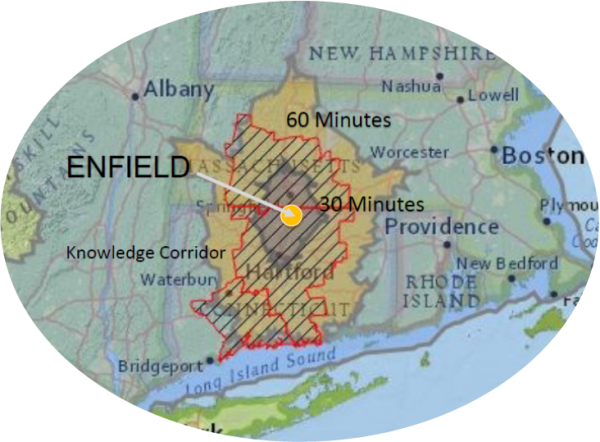 Knowledge Corridor, Enfield provides quick and easy access to several US Highways, airports and rail systems," the 12-page Enfield proposal explained. "Tax Increment Financing (TIF) districts are being created in Enfield and surrounding towns to support new development and growth. Abatements and Regional Revenue Sharing are all available to sweeten the deal. Connecticut has the lowest corporate tax rate in the North East."



 “VentureClash again attracted an impressive list of innovative, early-stage companies poised for growth,” said Matt McCooe, CEO of Connecticut Innovations. “The fundamental improvement in this year’s competition is the deep involvement of so many corporate partners. Many of Connecticut’s flagship companies engaged in the process to learn about, meet and help us select the competitors in VentureClash. The Connecticut-based companies are looking to CI to act as a tech scout, and to help identify fantastic talent and innovation from across the globe.”

 This marks the 13th consecutive quarter with an Outlook of +15% or stronger, according to Manpower Group. Compared with this time one year ago, hiring prospects are slightly stronger in the Northeast and remain relatively stable in the other three regions. The Northeast Region includes Connecticut, Maine, Massachusetts, New Hampshire, New Jersey, New York, Pennsylvania, Rhode Island, and Vermont. Employers across all sectors report favorable hiring intentions, with those in durable goods manufacturing reporting the strongest intentions in the past 10 years.

 “Despite growing private-sector demand, it appears that construction employment in some parts of the country is being brought down by declining public-sector investments,” said Ken Simonson, chief economist for the association. “Some of these declines will be offset thanks to recently enacted state infrastructure funding increases, but stagnant federal investments are not helping.”
 e of new construction jobs during the past year, followed by Nevada (12.8 percent, 9,700 jobs).