Report Reflects Good News, Continuing Challenges for Women, Girls in Eastern CT

Women and girls in Eastern Connecticut are progressing in many ways, but gender equity is elusive in many others, according to a new report.  The Community Foundation of Eastern Connecticut commissioned DataHaven to develop a report on the Status of Women and Girls in Eastern Connecticut, and the findings provide an insightful snapshot of disparities that persist, and challenges that remain and may increase, as well as diminish, in the years ahead. The purpose of the 26-page report, explains the Community Foundation’s President and Chief Executive Officer Maryam Elahi, is “to help inform and guide thoughtful conversations and inspire local ideas for social and policy advancements and investments.”   It is designed to be a “platform for action” to increase opportunity, access and equity for women and girls in Eastern Connecticut, officials indicated.  It is the first time that such a report was developed.

Among the key findings:

  • Young women are achieving in school, but greater educational attainment has yet to translate to economic equality.
  • Positive educational outcomes and economic equality are further out of reach for women of color.
  • Many occupations remain segregated by gender, and women make up a majority of part-time workers.
  • Women are at greater risk of financial insecurity, with single mothers at the greatest risk. 25% of all children in Eastern Connecticut live with a single mother, and 90% of single-parent households are headed by a mother.
  • Women in Eastern Connecticut are healthy, with a life expectancy of about 82 years—slightly above the national average, but below the state average.

The report also found that:

  • The opioid epidemic continues to ravage our communities, with deaths of women in 2016 more than double those of 2012.
  • Young women are at heightened risk for many mental health conditions. 35% of female students reported feeling hopeless or depressed vs. 19% of male students, and women are three times more likely to attempt suicide than men.
  • Violence against women continues to be a major public health problem. Almost 5,000 women in Windham and New London counties received services from domestic violence shelters.

The report defines Eastern Connecticut as the Community Foundation of Eastern Connecticut service area:  42 towns that include 453,000 people, 227,000 women.  The population of the region is 80% white, 9% Latina, 4% Black and 4% Asian.  Approximately 33,700 residents, or 7 percent, are foreign born.  Looking ahead, the report noted that the population of women ages 65 and up is projected to grow significantly over the next decade; estimated to increase 44 percent by 2025.

Continuing racial disparities are highlighted by the finding that among 90 percent of girls in the region’s class of 2016 graduated high school within four years, yet nearly 20 percent of women in New London and Windham/Willimantic lack a high school diploma.

The report noted that “a persistent gap” exists for women with degrees in STEM fields. Overall, 51 percent of men vs. 30 percent of women majored in science and engineering fields. Encouragingly, of 25-39 year-old women with degrees, 37 percent majored in the sciences. This is higher than previous generations.

Although women comprise 76 percent of educators, only 11 out of 41 superintendents in the region are women.  The report also found that 25 percent of businesses are women-owned.

“Women’s equality,” Elahi said, “is not just a women’s issue. It affects the wellbeing and prosperity of every family and community.”

The Community Foundation has organized public forums to discuss the report findings.  The first was held last week in Hampton, the next is February 15 in New London.

New Haven-based DataHaven’s mission is to improve quality of life by collecting, sharing, and interpreting public data for effective decision-making. The Community Foundation of Eastern Connecticut serves 42 towns and is comprised of over 490 charitable funds, putting “philanthropy into action to address the needs, rights and interests of the region.”

WalMart Dominates National Map, But Not in Connecticut

Connecticut’s largest employers – after the state itself – are Yale New Haven Health Systems, Hartford Healthcare, Yale University and United Technologies Corp, General Dynamics Electric Boat, and the University of Connecticut, according to a list published last year by the Hartford Business Journal.  Wal-Mart Stores ranks eighth in the state, followed by Sikorsky (Lockheed Martin) and Travelers and The Hartford Financial Services Group. Connecticut is one of a dozen states where the dominant employer is the healthcare.  The others include Rhode Island, Massachusetts, Vermont, Alaska, Delaware, Minnesota, North Dakota, South Dakota, Oregon, Idaho, and Utah, according to data published by Visual Capitalist.

In nearly as many – 11 states – higher education institutions are the largest employer, including New York, Michigan, Wisconsin, Iowa, Nebraska, New Mexico, California, Maryland, Pennsylvania, and North Carolina.

Maine’s largest employer is Hannaford Supermarkets.  In New Jersey it is Wakefern Food Corporation, the largest supermarket cooperative in the United States, including ShopRite and PriceRite stores in Connecticut.

In an era where Amazon steals most of the headlines, it’s easy to forget about brick-and-mortar retailers - especially Walmart, which remains dominant across much of the nation's retail landscape.  The company is the biggest private employer in America in a whopping 22 states -  and employs 1.5 million people nationwide.

In New England, Wal-Mart is the largest employer in New Hampshire, with more than 8,000 employees.

In Walmart’s home state of Arkansas, the company employees 53,310 people, or about 4% of the non-farm work force. That includes about 18,600 jobs at the HQ in Bentonville, AR.

Despite the company’s obvious influence in the state where it was founded, Walmart is also the largest employer across the South in general. Whether it is Texas (171,531 employees) or Virginia (44,621), there are Walmarts aplenty in the states surrounding Arkansas.


Eversource Hartford Marathon Brought $14.5 Million in Economic Benefit to Region in 2017

Just four years ago, in 2014, there was a title sponsor changing-of-the-guard at Connecticut’s premier spectator sporting events, as Eversource took over sponsorship of the Hartford Marathon, Travelers stepped in to save the state’s PGA Tour event (now the Travelers Championship), and United Technologies took the lead sponsorship that same year of what had been the Pilot Pen tennis tournament, now renamed as the Connecticut Open. Aside from a source of pride in maintaining marquee sporting events, the economic impact of the events continue to underscore the significance of local corporations coming through to sustain the events.

The latest evidence comes with news that the Hartford Marathon Foundation’s 2017 Eversource Hartford Marathon, Half Marathon, Team 26.2 Relay and Charity 5K brought an estimated $14.5 million of economic value to the area over the course of race weekend.  That figure is up from an estimated $13.6 million in 2015.  Eversource is signed on as title sponsor through 2019.

Official indicated that the Hartford Marathon Foundation (HMF) spent approximately $1 million to produce the Saturday, October 14th race in 2017, primarily working with local vendors and service providers.

In addition to a local economic boost to the city of Hartford and surrounding communities, the marathon drew 71,780 spectators, participants and volunteers to the area. Officials point out that runners, friends and families stayed in Hartford lodging, shopped in the area and dined in local restaurants. Significantly, 87 percent of participants visited Hartford primarily for the event. Of those traveling from out of state, 44 percent were visiting the city for the first time, officials specified.

Thousands of runners are motivated to use the race to raise funds on behalf of various charities and causes. Through these efforts more than $288,000 was raised and reported by the event’s 20 official charities and other groups, although charity fundraising is not required to be reported, so the true numbers may be higher.

The annual Travelers Championship has an annual economic impact on the state of $68.2 million, according to a recent study by Connecticut Economic Resource Center, Inc. (CERC). An economic impact study conducted a decade ago, in 2008, found that the tennis tournament predecessor to the Connecticut Open contributed approximately $26 million to the regional economy, including $10 million in local economic impact.

The Hartford Marathon will mark its 25th running on October 13, 2018.  The 2018 Travelers Championship, will be held June 18-24 at TPC River Highlands in Cromwell.  The Connecticut Open, at the Connecticut Tennis Center at Yale, will be held August 17-25 in 2018.
“We’re proud to host people from across the country to achieve personal goals and celebrate their accomplishments,” said Beth Shluger, CEO of the Hartford Marathon Foundation and Race Director of the Eversource Hartford Marathon and Half Marathon. “We are able to highlight the best of what the capitol region has to offer in a positive and truly inspiring event that allows tens of thousands to run, walk, volunteer or spectate. We are excited to be celebrating our 25th running in October 2018 and hope to create an even bigger positive impact through this milestone event.”

The Hartford Marathon Foundation also produces more than 30 events through the year, many that contribute to other organizations’ community fundraising goals.  The 2017 Mystic Half Marathon and 10K in May 2017 generated $28,000 to benefit the charitable works of the Mystic Rotary Club.  Additional fundraising events HMF was contracted to produce races for in 2017 include the Mahoney Sabol 5K to benefit Hospital for Special Care, CT Race in the Park to benefit CT Breast Health Initiative, Zero Prostate 5K to benefit ZERO - The End of Prostate Cancer, Achilles CT Hope & Possibility 5K & 10K to benefit Achilles International – CT Chapter, Pumpkin Run/Walk to benefit Youth & Family Services of Haddam-Killingworth, Inc. and the Norwich Winterfest 5K to benefit Reliance Health, Inc.

Hartford Rail Line May Bring Jobs, Opportunity for Key Populations, Study of Public Transit Suggests

As Connecticut moves closer to a significant increase in rail service connecting communities from New Haven to Springfield, MA, with the introduction of the Hartford line, anticipated in May, a report by Demos underscores the potential impact on economic opportunity and segments of the state’s population. The report, “To Move is to Thrive:  Public Transit and Economic Opportunity for People of Color,” which looked at public transportation in metropolitan areas across the country, presents a series of findings on the use of public transit by people of color and on the potential jobs benefits that people of color can gain from investments in public transit.

Its key findings on the use of public transit are:

  • Racial, ethnic, and class inequities in the access to and funding of public transit continue today.
  • Latino and Asian-American workers are twice as likely as white workers not to have a vehicle at home. African American workers are three times as likely. These disparities are heightened in certain metropolitan areas; Latino and black workers lack a private vehicle at as much as six times the rate of white workers in some areas.
  • Asian-American and African-American workers commute by public transit at nearly four times the rate of white workers. Latino workers commute by public transit at nearly three times the white rate.
  • Workers of color are overrepresented among public transit commuters with “long commutes”—one-way commutes of 60 minutes or longer.

The key findings on the jobs benefits from investment in public transit are:

  • America’s employment rates are still low relative to 2000, and there is a strong racial hierarchy in employment rates.
  • The majority of the jobs created from infrastructure investments can be non-construction jobs.
  • All racial and ethnic groups gain jobs from large infrastructure investments and, generally, the larger the investment, the more jobs for each group.
  • Investments in public transit show good returns in terms of the shares of the total jobs going to workers of color.

The report also noted that “growing numbers of Americans rely on public transit in their daily lives. In 2015, passengers took 10.5 billion trips on transit systems, up 33 percent from 20 years ago. Public transit ridership has grown faster than the population. But our public transit infrastructure, like much of our infrastructure generally, is old and decrepit. And many of our transit systems were not designed to handle such heavy use.”

While Connecticut’s cities are not as large as many of the nation’s largest metropolitan areas, they do have populations with larger numbers of people of color than mnay surrounding suburbs.  Providing greater ease of mobility to station stops along the Hartford line could offer impacts suggested by the study.

The Hartford line, which is focused on increasing the frequency of station stops from Springfield to New Haven, will also see additional stations constructed in the coming years.  When the CTrail Hartford Line service launches in May, it will consist of both expanded Amtrak service and new regional trains operated by the Connecticut Department of Transportation and will offer more frequent, convenient and faster passenger rail service between New Haven, Hartford and Springfield.

Plans call for an increase in the number of round trip trains from six daily Amtrak intercity and regional trains to a total of 17 round trip trains a day to Hartford, and 12 trains per day to Springfield. In addition, trains will operate at speeds up to 110 mph, reducing travel time between Springfield and New Haven. Stops are to include rail stations in Windsor Locks, Windsor, Hartford, Berlin, Meriden, Wallingford and New Haven.   New stations are to be added, refurbished or relocated in North Haven, Newington, West Hartford, Windsor, Windsor Locks and Enfield by 2020.

Projections include more than 4,500 construction related jobs and over 8,000 total jobs, including both direct and indirect jobs.  Transit-oriented development, including housing is also anticipated along the route. Recently, plans to convert a long-vacant factory into housing was announced in Windsor Locks.

The national data indicates that workers of color are roughly 2 to 3 times as likely as white workers not to have a private vehicle at home: only 2.8 percent of white workers do not have a vehicle at home, but 6.9 percent of Asian-American workers, 7 percent of Latino workers, and 9.5 percent of African-American workers do not have a vehicle at home.

Nationally, 3.1 percent of white workers use public transit, while 7.8 percent of Latino workers, 11 percent of Asian-American workers, and 11.1 percent of African-American workers commute using public transit. In other words, Latino workers are almost 3 times as likely, and Asian-American and African-American workers are almost 4 times as likely as white workers to commute by public transit, the report indicated.

Based in New York, Boston and Washington D.C., Demos is a public policy organization “working for an America where we all have an equal say in our democracy and an equal chance in our economy.”

New Requirements for Data and Analysis Due in Economic Development Report on February 1

A new state law is making changes to the annual report of the state Department of Economic and Community Development (DECD), due to be completed by February 1.  The law changes the mix of data and analyses DECD must include in the report, eliminating many types of previously required information but also requiring more data and analyses about the impact of all economic development programs, not just those DECD administers, according to the Office of Legislative Research (OLR). The analysis of each program in the DECD annual report must now include:

  1. an analysis of the program’s impact on the state’s economy, including, if available, the number of new jobs it created and its estimated impact on the state’s annual revenues;
  2. an assessment of whether the program is meeting its statutory and programmatic goals and, if possible, the obstacles preventing it from meeting those goals;
  3. recommendations about whether the program should be continued, modified, or repealed and the reasons for each recommendation;
  4. recommendations for additional data that must be collected to improve the evaluation; and
  5. a description of the methodologies used and the assumptions made to analyze the program.

DECD must also include how much it cost the state to borrow funds to finance them.

Public Act 17-219 also requires DECD to include:

  • an overview of its tourism, arts, and historic preservation activities and
  • an economic impact analysis of each state economic development business assistance or incentive program, including those administered by other agencies that had 10 or more recipients or awarded over $1 million in assistance during the prior fiscal year.

Examples of economic development programs administered by other agencies include the Labor Department’s Subsidized Training and Employment Program and Connecticut Innovations’ Angel Investor Tax Credit.

Instead of submitting a separate report about film industry tax credits, as was done previously, DECD must report about them in the annual report. In doing so, the law passed in 2017 requires DECD to summarize its efforts concerning media and motion picture production in Connecticut and indicate the total (1) amount of credits it issued during the reporting period and (2) production costs and expenses credit recipients incurred in Connecticut.

The law also requires DECD to submit the report annually, by February 1 to the governor, the auditors, and the legislative review committees. Under prior law, it had to submit the report to the governor and the entire legislature annually by that date. Beginning March 1, 2018, OLR indicates, the law requires the legislature’s review committees to hold one or more separate or joint annual hearings on DECD’s report, focusing on the analyses of DECD’s community development projects and DECD’s efforts to promote international trade.  The new law also calls for the Appropriations; Commerce; and Finance, Revenue and Bonding committees to hold hearings periodically on the economic impact of state economic development programs.

The law further requires DECD to analyze the First Five Plus program’s net return to the state and include that analysis in its biannual report on the program, which, by law, it must submit to the Commerce and Finance, Revenue and Bonding committees.   It also requires the committees to hold a hearing exclusively on the program, which combines financing and tax incentives under various programs into a comprehensive assistance package for business development projects that meet specified investment and job creation targets.

OLR also notes that among other things, the law approved by the state legislature last year eliminates the requirement that the report include data about specific businesses, municipalities, and projects that received DECD funding and instead requires the report to identify the website where this information can be found.

Connecticut, Massachusetts Economies on Divergent Paths

Connecticut and Massachusetts share a border but diverge dramatically in economic standing.  The stark contrast was evident this week in local updates provided by the Boston Globe and Connecticut Business and Industry Association newsfeeds. First, Connecticut:

Connecticut lost 3,500 jobs in November, extending a five-month slide that now marks a crisis point for the state's struggling economy.  The state has lost 15,300 jobs since reaching a post-recession employment high in June—a trend that stands in stark contrast to what's happening in the region and the country.

Connecticut has lost 15,300 jobs since hitting a post-recession employment high in June.

CBIA economist Pete Gioia noted that after an encouraging start to 2017, Connecticut's year-over-year job growth is now flat.

The New England states average 1.2% growth over the last 12 months, while U.S. growth is at 1.4%.

"You can't deny the fact that we now have a full-blown crisis in jobs," Gioia said.  "It's difficult to define the glass as half full when we see continued job losses like this."

Next, Massachusetts:

The Massachusetts unemployment rate dropped to 3.6 percent in November, from 3.7 percent in October, the fourth consecutive monthly decline – the Executive Office of Labor and Workforce Development reported.  The state jobless rate remained one-half percentage point below the national average of 4.1 percent, according to the Massachusetts Department of Unemployment Assistance.

An estimated 6,700 jobs were added to payrolls statewide.  In the private sector, most of the gains occurred in areas that included leisure and hospitality education and health services, construction and manufacturing.  The state labor force dropped by 8,200 from October and is now at more than 3.6 million.

The U.S. Bureau of Labor Statistics estimates that Massachusetts has added 65,200 jobs since last November.


Where Are America’s Big Spenders? Connecticut Ranks Number 6

Consumer spending is the engine that powers the American economy, accounting for about 70 percent of all activity. When the U.S. Bureau of Economic Analysis— part of the U.S. Department of Commerce—published new numbers in October tabulating personal consumption, the website howmuch.net reviewed the data and published the state-by-state breakdown. The data includes areas such as housing and utilities, health care expenses, and eating at restaurants. Washington D.C. topped the personal consumption per capita list, and Connecticut reached the top ten, landing at number six.  The data, the website suggests, “reveals an interesting snapshot about the economy.”  The top ten:

  1. Washington, DC: $56,843
  2. Massachusetts: $51,981
  3. Alaska: $49,547
  4. New Jersey: $48,972
  5. New Hampshire: $48,810
  6. Connecticut: $48,497
  7. North Dakota: $48,225
  8. Vermont: $47,648
  9. New York: $46,906
  10. Hawaii: $45,123

The map of the data illustrates a number of trends including that the Northeast has a cluster of heavy consumer spending states.  Six of the top ten most expensive places are in the Northeast, including three of the New England states, led by Massachusetts.

There is also a collection of lower consumer spending states across the Deep South to the Southwest, stretching all the way from North Carolina ($33,779) to Nevada ($36,177) and even up to Oregon ($39,742). At the bottom of the list is Mississippi, “where it costs only $30,200 to pay for life’s most common expenses,” the website points out.

Economic Impact of Travelers Championship Doubles in Past Six Years, Analysis Finds; 2017 Tournament is PGA Tour’s Best

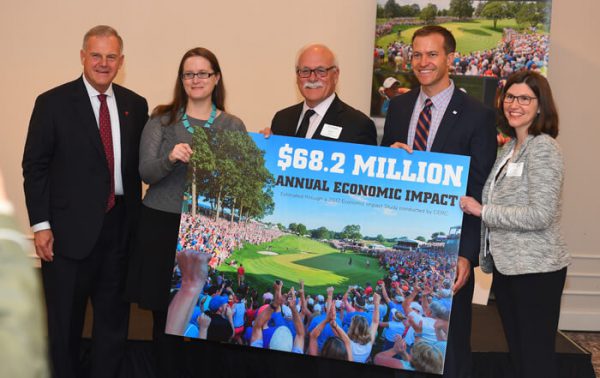
The Travelers Championship has an annual economic impact on the state of $68.2 million, according to a recent study by Connecticut Economic Resource Center, Inc.(CERC)  – and the recognition of its success is not only local, but national.  The tournament has been selected by the PGA tour as recipient of the prestigious “Tournament of the Year” award for 2017. The Travelers Championship also won awards for “Most Fan-Friendly Event,” “Best Sales” and the inaugural “Players Choice.” CERC first conducted an impact analysis of the tournament in 2011, and completed another impact analysis for the Travelers Championship in 2017.  The results were compared, to look at the changes over time and factors that may have influenced changes in the tournament’s economic effects.
The results: The economic impact had more than doubled between 2011 and 2017, due to two primary factors; a much larger total number of spectators, especially the increased number of individuals from outside the state, and increased spending by the tournament in preparing for and administering the increased number of events that occur during the tournament week.

“The Tournament activities and events, along with all of its associated events throughout the year has grown substantially over the past few years, which has resulted in a large increase in the number of spectators from Connecticut and beyond its borders,” said Alissa DeJonge, Vice President of Research, CERC. “Attendance increased dramatically, which increased spending at the event and among the local businesses.”

With record attendance, sales and fan engagement, the 2017 Travelers Championship raised the bar across the board through a strategic approach that focused on providing a first-class experience for fans, players, sponsors, volunteers and charity, officials pointed out. This marks the first time that the Travelers Championship has been recognized as “Tournament of the Year.”
The Travelers Championship, which donates 100 percent of its net proceeds to charity, announced last month that the 2017 tournament generated $1.72 million for more than 165 local charities, including The Hole in the Wall Gang Camp, the primary beneficiary of this summer’s tournament. With approximately 4,000 volunteers worked over 80,000 hours.

It is the largest core amount raised in the history of the tournament, officials pointed out. The record-setting 2017 total brings the total money generated to $14.7 million since Travelers became title sponsor in 2007. More than 750 charities have received funds from the tournament over that time.

“We’re proud of the partnerships we’ve built with local organizations that need help,” said Travelers Championship Tournament Director Nathan Grube. “Handing out these checks to so many worthy charities is the highlight of our year. We won’t forget the week we had at TPC River Highlands, with Jordan Spieth winning in such dramatic fashion and the celebration that ensued. But knowing that more than $1.7 million is being given to such a wide spectrum of nonprofits this year reminds us why we do this. It inspires us.”

As the “Most Fan-Friendly Event,” the tournament provided options for fans of all ages, including affordable access, more than 18 food and beverage locations, fan and kid zones and public on-site concerts. The tournament increased fan engagement by 441 percent through creative video and dynamic content, and following Spieth’s thrilling hole-out to win, the tournament handle trended on Twitter for nearly four hours and the video reached YouTube’s front page within 24 hours.

The tournament continued to enhance the player and caddie experience, providing a complimentary charter flight from the preceding event, healthy food options and a variety of special features including caddie appreciation day, a performance by Kevin Nealon and multiple off-site events. To determine the new “Players Choice” category, TOUR players were asked to vote for one event based on tournament services, hospitality, player and family amenities, community support and attendance.

“We work hard on making sure everyone who attends or participates in our event has a world-class experience, so no detail toward that goal is too small,” said Andy Bessette, Executive Vice President and Chief Administrative Officer of Travelers. “We are proud to associate our brand with the PGA Tour and this event, and are honored by this tremendous recognition. The best part is that any success we have means more money and attention raised for so many local charities that partner with the tournament.”

The 2018 Travelers Championship, will be held June 18-24 at TPC River Highlands in Cromwell.

Andy Bessette, Executive Vice President and Chief Administrative Officer of Travelers; Sarah Ficenec and Bob Santy, CERC; Nathan Grube, Tournament Director at Travelers Championship; and Alissa DeJonge, CERC

State Branding Drives Tourism, Economic Development Goals

As Connecticut suffers through budget deficits, cuts in spending and services, and high-profile departures of leading businesses, states nearby are advancing economic development branding and marketing strategies to retain and attract business, according to a new report by the state legislature’s Office of Legislative Research. “As competition among states increases, economic development organizations (EDOs) continue to develop plans and campaigns to brand and market their states as great places to live, work, visit, and do business,” the report observes. “However, the effectiveness of such campaigns is mixed, often reflecting the authenticity of the message and the extent to which it reaches targeted audiences.”

Effective branding efforts can drive business recruitment and development efforts and change perceptions of a state, the report noted. It provides examples of marketing efforts in several states, including Florida, Louisiana, Maryland, New York, North Dakota, Rhode Island, Vermont, and Wisconsin.

The report, issued last week, describes branding as the message an organization is trying to convey, and marketing as the tools and tactics used to deliver that message.

According to the 17-page report, Tennessee’s “Mastered in Tennessee” branding effort is cited by several industry groups as an example of effective state branding. The campaign highlights Tennessee’s unique competitive advantages and demonstrates why it is a great place to live and work.

Michigan provides an example of how tourism branding can also serve economic development goals. The campaign, “Pure Michigan,” was designed to create an emotional brand that resonated with families and drew attention to the state’s vast, unspoiled beauty. It is widely regarded as successful among marketing and tourism professionals, with Forbes naming it the sixth-most successful tourism campaign of all time.

Greater Rhode Island Economic Development Partnership recently launched a campaign to market Rhode Island as a hub of entrepreneurship and challenge negative perceptions of the state. Greater Rhode Island developed a new website, which saw a 122% increase in web traffic, 68% increase in engagement on the site, and a 288% increase in the time users spend on the site.

Many in Connecticut are familiar with New York’s “Start Up NY” campaign, which aired many commercials in Connecticut markets, the report indicated. The campaign marketed a host of economic development incentives available to businesses that relocate to or expand in New York.

Vermont recently launched a digital ambassador campaign as part of its three-year marketing plan launched in 2016. According to the plan, the campaign uses business and community leaders, entrepreneurs, and other Vermont-loving influencers to share business announcements, national media placements, and other information that reflects well on Vermont as a great place to live, work, start and grow a business, and raise a family.

The report did not include a review or analysis of Connecticut’s branding efforts.  In 2012, Connecticut launched a two-year, $27 million marketing campaign to promote tourism and brand the state as “still revolutionary.” The state spent $500,000 on its new logo and other creative materials, with most of the remainder of the two-year budget going to the placement of ads on television, radio, billboards and social media, according to published reports. It also created a new website, ctvisit.com.

Two years later, the state announced plans to spend $3.4 million to promote Connecticut tourism ahead of the summer travel season within the state and to audiences in New York, Rhode Island and western Massachusetts.  And last year, the state’s tourism website was re-launched with a new look for the first time in a decade.

A study prepared for the state, “The Economic Impact of Travel in Connecticut,” released in March, 2017, found that the state’s tourism industry generated $14.7 billion in total business sales in 2015, a 4.6 percent increase over 2013. During the same period, tourism employment grew 2 percent, supplying 82,688 jobs in 2015, the fifth straight year it generated more jobs than the year before, according to the study.

The state’s recently adopted two-year budget includes $6.4 million for statewide tourism marketing in 2017-18 and $4.1 million for 2018-19, according to published reports.  The slogan “Still Revolutionary” remains in place.

The Difference A Dollar Makes: UConn Research Finds Minimum Wage Increase Reduces Maltreatment of Children

It has been nearly a year since a study co-authored by UConn Assistant Professor of Public Policy Kerri M. Raissian appeared in the academic journal Children and Youth Services Review, but the interest hasn’t waned.  In fact, it now tops the list of downloaded articles in the past 90 days from the journal’s website. The article, which Raissian co-authored with Lindsey Rose Bullinger, asks – and answers – this question:  Does the minimum wage affect child maltreatment rates?

Short answer, according to their research:  yes. 

Raising the minimum wage by $1 per hour would result in a substantial decrease in the number of reported cases of child neglect, according to a study co-authored by Raissian and Bullinger.  They reviewed eleven years of records on child abuse and neglect and found that increases in the minimum wage correlate with declining child maltreatment rates.

A $1 increase would result in 9,700 (9.6 percent) fewer reported cases of child neglect annually as well as a likely decrease in cases of physical abuse, Bullinger explained on the website sciencedaily.com, where their study was featured earlier this year. This decline is concentrated among young children (ages 0–5) and school-aged children (ages 6–12); the effect diminishes among adolescents and is not significant, the study’s abstract points out.

“Our results suggest that policies that increase incomes of the working poor can improve children's welfare, especially younger children, quite substantially,” the authors conclude in their 70-page article on the study.

"Money matters," Bullinger noted on sciencedaily.com. "When caregivers have more disposable income, they're better able to provide a child's basic needs such as clothing, food, medical care and a safe home. Policies that increase the income of the working poor can improve children's welfare, especially younger children, quite substantially."

More than 30 states had minimum wages exceeding the federal requirement by an average of $1 during the study period, allowing the researchers to track changes in the number of reports to child protective service agencies with increases in the minimum wage.  Data from the National Child Abuse and Neglect Data System was used in the research.

The substantial decrease in child neglect cases is concentrated among toddlers and school-age children, but changes in the minimum wage had little impact on reports of neglect of teenagers. The researchers found no variation based on a child's race.

“Families with low incomes have a great ability to make a dollar go a long way. On average, the weekly SNAP (Supplemental Nutrition Assistance Program) food stamp benefit for a family of three is about $30. That’s about what a one dollar an hour minimum wage increase translates into for full-time workers. Other studies show that a $1,000 tax refund results in similar declines in child maltreatment – neglect, specifically. So for really low-income families that probably have pretty severe material deprivation or economic hardship, that extra dollar can make a really big difference,” Raissian told UConn Today.

Raissian’s research interests are linked by a common focus on child and family policy, according to the university’s website.  Her dissertation, “Assessing the Role and Impact of Public Policy on Child and Family Violence,” evaluated the efficacy of policies designed to reduce violence directed towards intimate partners, children, and other family members. Her professional background includes nearly 10 years of government and nonprofit sector experience, which focused on serving abused adults and children.

Bullinger is associate instructor in the school of public and environmental affairs at Indiana University at Bloomington.  Both attended Syracuse University’s Maxwell School of Citizenship and Public Affairs.

“Most of the states don’t have a minimum wage at or above $10; Connecticut does. It’s possible Connecticut may be at the threshold,” Raissian said in an interview featured in UConn Today. “It’s also really important to note that, while our study looks at the minimum wage, this could really be an income story – remember other studies find similar results when incomes are increased in other ways. Our very low-income families might be facing other reductions in their incomes that will be costly to us as a state. We should consider that, moving forward.”