Charter Oak State College Among Top 20 Online Bachelors Programs in Student Engagement; Three CT Colleges Reach Top 100 Online

Student engagement and on-line courses may seem incompatible, but Connecticut's Charter Oak State College is among the best in the nation at bringing those two concepts together effectively.  Charter Oak  ranked at #90 in the nation in the newly published U.S. News & World Report ranking of the top online bachelors programs in the country, and at #17 in student engagement.  In other categories, the online institution, based in New Britain, ranked #187 in faculty credentials and training, and #139 in student services and technology. Charter Oak State College is Connecticut's public online college offering bachelor's and associate degree completion programs for adults. The college was established in 1973, and offers degree completion programs in a number of high-demand fields including business, health care, public safety, information systems and cyber security. U.S. News indicates that all of the online classes are recorded and archived so students can access lecture material at their own convenience.generic-bachelors

The magazine ranked a total of 219 institutions offering online programs, with scores ranging from 100 (Pennsylvania State University-World Campus) to 44 (University of Wisconsin-River Falls).  Charter Oak’s score was 69. U.S. News evaluated several factors to rank the best online bachelor’s degree programs, including graduation rates, faculty credentials and support services available remotely.  Nearly 85 additional schools were analyzed but did not reach thebachelor's program rankings. Charter-oak-state-college-logo
U.S. News indicates that the new student retention rate in 2014 at Charter Oak was 82 percent, and that 63 percent of students graduate within six years.  Total enrollment is 1,898, according to the publication.

In offering the rankings of on-line programs, U.S. News noted that many schools are enriching their online degree programs ​as student interest in distance education  continues to increase.

Among private institutions in Connecticut, the University of Bridgeport ranked at #68 overall, spurred by faculty credentials and training, which ranked at #19.  Student engagement ranked at #94, and student services and technology ranked at #132.  The most popular online major, according to U.S. News, is dental hygiene and related health professions.  UB’s overall score was 74.  In addition, UB has the #13 ranked online graduate Information Technology program and #48 best online graduate engineering program.

Sacred Heart University ranked at #87 among on-line bachelors programs.  The category breakdowns for Sacred Heart were: #27 in student services and technology, #44 in faculty credentials and training, and #52 in student engagement.  Sacred Heart’s overall score was 70.  The institution also ranked #70 among best on-line graduate nursing programs.

Enrollment for each of the institutions on-line programs is predominantly female: 64 percent at Charter Oak, 84 percent at University of Bridgeport and 93 percent at Sacred Heart.

U.S. News assessed schools based on four general, weighted, categories:

  • Student engagement (40 percent): Quality bachelor's degree programs promote participation in courses, allowing students opportunities to readily interact with their instructors and classmates, as is possible in a campus-based setting. In turn, instructors not only are accessible and responsive, but they also are tasked with helping to create an experience rewarding enough that students stay enrolled and complete their degrees in a reasonable amount of time.
  • Faculty credentials and training (20 percent): Strong online programs employ instructors with academic credentials that mirror those of instructors for campus-based programs, and they have the resources to train these instructors on how to teach distance learners.
  • Student services and technology (20 percent): Programs that incorporate diverse online learning technologies allow greater flexibility for students to take classes from a distance. Outside of classes, strong support structures provide learning assistance, career guidance and financial aid resources commensurate with quality campus-based programs.
  • Peer reputation (20 percent): A survey of high-ranking academic officials helps account for intangible factors affecting program quality that are not captured by statistics. Also, degrees from programs that are well respected by academics may be held in higher regard among employers.

The reliability of the U.S. News rankings continue to be criticized by many in the higher education field for a variety of reasons, ranging from the self-reporting of institutions to the assessment criteria used.
Nominations Sought for Women of Innovation as Efforts to Boost Representation in STEM Fields Intensifies

The Women of Innovation® awards gala, held annually, recognizes Connecticut women accomplished in science, technology, engineering, math and those who are involved in their community.  As the January 16 nomination deadline for this year’s 11th annual event approaches, organizers at the Connecticut Technology Council are urging state residents to nominate their peers, colleagues, mentors and students, teachers and business leaders, research associates and inventors. A study last fall for the U.S. Small Business Administration found that “the gender gap persists for women in STEM fields. Women have increased their representation in STEM graduate enrollment, but that increase has been uneven across STEM fields,” the report found.women of innovation

“While women have achieved parity for PhDs in biological and medical sciences, their enrollment continues to lag in some of the most entrepreneurial fields, such as bioengineering, mechanical, and civil engineering and materials science,” the report pointed out.

Last month, the White House urged women in the technology fields to share their stories as a way of attracting more women to the STEM disciplines. “When it comes to inspiring young women to pursue careers in STEM fields,” the White House website explained, “research has already shown us what works: Providing early, hands-on experience and encouragement; sharing the stories of positive role models in these fields (like the women whose stories we share); and illustrating the broad impact of roles in these fCT-ORGields.”

In Connecticut, the Women of Innovation awards recognizes women who have demonstrated and sustained accomplishment in their field, from students to business owners.  Women can be nominated for awards in eight categories:

  • Research Innovation and Leadership
  • Academic Innovation and Leadership
  • Entrepreneurial Innovation and Leadership
  • Large Business Innovation and Leadership
  • Small Business Innovation and Leadership
  • Youth Innovation and Leadership
  • Collegian Innovation and Leadership
  • Community Innovation and Leadership

The awards event is "a time for like-minded, successful women to get together and celebrate their accomplishments” – and it provides a reminder that women are excelling in fields where their ranks have traditionally been slim.  The awards will be presented at the annual Women of Innovation Gala on Wednesday, April 1 at the Aqua Turf Club in Southington.  Presenting sponsors include Boehringer Ingelheim, Covidien, Day Pitney and United Technologies.

Keynote speaker for the event will be Maggie Wilderotter, Chairman and Chief Executive Officer, Frontier Communications, headquartered in Stamford.  Wilderotter serves on the boards of Xerox Corporation and Procter & Gamble Company and on the boards of a number of non-profit organizations. Frontier Communications Corporation  offers broadband, voice, satellite video, wireless Internet data access, data security solutions, bundled offerings, specialized bundles for residential customers, small businesses and home offices and advanced communications for medium and large businesses in 27 states.It recently began offering services in Connecticut for the first time.SBA

The SBA report also found that “women are more likely to start firms that provide research and consulting services and are less likely to start firms in semiconductor and aerospace manufacturing, navigational instruments or communications equipment, which may correlate with lower reported rates of R&D activities for women STEM PhDs.”

As Connecticut seeks to promote growth in the bioscience and related technology fields, the SBA findings may be of particular note, including that “High-tech women-owned businesses may also be less likely to locate in geographic regions where they can take advantage of regional clustering of highly skilled labor and knowledge spillovers.”  The report found, however, that “female STEM PhDs value the independence of self-employment more than their male counterparts.”

The White Houwhite hosuese Office of Science and Technology Policy notes that “Supporting women STEM students and researchers is not only an essential part of America’s strategy to out-innovate, out-educate, and out-build the rest of the world; it is also important to women themselves.”

Women in STEM jobs earn 33 percent more than those in non-STEM occupations and experience a smaller wage gap relative to men, according to the Office.  “Increasing opportunities for women in these fields is an important step towards realizing greater economic success and equality for women across the board.”

Demographics in New England Bring Enrollment Challenges for Higher Education

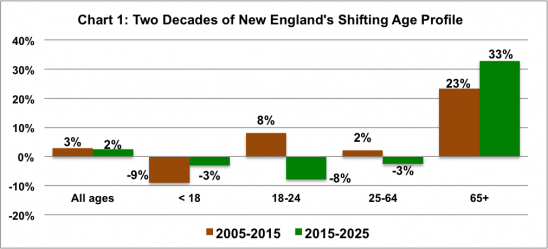
Connecticut’s public colleges and universities are pulling out all the stops to bring students back to campus who may have started – and stopped – their pursuit of higher education years ago.  Incentive programs – including free classes – are driven by an acute need to counter declining enrollment from “traditional” students that recent data suggests will continue to intensify for years to come. The New England Journal of Higher Education, using U.S. Census data, found that New England is demographically the oldest and most rapidly aging of the nine Census divisions in the United States. The Journal reported that “Its median age, which is now over 40, has risen by seven years since 1990. This region has six of the 12 states with the most rapidly rising median ages. Maine, Vermont and New Hampshire have the nation’s highest median ages (43.9, 42.4 and 42.3) and also rank first, second and third among the most rapidly aging since 1990.”Chart-1_Franchese-548x249

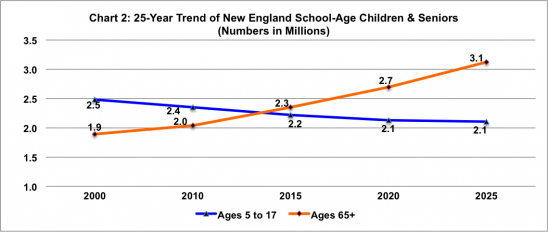
Between the 2000 and 2010 census, the number of children under age 18 in New England declined 197,000 or 6 percent, the Journal reported. From the 2010 census until mid-2013 this region dropped another 102,000 children, and that rate of decline is projected to continue. From 2010 to 2013, every New England state had more people move out than move in. In total, the region lost a net of almost 100,000 people through out-migration in just those three years.

After reaching an all-time peak in 2010, enrollment at Connecticut's 17 community colleges, state universities and the online-only Charter Oak State College – which make up the Connecticut State Colleges and Universities (CSCU) system - dropped to 92,989 last academic year, down 4.3 percent from its peak and its lowest level since 2008.  At Central, Southern, Eastern, and Western Connecticut State Universities combined enrollment reached its lowest level in 14 years, Hartford Business Journal has reported.

Writing in the New England Journal, a publication of the New England Board of Higher Education, demographer Peter Francese pointed out that “the most rapidly growing ages in New England are, by far, people aged 65 or older. That combined with the decline in numbers of children portend a very difficult decade for the region’s colleges and universities.”

Using state published projections, he describes “a picture of continuing decline among children, but also forecasts a shift in the 18-to-24 age group and the 25-to-64 age groups from growth in the past to decline in the future. However, the past double-digit growth among residents age 65 or older is projected to continue at an even faster pace over the next 10 years.”Chart-2_Franchese-548x232

The data and projections also indicate that the region is fast approaching “a tipping point where the number of elderly will increasingly outnumber school-age children.”  Francese, director of demographic forecasts for the New England Economic Partnership and founder of the former American Demographics magazine, suggests that “that this trend will mean continuing erosion of financial support for local public education. It may also mean a gradual erosion in the quality of the region’s secondary schools and the consequent impact on those in higher education who depend on having a reliable source of college-ready high school graduates.”

Enrollment at the 17 CSCU institutions in Connecticut for Fall 2014 was down by 1,428 students, or 1.5 percent, from the previous year, according to data compiled by the state Office of Higher Education.  The total number of students, 91,192, includes more part-time than full-time students – 47,670 part-time versus 43,522 full-time.  At the flagship University of Connecticut, which is outside the CSCU system, enrollment climbed 2.1 percent between 2013 and 2014, boosted by the hiring of additional faculty and additional state funding for "Next Generation UConn" - expansion plans that project increasing enrollment at the university's main campus by one-third over the next decade.

Chart 1: U.S. Census Bureau 2005 population estimates, New England states projections and author’s calculations; Chart 2: Historical data is from the Census Bureau, population projections are by each New England state.  These charts first appeared in the New England Journal of Higher Education.

As Latino Population Increases, Schools See More English Language Learners

A snapshot of America in 2044, based on U.S. Census Bureau data and current trends, will show this:  a nation with a youthful, growing minority population juxtaposed against an aging, slow-growing and soon to be declining white population. New population projections show whites will become a minority by 2044, according to published reports. The new projections from U.S. Census Bureau figures shows two trends for America's population -- a long-term decline for the nation's white population, making up just 49.7 percent of the population by 2044, and a growth of new minorities -- Asians, Latinos and multiracial persons. The populations among the rapidly-growing Latinos, Asians and multiracial populations are all expected to double in size over the next 30 years. Specifically, the rise of Latinos is projected to make up 25.1 percent of the U.S. population in 2044, doubling African-Americans, according to the data projections reported in the Latino Post.  By 2027, more than half of America's 20-somethings will be racial minorities, and in the 2028 presidential election, 40 percent of all eligible voters will be racial minorities._Hispanic_students

In Connecticut, the demographic shift is underway.  The Hispanic percentage of the statewide population in 2013 stood at 14.7 percent, steadily climbing during the past decade.  The Hispanic percentage of statewide population under age 18 in 2013: 22 percent.

When the website ctlatinonews.com selected five “Young Latinos to Watch” this month, two of the five were newly elected legislators.  Aundré Bumgardner was a surprise winner on Election Day.  The Republican, whose family is from Panama and Puerto Rico, will be the youngest State Representative in Connecticut’s legislature.  The 20 year-old won his party’s nomination to run for the state House from the 41st District, which covers Groton and New London.  Rep.-elect Christopher Rosario may be new to the state’s legislature, but he is not new to advocacy, politics  and working on behalf of the Latino community. He will represent his hometown of Bridgeport in the state legislature from the 128th District.   He has been Bridgeport’s youngest department head as Director of Anti-Blight under the Office of Neighborhood Revitalization.

Recent news reports highlight one of the issues that the legislature will be grappling with.  An analysis by CT Mirror found that during the 2013-14 school year, Hartford Public Schools had the most English Language Learner (ELL) students, with 3,550, but Windham had the highest percentage of ELL students at 23.8 percent.  The largest peeducation_student_newsrcentage increases in ELL students, between 2001 and last year, came in Windham (11.8% increase), Danbury (up 9.4%), Norwich (up 9.1%), and New London and West Haven (both up 7.4%).

The increasing number of ELL students in Connecticut is reflected in the current top 20 communities, according to the CT Mirror data, compiled from the State Department of Education:

  1. Hartford 3,550
  2. New Haven 2,709
  3. Bridgeport 2,685
  4. Danbury 2,204
  5. Waterbury 2,114
  6. Stamford 1,870
  7. New Britain 1,659
  8. Norwalk 1,277
  9. Meriden 1,011
  10. Windham 774
  11. West Haven 678
  12. East Hartford 606
  13. New London 588
  14. West Hartford 490
  15. Greenwich 486
  16. Norwich 465
  17. Manchester 351
  18. Torrington 334
  19. Bristol 317
  20. Wallingford 275

The top twelve municipalities with ELL students, by percentage of their student population:demographics_icon

  1. Windham 23.8%
  2. Danbury 20.4%
  3. New London 19.2%
  4. Hartford 16.7%
  5. New Britain 16.5%
  6. Bridgeport 12.9%
  7. New Haven 12.7%
  8. Meriden 12.5%
  9. Norwich 12.4%
  10. Stamford 11.8%
  11. Norwalk 11.5%
  12. West Haven 11.4%
  13. Waterbury 11.4%

The legislature's Latino and Puerto Rican Affairs Commission (LPRAC) is hosting this public policy forum on English Language Learners (ELL) and bilingual education in Connecticut on Tuesday, January 13, at the State Capitol in Hartford.  It will feature classroom teachers, business, professors, and legislators discussing the status of ELL/bilingual education and how to improve outcomes for Connecticut’s non-English speaking children.

New Interactive Tool Brings Focus to Cuts in State Funding of Children's Programs

If a picture is worth a thousand words, the impact of a series of interactive data visualization graphs must be, well, off the charts.  For Connecticut Voices for Children, the new online, interactive visualization tool has been designed to help the public and policymakers see how funding for children's programming in Connecticut has fallen through the years.  Coming on the brink of a new legislative session and an ever-tightening state budget, the hope is that more widespread understanding of  past trends will forestall further cuts. logo.inddThe new interactive tool, on the Connecticut Voices for Children website, enables visitors to track spending across nearly 100 children’s programs over 25 years.  Over the last two decades, spending on children’s programs has declined from 40% to 30% of the state budget, according to the advocacy organization.  Had the state not changed its budgeting priorities, it would have invested about $1.5 billion more each year in children’s programs—enough, for instance, to be the first state to implement a universal early care and education system, Voices points out.Picture1
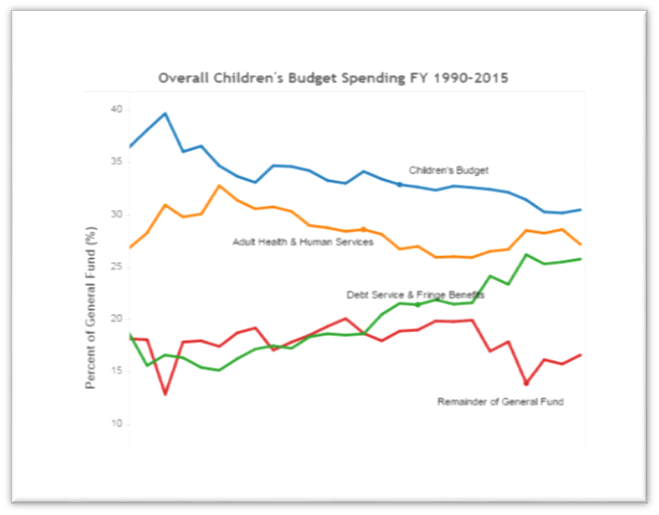
The new interactive tool, created by Connecticut Voices for Children, enables users to create their own graphs of state budget trends and then embed the charts in social media, blog posts, news articles, and reports. Users, for instance, can compare the dip in state support for K-12 education to the even steeper drop in support for higher education.

Detailed budget visualizations for Fiscal Years 1990 through 2015 are available for the following areas:

  • The overall Children's Budget (at right)
  • Early Care and Education
  • K-12 Education investments
  • Children's Health and Human Services
  • Debt and Fringe Benefits

In producing this resource, Connecticut Voices for Children seeks to draw attention to what they describe as "Connecticut’s long-term disinvestment in young people – a trend that is particularly troubling in a state with an aging and shrinking workforce that will result in an increasing demand for well educated, career ready young adults."

Regarding K-12 education, for example, the website points out "K-12 Education has declined substantially as a share of the General Fund since the early 1990s, from about one fifth to one seventh in the most recent budget. This decline is seen most clearly in Educational Equalization Grants, the state's main contribution to local school districts. State support for K-12 education in Connecticut is among the lowest of any state in the union. In Connecticut, we leave the large majority of education expenses up to towns, which have no major revenue source except the property tax, thus contributing to the state's high and inequitable property taxes."

The information used in creating the graphs is official appropriations data from the Connecticut legislature's non-partisan Office of Fiscal Analysis.

Connecticut Voices for Children's mission is to promote the well-being of all of Connecticut's children and families by identifying and advocating for strategic public investments and wise public policies. Connecticut Voices advances its mission through high quality research and analysis, policy development, strategic communications, and establishment of a sustainable and powerful voice for children.


CT’s First Sensory-Friendly Performance Ready at Hartford Stage

Hartford Stage will host a first-ever sensory-friendly performance of its annual holiday classic, A Christmas Carol - A Ghost Story of Christmas on Tuesday, December 9.  This will be the first time that Hartford Stage has offered this type of performance for the community – and apparently the first such effort in Connecticut. A “sensory-friendly” performance is a theatre production that is modified to accommodate individuals with sensory-input disorders, such as people on the autism spectrum, those with anxiety, and people with a range of cognitive abilities. hartford_stage_company

At the Tuesday night performance, “house rules” will be relaxed – people may need to get up, move around, and leave the theatre in the midst of the performance. There is no expectation that the audience will be completely quiet during the performance.  In addition, a Quiet Room will be available with sensory-friendly toys for anyone who needs a break from the performance.

"Sensory-friendly performances are designed to create a performing arts experience that is welcoming to all families of children with autism or other disabilities which create sensory sensitivities," says Jennifer Roberts, director of education for the theater.  The Hartford Stage website adds, “Our goal is to create an environmacc_sfent where people with autism or sensory needs, along with their families, can enjoy coming to the theatre together and will feel comfortable, supported and free to be themselves.”


Officials point out that while the script of A Christmas Carol will not change, some of the technical elements will be softened to accommodate sensitive ears and eyes. For example, haze will be reduced and strobe lights will be removed from the production. Lights in the audience will be remain lit at a dim level during the entire show to allow safe movement in and out of the theatre.

Abrupt and loud sound effects will be lowered, and there will be a signal to the audience to warn them that a potentially jarring moment is about to happen, so that caregivers can be ready to help those with sensory sensitivities.

The hope is to achieve “a judgment-free, fun experience for the entire family.”  About 150 people, students and their families, are expected to attend the performance.

Hartford Stage has prepared a plot synopsis and social story to help prepare audience members for the experience. They have encouraged families and caretakers to read the synopsis of A Christmas Carol and use the social story to prepare for the whole theatrical experience, from beginning to end.sponsor_tdf

The production, designed for age 9 and up, is about two hours long with a 15-minute intermission.   Theatre Development Fund’s Autism Theatre Initiative served as an advisor for the performance.

[view NBC Connecticut news story on the sensory-friendly performance]

New Business Aims to Deliver Science to 8-11 Year-Olds, One Month at a Time

There’s a new Connecticut start-up launching this month, aiming to engage upper elementary school age children with the fields of science, technology, engineering and math (STEM) through monthly hands-on activities delivered right to their doors.  What began as a response by two college friends to an entrepreneurial start-up challenge is now a full-fledged business, hoping to grow as it excites children ages 8-11 about the potential of the STEM fields. The business, Genius Box, delivers a “monthly STEM adventure to a subscriber’s mailbox, featuring a topic to explore and the tools to do so."  Each box will contain activities or experiments that further illustrate the topic of the month, providing hands on learning opportunities through a narrative “challenge” posed in each box.genius box  horiz

Kate Pipa and Shivangi Shah received second place at Demo Day at Northeastern University a few years ago, and “with much excitement and encouragement,” decided to launch a company based on their idea.  Next was a successful crowdfunding campaign in fall 2013, which led to initial beta testing and feedback collection, including work with students in Connecticut classrooms to obtain reactions from students and their teachers.  Earlier this year, a prototype Genius Box was provided to middle-school age participants at the Connecticut Technology Council’s annual Girls of Innovation program.

Genius Box aims to connect kids with real life examples of science, technology, engineering, and math to further the understanding of these critical subjects “in a way that resonates with upper elementary school aged children.” The topic to be explored in December’s inaugural Genius Box will be Kaleidoscopes.  The company’s website is now accepting one month, three month or six month subscriptions for the monthly deliveries.

“We are excited to staco foundersrt this new chapter,” said co-founder and CEO Kate Pipa, who lives in Shelton. “And we are excited to bring kids a new box each month of hands-on fun that also doubles as a learning opportunity and is making social impact for the kids and for our partner organizations.”

Co-founder and COO Shivangi Shah adds, “We hope that the next generation of geniuses will embrace STEM and apply it to the world around them. We want them to believe they can change the world.”

Each box includes a narrative story and activity cards to explain topic and activities in a fun, engaging way, and three or more activities and experiments in each box.  Each monthly kit is “designed in a way that puts each genius in the driver's seat to solve the challenge at hand, with minimal help from adults.”

Extending the Benefits

Pipa and Shah have also added a social benefit component to their sales. For each box sold, Genius Box Inc. will donate $1.00 to a partner nonprofit. December’s partner organization is Connecticut-based ManyMentors, which connects middle and high schools students interested in the S.T.E.M. fields with near age peer mentors via interactive, engaging workshops and a highly innovative online platform.

Genius Box is also among the first social benefit corporations in the state of Connecticut, allowing the company to pursue an expanded mission that embraces societal good along with profits.  Legislation creating the new designation was approved by the state legislature earlier this year, and took effect in October.

The company’s website explains “We want to provide an experience that inspires, encourages, and empowers kids to think big. To be curious. To experiment. To make mistakes. To explore new topics. Overall, to be the change makers and problem-solvers of tomorrow, today.”  Aiming directly at its target audience, the site invites, “Adventure on, geniuses. Your monthly mystery awaits.”

The company is currently shipping only within the United States, and offers free shipping.  More information about Genius Box is available at www.geniusbox.me.

Photo:  Kate Pipa and Shivangi Shah


Census Bureau Uses Bracketology to Test Population Knowledge

Three of Connecticut’s largest cities are in the game, but they may not last long.  The U.S. Census Bureau, in an effort to boost public knowledge of the relative populations of cities across the country, has launched “Population Bracketology.”  The interactive data game includes the 64 most populous metropolitan areas in the in the 50 states and District of Columbia.  The single-elimination bracket system will be familiar to any fan of March Madness.bracketology Making the grade are Bridgeport, Hartford, and New Haven.  Their respective round one opponents make the Connecticut cities strong underdogs in need of a sizable population surge.  Bridgeport goes up against San Francisco, Hartford faces Baltimore, and New Haven is up against Portland. (No, not Portland, Connecticut.)

Players start by choosing population bracketologyone of two versions of the game, geographic level: metro areas or states. Then they click on the name of the city in each match-up that you think has the larger population. Green shows a correct answer, red indicates an incorrect answer. Players are urged to “see how close you can come to a perfect score of 63” and then asked to “mouse-over results to view the most current population estimates for each pair.”


Data for the 50 states, D.C., and Puerto Rico are based on July 1, 2013 population estimates. Among the other New England states in play are Boston, Worcester and Providence.


Connecticut College Earns Place on LGBT-Friendly List

Connecticut College in New London is included in the Campus Pride list of the top 50 LGBT-friendly colleges and universities for 2014, the only higher education institution in Connecticut to make the list. Campus Pride, founded in 2001, is a national nonprofit network of student leaders and campus groups devoted to improving college life for lesbian, gay, bisexual and transgender students across the United States.CC logo

This is the first time Campus Pride has expanded its "Best of the Best" list to 50 colleges. In previous years, the top 25 institutions were honored. Campus Pride executive director Shane Windmeyer said the larger number of honorees reflects the progress colleges and universities have made in improving safety and academic life for LGBT students.

The LGBTQ Resource Center on the Connecticut College campus “aims to serve the unique needs of Lesbian, gay, bisexual, transgender, queer and questioning students by providing a supportive space, resource library, social events and educational programming,” according to the school’s website.

“We are committed to understanding how homophobia and heterosexism interlink with sexism, racism, and classism to perpetuate oppression,” the Center website points out. The Center also serves as a resource for the entire College community to learn about issues related to sexuality and gender identity.CPIndexLogoStacked-1024x576

The Campus Pride top 50 list is based on data from the Campus Pride Index, which includes detailed reports on the policies, programs and practices toward LGBT students, faculty and staff at more than 425 college campuses.

Connecticut College received a top rating of five stars from Campus Pride, highlighting efforts to provide a safe and supportive academic life for LGBTQ students. Colleges are ranked on a scale of one to five stars by LGBT experts in higher education. The College first appeared on the list in 2013.

"I am delighted that Connecticut College has once again earned national recognition for one of our most deeply held values: our commitment to an inclusive campus community,” said Connecticut College President Katherine Bergeron. “Our learning environment is enhanced immeasurably through the diverse perspectives and experiences of each member of this campus."LGBTQ_Resource_Center_banner

"More than ever, colleges today want to be viewed as LGBT-friendly and a welcoming place for all students." Windmeyer said. "Upper-level administrators are now understanding how LGBT-friendliness is key to future institutional success."  Officials said the Campus Pride ranking has become a critical factor for LGBT students and their families when choosing a university.

Since the Resource Center opened on the Connecticut College campus in 2007, policies have improved every year, along with the number of services offered to the transgender community. Now transgender students are offered housing consistent with the personal identities and gender-neutral restrooms in campus residences and academic buildings. Training on transgender issues is readily available to students, faculty and staff.

Millennials Consider Company's Causes When Accepting A Job

Millennial employees – those born in the past 20 years - prefer joining a company-wide or team-specific volunteer project rather than merely donating to a fundraising campaign.  In addition, their decision to accept a job is influenced by the company’s connections to the community, and whether they are seen as making a difference in the world. Those are among the findings in the 2014 Millennial Impact Report, issued by Indianapolis-based Achieve.  millenials

The annual survey found that companies need to build relationships with millennial employees to spark their passions and create opportunities to engage both their professional and personal interests.  The findings indicated that employers should develop what was described as a triple platform of involvement – company-wide, department-based and interest-driven.

While only 39 percent of Millennials researched their company’s “cause work” prior to their interview, 55 percent said they were influenced to take their job after discussing cause work in their interview. Notably, 92 percent of the Millennials surveyed felt they were working for a company that was making a positive impact on the world.

In the Greater Hartford area, the survey findings would be no surprise to the leadership of HYPE (Hartford Young Professionals and Entrepreneurs).  Their mission, “to help young professionals become better engaged in community life,” responds to their generation’s strong desire to have a meaningful community connection, at work and in life.  HYPE, which is administered by the MetroHartford Alliance, has 4,000 members, and climbing.

Their efforts have been integral to Hartford’s efforts to promote a more vibrant downtown, and to boost involvement with a range of organizations and agencies that strengthen the fabric of the city.  The organization’s website offers nearly two dozen volunteer activities in the community for members, but makes clear that’s only the tip of the iceberg.  Greater New Haven has a similar organization, PULSE, a program of the Greater New Haven Chamber of Commerce and the Quinnipiac Chamber of Commerce.

Throughout the first four years of the Millennial Impact Project, the following trends emerged and evolved:report logo

  • Millennials engage with causes to help other people, not institutions.
  • Millennials support issues rather than organizations.
  • Millennials prefer to perform smaller actions before fully committing to a cause.
  • Millennials are influenced by the decisions and behaviors of their peers.
  • Millennials treat all their assets (time, money, network, etc.) as having equal value.
  • Millennials need to experience an organization’s work without having to be on site.millprefer-indep-cause-wk

The report indicates that "this is a generation that has grown up with a new way of learning. Asking questions in a non-linear fashion and then finding the answers -- all while connecting with their peers, friends and colleagues to make change happen. Today's Millennials are transforming communities, relieving suffering and pursuing social change in a way that may run counter to the traditional ways of organizing, but it's because they are wired to work differently -- collaboratively, transparently, interactively, and entrepreneurially -- to affect positive change in their local communities and around the world."

Achieve, in partnership with the Case Foundation, leads the national research team of The Millennial Impact Project, which they describe as the most comprehensive and trusted study on Millennial  (age 20-30) involvement with causes.