Gender Identity in Schools Among Topics at Connecticut School Health Issues Conference
/The keynote address “When Boys Will be Girls: Getting A Grip on Gender” will greet attendees – school nurses and school health officials from across Connecticut - attending the 38th Annual School Health Conference on Thursday in Cromwell. “Critical Issues in School Health 2016,” a two-day conference, will have expert presentations on issues ranging from absenteeism to infectious diseases, food allergies to mental health. But no issue has grown in attention and interest recently than how to respond to LGBT students in the school setting.
The conference is coordinated by the Connecticut chapter of the American Academy of Pediatrics with the assistance of the Association of School Nurses of Connecticut. 
The keynote will be given by Robin McHaelen, MSW, founder and executive director of True Colors, a Hartford-based non-profit organization that works with social service agencies, schools, organizations, and within communities to ensure that the needs of sexual and gender minority youth are both recognized and competently met. McHaelen is co-author of several books and articles on LGBT youth concerns, and has a national reputation as a thought leader in LGBT youth concerns, programs and interventions.
In her presentation, titled “When Pink and Blue Are Not Enough,” McHaelen offers suggestions on working with LGBT students, and seeks to increase “understanding, knowledge and cultural competency regarding LGBT students,” while identifying issues of “risk, challenge and strengths specific to LGBT youth.” She also will point to “opportunities for intervention that will ensure appropriate care within a safe, affirming environment.”
Among the recommendations: offer gender-neutral bathroom options, always use the patients’ chosen name and chosen gender pronouns, and “recognize that there are additional stressors (and that there may be significant feat on the part of) transgender patients.” 
McHaelen will be offering a similar presentation at the New England School Nurse Conference, to be held in late April in Mystic, hosted by the Association of School Nurses of Connecticut. The president of the Association is Suzanne Levasseur, Supervisor of Health Services for the Westport Public Schools. The New England affiliates include Massachusetts, Vermont, New Hampshire and Maine. The conference theme is “Waves of Change, Oceans of Opportunity.”
Lesbian, gay, bisexual, and transgender students are the targets of bullying, harrassment, and disproportionately high discipline rates at school, researchers have pointed out. But without consistently collected, reliable, large-scale sources of data, it's difficult to track the extent of those problems or the effectiveness of proposed solutions, a group of researchers at Indiana University said in a briefing paper released this week.
Expanding existing federal surveys on youth safety and well-being to include more questions about gender identity and sexual orientation could provide a clearer picture, according to the researchers, noting that “if you don’t measure it, you can’t improve it.” They suggest addressing the data gap by adding discipline and harassment items to existing health surveys that currently include measures of sexual orientation and gender identity, such as the Youth Risk Behavior Survey, collected by the Centers for Disease Control and Prevention.
“Although these measures provide more specific information about sexual orientation and in some cases gender identity, they do not provide sufficient information about the specific negative outcomes experienced by LGBT students,” the research paper points out. They conclude: “the availability of data documenting the experiences of LGBT students is a civil rights concern, and the expansion of data collection efforts to include sexual orientation and gender identity is a critical next step in ensuring the rights of LGBT and all students to participation and protection in school.”
The mission of the Association of School Nurses of Connecticut is to support, assist and enhance the practice of professional school nurses in their development and implementation of comprehensive school health services that promotes students' health and academic success. The Connecticut Chapter of the American Academy of Pediatrics has over 600 active members committed to both improving the health and safety of Connecticut's children and supporting those who provide care to these children.

 In Connecticut, a person is guilty of trafficking in persons when such person compels or induces another person to engage in sexual contact or provide labor or services by means of force, threat of force, fraud or coercion. Anyone under the age of 18 engaged in commercial sexual exploitation is deemed a victim of domestic minor sex trafficking irrespective of the use of force, threat of force, fraud or coercion.
 The need for stronger action is underscored by recent statistics. In Connecticut, one of every three kindergartners is overweight or obese, as is one of every three low-income children. Children who are overweight or obese are more likely, according to the policy brief, to have:
 A number of the proposals have been successfully implemented in other jurisdictions, including states and cities. Marlene Schwartz, Director of UConn's Rudd Center for Food Policy and Obesity, noted that Connecticut has long been a leader in providing nutritional lunches in schools, and said that now the state’s attention needs to move to the earlier years of childhood. “The field has realized that we need to start even earlier,” she said. Rudd also indicated that determining "policy changes that might help reduce the disparities" in Connecticut, which are apparent in race, ethnicity and socioeconomic data, is also essential.
 The recommendations, described as “affordable, achievable, common sense measures,” were prepared for CHDI as part of a grant to the UConn Rudd Center for Food Policy and Obesity, funded by the Children’s Fund of Connecticut. The author was public health policy consultant Roberta R. Friedman, ScM.
 IMPACT “Preventing Childhood Obesity: Maternal-Child Life Course Approach” in 2014. The report reviewed scientific research on the causes of obesity and explored implications for prevention and early intervention. In 2015, the Children’s Fund of Connecticut funded four obesity prevention projects in Connecticut that addressed health messaging, data development, policy development and baby-friendly hospitals.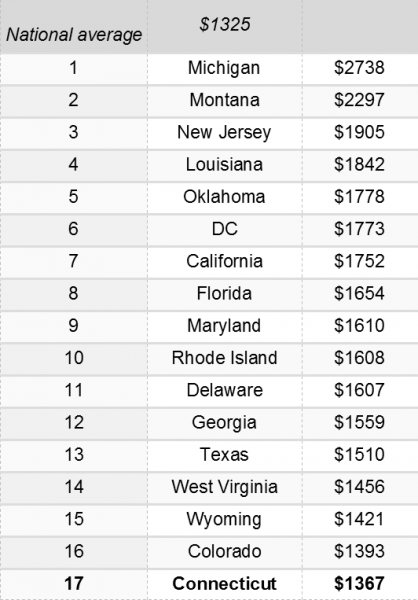
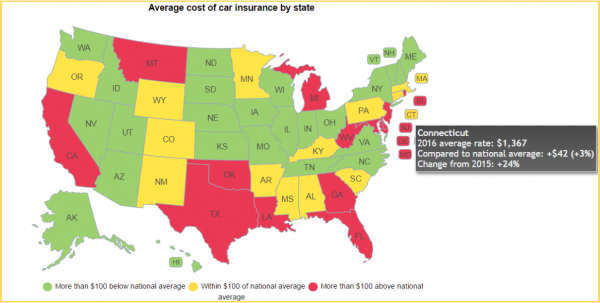 The national average for a full-coverage policy as featured in the Insure.com report came in at $1,325 this year – a slight increase from last year’s average of $1,311. Rates varied from a low of $808 a year in Maine to a budget-busting $2,738 in Michigan. Insurance rates in Michigan are more than double (107 percent) the national average.
 ucation systems positively, the lowest percentages in the country, in a
  State residents were asked “how would you rate the quality of public education provided in grades K-12” on a scale including excellent, good, fair and poor. The top 10 states after North Dakota, Minnesota and Nebraska are Iowa, New Hampshire and Massachusetts (80%), Wyoming (79%), South Dakota (78%) and Vermont and Virginia (75%).

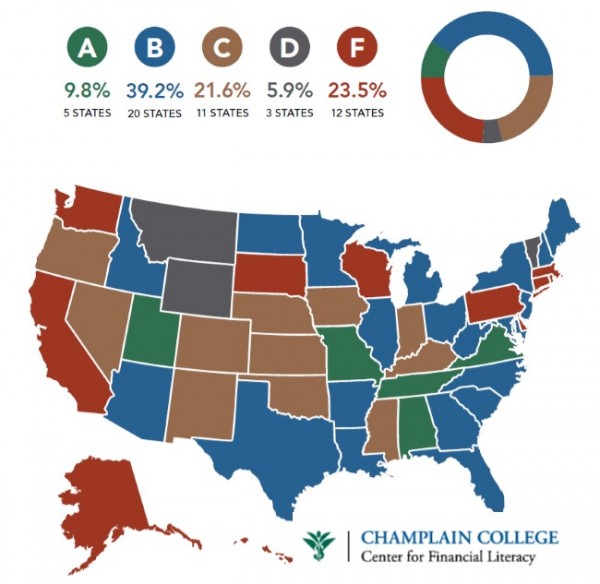 s a comprehensive look into the state of K-12 economic and financial education in the United States, collecting data from all 50 states and the District of Columbia. The biennial Survey of the States serves as an important benchmark, revealing “both how far we’ve come and how far we still have to go.” This year the report concluded that nationally “the pace of change has slowed.”
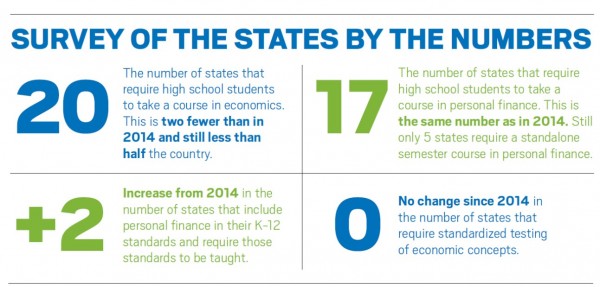 nts accountable for learning objectives have the best chance of promoting the development of young people who are better financial managers and stewards of their credit—behaviors with which many, if not most, young people tend to struggle,” said J. Michael Collins of the University of Wisconsin-Madison’s Center for Financial Security. “Rigorous state standards can facilitate local schools to implement well-designed programs, which in turn expose students to concepts they otherwise would not learn.”
 The new network would dramatically extend televised and online coverage and “on-demand access” to all legislative hearings and debates, as well as public policy conferences, regulatory hearings, executive agency meetings, and state Supreme Court and Appellate judicial proceedings.
 Giguere pointed out that “there are 10 hearing rooms, but CT¬N’s physical plant limits us to covering only two events concurrently. That means up to 80% of the Legislative committee process at any given time goes unseen. Our capacity to cover the Executive and Judicial Branches is even more limited.”
 currently funded, CFOG notes, “the new entity would be monitored and accountable to the public, but independent from government itself.”
 Following Connecticut in the top ten are New Jersey, Massachusetts, and Delaware, the only other states to receive an “A”, followed by North Dakota, New Hampshire, New York, Nebraska, Montana and Virginia. Connecticut, New Jersey and Massachusetts also ranked 1-2-3 a year ago.
 llege entrance exam, the percentage of students taking an advanced placement test and the student-teacher ratio.
 Callahan’s extensive touring, public speaking, and teaching make her a natural fit for the position. “