

Influx of Chinese Students in CT High Schools Reflects National Trend
/When the soon-to-be-vacated UConn campus in West Hartford attracted the interest of a Chinese education company looking to establish their first international high school in the United States, some may have been surprised by the interest by the interest in having American, Asian, and other international students live and receive instruction on the suburban campus. But for those who have noticed the nearly exponential growth of Chinese high school students coming to the United States to study, the proposal submitted to the town of West Hartford and the UConn Board of Trustees was less surprising.
 Chinese made up 35 percent of the 92,000 foreign secondary school students in the United States in 2015, according to the US Department of Homeland Security, by far the largest group studying here, the Boston Globe reported this week. That number has grown rapidly from only dozens a decade ago, fueled by the growing middle class in China and a desire to their children to gain an early advantage in efforts to attend college in the United States.
The number of international students across New England, with its long history and tradition of private schools, rose from 9,338 in 2010 to nearly 14,000 last year.
In Connecticut, with the second largest international student population in the region, the number has quickly climbed from 2,548 to 3.548, an increase of 39 percent in the past five years, the Globe reported, based on data from U.S. Immigration and Customs Enforcement. In Massachusetts, the number has jumped from 3,780 to 5,963 during the past five years. Every New England state has seen the number of international students attending local high schools increase, which Chinese students spurring the growth.
The number of Chinese K-12 students rose 290% percent to 34,578 as of November 2015 from 8,857 five years previously, according to data collected by the Student Exchange and Visitor Program, a unit of the Department of Homeland Security that tracks foreigners on student visas and the schools they attend, the Wall Street Journal reported. Chinese students make up roughly half of the 60,815 foreign pupils in U.S. high schools and the 6,074 in primary schools, according to the newspaper.
Founded in 1999, the Beijing-based Weiming Education Group is the largest and leading provider of private schools in China with over 40,000 students in 42 campuses. The Group, which is looking to establish the new international high school in West Hartford, has established a long-term international education partnership with more than 20 schools and education institutions from a dozen of countries including the United States, Britain, Canada, Singapore, and South Korea.
The company’s website points out that “Internationalized education has become the strategic direction” of the Weiming Education’s operation management, noting U.S. offices in Michigan and Connecticut. To date, about a half-dozen partner high schools in the United States are in Michigan.
The Hartford Courant reported last summer that Cheshire Academy, a private school with 400 boarding and day students in grades 8 through 12, had 85 students from mainland China this past academic year among its international contingent of 164 students from 32 countries, or more than 40 percent of its total enrollment.
West Hartford has yet to make a decision regarding the disposition of the UConn property, with a number of competing proposals under consideration. The UConn Board of Trustees is poised to move forward with a sale of the property to Weiming, but the town retains right of first refusal, and ultimately has zoning control over the property, regardless of the owner.


 In Connecticut, a person is guilty of trafficking in persons when such person compels or induces another person to engage in sexual contact or provide labor or services by means of force, threat of force, fraud or coercion. Anyone under the age of 18 engaged in commercial sexual exploitation is deemed a victim of domestic minor sex trafficking irrespective of the use of force, threat of force, fraud or coercion.
 The need for stronger action is underscored by recent statistics. In Connecticut, one of every three kindergartners is overweight or obese, as is one of every three low-income children. Children who are overweight or obese are more likely, according to the policy brief, to have:
 A number of the proposals have been successfully implemented in other jurisdictions, including states and cities. Marlene Schwartz, Director of UConn's Rudd Center for Food Policy and Obesity, noted that Connecticut has long been a leader in providing nutritional lunches in schools, and said that now the state’s attention needs to move to the earlier years of childhood. “The field has realized that we need to start even earlier,” she said. Rudd also indicated that determining "policy changes that might help reduce the disparities" in Connecticut, which are apparent in race, ethnicity and socioeconomic data, is also essential.

 The recommendations, described as “affordable, achievable, common sense measures,” were prepared for CHDI as part of a grant to the UConn Rudd Center for Food Policy and Obesity, funded by the Children’s Fund of Connecticut. The author was public health policy consultant Roberta R. Friedman, ScM.
 IMPACT “Preventing Childhood Obesity: Maternal-Child Life Course Approach” in 2014. The report reviewed scientific research on the causes of obesity and explored implications for prevention and early intervention. In 2015, the Children’s Fund of Connecticut funded four obesity prevention projects in Connecticut that addressed health messaging, data development, policy development and baby-friendly hospitals.
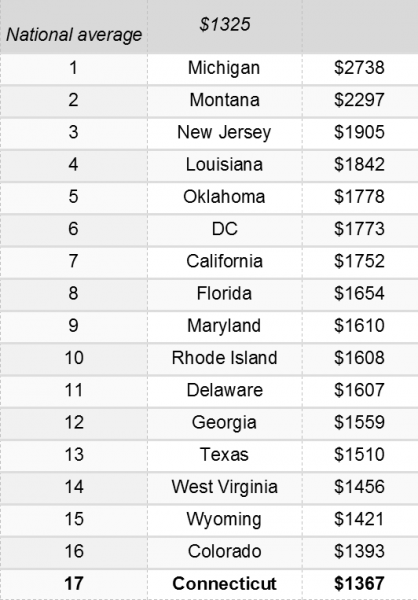
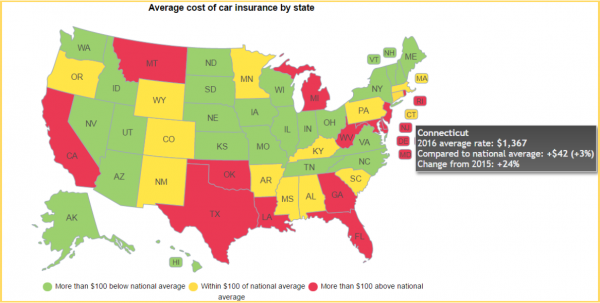 The national average for a full-coverage policy as featured in the Insure.com report came in at $1,325 this year – a slight increase from last year’s average of $1,311. Rates varied from a low of $808 a year in Maine to a budget-busting $2,738 in Michigan. Insurance rates in Michigan are more than double (107 percent) the national average.
 ucation systems positively, the lowest percentages in the country, in a
 State residents were asked “how would you rate the quality of public education provided in grades K-12” on a scale including excellent, good, fair and poor. The top 10 states after North Dakota, Minnesota and Nebraska are Iowa, New Hampshire and Massachusetts (80%), Wyoming (79%), South Dakota (78%) and Vermont and Virginia (75%).

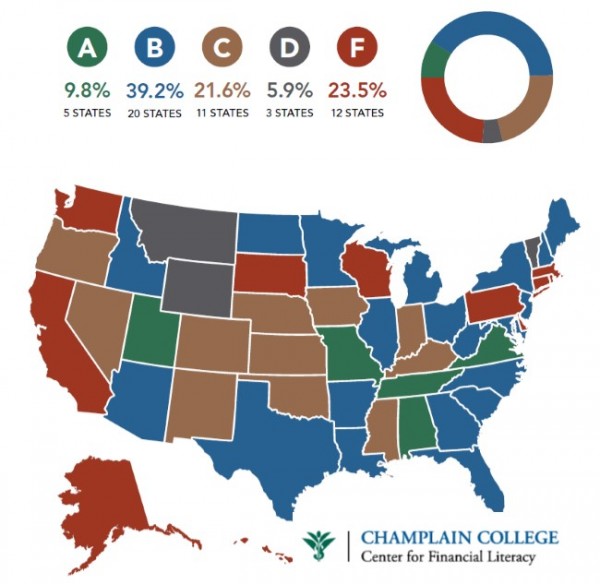 s a comprehensive look into the state of K-12 economic and financial education in the United States, collecting data from all 50 states and the District of Columbia. The biennial Survey of the States serves as an important benchmark, revealing “both how far we’ve come and how far we still have to go.” This year the report concluded that nationally “the pace of change has slowed.”
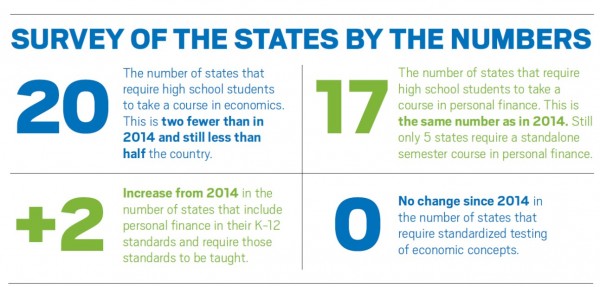 nts accountable for learning objectives have the best chance of promoting the development of young people who are better financial managers and stewards of their credit—behaviors with which many, if not most, young people tend to struggle,” said J. Michael Collins of the University of Wisconsin-Madison’s Center for Financial Security. “Rigorous state standards can facilitate local schools to implement well-designed programs, which in turn expose students to concepts they otherwise would not learn.”
 The new network would dramatically extend televised and online coverage and “on-demand access” to all legislative hearings and debates, as well as public policy conferences, regulatory hearings, executive agency meetings, and state Supreme Court and Appellate judicial proceedings.
 Giguere pointed out that “there are 10 hearing rooms, but CT¬N’s physical plant limits us to covering only two events concurrently. That means up to 80% of the Legislative committee process at any given time goes unseen. Our capacity to cover the Executive and Judicial Branches is even more limited.”
 currently funded, CFOG notes, “the new entity would be monitored and accountable to the public, but independent from government itself.”
 Following Connecticut in the top ten are New Jersey, Massachusetts, and Delaware, the only other states to receive an “A”, followed by North Dakota, New Hampshire, New York, Nebraska, Montana and Virginia. Connecticut, New Jersey and Massachusetts also ranked 1-2-3 a year ago.
 llege entrance exam, the percentage of students taking an advanced placement test and the student-teacher ratio.




















