Baseball Cards, eBay and Racial Discrimination Drive Research Study
/Racial discrimination is often difficult to prove, with a variety of influencing factors making a clear cut determination often impossible. But it is also widely recognized that racial discrimination is also difficult to eliminate. Now, academic researchers have found yet another way of demonstrating that racial prejudice continues to impact daily lives – often in ways we are unaware of or hadn’t considered.
In the 27-page study, published this past winter in the RAND Journal of Economics, Ian Ayres and Christine Jolls of Yale University, and Mahzarin Banaji of Harvard University investigated the  impact of a seller’s race in a field experiment involving baseball card auctions on eBay. The results, according to the researchers, left little doubt.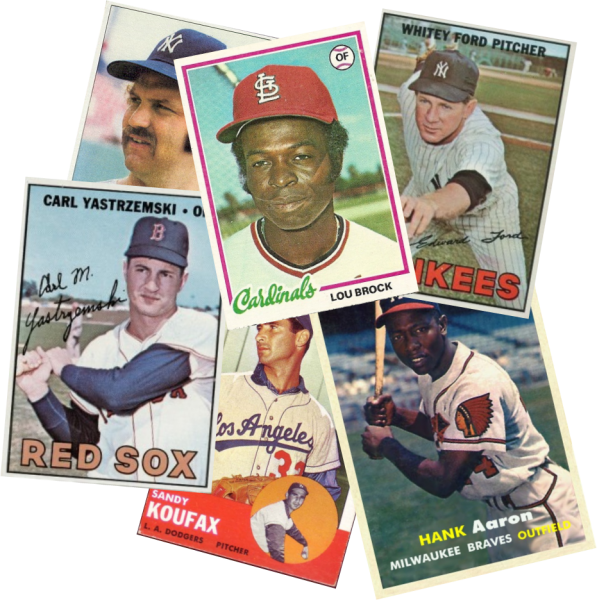
In the experiment, photographs posted on eBart showed the cards being held by either a dark-skinned/African-American hand or a light-skinned/Caucasian hand. The study found that cards held by African-American sellers sold for approximately 20 percent ($0.90) less than cards held by Caucasian sellers.
“Our evidence of race differentials is important,” the researchers said, “because the online environment is well controlled (with the absence of confounding tester effects) and because the results show that race effects can persist in a thick real-world market such as eBay.”
They added that the experiment is “well suited to studying and isolating race effects because online bidders have no access to the types of seller information—such as demeanor and socioeconomic background—that are usually observable in field experiments examining the effects of race on economic behavior.”
The study, “Race Effects on eBay,” was featured in the Winter 2015 edition of the Journal, and has been referenced in national publications thereafter. The Washington Post reported that “the cards that were held by the African-American hand actually ended up being worth more, suggesting they should have sold for more than the other batch. That is, when the researchers added up how much they had originally paid for all of the cards sold by the black hand versus the white hand, th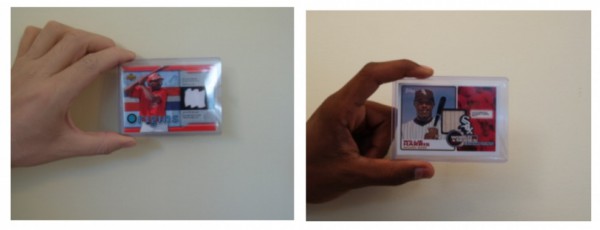 e first total was larger.”
The Post also reported that researchers found that cards sold by the African-American seller to bidders living in Zip codes with a higher proportion of white residents sold for less than those sold to in Zip codes with a larger Black population. In addition, the Post pointed out, “one interesting feature of the study is that, on eBay, the value of the auctioned good is decided in a kind of collective process. Buyers are not just trying to determine how much the good is worth to them; they are also trying to figure out how much everyone else is likely to bid for it. In an eBay auction, buyers can see others’ bids and continue to submit their price until the last minute. In other words, buyers might submit lower bids for the African-American seller not because they personally are biased, but because they expect everyone else to be.”
Christine Jolls (left) is th e Gordon Bradford Tweedy Professor at Yale Law School and the Director of the Law and Economics Program at the National Bureau of Economic Research (NBER) with headquarters in Cambridge, Massachusetts. Ian Ayres (center) is a lawyer and an economist. He is the William K. Townsend Professor at Yale Law School, the Anne Urowsky Professorial Fellow in Law, and a Professor at Yale's School of Management. Mahzarin Banaji (right), a psychology professor at Harvard University, studies unconscious thinking and feeling as they unfold in social context, relying on multiple methods including cognitive/affective behavioral measures and neuroimaging (fMRI). Previously, she was Director of Undergraduate Studies at Yale.


 Stamford has a public park named in his honor, recalling that Robinson represented tolerance, educational opportunity, and the confidence that inspires personal achievement and success. A life-size bronze statue of Jackie Robinson with an engraved base bearing the words “COURAGE,” “CONFIDENCE,” AND “PERSEVERANCE” stands in the park located on West Main Street, the gateway to downtown Stamford.
 “It brought back very personal memories of my father talking about his trip to Cuba in 1947, when the Brooklyn Dodgers trained in Havana. At the time, dad was a member of the Dodgers' farm team, the Montreal Royals. Branch Rickey arranged for him to fly to Cuba for an exhibition game, just a couple of months before he broke down baseball's color barrier in the United States. To me, this connection to my father almost brought me to tears. I was watching a baseball game in the same stadium nearly 70 years later.”

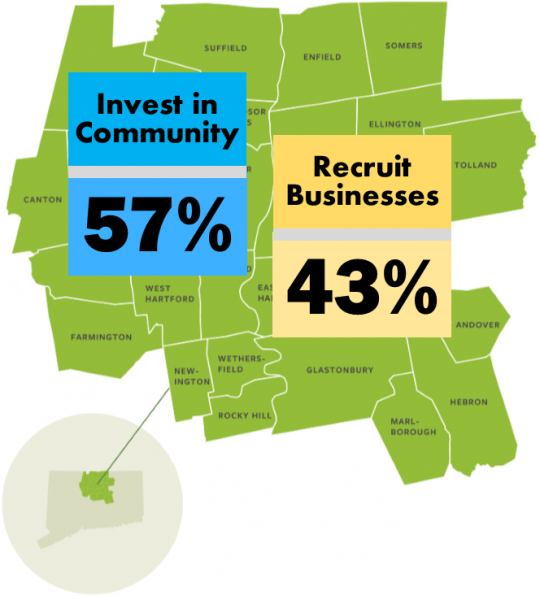 The data from the survey reflect a difference of opinion among older residents of the region. Individuals over age 46 took the opposite view from younger residents, with a majority expressing a preference for spending skewed toward recruiting companies. The reversal was dramatic, with two-thirds of those age 36-45 preferring investing in communities, by a margin of 67%-33%, and individuals age 46-55 expressing a preference for resources to be aimed at recruiting companies, with two-thirds holding the opposite view, 63%-38%.

 Chinese made up 35 percent of the 92,000 foreign secondary school students in the United States in 2015, according to the US Department of Homeland Security, by far the largest group studying here, the Boston Globe


 In Connecticut, a person is guilty of trafficking in persons when such person compels or induces another person to engage in sexual contact or provide labor or services by means of force, threat of force, fraud or coercion. Anyone under the age of 18 engaged in commercial sexual exploitation is deemed a victim of domestic minor sex trafficking irrespective of the use of force, threat of force, fraud or coercion.
 The need for stronger action is underscored by recent statistics. In Connecticut, one of every three kindergartners is overweight or obese, as is one of every three low-income children. Children who are overweight or obese are more likely, according to the policy brief, to have:
 A number of the proposals have been successfully implemented in other jurisdictions, including states and cities. Marlene Schwartz, Director of UConn's Rudd Center for Food Policy and Obesity, noted that Connecticut has long been a leader in providing nutritional lunches in schools, and said that now the state’s attention needs to move to the earlier years of childhood. “The field has realized that we need to start even earlier,” she said. Rudd also indicated that determining "policy changes that might help reduce the disparities" in Connecticut, which are apparent in race, ethnicity and socioeconomic data, is also essential.
 The recommendations, described as “affordable, achievable, common sense measures,” were prepared for CHDI as part of a grant to the UConn Rudd Center for Food Policy and Obesity, funded by the Children’s Fund of Connecticut. The author was public health policy consultant Roberta R. Friedman, ScM.
 IMPACT “Preventing Childhood Obesity: Maternal-Child Life Course Approach” in 2014. The report reviewed scientific research on the causes of obesity and explored implications for prevention and early intervention. In 2015, the Children’s Fund of Connecticut funded four obesity prevention projects in Connecticut that addressed health messaging, data development, policy development and baby-friendly hospitals.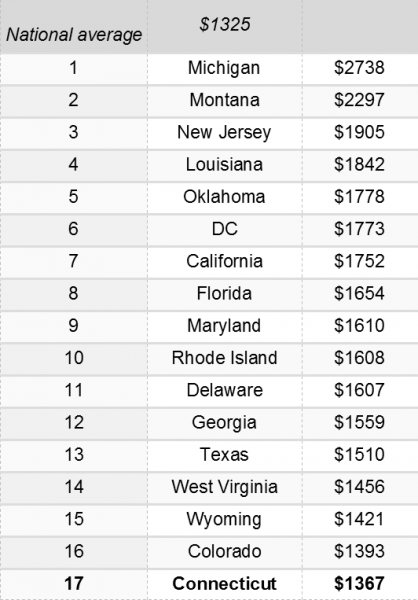
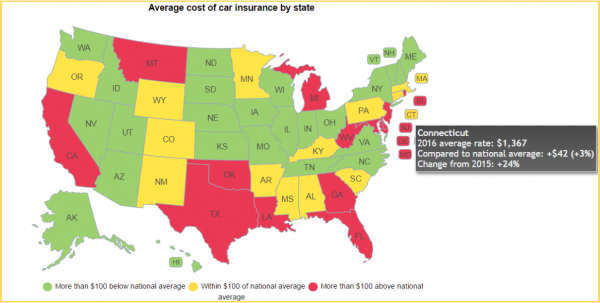 The national average for a full-coverage policy as featured in the Insure.com report came in at $1,325 this year – a slight increase from last year’s average of $1,311. Rates varied from a low of $808 a year in Maine to a budget-busting $2,738 in Michigan. Insurance rates in Michigan are more than double (107 percent) the national average.