Norwalk Among 15 Finalists for City Livability Awards; Energy Program Highlighted
/The City of Norwalk and Mayor Harry Rilling have been chosen as one of fifteen finalists for the U.S. Conference of Mayors City Livability Awards in the national division of cities with populations under 100,000. The awards recognize mayoral leadership for developing and implementing programs that improve the quality of life in America’s cities.
The program is characterized by the U.S. Conference of Mayors as “the most competitive award program” sponsored by the organization, and honors mayors and city governments for developing innovations that enhance the quality of life in urban areas. 
In its application, the City of Norwalk recognized the work of the Mayor’s Energy and Environment Task Force, chaired by Council member John Kydes, according to city officials. Mayor Rilling created the Task Force in February 2014 to promote environmentally responsible use of energy and natural resources among citizens and businesses in Norwalk, and to offer them green energy alternatives.
As a finalist, The City of Norwalk has been invited to submit a second application to the judges for the final round of decisions, which will take place in late spring. A first-place city and four runners-up will be announced at the organization’s annual meeting in June.
The other cities reaching the second round are Aguadilla, PR; Camuy, PR; Carmel, IN; Davie, FL; Hattiesburg, MS; Norcross, GA; Orland Park, IL; Pontiac, MI; Renton, WA; Rochester Hills, MI; Sumter, SC; Sunrise, FL; Warren, OH; and Westland, MI. 
Last year, New Orleans, LA Mayor Mitch Landrieu and West Sacramento, CA Mayor Chris Cabaldon were awarded first place honors – for cities above and below 100,000 population respectively - in the 2014 City Livability Awards, from a pool of over 200 applicants. Honorable mention for cities with populations of less than 100,000 was given to Beverly Hills (CA), Braintree (MA), Roanoke (VA) Tamarac (FL) and York (PA).
Mayor Bill Finch and the City of Bridgeport were recognized with an Outstanding Achievement Award among cities with populations over 100,000 in 2012, for the city’s Brownfields Remediation and Redevelopment Program – the City’s focus on reclaiming dormant brownfields to spur redevelopment. That same year, Hartford and Mayor Pedro Segarra also earned an Outstanding Achievement Award.
Established in 1979, the City Livability Awards are given annually to ten mayors and their cities--a first-place award and four Outstanding Achievement Awards for cities under 100,000 population, and a first-place and four Outstanding Achievement Awards for cities of 100,000 or more inhabitants.
The U.S. Conference of Mayors is the official nonpartisan organization of cities with populations of 30,000 or more. There are nearly 1,400 such cities in the country today, and each city is represented in the Conference by its chief elected official, the mayor.

 tently and robustly in research.” Describing Connecticut as “the home of innovation in engineering,” Esty said that engineers provide “the inspiration to solve the world’s problems.”
 Among the faculty award recipients was Dr. Alfred A. Gates, Professor of Engineering at Central Connecticut State University, whose two decades at the university have been a steady stream of technical innovation and teaching. Gates noted that CCSU has just become the first university in the United States to receive a

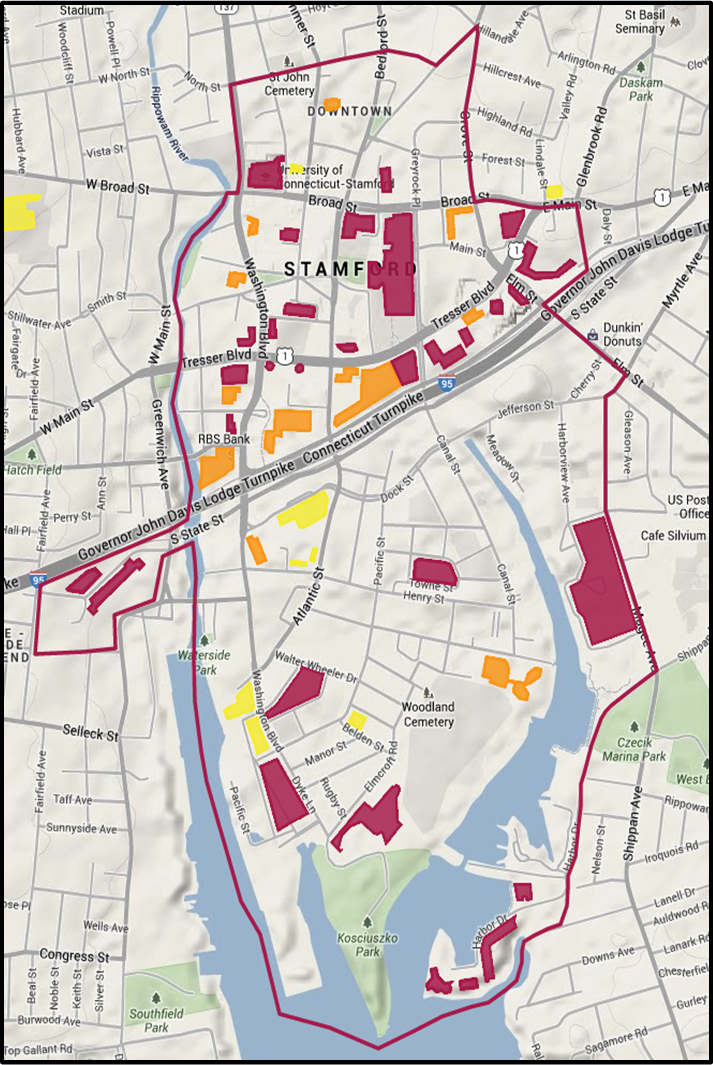 “These collective efforts will establish the Stamford 2030 District as an example of a financially viable, sustainability focused, multi-sector driven effort that maximizes profitability and prosperity for all involved. Through collaboration of diverse stakeholders, leveraging existing and developing new incentives and financing mechanisms, and creating and sharing joint resources, the Stamford 2030 District will prove the business case for healthy and high performing buildings.”
 rt this new chapter,” said co-founder and CEO Kate Pipa, who lives in Shelton. “And we are excited to bring kids a new box each month of hands-on fun that also doubles as a learning opportunity and is making social impact for the kids and for our partner organizations.”
 Rounding out the top 10 are Rhode Island (the state’s first time in top five), Oregon, and Vermont (all tied for #3); Connecticut (#6); New York (#7); Washington (#8); Maryland (#9); and Minnesota (#10).
 s, State, and Local Policy program, said: “Smart energy efficiency choices maintain the same comfort, convenience, and quality of life that consumers want and expect. Energy efficiency is also good for business. State action on energy efficiency improves bottom lines, drives investment across all sectors of the economy, creates jobs, and offsets the environmental harms created by the energy production system.”
 ss are Torrington, Danbury, West Hartford, Cheshire, Guilford, Greenwich, Plainville, Middlebury, New London, Killingly, Middletown, Fairfield, Madison, Branford, Farmington, Glastonbury, Windsor, Orange and East Hartford.

 tates according to their tendency to produce the highest or lowest monthly energy bills.
The analysis points out that “lower prices don’t always equate with lower costs, as consumption is a key determinant in the total amount of an energy bill.” Connecticut’s monthly energy cost for consumers, according to the analysis, is $404, ranking the state 49th out of 51 (the 50 states plus the District of Columbia). Mississippi’s total monthly cost paid by consumers averages $414, while Hawaii’s is $451.
tates according to their tendency to produce the highest or lowest monthly energy bills.
The analysis points out that “lower prices don’t always equate with lower costs, as consumption is a key determinant in the total amount of an energy bill.” Connecticut’s monthly energy cost for consumers, according to the analysis, is $404, ranking the state 49th out of 51 (the 50 states plus the District of Columbia). Mississippi’s total monthly cost paid by consumers averages $414, while Hawaii’s is $451. the highest in the nation. (see breakdown below)