Carolina Attendance Plummets; Proposal for Hartford Region to Buy Back Whalers, Bring 'Em Home

In a press conference on May 6, 1997, team owner Peter Karmanos Jr. said he was moving his hockey team, the Hartford Whalers, to Raleigh and renaming it the Carolina Hurricanes. It has been 20 years, and now there is an effort – voiced by Hartford City Councilman John Gale – to go back to the future, and bring the franchise to Hartford's XL Center.  It is a long-shot, wistful effort that has yet to capture the public imagination in Connecticut, or any apparent interest from Karmanos, despite near constant rumors, and some intimation, that the franchise could be bought, for the right price.  There has been consistent resistance from the NHL to moving the franchise from Raleigh, but no new comment since the latest idea became public.
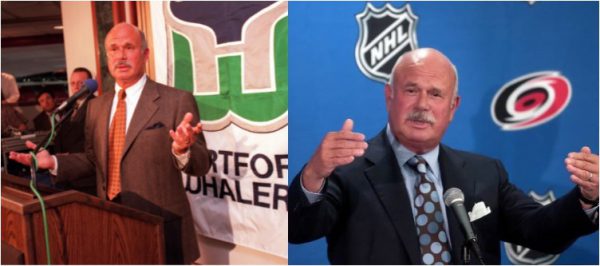
“This is a market where the people have a good feeling about themselves, have a good feeling about the future,” Karmanos said two decades ago of the Carolina market to which he was redirecting the soon-to-be former Whalers. “I think they want a sports team here as a quality-of-life issue, something they can identify with.”

Now, Gale suggests in an op-ed published by the Hartford Courant, the team ought to return for much the same reason. “What if we could provide the region with an identity, a rallying point; what if there were a way to bring back the Whale and give it a built-in metro area base of support; and we did it all by regionally cooperating,” Gale wrote.

It has been two decades of highs and lows as the Carolina Hurricanes – two Stanley Cup appearances, and one win of the Cup in the early years, and the worst attendance in the National Hockey League, or near the bottom, more recently.  In Hartford, the Whalers remain very much a part of the city's consciousness.

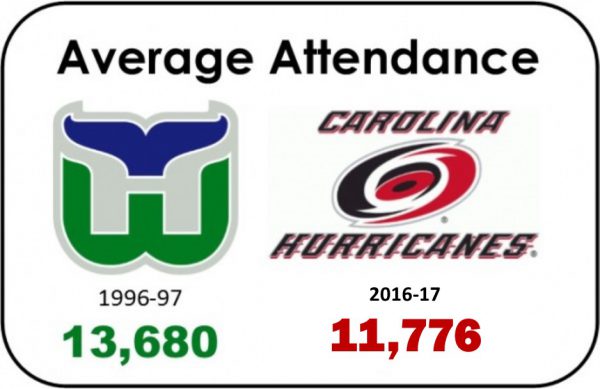
The Hurricanes have had the NHL’s worst home attendance in each of the past two years, and attendance at home games has dropped for five consecutive years, averaging 11,776 this season for 41 home games.

In January, NBC Sports reported that team President Don Waddell said Karmanos was not actively looking to sell the team, but that “If someone came along and wanted to buy it, I’m sure we’d talk about it but we’re not actively out there trying to find investors. If someone calls and says, ‘Hey, I want to buy the team,’ we’re taking that call.”  A year ago, there were rumors of a sale and move to Quebec City.

Today, the Hurricanes Executive Vice President and General Manager is Hall of Famer Ron Francis.  The former standout – in Hartford and Carolina – was the first player to have his number retired by the Hurricanes, on Jan. 28, 2006. Francis, captain dubbed “Ronnie Franchise,” saw his No. 10 – the jersey number in Connecticut and Carolina – raised high above the arena.

Earlier this year, NHL Commissioner Gary Bettman was quoted by USA Today as saying "Peter may sell, he may not sell.  He may sell all of it. He may sell some of it. He may sell none of it. There's no formal sale process going on. There's no imperative for the franchise to be sold on any immediate basis, and the franchise is not moving.”
Within weeks of those comments, Gov. Malloy and Hartford Mayor Luke Bronin made a play for the Brooklyn-based New York Islanders, rumored to be seeking a new home due to spotty attendance at the home they share with the Brooklyn Nets.  Those hopes were dashed last month when the team announced they planned to stay in New York, and are considering plans for a new hockey arena on Long Island or in Queens near Shea Stadium.

That effort caught the interest of data-guru Nate Silver, founder and editor of FiveThirtyEight.com, who revived his 2013 study that noted the Hartford-New Haven media market is the largest in the U.S. without a “big four” sports franchise.  He estimated that about 175,000 avid NHL fans live in the Hartford-New Haven metro area. “That sounds bad, though it’s comparable to or slightly better than some of the lower-tier American NHL markets, including Columbus, Raleigh-Durham, Miami and Nashville (and better than Las Vegas, where the NHL is expanding). Furthermore, there’s potentially room for growth. According to our estimates, 7 percent of adults in the Hartford metro area were avid NHL fans in 2013. But the percentage is 13 percent in the New York metro area and 17 percent in the Boston metro area.”  Sliver added that “If the Islanders or another team were to relocate to Hartford, the numbers would probably improve.”

Gale’s proposal: “What if all 38 towns in the Capitol Region Council of Governments banded together to buy the franchise and brought it back to Hartford? Grand lists are representative of the respective wealth of each town. So, the 38 towns would each pay a portion of the purchase price of the Whalers hockey team based on their percentage of the total grand list of all 38 towns. The average per capita cost for all 38 towns is $274 per person.”

In the Whalers’ final season in Hartford, 1996-97, attendance at the Hartford Civic Center had grown to 87 percent of capacity, with an average attendance of 13,680 per game.  Published reports suggest that the average attendance was, in reality, higher than 14,000 per game by 1996-97, but Whalers ownership did not count the skyboxes and coliseum club seating because the revenue streams went to the state, rather than the team.  Attendance increased for four consecutive years before management moved the team from Hartford. (To 10,407 in 1993-94, 11,835 in 1994-95, 11,983 in 1995-96 and 13,680 in 1996-97.)

Carolina’s average home attendance during the just-concluded 2016-17 season was 11,776– the worst in the 30 team league. That was a drop from the 2015-16 average of 12,203, which was lowest in the NHL that year as well.

ESPN reported last year that the Whalers Booster Club remains visible, and Whalers gear continues to sell briskly, in and beyond the Hartford region.

"We always march in Hartford's St. Patrick's Day parade," said Joanne Cortesa, the club's president.  "And every time we hear people chanting, 'Bring 'em back, bring 'em back!' Every place we go, it's 'Bring 'em back!'"

"It's probably not going to happen next week or next month," Bronin told ESPN. "But we'd certainly welcome having the NHL return to Hartford."

Edible Arrangements, Subway Take Steps Forward and Back in Roller-Coaster Economy

Two of Connecticut’s leading food franchise success stories - Edible Arrangements and Subway – have both been in the news in recent days, seemingly moving in opposite directions.  Subway, for the first time in memory, is reducing the number of franchises across the country, while Edible Arrangements is in the midst of extending its brand, as its founder has taken back control of the equity in the business. Subway dropped 359 U.S. locations in 2016, the first time that Subway has had a net reduction. The store count dropped 1.3 percent to 26,744 from 27,103, but Subway remains the nation’s most ubiquitous eatery. (Behind only McDonald’s in sales.) Sales at Subway franchises fell 1.7 percent last year to about $11.3 billion, according to published reports. Subway is still growing internationally, with sales outside the U.S. increasing 3.7 percent to $5.8 billion last year, as the company continued to open locations.

Subway was founded about 52 years ago by Fred DeLuca and Peter Buck in Bridgeport. DeLuca died in 2015, leaving the company in the hands of his younger sister, Suzanne Greco, who became chief executive officer. The chain’s restaurants are entirely owned by franchisees.

Since its founding in 1999 in East Haven, Edible Arrangements has grown to more than 1,300 locations worldwide. Tariq Farid developed a "healthy obsession with fruit," and used his experience in the floral industry insight to develop a new business concept: fruit bouquets. Edible Arrangements began franchising in 2001, according to the company website.

Farid has completed a buyback of equity of the company which had been held by Greenwich private equity firm L Catterton.  The company has entered into a strategic partnership with L Catterton in June of 2012. Farid said the relationship provided assistance during a key growth phase for the brand, a time in which Edible Arrangements expanded into offering fresh fruit smoothies, froyo fruit blends, chocolates and more.

“The timing was right to take back full ownership so that I could be more fully engaged in building the future of the brand with our franchisees," Farid said, adding that "Edible Arrangements finds itself well-positioned for a future that includes exciting new opportunities for our franchises and the brand.”

Edible Arrangements has launched a system-wide conversion of traditional stores to a "whole-store" experience in the Edible To Go platform, featuring fresh fruit smoothies, froyo fruit blends and other fresh fruit treats. The company is coming off a year in which it registered a 27 percent increase over the previous year in both the number of new store openings and signings of new franchise agreements. It was named in Entrepreneur's Top 40 of "Fastest Growing Franchises" and "America's Top Global Franchises" as well as being included among the "Inc. 5000" list of the fastest growing privately-held companies.

"This is an exciting time to be a part of Edible Arrangements," Farid said. "At heart we are really a family of small businesses that have enjoyed incredible growth through a shared passion and willingness to work together towards common goals. Now we can focus all our energy on working together on the next evolution of the Edible Arrangements brand."

Edible Arrangements is headquartered in Wallingford; Subway is headquartered in Milford.

Local College Students Selected by US State Department for Intensive Foreign Language Training

Four University of Bridgeport students have been awarded U.S. Department of State Critical Language Scholarships, among the most competitive in the field, to spend the summer abroad at intensive language programs. The Critical Language Scholarship (CLS) program is part of a U.S. government effort to dramatically expand the number of Americans studying and mastering foreign languages deemed to be of particular importance. They include but are not limited to: Arabic, Azerbaijani, Chinese, Persian, Russian, and Urdu.

Students Ana Rena, Justin Sabo and Fernando Gonzalez have been accepted into the Arabic language study program at a site still yet to be determined in the Middle East.  According to the State Department’s website, Arabic is taught in Amman, Jordan; Meknes, Morocco; Tanfier, Morocco; and Ibri, Oman.

UB student Sung Soon Gavel won a CLS to study Korean at Chonnam National University in Gwangju, South Korea.  The CLS Korean Program in Gwangju, Korea provides students opportunities to learn Korean both inside the classroom and in an immersive cultural setting during an intensive 8-week language program set in Korea’s sixth-largest city located just south of Seoul. Students receive a minimum of 20 hours per week of classroom instruction where they learn the four major skills of speaking, listening, reading and writing in Korean.

CLS Program institutes at 24 locations around the world cover approximately one academic year of university-level language coursework during an eight- to ten-week program and are designed to meet the needs of students from a variety of language levels and backgrounds.

The scholarships are highly competitive; just 10 percent of students who apply to the program are awarded one. But since 2011, eight University of Bridgeport students, including the four 2017 winners, have won them.

“As an application evaluator for the Critical Language Scholarships, I can confirm that the pool of applicants to the program include some of the nation’s brightest students at leading universities across the country. So having one CLS winner, or even having students make it to the final rounds, would be worthy of celebration. The fact that four were granted awards is a phenomenal testament to our students’ hard work.  They make us very proud,” said Brandon LaFavor, director of UB Education Abroad Resource Center.

Formal classroom language instruction is provided for a minimum of 20 hours per week. Extracurricular activities are designed to supplement the formal curriculum, including regular one-on-one meetings with native speaker language partners for conversational practice, as well as cultural activities and excursions designed to expand students’ understanding of the history, politics, culture and daily life of their host country.

In past years, students from institutions including University of Connecticut, Connecticut College, Trinity College, Wesleyan University, Quinnipiac University and Central Connecticut State University have also been selected to participate.  Most recently, a UConn student was selected to learn Hindi in India in 2016, and two Wesleyan students were selected last year to learn Russian and Hindi.

The Critical Language Scholarship Program is a program of the United States Department of State, Bureau of Educational and Cultural Affairs. CLS is administered by American Councils for International Education.

This year’s group of Critical Language Scholars from UB are all enrolled at the College of Public and International Affairs (CPIA) at the University. The school’s six undergraduate and four graduate programs groom students in fields related to diplomacy, including international security and global development. CPIA alumni have gone on to work for the FBI, the Department of State, Defense Department, United Nations, Council of Europe, as well as global NGO’s (non-governmental organizations) and private industry.

https://youtu.be/WUhZlih7hls

Survey Says: Hartford Is Among Nation’s Top Up-and-Coming Cities

What do Milwaukee, Syracuse and Hartford have in common? They are all – believe it or not – the nation’s most notable “up-can-coming place to live,” according to a new national analysis of the top places to live in the U.S.

In calculating the second-annual ranking of the Best Places to Live in the U.S., which evaluates the 100 most populous metro areas in the country based on qualities that Americans care about most, U.S. News looked at affordability, employment opportunities and the overall quality of life in each place.  Hartford’s ranking jumped from number 59 a year ago to number 31 this year, among the largest leaps of any city in the nation.

The leading reason cited by the publication is the increase in jobs.

"The Hartford region has seen some strong employment growth in a number of high-productivity sectors, including professional, technical services, education and health services," said Alissa DeJonge, vice president of research at the Connecticut Economic Resource Center.

The types of job opportunities that are available in the Hartford area tend to pay well, the publication points out, “with residents earning nearly $57,000 per year on average, which is significantly more than the average American's salary of $48,320 per year. United Technologies Corp. provides employment to residents in the manufacturing and engineering sectors, and the region is home to some of the country's largest financial institutions, including Aetna Inc. and the Hartford Financial Services Group.”

"Hartford is known as the 'insurance capital' of the U.S., a title substantiated with Connecticut ranking No. 1 in the U.S. for insurance employment per capita, with many of those employers located in the Hartford region," added Susan Winkler, executive director of Connecticut Insurance and Financial Services. "Connecticut is also home to the highest concentration of actuaries – many located in the Hartford region."

The U.S. News review also notes that the region features a diverse selection of restaurants and cultural attractions. Paul Pita, CEO and executive creative director of Hartford-based digital marketing firm The Pita Group, told U.S. News "Hartford is a great place to live because residents have access to what they need: great options for housing, great educational options and a wide variety of lifestyle options for food, arts, culture, entertainment and outdoor activities."

Syracuse moved from #53 to #28, and Milwaukee climbed from #72 to #47.  The top 10 places to live in the U.S., according to the rankings, are Austin, Denver, San Jose, Washington D.C., Fayetteville, Seattle, Raleigh/Durham, Boston, Des Moines, Salt Lake City and Colorado Springs.  Portland, Maine ranked #26 and Albany ranked #30, just ahead of Hartford.  New Haven ranked #81 in the top 100.

The metro areas included in the rankings were evaluated by U.S. News using data from sources including the United States Census Bureau, the Federal Bureau of Investigation, the Department of Labor and U.S. News' own internal resources. This data was categorized into five indexes – Job Market (including salary and unemployment rates), Value Index (including cost of living), Quality of Life Index (including education, crime, commuting, and health care), Desirability Index, and Net Migration - and then evaluated using a methodology determined by Americans' preferences. The percent weighting for each index was determined by the answers to a public survey in which people from across the country voted for what they believed was the most important thing to consider when thinking about moving, according to U.S. News.

Whalers Hartford Attendance 20 Years Ago Exceeds Islanders in Brooklyn

For Hartford hockey fans of the Whalers vintage, a peek at this year’s National Hockey League (NHL) attendance figures are either demoralizing or encouraging – or both.  It has been two decades since the Whalers were uprooted by ownership, replanted in North Carolina and renamed the Hurricanes, and two weeks since Gov. Dannel Malloy and Hartford Mayor Luke Bronin took their first shot at the now Brooklyn-based New York Islanders. Lowest attendance in the NHL this year belongs to the Carolina Hurricanes, at 12,025 through 24 home games, followed at the bottom of the league by the Islanders, averaging 12,829 through 32 home games, as of this week.

Last year, the 2015-16 season, the Hurricanes averaged 12,203 for their 41 home games, last in the league, while the Islanders were third lowest in the NHL at 13,626.  Both are lower than the Whalers average attendance in their final season in Hartford, nearly two decades ago.

In comparison, the top teams in the league this year for home attendance are the Chicago Black Hawks, averaging 21,669 and Montreal Canadians, seeing 21,288 per game thus far this year.

In their final season on Long Island at the Nassau Coliseum in 2015-16, the Islanders average home attendance was 15,189, an increase from the immediate previous seasons.  The Carolina Hurricanes had the second lowest attendance in the league that year, at 12,594.  During the 2012-13 season, the Islanders attendance was the lowest in the 30-team league, at 13,306.

With more than 1,000 obstructed seats in the Barclay Center arena that the Islanders share with the New York Nets in Brooklyn, rumors have circulated since last year of a possible move to a new arena in Queens built for hockey, unlike the Islanders current home, first and foremost a basketball arena.  There has been local opposition to that possibility.  Recent published reports have also indicated that the Barclay Center and Islanders could part company after the 2018-19 season or a year earlier if the team decides to relocate.

With no official word one way or the other, Connecticut officials are taking their shot, with a possible assist from a $250 million makeover of the XL Center, former home of the Whalers.  That proposal must be approved by the state legislature, a tall order at a time when the state budget deficit is approaching $2 billion.

In the Whalers’ final season in Hartford, 1996-97, attendance at the Hartford Civic Center had grown to 87 percent of capacity, with an average attendance of 13,680 per game.  Published reports suggest that the average attendance was, in reality, higher than 14,000 per game by 1996-97, but Whalers ownership did not count the skyboxes and coliseum club seating because the revenue streams went to the state, rather than the team.  Attendance increased for four consecutive years before management moved the team from Hartford. (To 10,407 in 1993-94, 11,835 in 1994-95, 11,983 in 1995-96 and 13,680 in 1996-97.)

During the team’s tenure in Hartford, average attendance exceeded 14,000 twice – in 1987-88 and 1986-87, when the team ranked 13th in the league in attendance in both seasons.

In recent years, the Islanders have been at or near the bottom of the league in home attendance:

  • 2015-16       28th
  • 2014-15      25th
  • 2013-14      26th
  • 2012-13      30th
  • 2011-12      29th
  • 2010-11      30th
  • 2009-10      29th

Whalers merchandise continues to sell well, despite the team not having played a single game in this century.  Whalers merchandise was Reebok's top selling non-current NHL team, according to published reports in 2015. While the company has expanded its lineup to include Whalers logos from different eras, the Hartford Business Journal reported, gear featuring the team's original logo remained the most popular and continues to be offered on the NHL Official Shop website, on multiple websites and in retail locations in the U.S. and Canada.

The Connecticut officials said “this is a ready market anxious for an NHL team, eager to fill seats, buy merchandise, and support your team,” reminding Islanders officials that ““Your AHL affiliate is in nearby Bridgeport, allowing quick and easy access to your minor-league players, and represents a footing in Connecticut of the Islander franchise.”

The NHL has given no indication that it will approve a move out of the New York market, according to NBC Sports, although Commissioner Gary Bettman has said that the teams owners “are reviewing the situation and looking very seriously at what their options are.”

The only statement released by Islanders ownership after receiving the letter last week from Malloy and Bronin said the team does “look forward to another great year of New York Islanders hockey at Barclays Center next season.”  No word on what might, or might not, occur after that.

CT’s Cuban-American Population Is Centered in Bridgeport, As Immigration to U.S. From Cuba Grows

The number of Cubans entering the U.S. has picked up dramatically since former President Barack Obama announced a renewal of ties with the island nation in late 2014, a Pew Research Center analysis of government data shows. The U.S. has since opened an embassy in Havana, a move supported by a large majority of Americans, and public support is growing for ending the trade embargo with Cuba, according to Pew surveys. Outside of Florida, the New York metropolitan area – including Connecticut - is home to the most Cuban Americans.  More than 10,600 Cuban-Americans call Connecticut home, according to U.S. Census 2014 data. The city with the largest Cuban population is Bridgeport, with more than 1,000 residents of Cuban heritage, according to published reports.

According to the website ZipAlas, the Connecticut communities with the largest percentage of Cuban residents among local their residents include Bridgeport, Hartford, Stratford, Westport, New Britain, Bolton, Stamford, Weston, New Haven, and West Hartford.

Overall, 56,406 Cubans entered the U.S. via ports of entry in fiscal year 2016, up 31 percent from fiscal 2015 when 43,159 Cubans entered the same way, according to the U.S. Customs and Border Protection data reported by Pew. Fiscal 2015 saw an even larger surge, as Cuban entries jumped 78 percent over 2014, when 24,278 Cubans entered the U.S.

There are 2 million Hispanics of Cuban ancestry living in the U.S. today, the fourth largest Hispanic origin group behind Mexicans, Puerto Ricans and Salvadorans. But population growth for this group is now being driven by Cuban Americans born in the U.S. The share of foreign born among Cubans in the U.S. declined from 68 percent in 2000 to 57 percent as of 2015, Pew reported. The Cuban population in the United States has steadily grown, accelerating from 737,000 in 1990 to 1,144,000 in 2013, according to the Migration Policy Institute.

According to the 2014 American Community Survey (ACS), 923,111 foreign-born Hispanics of Cuban origin lived in Florida, 47,016 in New Jersey, 30,398 in Texas, 28,436 in California, and 24,898 in New York, the Center for Immigration Studies reported.

The Cuban Lyceum of Bridgeport -- Liceo Cubano de Bridgeport- celebrated its 60th year in 2014, the Connecticut Post reported.  Founded in 1954 on the East Side of Bridgeport, the organization continues as the longest running Hispanic social club in all of New England, according to local leaders. The Lyceum was officially incorporated on July 21, 1954, created to “promote unity, understanding and friendship among all Cuban and others Spanish-speaking people,” and “provide a welcomed place for newly relocated Cubans in the United States,” to continue the traditions of Cuban culture.

Bridgeport Police Chief A.J. Perez was born in Cuba migrated with his family as a youngster to the United States in 1968, according to published reports.  He joined the Bridgeport Police Department in 1983 and became Chief of Police last year, the first Cuban-American police chief in the state’s history.


College Students in Connecticut Gather for Study Abroad Conference in Changing Context

Timing, as the saying goes, is everything.  This Saturday, February 4, the fourth annual Connecticut Area Study Abroad Conference will held, sponsored by eight higher education institutions and hosted at the University of Hartford.  The conference offers sessions for students who have studied abroad, highlighting “unpacking your time abroad, and learning how to use your study abroad experience to network and get your dream job.” Developed by a committee of study abroad professionals, the conference will also offer sessions on topics including career paths of study abroad participants, volunteer and non-profit opportunities abroad and internationalizing your résumé and interviews.

Organizers from eight colleges and universities in Connecticut could not have imagined, when the date was set months ago, that international travel through the United States would be the focus of world-wide attention in the wake of a presidential executive order.

Participating universities include University of Bridgeport, University of New Haven, Sacred Heart University, Fairfield University, Quinnipiac University, UConn Law School, Trinity College and University of Hartford.  Last year’s conference was hosted by the University of New Haven.

“Now more than ever, studying abroad is important,” said Trinity College’s Zachary Macinnes, one of the individuals developing the conference.  “In addition to setting students apart on the job market after graduation, participation in study abroad is positively associated with a host of benefits, including higher GPA, retention, increases in critical thinking and writing skills, greater appreciation for diversity, increased lifetime earnings and deeper engagement overall.” 

Macinnes, Outreach Coordinator and Study Away Advisor: Spain, Latin America & the Caribbean at Trinity College in Hartford, also notes that only 10 percent of U.S. students study abroad during college.  Taking the lead for the University of Hartford is Meaghan Murphy, international program administrator for the school’s Study Abroad program.  Nationwide, 33 percent of college students participating in study abroad programs are juniors, 26 percent are seniors and 13 percent are sophomores.

The top nations for U.S. students participating in study abroad programs are the United Kingdome, Italy, Spain, France, China, Germany, Ireland, Costa Rica, Australia, Japan, South Africa, Mexico, India and the Czech Republic, according to data compiled by the Institute of International Education.   The most frequent academic areas studied include the STEM fields, business & management, physical or life sciences, health professions, engineering, math or computer science, and agriculture, the organization’s data reveals.

The website promoting the event tells students that “Your study abroad experience is not an isolated activity that has a definite beginning and end. Instead, study abroad is a life-changing event that continues to develop and evolve long after you have returned home.”  The site adds that “You will find yourself changed, sometimes in surprising, unanticipated ways. Your academic and personal goals may be different, and you may now have a better appreciation for the international students on campus.”

The plan was for student resumes to be reviewed, and for information to be provided to enable students “learn more about how to go abroad again.”  Organizers indicate that will still take place, but clearly in a very different context.

The event is open to any student from a college or university in Connecticut who has studied abroad, in any foreign country, for any length of time. The conference, hosted by Trinity College and the Univeristy of Hartford, will take place on Saturday, February 4, 2017 from 9:30am-3:00pm at the University of Hartford in the Great Room of Konover Campus Center.

Connecticut Book Awards Set to Make a Comeback in 2017

Connecticut Center for the Book at Connecticut Humanities is now accepting submissions for the Connecticut Book Awards, returning after a multi-year absence from the literary landscape in the state.  The awards were last presented in 2011.  They were presented annually beginning in 2002. These awards recognize the best books of 2016 by authors and illustrators who reside in Connecticut.   The 2017 Connecticut Book Awards will honor authors in Fiction, Nonfiction, and Poetry. There will also be awards open to authors and illustrators in the category of Books for Young Readers (Juvenile, Young Adult, and Teen).  Book award nominations may be made through April 21, with the formal announcement of recipients later this year.

"There is a void in the Connecticut literary landscape for this kind of recognition of home grown authors. Several other awards and prizes in the state exist, awards such as The Nutmeg Awards, New Voices in Children’s Literature: Tassy Walden Awards, The Windham Campbell Prize, and a small handful of others, but these awards have specific criteria and don’t necessarily focus on Connecticut-based authorship," the Center for the Book website points out. "Without the Connecticut Book Awards, there is no statewide recognition of Connecticut authors who craft words and convey ideas in a compelling way."

Entry fee starts at $40 for a 2,000 copy or less print run. Award winners will receive exposure in Connecticut media outlets and personal appearances in Connecticut locations. For guidelines and to submit, please visit http://bit.ly/CTBook2017

The Center for the Book at Connecticut Humanities promotes the written and spoken word throughout the state and is an affiliate of the Center for the Book in the Library of Congress.  "We’re bringing the Connecticut Book Awards back. Because they are important," the website notes emphatically.

Nominated authors must currently reside in Connecticut and must have lived in the state at least three successive years or have been born in the state, or the book must be substantially set in Connecticut. Panels of five judges will assess nominated books in each category.

Eligibility Requirements for Book Awards to be made in 2017:

  • Author must currently reside in Connecticut and must have lived in the state at least three successive years or have been born in the state. Alternatively, the work may be substantially set in Connecticut.
  • Titles must have been first published between January 1, 2016 and December 31, 2016.
  • All submitted books must have a valid ISBN.
  • Authors may enter more than one book per year.
  • Anthologies are acceptable. Author(s) must have resided in Connecticut for at least three years of have been born in the state. Alternatively, the works must be substantially set in Connecticut.
  • Books by deceased authors will be accepted only if the author was still living at the beginning of the eligibility year (January 1, 2016).

National Effort to "Revive Civility" is Underway, Looking Ahead to Next Elections

The National Institute for Civil Discourse (NICD), launched in the aftermath of the shooting targeting Congresswoman Gabby Giffords in Arizona in 2011, has launched a new initiative – Revive Civility. “Incivility in America has reached epidemic proportions,” organizers point out. “Every day rudeness, disrespect and hostility sideline collaboration and compromise. Sound bites replace sound journalism. Extremes on both ends of the political spectrum stymie productive dialogue. The public, initially worn and weary, is increasingly enraged about how the lack of civility has left government helpless in the face of our nation's most pressing problems.”

The initiative includes proposed Standards of Conduct, toolkits for citizens, and suggested text messages  that emphasize how ”civility strengthens our democracy.”

Pointing out that “research found that most people think mocking or making fun of a political opponent, making disrespectful or demeaning statements, refusing to listen to arguments of different points of view, or making exaggerated statements that misrepresent the truth are all uncivil behaviors.”

In 2017, “reviving civility is more important than ever” and NICD plans to continue to champion “respectful interactions” in media, legislatures, and the public.  The organization will also educate “the next generation on the importance of civility and ways in which respectful dialogue and interaction between a variety of viewpoints can be created in your own life.”

The 2016 campaign, NICD points out, “brought political incivility directly into living rooms across America,” pointing out that candidates used “disrespectful remarks, name calling,” insulted various members of minority groups, and “the tone of the campaigns has also led to physical violence. Uncivil words have led to uncivil actions and are the direct result of the nature of the rhetoric expressed by those competing to lead in public office.”

NICD points out that:

  • 2 in 3 voters say the 2016 election has been less civil than other elections.
  • 6 in 10 agree with the statement "The 2016 election will go down as one of the most negative elections."
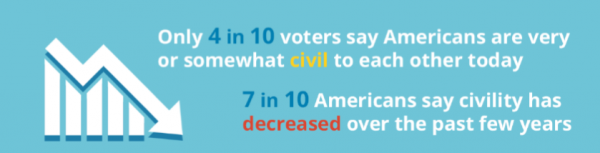
  • 4 in 10 voters say Americans are very or somewhat civil to each other today.
  • 7 in 10 Americans say civility has decreased over the past few years.

The honorary chairs of NICD, a nonprofit organization, are former presidents George H.W. Bush and Bill Clinton.  Among the honorary co-chairs is former U.S. Supreme Court Justice Sandra Day O’Connor.


Was Holocaust News in Connecticut As It Happened? Historians Seek to Find Out

What could Americans have known – in Connecticut and across the country - about the Nazi threat from reading their local newspapers in the 1930s and 1940s? The Connecticut League of History Organizations (CLHO) is looking for some research help to find out. CLHO is participating in History Unfolded, a project of the United States Holocaust Memorial Museum in Washington, DC. It asks students, teachers, and history buffs throughout the United States what was possible for Americans to have known about the Holocaust as it was happening and how Americans responded. “

Participants look in local newspapers for news and opinion about 31 different Holocaust-era events that took place in the United States and Europe, and submit articles they find to a national database, as well as information about newspapers that did not cover events. History Unfolded raises questions for scholars and will inform the Museum’s initiative on Americans and the Holocaust.

CLHO and Connecticuthistory.org are teaming up to introduce this project to Connecticut. On January 26, 2017, (the day before the United Nations Holocaust Remembrance Day) “citizen historians like you can register to join ‘Team Connecticut’ as we explore Holocaust history.”  Research volunteers will learn how to use primary sources in historical research, and challenge assumptions about American knowledge of, and responses to, the Holocaust.

Officials stress that no experience is needed to participate. Individuals may get involved on their own using online newspaper archives, at local libraries or participating museums, or in groups working as members of a research team.

Data from History Unfolded: U.S. Newspapers and the Holocaust will be used for two main purposes: to inform the upcoming exhibition on Americans and the Holocaust at the United States Holocaust Memorial Museum, and to enhance scholarly research about the American press and the Holocaust. Information captured in the general database will be available as a research source for generations to come.

As of January 9, 2017, 920 participants from across the country had submitted more than 6,300 articles from their local newspapers. The articles were published in newspapers located in all 50 states and the District of Columbia, and represent news articles, editorials, letters to the editor, political cartoons, and advertisements. Individuals are urged to check with their local museum, historical society, or library to see if they will be hosting a research group. A classroom or school, a temple or church, a museum or library, or other community organizations can participate. Individuals can also participate.  Organizations can email Liz Shapiro at liz@clho.org or Gregg Mangan, at gmangan@cthumanities.org for additional information.  For more about the national project, visit the project at https://newspapers.ushmm.org/